化工学报 ›› 2025, Vol. 76 ›› Issue (9): 4586-4600.DOI: 10.11949/0438-1157.20241084
周怀荣1( ), 伊嘉伟1, 曹阿波1, 郭奥雪1, 王东亮1, 杨勇1, 杨思宇2
收稿日期:2024-09-26
修回日期:2024-10-25
出版日期:2025-09-25
发布日期:2025-10-23
通讯作者:
周怀荣
作者简介:周怀荣(1988—),男,博士,副教授,zhouhr@lut.edu.cn
基金资助:
Huairong ZHOU1(), Jiawei YI1, Abo CAO1, Aoxue GUO1, Dongliang WANG1, Yong YANG1, Siyu YANG2
Received:2024-09-26
Revised:2024-10-25
Online:2025-09-25
Published:2025-10-23
Contact:
Huairong ZHOU
摘要:
针对传统二氧化碳加氢制甲醇单程转化率低的问题,提出了一种新的工艺:共电解耦合CO2间接加氢制甲醇(Co-SOEC-CO2tM),该工艺由共电解制取合成气单元、精馏单元以及二氧化碳捕集单元组成。基于工艺全流程模拟数据,进行公用工程电气化改造,并采用元素利用率、能效、CO2排放、生产成本指标等对新工艺进行技术经济评价,并与传统甲醇合成工艺进行对比分析。结果表明:新工艺的能效最高可达61.76%,远高于其他传统工艺。新工艺的氢元素利用率为70.99%,碳元素利用率为80.84%,CO2排放可以低至0.197 t/t (MeOH),相比于其他合成甲醇工艺具有明显优势。然而,当前可再生能源电价为0.35 CNY/kWh,新工艺成本较高,随着可再生能源的大力发展,未来电价下降至0.1 CNY/kWh时,新工艺的成本最低可降至1785.16 CNY/t (MeOH),具备良好的经济可行性和优势。
中图分类号:
周怀荣, 伊嘉伟, 曹阿波, 郭奥雪, 王东亮, 杨勇, 杨思宇. 共电解耦合CO2间接加氢制甲醇工艺集成设计与性能评价[J]. 化工学报, 2025, 76(9): 4586-4600.
Huairong ZHOU, Jiawei YI, Abo CAO, Aoxue GUO, Dongliang WANG, Yong YANG, Siyu YANG. Integrated design and performance evaluation of co-electrolysis coupled CO2 indirect hydrogenation methanol synthesis process[J]. CIESC Journal, 2025, 76(9): 4586-4600.

图1 Co-SOEC耦合CO2间接加氢制甲醇工艺流程
Fig.1 Flow diagram of Co-SOEC-CO2tM process

图2 Co-SOEC共电解H2O和CO2反应机理
Fig.2 Basic principle of the Co-SOEC technology
| Reaction | k | Ea/(J/(mol·K)) |
|---|---|---|
| A | 4.0638×10⁻⁶ [kmol/(kgcat·s·Pa)] | 11695 |
| B | 9.0421×10⁸ [kmol/(kgcat·s·Pa1/2)] | 112860 |
| C | 1.5188×10⁻³³ [kmol/(kgcat·s·Pa)] | 266010 |
表1 反应动力学参数[26]
Table 1 Reaction kinetic parameters[26]
| Reaction | k | Ea/(J/(mol·K)) |
|---|---|---|
| A | 4.0638×10⁻⁶ [kmol/(kgcat·s·Pa)] | 11695 |
| B | 9.0421×10⁸ [kmol/(kgcat·s·Pa1/2)] | 112860 |
| C | 1.5188×10⁻³³ [kmol/(kgcat·s·Pa)] | 266010 |
| 流股 | 温度/℃ | 压力/MPa | 摩尔流量/ (kmol/h) | 摩尔分数/% | 质量流量/ (kg/h) | ||||||
|---|---|---|---|---|---|---|---|---|---|---|---|
| H2O | O2 | H2 | CO2 | N2 | CO | CH3OH | |||||
| 1 | 42.00 | 0.13 | 40000 | 4.20 | 3.3 | 0 | 14.6 | 77.9 | 0 | 0 | 1202421 |
| 2 | 40.00 | 0.10 | 5232 | 0 | 0 | 0 | 100.00 | 0 | 0 | 0 | 230266 |
| 3 | 25.00 | 0.10 | 13300 | 100.00 | 0 | 0 | 0 | 0 | 0 | 0 | 239603 |
| 4 | 40.00 | 0.10 | 16537 | 0 | 0 | 68.36 | 3.49 | 0 | 28.15 | 0 | 178578 |
| 5 | 230.00 | 5.00 | 75444 | 0.01 | 0 | 88.38 | 2.57 | 0 | 8.60 | 0.44 | 412260 |
| 6 | 250.00 | 5.00 | 65189 | 0.77 | 0 | 85.79 | 2.21 | 0 | 2.84 | 8.38 | 412260 |
| 7 | 72.74 | 0.13 | 5617 | 8.77 | 0 | 0 | 0 | 0 | 0 | 91.23 | 173072 |
| 8 | 64.38 | 0.10 | 4732 | 0.25 | 0 | 0 | 0 | 0 | 0 | 99.75 | 151270 |
表2 SOEC系统关键物流模拟结果
Table 2 Critical logistics simulation results of SOEC system
| 流股 | 温度/℃ | 压力/MPa | 摩尔流量/ (kmol/h) | 摩尔分数/% | 质量流量/ (kg/h) | ||||||
|---|---|---|---|---|---|---|---|---|---|---|---|
| H2O | O2 | H2 | CO2 | N2 | CO | CH3OH | |||||
| 1 | 42.00 | 0.13 | 40000 | 4.20 | 3.3 | 0 | 14.6 | 77.9 | 0 | 0 | 1202421 |
| 2 | 40.00 | 0.10 | 5232 | 0 | 0 | 0 | 100.00 | 0 | 0 | 0 | 230266 |
| 3 | 25.00 | 0.10 | 13300 | 100.00 | 0 | 0 | 0 | 0 | 0 | 0 | 239603 |
| 4 | 40.00 | 0.10 | 16537 | 0 | 0 | 68.36 | 3.49 | 0 | 28.15 | 0 | 178578 |
| 5 | 230.00 | 5.00 | 75444 | 0.01 | 0 | 88.38 | 2.57 | 0 | 8.60 | 0.44 | 412260 |
| 6 | 250.00 | 5.00 | 65189 | 0.77 | 0 | 85.79 | 2.21 | 0 | 2.84 | 8.38 | 412260 |
| 7 | 72.74 | 0.13 | 5617 | 8.77 | 0 | 0 | 0 | 0 | 0 | 91.23 | 173072 |
| 8 | 64.38 | 0.10 | 4732 | 0.25 | 0 | 0 | 0 | 0 | 0 | 99.75 | 151270 |

图3 Co-SOEC共电解单元换热网络
Fig.3 The heat exchanger network of Co-SOEC unit
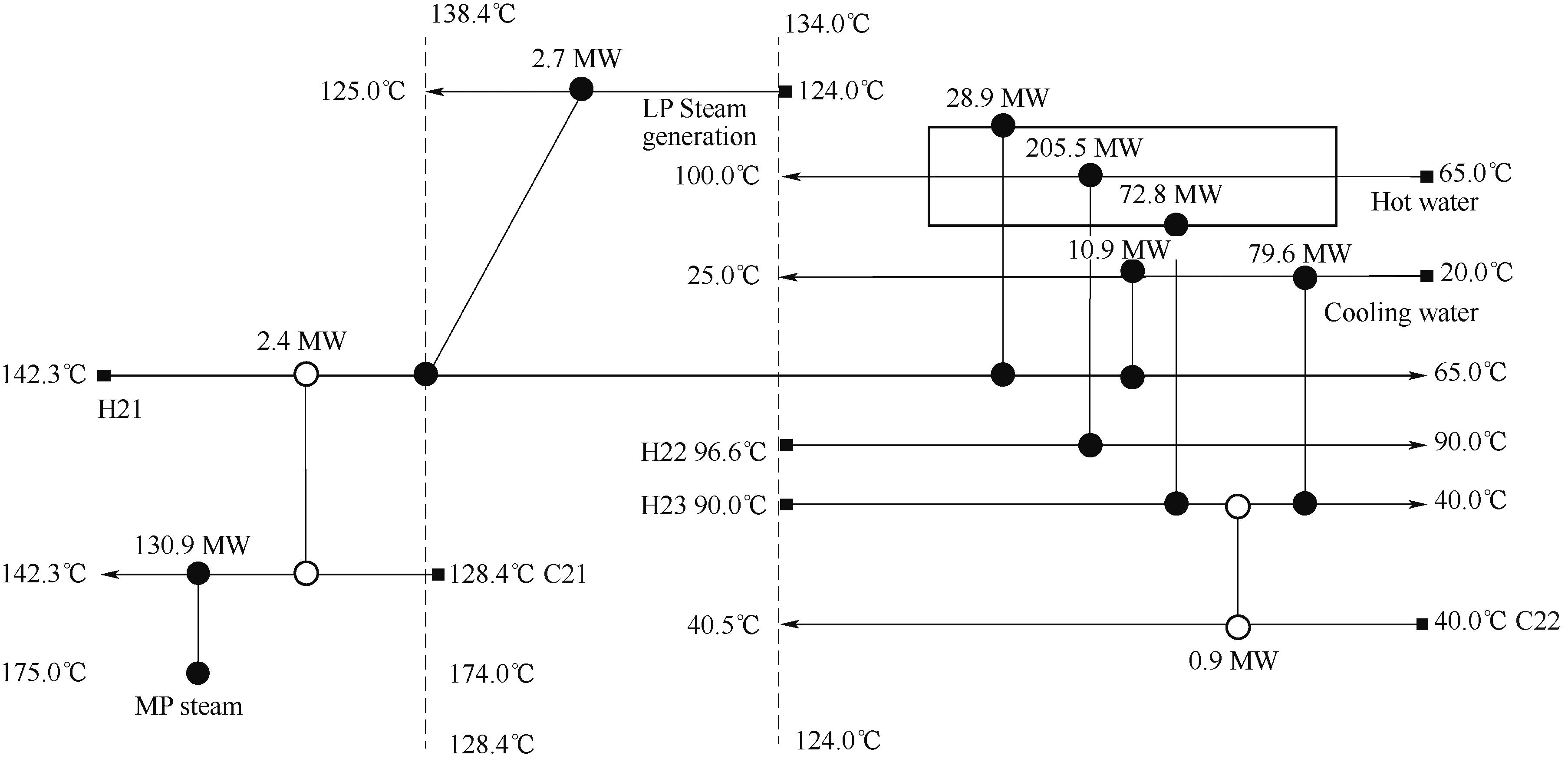
图4 CO2捕集单元换热网络
Fig.4 The heat exchanger network of CO2 capture unit

图5 甲醇合成与精馏单元换热网络
Fig.5 The heat exchanger network of MSD unit

图6 燃烧单元换热网络
Fig.6 The heat exchanger network of COMB unit
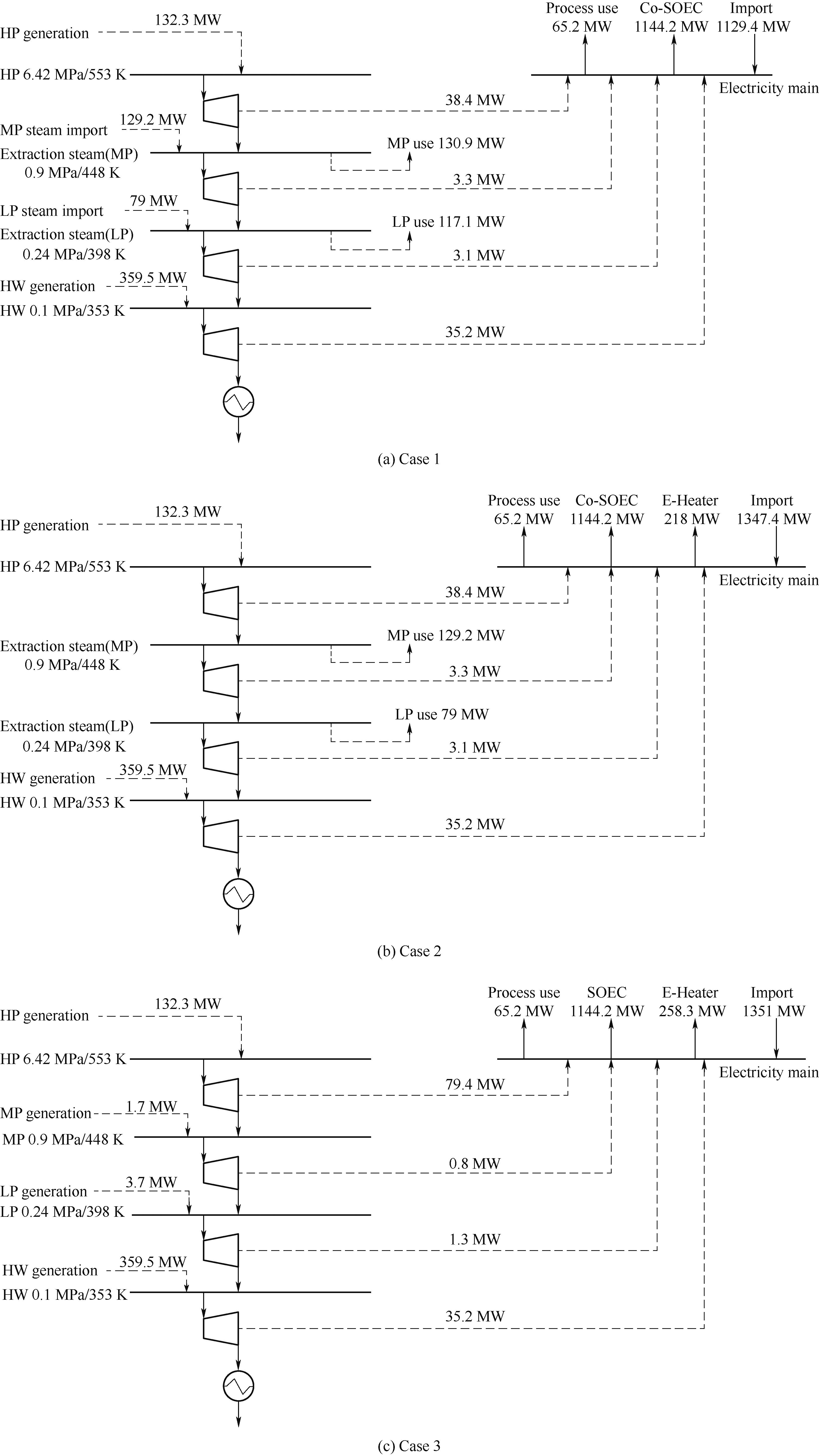
图7 电能平衡结构
Fig.7 Electricity balance structure
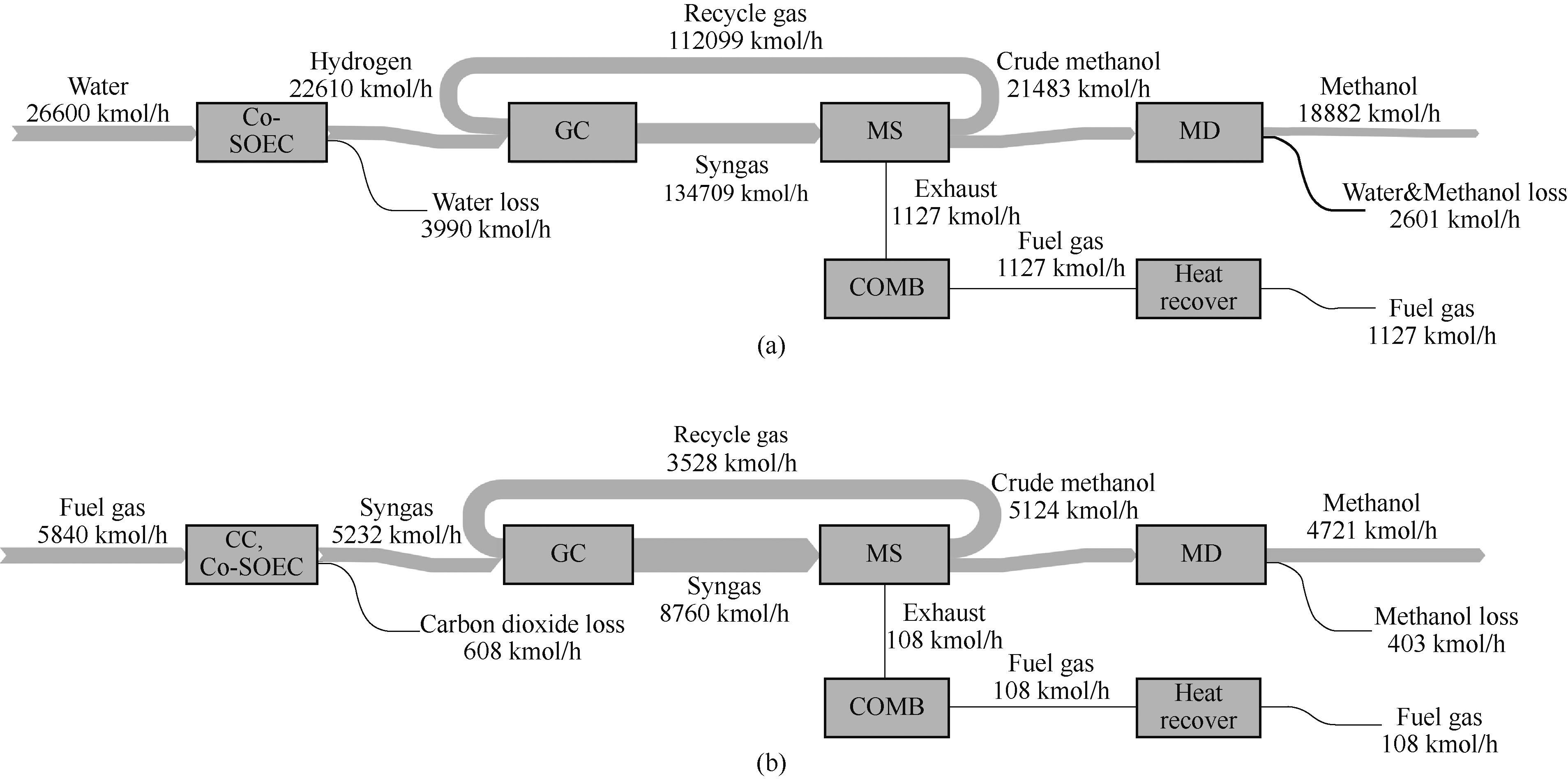
图8 Co-SOEC-CO2tM工艺的氢、碳元素流动图
Fig.8 The hydrogen and carbon element flow of the Co-SOEC-CO2tM process

图9 不同甲醇合成工艺的氢、碳元素利用率
Fig.9 Utilization of hydrogen and carbon elements in different methanol synthesis processes

图10 Co-SOEC-CO2tM工艺的能量流动图
Fig.10 Energy flow diagram of Co-SOEC-CO2tM process
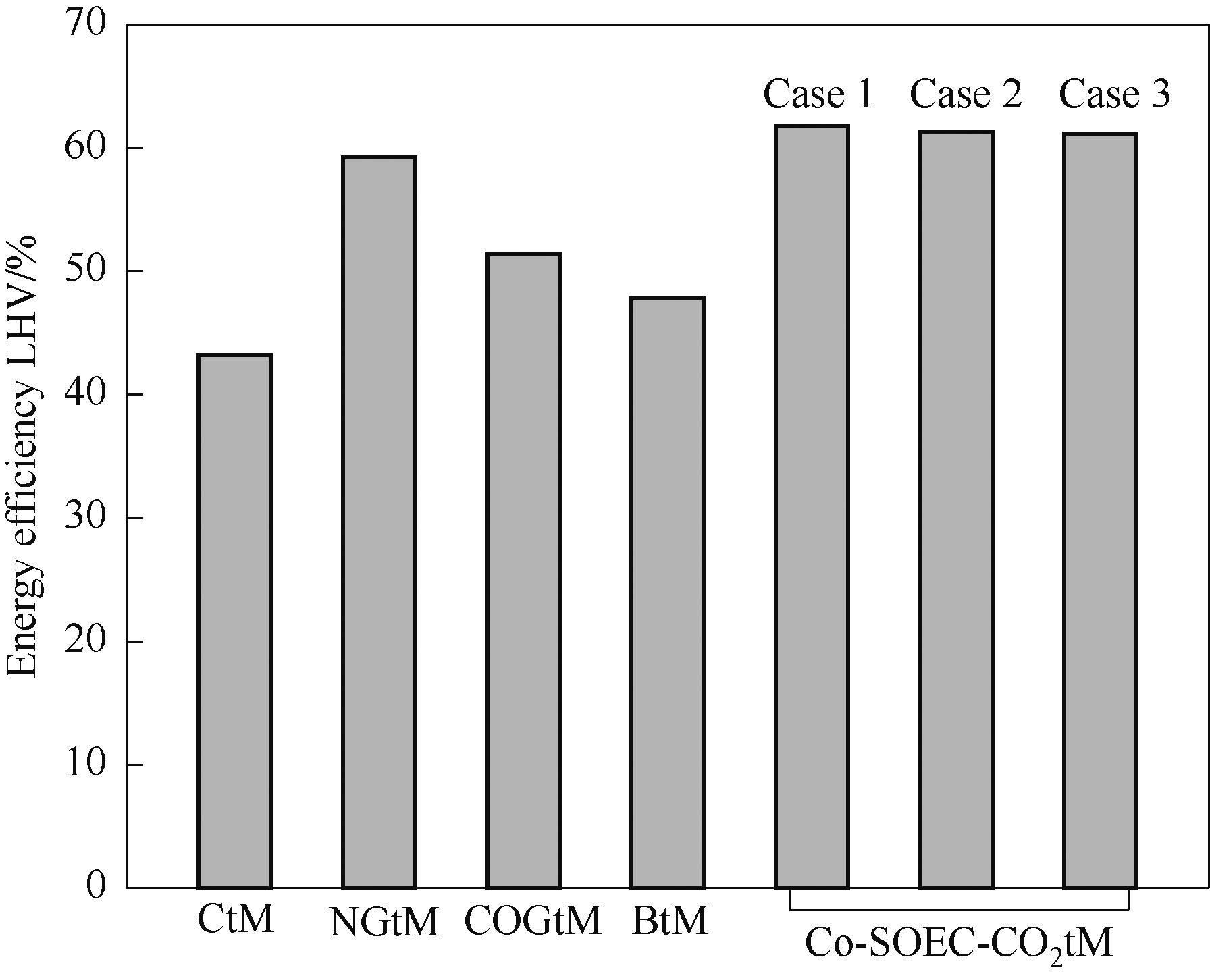
图11 甲醇合成工艺的能量利用效率
Fig.11 Energy utilization efficiency of different methanol synthesis processes
| CO2排放 | 数值 |
|---|---|
| 原煤燃烧/(t/MJ) | 98 |
| 风力发电/(t/MWh) | 22000 |
| 光伏发电/(t/MWh) | 101500 |
| 风光耦合发电/(t/MWh) | 23300 |
表3 CO2间接排放因子
Table 3 Indirect emission factor
| CO2排放 | 数值 |
|---|---|
| 原煤燃烧/(t/MJ) | 98 |
| 风力发电/(t/MWh) | 22000 |
| 光伏发电/(t/MWh) | 101500 |
| 风光耦合发电/(t/MWh) | 23300 |
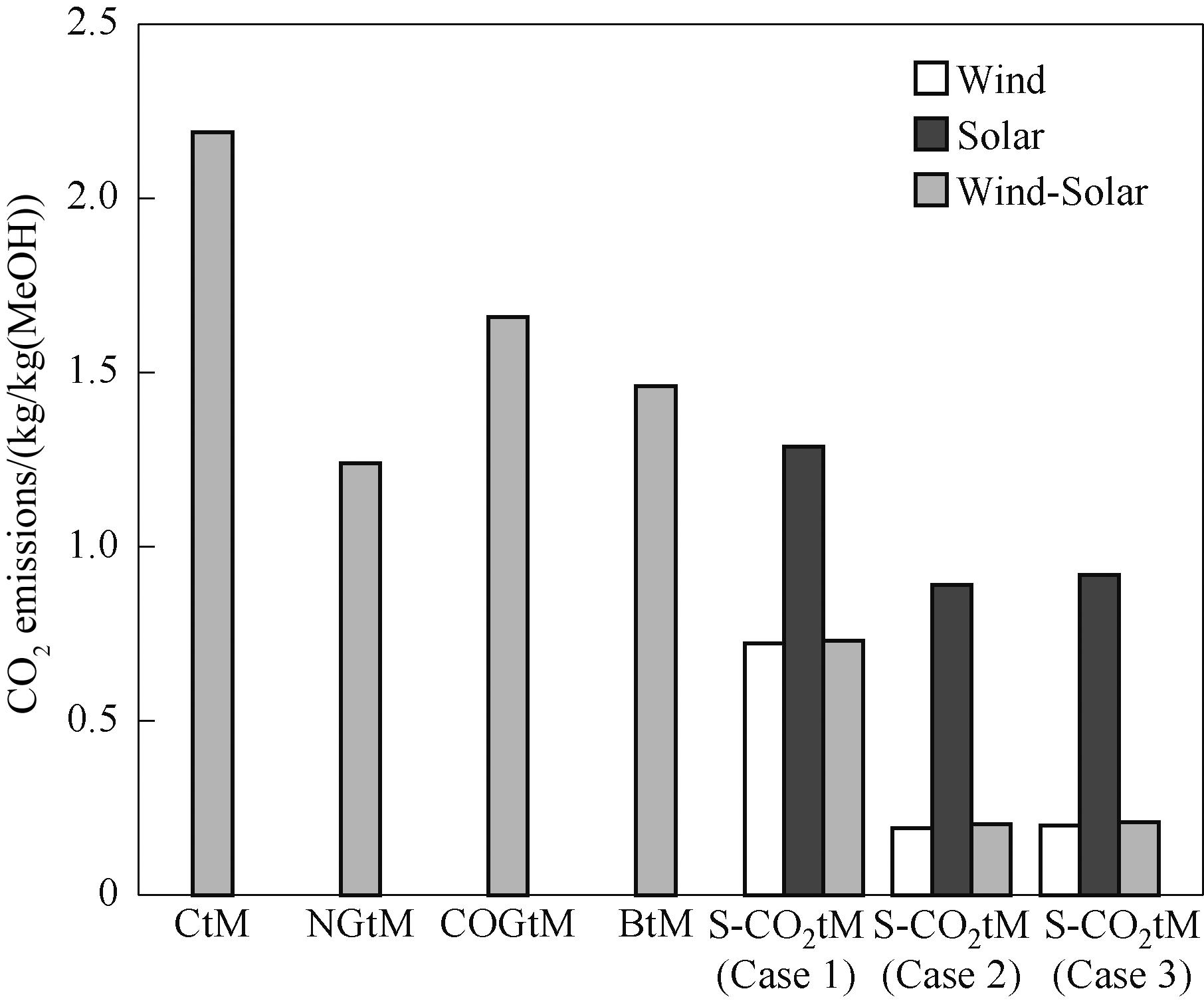
图12 甲醇合成工艺不同的CO2排放
Fig.12 CO2 emissions of different methanol synthesis processes
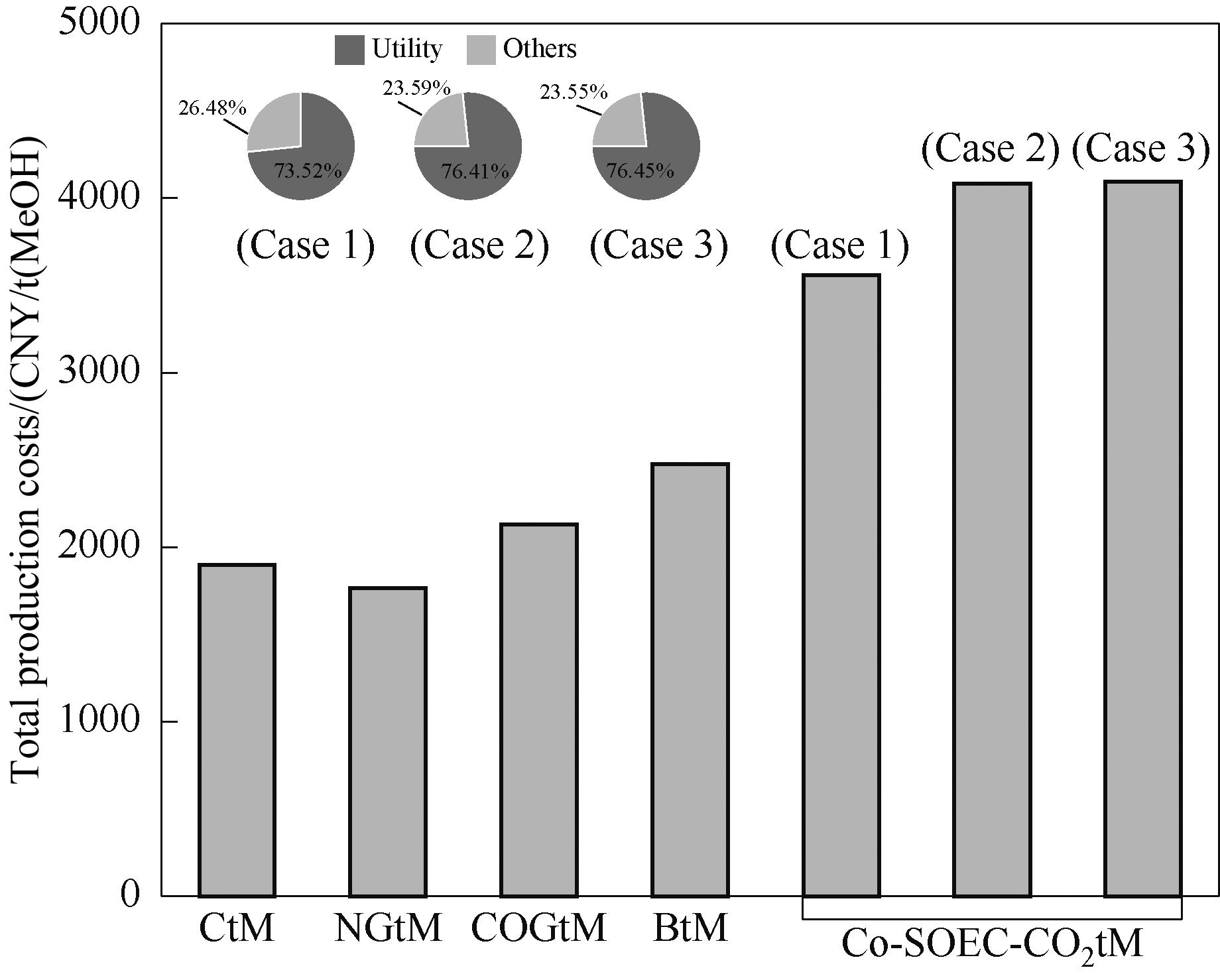
图13 甲醇合成不同工艺的生产成本
Fig.13 The production cost of methanol synthesis with different processes
| 价格 | 当前 | 未来 |
|---|---|---|
| 煤/(CNY/t) | 550.0 | 450.0 |
| 天然气/(CNY/m3) | 1.6 | 1.40 |
| 生物质/(CNY/t) | 750.0 | 600.0 |
| 可再生电能/(CNY/kWh) | 0.35 | 0.1 |
| 碳税/(CNY/t) | 51.0 | 160.0 |
表4 当前场景和未来场景的运营成本
Table 4 Operating costs of the current scenarios and future scenarios
| 价格 | 当前 | 未来 |
|---|---|---|
| 煤/(CNY/t) | 550.0 | 450.0 |
| 天然气/(CNY/m3) | 1.6 | 1.40 |
| 生物质/(CNY/t) | 750.0 | 600.0 |
| 可再生电能/(CNY/kWh) | 0.35 | 0.1 |
| 碳税/(CNY/t) | 51.0 | 160.0 |

图14 当前和未来情景下甲醇合成不同工艺的生产成本
Fig.14 Total production costs of different methanol synthesis processes in current and future situations

图15 不同甲醇合成工艺的相对性能矩阵
Fig.15 Relative performance matrix of methanol synthesis process
| [1] | 王集杰, 韩哲, 陈思宇, 等. 太阳燃料甲醇合成[J]. 化工进展, 2022, 41(3): 1309-1317. |
| Wang J J, Han Z, Chen S Y, et al. Liquid sunshine methanol[J]. Chemical Industry and Engineering Progress, 2022, 41(3): 1309-1317. | |
| [2] | 季东, 王健, 王可, 等. 不同CO2捕集技术的CO2耦合绿氢制甲醇工艺研究[J]. 化工学报, 2022, 73(10): 4565-4575. |
| Ji D, Wang J, Wang K, et al. Process research of methanol production by CO2 coupled green hydrogen with different CO2 capture technologies[J]. CIESC Journal, 2022, 73(10): 4565-4575. | |
| [3] | 孔昕山, 黄仁星, 康丽霞, 等. 甲醇模块化生产中分时储热系统的优化设计[J]. 化工学报, 2022, 73(2): 770-781. |
| Kong X S, Huang R X, Kang L X, et al. Optimal design of time-sharing heat storage system for modular production of methanol[J]. CIESC Journal, 2022, 73(2): 770-781. | |
| [4] | 邹才能, 李建明, 张茜, 等. 氢能工业现状、技术进展、挑战及前景[J]. 天然气工业, 2022, 42(4): 1-20. |
| Zou C N, Li J M, Zhang X, et al. Industrial status, technological progress, challenges and prospects of hydrogen energy[J]. Natural Gas Industry, 2022, 42(4): 1-20. | |
| [5] | 孟文亮. 二氧化碳加氢合成甲醇工艺建模、分析与系统集成研究[D]. 兰州: 兰州理工大学, 2021. |
| Meng W L. Modeling, analysis and system integration of methanol synthesis from carbon dioxide hydrogenation[D]. Lanzhou: Lanzhou University of Technology, 2021. | |
| [6] | Olah G A, Goeppert A, Surya Prakash G K. Beyond Oil and Gas: The Methanol Economy[M]. Washington, DC: Wiley, 2009. |
| [7] | 张晨佳. 高温固体氧化物电解水制氢性能分析与模拟研究[D]. 北京: 华北电力大学, 2021. |
| Zhang C J. Performance analysis and simulation study on hydrogen production from electrolyzed water by high temperature solid oxide[D]. Beijing: North China Electric Power University, 2021. | |
| [8] | 侯权. 高温固体氧化物电解池模拟分析[D]. 上海: 中国科学院大学(中国科学院上海应用物理研究所), 2018. |
| Hou Q. Simulation analysis of high temperature solid oxide electrolytic cell[D]. Shanghai: Shanghai Institute of Applied Physics, Chinese Academy of Sciences, 2018. | |
| [9] | Mohebali Nejadian M, Ahmadi P, Houshfar E. Comparative optimization study of three novel integrated hydrogen production systems with SOEC, PEM, and alkaline electrolyzer[J]. Fuel, 2023, 336: 126835. |
| [10] | Yu S B, Lee S H, Mehran M T, et al. Syngas production in high performing tubular solid oxide cells by using high-temperature H2O/CO2 co-electrolysis[J]. Chemical Engineering Journal, 2018, 335: 41-51. |
| [11] | 王振, 于波, 张文强, 等. 高温共电解H2O/CO2制备清洁燃料[J]. 化学进展, 2013, 25(7): 1229-1236. |
| Wang Z, Yu B, Zhang W Q, et al. Clean fuel production through high temperature co-electrolysis of H2O and CO2 [J]. Progress in Chemistry, 2013, 25(7): 1229-1236. | |
| [12] | Andika R, Nandiyanto A B D, Putra Z A, et al. Co-electrolysis for power-to-methanol applications[J]. Renewable and Sustainable Energy Reviews, 2018, 95: 227-241. |
| [13] | Zhang H F, Desideri U. Techno-economic optimization of power-to-methanol with co-electrolysis of CO2 and H2O in solid-oxide electrolyzers[J]. Energy, 2020, 199: 117498. |
| [14] | Lee B, Lee H, Lim D, et al. Renewable methanol synthesis from renewable H2 and captured CO2: how can power-to-liquid technology be economically feasible?[J]. Applied Energy, 2020, 279: 115827. |
| [15] | Wang D L, Li J W, Meng W L, et al. A near-zero carbon emission methanol production through CO2 hydrogenation integrated with renewable hydrogen: process analysis, modification and evaluation[J]. Journal of Cleaner Production, 2023, 412: 137388. |
| [16] | Zhang Q J, Chen H, Li B, et al. A novel system integrating water electrolysis and supercritical CO2 cycle for biomass to methanol[J]. Applied Thermal Engineering, 2023, 225: 120234. |
| [17] | 李贵贤, 曹阿波, 孟文亮, 等. 耦合固体氧化物电解槽的CO2制甲醇过程设计与评价研究[J]. 化工学报, 2023, 74(7): 2999-3009. |
| Li G X, Cao A B, Meng W L, et al. Process design and evaluation of CO2 to methanol coupled with SOEC[J]. CIESC Journal, 2023, 74(7): 2999-3009. | |
| [18] | 李汶颖. 固体氧化物电解池共电解二氧化碳和水机理及性能研究[D]. 北京: 清华大学, 2015. |
| Li W Y. Study on mechanism and performance of co-electrolysis of carbon dioxide and water in solid oxide electrolytic cell[D]. Beijing: Tsinghua University, 2015. | |
| [19] | Clausen L R, Butera G, Jensen S H. High efficiency SNG production from biomass and electricity by integrating gasification with pressurized solid oxide electrolysis cells[J]. Energy, 2019, 172: 1117-1131. |
| [20] | 张俊杰, 孙旺, 高啸天, 等. 固体氧化物电解池制氢关键技术及产业化进展[J]. 化工学报, 2023, 74(12): 4749-4763. |
| Zhang J J, Sun W, Gao X T, et al. Key technology and industrialization progress of hydrogen production by solid oxide electrolytic cell[J]. CIESC Journal, 2023, 74(12): 4749-4763. | |
| [21] | Du Y M, Qin Y Z, Zhang G B, et al. Modelling of effect of pressure on co-electrolysis of water and carbon dioxide in solid oxide electrolysis cell[J]. International Journal of Hydrogen Energy, 2019, 44(7): 3456-3469. |
| [22] | Stoots C M, O'Brien J E, Herring J S, et al. Syngas production via high-temperature coelectrolysis of steam and carbon dioxide[J]. Journal of Fuel Cell Science and Technology, 2009, 6(1): 110141-1101412. |
| [23] | Chen X B, Guan C Z, Xiao G P, et al. Syngas production by high temperature steam/CO2 coelectrolysis using solid oxide electrolysis cells[J]. Faraday Discussions, 2015, 182: 341-351. |
| [24] | Ni M. An electrochemical model for syngas production by co-electrolysis of H2O and CO2 [J]. Journal of Power Sources, 2012, 202: 209-216. |
| [25] | An X, Zuo Y Z, Zhang Q, et al. Methanol synthesis from CO2 hydrogenation with a Cu/Zn/Al/Zr fibrous catalyst[J]. Chinese Journal of Chemical Engineering, 2009, 17(1): 88-94. |
| [26] | Kiss A A, Pragt J J, Vos H J, et al. Novel efficient process for methanol synthesis by CO2 hydrogenation[J]. Chemical Engineering Journal, 2016, 284: 260-269. |
| [27] | Wiertzema H, Svensson E, Harvey S. Bottom-up assessment framework for electrification options in energy-intensive process industries[J]. Frontiers in Energy Research, 2020, 8: 192. |
| [28] | Wang D L, Meng W L, Zhou H R, et al. Green hydrogen coupling with CO2 utilization of coal-to-methanol for high methanol productivity and low CO2 emission[J]. Energy, 2021, 231: 120970. |
| [29] | Arnaiz del Pozo C, Cloete S, Jiménez Álvaro Á. Techno-economic assessment of long-term methanol production from natural gas and renewables[J]. Energy Conversion and Management, 2022, 266: 115785. |
| [30] | Deng L Y, Adams T A II. Techno-economic analysis of coke oven gas and blast furnace gas to methanol process with carbon dioxide capture and utilization[J]. Energy Conversion and Management, 2020, 204: 112315. |
| [31] | Harris K, Grim R G, Huang Z, et al. A comparative techno-economic analysis of renewable methanol synthesis from biomass and CO2: opportunities and barriers to commercialization[J]. Applied Energy, 2021, 303: 117637. |
| [32] | Zhang J P, Li Z W, Zhang Z H, et al. Techno-economic analysis of integrating a CO2 hydrogenation-to-methanol unit with a coal-to-methanol process for CO2 reduction[J]. ACS Sustainable Chemistry & Engineering, 2020, 8(49): 18062-18070. |
| [33] | Yang Q C, Zhu S, Yang Q, et al. Comparative techno-economic analysis of oil-based and coal-based ethylene glycol processes[J]. Energy Conversion and Management, 2019, 198: 111814. |
| [34] | 李贵贤, 王可, 王健, 等. 膜分离捕集燃煤电厂烟气CO2过程优化设计[J]. 化工学报, 2022, 73(11): 5065-5077. |
| Li G X, Wang K, Wang J, et al. Optimal design of membrane separation process for capturing CO2 from flue gas of coal-fired power plant[J]. CIESC Journal, 2022, 73(11): 5065-5077. | |
| [35] | Adnan M A, Kibria M G. Comparative techno-economic and life-cycle assessment of power-to-methanol synthesis pathways[J]. Applied Energy, 2020, 278: 115614. |
| [36] | 杨庆, 许思敏, 张大伟, 等. 石油与煤路线制乙二醇过程的技术经济分析[J]. 化工学报, 2020, 71(5): 2164-2172. |
| Yang Q, Xu S M, Zhang D W, et al. Techno-economic analysis of oil and coal to ethylene glycol processes[J]. CIESC Journal, 2020, 71(5): 2164-2172. | |
| [37] | Xiang D, Li P, Yuan X Y, et al. Highly efficient carbon utilization of coal-to-methanol process integrated with chemical looping hydrogen and air separation technology: process modeling and parameter optimization[J]. Journal of Cleaner Production, 2020, 258: 120910. |
| [1] | 刘中毅, 胡斌, 王如竹, 赵云, 蔡梓文, 李云峰. 酿酒行业用热电气化发展潜力与供热系统[J]. 化工学报, 2025, 76(S1): 401-408. |
| [2] | 曹健, 钱红亮, 冯新, 陆小华. 热力学视角下的碳中和三问[J]. 化工学报, 2024, 75(11): 4378-4384. |
| [3] | 李贵贤, 曹阿波, 孟文亮, 王东亮, 杨勇, 周怀荣. 耦合固体氧化物电解槽的CO2制甲醇过程设计与评价研究[J]. 化工学报, 2023, 74(7): 2999-3009. |
| [4] | 季东, 王健, 王可, 李婧玮, 孟文亮, 杨勇, 李贵贤, 王东亮, 周怀荣. 不同CO2捕集技术的CO2耦合绿氢制甲醇工艺研究[J]. 化工学报, 2022, 73(10): 4565-4575. |
| [5] | 杨蕴哲,杨卫身,杨凤林,张兴文. 在不分隔的反应器中原位电生成活性氯氧化降解蒽醌染料 [J]. CIESC Journal, 2005, 13(5): 628-633. |
| 阅读次数 | ||||||
|
全文 |
|
|||||
|
摘要 |
|
|||||
 京公网安备 11010102001995号