• •
方双( ), 李勇刚, 韩洁(), 阳春华, 桂卫华
收稿日期:2025-09-01
修回日期:2025-10-24
出版日期:2025-11-25
通讯作者:
韩洁
作者简介:方双(1993—),女,博士研究生,shuang.fang@csu.edu.cn
基金资助:
Shuang FANG(), Yonggang LI, Jie HAN(), Chunhua YANG, Weihua GUI
Received:2025-09-01
Revised:2025-10-24
Online:2025-11-25
Contact:
Jie HAN
摘要:
蒸发过程作为氧化铝生产工艺中的高能耗单元,已成为制约行业节能降耗、绿色转型的关键环节。本文对其进行系统性研究有助于从多维度统筹能量利用模式与过程调控机制,明确节能优化路径,从而为氧化铝蒸发过程的节能降耗和工艺提升提供科学依据。首先,全面梳理了氧化铝的生产方式、蒸发作业流程及蒸发设备的发展演变,为理解其运行机理和节能潜力奠定了基础。随后,从工艺设备优化、工艺流程优化以及工艺参数优化三个层面构建分层分析框架,系统总结了该领域的优化技术演变规律和发展趋势。在此基础上,归纳总结了液位优化设定与汽水比优化这两类工程优化问题,并通过引入㶲分析理论与智能优化算法,揭示热力学理论与智能优化工具在节能降耗中的融合机制与应用模式。本文可为蒸发系统的节能方案制定、运行策略优化以及工程能效提升提供理论依据和技术借鉴,对推动氧化铝行业实现节能高效运行和绿色低碳转型具有重要意义。
中图分类号:
方双, 李勇刚, 韩洁, 阳春华, 桂卫华. 面向节能降耗的氧化铝蒸发过程优化研究进展[J]. 化工学报, DOI: 10.11949/0438-1157.20250971.
Shuang FANG, Yonggang LI, Jie HAN, Chunhua YANG, Weihua GUI. A review of optimization advances in the alumina evaporation process oriented toward energy conservation and consumption reduction[J]. CIESC Journal, DOI: 10.11949/0438-1157.20250971.
| 工艺类型 | 优点 | 缺点 |
|---|---|---|
拜耳法 | ①工艺流程简单,便于工业化连续操作; ②由于不涉及烧结环节,能耗相对较低; ③晶种自发分解,杂质分离效果好,产品氧化铝纯度高; | ①难以有效处理铝硅比低的铝土矿; |
烧结法 | ①适用于铝硅比低的高硅铝土矿; ②消耗原料为碳酸钠,价格低廉,经济性较好; | ①整体工艺流程相对复杂,操作与控制难度较大; ②由于包含烧结环节,单位产品的能源消耗较高; ③产品主要通过碳酸化分解进行脱碳,易引入杂质,导致氧化铝产品质量较差; |
联合法 | ①融合拜耳法和烧结法的优势,兼顾原料适应性与产品质量; | ①流程更加复杂,不同联合法之间差异较大,难以形成统一标准; ②部分流程仍包含烧结环节,能耗高、碳排放大; ③整体技术成熟度不如拜耳法,运行管理要求较高; |
表1 拜耳法、烧结法、联合法的工艺特点
Table 1 Process characteristics of Bayer process, sintering process, and combined process
| 工艺类型 | 优点 | 缺点 |
|---|---|---|
拜耳法 | ①工艺流程简单,便于工业化连续操作; ②由于不涉及烧结环节,能耗相对较低; ③晶种自发分解,杂质分离效果好,产品氧化铝纯度高; | ①难以有效处理铝硅比低的铝土矿; |
烧结法 | ①适用于铝硅比低的高硅铝土矿; ②消耗原料为碳酸钠,价格低廉,经济性较好; | ①整体工艺流程相对复杂,操作与控制难度较大; ②由于包含烧结环节,单位产品的能源消耗较高; ③产品主要通过碳酸化分解进行脱碳,易引入杂质,导致氧化铝产品质量较差; |
联合法 | ①融合拜耳法和烧结法的优势,兼顾原料适应性与产品质量; | ①流程更加复杂,不同联合法之间差异较大,难以形成统一标准; ②部分流程仍包含烧结环节,能耗高、碳排放大; ③整体技术成熟度不如拜耳法,运行管理要求较高; |
| 效数 | 单效 | 两效 | 三效 | 四效 | 五效 |
|---|---|---|---|---|---|
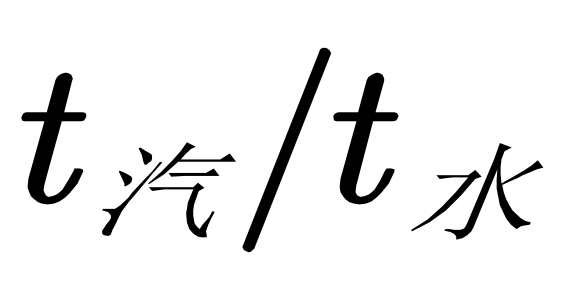 (不小于) (不小于) | 1.10 | 0.57 | 0.40 | 0.30 | 0.27 |
表2 蒸发过程中蒸汽消耗量与蒸发效数之间的关系
Table 2 Relationship between steam consumption and number of evaporation effects in the evaporation process
| 效数 | 单效 | 两效 | 三效 | 四效 | 五效 |
|---|---|---|---|---|---|
| (不小于) | 1.10 | 0.57 | 0.40 | 0.30 | 0.27 |
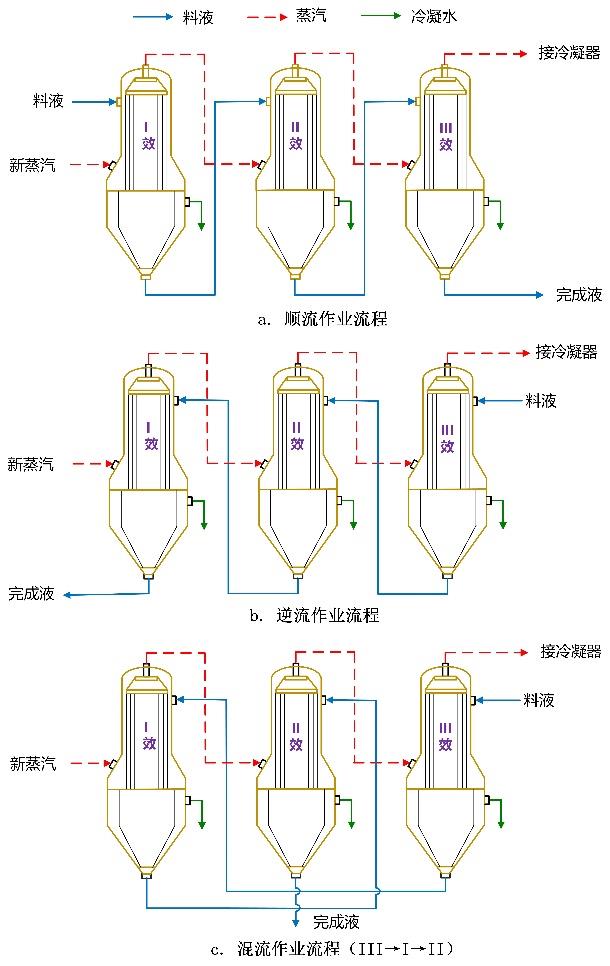
图1 氧化铝蒸发过程三种作业流程的示意图
Fig. 1 Schematic diagram of three operation processes in the alumina evaporation process
| 蒸发流程 | 优点 | 缺点 |
|---|---|---|
顺流 | ①料液借助压力差自流输送无需用泵; ②自蒸发现象增强,蒸发效率高; ③首效浓度低、温度高,有利于杂质析出; | ①末效浓度高、蒸汽温度低,传热效率差; ②首、末效传热系数相差较大,系统整体传热性能不佳; |
逆流 | ①高浓度效匹配高温蒸汽,提高整体传热系数; ②高温度高浓度的双重作用限制硅盐析出,减少结垢; | ①需要用泵输送料液,增加电耗; ②高温度高浓度对设备腐蚀增强,降低管道寿命; |
混流 | ①兼具顺流与逆流的优势; ②能起到清洗设备、缓解结垢的作用,提高蒸发效率; | ①工艺路径复杂,调控难度增大; ②系统设计需结合工程需求定制; |
表3 顺流、逆流、混流作业流程的特点
Table 3 Characteristics of forward flow, countercurrent flow, and mixed flow operation workflows
| 蒸发流程 | 优点 | 缺点 |
|---|---|---|
顺流 | ①料液借助压力差自流输送无需用泵; ②自蒸发现象增强,蒸发效率高; ③首效浓度低、温度高,有利于杂质析出; | ①末效浓度高、蒸汽温度低,传热效率差; ②首、末效传热系数相差较大,系统整体传热性能不佳; |
逆流 | ①高浓度效匹配高温蒸汽,提高整体传热系数; ②高温度高浓度的双重作用限制硅盐析出,减少结垢; | ①需要用泵输送料液,增加电耗; ②高温度高浓度对设备腐蚀增强,降低管道寿命; |
混流 | ①兼具顺流与逆流的优势; ②能起到清洗设备、缓解结垢的作用,提高蒸发效率; | ①工艺路径复杂,调控难度增大; ②系统设计需结合工程需求定制; |
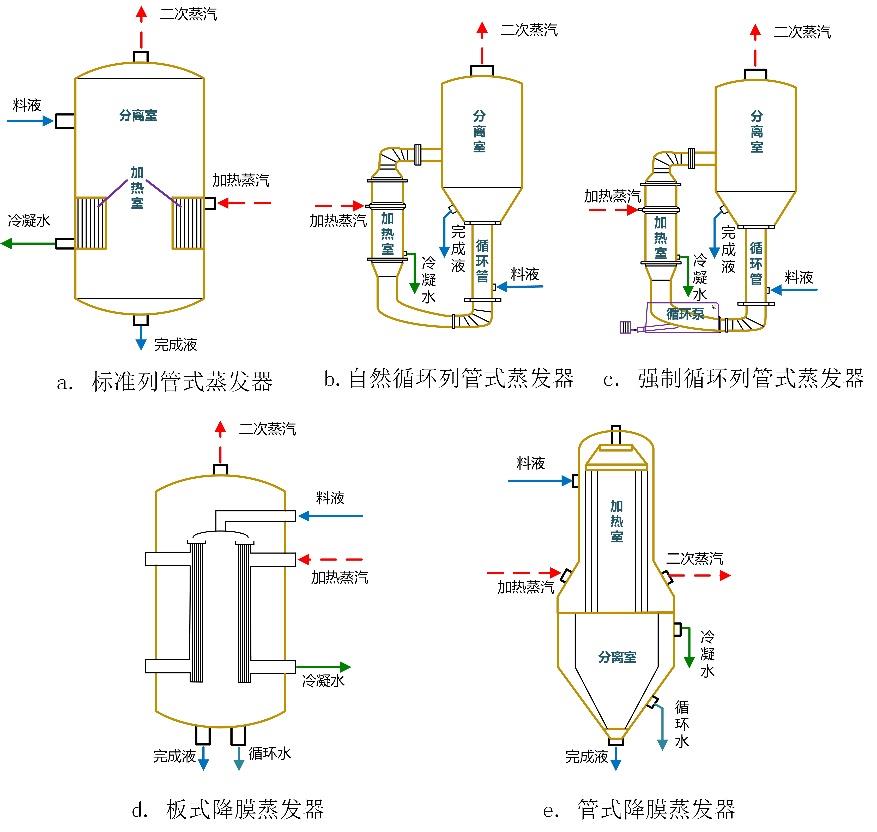
图2 典型蒸发设备的结构示意图
Fig.2 Structural schematic diagram of typical evaporation equipment
| 设备类型 | 工作原理 | 优点 | 缺点 | 性能表现(相对等级) |
|---|---|---|---|---|
| 标准列管式蒸发器 | 其加热室由垂直管束组成,利用中央循环管和加热管内料液的密度差可使料液作沿粗管下降、沿细管上升的自然循环运动; | 结构简单、制造成本低; | 传热面积受限、传热系数低、汽耗高、不适用于处理结晶性物料; | 传热系数:低 能耗效率:低 |
自然循环列管式蒸发器 | 加热室内料液吸收热量之后,造成循环管道两侧料液密度不均匀而产生密度差,进而形成驱动料液循环流动的动力,推动料液的不断循环流动; | 单台设备能力强、加热室与分离室独立,便于清晰和更换,适用于大型氧化铝厂; | 易结垢、传热系数偏低、汽耗偏高、需较大有效温差且限制多效蒸发的效数; | 传热系数:中低 能耗效率:中低 |
强制循环列管式蒸发器 | 在循环泵的外加动力作用下,料液以较高流速被强制送入加热室,吸收热量后进入分离室,料液因温度升高而发生部分汽化;蒸汽与未汽化液体在分离室中完成汽液分离,未汽化部分在循环泵作用下再次进入加热室;通过循环泵持续驱动,料液在系统中形成稳定的强制对流循环; | 减缓结垢、避免堵塞、传热效率高、操作弹性大; | 动力消耗高、循环泵检修频繁; | 传热系数:中 能耗效率:中 |
板式降膜蒸发器 | 蒸汽在加热板内侧冷凝,料液沿着加热板外侧形成薄膜流动,热量通过加热板传递使液膜一边流动一边蒸发汽化。二次蒸汽在加热板之间上升,通过液膜分离器进入下一效; | 传热强度高、蒸发速率快、汽耗低; | 设备价格昂贵、加热板易腐蚀或机械损坏且不易更换; | 传热系数:高 能耗效率:中高 |
管式降膜蒸发器 | 料液从顶部进入加热管,经布膜器作用后均匀流入加热管并形成液膜,液膜吸收管壁传递的热量,一边流动一边蒸发汽化。二次蒸汽随液膜进入分离室,并在分离室实现汽液分离,进入下一效提供热源; | 传热系数高、加热管易于更换、造价低、消除了由静压引起的有效温差损失,适用于多效蒸发和大规模连续生产; | 结构复杂、对液膜分布要求较高; | 传热系数:高 能耗效率:高 |
表4 典型蒸发设备的工作原理、运行特性与性能表现
Table 4 Working principles, operating characteristics and performance evolution of typical evaporation equipment
| 设备类型 | 工作原理 | 优点 | 缺点 | 性能表现(相对等级) |
|---|---|---|---|---|
| 标准列管式蒸发器 | 其加热室由垂直管束组成,利用中央循环管和加热管内料液的密度差可使料液作沿粗管下降、沿细管上升的自然循环运动; | 结构简单、制造成本低; | 传热面积受限、传热系数低、汽耗高、不适用于处理结晶性物料; | 传热系数:低 能耗效率:低 |
自然循环列管式蒸发器 | 加热室内料液吸收热量之后,造成循环管道两侧料液密度不均匀而产生密度差,进而形成驱动料液循环流动的动力,推动料液的不断循环流动; | 单台设备能力强、加热室与分离室独立,便于清晰和更换,适用于大型氧化铝厂; | 易结垢、传热系数偏低、汽耗偏高、需较大有效温差且限制多效蒸发的效数; | 传热系数:中低 能耗效率:中低 |
强制循环列管式蒸发器 | 在循环泵的外加动力作用下,料液以较高流速被强制送入加热室,吸收热量后进入分离室,料液因温度升高而发生部分汽化;蒸汽与未汽化液体在分离室中完成汽液分离,未汽化部分在循环泵作用下再次进入加热室;通过循环泵持续驱动,料液在系统中形成稳定的强制对流循环; | 减缓结垢、避免堵塞、传热效率高、操作弹性大; | 动力消耗高、循环泵检修频繁; | 传热系数:中 能耗效率:中 |
板式降膜蒸发器 | 蒸汽在加热板内侧冷凝,料液沿着加热板外侧形成薄膜流动,热量通过加热板传递使液膜一边流动一边蒸发汽化。二次蒸汽在加热板之间上升,通过液膜分离器进入下一效; | 传热强度高、蒸发速率快、汽耗低; | 设备价格昂贵、加热板易腐蚀或机械损坏且不易更换; | 传热系数:高 能耗效率:中高 |
管式降膜蒸发器 | 料液从顶部进入加热管,经布膜器作用后均匀流入加热管并形成液膜,液膜吸收管壁传递的热量,一边流动一边蒸发汽化。二次蒸汽随液膜进入分离室,并在分离室实现汽液分离,进入下一效提供热源; | 传热系数高、加热管易于更换、造价低、消除了由静压引起的有效温差损失,适用于多效蒸发和大规模连续生产; | 结构复杂、对液膜分布要求较高; | 传热系数:高 能耗效率:高 |
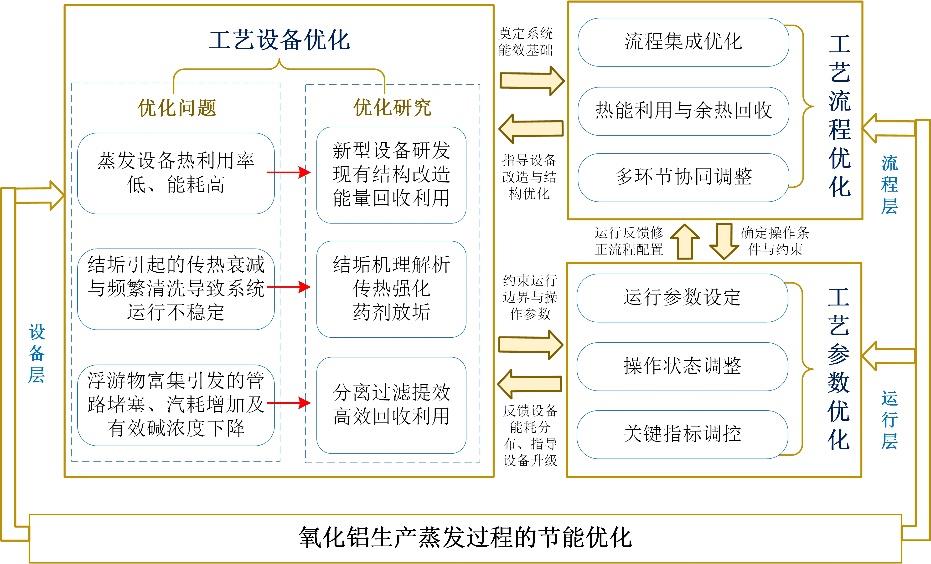
图3 氧化铝蒸发过程节能优化的分层分析框架
Fig.3 Hierarchical analytical framework for energy-efficient optimization of the alumina evaporation process
| 工艺设备优化问题 | 主要研究方向 | 优点 | 缺点 | 适用场景 |
|---|---|---|---|---|
蒸发设备热利用率低、能耗偏高 | 新型设备研发 | 显著提升传热效率、延长运行周期 | 投资高、改造周期长 | 新建装置或大规模改造 |
| 现有结构改造 | 成本低、见效周期短 | 改造幅度有限、提升效果受现有设备制约 | 现有装置的节能改造 | |
| 能量回收利用 | 充分利用余热、大幅提高能源利用率并降低汽耗 | 系统集成、改造复杂,运维成本较高 | 大型装置系统的整体能效改造 | |
结垢引起的传热衰减与频繁清洗导致系统运行不稳定 | 结垢机理解析 | 揭示影响因素,为防垢提供理论依据 | 属于理论研究,需与工程技术结合方能转化为可见节能成效 | 放垢机制研究与防垢方案设计 |
| 传热强化 | 显著提升传热系数和蒸发效率、延长清洗周期 | 强化效果依赖物料性质与操作条件,对工况敏感且需配套改造 | 设备换热性能快速提升 | |
| 药剂防垢 | 治垢效果显著、回报周期短 | 前期实验与试错成本较高、药剂研发周期较长、适用工况有限 | 管道结垢情况复杂、高负荷工况下设备传热性能提升 | |
| 浮游物富集引发的管路堵塞、汽耗增加及有效碱浓度下降 | 分离过滤提效 | 显著降低浮游物含量、提高运行稳定性 | 对系统传热和能耗水平的直接改善作用有限 | 系统运行优化、周期延长、维护成本降低 |
| 高效回收利用 | 提高氧化铝回收率,改善产品质量 | 设备投资较高,运行维护要求提升 | 资源回收与品质提升 |
表5 氧化铝蒸发过程工艺设备优化方案的对比分析
Table 5 Comparative analysis of process equipment optimization schemes for the alumina evaporation process
| 工艺设备优化问题 | 主要研究方向 | 优点 | 缺点 | 适用场景 |
|---|---|---|---|---|
蒸发设备热利用率低、能耗偏高 | 新型设备研发 | 显著提升传热效率、延长运行周期 | 投资高、改造周期长 | 新建装置或大规模改造 |
| 现有结构改造 | 成本低、见效周期短 | 改造幅度有限、提升效果受现有设备制约 | 现有装置的节能改造 | |
| 能量回收利用 | 充分利用余热、大幅提高能源利用率并降低汽耗 | 系统集成、改造复杂,运维成本较高 | 大型装置系统的整体能效改造 | |
结垢引起的传热衰减与频繁清洗导致系统运行不稳定 | 结垢机理解析 | 揭示影响因素,为防垢提供理论依据 | 属于理论研究,需与工程技术结合方能转化为可见节能成效 | 放垢机制研究与防垢方案设计 |
| 传热强化 | 显著提升传热系数和蒸发效率、延长清洗周期 | 强化效果依赖物料性质与操作条件,对工况敏感且需配套改造 | 设备换热性能快速提升 | |
| 药剂防垢 | 治垢效果显著、回报周期短 | 前期实验与试错成本较高、药剂研发周期较长、适用工况有限 | 管道结垢情况复杂、高负荷工况下设备传热性能提升 | |
| 浮游物富集引发的管路堵塞、汽耗增加及有效碱浓度下降 | 分离过滤提效 | 显著降低浮游物含量、提高运行稳定性 | 对系统传热和能耗水平的直接改善作用有限 | 系统运行优化、周期延长、维护成本降低 |
| 高效回收利用 | 提高氧化铝回收率,改善产品质量 | 设备投资较高,运行维护要求提升 | 资源回收与品质提升 |
| 工艺流程优化方向 | 技术路线 | 特点 | 局限性 | 适用场景 |
|---|---|---|---|---|
流程集成优化 | 通过工艺流程重构实现蒸发路段的功能分离与物料动态分配 | 显著提升蒸发效率与运行稳定性、适应复杂物料特性和波动工况 | 改造复杂度高、投资成本大、实施周期长 | 新建装置、系统全流程改造升级 |
| 热能梯级利用与余热回收 | 利用余热潜力实现热能梯级利用和综合回收 | 大幅度降低蒸汽消耗、经济效益突出 | 对余热品位和热负荷有一定要求、初期投资较高 | 余热资源充足的装置、高能耗系统节能改造 |
| 多环节协同调整 | 改善环节间的匹配与协同、提高整体运行协调性 | 实施灵活、改造成本低、对系统适应性强 | 节能潜力相对有限,效果受工况波动影响较大 | 存量装置优化、系统精细化改造 |
表6 氧化铝蒸发过程工艺流程优化路线的对比分析
Table 6 Comparative analysis of process flow optimization routes for the alumina evaporation process
| 工艺流程优化方向 | 技术路线 | 特点 | 局限性 | 适用场景 |
|---|---|---|---|---|
流程集成优化 | 通过工艺流程重构实现蒸发路段的功能分离与物料动态分配 | 显著提升蒸发效率与运行稳定性、适应复杂物料特性和波动工况 | 改造复杂度高、投资成本大、实施周期长 | 新建装置、系统全流程改造升级 |
| 热能梯级利用与余热回收 | 利用余热潜力实现热能梯级利用和综合回收 | 大幅度降低蒸汽消耗、经济效益突出 | 对余热品位和热负荷有一定要求、初期投资较高 | 余热资源充足的装置、高能耗系统节能改造 |
| 多环节协同调整 | 改善环节间的匹配与协同、提高整体运行协调性 | 实施灵活、改造成本低、对系统适应性强 | 节能潜力相对有限,效果受工况波动影响较大 | 存量装置优化、系统精细化改造 |
| 工艺参数优化方向 | 技术路线 | 特点 | 局限性 | 适用场景 |
|---|---|---|---|---|
运行参数设定 | 构建蒸水量、流量、液位等关键运行参数与能效指标间的映射关系 | 提升能源利用效率、降低汽水比、提高系统产能 | 对工况敏感,且需依赖精准的模型支撑 | 新建或大规模节能改造装置的运行参数优化 |
| 操作状态调整 | 基于热平衡与能耗分析优化运行条件,通过调整蒸汽温度、真空度、进料方式及酸洗流程等操作策略,结合DCS实现多环节动态调节 | 改善蒸发效率与系统运行稳定性、在一定程度上抑制工况波动并降低能耗 | 涉及多环节协同,操作值需随工况动态调整 | 存量装置的运行优化与过程调优 |
| 关键指标调控 | 建立㶲效率、㶲损失以及汽耗等关键工艺指标优化模型,结合智能优化算法高效求解 | 降低㶲损失与汽耗、提升㶲效率,实现蒸发能效与运行成本的协同优化 | 模型构建难度大,算法实施复杂,对数据质量和模型精度要求高 | 系统运行成本与能效水平需综合权衡的复杂工况,以及智能化升级的工程场景 |
表7 氧化铝蒸发过程工艺参数优化方法的对比分析
Table 7 Comparative analysis of process parameter optimization methods for the alumina evaporation process
| 工艺参数优化方向 | 技术路线 | 特点 | 局限性 | 适用场景 |
|---|---|---|---|---|
运行参数设定 | 构建蒸水量、流量、液位等关键运行参数与能效指标间的映射关系 | 提升能源利用效率、降低汽水比、提高系统产能 | 对工况敏感,且需依赖精准的模型支撑 | 新建或大规模节能改造装置的运行参数优化 |
| 操作状态调整 | 基于热平衡与能耗分析优化运行条件,通过调整蒸汽温度、真空度、进料方式及酸洗流程等操作策略,结合DCS实现多环节动态调节 | 改善蒸发效率与系统运行稳定性、在一定程度上抑制工况波动并降低能耗 | 涉及多环节协同,操作值需随工况动态调整 | 存量装置的运行优化与过程调优 |
| 关键指标调控 | 建立㶲效率、㶲损失以及汽耗等关键工艺指标优化模型,结合智能优化算法高效求解 | 降低㶲损失与汽耗、提升㶲效率,实现蒸发能效与运行成本的协同优化 | 模型构建难度大,算法实施复杂,对数据质量和模型精度要求高 | 系统运行成本与能效水平需综合权衡的复杂工况,以及智能化升级的工程场景 |
| 算法 | 适应度函数 | F0 | P0 | Pm | T0 | D | CPU time |
|---|---|---|---|---|---|---|---|
| m³/h | MPa | MPa | ℃ | t/h | s | ||
| 粒子群优化算法 | 0.3603 | 0.64 | 4.91 | 0.18 | 69.92 | 51.97 | 39.28 |
| 遗传算法[ | 0.362 | 0.56 | 5.20 | 0.13 | 70.00 | 52.35 | 57.55 |
表8 粒子群优化算法与遗传算法在汽水比优化问题上的求解结果对比
Table 8 Comparison of the solution results of particle swarm optimization and genetic algorithm for the steam-to-water ratio optimization problem
| 算法 | 适应度函数 | F0 | P0 | Pm | T0 | D | CPU time |
|---|---|---|---|---|---|---|---|
| m³/h | MPa | MPa | ℃ | t/h | s | ||
| 粒子群优化算法 | 0.3603 | 0.64 | 4.91 | 0.18 | 69.92 | 51.97 | 39.28 |
| 遗传算法[ | 0.362 | 0.56 | 5.20 | 0.13 | 70.00 | 52.35 | 57.55 |
| 对比维度 | 液位优化设定 | 汽水比优化 |
|---|---|---|
| 优化类型 | 运行参数优化 | 性能指标优化 |
影响蒸发过程的方式 | 液位过高会使底部料液蒸发温度升高从而抑制蒸发过程,液位过低则影响系统产能,维持液位稳定才能保证蒸发效率 | 汽水比的反映蒸汽量与蒸水量之间的匹配关系,其直接决定了蒸发系统的能源利用效率与运行经济性 |
| 理论基础 | 㶲分析理论 | 热量平衡、物料平衡 |
| 工程意义 | 保证设备稳定运行,提高系统产能与稳定性 | 提升蒸汽利用程度,降低生产能耗与运行成本,实现蒸发系统的高效益运行 |
| 关注重点 | 关注蒸发设备内部的运行调控 | 聚焦蒸发系统能源与负荷的最优匹配 |
| 适用场景 | 多效蒸发设备内部液位的精准调控与稳定性调节场景 | 蒸发系统整体的能源调度与节能优化场景 |
表9 氧化铝蒸发过程的液位优化设定与汽水比优化的系统性总结
Table 9 Systematic summary of liquid level optimization setting and steam-to-water ratio optimization in the alumina evaporation process
| 对比维度 | 液位优化设定 | 汽水比优化 |
|---|---|---|
| 优化类型 | 运行参数优化 | 性能指标优化 |
影响蒸发过程的方式 | 液位过高会使底部料液蒸发温度升高从而抑制蒸发过程,液位过低则影响系统产能,维持液位稳定才能保证蒸发效率 | 汽水比的反映蒸汽量与蒸水量之间的匹配关系,其直接决定了蒸发系统的能源利用效率与运行经济性 |
| 理论基础 | 㶲分析理论 | 热量平衡、物料平衡 |
| 工程意义 | 保证设备稳定运行,提高系统产能与稳定性 | 提升蒸汽利用程度,降低生产能耗与运行成本,实现蒸发系统的高效益运行 |
| 关注重点 | 关注蒸发设备内部的运行调控 | 聚焦蒸发系统能源与负荷的最优匹配 |
| 适用场景 | 多效蒸发设备内部液位的精准调控与稳定性调节场景 | 蒸发系统整体的能源调度与节能优化场景 |
| [1] | 刘振楠, 姚春玲. 氧化铝生产[M]. 北京: 冶金工业出版社, 2022. |
| Liu Z N, Yao C L. Production of alumina[M]. Beijing: Metallurgical Industry Press, 2022. | |
| [2] | 金会心. 氧化铝生产工艺与技术[M]. 北京: 化学工业出版社, 2024. |
| Jin H X. Alumina production process and technology[M]. Beijing: Chemical Industry Press, 2024. | |
| [3] | 李旺兴. 氧化铝生产理论与工艺[M]. 长沙: 中南大学出版社, 2010: 226-229. |
| Li W X. Theory and technics of alumina production[M]. Changsha: Central South University Press, 2010: 226-229. | |
| [4] | 李志国. 多级闪蒸蒸发在氧化铝生产中的应用探讨[J]. 轻金属, 2022(10): 10-13. |
| Li Z G. Discussion on application of multi-stage flash evaporation to alumina production[J]. Light Metals, 2022(10): 10-13. | |
| [5] | 郭焕雄. 混联法种分母液蒸发[J]. 轻金属, 1999(2): 11-15, 23. |
| Guo H X. Evaporation of seed precipitation mother liquor by hybrid process[J]. Light Metals, 1999(2): 11-15, 23. | |
| [6] | 邵伟生, 李景秀. 混联法种分母液蒸发工艺与设备[J]. 有色金属工业, 2004(6): 54-55. |
| Shao W S, Li J X. Process and equipment for hybrid process evaporation of seed precipitation mother liquor[J]. China Nonferrous Metals Industry, 2004(6): 54-55. | |
| [7] | 先晋聪, 孙克萍, 程立. 我国氧化铝工艺蒸发装置效能分析及应用前景研讨[J]. 贵州科学, 1999, 17(4): 291-295. |
| Xian J C, Sun K P, Cheng L. On the evaporation installations for high-amperagc alumina refineries analysis of efficiency and energy and rinally discusses its further application in China[J]. Guizhou Science, 1999, 17(4): 291-295. | |
| [8] | 李红梅. 我国氧化铝蒸发技术现状及展望[J]. 有色冶炼, 2002, 31(6): 3-5. |
| Li H M. Current status and prospects of alumina evaporation technology in China[J]. Non-ferrous Smelting, 2002, 31(6): 3-5. | |
| [9] | 张雪霞, 杜启忠. 氧化铝蒸发工序的节能技术改造[J]. 有色冶金节能, 2003, 19(4): 40-43. |
| Zhang X X, Du Q Z. Energy saving technical reconstruction of alumina evaporating process[J]. Energy Saving of Non-Ferrous Metallurgy, 2003, 19(4): 40-43. | |
| [10] | 程涛, 史玉娟, 付高峰. 氧化铝蒸发系统综合提产节能途径[J]. 有色矿冶, 2005, 21(2): 24-26. |
| Cheng T, Shi Y J, Fu G F. Yield-increasing and energy-saving ways of alumina vaporization system[J]. Non-Ferrous Mining and Metallurgy, 2005, 21(2): 24-26. | |
| [11] | 胡运忠. 管-板式降膜蒸发器在氧化铝生产中的应用研究[J]. 化工技术与开发, 2012, 41(8): 51-53. |
| Hu Y Z. Application study of pipe-plate falling film evaporator in alumina production[J]. Technology & Development of Chemical Industry, 2012, 41(8): 51-53. | |
| [12] | 孙江波, 谷凤飞. 氧化铝厂板式降膜蒸发器板片更换工艺研究[J]. 设备管理与维修, 2025(7): 61-66. |
| Sun J B, Gu F F. Research on the plate replacement process for plate-type falling film evaporators in alumina plants[J]. Plant Maintenance Engineering, 2025(7): 61-66. | |
| [13] | Rahimi B, Regenauer-Lieb K, Chua H T, et al. A novel flash boosted evaporation process for alumina refineries[J]. Applied Thermal Engineering, 2016, 94: 375-384. |
| [14] | 李文斌. 氧化铝厂MVR蒸发器与传统管式降膜蒸发器相结合的新方式[J]. 世界有色金属, 2020(16): 34-35. |
| Li W B. A new way of combining MVR evaporator with traditional tube falling film evaporator in alumina plant[J]. World Nonferrous Metals, 2020(16): 34-35. | |
| [15] | 杨权平, 邹若飞. 氧化铝生产中蒸发器结垢的预防与清除[J]. 有色冶金节能, 2004, 20(4): 63-65. |
| Yang Q P, Zou R F. Prevention and cleaning of scabbing in evaporator in alumina production[J]. Energy Saving of Non-Ferrous Metallurgy, 2004, 20(4): 63-65. | |
| [16] | 王利娟, 蒋涛, 杨会宾. 氧化铝生产过程中结疤的生成及防治技术的探索[J]. 轻金属, 2011(2): 11-15. |
| Wang L J, Jiang T, Yang H B. The research of scaling growing and prevention in the alumina process[J]. Light Metals, 2011(2): 11-15. | |
| [17] | 肖钊铝. 种分蒸发器防垢节能技术的研究与应用[J]. 世界有色金属, 2007(6): 52-54. |
| Xiao Z L. Research and application of scale removal and energy-saving technology in seed pregnant solution evaporation process[J]. World Nonferrous Metals, 2007(6): 52-54. | |
| [18] | 彭志宏, 陈科云, 李小斌, 等. 铝酸钠溶液蒸发过程中的结垢与防垢[J]. 中南大学学报(自然科学版), 2008, 39(1): 69-74. |
| Peng Z H, Chen K Y, Li X B, et al. Scaling and anti-scale in evaporation process of sodium aluminate solutions[J]. Journal of Central South University (Science and Technology), 2008, 39(1): 69-74. | |
| [19] | 王引龙. 高效液态阻垢剂在母液蒸发过程中的工业试验[J]. 轻金属, 2009(6): 17-18, 21. |
| Wang Y L. Commercial test of high efficient liquid anti-scaling agent in spent liquor evaporation[J]. Light Metals, 2009(6): 17-18, 21. | |
| [20] | 刘绍策. 新型抗结垢药剂在管式降膜蒸发器上的应用[J]. 中国科技信息, 2010(12): 156-157. |
| Liu S C. Application of novel anti-scaling agent in tubular falling film evaporator[J]. China Science and Technology Information, 2010(12): 156-157. | |
| [21] | 师树英, 史青菊. Al(OH)3浮游物对氧化铝生产的影响及应对措施[J]. 世界有色金属, 2002(5): 37-39. |
| Shi S Y, Shi Q J. Influential effects of Al(OH)3 suspension to alumina production and corresponding measures[J]. World Nonferrous Metals, 2002(5): 37-39. | |
| [22] | 黄恩杰, 郭秀爽. 降低拜耳法氧化铝生产中精液浮游物的工艺技术改进[J]. 有色冶金节能, 2020, 36(2): 31-33, 43. |
| Huang E J, Guo X S. Process improvement for reducing suspended matter in green liquor in alumina production by bayer process[J]. Energy Saving of Nonferrous Metallurgy, 2020, 36(2): 31-33, 43. | |
| [23] | 王业春, 侯庆海, 满丽, 等. 降低氧化铝生产中精液浮游物的工艺措施[J]. 山东冶金, 2022, 44(5): 77-78. |
| Wang Y C, Hou Q H, Man L, et al. Processing measures to reduce floating matter in refined liquid aluminum for alumina production[J]. Shandong Metallurgy, 2022, 44(5): 77-78. | |
| [24] | 侯炳毅, 卫津萍. 烧结法母液浮游物回收新措施[J]. 有色冶金节能, 2004, 20(1): 5-6. |
| Hou B Y, Wei J P. New recovery measures of mother liquorfloating substance applied sinter process[J]. Energy Saving of Non-Ferrous Metallurgy, 2004, 20(1): 5-6. | |
| [25] | 李学武, 李云中. 碳分母液深度分解及种分母液浮游物回收可行性分析[J]. 轻金属, 2004(1): 16-18. |
| Li X W, Li Y Z. Feasibility analysis of deep decomposition of carbonated mother liquor and recovery of suspended solids from seed precipitation mother liquor[J]. Light Metals, 2004(1): 16-18. | |
| [26] | 张志斌, 周风江, 荆全海, 等. 蒸发技术在氧化铝行业中的应用[J]. 湿法冶金, 2016, 35(4): 275-279. |
| Zhang Z B, Zhou F J, Jing Q H, et al. Application of evaporation technology in alumina industry[J]. Hydrometallurgy of China, 2016, 35(4): 275-279. | |
| [27] | 胡小龙, 张秋. 管式降膜蒸发器在氧化铝生产中的运用[J]. 冶金管理, 2023(9): 59-60. |
| Hu X L, Zhang Q. Application of tubular falling film evaporator in alumina production[J]. China Steel Focus, 2023(9): 59-60. | |
| [28] | 杨辉, 金刚. 氧化铝生产系统中有效碱的经济回收与利用研究[J]. 绿色矿冶, 2024, 40(2): 55-60. |
| Yang H, Jin G. Study on economic recovery and utilization of effective alkali in alumina production system[J]. Sustainable Mining and Metallurgy, 2024, 40(2): 55-60. | |
| [29] | 贾章椿, 陈茂波, 毛鹏. 氧化铝蒸发工艺末效乏汽的余热回收利用[J]. 有色冶金节能, 2021, 37(3): 40-43. |
| Jia Z C, Chen M B, Mao P. Waste heat recovery and utilization of the last effect exhaust steam in alumina evaporation process[J]. Energy Saving of Nonferrous Metallurgy, 2021, 37(3): 40-43. | |
| [30] | 白冉冉, 马永富. 针对氧化铝生产中蒸发工序降低汽耗的研究[J]. 冶金与材料, 2022, 14(6): 14-15, 67. |
| Bai R R, Ma Y F. Study on reducing steam consumption in the evaporation process of alumina production[J]. Metallurgy and Materials, 2022, 14(6): 14-15, 67. | |
| [31] | 宋二伟, 周晓宇, 王建城, 等. 氧化铝生产多效蒸发器末效乏汽潜热回收发电工艺研究[J]. 现代化工, 2023, 43(12): 209-212. |
| Song E W, Zhou X Y, Wang J C, et al. Research on power generation technology utilizing latent heat of final-effect spent steam from multi-effect evaporator in alumina production[J]. Modern Chemical Industry, 2023, 43(12): 209-212. | |
| [32] | 石志强, 刘丽. 氧化铝生产过程中能源消耗与减排技术分析[J]. 有色金属设计, 2025, 52(2): 43-45, 57. |
| Shi Z Q, Liu L. Analysis of energy consumption and emissions reduction technology in alumina production process[J]. Nonferrous Metals Design, 2025, 52(2): 43-45, 57. | |
| [33] | 李续平, 周在毅. 氧化铝蒸发节能降耗途径的探讨[J]. 轻金属, 2006(8): 37-39. |
| Li X P, Zhou Z Y. Discussion about energy saving for alumina evaporation process[J]. Light Metals, 2006(8): 37-39. | |
| [34] | 程涛, 薛祎姝. 混联法氧化铝生产系统碳碱升高原因及措施探讨[J]. 轻金属, 2009(7): 13-15, 18. |
| Cheng T, Xue Y S. Reasons about rising of nc in bayer-sintering mixed process and the measures[J]. Light Metals, 2009(7): 13-15, 18. | |
| [35] | Zhang J Z, Peng X Q, Li S M, et al. Energy utilization analysis and energy-saving measures of alumina evaporation process[C]//2012 Second International Conference on Intelligent System Design and Engineering Application. January 6-7, 2012, Sanya, China. IEEE, 2012: 1036-1039. |
| [36] | 彭小奇, 李时民, 张建智, 等. 氧化铝蒸发工序的用能分析及节能途径探讨[J]. 热科学与技术, 2011(1): 88-94. |
| Peng X Q, Li S M, Zhang J Z, et al. Energy use analysis and discussion of energy-saving approaches for the alumina evaporation process[J]. Journal of Thermal Science and Technology, 2011(1): 88-94. | |
| [37] | 吕瑞. 拜耳法氧化铝生产节能探讨[J]. 当代化工, 2012, 41(5): 509-511, 515. |
| Lv R. Discussion on energy saving of alumina production by bayer method[J]. Contemporary Chemical Industry, 2012, 41(5): 509-511, 515. | |
| [38] | 李永, 吴呈祥, 张宗娥, 等. 分析氧化铝蒸发工艺技术节能降耗的工艺途径[J]. 世界有色金属, 2021(16): 198-199. |
| Li Y, Wu C X, Zhang Z E, et al. Analysis of energy saving and consumption reduction in alumina evaporation process[J]. World Nonferrous Metals, 2021(16): 198-199. | |
| [39] | 柳权, 郝跃鹏, 石亚飞. 氧化铝厂蒸发节能、降耗的探索与实践[C]//第三届中原国际铝加工新技术应用及发展论坛. 郑州, 2021: 124-130. |
| Liu Q, Hao Y P, Shi Y F. Exploration and practice of energy saving and consumption reduction by evaporation in the production process of alumina plant[C]//the 3rd Zhongyuan international forum on application and development of new technologies in aluminum processing. Zhengzhou, 2021: 124-130. | |
| [40] | 张文声. 拜耳法生产的能耗分析[J]. 轻金属, 1982(10): 9-14. |
| Zhang W S. Energy consumption analysis of Bayer process production[J]. Light Metals, 1982(10): 9-14. | |
| [41] | 王文喜. 拜耳法氧化铝蒸发过程的数值模拟及在I/A系统上的实现[J]. 当代化工研究, 2022(16): 34-37. |
| Wang W X. Numerical simulation and implementation of bayer process alumina evaporation process based-on I/a DCS system[J]. Modern Chemical Research, 2022(16): 34-37. | |
| [42] | 宋二伟, 彭庆收, 王二强. 氧化铝生产多效蒸发器建模仿真[J]. 有色金属(冶炼部分), 2024(2): 57-63. |
| Song E W, Peng Q S, Wang E Q. Model and simulation for multi-effect evaporator in bayer process[J]. Nonferrous Metals (Extractive Metallurgy), 2024(2): 57-63. | |
| [43] | 左健, 谢永芳, 王晓丽, 等. 基于㶲的管式降膜蒸发器液位优化设定[J]. 化工学报, 2016, 67(3): 891-896. |
| Zuo J, Xie Y F, Wang X L, et al. Liquid level optimal-setting for tube falling film evaporator based on exergy[J]. CIESC Journal, 2016, 67(3): 891-896. | |
| [44] | 左健, 谢永芳, 王晓丽, 等. 基于㶲分析的氧化铝多效蒸发过程液位优化设定方法[J]. 化工学报, 2017, 68(3): 1005-1013. |
| Zuo J, Xie Y F, Wang X L, et al. Liquid level optimal-setting for alumina multi-effect evaporation process based on exergy analysis[J]. CIESC Journal, 2017, 68(3): 1005-1013. | |
| [45] | 桂学斌, 姜凌. 过热蒸汽对氧化铝蒸发传热效率的影响及解决方案[J]. 无机盐工业, 2008, 40(2): 43-44. |
| Gui X B, Jiang L. Effect of overheated steam on heat transfer efficiency of alumina evaporation and solutions thereof[J]. Inorganic Chemicals Industry, 2008, 40(2): 43-44. | |
| [46] | Wu Y P, Peng X Q, Zhang J Z. Test and analyze on thermal balance of evaporation process in alumina refinery[J]. Advanced Materials Research, 2011, 301/302/303: 1310-1315. |
| [47] | 张建智, 彭小奇, 陶焰明, 等. 氧化铝蒸发工序用能分析及系统优化节能研究[J]. 中南大学学报(自然科学版), 2016, 47(12): 4263-4269. |
| Zhang J Z, Peng X Q, Tao Y M, et al. Research of energy saving optimization system for alumina production evaporation process based on thermal analysis[J]. Journal of Central South University (Science and Technology), 2016, 47(12): 4263-4269. | |
| [48] | 毛鹏. 氧化铝蒸发工序能耗分析及节能措施[J]. 有色冶金节能, 2019, 35(4): 18-22. |
| Mao P. Energy consumption analysis and energy saving measures for alumina evaporation process[J]. Energy Saving of Nonferrous Metallurgy, 2019, 35(4): 18-22. | |
| [49] | 鲁振龙. 氧化铝蒸发站DCS系统的应用及其智能化升级展望[J]. 化工自动化及仪表, 2019, 46(6): 421-424, 493. |
| Lu Z L. Application of alumina evaporation station DCS and expectation of its intelligent upgrading[J]. Control and Instruments in Chemical Industry, 2019, 46(6): 421-424, 493. | |
| [50] | 陆明霞. 氧化铝蒸发工序调节阀设计选型问题探讨[J]. 轻金属, 2008(10): 23-25, 29. |
| Lu M X. The discussion about adjusting valve design and selection in alumina evaporation process[J]. Light Metals, 2008(10): 23-25, 29. | |
| [51] | 甘长能. 氧化铝生产流程关键工艺指标控制要点分析探讨[J]. 有色设备, 2023, 37(6): 38-44. |
| Gan C N. The key control points of process indicators in alumina production process are analyzed and discussed[J]. Nonferrous Metallurgical Equipment, 2023, 37(6): 38-44. | |
| [52] | 桂卫华, 崔书君, 阳春华, 等. 氧化铝管式降膜蒸发器的㶲分析[J]. 控制工程, 2010, 17(6): 723-726. |
| Gui W H, Cui S J, Yang C H, et al. Exergy analysis of tube falling-film evaporator in alumina production process[J]. Control Engineering of China, 2010, 17(6): 723-726. | |
| [53] | 阳春华, 柴琴琴, 桂卫华. 基于㶲分析的氧化铝蒸发过程能耗优化[J]. 化工学报, 2011, 62(7): 1957-1962. |
| Yang C H, Chai Q Q, Gui W H. Energy consumption optimization for alumina evaporation process based on exergy analysis[J]. CIESC Journal, 2011, 62(7): 1957-1962. | |
| [54] | 柴琴琴, 朱红求, 阳春华, 等. 基于改进NSGA的蒸发过程多目标操作优化[C]//中国人工智能学会第十三届学术年会. 北京, 2009: 941-946. |
| Chai Q Q, Zhu H Q, Yang C H, et al. Multi-objective operation optimization of evaporation process based on improved NSGA[C]//the 13th annual academic conference of the Chinese Association for Artificial Intelligence. Beijing, 2009: 941-946. | |
| [55] | Zhu H Q, Chai Q Q, Yang C H, et al. Vortex motion-based particle swarm optimisation for energy consumption of alumina evaporation[J]. The Canadian Journal of Chemical Engineering, 2012, 90(6): 1418-1425. |
| [56] | Chai Q Q, Yang C H, Gui W H, et al. Optimization of energy consumption for evaporation process using vortex motion based particle swarm optimization[C]//2011 International Symposium on Advanced Control of Industrial Processes (ADCONIP). May 23-26, 2011, Hangzhou, China. IEEE, 2011: 210-215. |
| [57] | Wang Y L, He H M, Zhou X J, et al. Optimization of both operating costs and energy efficiency in the alumina evaporation process by a multi-objective state transition algorithm[J]. The Canadian Journal of Chemical Engineering, 2016, 94(1): 53-65. |
| [58] | 严家騄, 余晓福, 王永青. 水和水蒸气热力性质图表[M]. 第2版. 北京: 高等教育出版社, 2004: 1-4. |
| Yan J L, Yu X F, Wang Y Q. Thermodynamic Property Tables and Diagrams for Water and Steam [M]. 2nd ed. Beijing: Higher Education Press, 2004: 1-4. | |
| [59] | Khademi M H, Rahimpour M R, Jahanmiri A. Simulation and optimization of a six-effect evaporator in a desalination process[J]. Chemical Engineering and Processing: Process Intensification, 2009, 48(1): 339-347. |
| [60] | Jain M, Saihjpal V, Singh N, et al. An overview of variants and advancements of PSO algorithm[J]. Applied Sciences, 2022, 12(17): 8392. |
| [61] | Liang J, Ban X X, Yu K J, et al. A survey on evolutionary constrained multiobjective optimization[J]. IEEE Transactions on Evolutionary Computation, 2023, 27(2): 201-221. |
| [1] | 孙诗瑞, 杨傲, 石涛, 申威峰. 特殊精馏热耦合强化技术研究进展[J]. 化工学报, 2020, 71(10): 4575-4589. |
| [2] | 李玉星, 常学煜, 朱建鲁, 韩辉, 孙崇正, 董龙飞, 陈杰, 曾伟平. 双混合制冷剂天然气液化过程实验分析[J]. 化工学报, 2017, 68(5): 2122-2131. |
| [3] | 董英, 周孑民, 杨晓力, 彭伟. 呼吸蓄能式玻璃幕墙的研究与设计[J]. 化工学报, 2013, 64(6): 2015-2021. |
| [4] | 王永刚, 庞新富, 李海波, 柴天佑. 氧化铝蒸发过程的混合智能优化设定控制[J]. 化工学报, 2013, 64(12): 4342-4347. |
| [5] | 唐明珠, 阳春华, 桂卫华, 谢永芳. 基于代价敏感主动学习的氧化铝蒸发过程故障检测[J]. 化工学报, 2011, 62(8): 2108-2115. |
| [6] | 阳春华, 柴琴琴, 桂卫华. 基于火用分析的氧化铝蒸发过程能耗优化 [J]. 化工学报, 2011, 62(7): 1957-1962. |
| [7] | 徐立杰, 王淑莹, 甘冠雄, 陈祥东, 彭永臻. CAST工艺改良对系统强化除磷性能的影响 [J]. 化工学报, 2011, 62(5): 1402-1407. |
| [8] | 张 沛 存. 丙烯腈装置节能降耗技术[J]. CIESC Journal, 2011, 30(10): 2317-. |
| [9] | 李国涛1,隋 红1,2,王汉明3,崔小逖1,唐忠杰4,李鑫钢1,2. 吸收稳定系统节能流程的开发 [J]. CIESC Journal, 2010, 29(8): 1423-. |
| 阅读次数 | ||||||
|
全文 |
|
|||||
|
摘要 |
|
|||||
 京公网安备 11010102001995号