• •
刘鹏鹏( ), 王志国(), 栾小丽, 刘飞
收稿日期:2025-09-28
修回日期:2025-11-19
出版日期:2025-12-12
通讯作者:
王志国
作者简介:刘鹏鹏(2001—),男,硕士研究生,liu_pengp@163.com
基金资助:
Pengpeng LIU(), Zhiguo WANG(), Xiaoli LUAN, Fei LIU
Received:2025-09-28
Revised:2025-11-19
Online:2025-12-12
Contact:
Zhiguo WANG
摘要:
模型是模拟移动床工艺优化的基础。针对机理模型和数据驱动模型各自的不足,提出一种在机理模型中嵌入神经网络的混合建模方法。首先,通过双柱实验采集数据,利用双分支神经网络学习系统状态与吸附速率之间的非线性映射;然后,结合差分进化与网格搜索辨识模型结构与参数,构建顺序式模拟移动床系统;最后,以低聚木糖的纯化过程进行验证。结果表明,该模型能准确预测双柱实验与顺序式模拟移动床的出口浓度,并在工艺优化中获得连续均匀的帕累托前沿,目标产物纯度和收率的预测误差均低于2%。
中图分类号:
刘鹏鹏, 王志国, 栾小丽, 刘飞. 一种顺序式模拟移动床混合建模与优化策略[J]. 化工学报, DOI: 10.11949/0438-1157.20251079.
Pengpeng LIU, Zhiguo WANG, Xiaoli LUAN, Fei LIU. A hybrid modeling and optimization strategy for sequential simulated moving bed[J]. CIESC Journal, DOI: 10.11949/0438-1157.20251079.
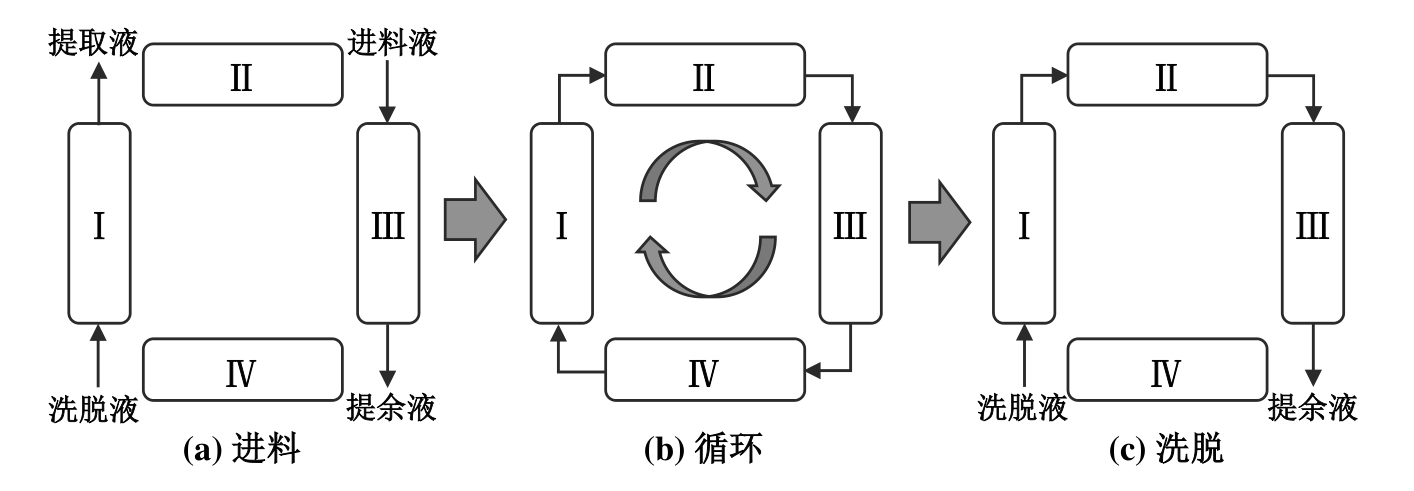
图1 顺序式模拟移动床的操作示意图
Fig.1 The operation diagram of the sequential simulated moving bed
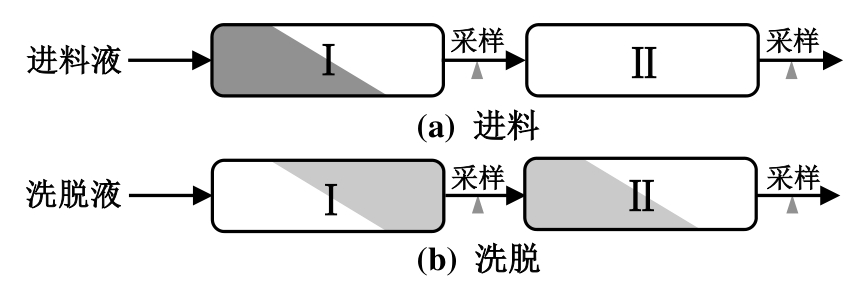
图2 双柱实验的运行示意图
Fig.2 Schematic diagram of the operation of the twin-column experiment
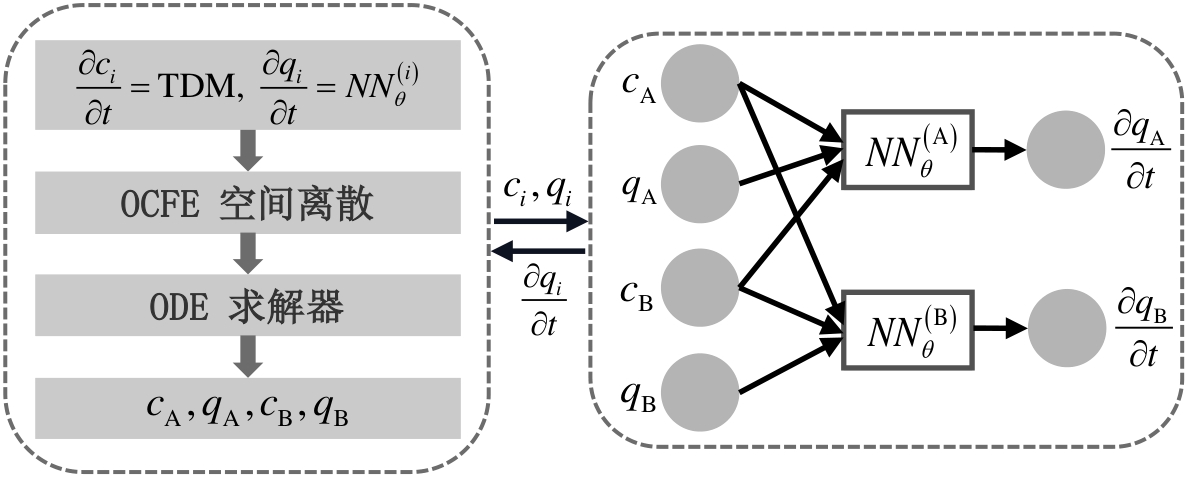
图3 混合模型的求解过程
Fig.3 The solution process of the hybrid model
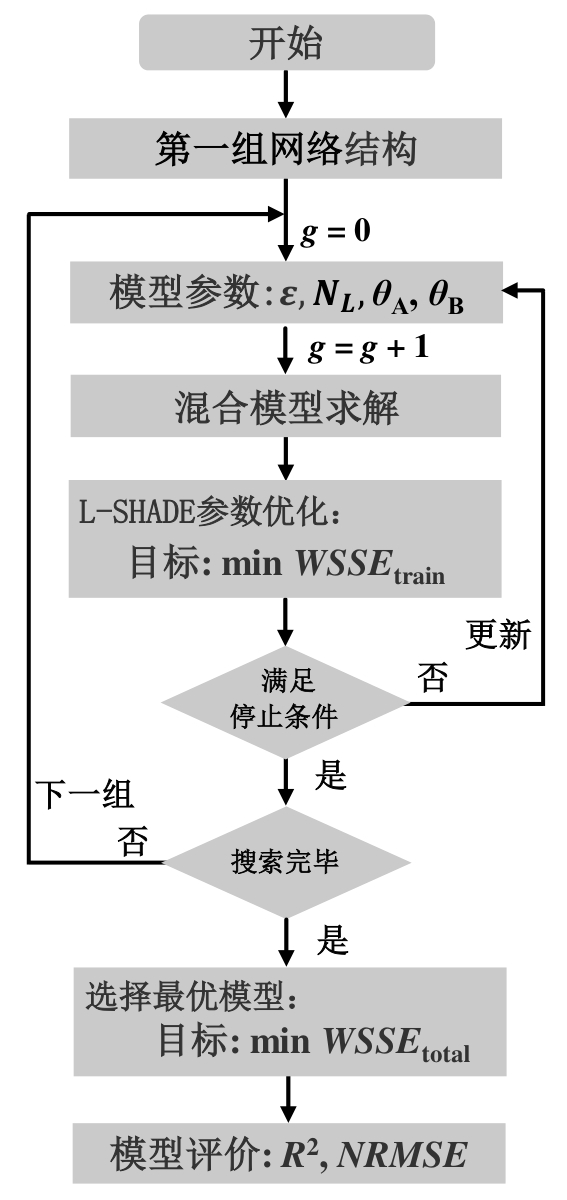
图4 混合模型的训练流程
Fig.4 The training process of the hybrid model
| 设备与进料参数 | 吸附特性参数 | ||
|---|---|---|---|
| 柱分布结构 | 1-1-1-1 | 理论塔板数 | 2000 |
| 柱直径 | 2.5 cm | A的传质系数 | 4.54 min-1 |
| 柱长 | 100 cm | B的传质系数 | 0.36 min-1 |
| 空隙率 | 0.416 | A的亨利常数 | 0.450 |
| 最大允许流量 | 20 ml/min | B的亨利常数 | 0.167 |
| A的进料浓度 | 0.09 g/ml | A的吸附常数 | 1.11 |
| B的进料浓度 | 0.21 g/ml | B的吸附常数 | 0.467 |
表1 SSMB的系统参数
Table 1 System parameters for SSMB
| 设备与进料参数 | 吸附特性参数 | ||
|---|---|---|---|
| 柱分布结构 | 1-1-1-1 | 理论塔板数 | 2000 |
| 柱直径 | 2.5 cm | A的传质系数 | 4.54 min-1 |
| 柱长 | 100 cm | B的传质系数 | 0.36 min-1 |
| 空隙率 | 0.416 | A的亨利常数 | 0.450 |
| 最大允许流量 | 20 ml/min | B的亨利常数 | 0.167 |
| A的进料浓度 | 0.09 g/ml | A的吸附常数 | 1.11 |
| B的进料浓度 | 0.21 g/ml | B的吸附常数 | 0.467 |
| 分类 | 序号 | tf/ min | Qf/ (ml/min) | te/ min | Qe/ (ml/min) |
|---|---|---|---|---|---|
| 训练集 | 1 | 80 | 6 | 60 | 20 |
| 2 | 60 | 8 | 60 | 20 | |
| 3 | 40 | 10 | 60 | 20 | |
| 4 | 40 | 12 | 60 | 20 | |
| 5 | 30 | 14 | 60 | 20 | |
| 6 | 30 | 16 | 60 | 20 | |
| 内插测试 | 7 | 60 | 7 | 60 | 20 |
| 8 | 50 | 9 | 60 | 20 | |
| 9 | 40 | 11 | 60 | 20 | |
| 10 | 40 | 13 | 60 | 20 | |
| 11 | 30 | 15 | 60 | 20 | |
| 外推测试 | 12 | 120 | 2 | 60 | 20 |
| 13 | 100 | 4 | 60 | 20 | |
| 14 | 30 | 18 | 60 | 20 | |
| 15 | 20 | 20 | 60 | 20 |
表2 双柱实验的工艺条件
Table 2 Process conditions for the twin-column experiment
| 分类 | 序号 | tf/ min | Qf/ (ml/min) | te/ min | Qe/ (ml/min) |
|---|---|---|---|---|---|
| 训练集 | 1 | 80 | 6 | 60 | 20 |
| 2 | 60 | 8 | 60 | 20 | |
| 3 | 40 | 10 | 60 | 20 | |
| 4 | 40 | 12 | 60 | 20 | |
| 5 | 30 | 14 | 60 | 20 | |
| 6 | 30 | 16 | 60 | 20 | |
| 内插测试 | 7 | 60 | 7 | 60 | 20 |
| 8 | 50 | 9 | 60 | 20 | |
| 9 | 40 | 11 | 60 | 20 | |
| 10 | 40 | 13 | 60 | 20 | |
| 11 | 30 | 15 | 60 | 20 | |
| 外推测试 | 12 | 120 | 2 | 60 | 20 |
| 13 | 100 | 4 | 60 | 20 | |
| 14 | 30 | 18 | 60 | 20 | |
| 15 | 20 | 20 | 60 | 20 |
| 参数 | 数值 |
|---|---|
| 初始种群规模 | 60 |
| 最小种群规模 | 2 |
| 最大迭代次数(Gmax) | 300 |
| 记忆长度 | 10 |
| p-best比例 | 0.11 |
| 迭代间隔(Δg) | 10 |
| 相对改善阈值(εrel) | 2% |
| 重复运行次数 | 5 |
表3 L-SHADE算法参数
Table 3 L-SHADE algorithm parameters
| 参数 | 数值 |
|---|---|
| 初始种群规模 | 60 |
| 最小种群规模 | 2 |
| 最大迭代次数(Gmax) | 300 |
| 记忆长度 | 10 |
| p-best比例 | 0.11 |
| 迭代间隔(Δg) | 10 |
| 相对改善阈值(εrel) | 2% |
| 重复运行次数 | 5 |
网络 结构 | WSSEtotal | 网络 结构 | WSSEtotal | ||||||
|---|---|---|---|---|---|---|---|---|---|
| sigmoid | tanh | sigmoid | tanh | ||||||
| [ | 0.0452 | 0.0335 | [2,2] | 0.0417 | 0.0402 | ||||
| [ | 0.0322 | 0.0286 | [ | 0.0368 | 0.0402 | ||||
| [ | 0.0414 | 0.0376 | [ | 0.0355 | 0.0342 | ||||
| [ | 0.0363 | 0.0332 | [ | 0.0364 | 0.0358 | ||||
表4 神经网络结构的筛选结果
Table 4 Screening results for neural network architectures
网络 结构 | WSSEtotal | 网络 结构 | WSSEtotal | ||||||
|---|---|---|---|---|---|---|---|---|---|
| sigmoid | tanh | sigmoid | tanh | ||||||
| [ | 0.0452 | 0.0335 | [2,2] | 0.0417 | 0.0402 | ||||
| [ | 0.0322 | 0.0286 | [ | 0.0368 | 0.0402 | ||||
| [ | 0.0414 | 0.0376 | [ | 0.0355 | 0.0342 | ||||
| [ | 0.0363 | 0.0332 | [ | 0.0364 | 0.0358 | ||||
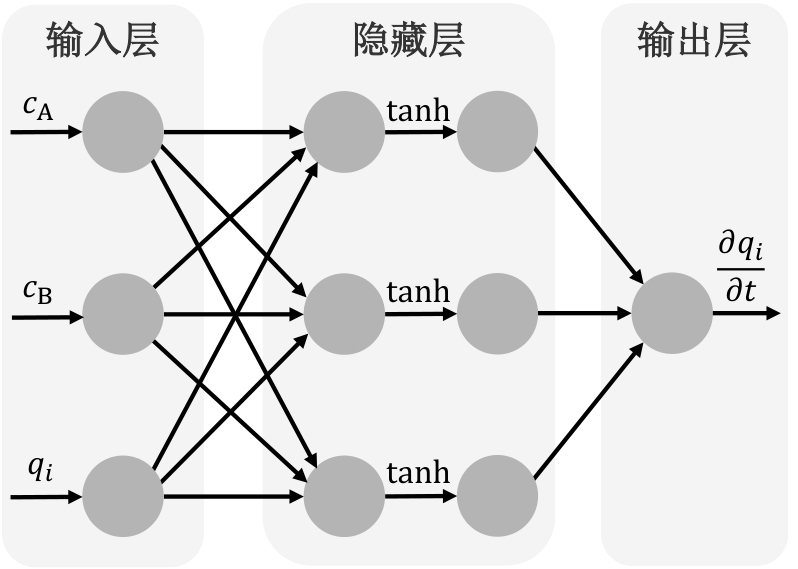
图5 网络结构的筛选结果
Fig.5 Screening results of the network structure
| 分类 | 序号 | R2 | NRMSE/% | ||||||
|---|---|---|---|---|---|---|---|---|---|
| A | B | A | B | ||||||
| 训练集 | 1 | 0.9970 | 0.9996 | 2.12 | 0.81 | ||||
| 2 | 0.9965 | 09995 | 2.32 | 0.88 | |||||
| 3 | 0.9949 | 0.9993 | 2.64 | 0.98 | |||||
| 4 | 0.9955 | 0.9994 | 2.70 | 0.98 | |||||
| 5 | 0.9941 | 0.9992 | 2.97 | 1.05 | |||||
| 6 | 0.9944 | 0.9993 | 3.05 | 1.05 | |||||
| 内插测试 | 7 | 0.9955 | 0.9992 | 2.43 | 0.97 | ||||
| 8 | 0.9946 | 0.9991 | 2.50 | 1.07 | |||||
| 9 | 0.9942 | 0.9989 | 2.88 | 1.13 | |||||
| 10 | 0.9938 | 0.9987 | 3.05 | 1.22 | |||||
| 11 | 0.9933 | 0.9983 | 3.11 | 1.24 | |||||
| 外推测试 | 12 | 0.9923 | 0.9958 | 3.70 | 1.82 | ||||
| 13 | 0.9936 | 0.9979 | 2.51 | 1.37 | |||||
| 14 | 0.9924 | 0.9966 | 3.69 | 1.79 | |||||
| 15 | 0.9922 | 0.9954 | 3.72 | 1.83 | |||||
表5 双柱实验中模型对训练集及测试集的拟合与预测精度
Table 5 Fitting and prediction accuracy of the model in the twin-column experiment
| 分类 | 序号 | R2 | NRMSE/% | ||||||
|---|---|---|---|---|---|---|---|---|---|
| A | B | A | B | ||||||
| 训练集 | 1 | 0.9970 | 0.9996 | 2.12 | 0.81 | ||||
| 2 | 0.9965 | 09995 | 2.32 | 0.88 | |||||
| 3 | 0.9949 | 0.9993 | 2.64 | 0.98 | |||||
| 4 | 0.9955 | 0.9994 | 2.70 | 0.98 | |||||
| 5 | 0.9941 | 0.9992 | 2.97 | 1.05 | |||||
| 6 | 0.9944 | 0.9993 | 3.05 | 1.05 | |||||
| 内插测试 | 7 | 0.9955 | 0.9992 | 2.43 | 0.97 | ||||
| 8 | 0.9946 | 0.9991 | 2.50 | 1.07 | |||||
| 9 | 0.9942 | 0.9989 | 2.88 | 1.13 | |||||
| 10 | 0.9938 | 0.9987 | 3.05 | 1.22 | |||||
| 11 | 0.9933 | 0.9983 | 3.11 | 1.24 | |||||
| 外推测试 | 12 | 0.9923 | 0.9958 | 3.70 | 1.82 | ||||
| 13 | 0.9936 | 0.9979 | 2.51 | 1.37 | |||||
| 14 | 0.9924 | 0.9966 | 3.69 | 1.79 | |||||
| 15 | 0.9922 | 0.9954 | 3.72 | 1.83 | |||||
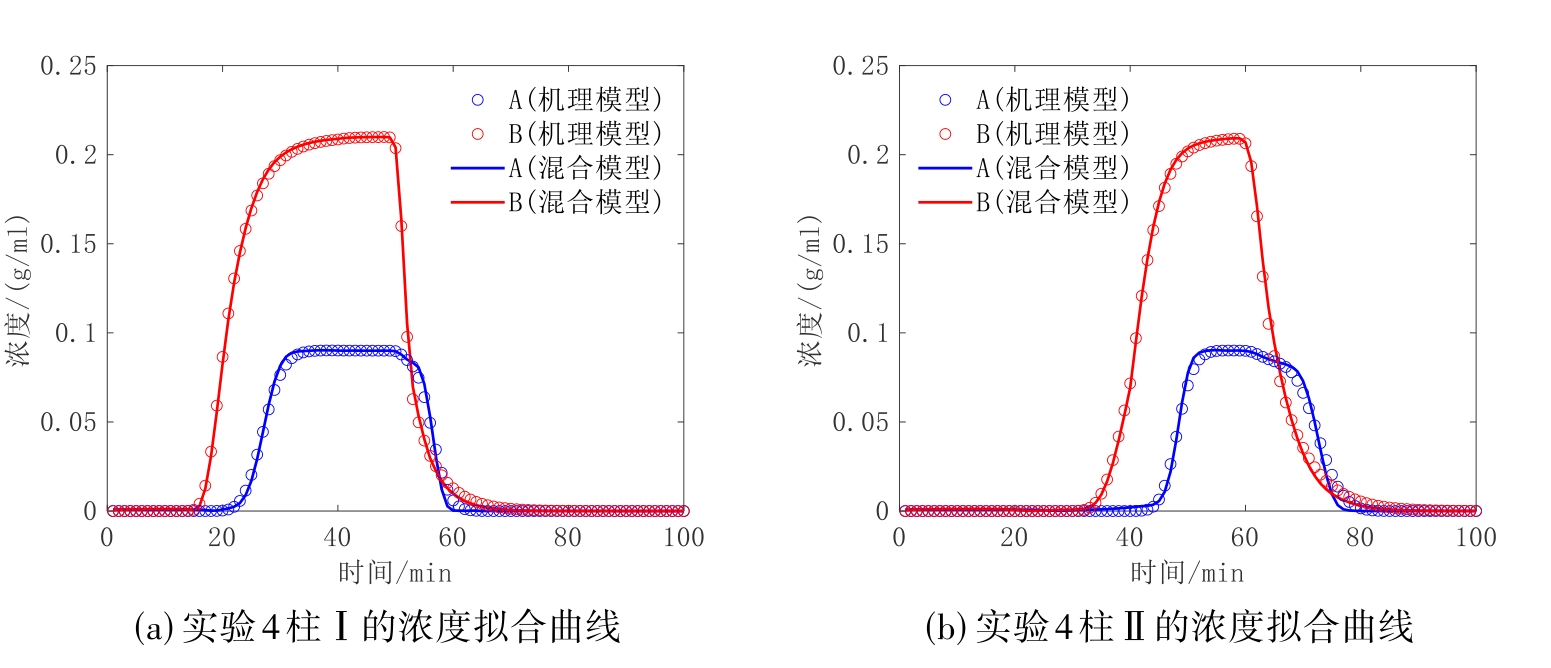
图6 混合模型在训练集中的浓度拟合曲线
Fig.6 The concentration fitting curve of the hybrid model in the training set
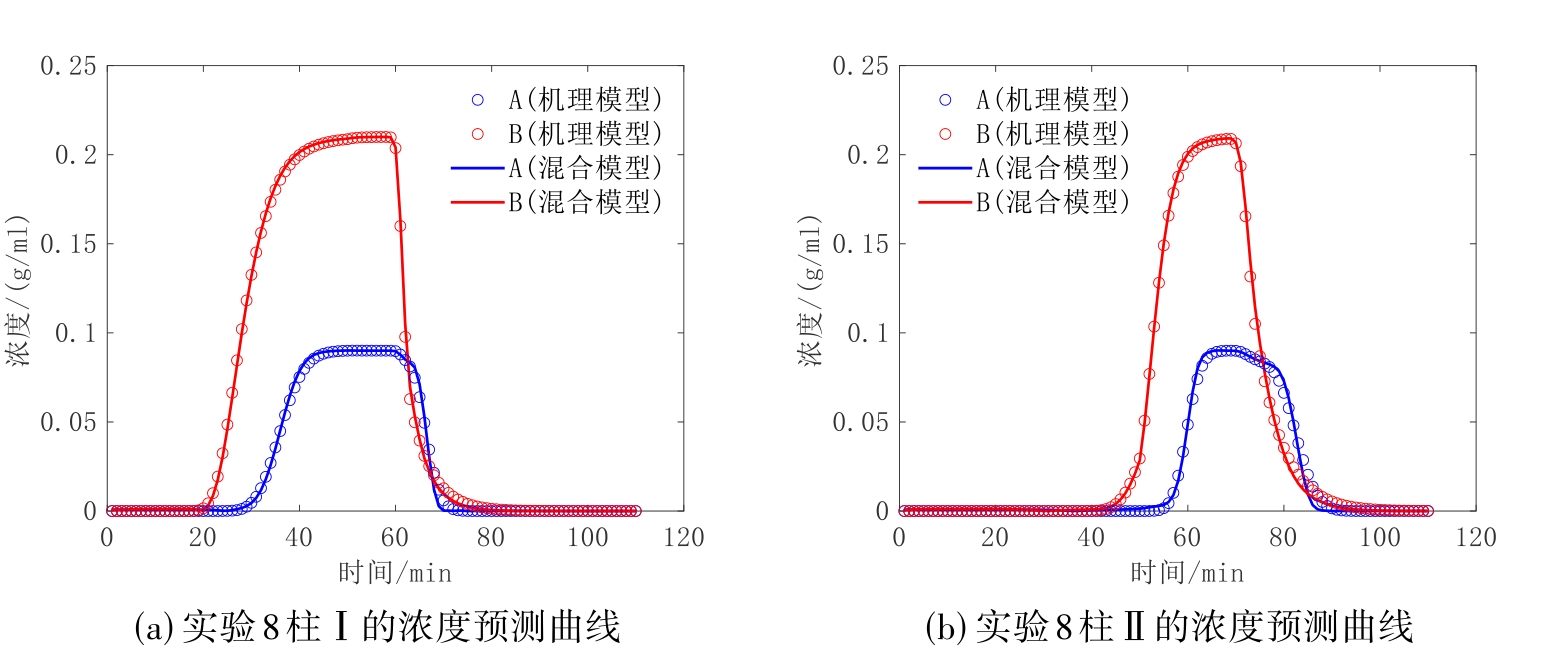
图7 混合模型在内插测试中的浓度预测曲线
Fig.7 The concentration prediction curve of the hybrid model in the interpolation test
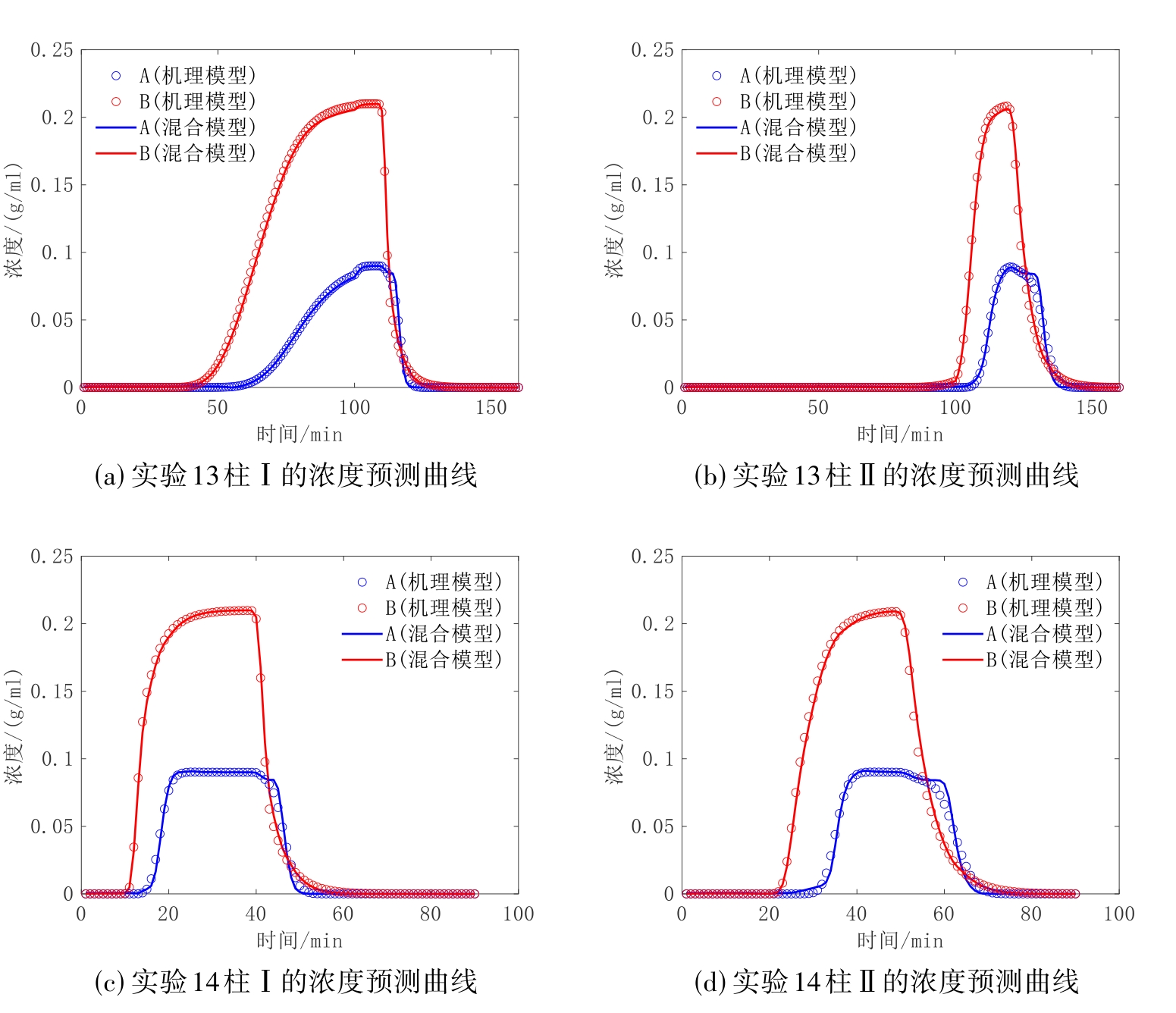
图8 混合模型在外推测试中的浓度预测曲线
Fig.8 The concentration prediction curve of the hybrid model in the extrapolation test
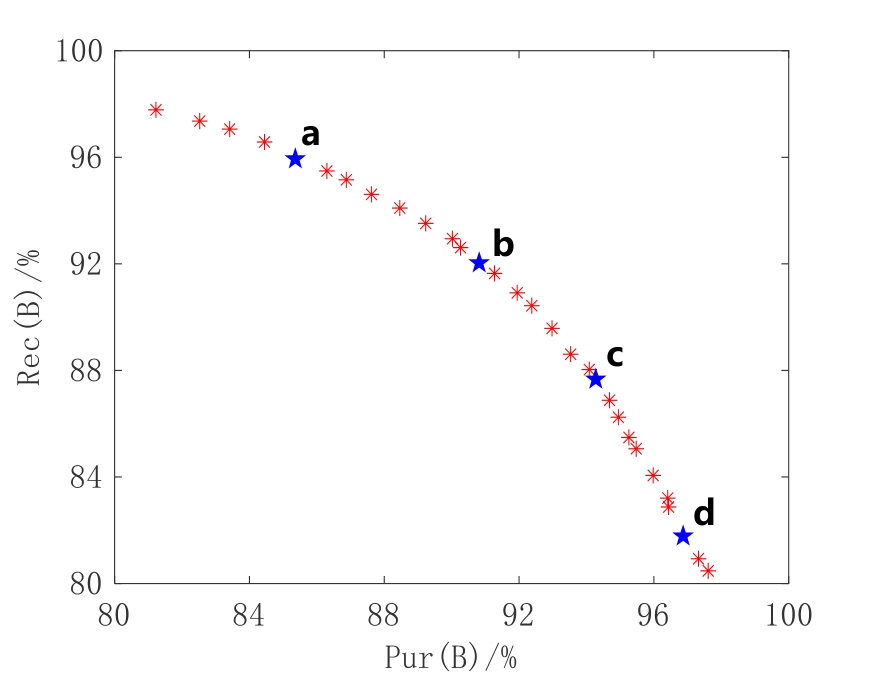
图9 SSMB过程的多目标优化帕累托前沿
Fig.9 Pareto front of multi-objective optimization for the SSMB process
| 案例 | t1/ | t2/ | t3/ | QF/ | R2 | NRMSE/% | |||||
|---|---|---|---|---|---|---|---|---|---|---|---|
| min | min | min | (ml/min) | A | B | A | B | ||||
| a | 8.00 | 11.45 | 1.71 | 11.65 | 0.9385 | 0.9953 | 9.27 | 1.96 | |||
| b | 5.51 | 11.76 | 0.78 | 16.52 | 0.9581 | 0.9957 | 7.88 | 1.74 | |||
| c | 11.47 | 12.11 | 0.34 | 6.91 | 0.9230 | 0.9940 | 9.33 | 2.31 | |||
| d | 12.15 | 12.03 | 0.12 | 5.77 | 0.8882 | 0.9948 | 8.33 | 2.32 | |||
表6 模型在SSMB产物收集位置的预测精度
Table 6 Prediction accuracy of the model at the SSMB product collection position
| 案例 | t1/ | t2/ | t3/ | QF/ | R2 | NRMSE/% | |||||
|---|---|---|---|---|---|---|---|---|---|---|---|
| min | min | min | (ml/min) | A | B | A | B | ||||
| a | 8.00 | 11.45 | 1.71 | 11.65 | 0.9385 | 0.9953 | 9.27 | 1.96 | |||
| b | 5.51 | 11.76 | 0.78 | 16.52 | 0.9581 | 0.9957 | 7.88 | 1.74 | |||
| c | 11.47 | 12.11 | 0.34 | 6.91 | 0.9230 | 0.9940 | 9.33 | 2.31 | |||
| d | 12.15 | 12.03 | 0.12 | 5.77 | 0.8882 | 0.9948 | 8.33 | 2.32 | |||
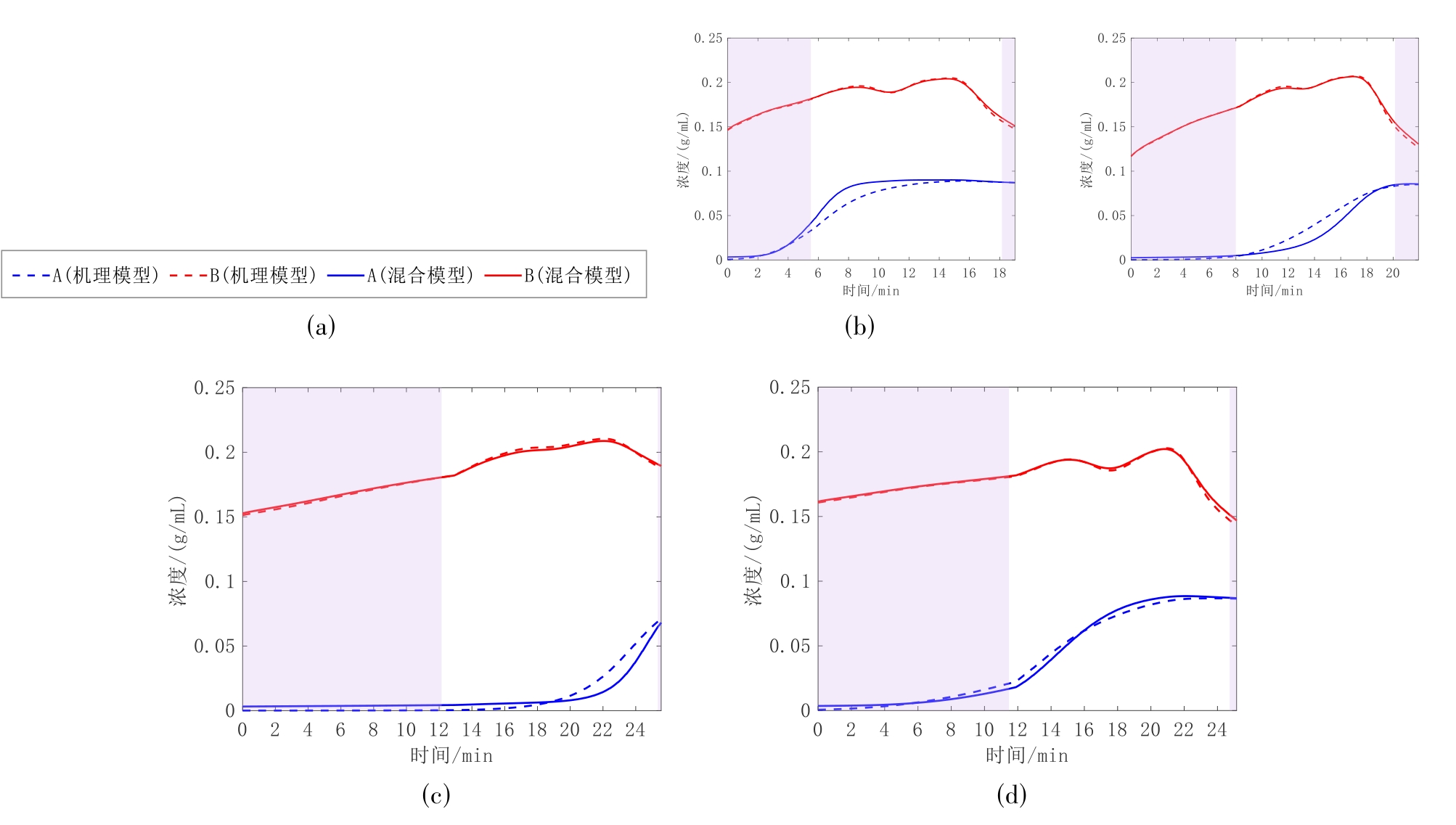
图10 型在SSMB产物收集位置的预测结果
Fig.10 prediction result of the model at the SSMB product collection position
| 案例 | 机理模型 | 混合模型 | 相对误差 | |||||||
|---|---|---|---|---|---|---|---|---|---|---|
| Pur(B)/% | Rec(B)/% | Pur(B)/% | Rec(B)/% | Pur(B)/% | Rec(B)/% | |||||
| a | 86.32 | 95.35 | 85.41 | 96.18 | 1.05 | 0.87 | ||||
| b | 90.98 | 91.39 | 90.83 | 91.94 | 0.16 | 0.60 | ||||
| c | 95.66 | 87.29 | 94.32 | 87.71 | 1.40 | 0.48 | ||||
| d | 98.69 | 81.15 | 96.84 | 81.77 | 1.87 | 0.76 | ||||
表7 混合模型对性能指标的预测
Table 7 Prediction of performance indicators by hybrid models
| 案例 | 机理模型 | 混合模型 | 相对误差 | |||||||
|---|---|---|---|---|---|---|---|---|---|---|
| Pur(B)/% | Rec(B)/% | Pur(B)/% | Rec(B)/% | Pur(B)/% | Rec(B)/% | |||||
| a | 86.32 | 95.35 | 85.41 | 96.18 | 1.05 | 0.87 | ||||
| b | 90.98 | 91.39 | 90.83 | 91.94 | 0.16 | 0.60 | ||||
| c | 95.66 | 87.29 | 94.32 | 87.71 | 1.40 | 0.48 | ||||
| d | 98.69 | 81.15 | 96.84 | 81.77 | 1.87 | 0.76 | ||||
| [1] | Broughton D B. Production-scale adsorptive separations of liquid mixtures by simulated moving-bed technology[J]. Separation Science and Technology, 1984, 19(11/12): 723-736. |
| [2] | Aniceto J P S, Silva C M. Simulated moving bed strategies and designs: from established systems to the latest developments[J]. Separation & Purification Reviews, 2015, 44(1): 41-73. |
| [3] | Kim K M, Han K W, Kim S I, et al. Simulated moving bed with a product column for improving the separation performance[J]. Journal of Industrial and Engineering Chemistry, 2020, 88: 328-338. |
| [4] | Barker P E, Abusabah E K E. The separation of synthetic mixtures of glucose and fructose and also inverted sucrose feedstocks using countercurrent chromatographic techniques[J]. Chromatographia, 1985, 20(1): 9-12. |
| [5] | Nagamatsu S, Murazumi K, Makino S. Chiral separation of a pharmaceutical intermediate by a simulated moving bed process[J]. Journal of Chromatography A, 1999, 832(1/2): 55-65. |
| [6] | Wu C K, Xu Y Z, Bai Z Y, et al. High-purity tri-alpha-linolenin isolation from silkworm pupae oil using sequential simulated moving bed chromatography[J]. Biomass Conversion and Biorefinery, 2023, 13(18): 16453-16466. |
| [7] | 李艳, 雷美丽, 李鑫钢. 基于分离性能的顺序式模拟移动床结构调控策略[J]. 化工学报, 2025, 76(5): 2219-2229. |
| Li Y, Lei M L, Li X G. Regulation strategy of sequential simulated moving bed structure based on separation performance[J]. CIESC Journal, 2025, 76(5): 2219-2229. | |
| [8] | 李艳, 凌山, 刘聚明, 等. 顺序式模拟移动床分离低聚木糖多目标优化及其变量调控机制[J]. 现代化工, 2023, 43(1): 240-245. |
| Li Y, Ling S, Liu J M, et al. Multi-objective optimization of sequentially-simulated moving bed for separation of xylo-oligosaccharides and its variables regulation mechanism[J]. Modern Chemical Industry, 2023, 43(1): 240-245. | |
| [9] | Zhang X T, Liu J M, Ray A K, et al. Multi-objective optimization of sequential simulated moving bed for multi-component separation based on multi-parameter modeling and its determination[J]. Chemical Engineering Science, 2024, 295: 120172. |
| [10] | Li Y, Ding Z Y, Wang J, et al. A comparison between simulated moving bed and sequential simulated moving bed system based on multi-objective optimization[J]. Chemical Engineering Science, 2020, 219: 115562. |
| [11] | Li Y, Xu J, Yu W F, et al. Multi-objective optimization of sequential simulated moving bed for the purification of xylo-oligosaccharides[J]. Chemical Engineering Science, 2020, 211: 115279. |
| [12] | 李洪飞, 孙大庆, 李良玉, 等. 基于顺序式模拟移动床色谱法的两种木糖母液分离工艺比较[J]. 食品与机械, 2019, 35(10): 210-213. |
| Li H F, Sun D Q, Li L Y, et al. Comparing of two seperation processes for recovering xylose mother liquor with sequential simulated moving bed technology[J]. Food & Machinery, 2019, 35(10): 210-213. | |
| [13] | 曹俊雅, 宋恕哲, 贺鹏, 等. 顺序式模拟移动床分离煤基混合醇的Aspen色谱动态模拟[J]. 化工进展, 2025, 44(3): 1228-1242. |
| Cao J Y, Song S Z, He P, et al. Dynamic simulation using Aspen chromatography for sequential simulated moving bed separation of coal-based mixed alcohols[J]. Chemical Industry and Engineering Progress, 2025, 44(3): 1228-1242. | |
| [14] | Bürger R, Mulet P, Rubio L, et al. Linearly implicit-explicit schemes for the equilibrium dispersive model of chromatography[J]. Applied Mathematics and Computation, 2018, 317: 172-186. |
| [15] | Vajda P, Bocian S, Buszewski B, et al. Examination of the surface heterogeneity of reversed-phase packing materials with solvent adsorption[J]. Journal of Separation Science, 2010, 33(23/24): 3644-3654. |
| [16] | Shekhawat L K, Rathore A S. An overview of mechanistic modeling of liquid chromatography[J]. Preparative Biochemistry & Biotechnology, 2019, 49(6): 623-638. |
| [17] | Mao S M, Zhang Y, Rohani S, et al. Chromatographic resolution and isotherm determination of (R, S)-mandelic acid on Chiralcel-OD column[J]. Journal of Separation Science, 2012, 35(17): 2273-2281. |
| [18] | Xu J, Zhu L, Xu G Q, et al. Determination of competitive adsorption isotherm of enantiomers on preparative chromatographic columns using inverse method[J]. Journal of Chromatography A, 2013, 1273: 49-56. |
| [19] | Poole C F. Fundamentals of preparative and nonlinear chromatography[J]. Analytica Chimica Acta, 1995, 302(1): 127-128. |
| [20] | Qamar S, Abbasi J N, Mehwish A, et al. Linear general rate model of chromatography for core–shell particles: Analytical solutions and moment analysis[J]. Chemical Engineering Science, 2015, 137: 352-363. |
| [21] | Mukhopadhyay S, Tsang Y W, Finsterle S. Parameter estimation from flowing fluid temperature logging data in unsaturated fractured rock using multiphase inverse modeling[J]. Water Resources Research, 2009, 45(4): 2008WR006869. |
| [22] | Wang X, Liu Y, Ching C B. Kinetic and equilibrium study of enantioseparation of propranolol in preparative scale chromatography[J]. Separation and Purification Technology, 2006, 50(2): 204-211. |
| [23] | Mueller I, Seidel-Morgenstern A, Hamel C. Simulated-moving-bed technology for purification of the prebiotics galacto-oligosaccharides[J]. Separation and Purification Technology, 2021, 271: 118829. |
| [24] | Sherstinsky A. Fundamentals of recurrent neural network (RNN) and long short-term memory (LSTM) network[J]. Physica D: Nonlinear Phenomena, 2020, 404: 132306. |
| [25] | Abbasimehr H, Shabani M, Yousefi M. An optimized model using LSTM network for demand forecasting[J]. Computers & Industrial Engineering, 2020, 143: 106435. |
| [26] | Narayanan H, Luna M, Sokolov M, et al. Hybrid models based on machine learning and an increasing degree of process knowledge: application to capture chromatographic step[J]. Industrial & Engineering Chemistry Research, 2021, 60(29): 10466-10478. |
| [27] | Ding C, Yang M L, Zhao Y M, et al. Graph convolutional network for axial concentration profiles prediction in simulated moving bed[J]. Chinese Journal of Chemical Engineering, 2024, 73: 270-280. |
| [28] | Wang Y Q, Wen J W, Wang Z G, et al. Modeling and learning-based predictive control for separation processes of simulated moving beds[J]. Chemical Engineering Research and Design, 2025, 220: 292-299. |
| [29] | Santana V V, Martins M A F, Loureiro J M, et al. Novel framework for simulated moving bed reactor optimization based on deep neural network models and metaheuristic optimizers: an approach with optimality guarantee[J]. ACS Omega, 2023, 8(7): 6463-6475. |
| [30] | Raissi M, Perdikaris P, Karniadakis G E. Physics-informed neural networks: a deep learning framework for solving forward and inverse problems involving nonlinear partial differential equations[J]. Journal of Computational Physics, 2019, 378: 686-707. |
| [31] | Cai S Z, Mao Z P, Wang Z C, et al. Physics-informed neural networks (PINNs) for fluid mechanics: a review[J]. Acta Mechanica Sinica, 2021, 37(12): 1727-1738. |
| [32] | Narayanan H, Seidler T, Luna M F, et al. Hybrid Models for the simulation and prediction of chromatographic processes for protein capture[J]. Journal of Chromatography A, 2021, 1650: 462248. |
| [33] | Ding C Y, Gerberich C, Ierapetritou M. Hybrid model development for parameter estimation and process optimization of hydrophobic interaction chromatography[J]. Journal of Chromatography A, 2023, 1703: 464113. |
| [34] | Deb K, Pratap A, Agarwal S, et al. A fast and elitist multiobjective genetic algorithm: NSGA-II[J]. IEEE Transactions on Evolutionary Computation, 2002, 6(2): 182-197. |
| [35] | Arora S, Dhaliwal S S, Kukreja V K. Solution of two point boundary value problems using orthogonal collocation on finite elements[J]. Applied Mathematics and Computation, 2005, 171(1): 358-370. |
| [36] | Arora S, Dhaliwal S S, Kukreja V K. Simulation of washing of packed bed of porous particles by orthogonal collocation on finite elements[J]. Computers & Chemical Engineering, 2006, 30(6/7): 1054-1060. |
| [37] | 魏朋, 陈珺, 王志国, 等. 基于平衡理论的模拟移动床工艺参数鲁棒寻优[J]. 化工学报, 2022, 73(2): 792-800. |
| Wei P, Chen J, Wang Z G, et al. Robust optimization of process parameters of simulated moving bed based on equilibrium theory[J]. CIESC Journal, 2022, 73(2): 792-800. | |
| [38] | Piotrowski A P. L-SHADE optimization algorithms with population-wide inertia[J]. Information Sciences, 2018, 468: 117-141. |
| [1] | 臧子晴, 李修真, 谈莹莹, 刘晓庆. 分凝器对两级分离自复叠制冷循环特性影响研究[J]. 化工学报, 2025, 76(S1): 17-25. |
| [2] | 裴星亮, 叶翠平, 裴赢丽, 李文英. 碱改性MIL-53(Cr)选择性吸附分离二甲苯异构体[J]. 化工学报, 2025, 76(S1): 258-267. |
| [3] | 李银龙, 刘国强, 晏刚. 分馏与闪蒸分离耦合自复叠制冷循环性能分析[J]. 化工学报, 2025, 76(S1): 26-35. |
| [4] | 李文龙, 常程, 吴小林, 姬忠礼. 油水聚结过滤材料中的液体分布特性及过程压降演化研究[J]. 化工学报, 2025, 76(9): 4850-4861. |
| [5] | 朱春梦, 李增, 柳楠, 赵云鹏, 石孝刚, 蓝兴英. 基于自编码器和多尺度符号转移熵的FCC沉降器跑剂故障检测[J]. 化工学报, 2025, 76(9): 4512-4523. |
| [6] | 张建民, 何美贵, 贾万鑫, 赵静, 金万勤. 聚氧化乙烯/冠醚共混膜及其二氧化碳分离性能[J]. 化工学报, 2025, 76(9): 4862-4871. |
| [7] | 郭旭, 贾继宁, 姚克俭. 基于优化CNN-BiLSTM神经网络的间歇精馏过程建模[J]. 化工学报, 2025, 76(9): 4613-4629. |
| [8] | 王杰, 林渠成, 张先明. 基于分解算法的混合气体多级膜分离系统全局优化[J]. 化工学报, 2025, 76(9): 4670-4682. |
| [9] | 陈治宏, 吴佳伟, 楼小玲, 贠军贤. 化学品生物制造过程机器学习的研究进展[J]. 化工学报, 2025, 76(8): 3789-3804. |
| [10] | 张荟钦, 赵泓竣, 付正军, 庄力, 董凯, 贾添智, 曹雪丽, 孙世鹏. 纳滤膜在离子型稀土浸出液提浓中的应用研究[J]. 化工学报, 2025, 76(8): 4095-4107. |
| [11] | 王芳, 马素霞, 田营, 刘众元. 基于LSTM动态修正一维机理模型的CFB机组NO x 排放浓度预测方法[J]. 化工学报, 2025, 76(7): 3416-3425. |
| [12] | 王金江, 鲁振杰, 安维峥, 杨风允, 秦小刚. ORC发电系统工艺过程预警诊断技术研究与展望[J]. 化工学报, 2025, 76(7): 3137-3152. |
| [13] | 蒋明虎, 汪帆, 邢雷, 赵立新, 李新亚, 陈丁玮. 井下含气对油水分离管柱流场特性及性能影响[J]. 化工学报, 2025, 76(7): 3361-3372. |
| [14] | 高照, 吴熙, 夏丹, 张霖宙. 石油加工分子管理平台热力学及分离单元模块开发[J]. 化工学报, 2025, 76(7): 3212-3225. |
| [15] | 李欣怡, 王功明, 王自鹏, 乔俊飞. 基于事件触发的污水处理过程水质智能预测研究[J]. 化工学报, 2025, 76(6): 2828-2837. |
| 阅读次数 | ||||||
|
全文 |
|
|||||
|
摘要 |
|
|||||
 京公网安备 11010102001995号