化工学报 ›› 2025, Vol. 76 ›› Issue (11): 5617-5629.DOI: 10.11949/0438-1157.20250480
曾宇飞1,2( ), 唐天琪1,2, 何玉荣1,2()
收稿日期:2025-05-06
修回日期:2025-07-02
出版日期:2025-11-25
发布日期:2025-12-19
通讯作者:
何玉荣
作者简介:曾宇飞(2001—),男,硕士研究生,fjszyf@126.com
基金资助:
Yufei ZENG1,2(), Tianqi TANG1,2, Yurong HE1,2()
Received:2025-05-06
Revised:2025-07-02
Online:2025-11-25
Published:2025-12-19
Contact:
Yurong HE
摘要:
水合物储氢具有环境友好、经济性高的优点,在储能领域具有广阔的应用前景。水合物合成前期易形成气体分子的过饱和状态,进而诱导生成纳米气泡,这会对水合物储氢效率产生影响。因此,本文以纳米气泡为研究对象,采用分子动力学数值模拟方法,围绕甲烷与氢气混合气体合成储氢水合物阶段,分析纳米气泡的演化规律,探究纳米气泡演化过程对气体分子扩散、水分子有序度和气体相互作用的影响。结果表明,纳米气泡的生成经历膨胀期与稳定期,可有效促进气体分子扩散。但纳米气泡对甲烷分子的促进作用强于对氢气分子,进而影响水合物的储氢密度。纳米气泡在膨胀期会提升水分子的有序度,在稳定期水分子的有序度逐渐趋于恒定。气泡内部的氢气分子倾向于在中心区域聚集分布,甲烷分子则富集于气液界面,该分布特征虽利于水合物成核,却可能影响水合物结构内的氢气含量。
中图分类号:
曾宇飞, 唐天琪, 何玉荣. 掺甲烷储氢水合物合成过程纳米气泡演化特性分子动力学模拟研究[J]. 化工学报, 2025, 76(11): 5617-5629.
Yufei ZENG, Tianqi TANG, Yurong HE. Molecular dynamics simulation of nanobubble evolution characteristics during synthesis of methane-doped hydrogen storage hydrate[J]. CIESC Journal, 2025, 76(11): 5617-5629.
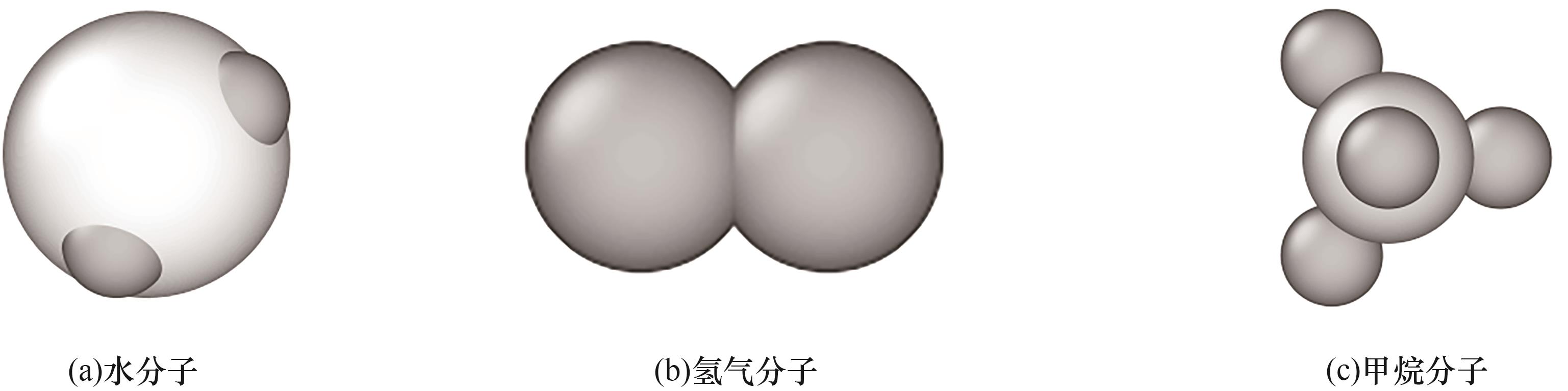
图1 分子模型
Fig.1 Molecular models
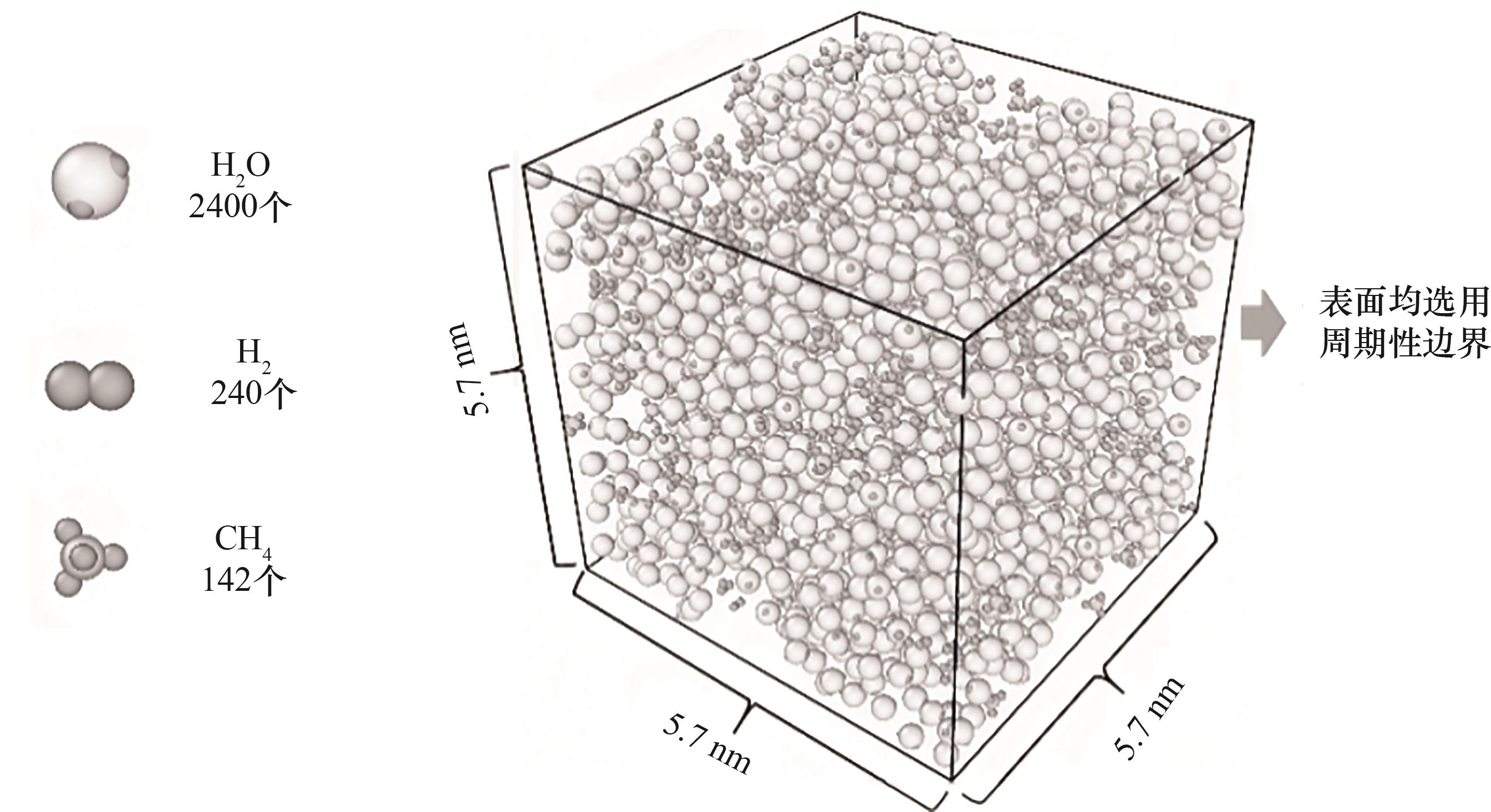
图2 模拟体系初始时刻构象
Fig.2 Conformation of the simulation system at the initial moment
| 原子 | 摩尔质量/(g/mol) | 势能参数ε/(kJ/mol) | 势能参数σ/nm | 电荷量q/e |
|---|---|---|---|---|
| H2O | ||||
| O | 16.000 | 0.882 | 0.317 | 0 |
| H | 1.008 | 0 | 0 | 0.590 |
| M(virtual site) | 0 | 0 | 0 | -1.178 |
| CH4 | ||||
| C | 12.011 | 0.276 | 0.035 | -0.240 |
| H | 1.008 | 0.125 | 0.250 | 0.060 |
| H2 | ||||
| H | 1.008 | 0 | 0 | 0.590 |
表1 模拟体系的相互作用参数和原子电荷[26,28-31]
Table 1 Interaction parameters and atomic charges of simulation systems[26.28-31]
| 原子 | 摩尔质量/(g/mol) | 势能参数ε/(kJ/mol) | 势能参数σ/nm | 电荷量q/e |
|---|---|---|---|---|
| H2O | ||||
| O | 16.000 | 0.882 | 0.317 | 0 |
| H | 1.008 | 0 | 0 | 0.590 |
| M(virtual site) | 0 | 0 | 0 | -1.178 |
| CH4 | ||||
| C | 12.011 | 0.276 | 0.035 | -0.240 |
| H | 1.008 | 0.125 | 0.250 | 0.060 |
| H2 | ||||
| H | 1.008 | 0 | 0 | 0.590 |
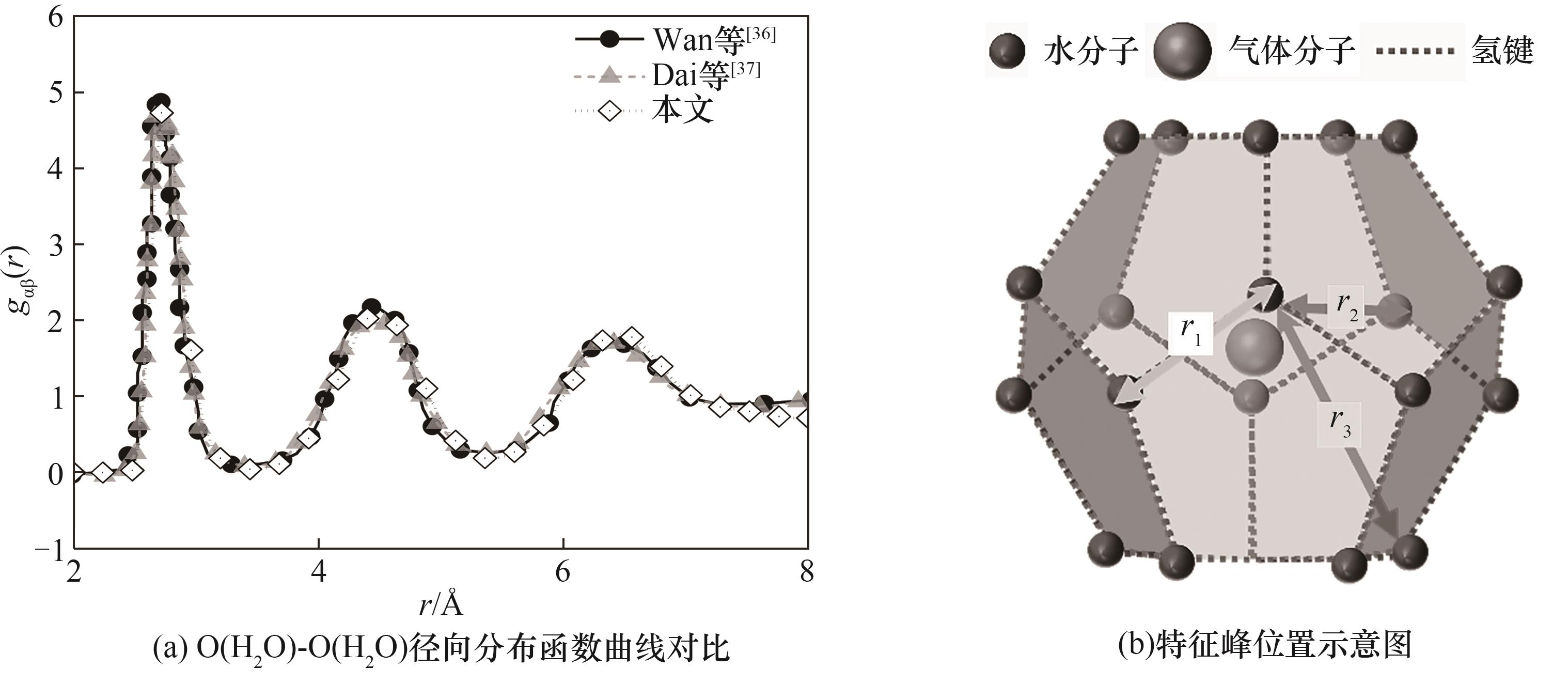
图3 特征峰径向分布函数曲线及示意图
Fig.3 Characteristic peaks radial distribution function curves and schematic diagrams
| 波峰 | 文献[ | 文献[ | |||
|---|---|---|---|---|---|
| ri /Å | φ/% | ri /Å | φ/% | ||
| 第一波峰 | 2.76 | 2.71 | 1.8 | 2.76 | 0 |
| 第二波峰 | 4.52 | 4.43 | 1.9 | 4.54 | 0.4 |
| 第三波峰 | 6.46 | 6.33 | 2.0 | 6.34 | 1.9 |
表2 特征波峰位置对比
Table 2 Comparison of the positions of characteristic wave peaks
| 波峰 | 文献[ | 文献[ | |||
|---|---|---|---|---|---|
| ri /Å | φ/% | ri /Å | φ/% | ||
| 第一波峰 | 2.76 | 2.71 | 1.8 | 2.76 | 0 |
| 第二波峰 | 4.52 | 4.43 | 1.9 | 4.54 | 0.4 |
| 第三波峰 | 6.46 | 6.33 | 2.0 | 6.34 | 1.9 |
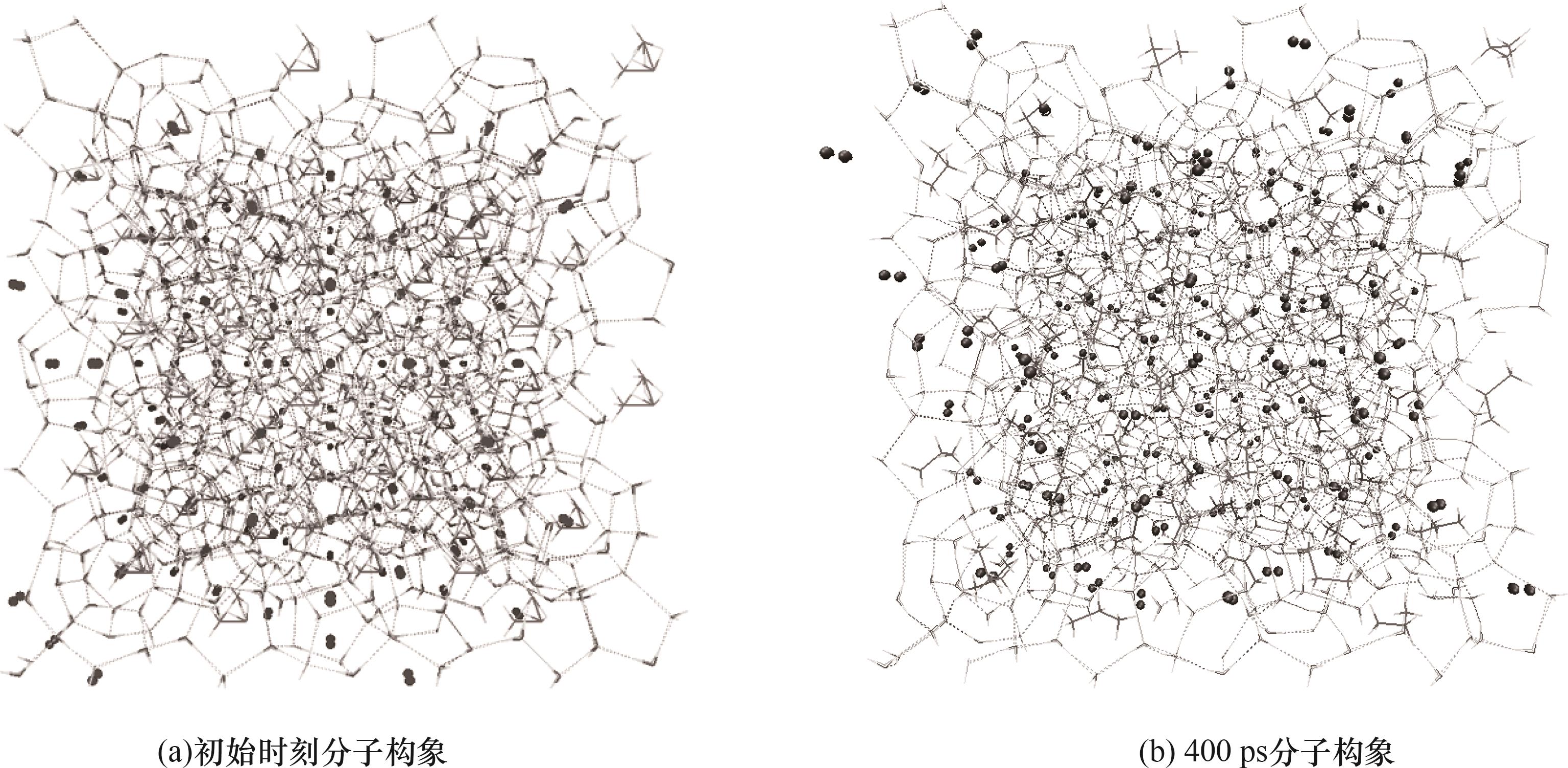
图4 储氢水合物晶体初始分子构象图和400 ps分子构象
Fig.4 Initial and 400 ps molecular conformation of hydrogen storage hydrate crystals
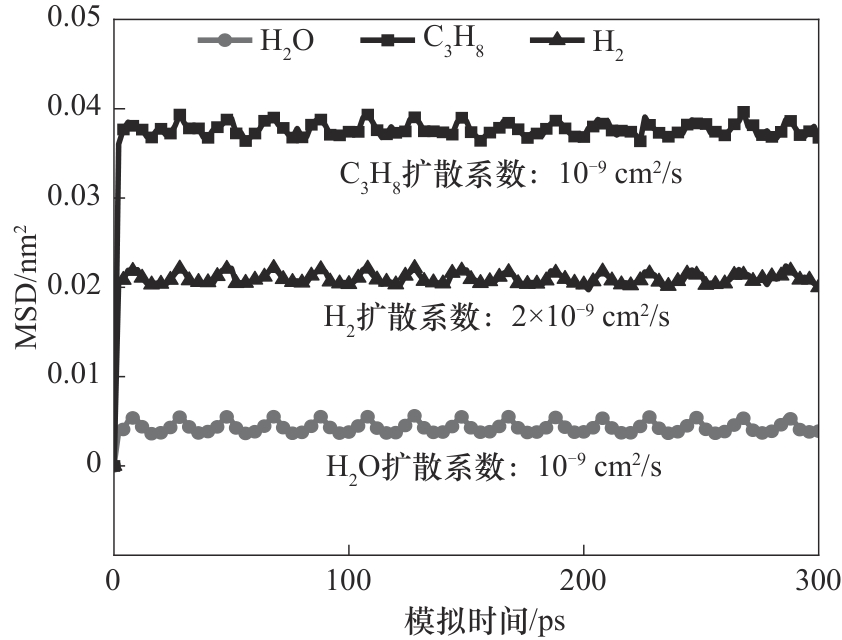
图5 模拟体系丙烷、氢气、水分子均方位移曲线
Fig.5 Mean square displacement curves of propane, hydrogen and water molecules in the simulation system
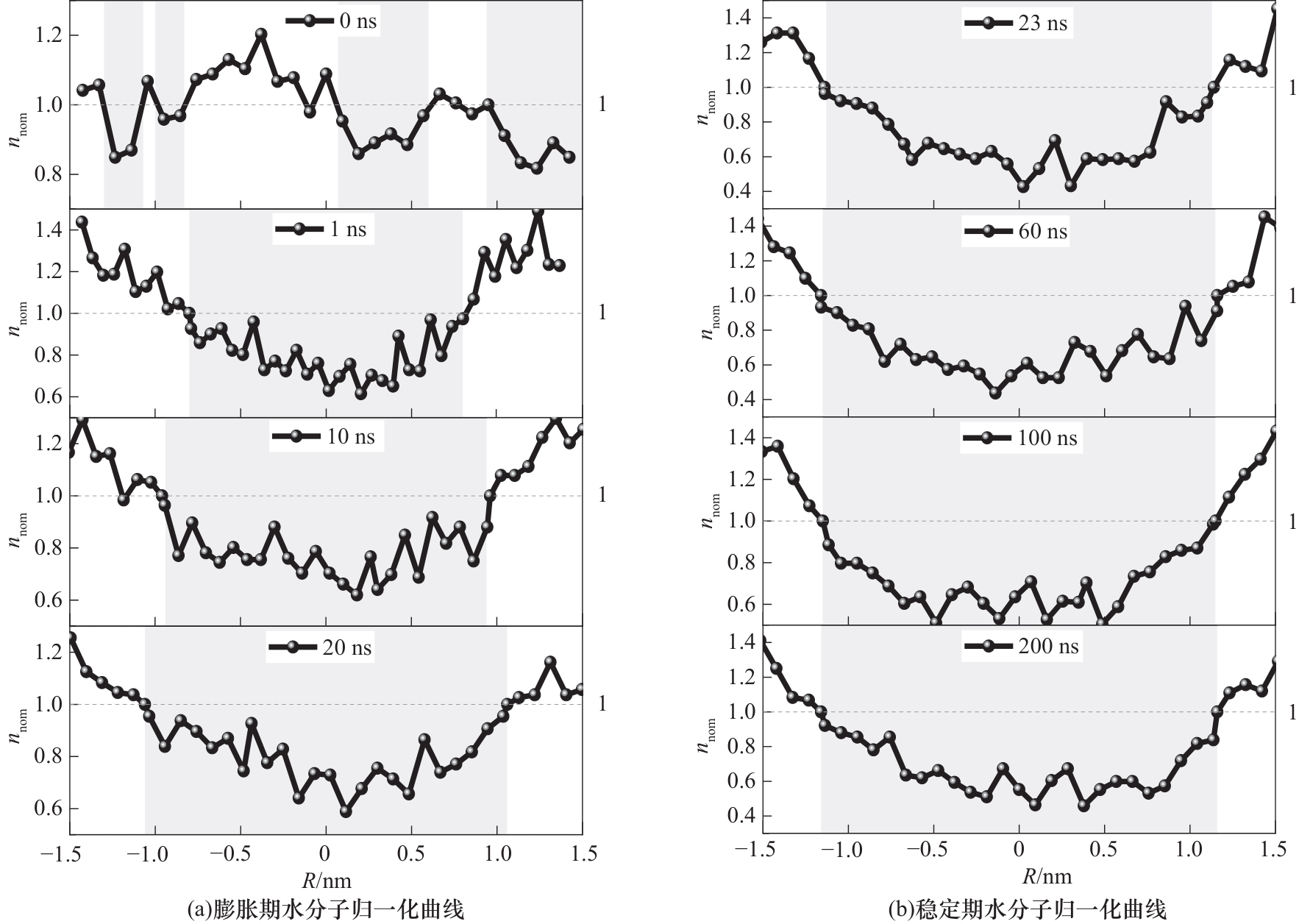
图6 不同时刻反应体系水分子归一化密度曲线
Fig.6 Normalized density curves of water molecules in the reaction system at different moments

图7 不同时刻纳米气泡半径与半径的相对增加量
Fig.7 Temporal evolution of nanobubble radius and relative radius increment

图8 不同时刻混合体系分子构象
Fig.8 Molecular conformation of the mixed system at different moments
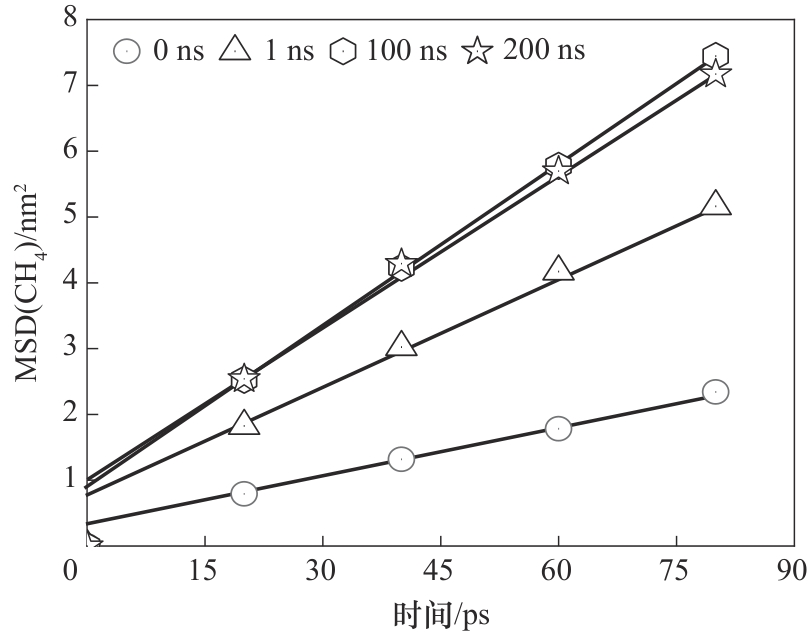
图9 特征时刻甲烷分子均方位移
Fig.9 Mean squared displacement of methane molecules at characteristic moments
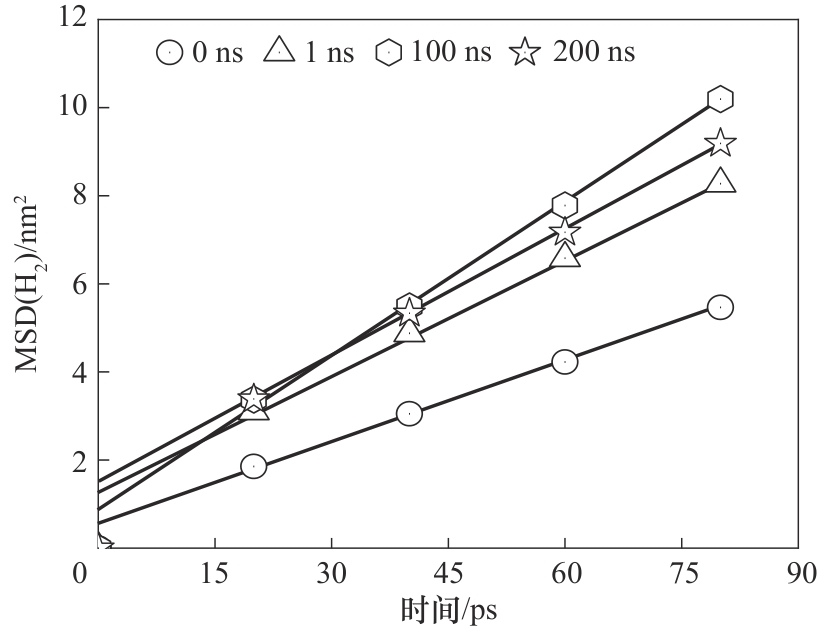
图10 特征时刻氢气分子均方位移
Fig.10 Mean squared displacement of hydrogen molecules at characteristic moments
| 气体分子 | D0/(103 cm2/s) | D1/(103 cm2/s) | μ1 | D100/(103 cm2/s) | μ100 | D200/(103 cm2/s) | μ200 |
|---|---|---|---|---|---|---|---|
| 氢气 | 1.14 | 1.72 | 0.509 | 2.12 | 0.860 | 1.91 | 0.675 |
| 甲烷 | 0.488 | 1.08 | 1.21 | 1.55 | 2.18 | 1.49 | 2.05 |
表3 特征时刻氢气分子与甲烷分子扩散系数
Table 3 Diffusion coefficients of hydrogen molecules and methane molecules at characteristic moments
| 气体分子 | D0/(103 cm2/s) | D1/(103 cm2/s) | μ1 | D100/(103 cm2/s) | μ100 | D200/(103 cm2/s) | μ200 |
|---|---|---|---|---|---|---|---|
| 氢气 | 1.14 | 1.72 | 0.509 | 2.12 | 0.860 | 1.91 | 0.675 |
| 甲烷 | 0.488 | 1.08 | 1.21 | 1.55 | 2.18 | 1.49 | 2.05 |
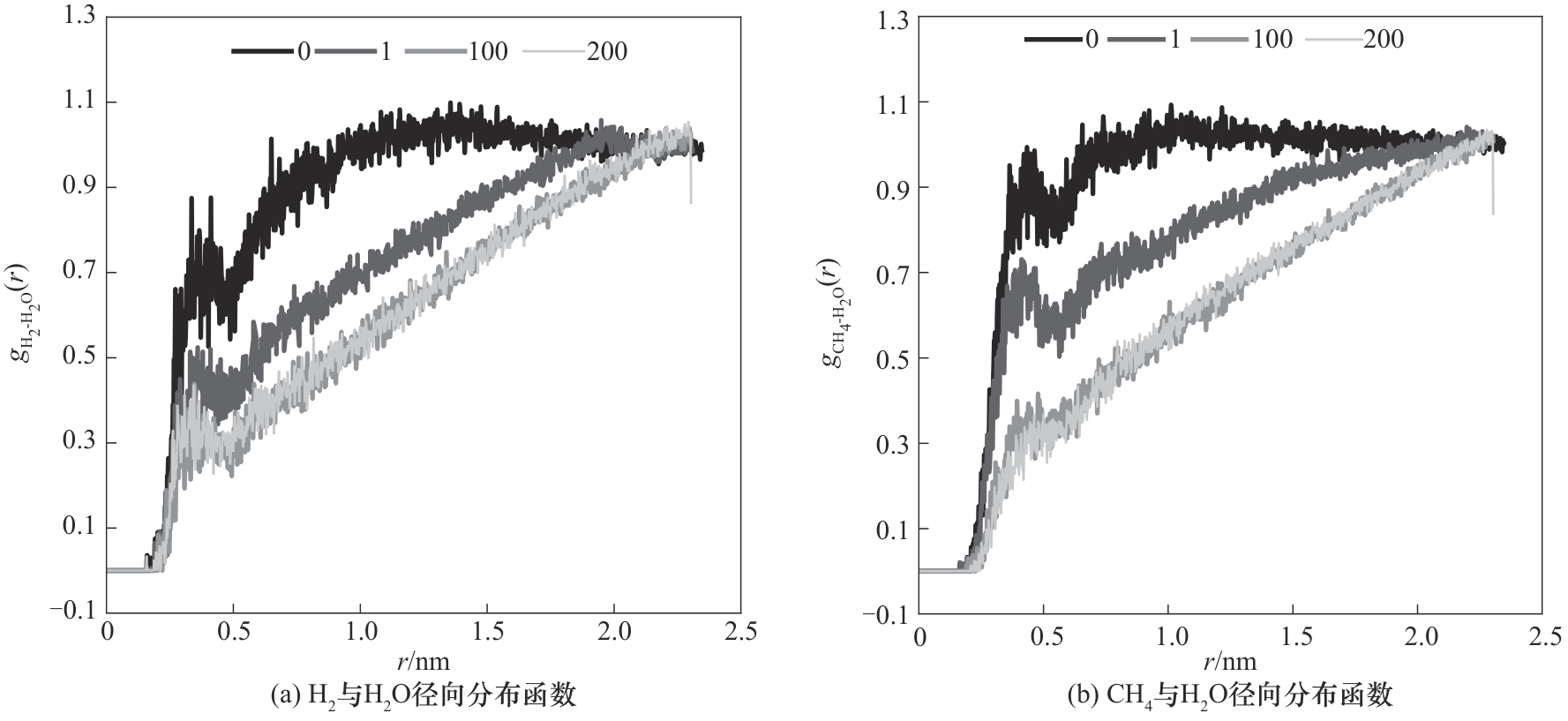
图11 特征时刻气体分子与水分子径向分布函数曲线
Fig.11 Radial distribution function curves of gas molecules and water molecules at characteristic moments
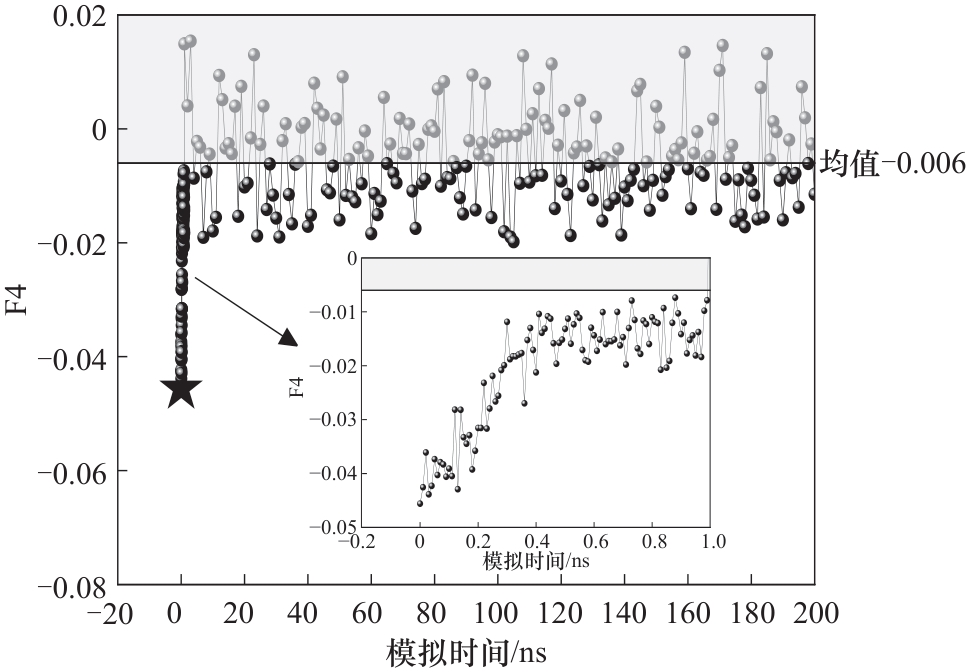
图12 F4函数变化曲线
Fig.12 Change curve of the four-body order parameter

图13 特征时刻不同气泡状态F4函数
Fig.13 F4 function at characteristic moments under different bubble states
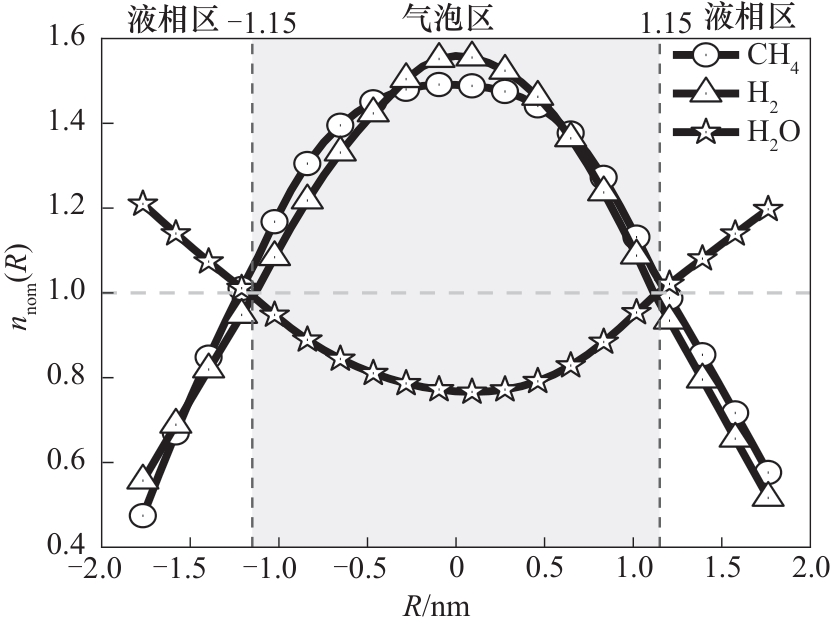
图14 纳米气泡不同距离处归一化密度曲线
Fig.14 Normalized density curves at different distances from nanobubbles
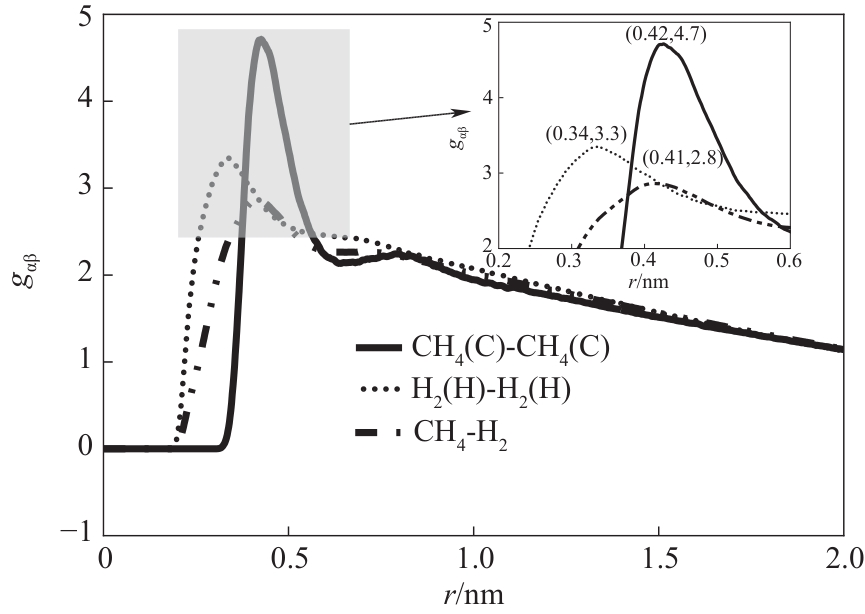
图15 气体分子之间径向分布函数曲线
Fig.15 Radial distribution function curves between gas molecules
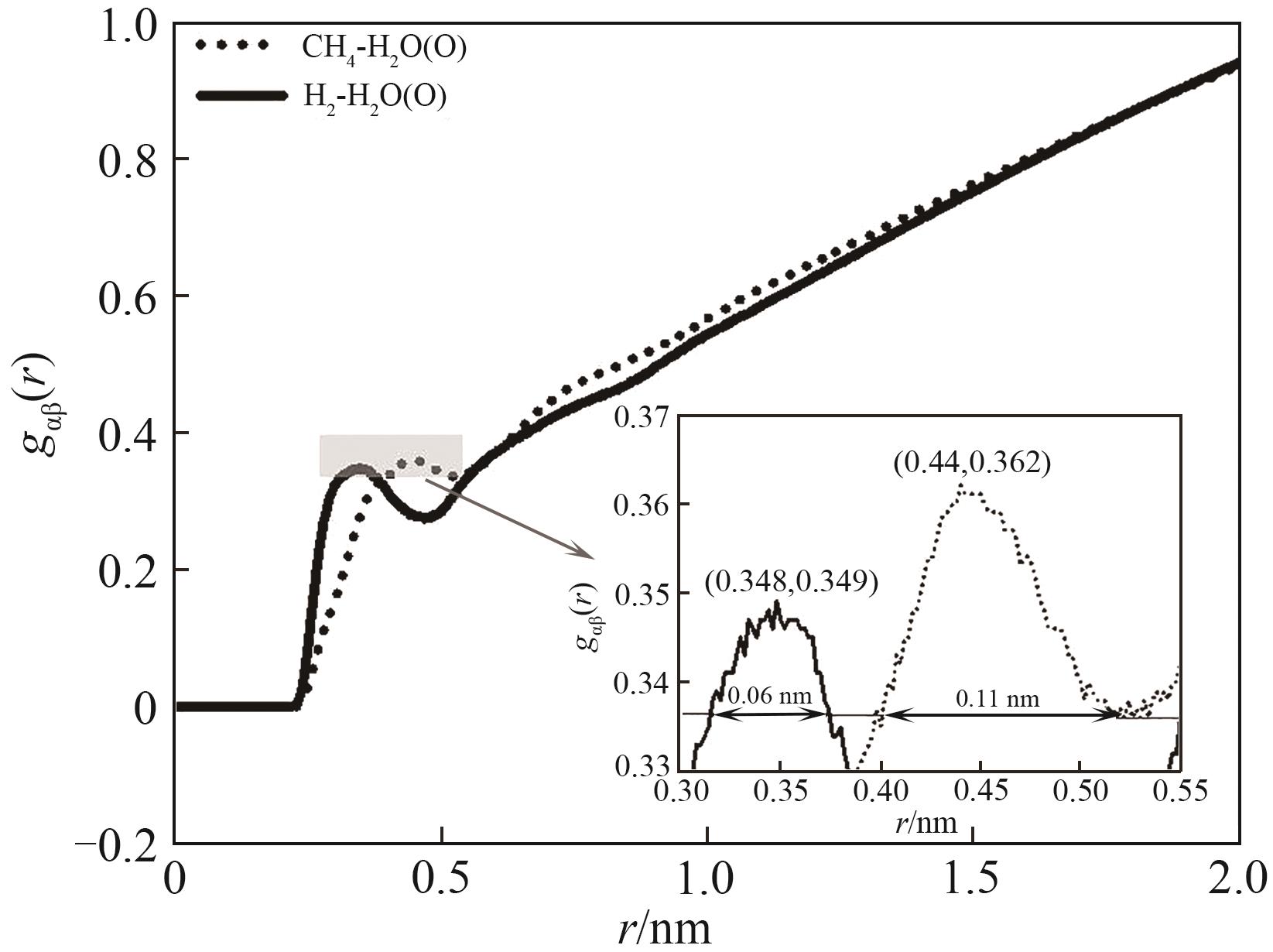
图16 气体分子与水分子径向分布函数曲线
Fig.16 Radial distribution function curves between gas molecules and water molecules
| [1] | 岳子瀚, 龙臻, 周雪冰, 等. sⅡ型水合物储氢研究进展[J]. 化工进展, 2023, 42(10): 5121-5134. |
| Yue Z H, Long Z, Zhou X B, et al. State of the art on hydrogen storage of sⅡ clathrate hydrate[J]. Chemical Industry and Engineering Progress, 2023, 42(10): 5121-5134. | |
| [2] | 范以薇, 刘威, 李盈盈, 等. 有机液体储氢中全氢化乙基咔唑催化脱氢研究进展[J]. 化工学报, 2024, 75(4): 1198-1208. |
| Fan Y W, Liu W, Li Y Y, et al. Research progress on catalytic dehydrogenation of dodecahydro-N-ethylcarbazole as liquid organic hydrogen carrier[J]. CIESC Journal, 2024, 75(4): 1198-1208. | |
| [3] | Schlapbach L, Züttel A. Hydrogen-storage materials for mobile applications[J]. Nature, 2001, 414(6861): 353-358. |
| [4] | 刘奕扬, 邢志祥, 刘烨铖, 等. 加氢站液氢泄漏扩散特性与安全监测数值模拟研究[J]. 化工学报, 2025, 76(9): 4694-4708. |
| Liu Y Y, Xing Z X, Liu Y C, et al. Numerical simulation study on the leakage diffusion characteristics and safety monitoring of liquid hydrogen in hydrogen refueling stations[J]. CIESC Journal, 2025, 76(9): 4694-4708. | |
| [5] | Epelle E I, Obande W, Udourioh G A, et al. Perspectives and prospects of underground hydrogen storage and natural hydrogen[J]. Sustainable Energy & Fuels, 2022, 6(14): 3324-3343. |
| [6] | Hassanpouryouzband A, Joonaki E, Edlmann K, et al. Offshore geological storage of hydrogen: is this our best option to achieve net-zero?[J]. ACS Energy Letters, 2021, 6(6): 2181-2186. |
| [7] | Andersson J, Grönkvist S. Large-scale storage of hydrogen[J]. International Journal of Hydrogen Energy, 2019, 44(23): 11901-11919. |
| [8] | Milanese C, Jensen T R, Hauback B C, et al. Complex hydrides for energy storage[J]. International Journal of Hydrogen Energy, 2019, 44(15): 7860-7874. |
| [9] | Mao W L, Mao H K. Hydrogen storage in molecular compounds[J]. Proceedings of the National Academy of Sciences of the United States of America, 2004, 101(3): 708-710. |
| [10] | Zhang J S, Lee J W. Equilibrium of hydrogen + cyclopentane and carbon dioxide + cyclopentane binary hydrates[J]. Journal of Chemical & Engineering Data, 2009, 54(2): 659-661. |
| [11] | Tsuda T, Ogata K, Hashimoto S, et al. Storage capacity of hydrogen in tetrahydrothiophene and furan clathrate hydrates[J]. Chemical Engineering Science, 2009, 64(19): 4150-4154. |
| [12] | Trueba A T, Radović I R, Zevenbergen J F, et al. Kinetics measurements and in situ Raman spectroscopy of formation of hydrogen-tetrabutylammonium bromide semi-hydrates[J]. International Journal of Hydrogen Energy, 2012, 37(7): 5790-5797. |
| [13] | Jr E D S. Fundamental principles and applications of natural gas hydrates[J]. Nature, 2003, 426(6964): 353-363. |
| [14] | Koh C A, Sum A K, Sloan E D. Gas hydrates: unlocking the energy from icy cages[J]. Journal of Applied Physics, 2009, 106(6): 061101. |
| [15] | Wang P F, Li K H, Yang J Y, et al. Experimental and theoretical study on dissociation thermodynamics and kinetics of hydrogen-propane hydrate[J]. Chemical Engineering Journal, 2021, 426: 131279. |
| [16] | Wang P F, Long H, Teng Y, et al. Investigation of hydrogen-propane hydrate formation mechanism and optimal pressure range via hydrate-based hydrogen storage[J]. Fuel, 2024, 361: 130791. |
| [17] | Bao W C, Teng Y, Wang P F, et al. Molecular analysis of hydrogen-propane hydrate formation mechanism and its influencing factors for hydrogen storage[J]. International Journal of Hydrogen Energy, 2024, 50: 697-708. |
| [18] | Zhang Y, Zhao L, Deng S, et al. Effect of nanobubble evolution on hydrate process: a review[J]. Journal of Thermal Science, 2019, 28(5): 948-961. |
| [19] | Fang B, Moultos O A, Lv T, et al. Effects of nanobubbles on methane hydrate dissociation: a molecular simulation study[J]. Fuel, 2023, 345: 128230. |
| [20] | Zhou Z W, Feng J C, Zeng X Y, et al. Revealing the kinetic behaviors of hydrate formation on bubble surface with different pressure gradients in deep-sea methane seepage areas of the South China Sea[J]. Energy, 2024, 308: 132808. |
| [21] | 张炜, 李昊阳, 徐纯刚, 等. 气体水合物生成微观机理及分析方法研究进展[J]. 化工学报, 2022, 73(9): 3815-3827. |
| Zhang W, Li H Y, Xu C G, et al. Research progress on the microscopic mechanism and analytical methods of gas hydrate formation[J]. CIESC Journal, 2022, 73(9): 3815-3827. | |
| [22] | Wang Y H, Yin K D, Fan S S, et al. The molecular insight into the "zeolite-ice" as hydrogen storage material[J]. Energy, 2021, 217: 119406. |
| [23] | Chen S Y, Wang Y H, Fan S S, et al. An innovative nucleation method for high and rapid hydrogen storage based on clathrate hydrates[J]. Journal of Materials Chemistry A, 2024, 12(19): 11424-11438. |
| [24] | 严六明, 朱素华. 分子动力学模拟的理论与实践[M]. 北京: 科学出版社, 2013. |
| Yan L M, Zhu S H. Theory and Practice of Molecular Dynamics Simulation[M]. Beijing: Science Press, 2013. | |
| [25] | Boda D, Henderson D. The effects of deviations from Lorentz-Berthelot rules on the properties of a simple mixture[J]. Molecular Physics, 2008, 106(20): 2367-2370. |
| [26] | Abascal J F, Sanz E, Fernández R G, et al. A potential model for the study of ices and amorphous water: TIP4P/ice[J]. The Journal of Chemical Physics, 2005, 122(23): 234511. |
| [27] | Abraham M J, Murtola T, Schulz R, et al. GROMACS: high performance molecular simulations through multi-level parallelism from laptops to supercomputers[J]. SoftwareX, 2015, 1: 19-25. |
| [28] | Jorgensen W L, Tirado-Rives J. Potential energy functions for atomic-level simulations of water and organic and biomolecular systems[J]. Proceedings of the National Academy of Sciences of the United States of America, 2005, 102(19): 6665-6670. |
| [29] | Dodda L S, Vilseck J Z, Tirado-Rives J, et al. 1.14*CM1A-LBCC: localized bond-charge corrected CM1A charges for condensed-phase simulations[J]. The Journal of Physical Chemistry B, 2017, 121(15): 3864-3870. |
| [30] | Dodda L S, Cabeza de Vaca I, Tirado-Rives J, et al. LigParGen web server: an automatic OPLS-AA parameter generator for organic ligands[J]. Nucleic Acids Research, 2017, 45(W1): W331-W336. |
| [31] | Wang S Y, Hou K Y, Heinz H. Accurate and compatible force fields for molecular oxygen, nitrogen, and hydrogen to simulate gases, electrolytes, and heterogeneous interfaces[J]. Journal of Chemical Theory and Computation, 2021, 17(8): 5198-5213. |
| [32] | Essmann U, Perera L, Berkowitz M L, et al. A smooth particle mesh Ewald method[J]. The Journal of Chemical Physics, 1995, 103(19): 8577-8593. |
| [33] | Nosé S. A molecular dynamics method for simulations in the canonical ensemble[J]. Molecular Physics, 2002, 100(1): 191-198. |
| [34] | Parrinello M, Rahman A. Polymorphic transitions in single crystals: a new molecular dynamics method[J]. Journal of Applied Physics, 1981, 52(12): 7182-7190. |
| [35] | Kondori J, Zendehboudi S, James L. New insights into methane hydrate dissociation: utilization of molecular dynamics strategy[J]. Fuel, 2019, 249: 264-276. |
| [36] | 万丽华, 梁德青, 关进安. 烃类水合物导热特性的分子动力学模拟[J]. 化工学报, 2014, 65(3): 792-796. |
| Wan L H, Liang D Q, Guan J A. Characteristic of thermal conduction in hydrocarbon hydrates using molecular dynamics method[J]. CIESC Journal, 2014, 65(3): 792-796. | |
| [37] | Dai C L, Hu Y, Wu Y N, et al. Effects of structural properties of alcohol molecules on decomposition of natural gas hydrates: a molecular dynamics study[J]. Fuel, 2020, 268: 117322. |
| [38] | Wu Y J, He Y R, Tang T Q, et al. Molecular dynamic simulations of methane hydrate formation between solid surfaces: implications for methane storage[J]. Energy, 2023, 262: 125511. |
| [39] | Rodger P M, Forester T R, Smith W. Simulations of the methane hydrate/methane gas interface near hydrate forming conditions conditions[J]. Fluid Phase Equilibria, 1996, 116(1/2): 326-332. |
| [40] | 张少冬, 夏宇, 张志兴, 等. 气体水合物分子动力学模拟研究进展[J]. 低碳化学与化工, 2025, 50(2): 137-147. |
| Zhang S D, Xia Y, Zhang Z X, et al. Research progress on molecular dynamics simulations of gas hydrates[J]. Low-Carbon Chemistry and Chemical Engineering, 2025, 50(2): 137-147. | |
| [41] | 杨海昌, 徐梦迪, 邢耀文, 等. 光滑及粗糙表面纳米气泡成核与生长动力学行为[J]. 物理学报, 2025, 74(2): 024702-1. |
| Yang H C, Xu M D, Xing Y W, et al. Nucleation and growth dynamics of nanobubbles on smooth and rough surfaces[J]. Acta Physica Sinica, 2025, 74(2): 024702-1. | |
| [42] | Makaremi M, Jordan K D, Guthrie G D, et al. Multiphase Monte Carlo and molecular dynamics simulations of water and CO2 intercalation in montmorillonite and beidellite[J]. The Journal of Physical Chemistry C, 2015, 119(27): 15112-15124. |
| [1] | 彭建斌, 李明, 谢军龙, 陈建业. 液氢接收终端液氢泄漏扩散及爆炸超压研究[J]. 化工学报, 2025, 76(S1): 453-461. |
| [2] | 丁昊, 王林, 刘豪. R290/R245fa汽液相平衡混合规则对比研究[J]. 化工学报, 2025, 76(S1): 9-16. |
| [3] | 何婷, 张开, 林文胜, 陈利琼, 陈家富. 沼气超临界压力低温脱碳-液化耦合流程研究[J]. 化工学报, 2025, 76(S1): 418-425. |
| [4] | 刘璐, 王文玥, 王腾, 王太, 董新宇, 汤建成, 王少恒. 基于双混合工质深冷的氢液化工艺优化与分析[J]. 化工学报, 2025, 76(9): 4933-4943. |
| [5] | 胡国祥, 朱忆魁, 龙华, 刘晓雯, 熊勤钢. 组分配比影响氯化胆碱-乳酸低共熔溶剂碱木质素溶解度的底层机理研究[J]. 化工学报, 2025, 76(9): 4449-4461. |
| [6] | 刘奕扬, 邢志祥, 刘烨铖, 彭明, 李玉洋, 李云浩, 沈宁舟. 加氢站液氢泄漏扩散特性与安全监测数值模拟研究[J]. 化工学报, 2025, 76(9): 4694-4708. |
| [7] | 邹家庆, 张肇钰, 张建国, 张博宇, 刘定胜, 毛庆, 王挺, 李建军. 碱水制氢电解槽极板通道中气泡的生成及演化性质[J]. 化工学报, 2025, 76(9): 4786-4799. |
| [8] | 李相海, 赖德林, 孔纲, 周健. 双仿生表面水下疏油协同机制的分子动力学模拟研究[J]. 化工学报, 2025, 76(9): 4551-4562. |
| [9] | 廖兵, 祝鑫宇, 黄倩倩, 胥雯, 寇梦瑶, 郭娜. 盐酸羟胺强化芬顿体系在近中性条件下去除2,4-DCP的性能及机理研究[J]. 化工学报, 2025, 76(8): 4273-4283. |
| [10] | 刘世昌, 李一白, 王靖, 刘永忠. 氢气驱动电化学捕碳系统的模块化设计与优化[J]. 化工学报, 2025, 76(8): 4108-4118. |
| [11] | 李科, 谢昊琳, 文键. 耦合多重蒸气冷却屏的液氢储罐绝热性能的多目标遗传算法优化[J]. 化工学报, 2025, 76(8): 4217-4227. |
| [12] | 高正, 汪辉, 屈治国. 数据驱动辅助高通量筛选阴离子柱撑金属有机框架储氢[J]. 化工学报, 2025, 76(8): 4259-4272. |
| [13] | 周运桃, 崔丽凤, 张杰, 于富红, 李新刚, 田野. Ga2O3调控CuCeO催化CO2加氢制甲醇的研究[J]. 化工学报, 2025, 76(8): 4042-4051. |
| [14] | 刘建海, 王磊, 鲁朝金, 白志山, 张平雨. 耦合电化学与多相流模型的电解槽性能研究[J]. 化工学报, 2025, 76(8): 3885-3893. |
| [15] | 王御风, 罗小雪, 范鸿亮, 吴白婧, 李存璞, 魏子栋. 耦合电解水制氢的绿色有机电合成——电极界面调控策略综述[J]. 化工学报, 2025, 76(8): 3753-3771. |
| 阅读次数 | ||||||
|
全文 |
|
|||||
|
摘要 |
|
|||||
 京公网安备 11010102001995号


