化工学报 ›› 2025, Vol. 76 ›› Issue (12): 6423-6438.DOI: 10.11949/0438-1157.20250844
毛正鑫1,2( ), 申佳昌1,2, 刘梦鑫3, 季延洁3, 王钦宏4, 杨茂华1(), 邢建民1,2()
收稿日期:2025-07-29
修回日期:2025-10-23
出版日期:2025-12-31
发布日期:2026-01-23
通讯作者:
杨茂华,邢建民
作者简介:毛正鑫(1995—), 男, 博士研究生, maozhengxin@ipe.ac.cn
Zhengxin MAO1,2(), Jiachang SHEN1,2, Mengxin LIU3, Yanjie JI3, Qinhong WANG4, Maohua YANG1(), Jianmin XING1,2()
Received:2025-07-29
Revised:2025-10-23
Online:2025-12-31
Published:2026-01-23
Contact:
Maohua YANG, Jianmin XING
摘要:
磷酸糖是重要的生化药物与糖类合成关键中间体。在多酶催化制备糖类物质时,伴随着磷酸糖的生成,磷酸盐(Pi)的浓度逐渐升高,高浓度Pi对酶活性具有抑制作用。因此,Pi的高效去除是实现糖类物质合成技术推广应用的关键。本研究针对磷酸糖/Pi模拟体系,考察了Pi总浓度、pH和溶液组成对分离效率的影响。对比分析了多种纳滤膜,结果表明,在高盐浓度下,纳滤膜NF4和NF7展现出良好的分离选择性能,可以实现磷酸糖与高浓度磷酸盐的高效分离。通过洗滤,Pi的去除率可达到80%以上。采用了DSPM-DE模型对分离机制进行解析,空间位阻和介电排斥是实现溶质分离的关键机制。本研究利用纳滤技术实现了高盐体系中磷酸糖与Pi的高效分离,同时解决了高盐环境对催化体系中酶活性的潜在抑制作用,确保了体系的长期稳定运行,为磷酸糖制备技术的工业应用奠定了基础。
中图分类号:
毛正鑫, 申佳昌, 刘梦鑫, 季延洁, 王钦宏, 杨茂华, 邢建民. 磷酸糖与高浓度磷酸盐的高效纳滤分离[J]. 化工学报, 2025, 76(12): 6423-6438.
Zhengxin MAO, Jiachang SHEN, Mengxin LIU, Yanjie JI, Qinhong WANG, Maohua YANG, Jianmin XING. Efficient separation of phosphorylated sugars and high-concentration phosphate by nanofiltration[J]. CIESC Journal, 2025, 76(12): 6423-6438.
| SOM | MW/(g·mol-1) | pKa | Charge (pH6) | Stokes radius/nm | Diffusion coefficient/(10-10 m2·s-1)③ | Ref. |
|---|---|---|---|---|---|---|
| carbamazepine | 236.27 | 15.96 | 0 | 0.36 | 6.81 | [ |
| dienestrol | 266 | 10.50 | — | 0.47 | 5.21 | [ |
| trimethoprim | 290.32 | 7.16 | 1 | 0.42 | 5.83 | [ |
| ethynyl estradiol | 296 | 10.05 | — | 0.49 | 5.00 | [ |
| perfluoroheptanoic acid | 364.02 | -2.29 | -1 | 0.35 | 7.00 | [ |
| FDP | 340.12 | — | -2① | 0.58② | 4.21 | this work |
表1 SOM的理化性质
Table 1 Physicochemical properties of SOM
| SOM | MW/(g·mol-1) | pKa | Charge (pH6) | Stokes radius/nm | Diffusion coefficient/(10-10 m2·s-1)③ | Ref. |
|---|---|---|---|---|---|---|
| carbamazepine | 236.27 | 15.96 | 0 | 0.36 | 6.81 | [ |
| dienestrol | 266 | 10.50 | — | 0.47 | 5.21 | [ |
| trimethoprim | 290.32 | 7.16 | 1 | 0.42 | 5.83 | [ |
| ethynyl estradiol | 296 | 10.05 | — | 0.49 | 5.00 | [ |
| perfluoroheptanoic acid | 364.02 | -2.29 | -1 | 0.35 | 7.00 | [ |
| FDP | 340.12 | — | -2① | 0.58② | 4.21 | this work |
| Product model | Material | MWCO/Da | Water flux/(L·m-2·h-1) |
|---|---|---|---|
| UE003 | PES | 3500 | 45① |
| UE005 | PES | 5000 | 100① |
| UX003 | — | 3000 | 60① |
| NF2 | PA | 200—300 | 55② |
| NF3 | PA | 300—400 | 70② |
| NF4 | PA | 400—500 | 55② |
| NF7 | PA | 400—700 | 60② |
| NF8 | PA | 800—1000 | 65② |
表2 膜参数
Table 2 Membrane parameters
| Product model | Material | MWCO/Da | Water flux/(L·m-2·h-1) |
|---|---|---|---|
| UE003 | PES | 3500 | 45① |
| UE005 | PES | 5000 | 100① |
| UX003 | — | 3000 | 60① |
| NF2 | PA | 200—300 | 55② |
| NF3 | PA | 300—400 | 70② |
| NF4 | PA | 400—500 | 55② |
| NF7 | PA | 400—700 | 60② |
| NF8 | PA | 800—1000 | 65② |
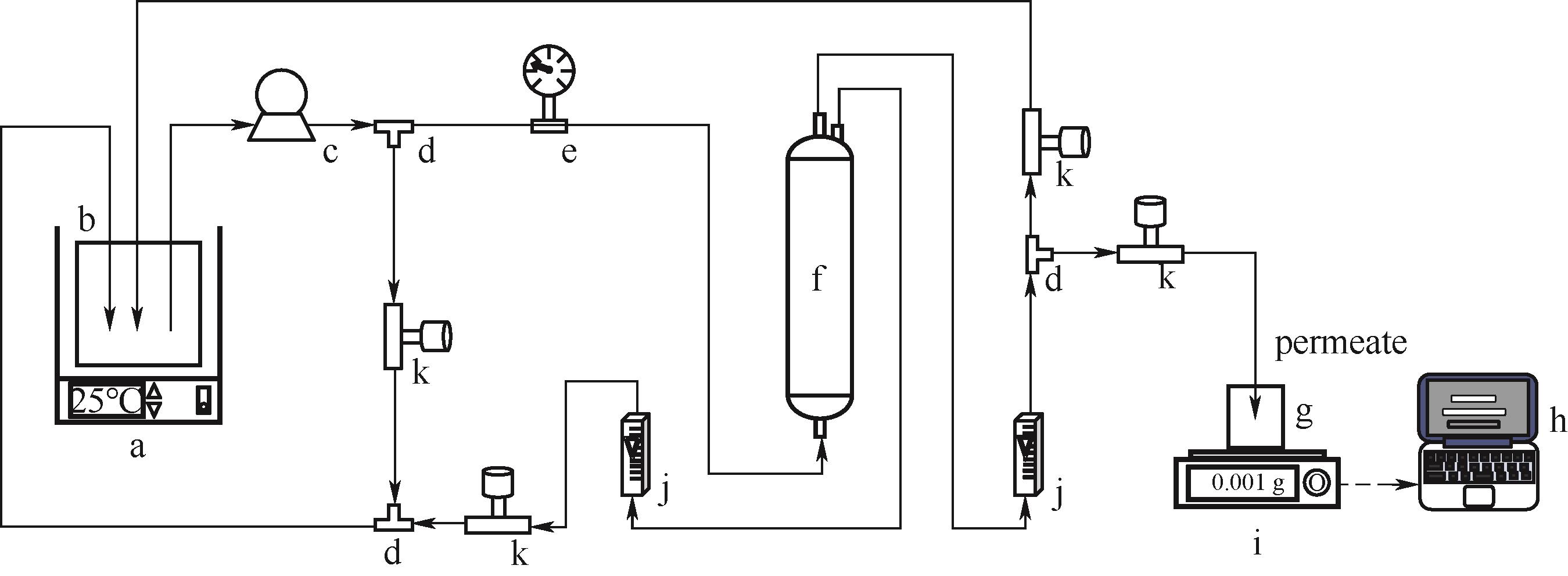
图1 错流洗滤装置示意图a—恒温水浴;b—进料罐;c—隔膜泵;d—三通;e—压力表;f—螺旋缠绕卷式膜组件;g—透过液罐;h—计算机;i—电子天平;j—流量计;k—节流阀
Fig.1 Device diagram of cross-flow diafiltrationa—thermostatic water bath; b—feed tank; c—diaphragm pump; d—three-way; e—pressure gauge; f—spiral-wound membrane module; g—permeate tank; h—computer; i—electronic balance; j—flow meter; k—control valve
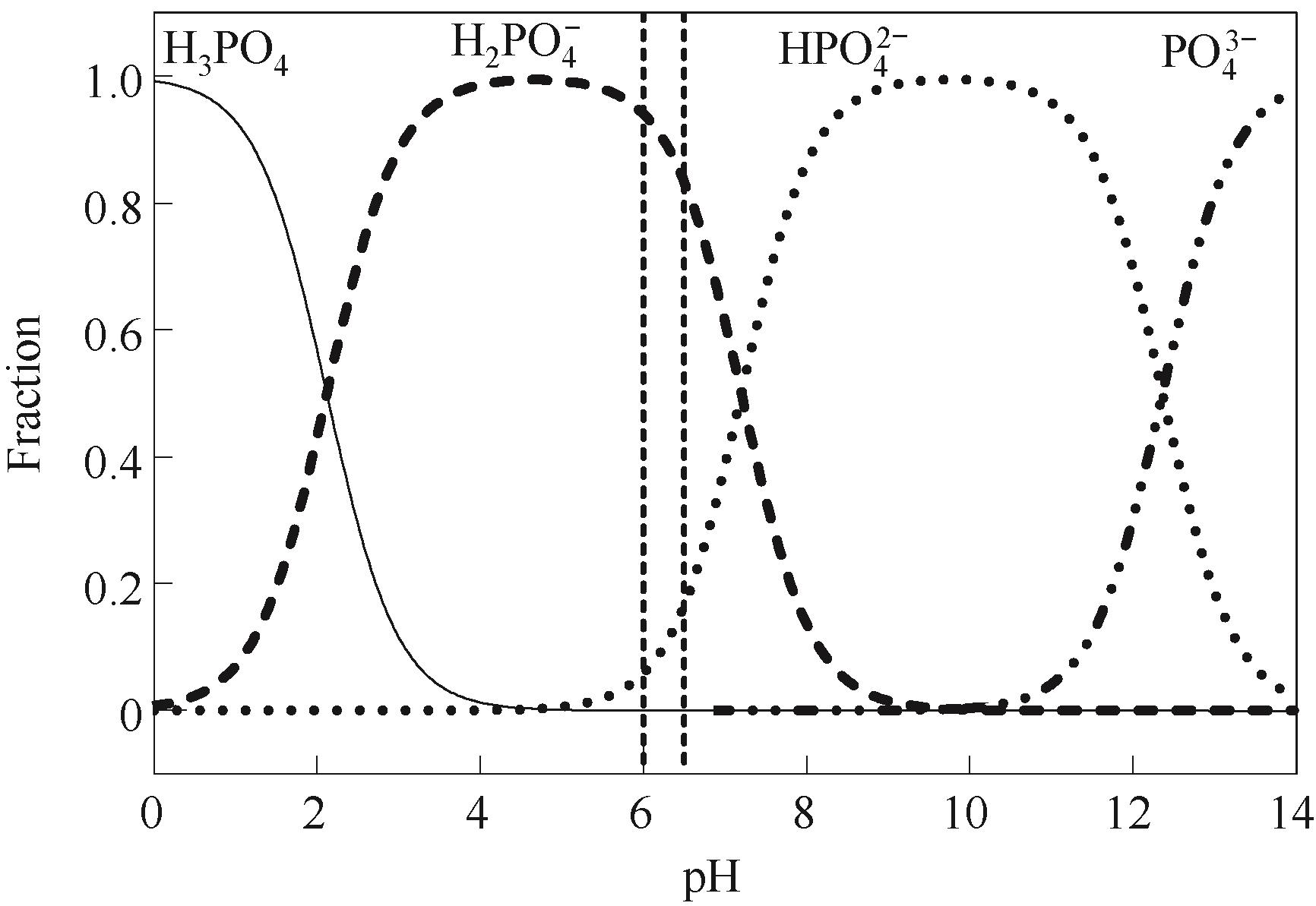
图2 不同pH的Pi组成
Fig.2 Distributions of phosphate species as a function of pH
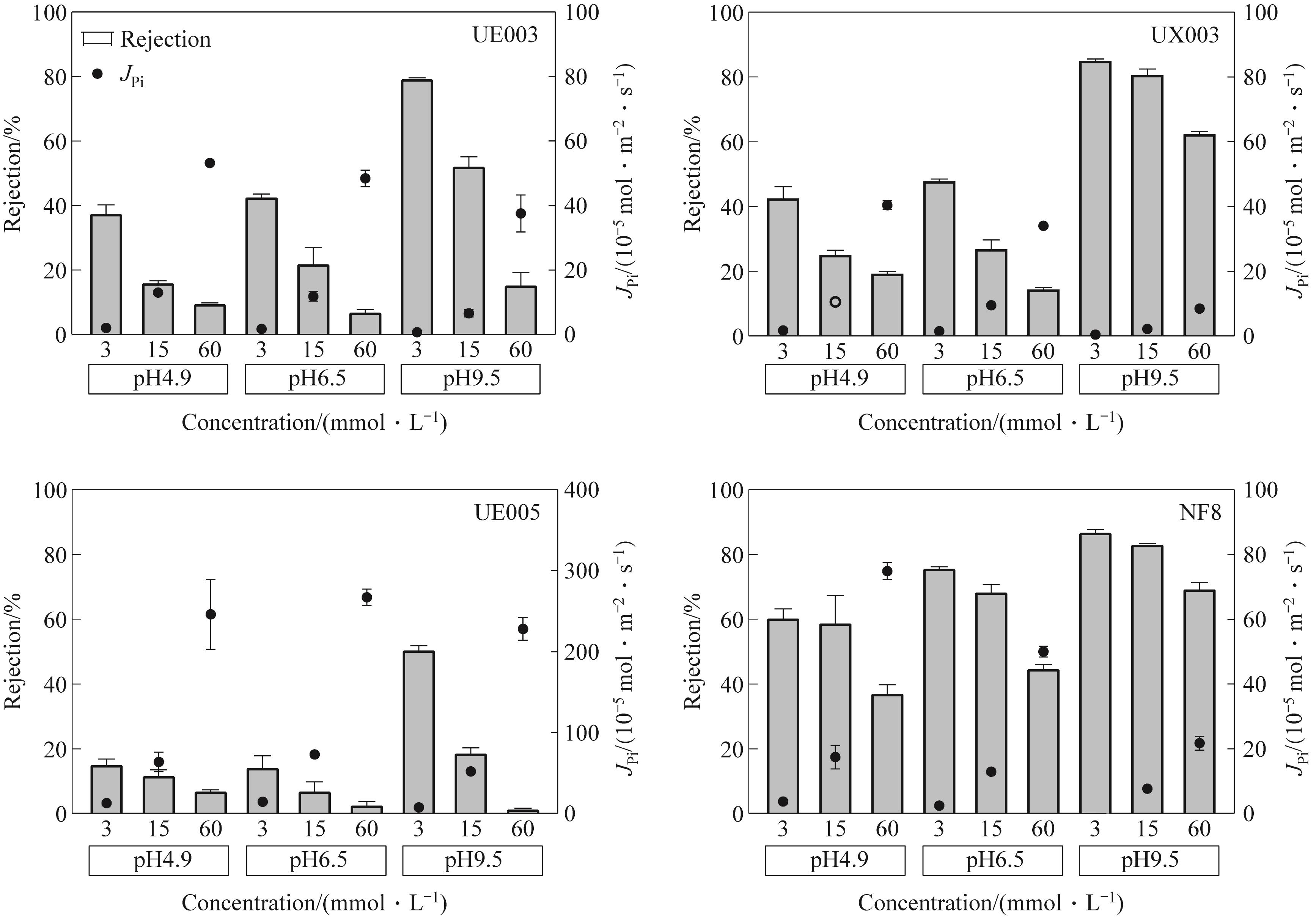
图3 pH和浓度对Pi截留率和通量的影响
Fig.3 Effect of pH and concentration on phosphate rejection and flux
| Specie | Stokes radius/nm | Hydrated radius /nm | Hydration free energy/(kJ·mol-1) | Diffusion coefficient/(10-9 m2·s-1) |
|---|---|---|---|---|
| Na+ | 0.184 | 0.358 | -365 | 1.177 |
| Cl- | 0.121 | 0.332 | -340 | 2.028 |
| 0.231 | 0.379 | -1080 | 1.062 | |
| 0.256 | 0.302 | -465 | 0.846 | |
| 0.323 | 0.327 | -1089 | 0.690 | |
| — | 0.339 | -2765 | 0.612 |
表3 离子物性参数
Table 3 Physical parameters of ions
| Specie | Stokes radius/nm | Hydrated radius /nm | Hydration free energy/(kJ·mol-1) | Diffusion coefficient/(10-9 m2·s-1) |
|---|---|---|---|---|
| Na+ | 0.184 | 0.358 | -365 | 1.177 |
| Cl- | 0.121 | 0.332 | -340 | 2.028 |
| 0.231 | 0.379 | -1080 | 1.062 | |
| 0.256 | 0.302 | -465 | 0.846 | |
| 0.323 | 0.327 | -1089 | 0.690 | |
| — | 0.339 | -2765 | 0.612 |
| No. | Conc. of FDP/ (mmol·L-1) | Conc. of Pi/(mmol·L-1) | Ion strength/(mmol·L-1) |
|---|---|---|---|
| 1 | 2 | 18 | 24 |
| 2 | 4 | 36 | 48 |
| 3 | 8 | 72 | 96 |
| 4 | 15 | 135 | 180 |
| 5 | 30 | 270 | 360 |
| 6 | 8 | 216 | 240 |
| 7 | 16 | 192 | 240 |
| 8 | 24 | 168 | 240 |
| 9 | 32 | 144 | 240 |
| 10 | 48 | 96 | 240 |
表4 模拟高盐体系的组成和浓度
Table 4 Compositions and concentrations of simulated high salinity solution
| No. | Conc. of FDP/ (mmol·L-1) | Conc. of Pi/(mmol·L-1) | Ion strength/(mmol·L-1) |
|---|---|---|---|
| 1 | 2 | 18 | 24 |
| 2 | 4 | 36 | 48 |
| 3 | 8 | 72 | 96 |
| 4 | 15 | 135 | 180 |
| 5 | 30 | 270 | 360 |
| 6 | 8 | 216 | 240 |
| 7 | 16 | 192 | 240 |
| 8 | 24 | 168 | 240 |
| 9 | 32 | 144 | 240 |
| 10 | 48 | 96 | 240 |
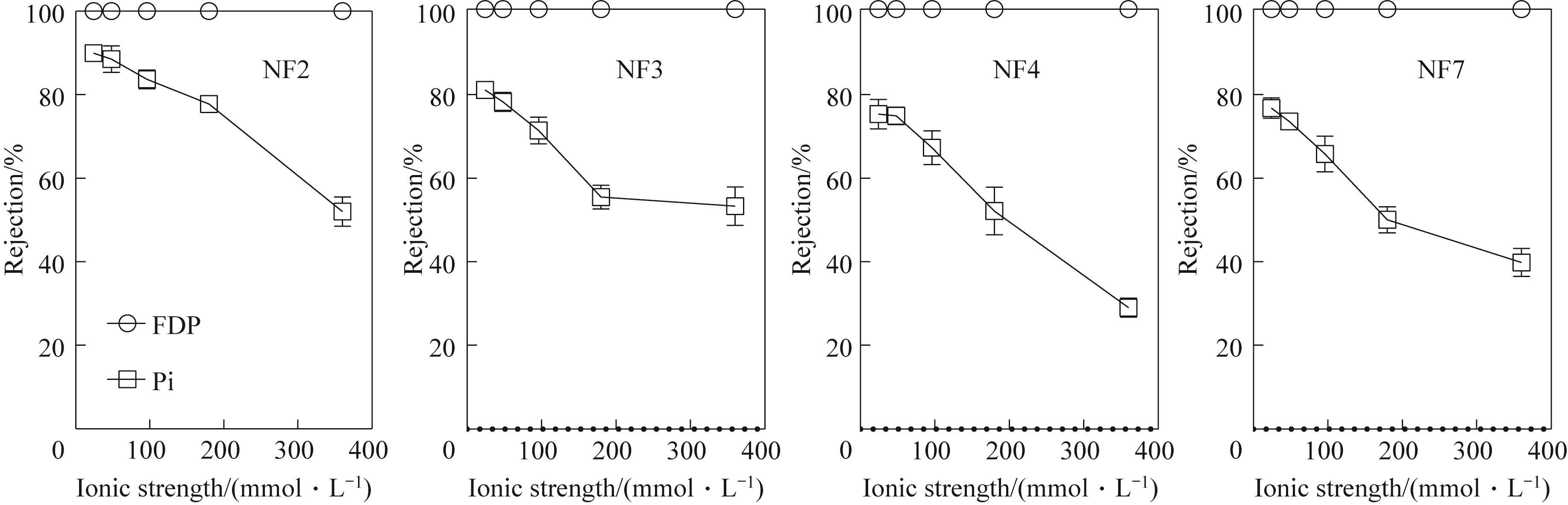
图4 不同离子强度对磷酸糖/Pi截留率的影响(固定FDP的比例)
Fig.4 Effect of different ionic strengths on the rejection of phosphorylated sugars/phosphates (fixed the percentage of FDP)
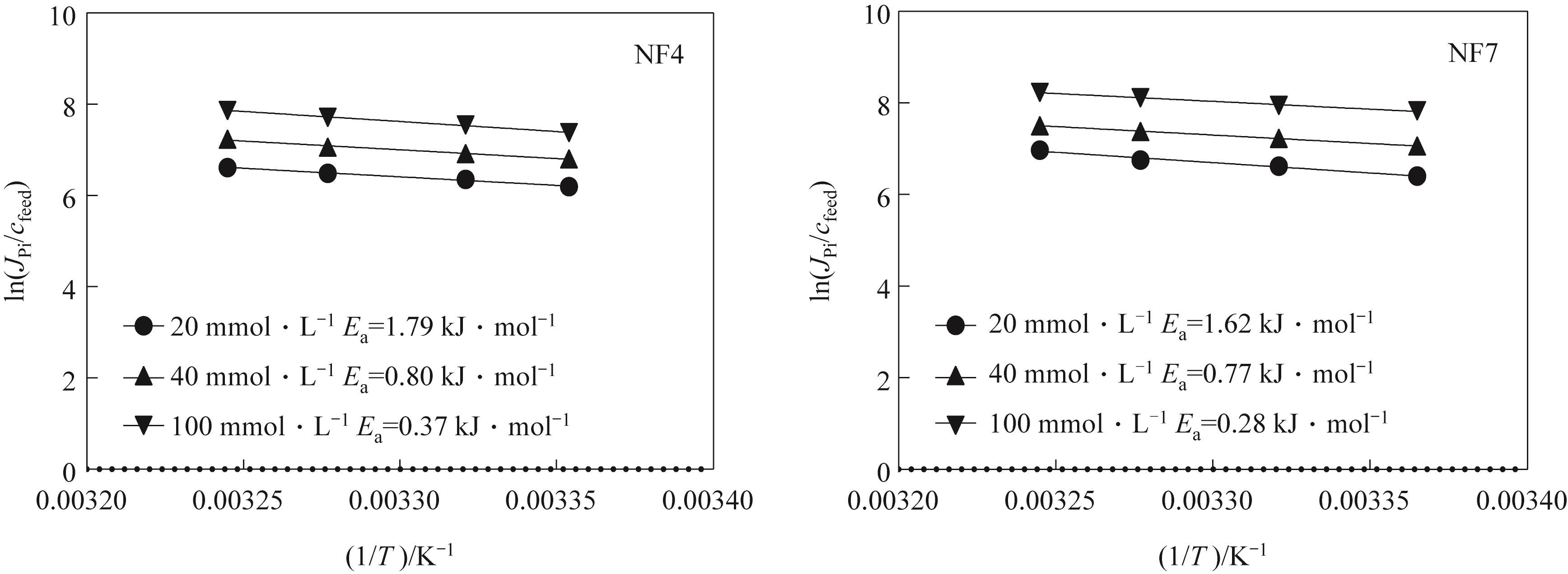
图5 不同离子强度Pi离子通过NF4和NF7膜的跨膜传输活化能
Fig.5 Transport activation energy of Pi through the NF4 and NF7 membrane at different ionic strengths
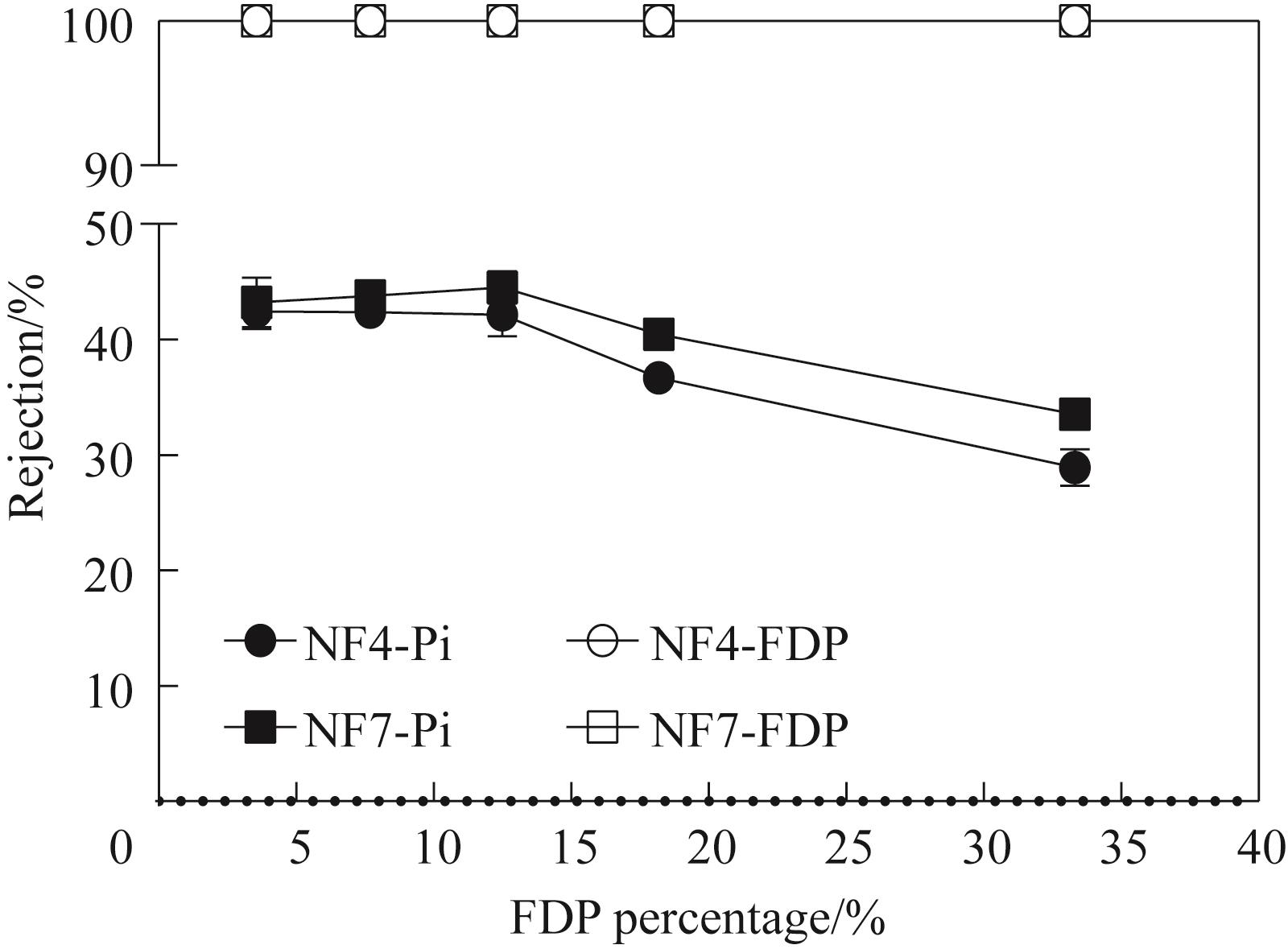
图6 不同磷酸糖比例对磷酸糖/Pi截留率的影响(固定离子强度)
Fig.6 Effect of different percentage of FDP on the rejection of phosphorylated sugars/phosphates (fixed the ionic strengths)
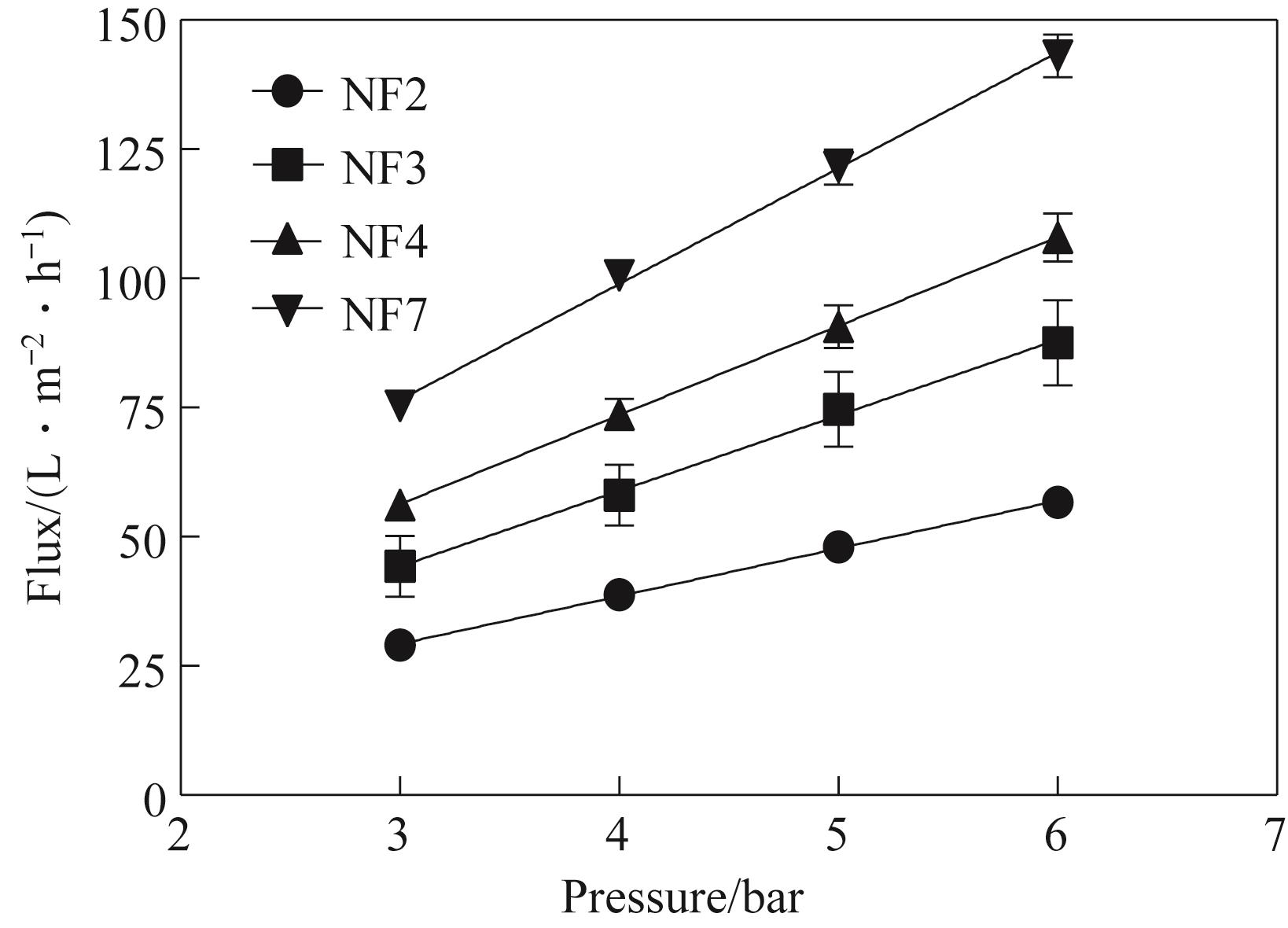
图7 膜的纯水渗透系数(1 bar=105 Pa)
Fig.7 Pure water permeability coefficient of different membranes
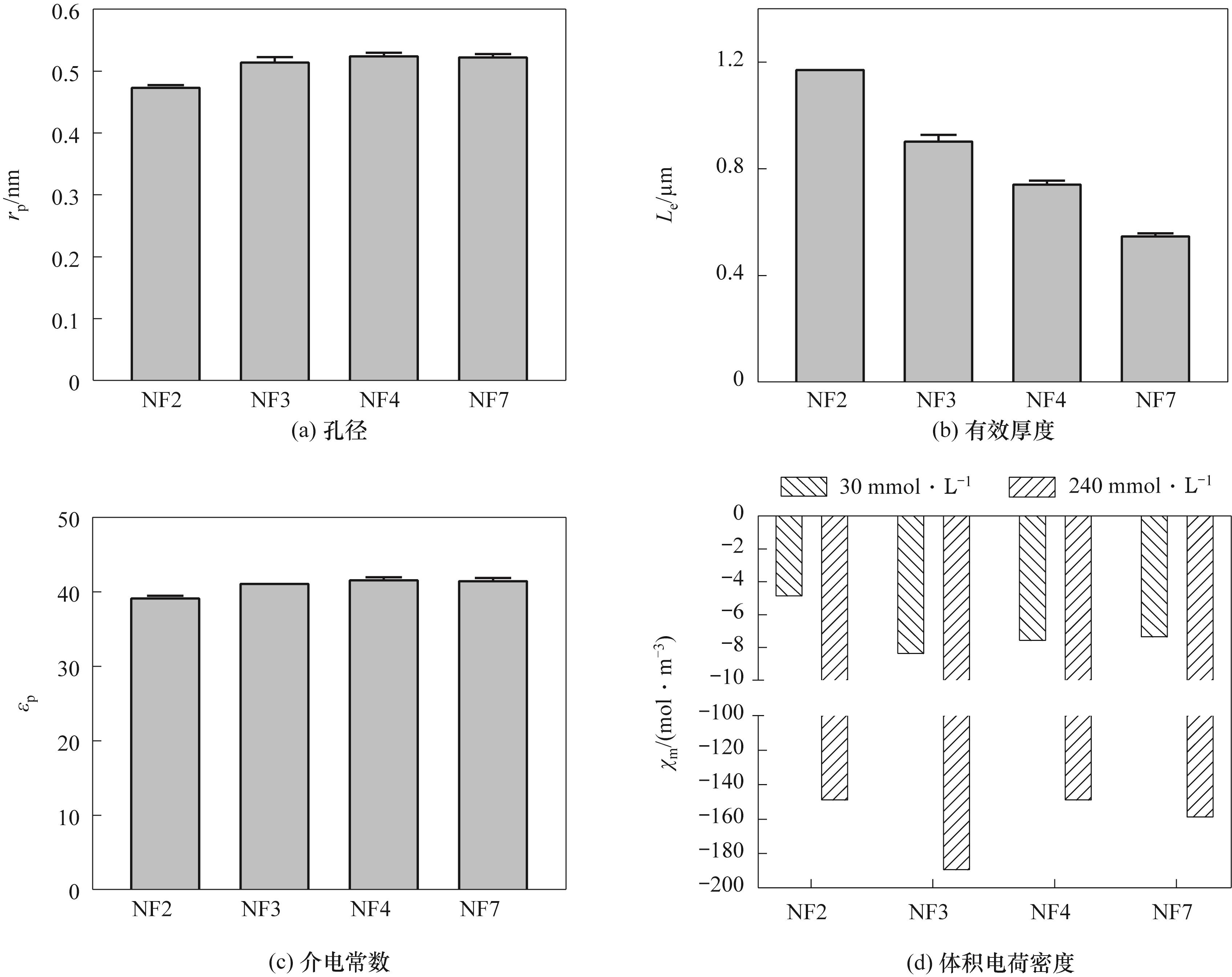
图8 膜参数计算值
Fig.8 Calculated values for membrane parameters
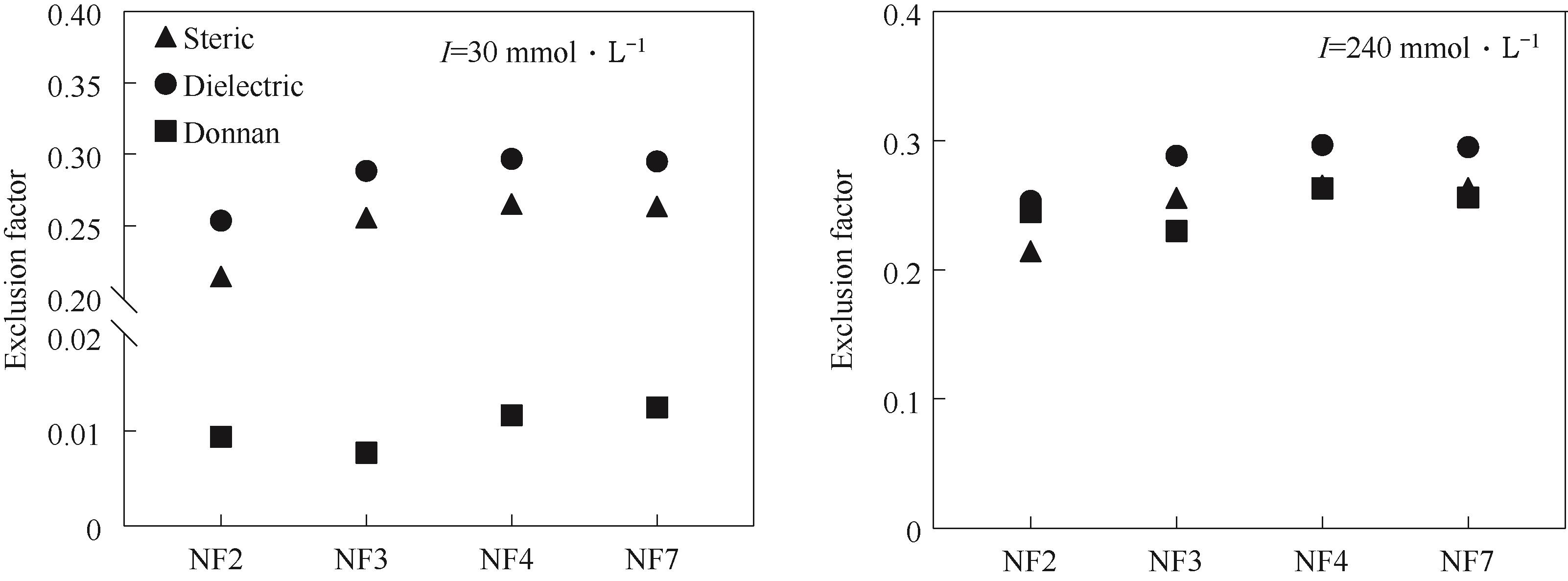
图9 量化空间排斥、介电排斥和Donnan排斥(进料侧)对Pi截留的贡献
Fig.9 Distinction the contribution of steric, dielectric and donnan exclusion (feed side) on phosphates rejection
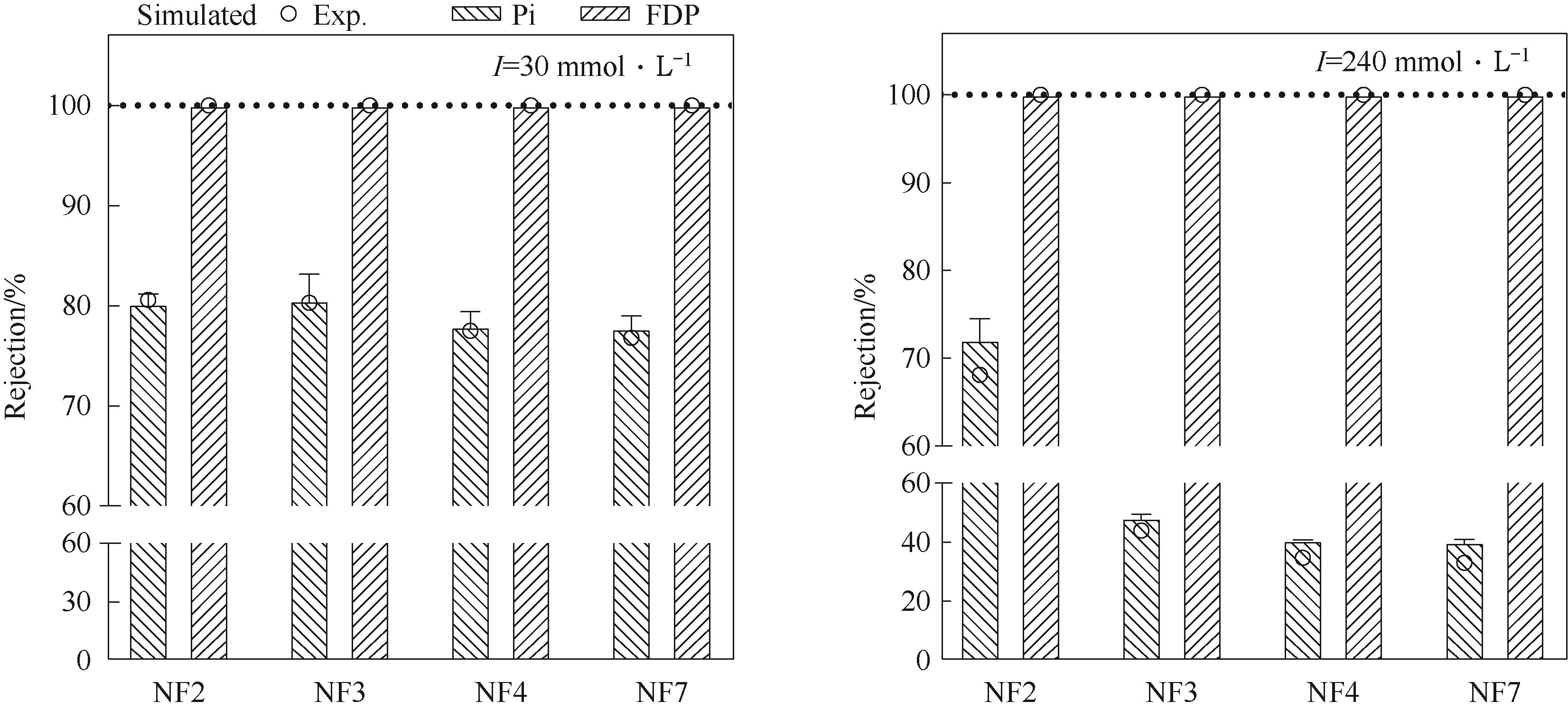
图10 DSPM-DE模型对离子截留行为的描述
Fig.10 Description of ion retention behavior by the DSPM-DE model
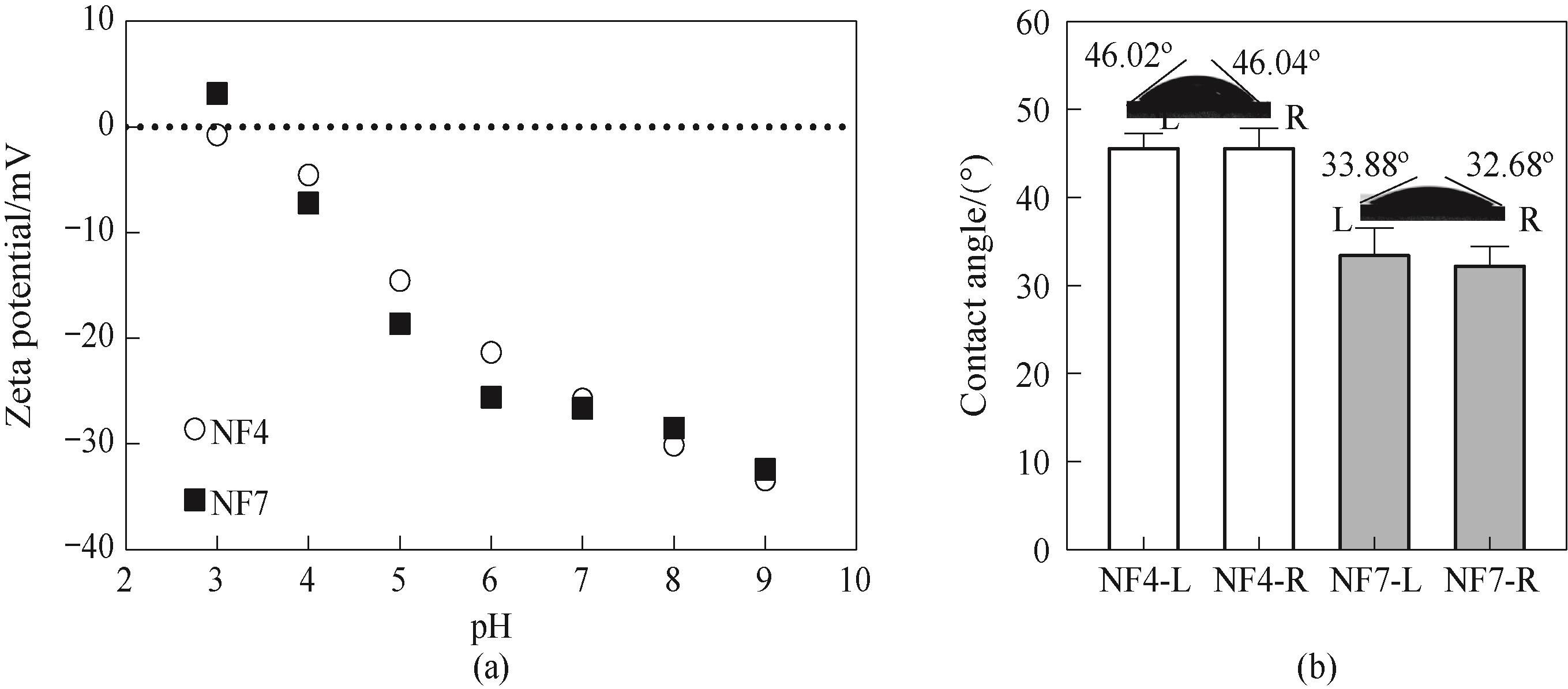
图11 NF4和NF7在不同pH下的Zeta电位值(a)及接触角(b)(L和R分别表示左右两侧)
Fig.11 Zeta potential values at different pH (a) and contact angles (b) of NF4 and NF7
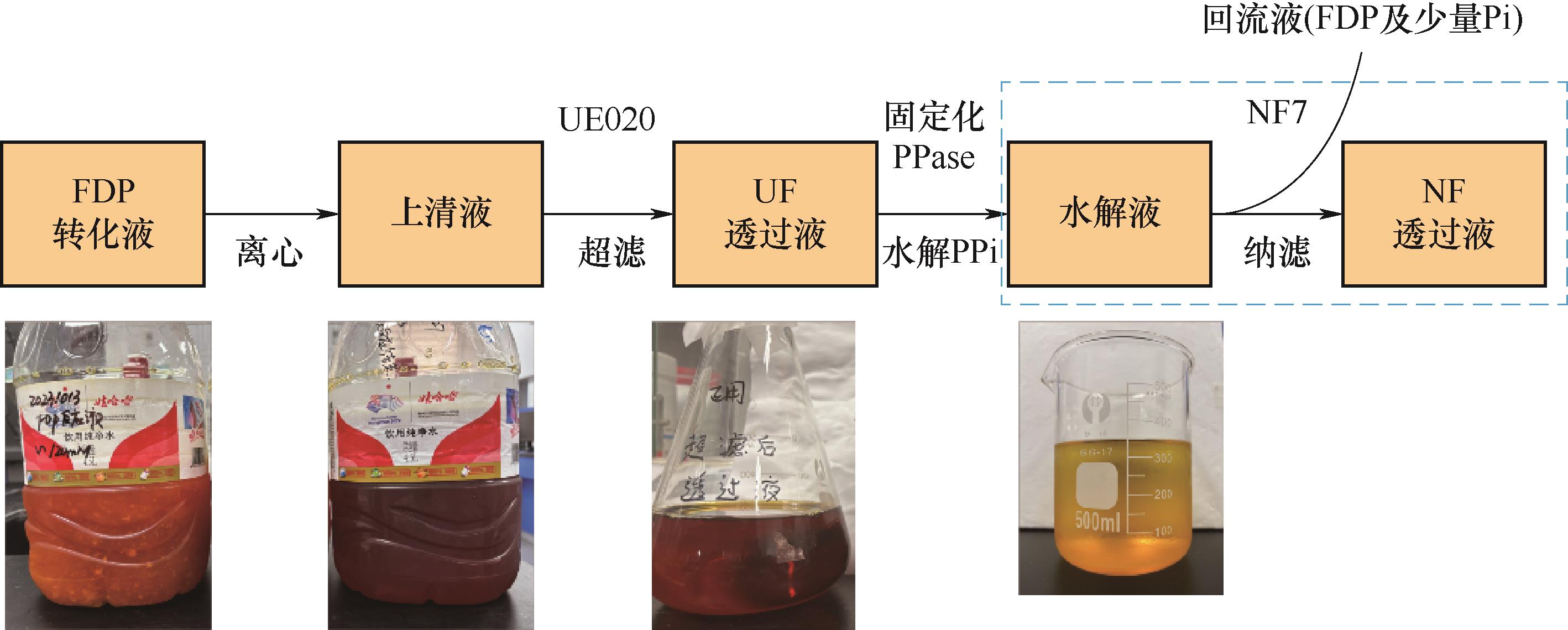
图12 FDP转化液分离纯化流程示意图
Fig.12 Separation and purification process for FDP conversion solution
| Batch | Volume/L | Concentration/(mmol·L-1) | Rejection rate/% | |||
|---|---|---|---|---|---|---|
| Pi | Phosphorylated sugars | Pi | Phosphorylated sugars | |||
| 1 | Feed | 0.77 | 89.50 | 28.04 | 66.85 | 100.00 |
| Permeate | 0.53 | 43.10 | ND | |||
| 2 | Feed | 1.00 | 104.16 | 40.05 | 63.15 | 100.00 |
| Permeate | 0.50 | 76.77 | ND | |||
表5 实际体系纳滤测试结果
Table 5 Results of nanofiltration tests in the actual system
| Batch | Volume/L | Concentration/(mmol·L-1) | Rejection rate/% | |||
|---|---|---|---|---|---|---|
| Pi | Phosphorylated sugars | Pi | Phosphorylated sugars | |||
| 1 | Feed | 0.77 | 89.50 | 28.04 | 66.85 | 100.00 |
| Permeate | 0.53 | 43.10 | ND | |||
| 2 | Feed | 1.00 | 104.16 | 40.05 | 63.15 | 100.00 |
| Permeate | 0.50 | 76.77 | ND | |||
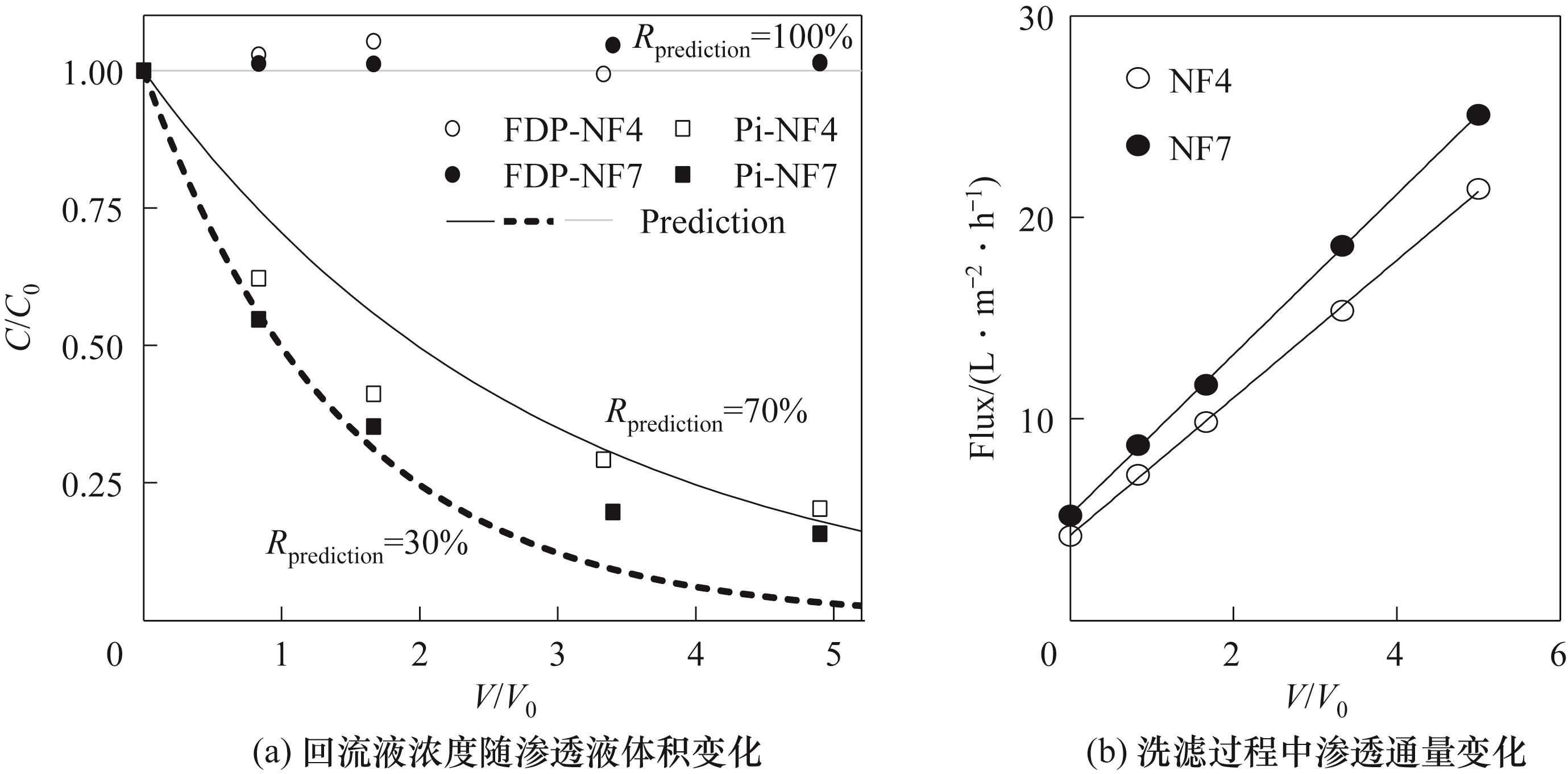
图13 恒压洗滤分离磷酸糖/Pi
Fig.13 Separation of phosphorylated sugars/phosphates under constant-pressure diafiltration
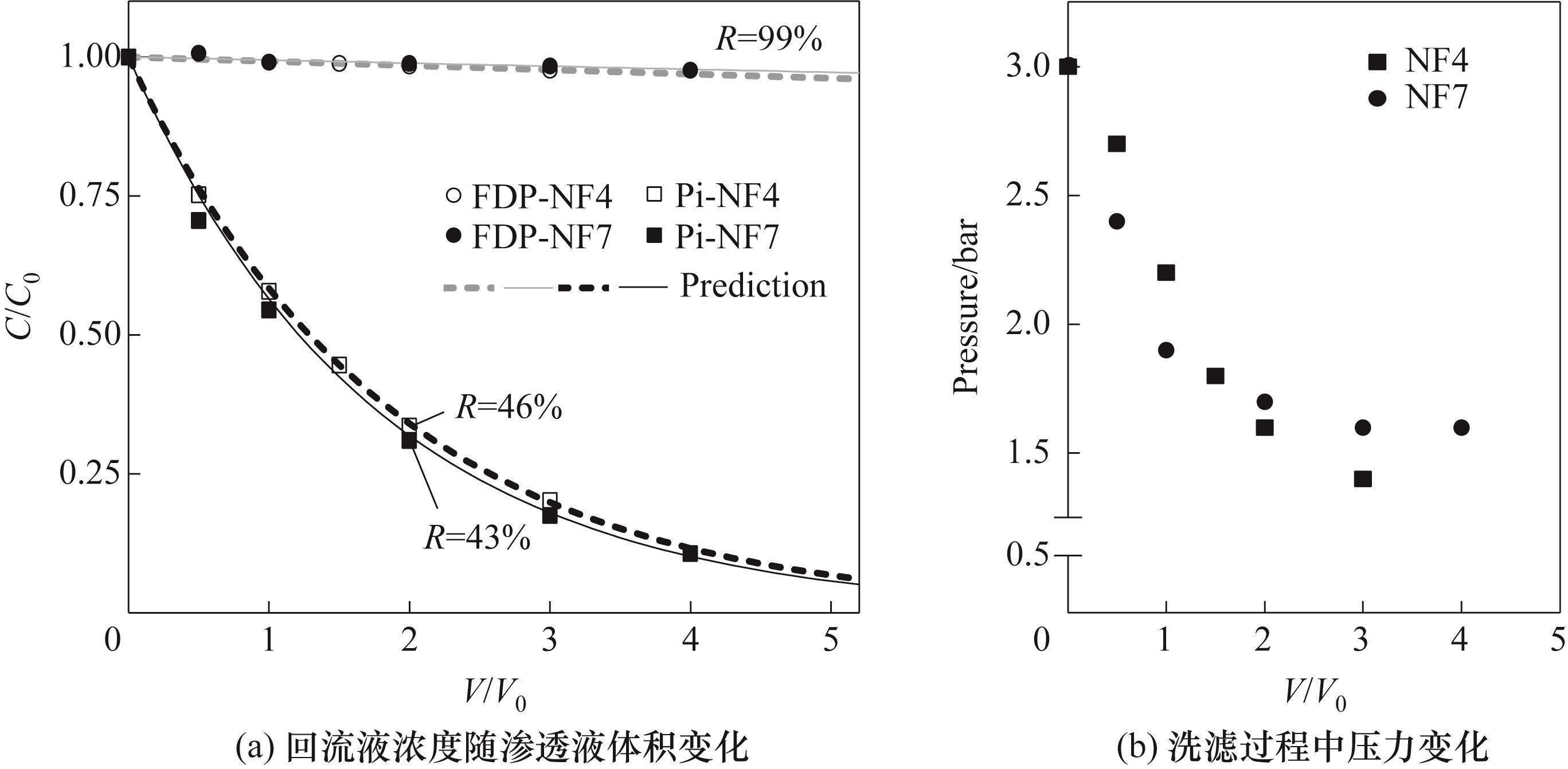
图14 恒通量洗滤分离磷酸糖/Pi
Fig.14 Separation of phosphorylated sugars/phosphates under constant-flux diafiltration
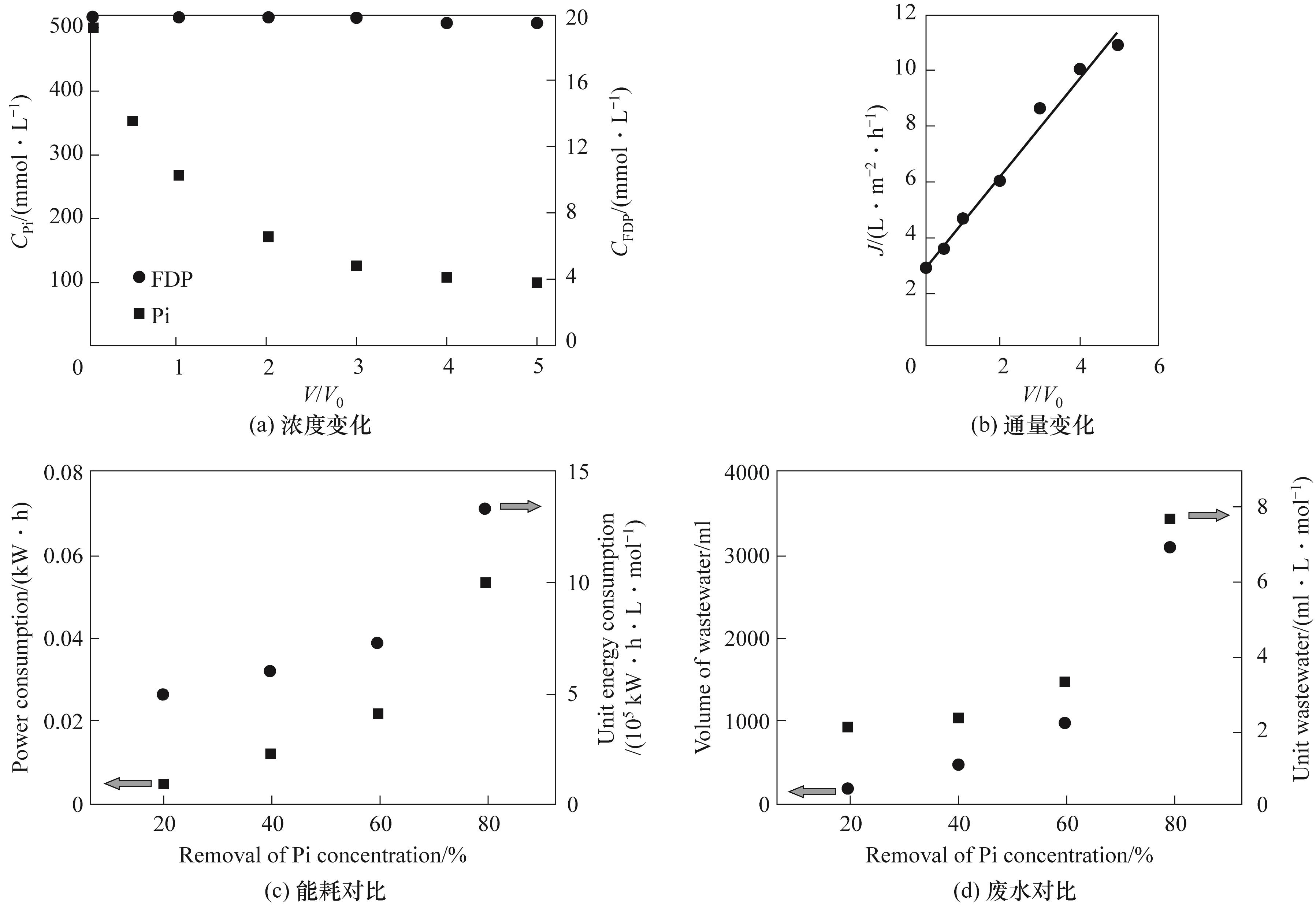
图15 高浓度Pi (500 mmol·L-1)恒压洗滤
Fig.15 Constant pressure filtration with high concentration of Pi (500 mmol·L-1)
| [1] | Li Y J, Shi T, Han P P, et al. Thermodynamics-driven production of value-added d-allulose from inexpensive starch by an in vitro enzymatic synthetic biosystem[J]. ACS Catalysis, 2021, 11(9): 5088-5099. |
| [2] | Zhao L T, Ma Z B, Zhang L P, et al. Synthesis of value-added uridine 5'-diphosphate-glucose from sucrose applying an engineered sucrose synthase counteracts the activity-stability trade-off[J]. Food Chemistry, 2025, 464: 141765. |
| [3] | Cai T, Sun H B, Qiao J, et al. Cell-free chemoenzymatic starch synthesis from carbon dioxide[J]. Science, 2021, 373(6562): 1523-1527. |
| [4] | Tian C Y, Yang J G, Liu C, et al. Engineering substrate specificity of HAD phosphatases and multienzyme systems development for the thermodynamic-driven manufacturing sugars[J]. Nature Communications, 2022, 13: 3582. |
| [5] | Jung B, Choi J S, Park C M, et al. Tannic acid as a natural organic matter surrogate in ultrafiltration membrane process[J]. Chemical Engineering Journal, 2025, 516, 164132. |
| [6] | Chai Y K, Lam H C, Koo C H, et al. Performance evaluation of polyamide nanofiltration membranes for phosphorus removal process and their stability against strong acid/alkali solution[J]. Chinese Journal of Chemical Engineering, 2019, 27(8): 1789-1797. |
| [7] | Sun D, Gu B X, Huo H Q, et al. Polyamide modified anion exchange membrane by interfacial polymerization for nitrate and phosphate salt separation[J]. Journal of Membrane Science, 2025, 717: 123640. |
| [8] | 杨丰瑞, 王志. 纳滤用于一价/二价无机盐溶液分离研究进展[J]. 化工学报, 2021, 72(2): 799-813. |
| Yang F R, Wang Z. Progress in separation of monovalent/divalent inorganic salt solutions by nanofiltration[J]. CIESC Journal, 2021, 72(2): 799-813. | |
| [9] | Wang J D, Jiang Y X, Tian Z Z, et al. Highly permeable acid-stable poly (sulfonamide-urea) nanofiltration membrane for purifying phosphoric acid[J]. Separation and Purification Technology, 2025, 362: 131662. |
| [10] | Guo S W, Wan Y H, Chen X R, et al. Loose nanofiltration membrane custom-tailored for resource recovery[J]. Chemical Engineering Journal, 2021, 409: 127376. |
| [11] | Guo X, Zhao B, Li Y, et al. A novel loose nanofiltration membrane prepared using large rigid-contorted diamine monomer for dye purification[J]. Journal of Membrane Science, 2025, 723: 123928. |
| [12] | Su Y F, Zhang X K, Li H, et al. In-situ incorporation of halloysite nanotubes with 2D zeolitic imidazolate framework-L based membrane for dye/salt separation[J]. Chinese Journal of Chemical Engineering, 2023, 58: 103-111. |
| [13] | Zhao Y Y, Tong X, Chen Y S. Fit-for-purpose design of nanofiltration membranes for simultaneous nutrient recovery and micropollutant removal[J]. Environmental Science & Technology, 2021, 55(5): 3352-3361. |
| [14] | Yang L Y, Xia C P, Jiang J L, et al. Removal of antibiotics and estrogens by nanofiltration and reverse osmosis membranes[J]. Journal of Hazardous Materials, 2024, 461: 132628. |
| [15] | Zhao Y Y, Tong X, Kim J, et al. Capillary-assisted fabrication of thin-film nanocomposite membranes for improved solute–solute separation[J]. Environmental Science & Technology, 2022, 56(9): 5849-5859. |
| [16] | Novalin S, Kongbangkerd T, Reisinger M, et al. Integration of electrodialysis into an enzymatic synthesis for the separation of phosphate from glucose-1-phosphate[J]. Separation and Purification Technology, 2017, 182: 224-229. |
| [17] | Wang X M, Li B, Zhang T, et al. Performance of nanofiltration membrane in rejecting trace organic compounds: experiment and model prediction[J]. Desalination, 2015, 370: 7-16. |
| [18] | Miyabe K, Isogai R. Estimation of molecular diffusivity in liquid phase systems by the Wilke–Chang equation[J]. Journal of Chromatography A, 2011, 1218(38): 6639-6645. |
| [19] | Wang R Y, Lin S H. Pore model for nanofiltration: history, theoretical framework, key predictions, limitations, and prospects[J]. Journal of Membrane Science, 2021, 620: 118809. |
| [20] | Xu S Y, Zheng R Q, Li Z Y, et al. Deciphering the overlooked role of dielectric exclusion in the ion selectivity of nanofiltration membranes[J]. Journal of Membrane Science, 2025, 733: 124342. |
| [21] | Guo H Y, Gao X Q, Yu K C, et al. Ion adsorption on nanofiltration membrane surface and its effect on rejection of charged solutes: a zeta potential approach[J]. Separation and Purification Technology, 2023, 326: 124830. |
| [22] | Shen J C, Yang M H, Xing J M. Efficient separation of HEPES and CO2-derived fructose by nanofiltration: optimizing pH for improved separation and proposing a potential mechanism[J]. Separation and Purification Technology, 2025, 355: 129657. |
| [23] | Luo J Q, Wan Y H. Effect of highly concentrated salt on retention of organic solutes by nanofiltration polymeric membranes[J]. Journal of Membrane Science, 2011, 372(1/2): 145-153. |
| [24] | Mao Z X, Shen J C, Liu M X, et al. Efficient separation of phosphorylated sugars from multi-enzyme system by ultrafiltration and membrane fouling mechanism[J]. Chinese Journal of Chemical Engineering, 2025, 87: 157-170. |
| [25] | Myung S, Wang Y R, Zhang Y P. Fructose-1,6-bisphosphatase from a hyper-thermophilic bacterium Thermotoga maritima: characterization, metabolite stability, and its implications[J]. Process Biochemistry, 2010, 45(12): 1882-1887. |
| [26] | Sigurdardottir S B, DuChanois R M, Epsztein R, et al. Energy barriers to anion transport in polyelectrolyte multilayer nanofiltration membranes: role of intra-pore diffusion[J]. Journal of Membrane Science, 2020, 603: 117921. |
| [27] | Epsztein R, Shaulsky E, Qin M H, et al. Activation behavior for ion permeation in ion-exchange membranes: role of ion dehydration in selective transport[J]. Journal of Membrane Science, 2019, 580: 316-326. |
| [28] | Cevallos-Curva N, Rahman M M, Hailu Kinfu H, et al. Mass transport mechanism of nitrate selective nanofiltration membranes on the basis of the Donnan steric pore model with dielectric exclusion (DSPM-DE) [J]. Chemical Engineering Journal, 2024, 493: 152775. |
| [29] | Geraldes V, Brites Alves A M. Computer program for simulation of mass transport in nanofiltration membranes[J]. Journal of Membrane Science, 2008, 321(2): 172-182. |
| [30] | Hasted J B, Ritson D M, Collie C H. Dielectric properties of aqueous ionic solutions. Parts Ⅰ and Ⅱ[J]. The Journal of Chemical Physics, 1948, 16(1): 1-21. |
| [31] | Zhao Y Y, Tong T Z, Wang X M, et al. Differentiating solutes with precise nanofiltration for next generation environmental separations: a review[J]. Environmental Science & Technology, 2021, 55(3): 1359-1376. |
| [32] | Qi T, Chen X F, Lu T D, et al. Enhancing ion separation efficiency: Janus charged nanofiltration membrane fabricated via polyethyleneimine-manipulated interfacial polymerization[J]. Journal of Membrane Science, 2024, 706: 122930. |
| [33] | Lin J Y, Ye W Y, Baltaru M C, et al. Tight ultrafiltration membranes for enhanced separation of dyes and Na2SO4 during textile wastewater treatment[J]. Journal of Membrane Science, 2016, 514: 217-228. |
| [34] | Epsztein R, DuChanois R M, Ritt C L, et al. Towards single-species selectivity of membranes with subnanometre pores[J]. Nature Nanotechnology, 2020, 15(6): 426-436. |
| [35] | 李燕, 王敏, 赵有璟, 等. 纳滤膜对高镁锂比盐湖卤水镁锂分离性能研究[J]. 化工学报, 2021, 72(6): 3130-3139. |
| Li Y, Wang M, Zhao Y J, et al. Study on separation of magnesium and lithium from salt lake brine with high magnesium-to-lithium mass ratio by nanofiltration membrane[J]. CIESC Journal, 2021, 72(6): 3130-3139. | |
| [36] | Liu W K, Wang X M, Li D Y, et al. Dominant mechanism of nanofiltration for chloride/sulfate ion separation in high salinity solutions: the quantification of pore size-influenced dielectric exclusion[J]. Environmental Science & Technology, 2025, 59(11): 5848-5855. |
| [37] | Bruni L, Bandini S. The role of the electrolyte on the mechanism of charge formation in polyamide nanofiltration membranes[J]. Journal of Membrane Science, 2008, 308(1/2): 136-151. |
| [38] | Zhu Y Z, Gui L L, Wang R Y, et al. Regulation of molecular transport in polymer membranes with voltage-controlled pore size at the angstrom scale[J]. Nature Communications, 2023, 14: 2373. |
| [39] | Zhou W Z, Chen J, Dai R B, et al. Selective removal of organic matters from high-salinity chemical industrial wastewater: ultrafiltration or nanofiltration?[J]. Water Research, 2025, 282: 123762. |
| [40] | Han L, Tian J, Liu C, et al. Influence of pH and NaCl concentration on boron rejection during nanofiltration[J]. Separation and Purification Technology, 2021, 261: 118248. |
| [41] | Hoek E M V, Elimelech M. Cake-enhanced concentration polarization: a new fouling mechanism for salt-rejecting membranes[J]. Environmental Science & Technology, 2003, 37(24): 5581-5588. |
| [42] | Shefer I, Peer-Haim O, Leifman O, et al. Enthalpic and entropic selectivity of water and small ions in polyamide membranes[J]. Environmental Science & Technology, 2021, 55(21): 14863-14875. |
| [43] | Liu L L, Lin S H, Xu X Y, et al. Preference of negatively charged membranes in magnesium and lithium separation by nanofiltration[J]. Nature Communications, 2025, 16: 5731. |
| [44] | Pérez-González A, Ibáñez R, Gómez P, et al. Nanofiltration separation of polyvalent and monovalent anions in desalination brines[J]. Journal of Membrane Science, 2015, 473: 16-27. |
| [45] | Schaep J, Vandecasteele C, Mohammad A W, et al. Analysis of the salt retention of nanofiltration membranes using the donnan-steric partitioning pore model[J]. Separation Science and Technology, 1999, 34(15): 3009-3030. |
| [46] | Wang W, Liu M X, You C, et al. ATP-free biosynthesis of a high-energy phosphate metabolite fructose 1,6-diphosphate by in vitro metabolic engineering[J]. Metabolic Engineering, 2017, 42: 168-174. |
| [47] | Luo J Q, Guo S W, Wu Y Y, et al. Separation of sucrose and reducing sugar in cane molasses by nanofiltration[J]. Food and Bioprocess Technology, 2018, 11(5): 913-925. |
| [1] | 臧子晴, 李修真, 谈莹莹, 刘晓庆. 分凝器对两级分离自复叠制冷循环特性影响研究[J]. 化工学报, 2025, 76(S1): 17-25. |
| [2] | 黄灏, 王文, 贺隆坤. LNG船薄膜型液货舱预冷过程模拟与分析[J]. 化工学报, 2025, 76(S1): 187-194. |
| [3] | 黄博, 黄灏, 王文, 贺隆坤. 薄膜型LNG船液货舱温度场计算分析[J]. 化工学报, 2025, 76(S1): 195-204. |
| [4] | 裴星亮, 叶翠平, 裴赢丽, 李文英. 碱改性MIL-53(Cr)选择性吸附分离二甲苯异构体[J]. 化工学报, 2025, 76(S1): 258-267. |
| [5] | 李银龙, 刘国强, 晏刚. 分馏与闪蒸分离耦合自复叠制冷循环性能分析[J]. 化工学报, 2025, 76(S1): 26-35. |
| [6] | 李文龙, 常程, 吴小林, 姬忠礼. 油水聚结过滤材料中的液体分布特性及过程压降演化研究[J]. 化工学报, 2025, 76(9): 4850-4861. |
| [7] | 王钰, 冯英楠, 王涛, 赵之平. 原位生长构筑纳米复合纳滤膜:膜制备与应用[J]. 化工学报, 2025, 76(9): 4723-4736. |
| [8] | 张建民, 何美贵, 贾万鑫, 赵静, 金万勤. 聚氧化乙烯/冠醚共混膜及其二氧化碳分离性能[J]. 化工学报, 2025, 76(9): 4862-4871. |
| [9] | 郭旭, 贾继宁, 姚克俭. 基于优化CNN-BiLSTM神经网络的间歇精馏过程建模[J]. 化工学报, 2025, 76(9): 4613-4629. |
| [10] | 王杰, 林渠成, 张先明. 基于分解算法的混合气体多级膜分离系统全局优化[J]. 化工学报, 2025, 76(9): 4670-4682. |
| [11] | 陈治宏, 吴佳伟, 楼小玲, 贠军贤. 化学品生物制造过程机器学习的研究进展[J]. 化工学报, 2025, 76(8): 3789-3804. |
| [12] | 张荟钦, 赵泓竣, 付正军, 庄力, 董凯, 贾添智, 曹雪丽, 孙世鹏. 纳滤膜在离子型稀土浸出液提浓中的应用研究[J]. 化工学报, 2025, 76(8): 4095-4107. |
| [13] | 孙国庆, 李海波, 丁志阳, 郭文辉, 徐浩, 赵艳侠. 硅基负极材料的研究进展[J]. 化工学报, 2025, 76(7): 3197-3211. |
| [14] | 高凤凤, 程慧峰, 杨博, 郝晓刚. 电驱动NiFeMn LDH/CNTs/PVDF膜电极选择性提取钨酸根离子[J]. 化工学报, 2025, 76(7): 3350-3360. |
| [15] | 蒋明虎, 汪帆, 邢雷, 赵立新, 李新亚, 陈丁玮. 井下含气对油水分离管柱流场特性及性能影响[J]. 化工学报, 2025, 76(7): 3361-3372. |
| 阅读次数 | ||||||
|
全文 |
|
|||||
|
摘要 |
|
|||||
 京公网安备 11010102001995号