化工学报 ›› 2025, Vol. 76 ›› Issue (9): 4601-4612.DOI: 10.11949/0438-1157.20250280
田鹏1( ), 张忠林1(), 任超1, 孟国超1,2, 郝晓刚1(), 刘叶刚1,3, 侯起旺1,4, ABUDULA Abuliti5, 官国清6
收稿日期:2025-03-21
修回日期:2025-04-14
出版日期:2025-09-25
发布日期:2025-10-23
通讯作者:
张忠林,郝晓刚
作者简介:田鹏(1999—),男,硕士研究生,2448771441@qq.com
基金资助:
Peng TIAN1(), Zhonglin ZHANG1(), Chao REN1, Guochao MENG1,2, Xiaogang HAO1(), Yegang LIU1,3, Qiwang HOU1,4, Abuliti ABUDULA5, Guoqing GUAN6
Received:2025-03-21
Revised:2025-04-14
Online:2025-09-25
Published:2025-10-23
Contact:
Zhonglin ZHANG, Xiaogang HAO
摘要:
低温甲醇洗工艺存在运行能耗高和CO2捕集不充分的问题。为优化捕集性能、降低能耗,设计了一种“双级减压闪蒸耦合半贫液循环”工艺,降低再生能耗的同时提高CO2捕集效率,结果显示CO2产量增加12.16%。设计两种“自热再生”优化方案,并对其进行换热网络设计,从能耗、㶲损、CO2排放量、年度运行费用、单位CO2产品成本等多个维度进行评价。结果表明,基于自热再生的两种甲醇洗工艺较原工艺㶲效率有所提升,热力学性能得到优化,能耗分别降低36.98%、37.20%,㶲损分别降低26.72%,26.86%,年度运行费用分别降低17.25%、15.06%,单位CO2产品成本分别降低13.33%、10.91%。改进后的低温甲醇洗工艺在经济性以及节能、减排、环保方面表现出更好的性能。
中图分类号:
田鹏, 张忠林, 任超, 孟国超, 郝晓刚, 刘叶刚, 侯起旺, ABUDULA Abuliti, 官国清. 基于自热再生的一种低温甲醇洗工艺建模与优化[J]. 化工学报, 2025, 76(9): 4601-4612.
Peng TIAN, Zhonglin ZHANG, Chao REN, Guochao MENG, Xiaogang HAO, Yegang LIU, Qiwang HOU, Abuliti ABUDULA, Guoqing GUAN. Modeling and optimization of rectisol process based on self-heat regeneration[J]. CIESC Journal, 2025, 76(9): 4601-4612.
| 参数 | 原料气 | 甲醇 |
|---|---|---|
| 表压/MPa | 5.8 | 5 |
| 温度/℃ | -15.4 | -52.4 |
| 质量流率/(kg·h-1) | 289221.8 | 425494 |
| 摩尔流量/(kmol·h-1) | 12972.8 | 13281.2 |
| CO2 | 4663.5919 | 0 |
| H2 | 5730.7344 | 0 |
| N2 | 30.3564 | 0 |
| H2S | 21.4050 | 0 |
H2O CH4 | 22.3132 10.7674 | 4.6235 0 |
| CO | 2487.5344 | 0 |
AR COS CH3OH | 14.3998 0.6486 0 | 0 0 13276.57 |
表1 进料组成和条件
Table 1 Feed composition and conditions
| 参数 | 原料气 | 甲醇 |
|---|---|---|
| 表压/MPa | 5.8 | 5 |
| 温度/℃ | -15.4 | -52.4 |
| 质量流率/(kg·h-1) | 289221.8 | 425494 |
| 摩尔流量/(kmol·h-1) | 12972.8 | 13281.2 |
| CO2 | 4663.5919 | 0 |
| H2 | 5730.7344 | 0 |
| N2 | 30.3564 | 0 |
| H2S | 21.4050 | 0 |
H2O CH4 | 22.3132 10.7674 | 4.6235 0 |
| CO | 2487.5344 | 0 |
AR COS CH3OH | 14.3998 0.6486 0 | 0 0 13276.57 |
| 流股 | 参数 |
|---|---|
| 净化气 | S≤1.0×10⁻⁷,CO2≤2.3%±0.2% |
| 克劳斯气 | H2S+COS≥25% |
| 尾气 | H2S≤2.5×10⁻⁵,S≤2.3 kg·h-1,甲醇≤1.0×10⁻⁴,甲醇流量≤50 kg·h-1 |
表2 设计参数
Table 2 Design parameters
| 流股 | 参数 |
|---|---|
| 净化气 | S≤1.0×10⁻⁷,CO2≤2.3%±0.2% |
| 克劳斯气 | H2S+COS≥25% |
| 尾气 | H2S≤2.5×10⁻⁵,S≤2.3 kg·h-1,甲醇≤1.0×10⁻⁴,甲醇流量≤50 kg·h-1 |
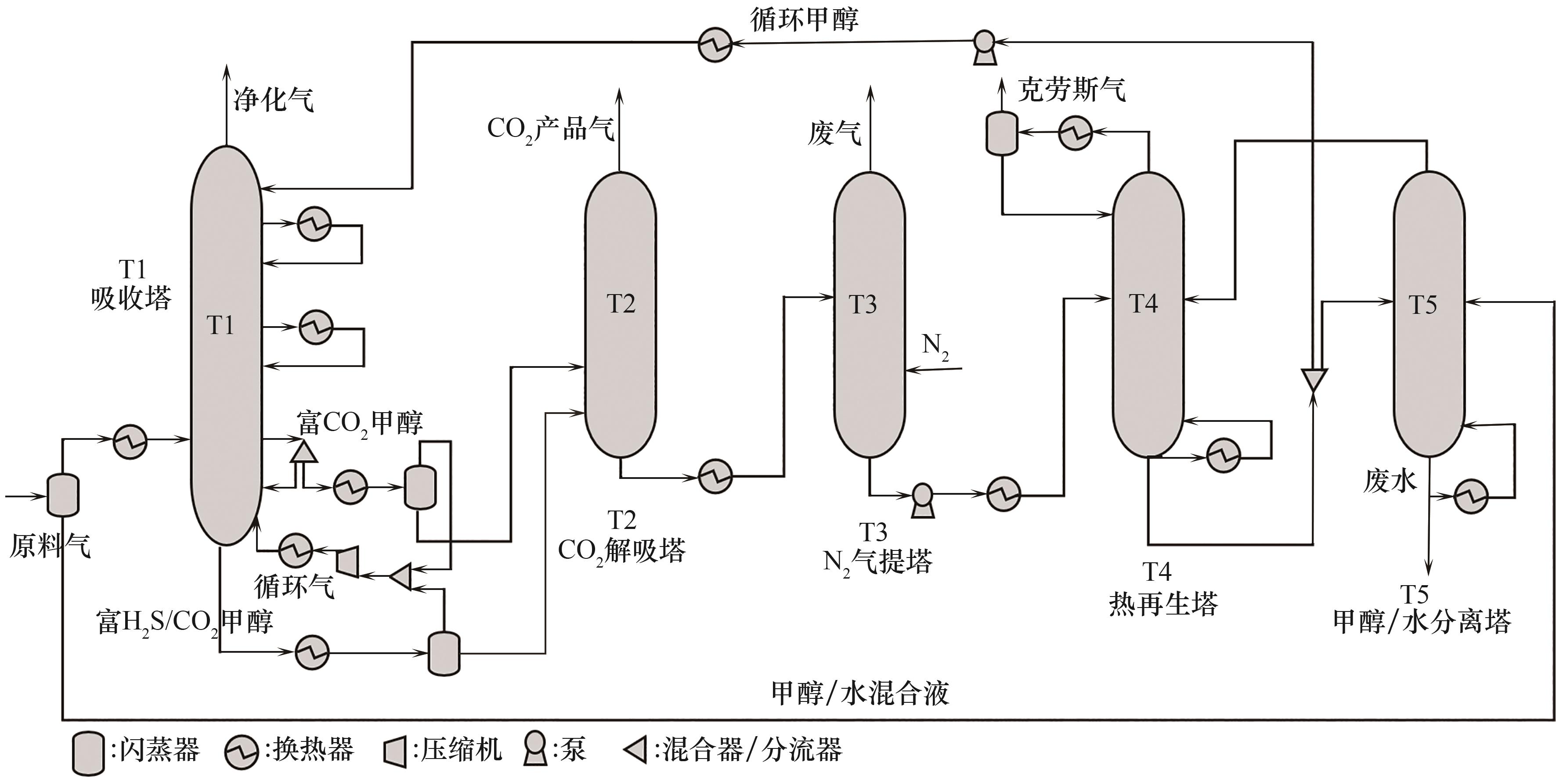
图1 林德低温甲醇洗工艺流程
Fig.1 Linde rectisol process diagram
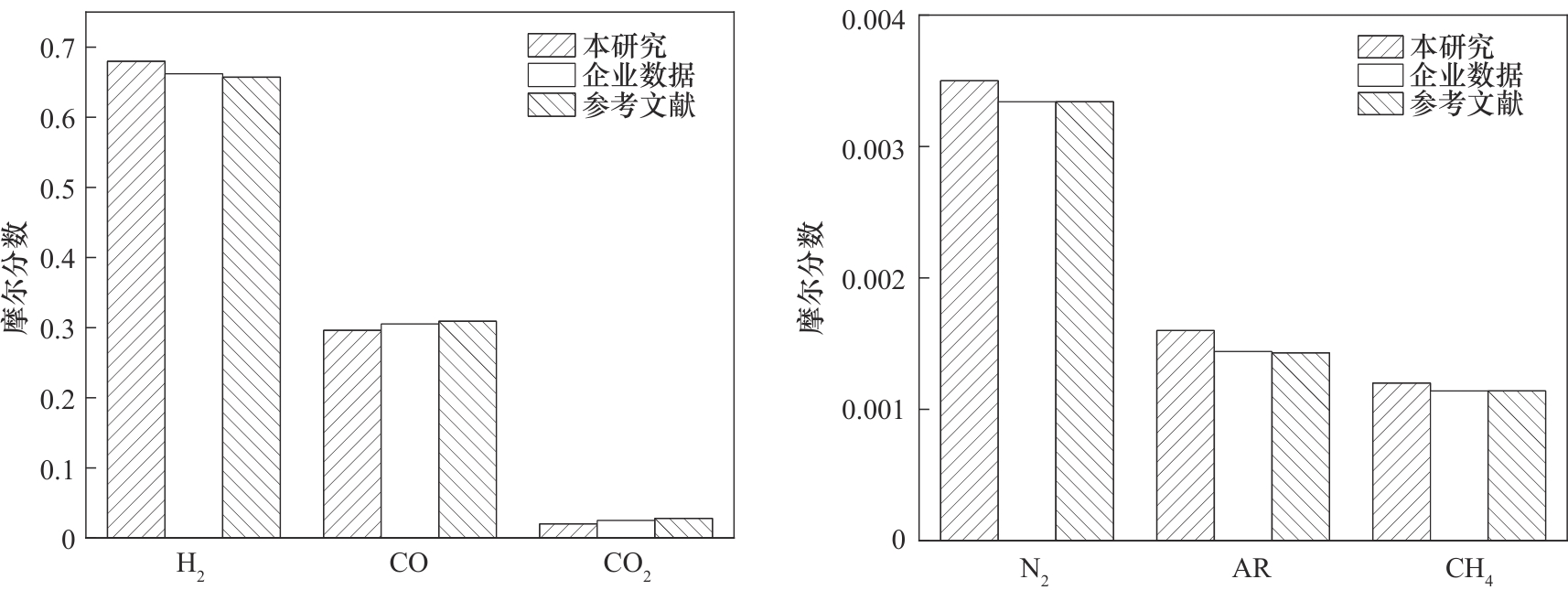
图2 净化气模拟结果与企业数据对比
Fig.2 Comparison of simulation results and industrial data of purified syngas
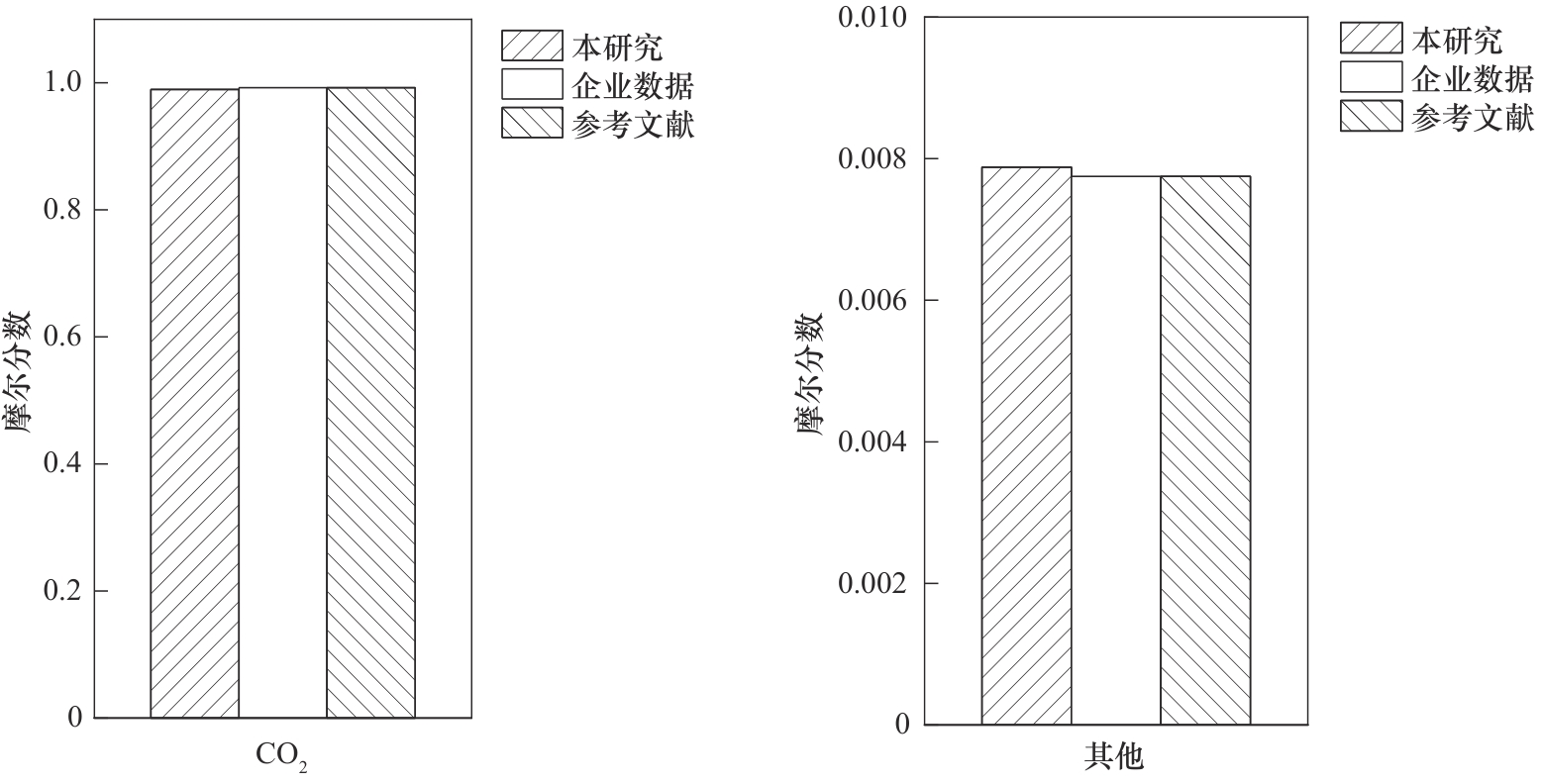
图3 CO2产品气模拟结果与企业数据对比
Fig.3 Comparison of simulation results and industrial data of CO2 product
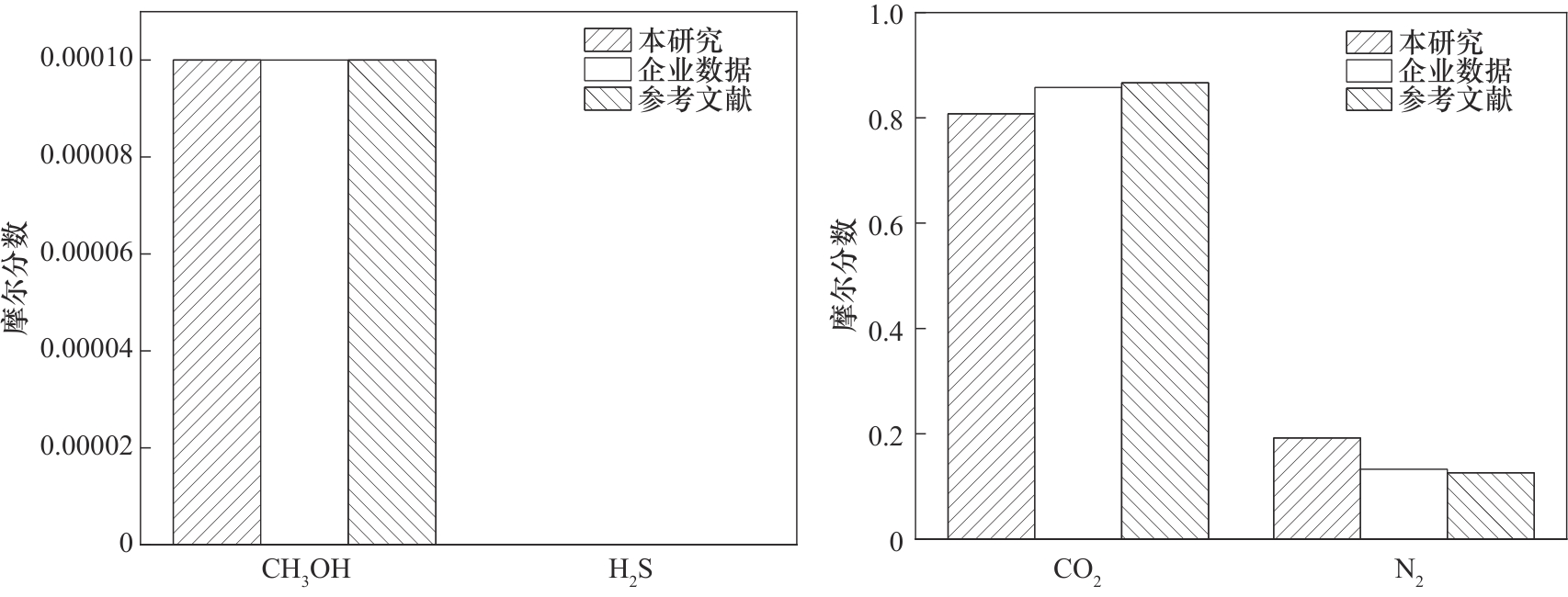
图4 尾气模拟结果与企业数据对比
Fig.4 Comparison of simulation results and industrial data of tail gas
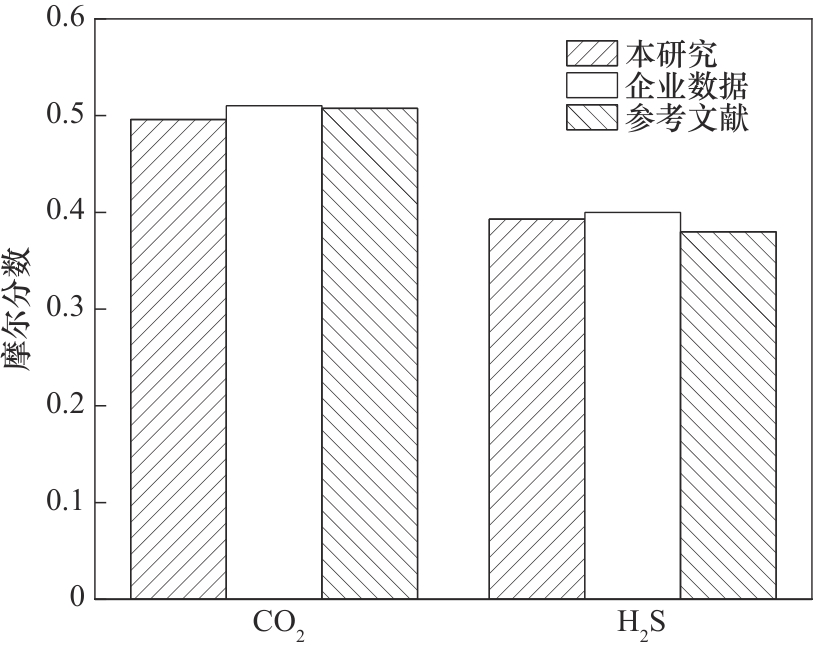
图5 克劳斯气模拟结果与企业数据对比
Fig.5 Comparison of simulation results and industrial data of Claus gas
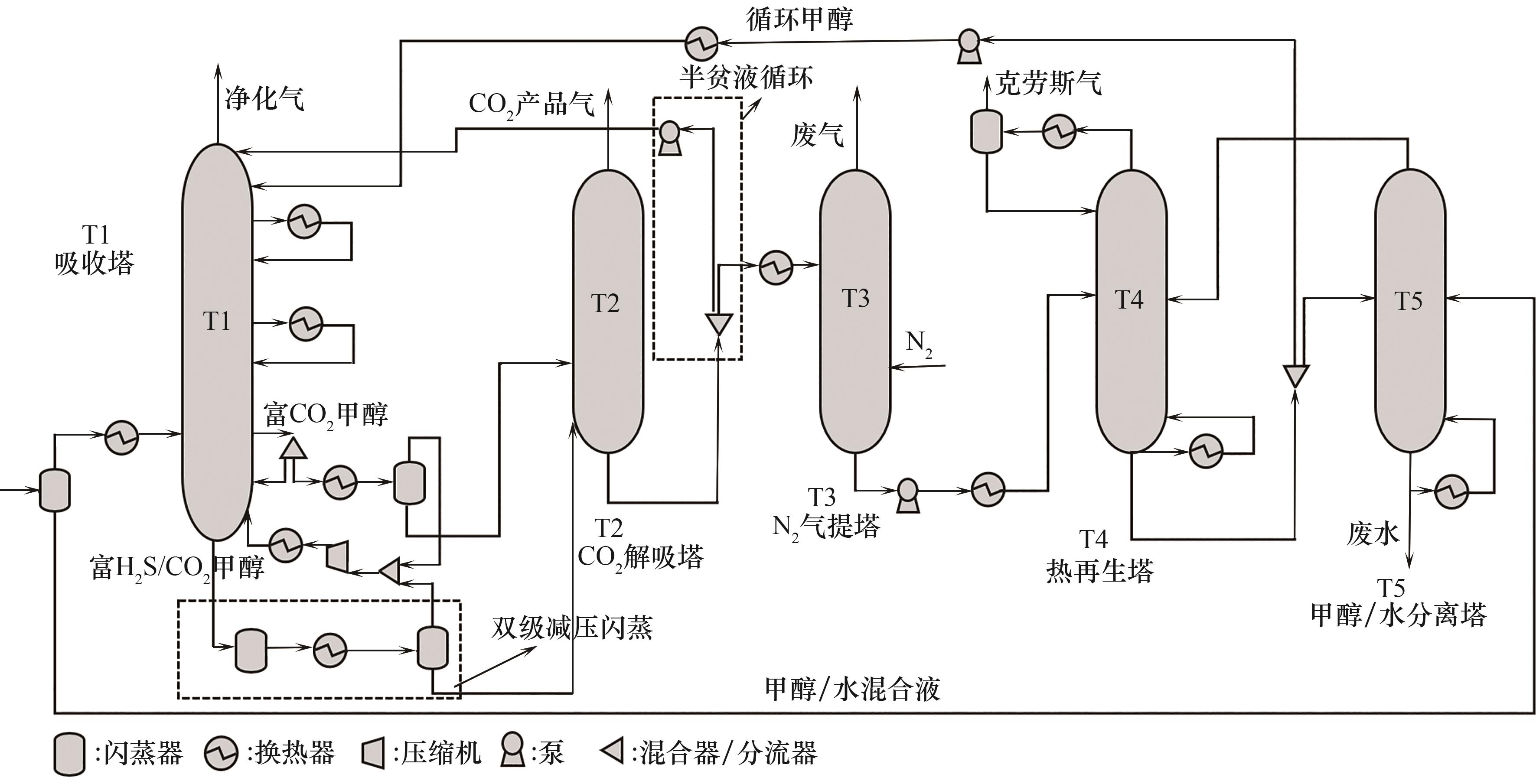
图6 低温甲醇洗循环工艺改进流程
Fig.6 Improvement process diagram of rectisol cycle technology
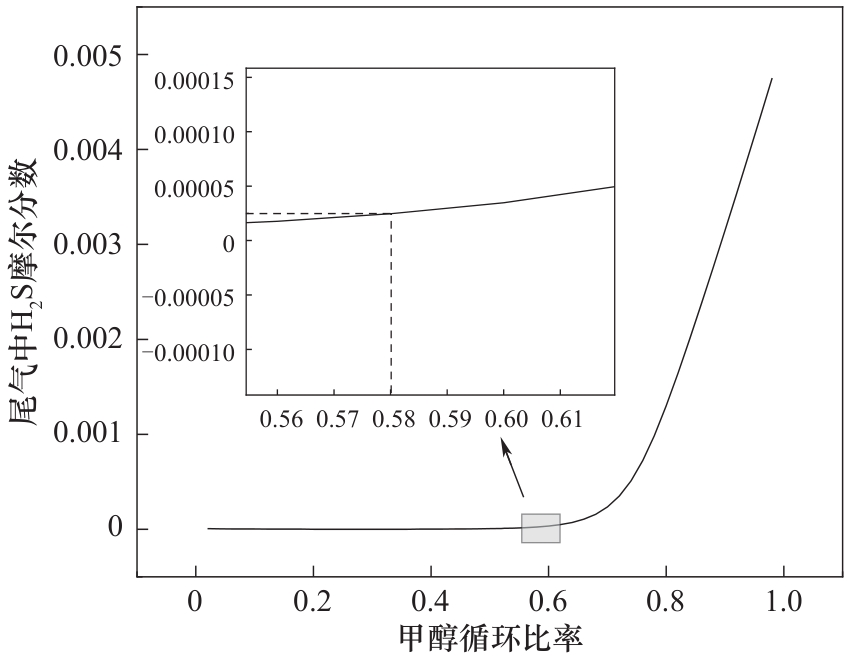
图7 甲醇循环比率对尾气中H2S含量的影响
Fig.7 Influence of methanol circulation ratio on H2S content in exhaust gas
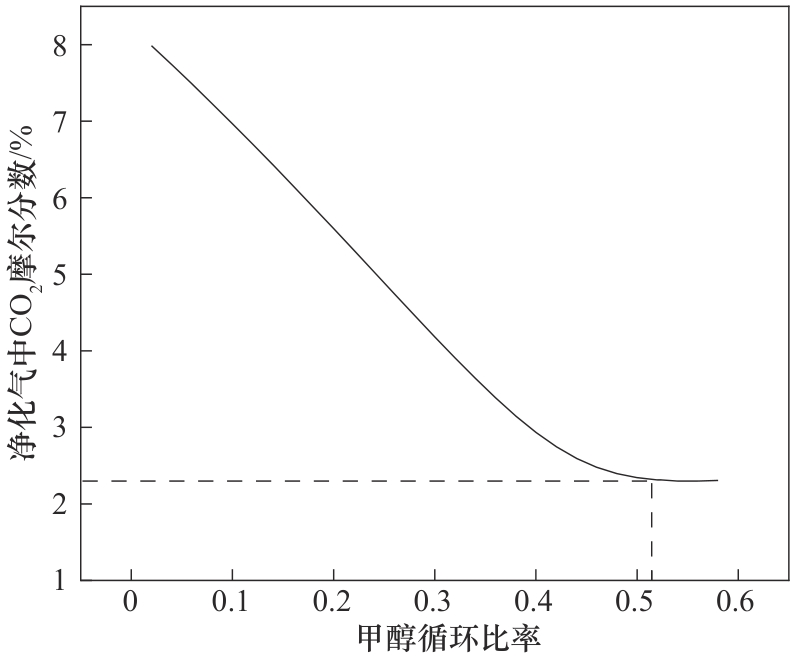
图8 甲醇循环比率对产品气中CO2含量的影响
Fig.8 Influence of methanol circulation ratio on CO2 content in product gas
| 参数 | 传统工艺 | 循环工艺 |
|---|---|---|
| CO2产量/(kmol·h-1) | 2788 | 3127 |
| CO2产量增加/% | — | 12.16 |
| CO2捕集效率/% | 60.17 | 67.49 |
| 尾气CO2排放量/(kmol·h-1) | 1683 | 1322 |
表3 CO2捕集量与排放量结果对比
Table 3 Comparison of CO2 capture rate and emissions results
| 参数 | 传统工艺 | 循环工艺 |
|---|---|---|
| CO2产量/(kmol·h-1) | 2788 | 3127 |
| CO2产量增加/% | — | 12.16 |
| CO2捕集效率/% | 60.17 | 67.49 |
| 尾气CO2排放量/(kmol·h-1) | 1683 | 1322 |
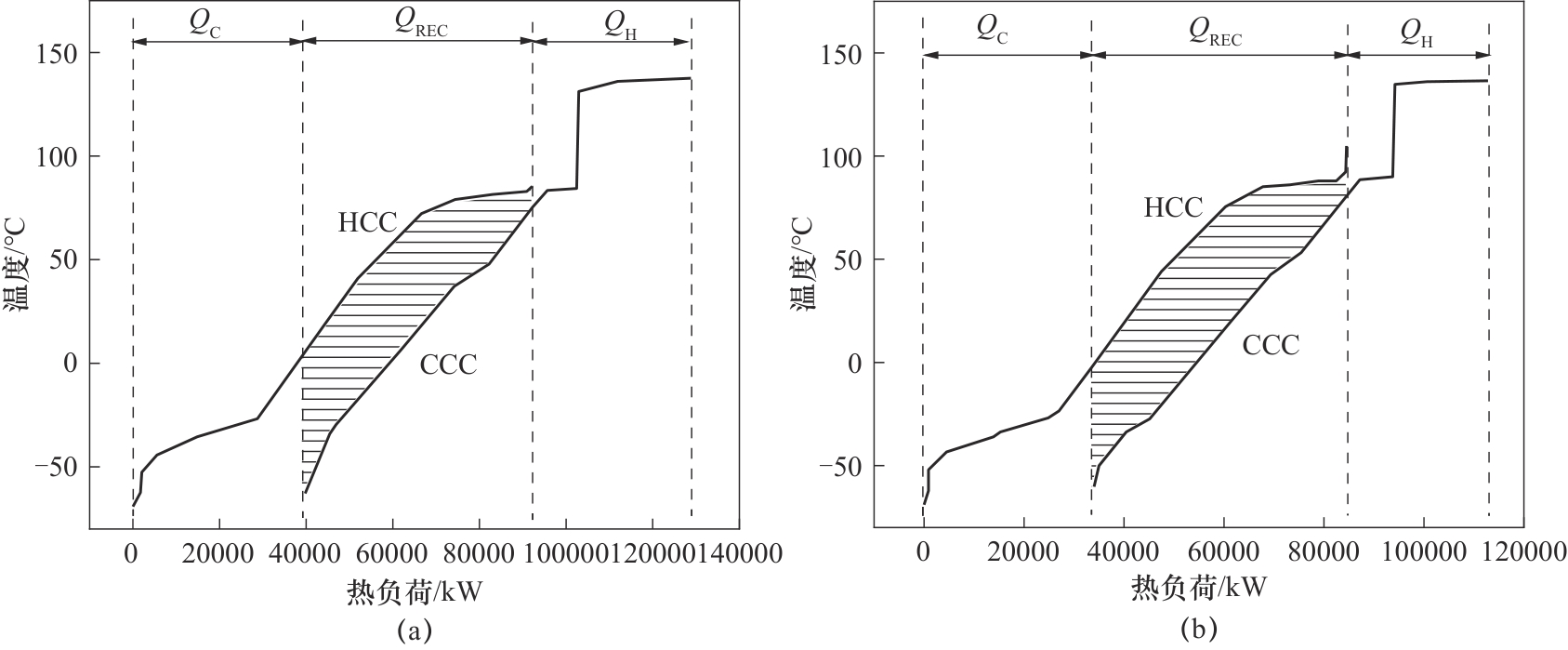
图9 传统工艺T-Q图(a)和循环工艺T-Q图(b)
Fig.9 T-Q diagram of traditional craft (a) and circulatory craft (b)

图10 双塔压缩工艺流程
Fig.10 Process flowchart of twin tower compression craft
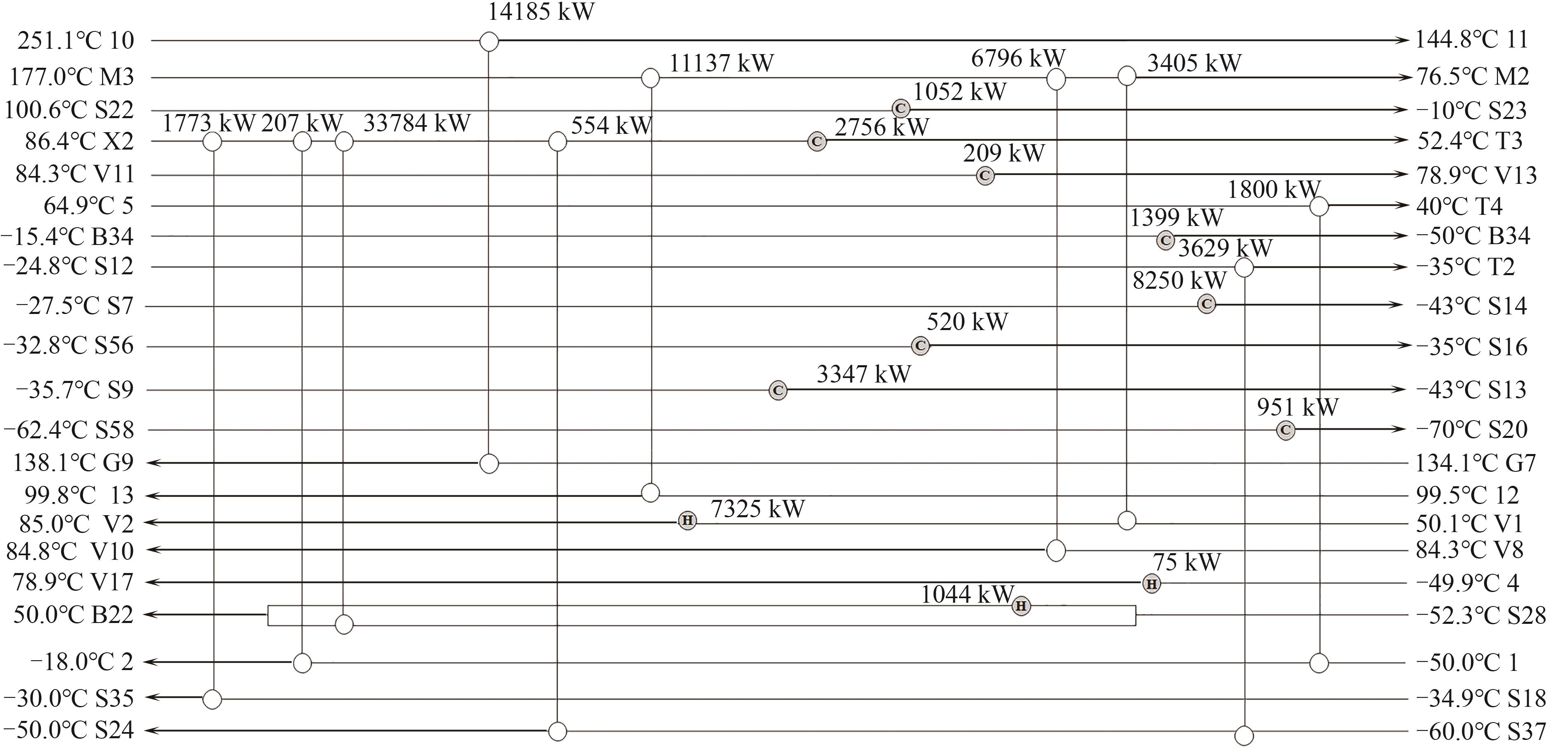
图11 双塔压缩工艺换热网络设计
Fig.11 HEN dseign of twin tower compression craft
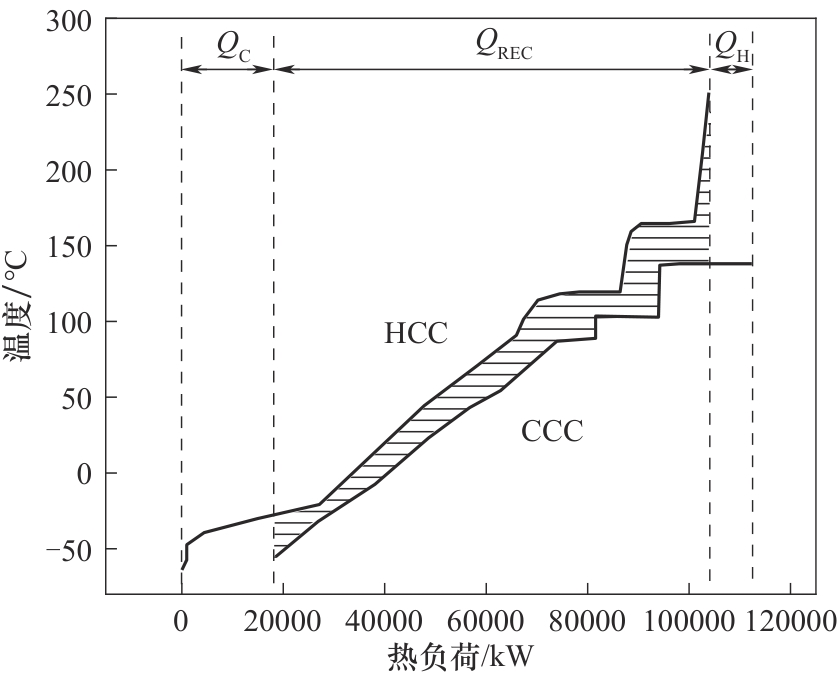
图12 双塔压缩工艺T-Q图
Fig.12 T-Q diagram of twin tower compression craft
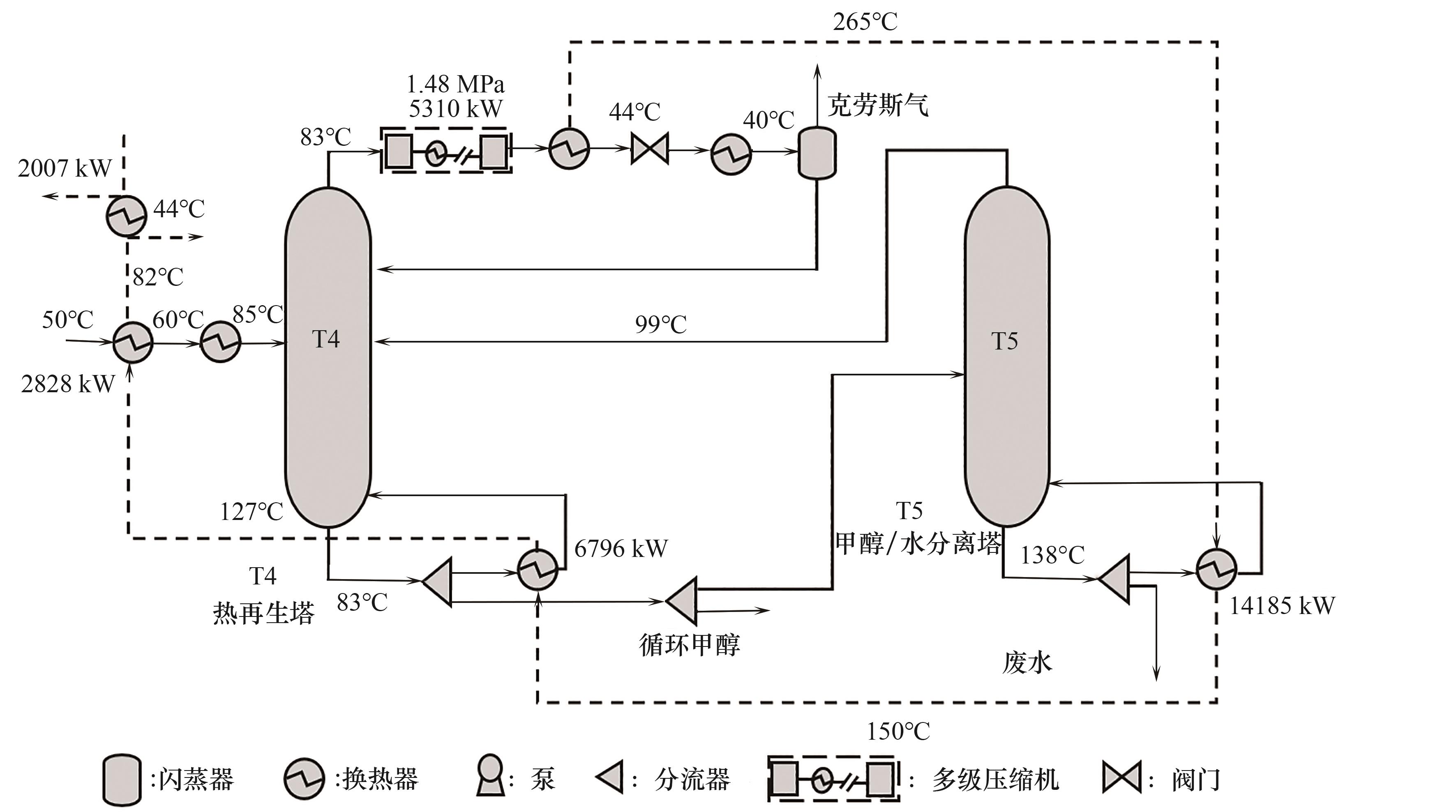
图13 单塔压缩工艺流程
Fig.13 Process flowchart of single tower compression craft
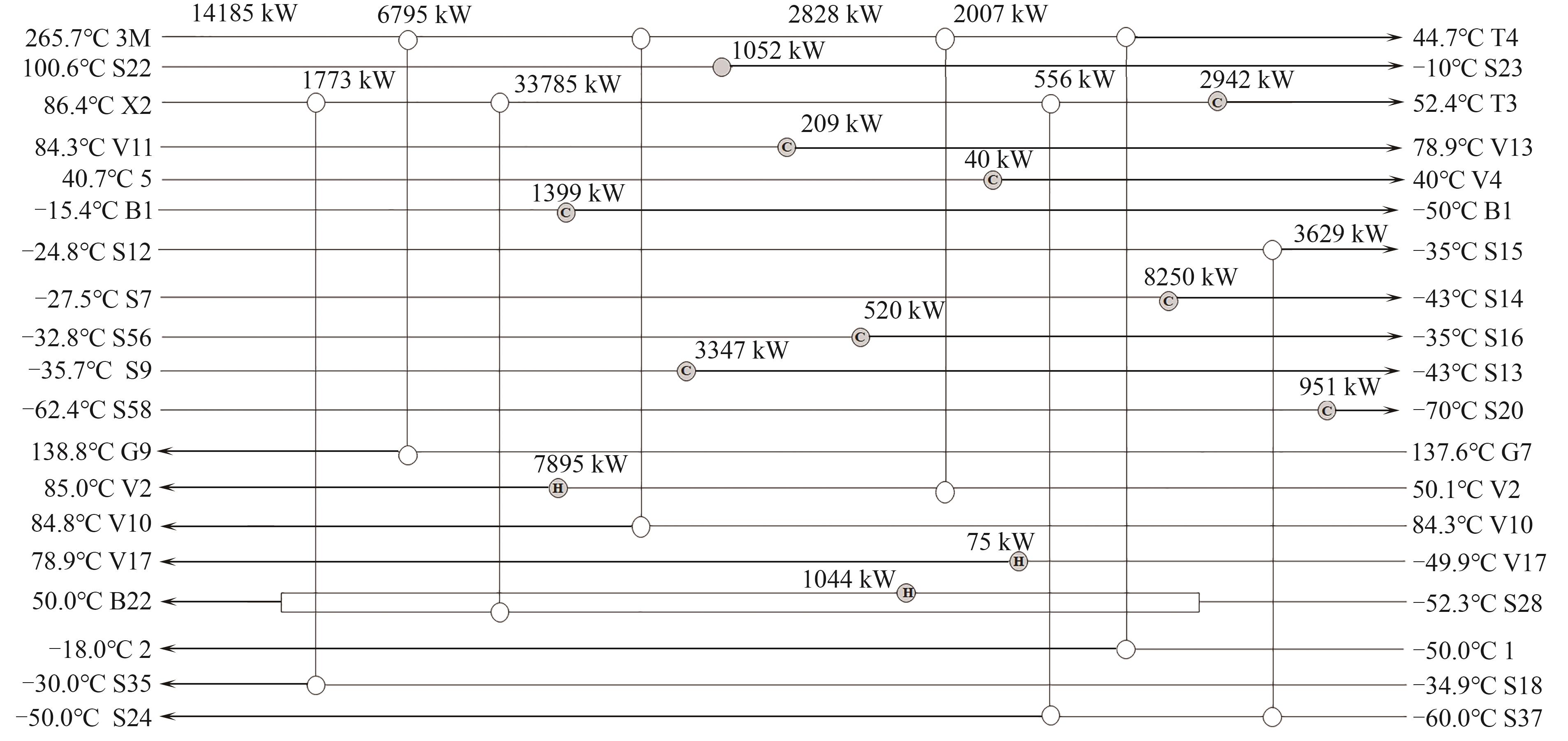
图14 单塔压缩工艺换热网络设计
Fig.14 HEN design of single tower compression craft
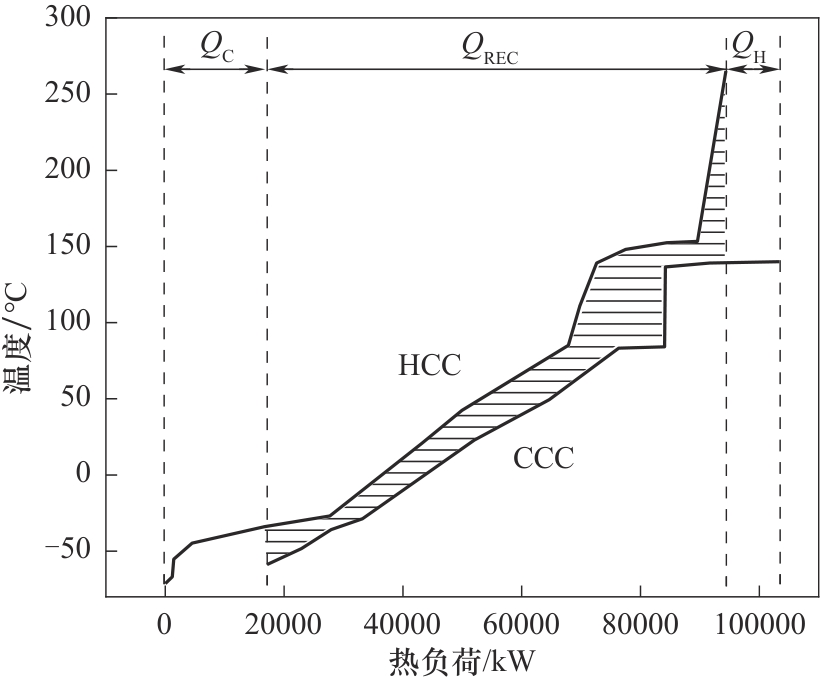
图15 单塔压缩工艺T-Q图
Fig.15 T-Q diagram of single tower compression craft
| 参数 | 传统工艺 | 循环工艺 | 单塔压缩 | 双塔压缩 |
|---|---|---|---|---|
| 电/kW | 1529.96 | 2463.01 | 7773.04 | 7980.94 |
| 蒸汽/kW | 36655.43 | 29328.53 | 9014.18 | 8444.78 |
| 冷却剂/kW | 39762.04 | 33992.63 | 18710.80 | 18484.72 |
| 总能耗/kW | 81007.35 | 70710.17 | 51044.10 | 50872.32 |
| 能耗减少/% | — | 12.71 | 36.98 | 37.20 |
表4 能耗分析结果对比
Table 4 Comparison of energy analysis results
| 参数 | 传统工艺 | 循环工艺 | 单塔压缩 | 双塔压缩 |
|---|---|---|---|---|
| 电/kW | 1529.96 | 2463.01 | 7773.04 | 7980.94 |
| 蒸汽/kW | 36655.43 | 29328.53 | 9014.18 | 8444.78 |
| 冷却剂/kW | 39762.04 | 33992.63 | 18710.80 | 18484.72 |
| 总能耗/kW | 81007.35 | 70710.17 | 51044.10 | 50872.32 |
| 能耗减少/% | — | 12.71 | 36.98 | 37.20 |
| 参数 | 单位CO2捕集能耗/(kWh·t-1) |
|---|---|
| 文献[ | 319.47 |
| 企业数据[ | 250~400 |
| 文献[ | 380.28 |
| 文献[ | 280.00 |
| 单塔压缩工艺 | 257.57 |
| 双塔压缩工艺 | 253.59 |
表5 单位CO2捕集能耗对比
Table 5 Comparison of energy consumption per unit of CO2 capture
| 参数 | 单位CO2捕集能耗/(kWh·t-1) |
|---|---|
| 文献[ | 319.47 |
| 企业数据[ | 250~400 |
| 文献[ | 380.28 |
| 文献[ | 280.00 |
| 单塔压缩工艺 | 257.57 |
| 双塔压缩工艺 | 253.59 |
| 参数 | 传统工艺 | 循环工艺 | 单塔压缩 | 双塔压缩 |
|---|---|---|---|---|
| 原料/kW | 624575.17 | 624575.17 | 624575.17 | 624575.17 |
| 电量㶲/kW | 1529.96 | 2463.01 | 7773.04 | 7980.94 |
| 热量㶲/kW | 10182.95 | 8248.69 | 2052.24 | 1915.08 |
| 冷量㶲/kW | 6710.02 | 5626.34 | 3674.99 | 3578.22 |
| 总输入/kW | 642998.11 | 640913.17 | 638075.44 | 638049.41 |
| 引入系统㶲量/kW | 18422.93 | 16338.04 | 13500.27 | 13474.24 |
| 㶲量减少/% | — | 11.32 | 26.72 | 26.86 |
| 总输出/kW | 615312.90 | 615179.97 | 615180.40 | 615179.97 |
| 㶲损失/kW | 27685.21 | 25709.59 | 22895.04 | 22869.44 |
| 㶲效率/% | 95.69 | 95.98 | 96.41 | 96.42 |
表6 㶲分析结果对比
Table 6 Comparison of exergy analysis results
| 参数 | 传统工艺 | 循环工艺 | 单塔压缩 | 双塔压缩 |
|---|---|---|---|---|
| 原料/kW | 624575.17 | 624575.17 | 624575.17 | 624575.17 |
| 电量㶲/kW | 1529.96 | 2463.01 | 7773.04 | 7980.94 |
| 热量㶲/kW | 10182.95 | 8248.69 | 2052.24 | 1915.08 |
| 冷量㶲/kW | 6710.02 | 5626.34 | 3674.99 | 3578.22 |
| 总输入/kW | 642998.11 | 640913.17 | 638075.44 | 638049.41 |
| 引入系统㶲量/kW | 18422.93 | 16338.04 | 13500.27 | 13474.24 |
| 㶲量减少/% | — | 11.32 | 26.72 | 26.86 |
| 总输出/kW | 615312.90 | 615179.97 | 615180.40 | 615179.97 |
| 㶲损失/kW | 27685.21 | 25709.59 | 22895.04 | 22869.44 |
| 㶲效率/% | 95.69 | 95.98 | 96.41 | 96.42 |
| 项目 | 传统工艺 | 单塔压缩 | 双塔压缩 |
|---|---|---|---|
| 换热器㶲损失/kW | 12217.48 | 8035.49 | 7982.75 |
| 混合器和塔设备㶲损失/kW | 8590.72 | 7631.28 | 7629.64 |
| 阀门等压力设备㶲损失/kW | 5883.11 | 5097.32 | 5089.81 |
| 电功率设备㶲损失/kW | 993.90 | 2130.95 | 2167.24 |
表7 㶲损失计算结果
Table 7 Calculation results of exergy loss
| 项目 | 传统工艺 | 单塔压缩 | 双塔压缩 |
|---|---|---|---|
| 换热器㶲损失/kW | 12217.48 | 8035.49 | 7982.75 |
| 混合器和塔设备㶲损失/kW | 8590.72 | 7631.28 | 7629.64 |
| 阀门等压力设备㶲损失/kW | 5883.11 | 5097.32 | 5089.81 |
| 电功率设备㶲损失/kW | 993.90 | 2130.95 | 2167.24 |
| 参数 | 传统工艺 | 改进工艺 | 单塔压缩 | 双塔压缩 |
|---|---|---|---|---|
| 塔/106 USD | 21.09 | 23.83 | 23.83 | 23.83 |
| 泵/106 USD | 0.45 | 0.58 | 0.58 | 0.58 |
| 压缩机/106 USD | 0.89 | 2.67 | 12.43 | 12.89 |
| 换热器/106 USD | 12.34 | 11.17 | 13.34 | 15.23 |
| 闪蒸器/106 USD | 0.17 | 0.19 | 0.19 | 0.19 |
| 再沸器/106 USD | 1.56 | 1.39 | — | — |
| 甲醇/106 USD | 0.18 | 0.16 | 0.16 | 0.16 |
| 设备成本/106 USD | 36.68 | 39.99 | 50.53 | 52.88 |
| 固定资本/106 USD | 93.90 | 102.37 | 129.35 | 135.37 |
| 营运资本/106 USD | 18.34 | 19.99 | 25.26 | 26.44 |
| 总资本投资/106 USD | 112.24 | 122.36 | 154.61 | 161.81 |
表8 资本投资总额结果对比
Table 8 Comparison of total capital investments
| 参数 | 传统工艺 | 改进工艺 | 单塔压缩 | 双塔压缩 |
|---|---|---|---|---|
| 塔/106 USD | 21.09 | 23.83 | 23.83 | 23.83 |
| 泵/106 USD | 0.45 | 0.58 | 0.58 | 0.58 |
| 压缩机/106 USD | 0.89 | 2.67 | 12.43 | 12.89 |
| 换热器/106 USD | 12.34 | 11.17 | 13.34 | 15.23 |
| 闪蒸器/106 USD | 0.17 | 0.19 | 0.19 | 0.19 |
| 再沸器/106 USD | 1.56 | 1.39 | — | — |
| 甲醇/106 USD | 0.18 | 0.16 | 0.16 | 0.16 |
| 设备成本/106 USD | 36.68 | 39.99 | 50.53 | 52.88 |
| 固定资本/106 USD | 93.90 | 102.37 | 129.35 | 135.37 |
| 营运资本/106 USD | 18.34 | 19.99 | 25.26 | 26.44 |
| 总资本投资/106 USD | 112.24 | 122.36 | 154.61 | 161.81 |
| 参数 | 传统工艺 | 循环工艺 | 单塔压缩 | 双塔压缩 |
|---|---|---|---|---|
| 蒸汽/106 USD | 8.21 | 6.57 | 2.02 | 1.89 |
| 电量/106 USD | 0.74 | 1.19 | 3.82 | 3.92 |
| 冷却剂/106 USD | 6.87 | 5.83 | 3.24 | 3.20 |
| 总运行成本/106 USD | 15.82 | 13.59 | 9.08 | 9.01 |
| 年度运行费用/106 USD | 23.30 | 21.75 (-6.65%) | 19.38 (-17.25%) | 19.79 (-15.06%) |
| 新增设备静态回收期/年 | — | 4.53 | 6.43 | 7.27 |
| 设备折旧年限/年 | 15 | 15 | 15 | 15 |
| 总生产成本/106 USD | 38.05 | 37.34 | 36.98 | 38.02 |
| 单位CO2产品成本/(USD·t-1) | 38.77 | 33.92 (-12.50%) | 33.6 (-13.33%) | 34.54 (-10.91%) |
表9 运行成本结果对比
Table 9 Comparison of operating cost results
| 参数 | 传统工艺 | 循环工艺 | 单塔压缩 | 双塔压缩 |
|---|---|---|---|---|
| 蒸汽/106 USD | 8.21 | 6.57 | 2.02 | 1.89 |
| 电量/106 USD | 0.74 | 1.19 | 3.82 | 3.92 |
| 冷却剂/106 USD | 6.87 | 5.83 | 3.24 | 3.20 |
| 总运行成本/106 USD | 15.82 | 13.59 | 9.08 | 9.01 |
| 年度运行费用/106 USD | 23.30 | 21.75 (-6.65%) | 19.38 (-17.25%) | 19.79 (-15.06%) |
| 新增设备静态回收期/年 | — | 4.53 | 6.43 | 7.27 |
| 设备折旧年限/年 | 15 | 15 | 15 | 15 |
| 总生产成本/106 USD | 38.05 | 37.34 | 36.98 | 38.02 |
| 单位CO2产品成本/(USD·t-1) | 38.77 | 33.92 (-12.50%) | 33.6 (-13.33%) | 34.54 (-10.91%) |
| 参数 | 传统工艺 | 循环工艺 | 单塔压缩 | 双塔压缩 |
|---|---|---|---|---|
| 蒸汽CO2/(kg·h-1) | 18711.04 | 14970.87 | 4601.41 | 4310.75 |
| 电CO2/(kg·h-1) | 98.95 | 376.97 | 2455.85 | 2536.85 |
| 总CO2排放/(kg·h-1) | 18809.99 | 15347.84 | 7057.26 | 6847.60 |
| 排放减少/% | — | 18.41 | 62.48 | 63.59 |
表10 CO2排放结果对比
Table 10 Comparison of CO2 emission results
| 参数 | 传统工艺 | 循环工艺 | 单塔压缩 | 双塔压缩 |
|---|---|---|---|---|
| 蒸汽CO2/(kg·h-1) | 18711.04 | 14970.87 | 4601.41 | 4310.75 |
| 电CO2/(kg·h-1) | 98.95 | 376.97 | 2455.85 | 2536.85 |
| 总CO2排放/(kg·h-1) | 18809.99 | 15347.84 | 7057.26 | 6847.60 |
| 排放减少/% | — | 18.41 | 62.48 | 63.59 |
| [1] | Petroleum British. Statistical review of world energy 2024[R]. UK: BP, 2024. |
| [2] | 郭李恒, 丁玉栋, 廖强, 等. 基于蒸汽压缩-分流的电厂烟气CO2捕集过程模拟优化[J]. 动力工程学报, 2021, 41(7): 565-571. |
| Guo L H, Ding Y D, Liao Q, et al. Simulation and optimization of carbon dioxide process for flue gas in power plants based on vapor compression and split flow[J]. Journal of Chinese Society of Power Engineering, 2021, 41(7): 565-571. | |
| [3] | Qu Y P, Sun J J. A quantitative investigation of the influence produced by the J-T valve replacement with nitrogen gas expander in Rectisol process[J]. Separation and Purification Technology, 2024, 345: 127364. |
| [4] | 相宏伟, 杨勇, 李永旺. 碳中和目标下的煤化工变革与发展[J]. 化工进展, 2022, 41(3): 1399-1408. |
| Xiang H W, Yang Y, Li Y W. Transformation and development of coal chemical industry under the goal of carbon neutralization[J]. Chemical Industry and Engineering Progress, 2022, 41(3): 1399-1408. | |
| [5] | 付楚芮. 现代煤化工气化能耗评价及节能潜力研究[J]. 中国煤炭, 2024, 50(8): 181-188. |
| Fu C R. Research on energy consumption evaluation and energy conservation potential of modern coal chemical gasification[J]. China Coal, 2024, 50(8): 181-188. | |
| [6] | 杨学萍. 碳中和背景下现代煤化工技术路径探索[J]. 化工进展, 2022, 41(7): 3402-3412. |
| Yang X P. Exploration on technical path of modern coal chemical industry under the background of carbon neutralization[J]. Chemical Industry and Engineering Progress, 2022, 41(7): 3402-3412. | |
| [7] | Xue C L, Cheng W P, Hao W M, et al. CH4/N2 adsorptive separation on zeolite X/AC composites[J]. Journal of Chemistry, 2019, 2019(1): 2078360. |
| [8] | Liang J X, Han H Y, Li W B, et al. Experimental study on the absorption enhancement of CO2 by MDEA-MEA based nanofluids[J]. The Canadian Journal of Chemical Engineering, 2022, 100(11): 3335-3344. |
| [9] | Ma S C, Song H H, Sun Y X. Ammonia escape inhibited by NHD in the process of carbon capture using ammonia solution[J]. Advanced Materials Research, 2012, 610/611/612/613: 1901-1904. |
| [10] | Liu S S, Zhou J F, Yang S Y. Advanced Rectisol wash equipment incorporating syngas liquefaction and methane recovery for enhanced energy management[J]. Energy, 2024, 299: 131431. |
| [11] | 张习文. 煤化工低温甲醇洗捕集CO2工艺流程模拟与优化研究[D]. 南京: 东南大学, 2023. |
| Zhang X W. Study on simulation and optimization of CO2 capture process by methanol washing at low temperature in coal chemical industry[D]. Nanjing: Southeast University, 2023. | |
| [12] | Sharma I, Hoadley A F A, Mahajani S M, et al. Multi-objective optimisation of a Rectisol™ process for carbon capture[J]. Journal of Cleaner Production, 2016, 119: 196-206. |
| [13] | Feng Z, Wang N, Li X H, et al. Process optimization, energy consumption analysis, and environmental assessment of total CO2 capture from syngas based on [NEMH][Ac] protic ionic liquid[J]. International Journal of Greenhouse Gas Control, 2024, 131: 104037. |
| [14] | 张陆, 杨声. 低温甲醇洗碳捕集改进与优化[J]. 化工进展, 2022, 41(11): 6167-6175. |
| Zhang L, Yang S. Improvement and optimization of carbon capture via Rectisol[J]. Chemical Industry and Engineering Progress, 2022, 41(11): 6167-6175. | |
| [15] | Chen J J, Lam H L, Qian Y, et al. Combined energy consumption and CO2 capture management: improved acid gas removal process integrated with CO2 liquefaction[J]. Energy, 2021, 215: 119032. |
| [16] | Sun X J, Liu L L, Zhang T, et al. Multi-objective optimization of a Rectisol process integrated with compression-absorption cascade refrigeration system and ORC for waste heat recovery[J]. Applied Thermal Engineering, 2024, 244: 122611. |
| [17] | Taheri M, Huang S, Lei Z G. IL-emitsol: ionic liquid based [EMIM][Tf2N] solvent process for selective removal of CO2 and H2S from syngas[J]. Industrial & Engineering Chemistry Research, 2019, 58(23): 10007-10017. |
| [18] | Kansha Y, Tsuru N, Sato K, et al. Self-heat recuperation technology for energy saving in chemical processes[J]. Industrial & Engineering Chemistry Research, 2009, 48(16): 7682-7686. |
| [19] | Kansha Y, Tsuru N, Fushimi C, et al. Integrated process module for distillation processes based on self-heat recuperation technology[J]. Journal of Chemical Engineering of Japan, 2010, 43(6): 502-507. |
| [20] | 刘叶刚, 张忠林, 侯起旺, 等. TBCFB合成气制甲醇工艺过程的概念设计和计算机模拟[J]. 化工学报, 2021, 72(9): 4838-4846. |
| Liu Y G, Zhang Z L, Hou Q W, et al. Process design and simulation of synthesis gas to methanol in TBCFB system[J]. CIESC Journal, 2021, 72(9): 4838-4846. | |
| [21] | 文兆伦, 李沛瑞, 张忠林, 等. 基于自热再生的隔壁塔深冷空分工艺设计及优化[J]. 化工学报, 2023, 74(7): 2988-2998. |
| Wen Z L, Li P R, Zhang Z L, et al. Design and optimization of cryogenic air separation process with dividing wall column based on self-heat regeneration[J]. CIESC Journal, 2023, 74(7): 2988-2998. | |
| [22] | Wang Y L, Liu X B, Kraslawski A, et al. A novel process design for CO2 capture and H2S removal from the syngas using ionic liquid[J]. Journal of Cleaner Production, 2019, 213: 480-490. |
| [23] | 李春澎, 张述伟, 李燕, 等. 低能耗半贫液多级再生低温甲醇洗建模与优化[J]. 天然气化工 (C1化学与化工), 2020, 45(4): 82-86, 93. |
| Li C P, Zhang S W, Li Y, et al. Simulation and optimization of low-energy-consumption Rectisol with multistage semi-lean solvent regeneration[J]. Natural Gas Chemical Industry, 2020, 45(4): 82-86, 93. | |
| [24] | 王培松, 李燕, 张述伟. 某厂低温甲醇洗工艺模拟及升级改造的研究[J]. 现代化工, 2023, 43(3): 221-225. |
| Wang P S, Li Y, Zhang S W. Research on simulation and upgrading of Rectisol process in a factory[J]. Modern Chemical Industry, 2023, 43(3): 221-225. | |
| [25] | Huang W G, Wang J F, Lu Z J, et al. Exergoeconomic and exergoenvironmental analysis of a combined heating and power system driven by geothermal source[J]. Energy Conversion and Management, 2020, 211: 112765. |
| [26] | Gadalla M, Olujić Ž, de Rijke A, et al. Reducing CO2 emissions of internally heat-integrated distillation columns for separation of close boiling mixtures[J]. Energy, 2006, 31(13): 2409-2417. |
| [27] | Liu J, Zhang X S, Lin Z. Exergy and energy analysis of a novel dual-chilling-source refrigerating system applied to temperature and humidity independent control[J]. Energy Conversion and Management, 2019, 197: 111875. |
| [28] | 张陆. 低温甲醇洗模拟与热力性能优化研究[D]. 长沙: 中南大学, 2022. |
| Zhang L. Study on simulation of low temperature methanol washing and optimization of thermal performance[D]. Changsha: Central South University, 2022. | |
| [29] | Zhao Z K, Andre Situmorang Y, An P, et al. A biomass-based small-scale power generation system with energy/exergy recuperation[J]. Energy Conversion and Management, 2021, 227: 113623. |
| [30] | Meng G C, Li P R, Zhang Z L, et al. Modeling and thermodynamic optimization of distributed combined heat and power system based on biomass chemical looping hydrogen generation process[J]. Chemical Engineering and Processing - Process Intensification, 2024, 203: 109862. |
| [31] | Yang S, Zhang L, Song D R. Conceptual design, optimization and thermodynamic analysis of a CO2 capture process based on Rectisol[J]. Energy, 2022, 244: 122566. |
| [32] | Li X G, Cui C T, Li H, et al. Process synthesis and simulation-based optimization of ethylbenzene/styrene separation using double-effect heat integration and self-heat recuperation technology: a techno-economic analysis[J]. Separation and Purification Technology, 2019, 228: 115760. |
| [33] | Xia H, Ye Q, Feng S Y, et al. Energy-efficient design of downstream separation to produce n-butanol by several heat-integrated technologies[J]. Industrial & Engineering Chemistry Research, 2018, 57(39): 13205-13216. |
| [34] | Zhai H, Rubin E S. Systems analysis of physical absorption of CO2 in ionic liquids for pre-combustion carbon capture[J]. Environmental Science & Technology, 2018, 52(8): 4996-5004. |
| [35] | Xie M N, Zhou M X, Chen L X, et al. Techno-economic assessment of the modified Allam cycle configurations with multi-stage pump/compressor for efficient operation in hot regions[J]. Energy Conversion and Management, 2024, 306: 118291. |
| [36] | Sipöcz N, Tobiesen F A. Natural gas combined cycle power plants with CO2 capture-opportunities to reduce cost[J]. International Journal of Greenhouse Gas Control, 2012, 7: 98-106. |
| [37] | Li K K, Leigh W, Feron P, et al. Systematic study of aqueous monoethanolamine (MEA)-based CO2 capture process: techno-economic assessment of the MEA process and its improvements[J]. Applied Energy, 2016, 165: 648-659. |
| [38] | 刘叶刚. TBCFB合成气制甲醇工艺模拟及自热再生能量优化[D]. 太原: 太原理工大学, 2021. |
| Liu Y G. Process simulation of methanol production from TBCFB syngas and optimization of autothermal regeneration energy[D]. Taiyuan: Taiyuan University of Technology, 2021. | |
| [39] | Qian Z H, Zhai R R, Feng L J, et al. Performance analysis of the acid gas removal from syngas based on self-heat recuperation technology[J]. Applied Thermal Engineering, 2023, 219: 119506. |
| [40] | Linde. Carbon capture, storage and utilisation[EB/OL]. [2024-05-01]. . |
| [41] | Yang S, Zhang L, Xie N, et al. Thermodynamic analysis of a semi-lean solution process for energy saving via Rectisol wash technology[J]. Energy, 2021, 226: 120402. |
| [42] | Wang J, Shen Y H, Zhang D H, et al. Integrated vacuum pressure swing adsorption and Rectisol process for CO2 capture from underground coal gasification syngas[J]. Chinese Journal of Chemical Engineering, 2023, 57: 265-279. |
| [1] | 密晓光, 孙国刚, 程昊, 张晓慧. 印刷电路板式天然气冷却器性能仿真模型和验证[J]. 化工学报, 2025, 76(S1): 426-434. |
| [2] | 杨语晴, 李银龙, 晏刚. 采用低GWP制冷剂的级联加热自复叠高温热泵循环热力学分析[J]. 化工学报, 2025, 76(S1): 43-53. |
| [3] | 张文锋, 郭玮, 张新玉, 曹昊敏, 丁国良. 铝管铝翅片换热器模型开发及软件实现[J]. 化工学报, 2025, 76(S1): 84-92. |
| [4] | 汪思远, 刘国强, 熊通, 晏刚. 窗式空调器轴流风机的风速非均匀分布特性及其对冷凝器流路优化设计的影响规律[J]. 化工学报, 2025, 76(S1): 205-216. |
| [5] | 孔繁臣, 张硕, 唐明生, 邹慧明, 胡舟航, 田长青. 二氧化碳直线压缩机气体轴承模拟[J]. 化工学报, 2025, 76(S1): 281-288. |
| [6] | 吴成云, 孙浩然. 民用飞机空调系统性能仿真与燃油代偿损失研究[J]. 化工学报, 2025, 76(S1): 351-359. |
| [7] | 周有苗, 刘晔, 余锋, 罗小钰, 王斌辉. 双源压缩-喷射复合热泵系统构建及特性分析[J]. 化工学报, 2025, 76(S1): 36-42. |
| [8] | 卓森庆, 陈华, 陈伟, 尚彬, 刘恒恒, 古汤汤, 白韡, 王龙炎, 曹昊敏, 丁国良. 多联式空调系统APF性能仿真的模型开发与软件实现[J]. 化工学报, 2025, 76(S1): 370-376. |
| [9] | 燕子腾, 詹飞龙, 丁国良. 空调用套管式分流器结构设计及分流效果验证[J]. 化工学报, 2025, 76(S1): 152-159. |
| [10] | 王杰, 林渠成, 张先明. 基于分解算法的混合气体多级膜分离系统全局优化[J]. 化工学报, 2025, 76(9): 4670-4682. |
| [11] | 周怀荣, 伊嘉伟, 曹阿波, 郭奥雪, 王东亮, 杨勇, 杨思宇. 共电解耦合CO2间接加氢制甲醇工艺集成设计与性能评价[J]. 化工学报, 2025, 76(9): 4586-4600. |
| [12] | 赵婧, 董书辰, 李高洋, 黄友科, 石浩森, 缪舒文, 谭辰妍, 朱唐琦, 李永帅, 潘慧, 凌昊. 基于电化学模型的电池性能模拟与优化[J]. 化工学报, 2025, 76(9): 4922-4932. |
| [13] | 刘璐, 王文玥, 王腾, 王太, 董新宇, 汤建成, 王少恒. 基于双混合工质深冷的氢液化工艺优化与分析[J]. 化工学报, 2025, 76(9): 4933-4943. |
| [14] | 曹潇风, 张华海, 王江云, 王利民. 锥形气体层流元件结构设计及流动特性研究[J]. 化工学报, 2025, 76(9): 4440-4448. |
| [15] | 周奕彤, 周明熙, 刘若晨, 叶爽, 黄伟光. 光伏与电网协同驱动氢基直接还原铁炼钢的技术经济分析[J]. 化工学报, 2025, 76(8): 4318-4330. |
| 阅读次数 | ||||||
|
全文 |
|
|||||
|
摘要 |
|
|||||
 京公网安备 11010102001995号