• •
邢梦可( ), 郑涛, 回天力(), 孟祥海, 张睿, 刘海燕, 刘植昌, 徐春明
收稿日期:2025-09-25
修回日期:2025-11-26
出版日期:2025-12-04
通讯作者:
回天力
作者简介:邢梦可(1997—),女,博士研究生,15830194737@163.com
基金资助:
Mengke XING(), Tao ZHENG, Tianli HUI(), Xianghai MENG, Rui ZHANG, Haiyan LIU, Zhichang LIU, Chunming XU
Received:2025-09-25
Revised:2025-11-26
Online:2025-12-04
Contact:
Tianli HUI
摘要:
制备了不同Zn掺杂量的PdO/Zn X Zr1-X O2催化剂,考察了氧空位和Lewis酸位点对CO2与苯酚合成碳酸二苯酯(DPC)反应性能的影响。XRD、Raman、EPR和XPS分析表明,适量Zn掺杂可形成锌锆固溶体,有效调节催化剂的氧空位浓度,增强CO2的吸附与活化。NH3-TPD和Py-IR研究结果显示,Zn掺杂和PdO负载增加了催化剂的Lewis酸位点,促进了苯酚的吸附与活化;氧空位和Lewis酸位点协同作用促进了DPC的高效合成。与Zn0.2Zr0.8O2和PdO/ZrO2相比,PdO/Zn0.2Zr0.8O2催化剂表现出最优性能,苯酚转化率达53.1%,DPC选择性达83.5%。原位FTIR分析表明,氧空位促进CO2活化生成双齿碳酸盐物种;Lewis酸位点促进苯酚O-H键断裂生成苯氧基物种,据此提出了氧空位与Lewis酸位点催化CO2和苯酚合成DPC的协同机理。
中图分类号:
邢梦可, 郑涛, 回天力, 孟祥海, 张睿, 刘海燕, 刘植昌, 徐春明. 富氧空位锌掺杂PdO/ZrO2催化CO2和苯酚合成碳酸二苯酯[J]. 化工学报, DOI: 10.11949/0438-1157.20251070.
Mengke XING, Tao ZHENG, Tianli HUI, Xianghai MENG, Rui ZHANG, Haiyan LIU, Zhichang LIU, Chunming XU. Zn-doped PdO/ZrO2 with rich oxygen vacancies for the synthesis of diphenyl carbonate from CO2 and phenol[J]. CIESC Journal, DOI: 10.11949/0438-1157.20251070.
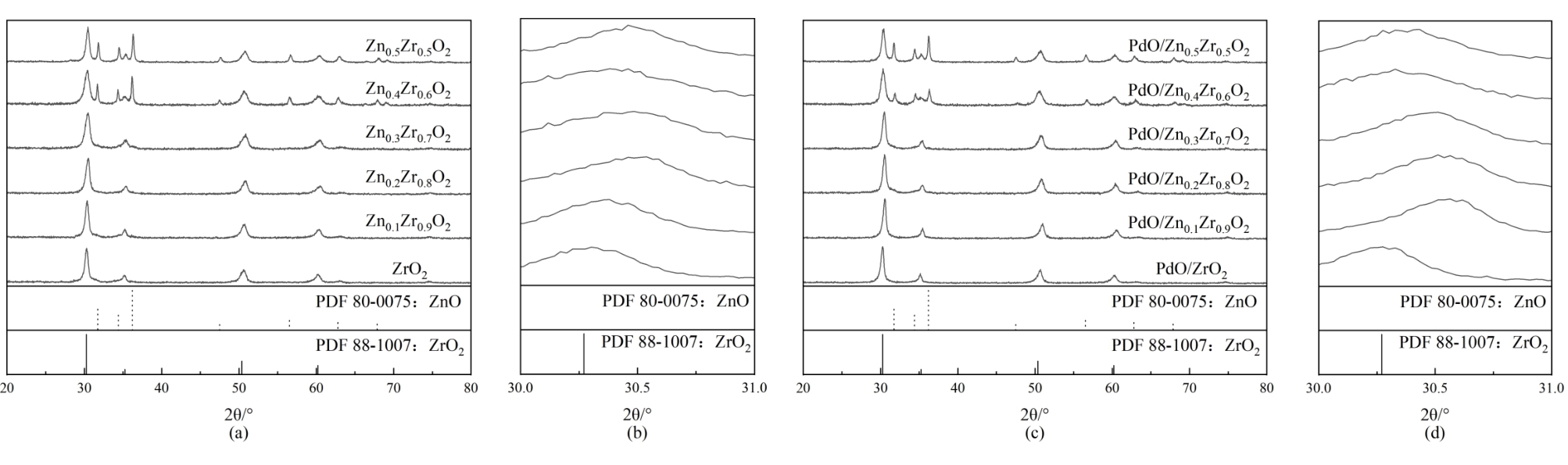
图1 (a, b) Zn X Zr1-X O2催化剂XRD谱图及其局部放大图;(c, d) PdO/Zn X Zr1-X O2催化剂XRD谱图及其局部放大图
Fig. 1 (a, b) XRD pattern and enlarge XRD pattern of Zn X Zr1-X O2 catalysts; (c, d) XRD pattern and enlarge XRD pattern of PdO/Zn X Zr1-X O2 catalysts
| Zn掺杂量 | 2θ/° | Zn X Zr1-X O2(011)晶面/nm | 晶格参数/nm | ||
|---|---|---|---|---|---|
| a | b | c | |||
| - | 30.3 | 0.295 | 3.610 | 3.610 | 5.150 |
| 0.1 | 30.4 | 0.289 | 3.602 | 3.602 | 5.106 |
| 0.2 | 30.6 | 0.285 | 3.593 | 3.599 | 5.088 |
| 0.3 | 30.5 | 0.287 | 3.599 | 3.599 | 5.091 |
| 0.4 | 30.3 | 0.290 | 3.605 | 3.605 | 5.125 |
| 0.5 | 30.3 | 0.292 | 3.608 | 3.608 | 5.142 |
表1 不同Zn掺杂量Zn X Zr1-X O2催化剂的晶面间距和晶格参数
Table 1 Interplanar spacing and lattice parameters of ZnZrO2(011) in Zn X Zr1-XO2 catalysts with different Zn doping content
| Zn掺杂量 | 2θ/° | Zn X Zr1-X O2(011)晶面/nm | 晶格参数/nm | ||
|---|---|---|---|---|---|
| a | b | c | |||
| - | 30.3 | 0.295 | 3.610 | 3.610 | 5.150 |
| 0.1 | 30.4 | 0.289 | 3.602 | 3.602 | 5.106 |
| 0.2 | 30.6 | 0.285 | 3.593 | 3.599 | 5.088 |
| 0.3 | 30.5 | 0.287 | 3.599 | 3.599 | 5.091 |
| 0.4 | 30.3 | 0.290 | 3.605 | 3.605 | 5.125 |
| 0.5 | 30.3 | 0.292 | 3.608 | 3.608 | 5.142 |
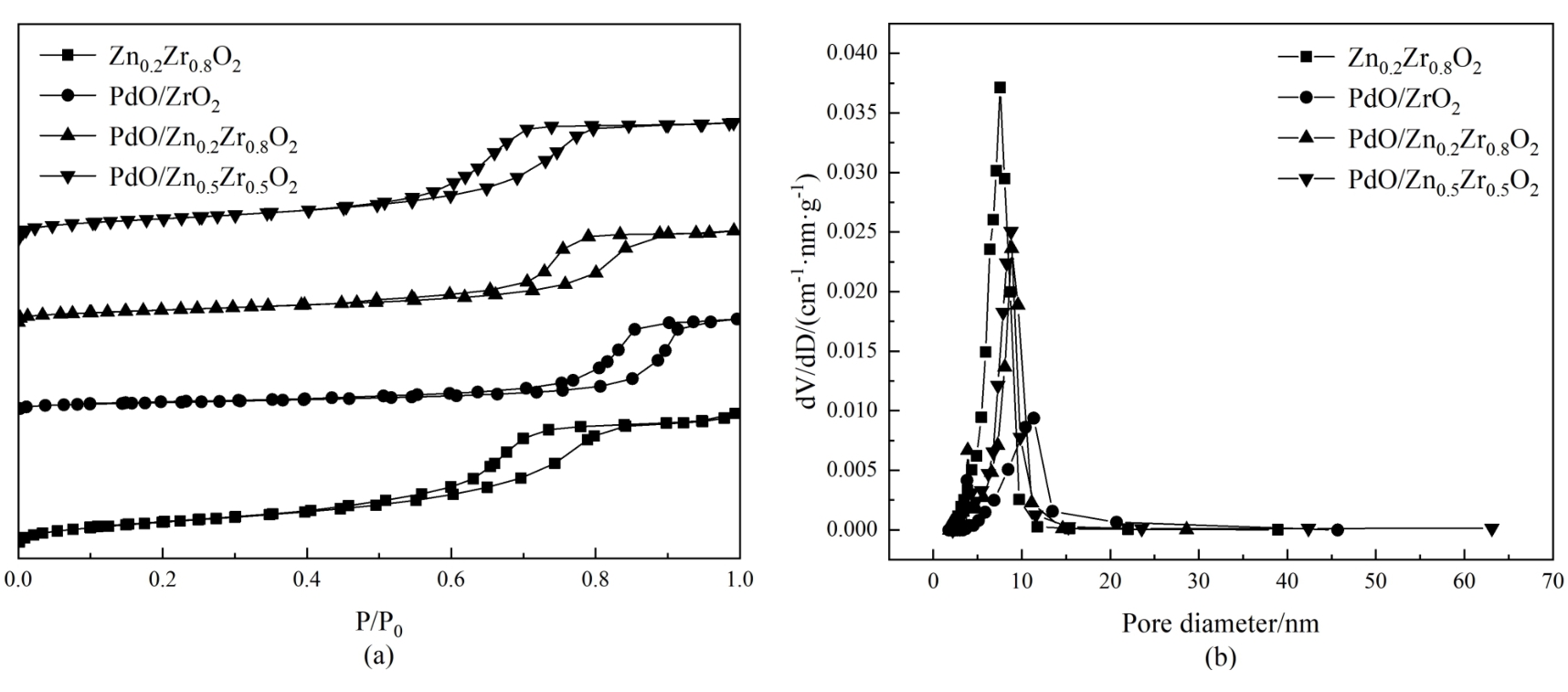
图2 PdO/Zn X Zr1-X O2催化剂的(a)N2吸附-脱附等温线和(b)孔径分布曲线
Fig. 2 (a) N2 adsorption-desorption isotherms and (b) pore size distribution curves of the PdO/Zn X Zr1-X O2 catalysts
| 催化剂 | 比表面积①/(m2·g-1) | 孔容②/(cm3·g-1) | 平均孔径/nm |
|---|---|---|---|
| Zn0.2Zr0.8O2 | 45 | 0.102 | 5 |
| PdO/ZrO2 | 28 | 0.0.70 | 8 |
| PdO/Zn0.2Zr0.8O2 | 39 | 0.076 | 6 |
| PdO/Zn0.5Zr0.5O2 | 34 | 0.069 | 6 |
表2 催化剂的理化性质
Table 2 Physical and chemical properties of catalysts
| 催化剂 | 比表面积①/(m2·g-1) | 孔容②/(cm3·g-1) | 平均孔径/nm |
|---|---|---|---|
| Zn0.2Zr0.8O2 | 45 | 0.102 | 5 |
| PdO/ZrO2 | 28 | 0.0.70 | 8 |
| PdO/Zn0.2Zr0.8O2 | 39 | 0.076 | 6 |
| PdO/Zn0.5Zr0.5O2 | 34 | 0.069 | 6 |
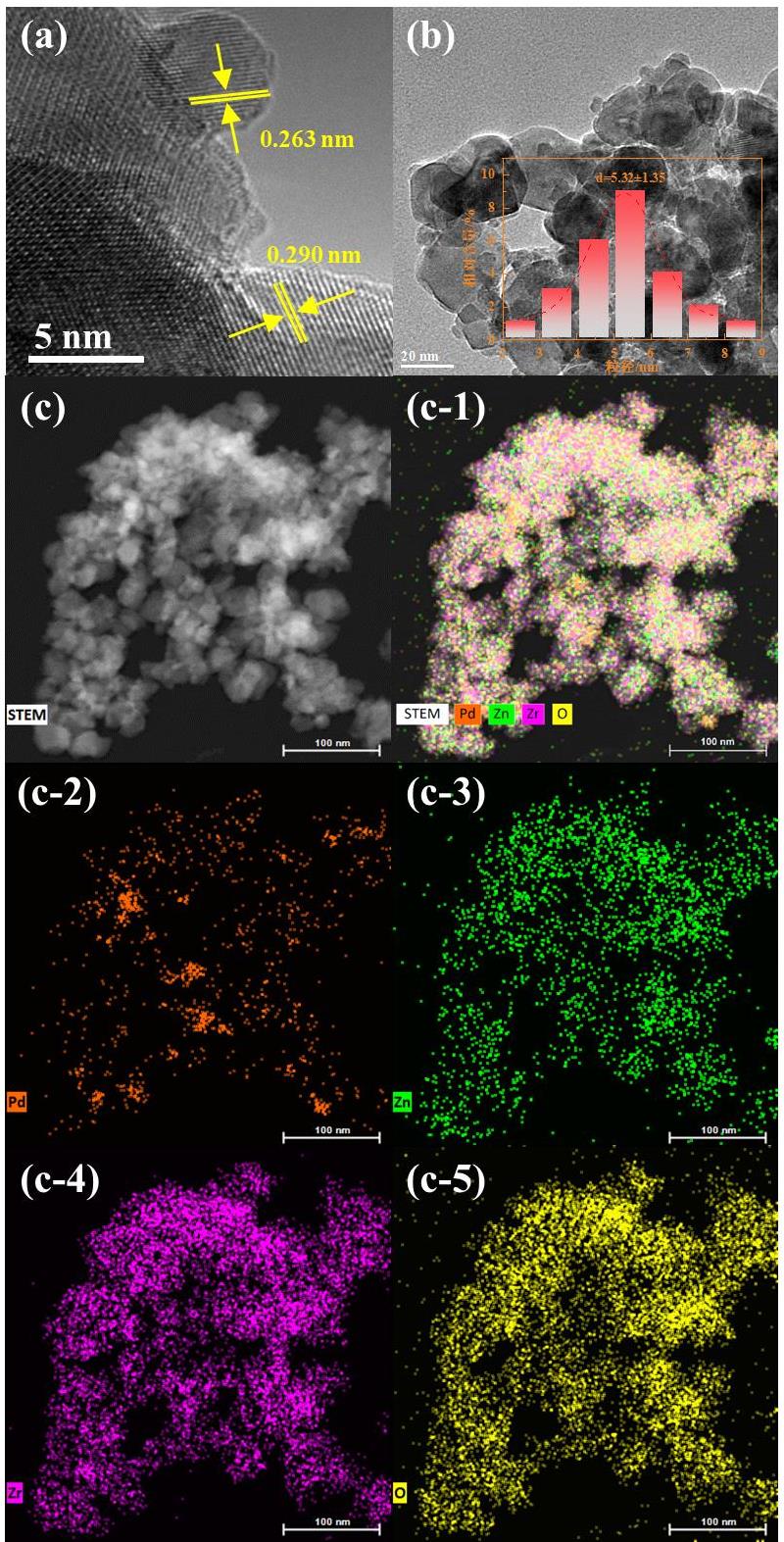
图3 (a) PdO/Zn0.2Zr0.8O2催化剂HRTEM图像;(b) PdO的粒径分布图;(c) PdO/Zn0.2Zr0.8O2对应的相应元素(Zr、Zn和O)映射图
Fig. 3 (a) HRTEM image of the PdO/Zn0.2Zr0.8O2 catalyst; (b) PdO particle size distribution; (c) elemental mapping of corresponding elements (Zr, Zn, and O) for the PdO/Zn0.2Zr0.8O2 catalyst
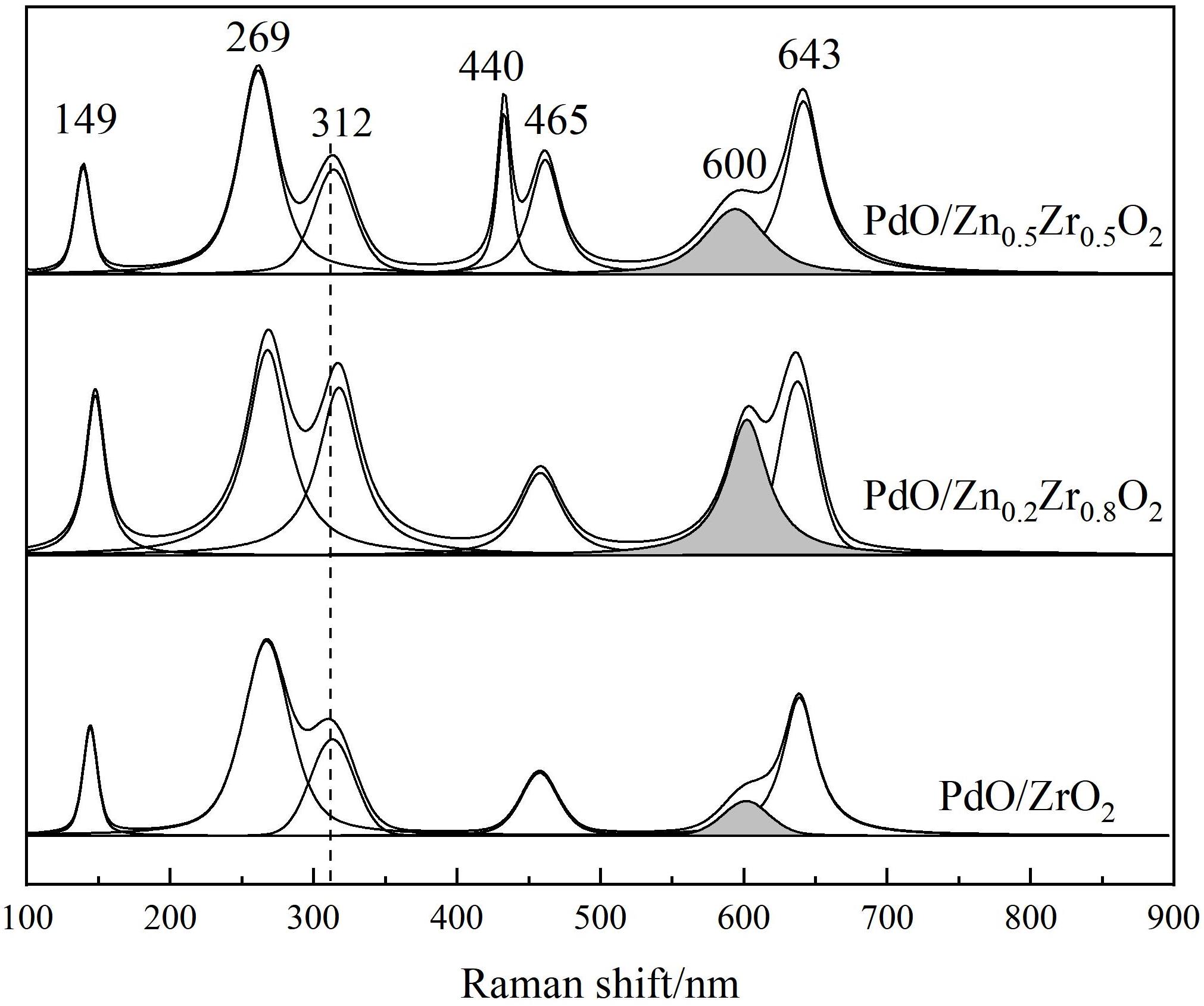
图4 PdO/Zn X Zr1-X O2催化剂Raman谱图
Fig. 4 Raman spectra of PdO/Zn X Zr1-X O2 catalysts
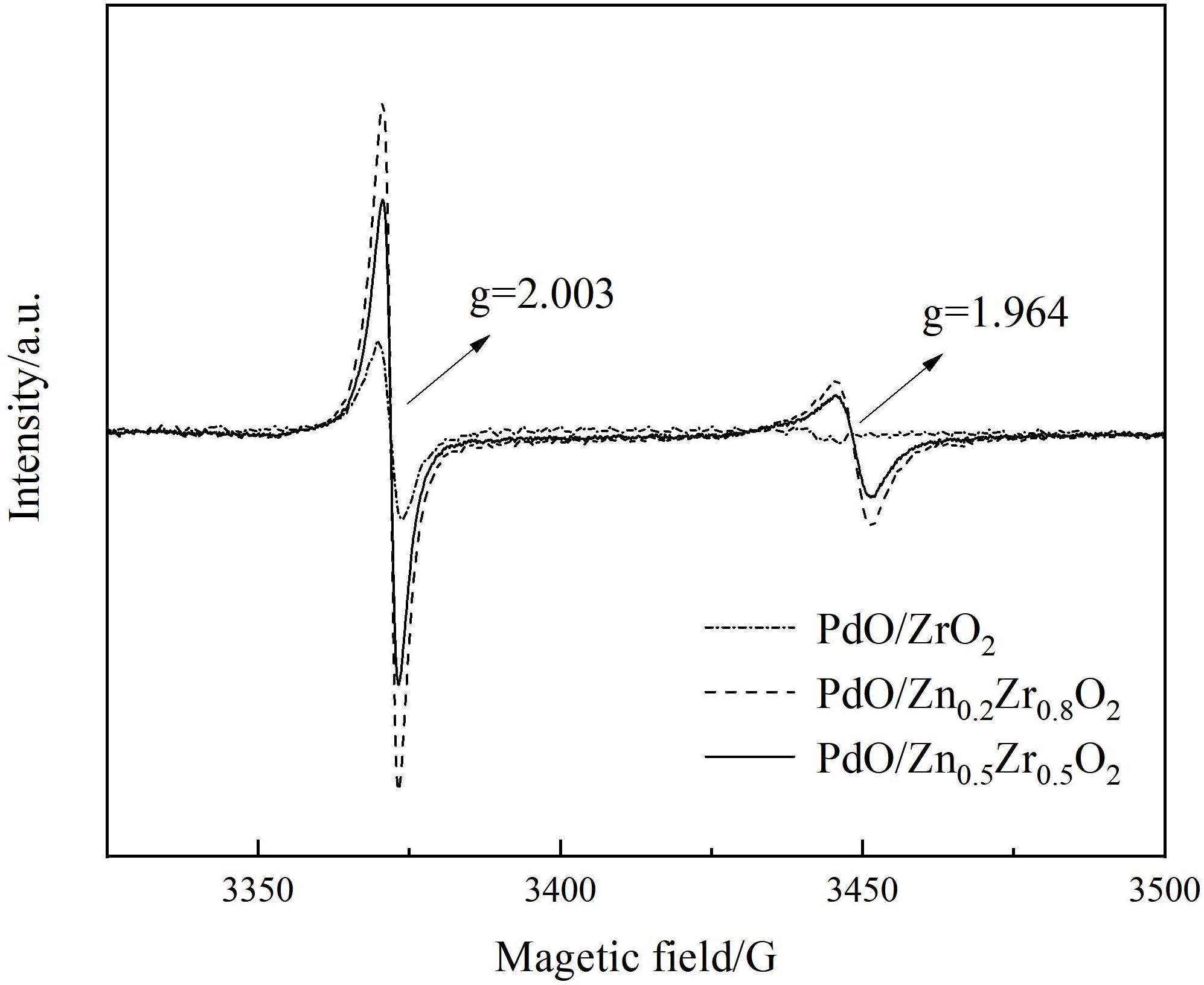
图5 PdO/Zn X Zr1-X O2催化剂EPR谱图
Fig. 5 EPR spectra of PdO/Zn X Zr1-X O2 catalysts
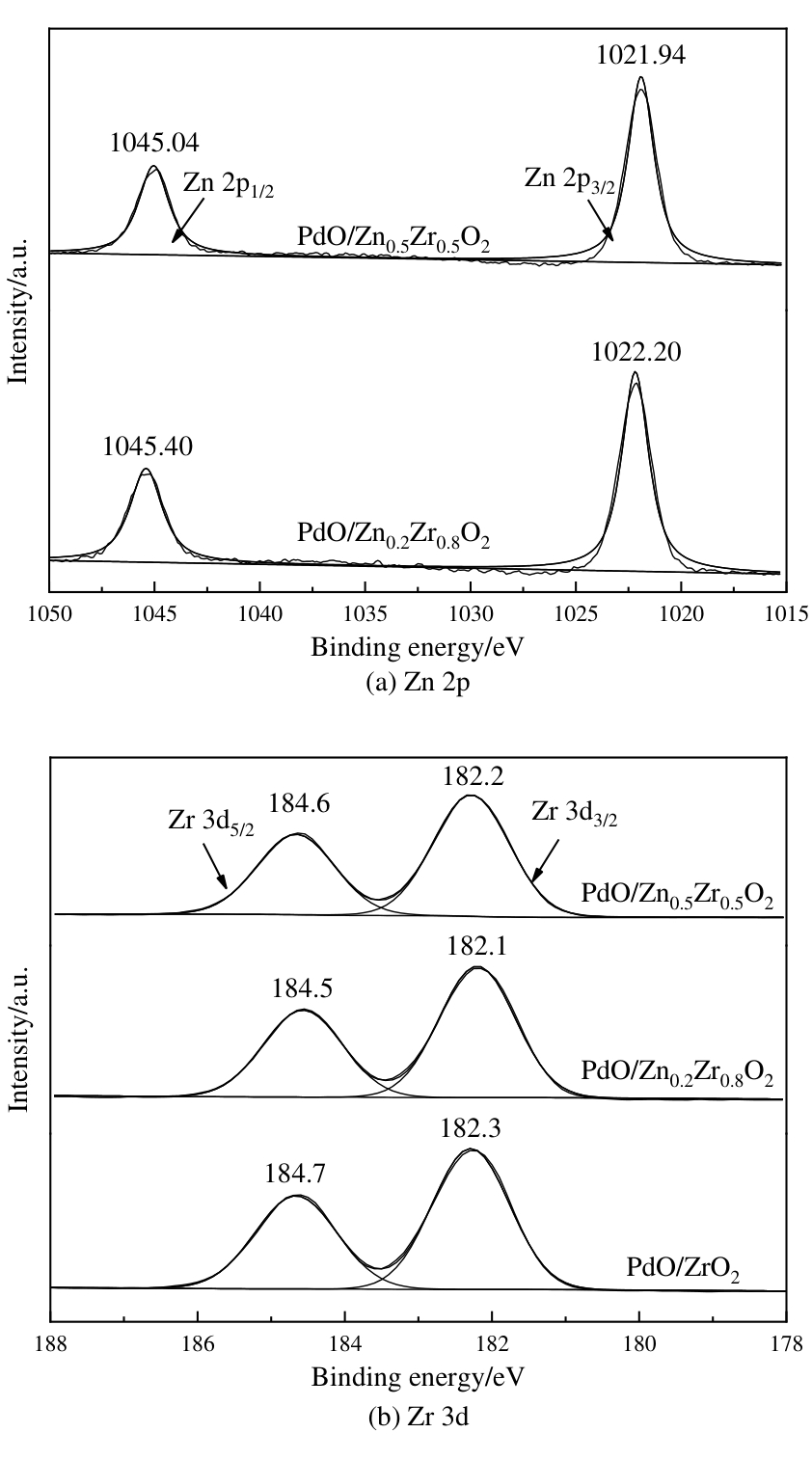
图6 PdO/Zn X Zr1-X O2催化剂Zn 2p和Zr 3d的XPS谱图
Fig. 6 XPS survey spectra of Zn 2p and Zr 3d in the PdO/Zn X Zr1-X O2 catalysts
| 催化剂 | n(Zn)/n(Zr) | [Oβ/(Oα+Oβ+Oγ)]/% | |
|---|---|---|---|
| XPS | ICP | ||
| PdO/Zn0.5Zr0.5O2 | 1.18 | 1.05 | 27.7 |
| PdO/Zn0.2Zr0.8O2 | 0.24 | 0.23 | 36.0 |
| PdO/ZrO2 | - | - | 23.1 |
表3 催化剂中Zn/Zr摩尔比和表面缺氧区(Oβ)浓度
Table 3 Zn/Zr molar ratio and surface oxygen defect (Oβ) concentration in the catalysts
| 催化剂 | n(Zn)/n(Zr) | [Oβ/(Oα+Oβ+Oγ)]/% | |
|---|---|---|---|
| XPS | ICP | ||
| PdO/Zn0.5Zr0.5O2 | 1.18 | 1.05 | 27.7 |
| PdO/Zn0.2Zr0.8O2 | 0.24 | 0.23 | 36.0 |
| PdO/ZrO2 | - | - | 23.1 |
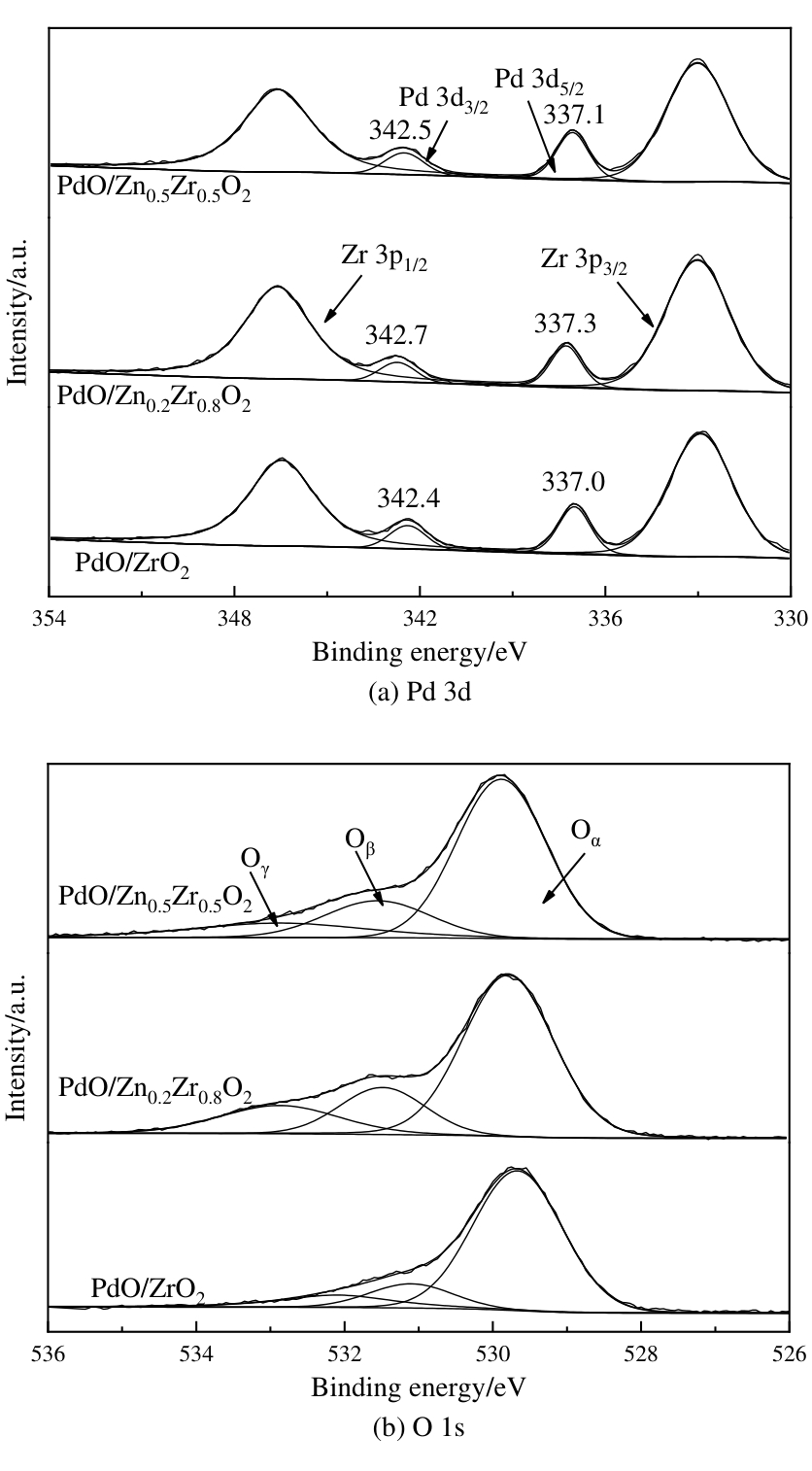
图7 PdO/Zn X Zr1-X O2催化剂Pd 3d和O 1s的高分辨XPS谱图
Fig. 7 XPS survey spectra of Pd 3d and O 1s in the PdO/Zn X Zr1-X O2 catalysts
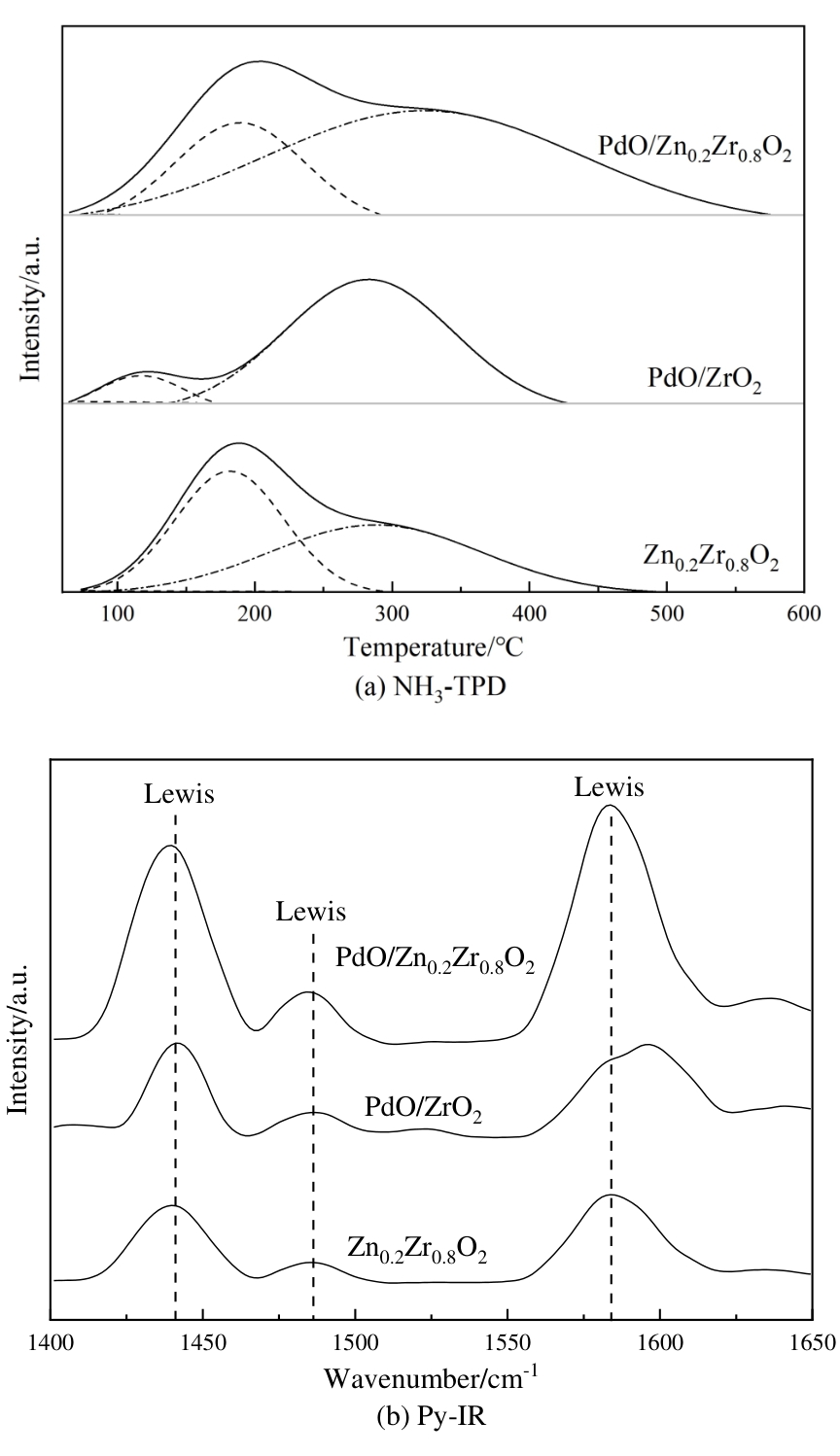
图8 PdO/Zn X Zr1-X O2催化剂的(a) NH3-TPD和(b) Py-IR光谱图
Fig. 8 (a) NH3-TPD and (b) Py-IR spectra of PdO/Zn X Zr1-X O2 catalysts
| 催化剂 | 弱酸位性点/mmol·g-1 | 中强酸性位点/mmol·g-1 | 总酸位点/mmol·g-1 | 酸密度 /μmol·m-2 |
|---|---|---|---|---|
| Zn0.2Zr0.8O2 | 0.27 | 0.24 | 0.51 | 11.33 |
| PdO/ZrO2 | 0.09 | 0.23 | 0.32 | 11.43 |
| PdO/Zn0.2Zr0.8O2 | 0.31 | 0.48 | 0.79 | 20.26 |
表4 PdO/Zn X Zr1-X O2催化剂表面酸性质
Table 4 Surface acidic properties of PdO/Zn X Zr1-X O2 catalysts
| 催化剂 | 弱酸位性点/mmol·g-1 | 中强酸性位点/mmol·g-1 | 总酸位点/mmol·g-1 | 酸密度 /μmol·m-2 |
|---|---|---|---|---|
| Zn0.2Zr0.8O2 | 0.27 | 0.24 | 0.51 | 11.33 |
| PdO/ZrO2 | 0.09 | 0.23 | 0.32 | 11.43 |
| PdO/Zn0.2Zr0.8O2 | 0.31 | 0.48 | 0.79 | 20.26 |
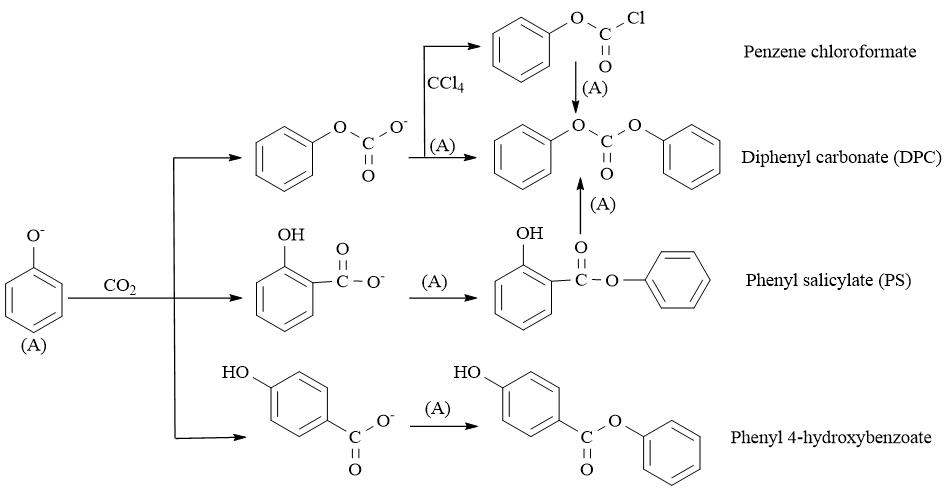
图9 CO2与苯酚反应生成DPC反应路径
Fig. 9 Reaction pathway of CO2 and phenol to produce DPC
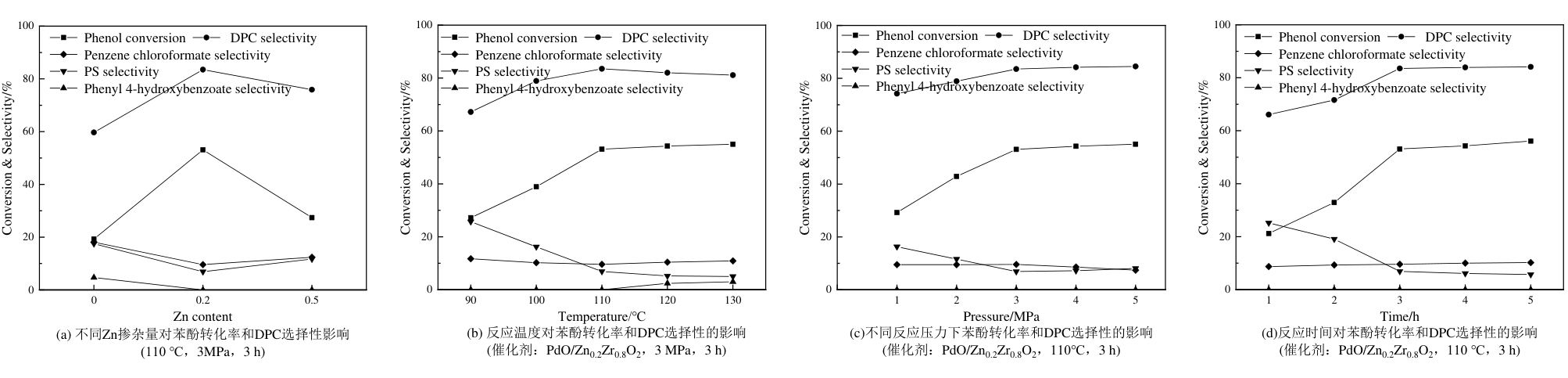
图10 不同条件对苯酚转化率和DPC选择性的影响
Fig. 10 Effect of different conditions on phenol conversion and DPC selectivity
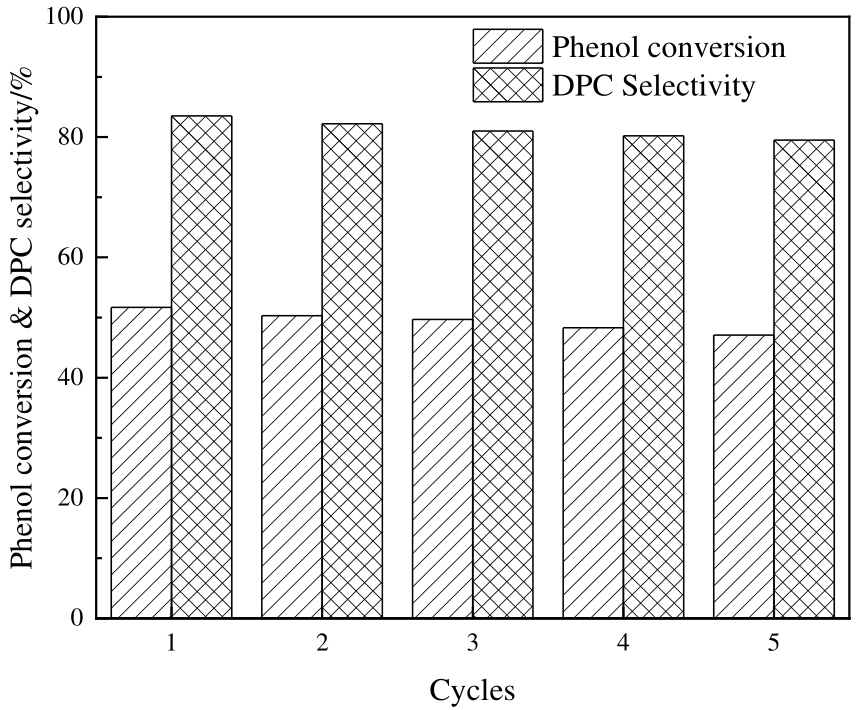
图11 PdO/Zn0.2Zr0.8O2催化剂的重复使用性能测试
Fig. 11 Reusability test of PdO/Zn0.2Zr0.8O2 catalyst
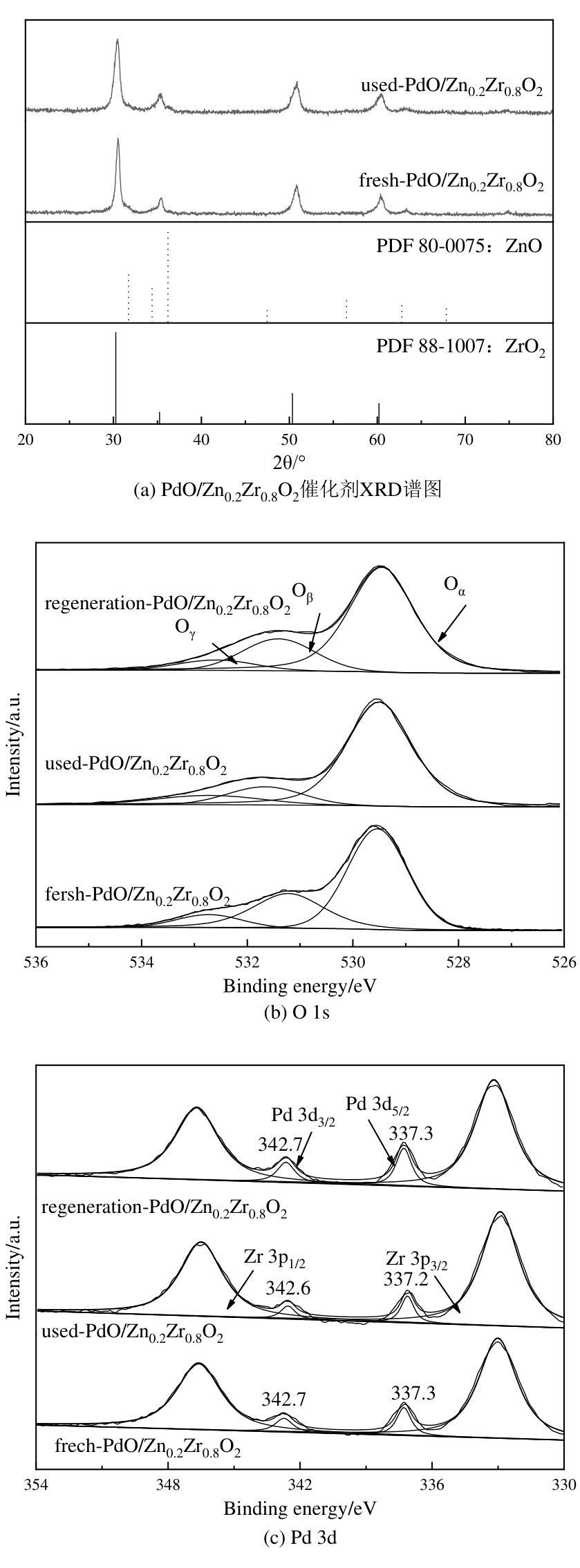
图12 使用前后及再生PdO/Zn0.2Zr0.8O2催化剂的结构表征(a) XRD谱图;(b) O 1s和(c) Pd 3d高分辨XPS谱图
Fig. 12 Structural characterization of the fresh, used and regeneration PdO/Zn0.2Zr0.8O2 catalysts (a) XRD patterns; High-resolution XPS spectra of (b) O 1s and (c) Pd 3d
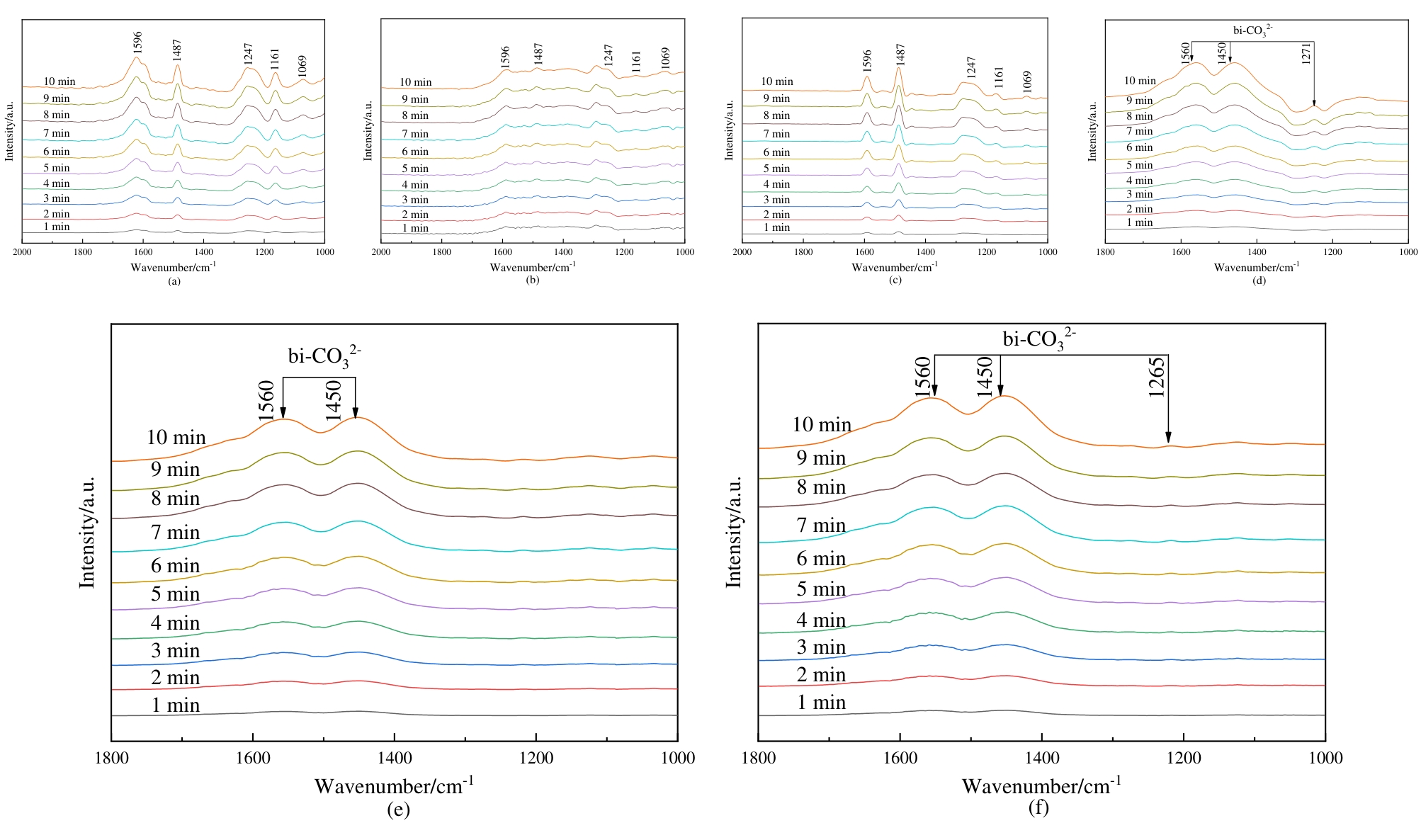
图13 催化剂表面苯酚吸附原位红外光谱图(a) PdO/Zn0.2Zr0.8O2, (b)PdO/ZrO2和(c) Zn0.2Zr0.8O2; CO2吸附原位红外光谱图(d) PdO/Zn0.2Zr0.8O2, (e)PdO/ZrO2 and (f) Zn0.2Zr0.8O2
Fig. 13 In situ FTIR spectra of phenol adsorption on catalyst surfaces: (a) PdO/Zn0.2Zr0.8O2, (b)PdO/ZrO2 and (c) Zn0.2Zr0.8O2; In situ FTIR spectra of CO2 adsorption on catalyst surfaces: (d) PdO/Zn0.2Zr0.8O2, (e) PdO/ZrO2 and (f) Zn0.2Zr0.8O2
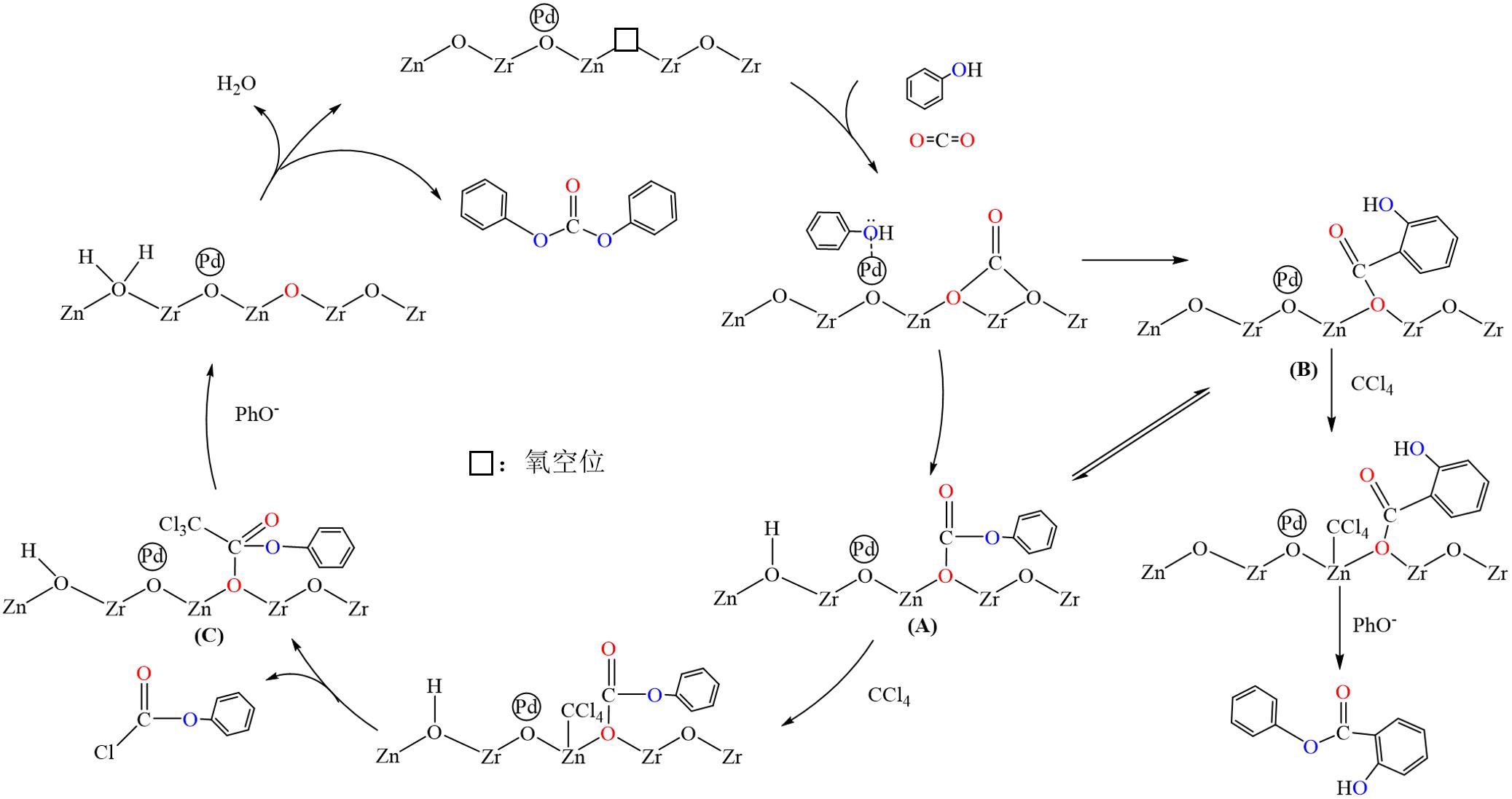
图14 PdO/Zn X Zr1-XO2催化剂合成DPC机理示意图
Fig. 14 Schematic diagram of the DPC synthesis mechanism on the PdO/Zn X Zr1-X O2 catalyst
| [1] | 安志杭, 李冰豪, 童德, 等. 熔融酯交换法绿色制备聚碳酸酯及抗菌改性[J]. 工程塑料应用, 2024, 52(6): 27-33. |
| An Z H, Li B H, Tong D, et al. Green preparation of polycarbonate with melt transesterification method and its antibacterial modification[J]. Engineering Plastics Application, 2024, 52(6): 27-33. | |
| [2] | 刘勇, 刘坚. 非光气法催化合成碳酸二苯酯研究进展[J]. 化工进展, 2013, 32(11): 2614-2620. |
| Liu Y, Liu J. Progress in the catalytic synthesis of diphenyl carbonate via non-phosgene routes[J]. Chemical Industry and Engineering Progress, 2013, 32(11): 2614-2620. | |
| [3] | Li Y W, Wang M, Liu X W, et al. Catalytic transformation of PET and CO2 into high-value chemicals[J]. Angewandte Chemie International Edition, 2022, 61(10): e202117205. |
| [4] | Kang K H, Jun J O, Han S J, et al. Direct synthesis of diphenyl carbonate from phenol and carbon dioxide over Ti-salen-based catalysts[J]. Journal of Nanoscience and Nanotechnology, 2015, 15(10): 8353-8358. |
| [5] | Fan G Z, Zhao H T, Duan Z X, et al. A novel method to synthesize diphenyl carbonate from carbon dioxide and phenol in the presence of methanol[J]. Catalysis Science & Technology, 2011, 1(7): 1138-1141. |
| [6] | Fan G Z, Wang Z G, Zou B, et al. Synthesis of diphenyl carbonate from compressed carbon dioxide and phenol without use of organic solvent[J]. Fuel Processing Technology, 2011, 92(5): 1052-1055. |
| [7] | Wang S L, Jiang N, Peng J L, et al. Efficient synthesis of diphenyl carbonate from CO2, phenol, and carbon tetrachloride under mild conditions[J]. ACS Sustainable Chemistry & Engineering, 2022, 10(38): 12689-12697. |
| [8] | Fan G Z, Luo S S, Wu Q, et al. ZnBr2 supported on silica-coated magnetic nanoparticles of Fe3O4 for conversion of CO2 to diphenyl carbonate[J]. RSC Advances, 2015, 5(70): 56478-56485. |
| [9] | Su K, Li Z, Cheng B, et al. Catalytic performance of metal oxide modified SiMCM-41 catalysts in diphenyl carbonate synthesis[J]. Kinetics and Catalysis, 2021, 51(3): 359-363. |
| [10] | 柏冬, 路文学, 王振华, 等. 无模板剂介孔锆基固体碱的制备及其催化合成甘油碳酸酯性能[J]. 石油学报(石油加工), 2020, 36(1): 54-62. |
| Bai D, Lu W X, Wang Z H, et al. Preparation of mesoporous Zr-based solid bases without templates for the synthesis of glycerol carbonate[J]. Acta Petrolei Sinica (Petroleum Processing Section), 2020, 36(1): 54-62. | |
| [11] | 陈红萍, 梁英华, 郑小满, 等. CO2和甲醇直接合成碳酸二甲酯的Fe-Zr-O催化剂制备和性能研究[J]. 高校化学工程学报, 2014, 28(4): 745-751. |
| Chen H P, Liang Y H, Zheng X M, et al. Preparation and catalytic performance of Fe-Zr-O catalysts for direct synthesis of dimethyl carbonate using CO2 and methanol[J]. Journal of Chemical Engineering of Chinese Universities, 2014, 28(4): 745-751. | |
| [12] | 郑谦, 官修帅, 靳山彪, 等. 铈锆固溶体Ce0.25Zr0.75O2光热协同催化CO2与甲醇合成DMC[J]. 化工进展, 2023, 42(S1): 319-327. |
| Zheng Q, Guan X S, Jin S B, et al. Photothermal catalysis synthesis of DMC from CO2 and methanol over Ce0.25Zr0.75O2 solid solution[J]. Chemical Industry and Engineering Progress, 2023, 42(S1): 319-327. | |
| [13] | Wang J J, Li G N, Li Z L, et al. A highly selective and stable ZnO-ZrO2 solid solution catalyst for CO2 hydrogenation to methanol[J]. Science Advances, 2017, 3(10): e1701290. |
| [14] | Zhang X B, Yu X, Mendes R G, et al. Highly dispersed ZnO sites in a ZnO/ZrO2 catalyst promote carbon dioxide-to-methanol conversion[J]. Angewandte Chemie International Edition, 2025, 64(4): e202416899. |
| [15] | Baylon R A L, Sun J M, Kovarik L, et al. Structural identification of ZnxZryOz catalysts for Cascade aldolization and self-deoxygenation reactions[J]. Applied Catalysis B: Environmental, 2018, 234: 337-346. |
| [16] | Li Y H, Ren Y H, Yang G C, et al. Unraveling the role of ZnZrOx morphology and oxygen vacancy in bifunctional catalyst for conversion of syngas into light olefins[J]. Applied Catalysis B: Environment and Energy, 2025, 365: 124945. |
| [17] | Liu B, Li C M, Zhang G Q, et al. Oxygen vacancy promoting dimethyl carbonate synthesis from CO2 and methanol over Zr-doped CeO2 nanorods[J]. ACS Catalysis, 2018, 8(11): 10446-10456. |
| [18] | Cao F X, Xiao Y S, Zhang Z M, et al. Influence of oxygen vacancies of CeO2 on reverse water gas shift reaction[J]. Journal of Catalysis, 2022, 414: 25-32. |
| [19] | Zhou S J, Li S G. Insights into the high activity and methanol selectivity of the Zn/ZrO2 solid solution catalyst for CO2 hydrogenation[J]. The Journal of Physical Chemistry C, 2020, 124(50): 27467-27478. |
| [20] | Huang Z S, Wang Y F, Qi M Y, et al. Interface synergy of exposed oxygen vacancy and Pd lewis acid sites enabling superior cooperative photoredox synthesis[J]. Angewandte Chemie International Edition, 2024, 63(47): e202412707. |
| [21] | 王志苗, 张洪起, 周立超, 等. Ce在负载Pd催化苯酚氧化羰基化合成碳酸二苯酯反应中的作用[J]. 化工学报, 2019, 70(12): 4625-4634, 4920. |
| Wang Z M, Zhang H Q, Zhou L C, et al. Role of Ce in supported Pd catalyst for oxidative carbonylation of phenol to diphenyl carbonate[J]. CIESC Journal, 2019, 70(12): 4625-4634, 4920. | |
| [22] | de Souza P M, Rabelo-Neto R C, Borges L E P, et al. Effect of zirconia morphology on hydrodeoxygenation of phenol over Pd/ZrO2 [J]. ACS Catalysis, 2015, 5(12): 7385-7398. |
| [23] | Yoshida H, Nakajima T, Yazawa Y, et al. Support effect on methane combustion over palladium catalysts[J]. Applied Catalysis B: Environmental, 2007, 71(1/2): 70-79. |
| [24] | Ma K, Zhao S Y, Dou M X, et al. Enhancing the stability of methanol-to-olefins reaction catalyzed by SAPO-34 zeolite in the presence of CO2 and oxygen-vacancy-rich ZnCeZrOx [J]. ACS Catalysis, 2024, 14(2): 594-607. |
| [25] | Tada S, Ochiai N, Kinoshita H, et al. Active sites on Zn x Zr1– x O2– x solid solution catalysts for CO2-to-methanol hydrogenation[J]. ACS Catalysis, 2022, 12(13): 7748-7759. |
| [26] | Dev G S, Sharma V, Singh A, et al. Raman spectroscopic study of ZnO/NiO nanocomposites based on spatial correlation model[J]. RSC Advances, 2019, 9(46): 26956-26960. |
| [27] | Chen H, Cui H S, Lv Y, et al. CO2 hydrogenation to methanol over Cu/ZnO/ZrO2 catalysts: Effects of ZnO morphology and oxygen vacancy[J]. Fuel, 2022, 314: 123035. |
| [28] | Ammar A U, Yildirim I D, Aleinawi M H, et al. Multifrequency EPR spectroscopy study of Mn, Fe, and Cu doped nanocrystalline ZnO[J]. Materials Research Bulletin, 2023, 160: 112117. |
| [29] | Drouilly C, Krafft J M, Averseng F, et al. ZnO oxygen vacancies formation and filling followed by in situ photoluminescence and in situ EPR[J]. The Journal of Physical Chemistry C, 2012, 116(40): 21297-21307. |
| [30] | Chen S L, Abdel-Mageed A M, Mochizuki C, et al. Controlling the O-vacancy formation and performance of Au/ZnO catalysts in CO2 reduction to methanol by the ZnO particle size[J]. ACS Catalysis, 2021, 11(15): 9022-9033. |
| [31] | Xue X D, Wang T, Jiang X D, et al. Interaction of hydrogen with defects in ZnO nanoparticles–studied by positron annihilation, Raman and photoluminescence spectroscopy[J]. CrystEngComm, 2014, 16(6): 1207-1216. |
| [32] | Liu M H, Chen Y W, Lin T S, et al. Defective mesocrystal ZnO-supported gold catalysts: facilitating CO oxidation via vacancy defects in ZnO[J]. ACS Catalysis, 2018, 8(8): 6862-6869. |
| [33] | Ling Y, Tan S Q, Wang D L, et al. An experimental and DFT study on enhanced elemental mercury removal performance via cerium chloride modified carbon aerogel: a synergistic effect between chemical adsorption and thermal catalysis[J]. Chemical Engineering Journal, 2021, 425: 127344. |
| [34] | Han S L, Zhao D, Otroshchenko T, et al. Elucidating the nature of active sites and fundamentals for their creation in Zn-containing ZrO2–based catalysts for nonoxidative propane dehydrogenation[J]. ACS Catalysis, 2020, 10(15): 8933-8949. |
| [35] | Srivastava M, Bera P, Balaraju J N, et al. FESEM and XPS studies of ZrO2 modified electrodeposited NiCoCrAlY nanocomposite coating subjected to hot corrosion environment[J]. RSC Advances, 2016, 6(110): 109083-109090. |
| [36] | Zao H J, Liu J, Chen G Y, et al. Enhanced conversion of syngas to high-quality diesel fuel over ZrO2 and acidized carbon nanotube bifunctional catalyst[J]. Fuel Processing Technology, 2023, 250: 107920. |
| [37] | Yang Y, Wang G, Zheng P, et al. Carbon deposits during catalytic combustion of toluene on Pd–Pt-based catalysts[J]. Catalysis Science & Technology, 2020, 10(8): 2452-2461. |
| [38] | Xie S H, Deng J G, Zang S M, et al. Au–Pd/3DOM Co3O4: Highly active and stable nanocatalysts for toluene oxidation[J]. Journal of Catalysis, 2015, 322: 38-48. |
| [39] | Wu Y, Chen J J, Hu W, et al. Phase transformation and oxygen vacancies in Pd/ZrO2 for complete methane oxidation under lean conditions[J]. Journal of Catalysis, 2019, 377: 565-576. |
| [40] | Su K M, Li Z H, Cheng B W, et al. The decomposition of CCl4 into diphenyl carbonate over MClχ/SiMCM-41[J]. Catalysis Communications, 2008, 9(7): 1666-1670. |
| [41] | Esteves L M, Brijaldo M H, Oliveira E G, et al. Effect of support on selective 5-hydroxymethylfurfural hydrogenation towards 2, 5-dimethylfuran over copper catalysts[J]. Fuel, 2020, 270: 117524. |
| [42] | Xu L L, Zhao R R, Zhang W P. One-step high-yield production of renewable propene from bioethanol over composite ZnCeOx oxide and HBeta zeolite with balanced Brönsted/Lewis acidity[J]. Applied Catalysis B: Environmental, 2020, 279: 119389. |
| [43] | Manrı́quez M E, López T, Gómez R, et al. Preparation of TiO2–ZrO2 mixed oxides with controlled acid–basic properties[J]. Journal of Molecular Catalysis A: Chemical, 2004, 220(2): 229-237. |
| [44] | 卢思, 陈晓丽, 苏秋成, 等. 原位红外光谱-吡啶吸附法表征分子筛酸性性质的实验方法研究[J]. 光谱学与光谱分析, 2024, 44(9): 2488-2493. |
| Lu S, Chen X L, Su Q C, et al. The study of experimental method on the characterization of acidic properties of zeolites by in situ FTIR-pyridine adsorption[J]. Spectroscopy and Spectral Analysis, 2024, 44(9): 2488-2493. | |
| [45] | Xing M K, Hui T L, Zhang R, et al. Diphenyl carbonate synthesis from CO2 over a ZnCeZrOX ternary solid solution: synergistic catalysis using oxygen vacancies and Lewis acid sites[J]. Catalysis Science & Technology, 2025, 15(16): 4872-4884. |
| [46] | 刘速, 孙晓艳, 樊宏飞, 等. 再生温度对FC-28型催化剂再生效果的影响[J]. 工业催化, 2012, 20(12): 45-49. |
| Liu S, Sun X Y, Fan H F, et al. Influence of temperature on regeneration effect of FC-28 catalyst[J]. Industrial Catalysis, 2012, 20(12): 45-49. | |
| [47] | Feng Z D, Tang C Z, Zhang P F, et al. Asymmetric sites on the ZnZrO x catalyst for promoting formate formation and transformation in CO2 hydrogenation[J]. Journal of the American Chemical Society, 2023, 145(23): 12663-12672. |
| [1] | 孙云龙, 徐肖肖, 黄永方, 郭纪超, 陈卫卫. 水平光滑管内CO2流动沸腾的非绝热可视化研究[J]. 化工学报, 2025, 76(S1): 230-236. |
| [2] | 郭纪超, 徐肖肖, 孙云龙. 基于植物工厂中的CO2浓度气流模拟及优化研究[J]. 化工学报, 2025, 76(S1): 237-245. |
| [3] | 孔繁臣, 张硕, 唐明生, 邹慧明, 胡舟航, 田长青. 二氧化碳直线压缩机气体轴承模拟[J]. 化工学报, 2025, 76(S1): 281-288. |
| [4] | 何婷, 张开, 林文胜, 陈利琼, 陈家富. 沼气超临界压力低温脱碳-液化耦合流程研究[J]. 化工学报, 2025, 76(S1): 418-425. |
| [5] | 张建民, 何美贵, 贾万鑫, 赵静, 金万勤. 聚氧化乙烯/冠醚共混膜及其二氧化碳分离性能[J]. 化工学报, 2025, 76(9): 4862-4871. |
| [6] | 王一飞, 李玉星, 欧阳欣, 赵雪峰, 孟岚, 胡其会, 殷布泽, 郭雅琦. 基于裂尖减压特性的CO2管道断裂扩展数值计算[J]. 化工学报, 2025, 76(9): 4683-4693. |
| [7] | 周运桃, 崔丽凤, 张杰, 于富红, 李新刚, 田野. Ga2O3调控CuCeO催化CO2加氢制甲醇的研究[J]. 化工学报, 2025, 76(8): 4042-4051. |
| [8] | 刘沁雯, 叶恒冰, 张逸伟, 朱法华, 钟文琪. 煤与禽类粪便混合燃料的加压富氧燃烧特性研究[J]. 化工学报, 2025, 76(7): 3487-3497. |
| [9] | 丁宏鑫, 干文翔, 赵雍洋, 贾润泽, 康子祺, 赵玉隆, 向勇. X65钢焊接接头在超临界CO2相及富H2O相中的腐蚀机理研究[J]. 化工学报, 2025, 76(7): 3426-3435. |
| [10] | 董泽明, 娄聚伟, 王楠, 陈良奇, 王江峰, 赵攀. 含余热回收的超临界压缩二氧化碳储能系统热力学特性研究[J]. 化工学报, 2025, 76(7): 3477-3486. |
| [11] | 范振宁, 梁海宁, 房茂立, 赫一凡, 于帅, 闫兴清, 安佳然, 乔帆帆, 喻健良. CO2管道不同相态节流放空特性研究与对比[J]. 化工学报, 2025, 76(7): 3742-3751. |
| [12] | 卢丽丽, 李晨, 陈柳云, 谢新玲, 罗轩, 苏通明, 秦祖赠, 纪红兵. BiOBr的形貌调控及其光催化CO2还原性能的研究[J]. 化工学报, 2025, 76(6): 2687-2700. |
| [13] | 陈建兵, 常昊, 高明, 邢兵, 张磊, 刘奇磊. 基于反应模板与分子动力学的胺基相变吸收剂分相预测方法[J]. 化工学报, 2025, 76(5): 2387-2396. |
| [14] | 赵俊德, 周爱国, 陈彦霖, 郑家乐, 葛天舒. 吸附法CO2直接空气捕集技术能耗现状[J]. 化工学报, 2025, 76(4): 1375-1390. |
| [15] | 张赵雪, 李正宇, 崔文慧, 王倩, 王志平, 龚领会. 基于液氖液氮梯级蓄冷的液氢储能中冷能回收利用研究[J]. 化工学报, 2025, 76(4): 1731-1741. |
| 阅读次数 | ||||||
|
全文 |
|
|||||
|
摘要 |
|
|||||
 京公网安备 11010102001995号