• •
明勇1( ), 苏文2, 余亚雄2, 肖珍1
收稿日期:2025-09-08
修回日期:2025-11-29
出版日期:2025-12-01
通讯作者:
明勇
作者简介:明勇(1984-),男,博士,讲师,280248885@qq.com
基金资助:
Yong MING1(), Wen SU2, Yaxiong YU2, Zhen XIAO1
Received:2025-09-08
Revised:2025-11-29
Online:2025-12-01
Contact:
Yong MING
摘要:
为评估ORC技术回收铝电解槽侧壁余热的可行性,本文设计并搭建了一套中温余热 ORC 现场实验系统,选用工质 RC318,在完全密封与可回收条件下开展实验研究。通过调控蒸发温度、冷凝温度及工质与冷却水流量,系统研究了关键运行参数对循环性能的影响规律。实验结果表明:系统性能主要由蒸发端与冷凝端的热力匹配决定,随着蒸发温度的升高净输出功和热效率增大,而冷凝温度升高则会显著降低系统性能。当蒸发温度接近工质的临界区时,性能提升呈现明显的边际递减特征。蒸发器是系统中不可逆损失最集中的部分,其㶲损随蒸发温度变化呈先下降、后趋于平缓的规律性趋势。过热度对整体性能的贡献有限,其影响主要体现在低蒸发温度区。在本实验条件下,膨胀机的最大输出功率为 9.5kW,循环热效率和㶲效率分别为 8.8% 和 33.96%。
中图分类号:
明勇, 苏文, 余亚雄, 肖珍. 基于RC318的铝电解槽侧壁余热发电系统的设计与实验分析[J]. 化工学报, DOI: 10.11949/0438-1157.20251012.
Yong MING, Wen SU, Yaxiong YU, Zhen XIAO. Design and experimental analysis for waste heat power generation system from aluminum reduction cell's sidewalls based on RC318 working fluid[J]. CIESC Journal, DOI: 10.11949/0438-1157.20251012.
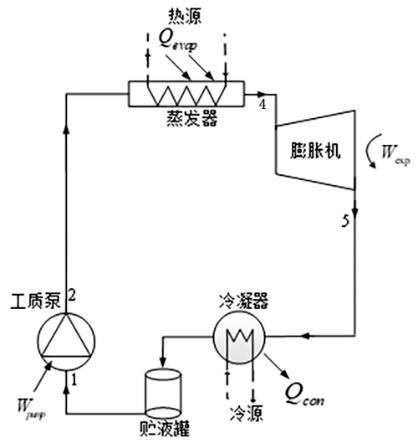
图1 结构和工作流程图
Fig. 1 Schematic diagram of system configuration and operating principle
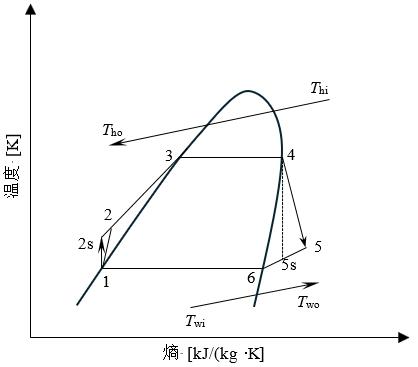
图2 T-S图
Fig.2 temperature vs entropy
| 组件 | 不可逆损失 |
|---|---|
| 蒸发器 | |
| 工质泵 | |
| 冷凝器 | |
| 膨胀机 |
表1 系统组件的不可逆损失
Table 1 Irreversible losses of system components
| 组件 | 不可逆损失 |
|---|---|
| 蒸发器 | |
| 工质泵 | |
| 冷凝器 | |
| 膨胀机 |
| 测点编号 | 工况 | 平均温度 / ℃ | 最大 / 最小 / ℃ | 波动幅度 / ℃ | 标准差 / ℃ |
|---|---|---|---|---|---|
| #3 | 加装前 | 250 | 254 / 246 | ± 4 | 1.4 |
| #8 | 加装前 | 259 | 264 / 255 | ± 4 | 1.3 |
| #12 | 加装前 | 268 | 272 / 265 | ± 3 | 1.0 |
| #3 | 加装后 | 161 | 163 / 159 | ± 2 | 0.8 |
| #8 | 加装后 | 158 | 160 / 156 | ± 2 | 0.7 |
| #12 | 加装后 | 155 | 157 / 153 | ± 2 | 0.7 |
表 2 典型测点温度波动统计结果
Table 2 Statistical results of temperature fluctuation at typical measuring points
| 测点编号 | 工况 | 平均温度 / ℃ | 最大 / 最小 / ℃ | 波动幅度 / ℃ | 标准差 / ℃ |
|---|---|---|---|---|---|
| #3 | 加装前 | 250 | 254 / 246 | ± 4 | 1.4 |
| #8 | 加装前 | 259 | 264 / 255 | ± 4 | 1.3 |
| #12 | 加装前 | 268 | 272 / 265 | ± 3 | 1.0 |
| #3 | 加装后 | 161 | 163 / 159 | ± 2 | 0.8 |
| #8 | 加装后 | 158 | 160 / 156 | ± 2 | 0.7 |
| #12 | 加装后 | 155 | 157 / 153 | ± 2 | 0.7 |
| 参数 | 数值 | 说明 |
|---|---|---|
| 蒸发压力/MPa | 小于3 | 保证现场实验安全 |
| 冷凝压力/MPa | 大于0.1 | 防止系统在负压下运行 |
| 冷却水温度/℃ | 20-30 | 板式冷凝器入口 |
| 热源入口温度/℃ | 120 (典型) | 侧壁导热油出口 |
| 膨胀机等熵效率 | 0.75 | 实测经验值 |
| 泵等熵效率 | 0.6 | 常规小型泵性能 |
| 环境温度/K | 293 | 基准温度 |
| 供热量/kW | 112 | 热源额定输入 |
表3 系统设计计算的基准参数
Table 3 Basic design parameters used for system calculation
| 参数 | 数值 | 说明 |
|---|---|---|
| 蒸发压力/MPa | 小于3 | 保证现场实验安全 |
| 冷凝压力/MPa | 大于0.1 | 防止系统在负压下运行 |
| 冷却水温度/℃ | 20-30 | 板式冷凝器入口 |
| 热源入口温度/℃ | 120 (典型) | 侧壁导热油出口 |
| 膨胀机等熵效率 | 0.75 | 实测经验值 |
| 泵等熵效率 | 0.6 | 常规小型泵性能 |
| 环境温度/K | 293 | 基准温度 |
| 供热量/kW | 112 | 热源额定输入 |
| 工质 | 临界温度(°C) | 临界压力(MPa) | 循环热效率(%) | 净输出功(kW) | 压比 |
|---|---|---|---|---|---|
| R123 | 183.7 | 3.67 | 8.92 | 9.99 | 4.1 |
| R141b | 204.3 | 4.25 | 8.71 | 9.75 | 3.8 |
| R245fa | 154.0 | 3.65 | 9.16 | 10.26 | 4.5 |
| R236fa | 124.9 | 3.19 | 9.44 | 10.58 | 4.6 |
| R1233zd-E | 165.6 | 3.57 | 9.01 | 10.09 | 4 |
| RC318 | 115.2 | 2.78 | 9.81 | 10.99 | 5.3 |
表4 各工质在相同工况下的循环性能比较
Table 4 Comparison of cycle performance of different working fluids under the same operating conditions
| 工质 | 临界温度(°C) | 临界压力(MPa) | 循环热效率(%) | 净输出功(kW) | 压比 |
|---|---|---|---|---|---|
| R123 | 183.7 | 3.67 | 8.92 | 9.99 | 4.1 |
| R141b | 204.3 | 4.25 | 8.71 | 9.75 | 3.8 |
| R245fa | 154.0 | 3.65 | 9.16 | 10.26 | 4.5 |
| R236fa | 124.9 | 3.19 | 9.44 | 10.58 | 4.6 |
| R1233zd-E | 165.6 | 3.57 | 9.01 | 10.09 | 4 |
| RC318 | 115.2 | 2.78 | 9.81 | 10.99 | 5.3 |
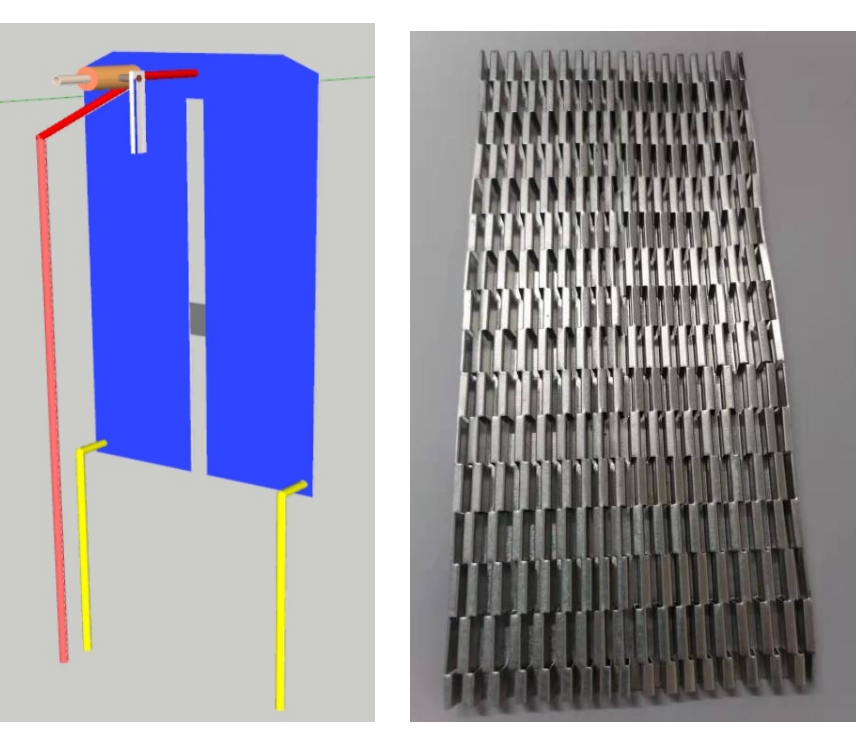
图3 侧壁换热单元结构
Fig.3 Structure of the sidewall heat-exchange unit
| 参数 | 数值 |
|---|---|
| 外壳尺寸/mm | 660×340×8(高×宽×厚) |
| 翅片类型 | 错齿形 |
| 翅片尺寸/mm | 610×(155×2片)×7 |
| 当量直径/mm | 2.6 |
| 内板壁尺寸/mm | 660×340×0.5 |
| 外板壁尺寸/mm | 666×(163×2片)×0.5 |
| 接管尺寸/mm | DN10 |
| 翅间流速/m·s-1 | 0.26 |
表5 板翅式换热单元设计结果
Table 5 Design results of the plate-fin heat-exchange unit
| 参数 | 数值 |
|---|---|
| 外壳尺寸/mm | 660×340×8(高×宽×厚) |
| 翅片类型 | 错齿形 |
| 翅片尺寸/mm | 610×(155×2片)×7 |
| 当量直径/mm | 2.6 |
| 内板壁尺寸/mm | 660×340×0.5 |
| 外板壁尺寸/mm | 666×(163×2片)×0.5 |
| 接管尺寸/mm | DN10 |
| 翅间流速/m·s-1 | 0.26 |
| 参数 | 数值 |
|---|---|
| 管外径/mm | 16 |
| 管壁厚度/mm | 2 |
| 中心距/mm | 20 |
| 单管长度/mm | 3000 |
| 壳体直径/mm | 273 |
| 管程数 | 1 |
| 管数 | 122 |
| 管束布置 | 正三角形 |
表6 蒸发器的主要结构参数
Table 6 Main structural parameters of the evaporator
| 参数 | 数值 |
|---|---|
| 管外径/mm | 16 |
| 管壁厚度/mm | 2 |
| 中心距/mm | 20 |
| 单管长度/mm | 3000 |
| 壳体直径/mm | 273 |
| 管程数 | 1 |
| 管数 | 122 |
| 管束布置 | 正三角形 |
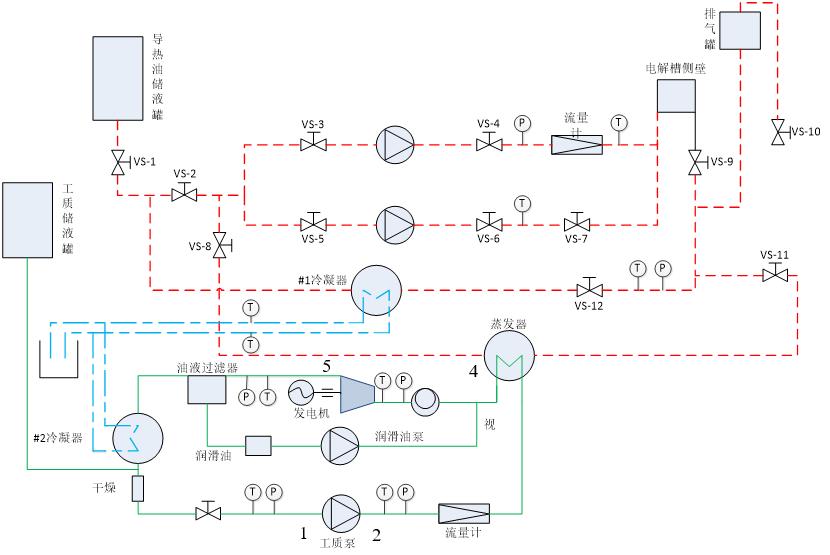
图4 电解槽侧壁余热发电系统组成原理图
Fig.4 Schematic of the sidewall waste-heat power-generation system for aluminum reduction cell
| 参数 | 数值 |
|---|---|
| 板片厚度/mm | 0.5 |
| 板片数目/片 | 53 |
| 板片宽度/mm | 250 |
| 板片高度/mm | 610 |
| 单板片面积/m2 | 0.129 |
| 板片间距/mm | 3.6 |
| 水平孔间距/mm | 162 |
| 垂直孔间距/mm | 516 |
表7 冷凝器1的主要结构参数
Table 7 Main structural parameters of Condenser 1
| 参数 | 数值 |
|---|---|
| 板片厚度/mm | 0.5 |
| 板片数目/片 | 53 |
| 板片宽度/mm | 250 |
| 板片高度/mm | 610 |
| 单板片面积/m2 | 0.129 |
| 板片间距/mm | 3.6 |
| 水平孔间距/mm | 162 |
| 垂直孔间距/mm | 516 |
| 参数 (单位) | 数值 |
|---|---|
| 板片厚度/mm | 0.5 |
| 板片数目/片 | 9 |
| 板片宽度/mm | 250 |
| 板片高度/mm | 610 |
| 单板片面积/m2 | 0.129 |
| 板片间距/mm | 5.4 |
| 水平孔间距/mm | 162 |
| 垂直孔间距/mm | 516 |
表8 冷却器2的主要结构参数
Table 8 Main structural parameters of Condenser 2
| 参数 (单位) | 数值 |
|---|---|
| 板片厚度/mm | 0.5 |
| 板片数目/片 | 9 |
| 板片宽度/mm | 250 |
| 板片高度/mm | 610 |
| 单板片面积/m2 | 0.129 |
| 板片间距/mm | 5.4 |
| 水平孔间距/mm | 162 |
| 垂直孔间距/mm | 516 |
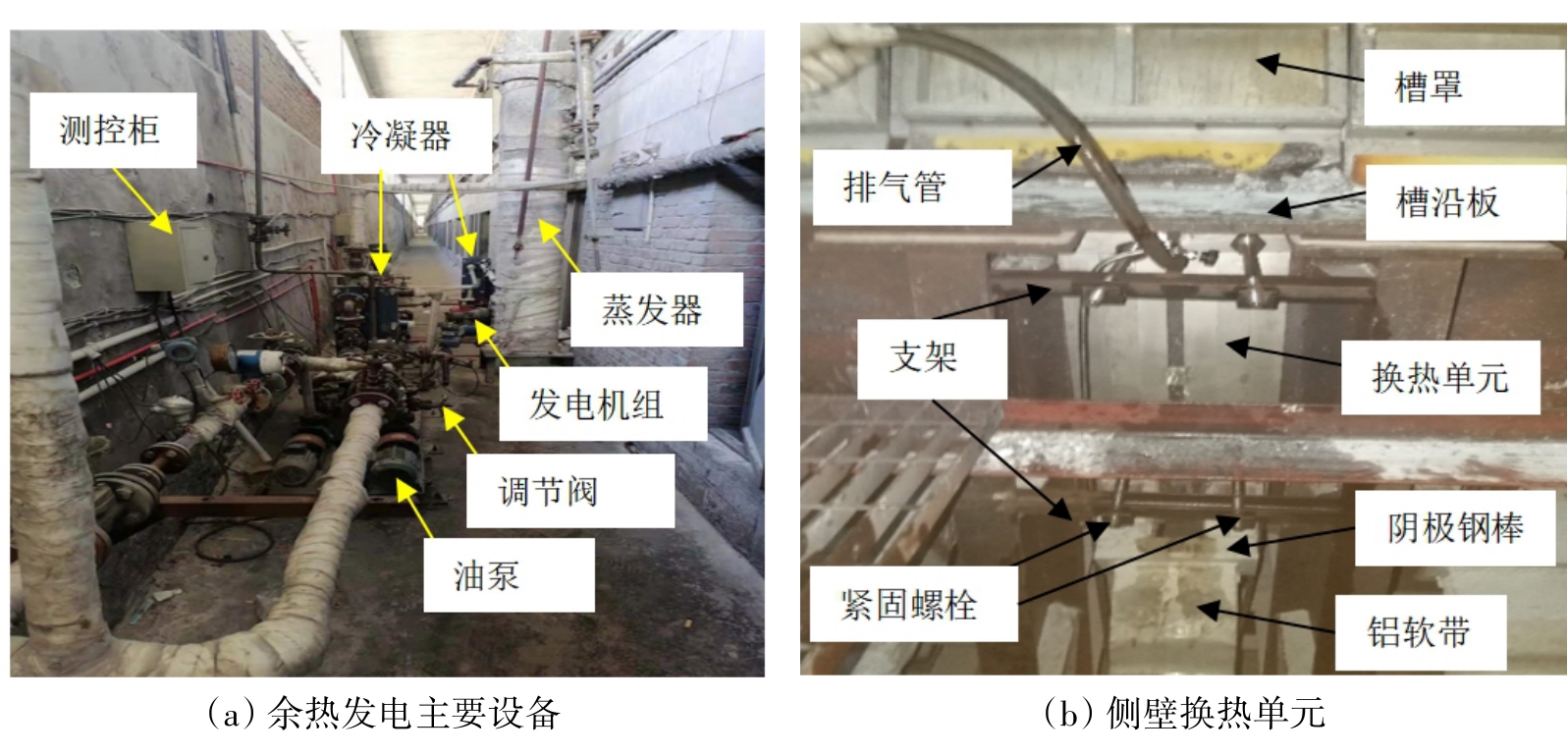
图5 实验系统现场安装照片
Fig.5 On-site installation of the experimental system
| 测量参数 | 仪表 | 型号 | 测量范围 | 误差 |
|---|---|---|---|---|
| 温度 | 热电阻 | WSP | 0~300 ℃ | ±0.1% 量程 |
| 压力 | 扩散硅压力变送器 | SD2088 | 0~2 MPa | ±0.5% 量程 |
| 管道压力 | 压力表 | Y-100 | 0~2 MPa | ±1.6% 量程 |
| 工质流量 | 涡轮流量计 | LWGY-C | 0.1~1.5 m³·h⁻¹ | ±0.5% 量程 |
| 冷却水流量 | 法兰式水表 | LX-15 | 0~5 m³·h⁻¹ | ±2% 量程 |
| 转速 | 转速传感器 | DK510 | 0~99999 rpm | ±1 rpm |
| 电流 | 电流传感器 | SIN-DJI-A | 0~20 A | ±0.1% 量程 |
| 电压 | 电压传感器 | MIK-DJU-500 | 0~500 V | ±0.1% 量程 |
表 9 现场实验主要测量仪表及精度
Table 9 Main on-site test instruments and their accuracies
| 测量参数 | 仪表 | 型号 | 测量范围 | 误差 |
|---|---|---|---|---|
| 温度 | 热电阻 | WSP | 0~300 ℃ | ±0.1% 量程 |
| 压力 | 扩散硅压力变送器 | SD2088 | 0~2 MPa | ±0.5% 量程 |
| 管道压力 | 压力表 | Y-100 | 0~2 MPa | ±1.6% 量程 |
| 工质流量 | 涡轮流量计 | LWGY-C | 0.1~1.5 m³·h⁻¹ | ±0.5% 量程 |
| 冷却水流量 | 法兰式水表 | LX-15 | 0~5 m³·h⁻¹ | ±2% 量程 |
| 转速 | 转速传感器 | DK510 | 0~99999 rpm | ±1 rpm |
| 电流 | 电流传感器 | SIN-DJI-A | 0~20 A | ±0.1% 量程 |
| 电压 | 电压传感器 | MIK-DJU-500 | 0~500 V | ±0.1% 量程 |
| 性能指标 | 主要影响因子 | 相对不确定度 / % |
|---|---|---|
| 净输出功率 (Wnet) | 电压、电流 | ±0.14 |
| 热输入功率 (Qe) | 温差、流量 | ±2.2 |
| 热效率 (ηth) | Wnet, Qe | ±3.0 |
| 㶲效率 (ηex) | 多温度参数 | ±3.5 |
表10 系统主要性能参数不确定性分析结果
Table 10 Uncertainty analysis results of the main system performance parameters
| 性能指标 | 主要影响因子 | 相对不确定度 / % |
|---|---|---|
| 净输出功率 (Wnet) | 电压、电流 | ±0.14 |
| 热输入功率 (Qe) | 温差、流量 | ±2.2 |
| 热效率 (ηth) | Wnet, Qe | ±3.0 |
| 㶲效率 (ηex) | 多温度参数 | ±3.5 |
| 项目 | 平均值 | 相对不确定度 | 绝对不确定度 | 单位 |
|---|---|---|---|---|
| 净输出功率 | 9.50 | ±0.14% | ±0.013 | kW |
| 热输入功率 | 110.59 | ±3.5% | ±3.9 | kW |
| 热效率 | 8.59 | ±3.0% | ±0.26 | % |
表11 实验性能参数的不确定度计算结果
Table 11 Summary of main performance parameters and their uncertainties
| 项目 | 平均值 | 相对不确定度 | 绝对不确定度 | 单位 |
|---|---|---|---|---|
| 净输出功率 | 9.50 | ±0.14% | ±0.013 | kW |
| 热输入功率 | 110.59 | ±3.5% | ±3.9 | kW |
| 热效率 | 8.59 | ±3.0% | ±0.26 | % |
| 状态点 | 温度/℃ | 压力/MPa | 焓值/kJ·kg-1 | 状态说明 |
|---|---|---|---|---|
| 1 | 32.4 | 2.08 | 235.6 | 泵出口,过冷液态 |
| 2 | 102.1 | 2.03 | 376.45 | 蒸发器出口 / 膨胀机入口,轻微过热气态 |
| 3 | 62.55 | 0.38 | 360.49 | 膨胀机出口 / 冷凝器入口,湿蒸汽 |
| 4 | 31.6 | 0.35 | 263.08 | 冷凝器出口 / 泵入口,饱和液态 |
表 12 系统各状态点的实验测量参数(稳态平均值)
Table 12 Experimental parameters of state points under steady-state operation
| 状态点 | 温度/℃ | 压力/MPa | 焓值/kJ·kg-1 | 状态说明 |
|---|---|---|---|---|
| 1 | 32.4 | 2.08 | 235.6 | 泵出口,过冷液态 |
| 2 | 102.1 | 2.03 | 376.45 | 蒸发器出口 / 膨胀机入口,轻微过热气态 |
| 3 | 62.55 | 0.38 | 360.49 | 膨胀机出口 / 冷凝器入口,湿蒸汽 |
| 4 | 31.6 | 0.35 | 263.08 | 冷凝器出口 / 泵入口,饱和液态 |
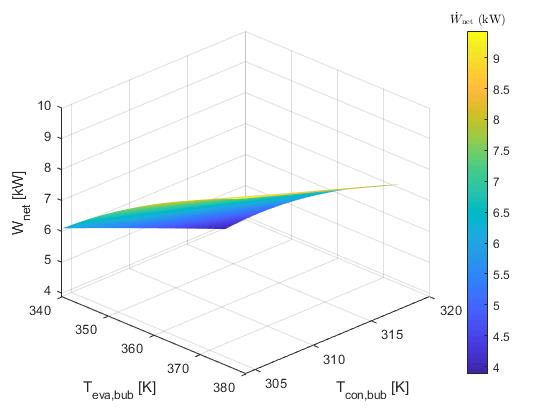
图6 净输出功随蒸发温度与冷凝温度的变化
Fig. 6 Variation of net output power with evaporating and condensing temperatures
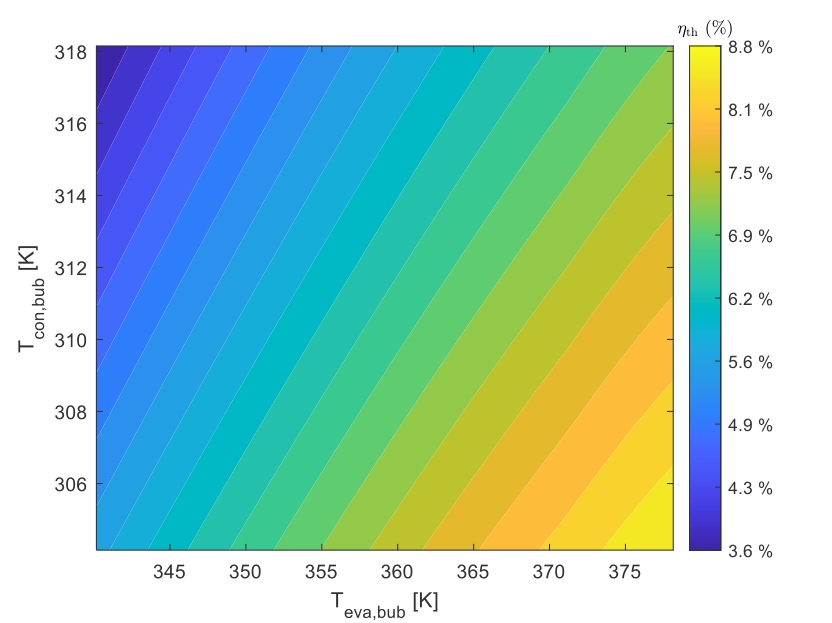
图7 热效率随蒸发温度与冷凝温度的变化
Fig. 7 Variation of thermal efficiency with evaporating and condensing temperatures
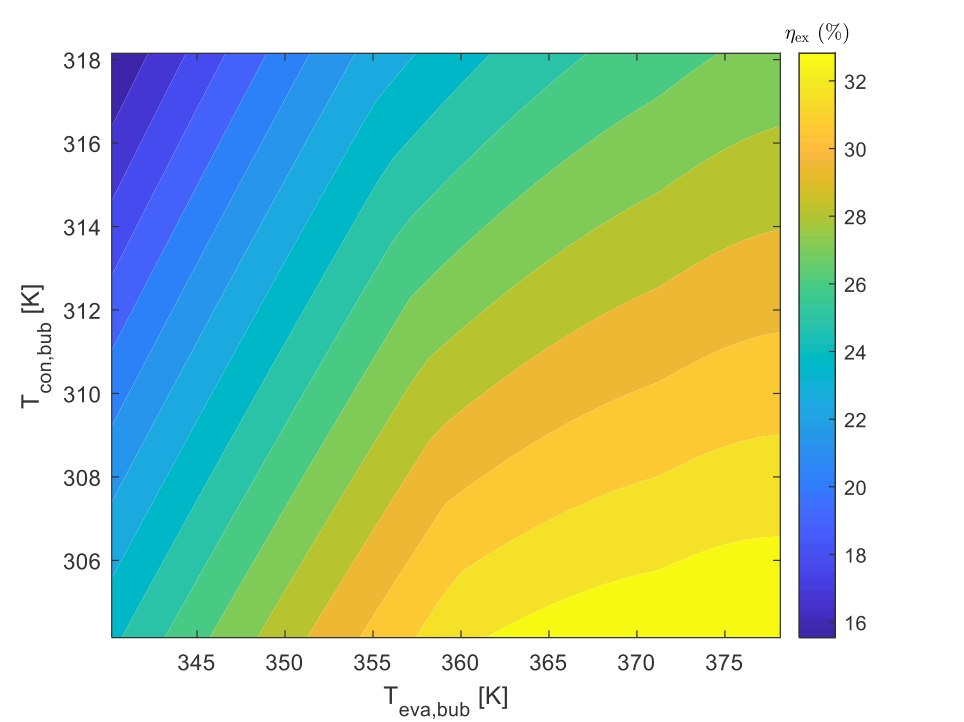
图8 㶲效率随蒸发温度与冷凝温度的变化
Fig. 8 Variation of exergy efficiency with evaporating and condensing temperatures
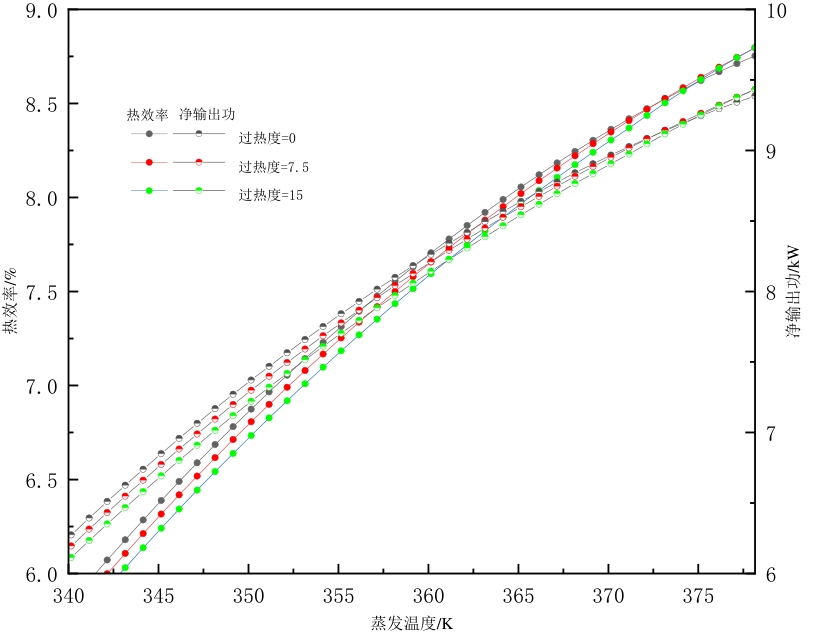
图9 过热度对热效率和净输出功率的影响
Fig. 9 Effect of the degree of superheat on thermal efficiency and net power output
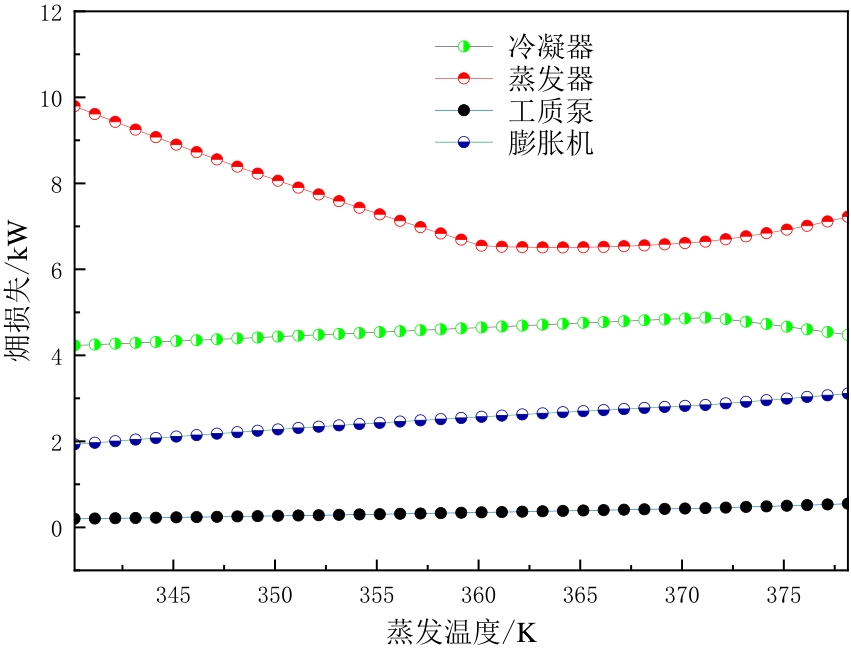
图10 系统各部件㶲损失随蒸发温度的变化
Fig.10 Exergy destruction of system components versus evaporating temperature
| 工况编号 | 蒸发温度 / ℃ | 冷凝温度 / ℃ | 理论净输出功 / kW | 实验净输出功 (kW) | 相对误差 (%) | 理论热效率 /% | 实验热效率 (%) | 相对误差 (%) |
|---|---|---|---|---|---|---|---|---|
| 1 | 70 | 30 | 7.18 | 6.83 | –4.9 | 6.41 | 6.10 | –4.8 |
| 2 | 70 | 35 | 6.51 | 6.00 | –7.8 | 5.81 | 5.40 | –7.1 |
| 3 | 70 | 40 | 5.65 | 5.20 | –8.0 | 5.04 | 4.65 | –7.7 |
| 4 | 70 | 45 | 4.77 | 4.40 | –7.8 | 4.26 | 3.95 | –7.3 |
| 5 | 75 | 30 | 7.79 | 7.36 | –5.5 | 6.96 | 6.60 | –5.2 |
| 6 | 75 | 35 | 7.14 | 6.50 | –7.7 | 6.38 | 5.73 | –7.3 |
| 7 | 75 | 40 | 6.32 | 5.85 | –7.4 | 5.64 | 5.23 | –7.3 |
| 8 | 75 | 45 | 5.48 | 5.05 | –7.8 | 4.89 | 4.50 | –8.0 |
| 9 | 80 | 30 | 8.35 | 7.80 | –6.6 | 7.45 | 6.97 | –6.4 |
| 10 | 80 | 35 | 7.72 | 7.15 | –7.4 | 6.89 | 6.37 | –7.6 |
| 11 | 80 | 40 | 6.93 | 6.40 | –7.7 | 6.18 | 5.70 | –7.8 |
| 12 | 80 | 45 | 6.13 | 5.65 | –7.8 | 5.47 | 5.00 | –8.6 |
| 13 | 85 | 30 | 8.86 | 8.25 | –6.9 | 7.91 | 7.36 | –7.0 |
| 14 | 85 | 35 | 8.25 | 7.63 | –7.5 | 7.36 | 6.82 | –7.3 |
| 15 | 85 | 40 | 7.48 | 6.95 | –7.1 | 6.68 | 6.22 | –6.9 |
| 16 | 85 | 45 | 6.71 | 6.20 | –7.6 | 5.99 | 5.52 | –7.8 |
| 17 | 90 | 30 | 9.32 | 8.64 | –7.3 | 8.32 | 7.71 | –7.3 |
| 18 | 90 | 35 | 8.73 | 8.05 | –7.8 | 7.79 | 7.20 | –7.6 |
| 19 | 90 | 40 | 7.99 | 7.35 | –8.0 | 7.13 | 6.55 | –8.1 |
| 20 | 90 | 45 | 7.24 | 6.65 | –8.2 | 6.46 | 5.95 | –7.9 |
| 21 | 95 | 30 | 9.74 | 8.99 | –7.7 | 8.69 | 8.02 | –7.7 |
| 22 | 95 | 35 | 9.16 | 8.46 | –7.6 | 8.18 | 7.57 | –7.4 |
| 23 | 95 | 40 | 8.44 | 7.78 | –7.8 | 7.54 | 6.96 | –7.7 |
| 24 | 95 | 45 | 7.72 | 7.10 | –8.0 | 6.89 | 6.35 | –7.8 |
| 25 | 100 | 30 | 10.13 | 9.29 | –8.3 | 9.05 | 8.31 | –8.2 |
| 26 | 100 | 35 | 9.57 | 8.76 | –8.5 | 8.54 | 7.82 | –8.4 |
| 27 | 100 | 40 | 8.87 | 8.15 | –8.1 | 7.91 | 7.25 | –8.3 |
| 28 | 100 | 45 | 8.16 | 7.47 | –8.5 | 7.28 | 6.65 | –8.6 |
| 29 | 105 | 30 | 10.48 | 9.50 | –8.9 | 9.36 | 8.53 | –8.9 |
| 30 | 105 | 35 | 9.93 | 9.05 | –8.9 | 8.86 | 8.07 | –8.9 |
| 31 | 105 | 40 | 9.24 | 8.40 | –9.1 | 8.25 | 7.49 | –9.2 |
| 32 | 105 | 45 | 8.55 | 7.77 | –9.1 | 7.63 | 6.93 | –9.2 |
表13 理论计算与实验结果对比
Table 13 Comparison between theoretical calculations and experimental results
| 工况编号 | 蒸发温度 / ℃ | 冷凝温度 / ℃ | 理论净输出功 / kW | 实验净输出功 (kW) | 相对误差 (%) | 理论热效率 /% | 实验热效率 (%) | 相对误差 (%) |
|---|---|---|---|---|---|---|---|---|
| 1 | 70 | 30 | 7.18 | 6.83 | –4.9 | 6.41 | 6.10 | –4.8 |
| 2 | 70 | 35 | 6.51 | 6.00 | –7.8 | 5.81 | 5.40 | –7.1 |
| 3 | 70 | 40 | 5.65 | 5.20 | –8.0 | 5.04 | 4.65 | –7.7 |
| 4 | 70 | 45 | 4.77 | 4.40 | –7.8 | 4.26 | 3.95 | –7.3 |
| 5 | 75 | 30 | 7.79 | 7.36 | –5.5 | 6.96 | 6.60 | –5.2 |
| 6 | 75 | 35 | 7.14 | 6.50 | –7.7 | 6.38 | 5.73 | –7.3 |
| 7 | 75 | 40 | 6.32 | 5.85 | –7.4 | 5.64 | 5.23 | –7.3 |
| 8 | 75 | 45 | 5.48 | 5.05 | –7.8 | 4.89 | 4.50 | –8.0 |
| 9 | 80 | 30 | 8.35 | 7.80 | –6.6 | 7.45 | 6.97 | –6.4 |
| 10 | 80 | 35 | 7.72 | 7.15 | –7.4 | 6.89 | 6.37 | –7.6 |
| 11 | 80 | 40 | 6.93 | 6.40 | –7.7 | 6.18 | 5.70 | –7.8 |
| 12 | 80 | 45 | 6.13 | 5.65 | –7.8 | 5.47 | 5.00 | –8.6 |
| 13 | 85 | 30 | 8.86 | 8.25 | –6.9 | 7.91 | 7.36 | –7.0 |
| 14 | 85 | 35 | 8.25 | 7.63 | –7.5 | 7.36 | 6.82 | –7.3 |
| 15 | 85 | 40 | 7.48 | 6.95 | –7.1 | 6.68 | 6.22 | –6.9 |
| 16 | 85 | 45 | 6.71 | 6.20 | –7.6 | 5.99 | 5.52 | –7.8 |
| 17 | 90 | 30 | 9.32 | 8.64 | –7.3 | 8.32 | 7.71 | –7.3 |
| 18 | 90 | 35 | 8.73 | 8.05 | –7.8 | 7.79 | 7.20 | –7.6 |
| 19 | 90 | 40 | 7.99 | 7.35 | –8.0 | 7.13 | 6.55 | –8.1 |
| 20 | 90 | 45 | 7.24 | 6.65 | –8.2 | 6.46 | 5.95 | –7.9 |
| 21 | 95 | 30 | 9.74 | 8.99 | –7.7 | 8.69 | 8.02 | –7.7 |
| 22 | 95 | 35 | 9.16 | 8.46 | –7.6 | 8.18 | 7.57 | –7.4 |
| 23 | 95 | 40 | 8.44 | 7.78 | –7.8 | 7.54 | 6.96 | –7.7 |
| 24 | 95 | 45 | 7.72 | 7.10 | –8.0 | 6.89 | 6.35 | –7.8 |
| 25 | 100 | 30 | 10.13 | 9.29 | –8.3 | 9.05 | 8.31 | –8.2 |
| 26 | 100 | 35 | 9.57 | 8.76 | –8.5 | 8.54 | 7.82 | –8.4 |
| 27 | 100 | 40 | 8.87 | 8.15 | –8.1 | 7.91 | 7.25 | –8.3 |
| 28 | 100 | 45 | 8.16 | 7.47 | –8.5 | 7.28 | 6.65 | –8.6 |
| 29 | 105 | 30 | 10.48 | 9.50 | –8.9 | 9.36 | 8.53 | –8.9 |
| 30 | 105 | 35 | 9.93 | 9.05 | –8.9 | 8.86 | 8.07 | –8.9 |
| 31 | 105 | 40 | 9.24 | 8.40 | –9.1 | 8.25 | 7.49 | –9.2 |
| 32 | 105 | 45 | 8.55 | 7.77 | –9.1 | 7.63 | 6.93 | –9.2 |
| [1] | Zhou N J, Wang X Y, Chen Z, et al. Experimental study on Organic Rankine Cycle for waste heat recovery from low-temperature flue gas[J]. Energy, 2013, 55: 216-225. |
| [2] | 王志奇, 贺妮, 罗兰, 等. 水平管内R245fa/R141b沸腾换热特性的实验研究[J]. 化工学报, 2020, 71(4): 1588-1596. |
| Wang Z Q, He N, Luo L, et al. Experimental investigation on flow boiling heat transfer of R245fa/R141b in horizontal smooth tube[J]. CIESC Journal, 2020, 71(4): 1588-1596. | |
| [3] | 陈林, 孙颖颖, 梁江涛, 等. 用于烟气余热回收的塑料翅片管换热器的设计及分析[J]. 化工学报, 2014, 65(S1): 175-179. |
| Chen L, Sun Y Y, Liang J T, et al. Design and analysis of plastic fin-tube heat exchanger for flu gas heat recovery[J]. CIESC Journal, 2014, 65(S1): 175-179. | |
| [4] | 吴双应, 汪菲, 肖兰. 基于低温烟气余热发电的Kalina循环热经济性能分析[J]. 化工学报, 2017, 68(3): 1170-1177. |
| Wu S Y, W F, Xiao L. Thermo-economic performance analysis of Kalina cycle based on low temperature flue gas waste heat power generation[J]. CIESC Journal, 2017, 68(3): 1170-1177. | |
| [5] | Zakeralhoseini S, Schiffmann J. Design, computational and experimental investigation of a small-scale turbopump for organic Rankine cycle systems[J]. Energy Conversion and Management, 2023, 287: 117073. |
| [6] | Kolasinski P. Experimental and modelling studies on the possible application of heat storage devices for powering the ORC (Organic Rankine Cycle) systems[J]. Thermal Science and Engineering Progress, 2020, 19: 100586. |
| [7] | Li X L, Lecompte S, Van Nieuwenhuyse J, et al. Experimental investigation of an organic Rankine cycle with liquid-flooded expansion and R1233zd(E) as working fluid[J]. Energy Conversion and Management, 2021, 234:113894. |
| [8] | Ottaviano S, Poletto C, Ancona M A, et al. Experimental investigation on micro-ORC system operating with partial evaporation and two-phase expansion[J]. Energy Conversion and Management, 2022, 274: 116415. |
| [9] | Moradi R, Villarini M, Cioccolanti L. Experimental modeling of a lubricated, open drive scroll expander for micro-scale organic Rankine cycle systems[J]. Applied Thermal Engineering, 2021, 190: 116784. |
| [10] | 黄国瑞, 赵耀, 谢明熹, 等. 一种新型数据中心余热回收系统实验与分析[J]. 化工学报, 2025,76(S1): 409-417. |
| Huang G R, Zhao Y, Xie M X, et al. Experimental study on a novel waste heat recovery system based on desiccant coated exchanger in data center[J]. CIESC Journal, 2025, 76(S1): 409-417. | |
| [11] | 董泽明, 娄聚伟, 王楠, 等. 含余热回收的超临界压缩二氧化碳储能系统热力学特性研究[J]. 化工学报, 2025, 76(7): 3477-3486. |
| Dong Z M, Lou J W, Wang N, et al. Research on thermodynamic properties of supercritical compressed carbon dioxide energy storage system with waste heat recovery[J]. CIESC Journal, 2025, 76(7): 3477-3486. | |
| [12] | Barzi Y M, Assadi M, Arvesen H M, et al. A Nonel heat recovery technology from An aluminum reduction cell side walls: experimental and theoretical investigations[J]. Light Metals, 2014: 733-738. |
| [13] | Yang Y J, Tao W J, Wang Z W, et al. A Numerical Approach on Waste Heat Recovery through Sidewall Heat-Exchanging in an Aluminum Electrolysis Cell[J]. Advances in Materials Science and Engineering, 2021, 2021: 3573306. |
| [14] | Ming Y, Zhou N J. Thermodynamic Performance Analysis of a Waste Heat Power Generation System (WHPGS) Applied to the Sidewalls of Aluminum Reduction Cells[J]. Entropy, 2020, 22(11): 1279. |
| [15] | Allard F, Desilets M, LeBreux M, et al. Improved heat transfer modeling of the top of aluminum electrolysis cells[J]. International Journal of Heat and Mass Transfer, 2019, 132: 1262-1276. |
| [16] | Khafajah H I, Abdelsamie M M, Mohamed Ali M I. Techno-economic assessment of waste heat harnessing in the primary aluminum industry through a dual-stage organic Rankine cycle integration[J]. Energy, 2024, 313:133952. |
| [17] | 梁高卫. 基于热电转换的铝电解槽侧壁余热发电研究[D]. 长沙:中南大学,2013. |
| Liang G W. Research on power generation of waste heat recovery from aluminum reduction cell's sidewalls based on thermoelectric conversion[D]. Changsha, Central South University, 2013. | |
| [18] | 王金江, 鲁振杰, 安维峥, 等. ORC 发电系统工艺过程预警诊断技术研究与展望[J].化工学报, 2025, 76(7): 3137-3152. |
| Wang J J, Lu Z J, An W Z, et al. Research and prospect of early warning and diagnosis technology for ORC power generation system process[J]. CIESC Journal, 2025, 76(7): 3137-3152. | |
| [19] | 闫沛伟, 张曼铮, 肖猛, 等. 地热能有机朗肯循环系统控制策略研究[J]. 化工学报, 2023, 74(12): 4810-4819. |
| Yan P W, Zhang M Z, Xiao M, et al. Study on the control strategy of a geothermal organic Rankine cycle system[J]. CIESC Journal, 2023, 74(12): 4810-4819. | |
| [20] | 党玉荣, 莫春兰, 史科锐, 等. 综合评价模型联合遗传算法的混合工质ORC 系统性能研究[J]. 化工学报, 2023, 74(5): 1884-1895. |
| Dang Y R, Mo C L, Shi K R, et al. Comprehensive evaluation model combined with genetic algorithm for the study on the performance of ORC system with zeotropic mixture[J]. CIESC Journal, 2023, 74(5): 1884-1895. | |
| [21] | Javed S, Tiwari A K. Performance assessment of different Organic Rankine Cycle (ORC) configurations driven by solar energy[J]. Process Safety and Environmental Protection, 2023, 171: 655-666. |
| [22] | Sun Z X, Lai J P, Wang S J, et al. Thermodynamic optimization and comparative study of different ORC configurations utilizing the exergies of LNG and low grade heat of different temperatures[J]. Energy, 2018, 147:688-700. |
| [23] | 曹健, 冯新, 吉晓燕,等. 基于混合工质的多级蒸发ORC 理论极限性能研究[J]. 化工学报, 2021, 72(7): 3780-3787. |
| Cao J, Feng X, Ji X Y, et al. Study on the theoretical limit performance of multi-pressure evaporation ORC based on zeotropic mixture[J]. CIESC Journal, 2021, 72(7): 3780-3787. | |
| [24] | 戴文智, 沈雄健, 宋晓博, 等. 生物质双级蒸发双回热有机朗肯循环系统环境分析[J]. 化工学报, 2025, 76(3): 1230-1242. |
| Dai W Z, Shen X J, Song X B, et al. Environmental analysis of biomass double-stage evaporation doubleregenerative organic Rankine cycle system[J]. CIESC Journal, 2025, 76(3): 1230-1242. | |
| [25] | 张曼铮, 肖猛, 闫沛伟, 等. 危废焚烧处理耦合有机朗肯循环系统工质筛选与热力学优化[J]. 化工学报, 2023, 74(8): 3502-3512. |
| Zhang M Z, Xiao M, Yan P W, et al. Working fluid screening and thermodynamic optimization of hazardous waste incineration coupled organic Rankine cycle system[J]. CIESC Journal, 2023, 74(8): 3502-3512. | |
| [26] | Li Z, Yu X L, Wang L, et al. Comparative investigations on dynamic characteristics of basic ORC and cascaded LTES-ORC under transient heat sources[J]. Applied Thermal Engineering, 2022, 207: 118197. |
| [27] | Sadeghi M, Nemati A, Ghavimi A, et al. Thermodynamic analysis and multi- objective optimization of various ORC (organic Rankine cycle) configurations using zeotropic mixtures. Energy, 2016, 109: 791-802. |
| [28] | Chagnon-Lessard T, Mathieu-Potvin F, Gosselin L. Optimal design of geothermal power plants: a comparison of single-pressure and dual-pressure organic Rankine cycles[J]. Geothermics. 2020, 86: 101787. |
| [29] | Wang Q L, Wang J Q, Li T L, et al. Techno-economic performance of two-stage series evaporation organic Rankine cycle with dual-level heat sources[J]. Applied Thermal Enginerring, 2020, 171: 115078. |
| [30] | Lemmon EW, Huber ML, Mclinden MO. NIST Standard ReferenceDatabase 23: reference fluid thermodynamic and transport properties-REFPROP. 9.0; 2010. |
| [31] | Su W, Hwang Y, Deng S, et al. Thermodynamic performance comparison of Organic Rankine Cycle between zeotropic mixtures and pure fluids under open heat source[J]. Energy Conversion and Management, 2018, 166: 720-737. |
| [32] | Essadik M, Hajabdollahi Ouderji Z, Yu Z B. Combined exergy-pinch point analysis of a multi-valve flexible heat pump with integrated latent thermal energy storage for defrosting operation[J]. International Journal of Refrigeration, 2025, 176: 254-267. |
| [1] | 袁琳慧, 王瑜. 单服务器浸没射流式液冷系统散热性能[J]. 化工学报, 2025, 76(S1): 160-169. |
| [2] | 石一帆, 柯钢, 陈浩, 黄孝胜, 叶芳, 李成娇, 郭航. 大型高低温环境实验室温度控制仿真[J]. 化工学报, 2025, 76(S1): 268-280. |
| [3] | 黄琮琪, 邵双全. 液冷数据中心余热驱动的压缩-吸收式制冷系统特性研究[J]. 化工学报, 2025, 76(S1): 326-335. |
| [4] | 吴迪, 胡斌, 姜佳彤. R1233zd(E)高温热泵实验研究与应用分析[J]. 化工学报, 2025, 76(S1): 377-383. |
| [5] | 黄国瑞, 赵耀, 谢明熹, 陈尔健, 代彦军. 一种新型数据中心余热回收系统实验与分析[J]. 化工学报, 2025, 76(S1): 409-417. |
| [6] | 沙鑫权, 胡然, 丁磊, 蒋珍华, 吴亦农. 空间用单机两级有阀线性压缩机研制及测试[J]. 化工学报, 2025, 76(S1): 114-122. |
| [7] | 孙浩然, 吴成云, 王艳蒙, 孙静楠, 胡仞与, 段钟弟. 热对流影响下液滴蒸发特性模型与实验研究[J]. 化工学报, 2025, 76(S1): 123-132. |
| [8] | 燕子腾, 詹飞龙, 丁国良. 空调用套管式分流器结构设计及分流效果验证[J]. 化工学报, 2025, 76(S1): 152-159. |
| [9] | 密晓光, 孙国刚, 程昊, 张晓慧. 印刷电路板式天然气冷却器性能仿真模型和验证[J]. 化工学报, 2025, 76(S1): 426-434. |
| [10] | 任现超, 谷雅秀, 段少斌, 贾文竹, 李汉林. 翅片式椭圆套管蒸发式冷凝器传热传质性能实验研究[J]. 化工学报, 2025, 76(S1): 75-83. |
| [11] | 罗海梅, 王泓, 孙照明, 尹艳华. 同向双螺杆传热系数计算模型的分析与验证[J]. 化工学报, 2025, 76(9): 4809-4823. |
| [12] | 刘璐, 杨莹, 杨浩文, 王太, 王腾, 董新宇, 闫润. 星形亲水区组合表面冷凝液滴脱落特性实验研究[J]. 化工学报, 2025, 76(8): 3905-3914. |
| [13] | 王小令, 王绍清, 赵云刚, 常方哲, 穆瑞峰. 基于ReaxFF MD模拟的煤加氢热解有机Ca转化机制研究[J]. 化工学报, 2025, 76(8): 4297-4309. |
| [14] | 董泽明, 娄聚伟, 王楠, 陈良奇, 王江峰, 赵攀. 含余热回收的超临界压缩二氧化碳储能系统热力学特性研究[J]. 化工学报, 2025, 76(7): 3477-3486. |
| [15] | 范振宁, 梁海宁, 房茂立, 赫一凡, 于帅, 闫兴清, 安佳然, 乔帆帆, 喻健良. CO2管道不同相态节流放空特性研究与对比[J]. 化工学报, 2025, 76(7): 3742-3751. |
| 阅读次数 | ||||||
|
全文 |
|
|||||
|
摘要 |
|
|||||
 京公网安备 11010102001995号