• •
王瑞琪1( ), 雷震1, 任思月1(), 段永丽2, 章结兵1, 张亚婷1
收稿日期:2025-10-14
修回日期:2025-11-11
出版日期:2025-11-20
通讯作者:
任思月
作者简介:王瑞琪(1992—),男,博士,讲师,ruiqi.wang@xust.edu.cn
基金资助:
Ruiqi WANG1(), Zhen LEI1, Siyue REN1(), Yongli DUAN2, Jiebing ZHANG1, Yating ZHANG1
Received:2025-10-14
Revised:2025-11-11
Online:2025-11-20
Contact:
Siyue REN
摘要:
针对化工过程数据高维性、非线性及强时序相关的特点,提出了一种基于SlowFast网络与Transformer的多尺度时空融合故障诊断方法。该方法设计了双通道特征提取架构:Slow路径通过时间下采样卷积捕捉宏观过程特征,Fast路径则保留高时间分辨率卷积以提取局部动态特性,并结合Transformer的自注意力机制实现长程依赖建模。采用滑动窗口构建时空样本,最终实现故障的精准分类和实时监测。在TE过程数据集上的实验结果表明,所提出的模型在4层Transformer块堆叠下,在测试集上展现出优异的诊断性能。与文献中的模型DCNN(88.20%)、LSTM(95.37%)、CNN-LSTM(96.64%)、DCRNN(91.70%)相比,故障诊断准确率有显著提升(98.44%)。本方法将视频分析领域的SlowFast架构引入化工时序数据建模,并结合Transformer的全局感知能力,显著增强了模型的分类效果。进一步地,提出了一种新的预警能力评估方式,并结合实验结果探讨了SlowFast诊断性能与可解释性之间的关系,为复杂工业过程的故障诊断提供新的技术路径与理论参考。
中图分类号:
王瑞琪, 雷震, 任思月, 段永丽, 章结兵, 张亚婷. 基于SlowFast-Transformer的化工过程故障检测与风险预警[J]. 化工学报, DOI: 10.11949/0438-1157.20251137.
Ruiqi WANG, Zhen LEI, Siyue REN, Yongli DUAN, Jiebing ZHANG, Yating ZHANG. Chemical process fault detection and risk early warning based on SlowFast-Transformer[J]. CIESC Journal, DOI: 10.11949/0438-1157.20251137.
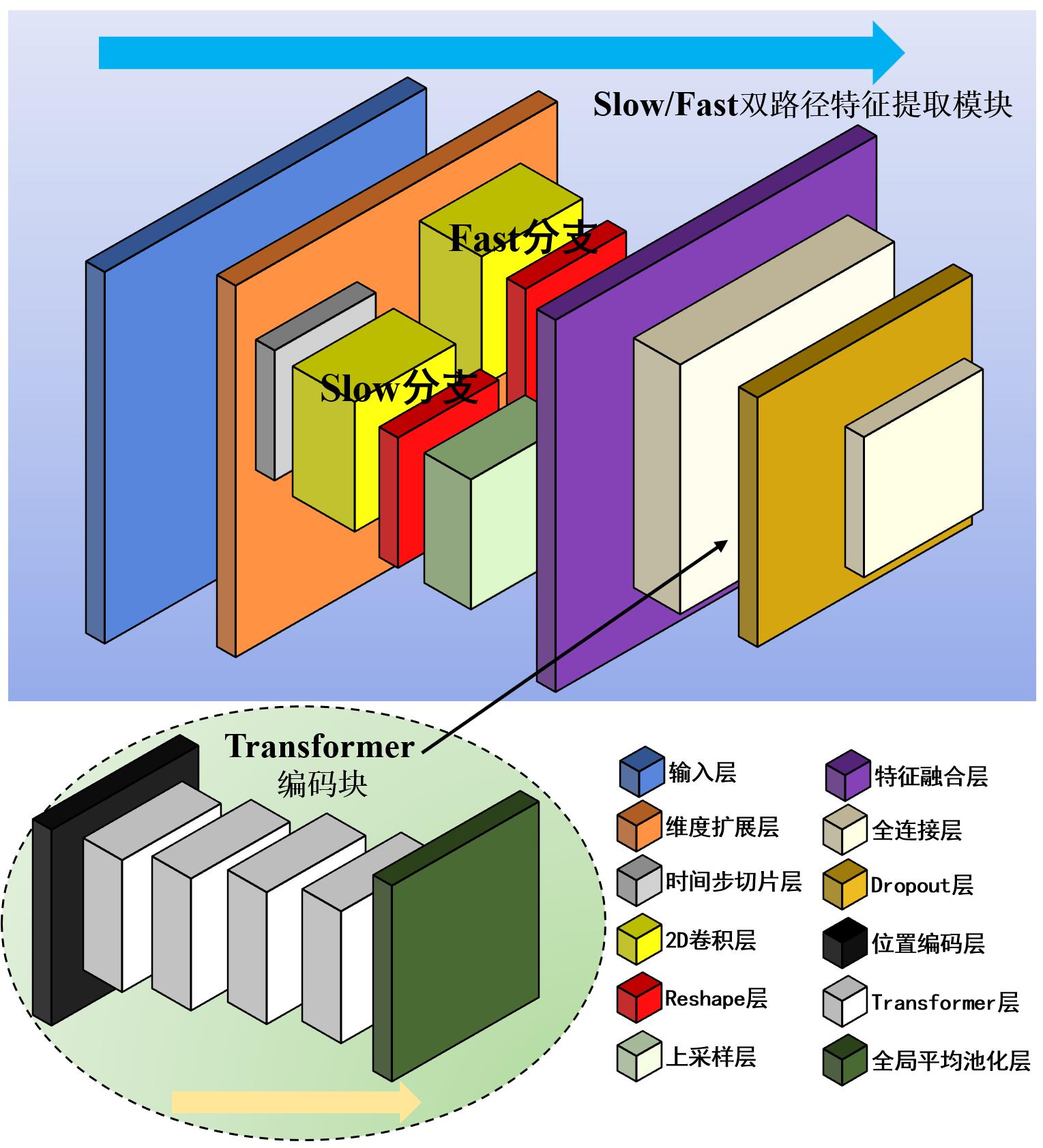
图1(a) SlowFast-Transformer模型结构图
Fig.1(a) Architecture of the SlowFast-Transformer model
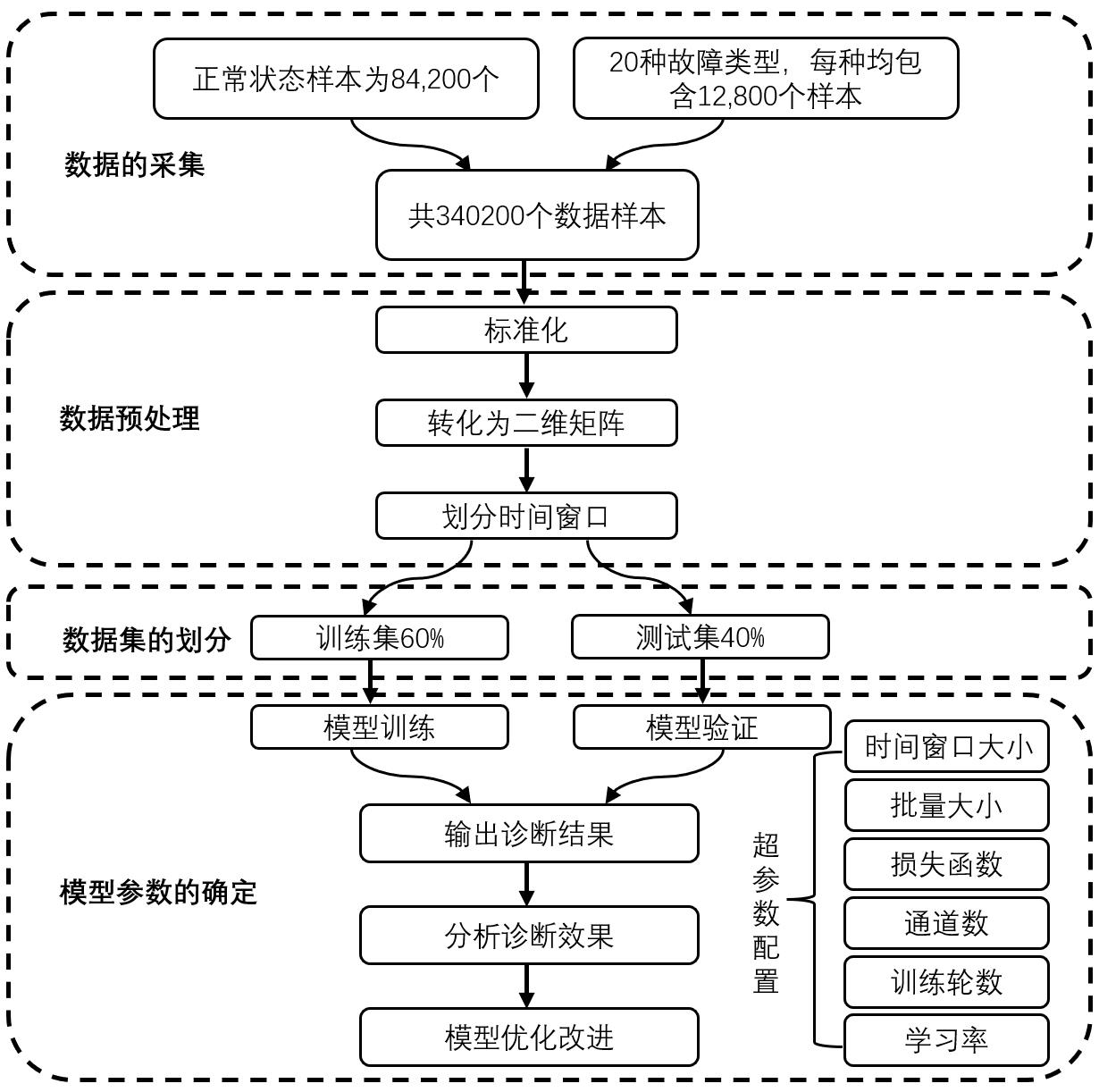
图2 模型流程图
Fig.2 Flow diagram of the proposed model
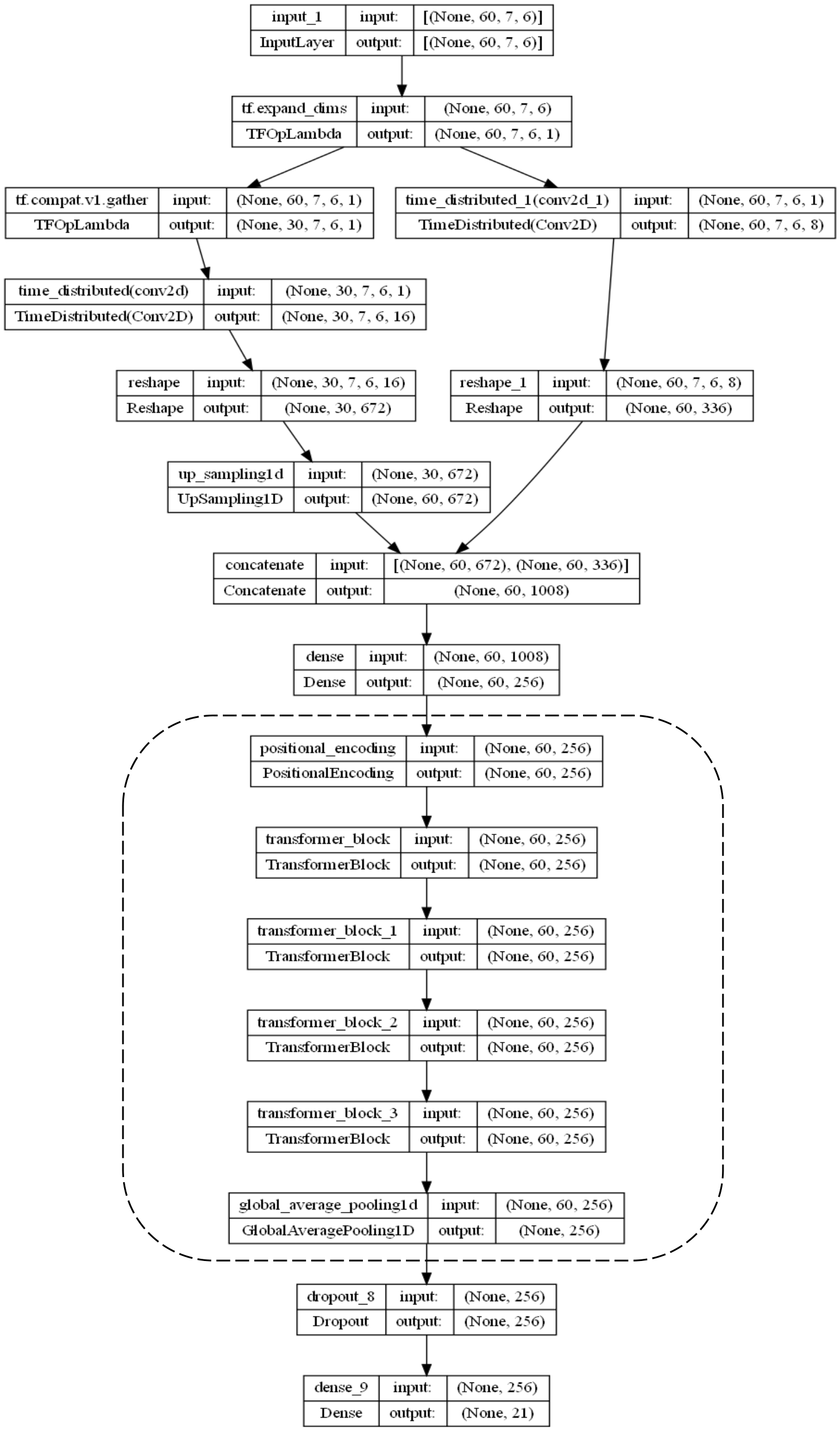
图1(b) SlowFast-Transformer数据维度和传递过程
Fig.1(b) Data flow and dimensional transformation in the SlowFast-Transformer model
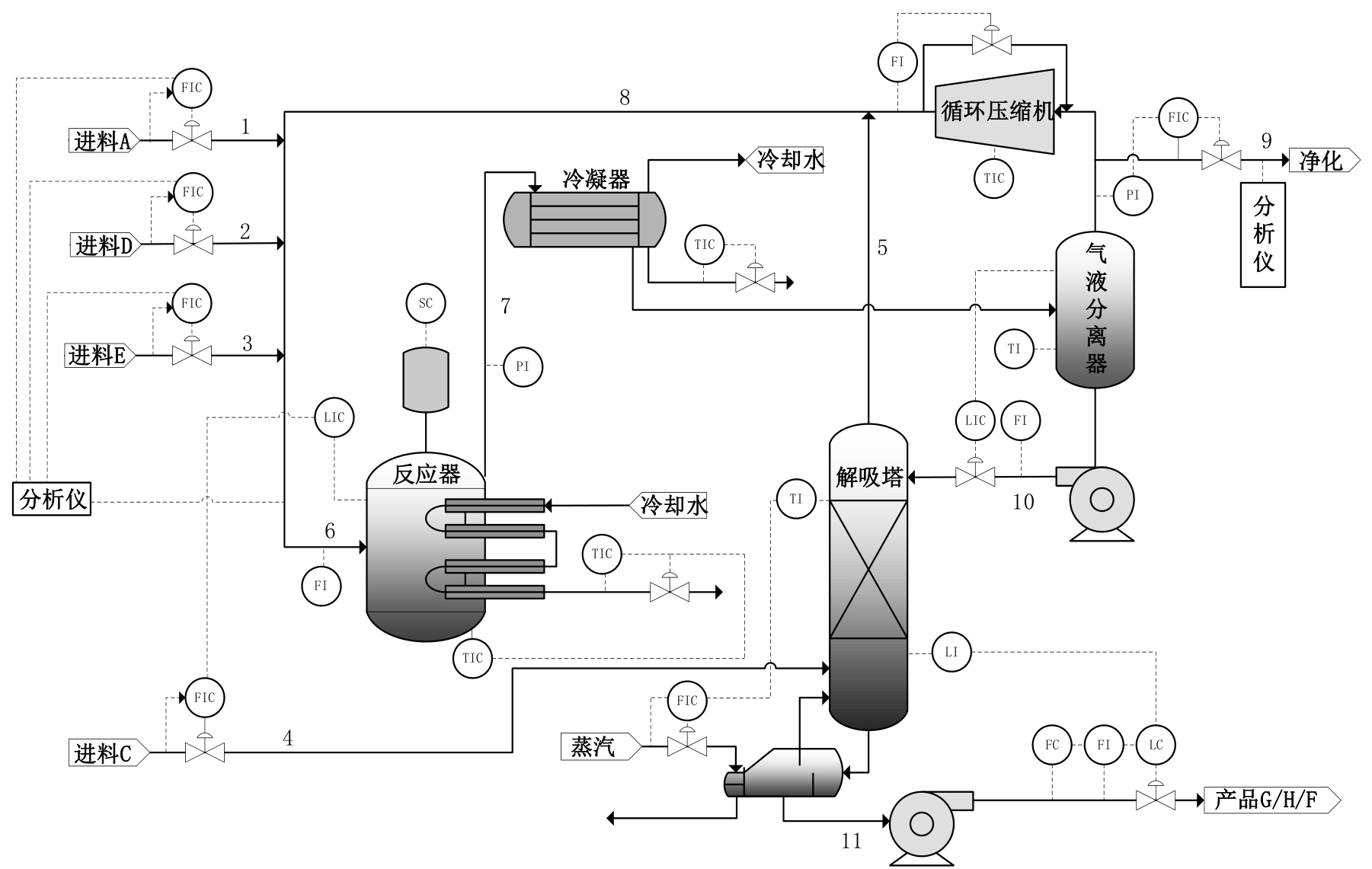
图3 TE 过程工艺流程图
Fig.3 Process flow diagram of the TE process
| 故障序号 | 故障描述 | 故障类型 | 故障序号 | 故障描述 | 故障类型 |
|---|---|---|---|---|---|
| 1 | A/C物料进料比变化,B组分不变 | 阶跃变化 | 11 | 反应器冷却水入口温度变化 | 随机变化 |
| 2 | B组分变化,A/C物料进料比不变 | 阶跃变化 | 12 | 冷凝器冷却水入口温度变化 | 随机变化 |
| 3 | 组分D进料温度变化 | 阶跃变化 | 13 | 反应器动力性能 | 缓慢漂移 |
| 4 | 反应器冷却水入口温度变化 | 阶跃变化 | 14 | 反应器冷却水阀门 | 堵塞 |
| 5 | 冷凝器冷却水入口温度变化 | 阶跃变化 | 15 | 冷凝器冷却水阀门 | 堵塞 |
| 6 | 物料A损失 | 阶跃变化 | 16 | 未知 | 未知 |
| 7 | 物料C压力损失 | 阶跃变化 | 17 | 未知 | 未知 |
| 8 | 物料A、B、C的组成变化 | 随机变化 | 18 | 未知 | 未知 |
| 9 | 组分D进料温度变化 | 随机变化 | 19 | 未知 | 未知 |
| 10 | 组分C进料温度变化 | 随机变化 | 20 | 未知 | 未知 |
表1 TE过程20种预设的故障
Table 1 20 Predefined faults in the TE process
| 故障序号 | 故障描述 | 故障类型 | 故障序号 | 故障描述 | 故障类型 |
|---|---|---|---|---|---|
| 1 | A/C物料进料比变化,B组分不变 | 阶跃变化 | 11 | 反应器冷却水入口温度变化 | 随机变化 |
| 2 | B组分变化,A/C物料进料比不变 | 阶跃变化 | 12 | 冷凝器冷却水入口温度变化 | 随机变化 |
| 3 | 组分D进料温度变化 | 阶跃变化 | 13 | 反应器动力性能 | 缓慢漂移 |
| 4 | 反应器冷却水入口温度变化 | 阶跃变化 | 14 | 反应器冷却水阀门 | 堵塞 |
| 5 | 冷凝器冷却水入口温度变化 | 阶跃变化 | 15 | 冷凝器冷却水阀门 | 堵塞 |
| 6 | 物料A损失 | 阶跃变化 | 16 | 未知 | 未知 |
| 7 | 物料C压力损失 | 阶跃变化 | 17 | 未知 | 未知 |
| 8 | 物料A、B、C的组成变化 | 随机变化 | 18 | 未知 | 未知 |
| 9 | 组分D进料温度变化 | 随机变化 | 19 | 未知 | 未知 |
| 10 | 组分C进料温度变化 | 随机变化 | 20 | 未知 | 未知 |
| 变量 | 描述 | 单位 | 变量 | 描述 | 单位 |
|---|---|---|---|---|---|
| XMEAS(1) | A进料(流股1) | km³·h-1 | XMEAS(22) | 分离器冷却水出口温度 | °C |
| XMEAS(2) | D进料(流股2) | kg·h-1 | XMEAS(23) | 成分A (流股6) | — |
| XMEAS(3) | E进料(流股3) | kg·h-1 | XMEAS(24) | 成分B (流股6) | — |
| XMEAS(4) | 总进料(流股4) | km³·h-1 | XMEAS(25) | 成分C (流股6) | — |
| XMEAS(5) | 再循环流量 (流股8) | km³·h-1 | XMEAS(26) | 成分D (流股6) | — |
| XMEAS(6) | 反应器进料速度(流股6) | km³·h-1 | XMEAS(27) | 成分E (流股6) | — |
| XMEAS(7) | 反应器压力 | kPa (表压) | XMEAS(28) | 成分F (流股6) | — |
| XMEAS(8) | 反应器等级 | % | XMEAS(29) | 成分A (流股9) | — |
| XMEAS(9) | 反应器温度 | °C | XMEAS(30) | 成分B (流股9) | — |
| XMEAS(10) | 排放速度 (流股9) | km³·h-1 | XMEAS(31) | 成分C (流股9) | — |
| XMEAS(11) | 产品分离器温度 | °C | XMEAS(32) | 成分D (流股9) | — |
| XMEAS(12) | 产品分离器液位 | % | XMEAS(33) | 成分E (流股9) | — |
| XMEAS(13) | 产品分离器压力 | kPa (表压) | XMEAS(34) | 成分F (流股9) | — |
| XMEAS(14) | 产品分离器塔底低流量(流股10) | m³·h-1 | XMEAS(35) | 成分G (流股9) | — |
| XMEAS(15) | 汽提器等级 | % | XMEAS(36) | 成分H (流股9) | — |
| XMEAS(16) | 汽提器压力 | kPa (表压) | XMEAS(37) | 成分D (流股11) | — |
| XMEAS(17) | 汽提器塔底流量(流股11) | m³·h-1 | XMEAS(38) | 成分E (流股11) | — |
| XMEAS(18) | 汽提器温度 | °C | XMEAS(39) | 成分F (流股11) | — |
| XMEAS(19) | 汽提器流量 | kg·h-1 | XMEAS(40) | 成分G (流股11) | — |
| XMEAS(20) | 压缩机功率 | kW | XMEAS(41) | 成分H (流股11) | — |
| XMEAS(21) | 反应器冷却水出口温度 | °C |
表2 TE过程的41个实时测量变量
Table.2 41 Real-time measured variables in the TE process
| 变量 | 描述 | 单位 | 变量 | 描述 | 单位 |
|---|---|---|---|---|---|
| XMEAS(1) | A进料(流股1) | km³·h-1 | XMEAS(22) | 分离器冷却水出口温度 | °C |
| XMEAS(2) | D进料(流股2) | kg·h-1 | XMEAS(23) | 成分A (流股6) | — |
| XMEAS(3) | E进料(流股3) | kg·h-1 | XMEAS(24) | 成分B (流股6) | — |
| XMEAS(4) | 总进料(流股4) | km³·h-1 | XMEAS(25) | 成分C (流股6) | — |
| XMEAS(5) | 再循环流量 (流股8) | km³·h-1 | XMEAS(26) | 成分D (流股6) | — |
| XMEAS(6) | 反应器进料速度(流股6) | km³·h-1 | XMEAS(27) | 成分E (流股6) | — |
| XMEAS(7) | 反应器压力 | kPa (表压) | XMEAS(28) | 成分F (流股6) | — |
| XMEAS(8) | 反应器等级 | % | XMEAS(29) | 成分A (流股9) | — |
| XMEAS(9) | 反应器温度 | °C | XMEAS(30) | 成分B (流股9) | — |
| XMEAS(10) | 排放速度 (流股9) | km³·h-1 | XMEAS(31) | 成分C (流股9) | — |
| XMEAS(11) | 产品分离器温度 | °C | XMEAS(32) | 成分D (流股9) | — |
| XMEAS(12) | 产品分离器液位 | % | XMEAS(33) | 成分E (流股9) | — |
| XMEAS(13) | 产品分离器压力 | kPa (表压) | XMEAS(34) | 成分F (流股9) | — |
| XMEAS(14) | 产品分离器塔底低流量(流股10) | m³·h-1 | XMEAS(35) | 成分G (流股9) | — |
| XMEAS(15) | 汽提器等级 | % | XMEAS(36) | 成分H (流股9) | — |
| XMEAS(16) | 汽提器压力 | kPa (表压) | XMEAS(37) | 成分D (流股11) | — |
| XMEAS(17) | 汽提器塔底流量(流股11) | m³·h-1 | XMEAS(38) | 成分E (流股11) | — |
| XMEAS(18) | 汽提器温度 | °C | XMEAS(39) | 成分F (流股11) | — |
| XMEAS(19) | 汽提器流量 | kg·h-1 | XMEAS(40) | 成分G (流股11) | — |
| XMEAS(20) | 压缩机功率 | kW | XMEAS(41) | 成分H (流股11) | — |
| XMEAS(21) | 反应器冷却水出口温度 | °C |
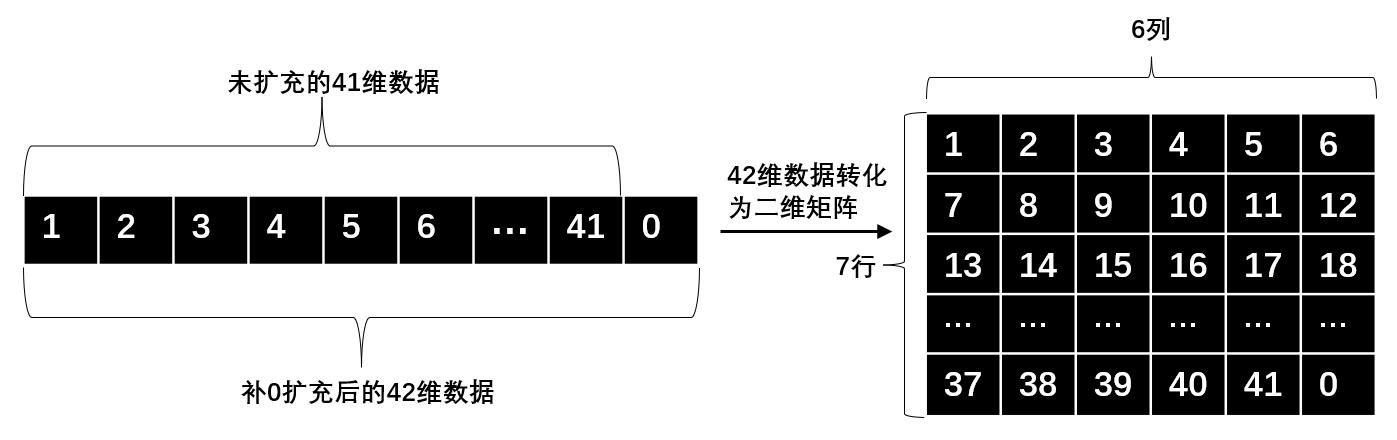
图4(a) 高维向量向二维结构的转换过程
Fig.4 (a)Process of converting high-dimensional vectors into a 2D matrix representation.
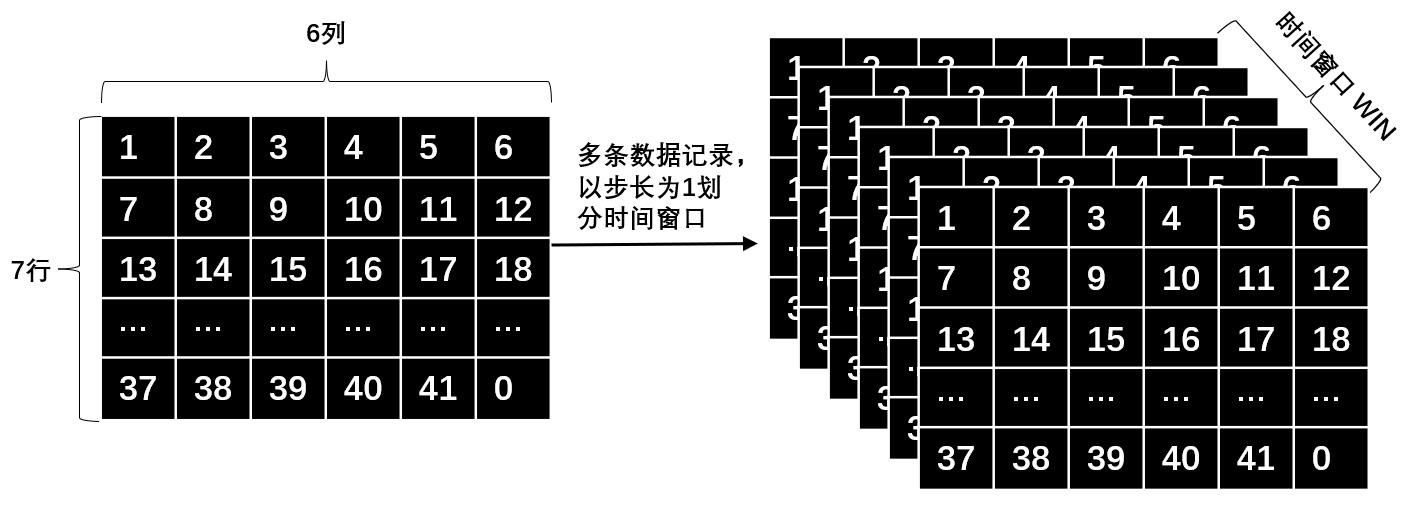
图4(b) 时间窗口的划分过程
Fig.4(b) Process of time window segmentation.
| 时间窗口 | 测试集诊断率 |
|---|---|
| WIN=10 | val_acc=92.25% |
| WIN=20 | val_acc=94.35% |
| WIN=30 | val_acc=95.92% |
| WIN=40 | val_acc=96.65% |
| WIN=50 | val_acc=96.88% |
| WIN=60 | val_acc=97.02% |
表3 时间窗口的大小对模型诊断率的影响
Table.3 The impact of time window size on the diagnostic accuracy of the model. (Batch Size = 128, Epochs = 100)
| 时间窗口 | 测试集诊断率 |
|---|---|
| WIN=10 | val_acc=92.25% |
| WIN=20 | val_acc=94.35% |
| WIN=30 | val_acc=95.92% |
| WIN=40 | val_acc=96.65% |
| WIN=50 | val_acc=96.88% |
| WIN=60 | val_acc=97.02% |
| 超参数名称 | 取值范围 | 最优参数值 /设定值 | 说明 |
|---|---|---|---|
| 时间窗口大小 | (10,20,30,40,50,60) | 60 | 时间序列每个窗口的步长长度 |
| 批量大小(Batch size) | (16,32,128,256) | 128 | 每次训练批次大小 |
| 学习率(Adam) | (3×10-5,4×10-4, 1×10⁻³) | 4×10⁻⁴ | 优化器的初始学习率 |
| 卷积通道数(Fast路径) | (8,16) | 8 | 每帧CNN的通道数(Fast) |
| 卷积通道数(Slow路径) | (16,32) | 16 | 每帧CNN的通道数(Slow) |
| Transformer维度 | - | 256 | Transformer输入线性变换维度 |
| 多头注意力头数 | - | 4 | Multi-Head Attention中的头数 |
| 前馈网络维度 | - | 512 | Transformer中的前馈层维度 |
| Transformer层数 | - | 4 | 堆叠的TransformerBlock数量 |
| Dropout率 | - | 0.1 / 0.65 | Transformer中Block使用0.1,全连接层使用0.65 |
表4 SlowFast-Transformer网络中的主要超参数
Table.4 Key hyperparameters in the SlowFast-Transformer network
| 超参数名称 | 取值范围 | 最优参数值 /设定值 | 说明 |
|---|---|---|---|
| 时间窗口大小 | (10,20,30,40,50,60) | 60 | 时间序列每个窗口的步长长度 |
| 批量大小(Batch size) | (16,32,128,256) | 128 | 每次训练批次大小 |
| 学习率(Adam) | (3×10-5,4×10-4, 1×10⁻³) | 4×10⁻⁴ | 优化器的初始学习率 |
| 卷积通道数(Fast路径) | (8,16) | 8 | 每帧CNN的通道数(Fast) |
| 卷积通道数(Slow路径) | (16,32) | 16 | 每帧CNN的通道数(Slow) |
| Transformer维度 | - | 256 | Transformer输入线性变换维度 |
| 多头注意力头数 | - | 4 | Multi-Head Attention中的头数 |
| 前馈网络维度 | - | 512 | Transformer中的前馈层维度 |
| Transformer层数 | - | 4 | 堆叠的TransformerBlock数量 |
| Dropout率 | - | 0.1 / 0.65 | Transformer中Block使用0.1,全连接层使用0.65 |
| 工况 | FAR | FDR | 工况 | FAR | FDR |
|---|---|---|---|---|---|
| 正常工况 | 0.0405 | 0.9413 | 故障11 | 0.0002 | 1.0000 |
| 故障1 | 0 | 1.0000 | 故障12 | 0 | 1.0000 |
| 故障2 | 0 | 1.0000 | 故障13 | 0 | 1.0000 |
| 故障3 | 0.1225 | 0.9343 | 故障14 | 0 | 1.0000 |
| 故障4 | 0.0022 | 0.9973 | 故障15 | 0.0201 | 0.9681 |
| 故障5 | 0 | 1.0000 | 故障16 | 0.0044 | 0.9973 |
| 故障6 | 0 | 1.0000 | 故障17 | 0 | 1.0000 |
| 故障7 | 0 | 1.0000 | 故障18 | 0 | 1.0000 |
| 故障8 | 0 | 1.0000 | 故障19 | 0.0002 | 1.0000 |
| 故障9 | 0.0111 | 0.9875 | 故障20 | 0 | 1.0000 |
| 故障10 | 0 | 0.9943 |
表5 最优参数下SlowFast- Transformer网络误报率和检出率
Table.5 FAR and FDR of SlowFast- Transformer network for different faults under optimal parameters.
| 工况 | FAR | FDR | 工况 | FAR | FDR |
|---|---|---|---|---|---|
| 正常工况 | 0.0405 | 0.9413 | 故障11 | 0.0002 | 1.0000 |
| 故障1 | 0 | 1.0000 | 故障12 | 0 | 1.0000 |
| 故障2 | 0 | 1.0000 | 故障13 | 0 | 1.0000 |
| 故障3 | 0.1225 | 0.9343 | 故障14 | 0 | 1.0000 |
| 故障4 | 0.0022 | 0.9973 | 故障15 | 0.0201 | 0.9681 |
| 故障5 | 0 | 1.0000 | 故障16 | 0.0044 | 0.9973 |
| 故障6 | 0 | 1.0000 | 故障17 | 0 | 1.0000 |
| 故障7 | 0 | 1.0000 | 故障18 | 0 | 1.0000 |
| 故障8 | 0 | 1.0000 | 故障19 | 0.0002 | 1.0000 |
| 故障9 | 0.0111 | 0.9875 | 故障20 | 0 | 1.0000 |
| 故障10 | 0 | 0.9943 |
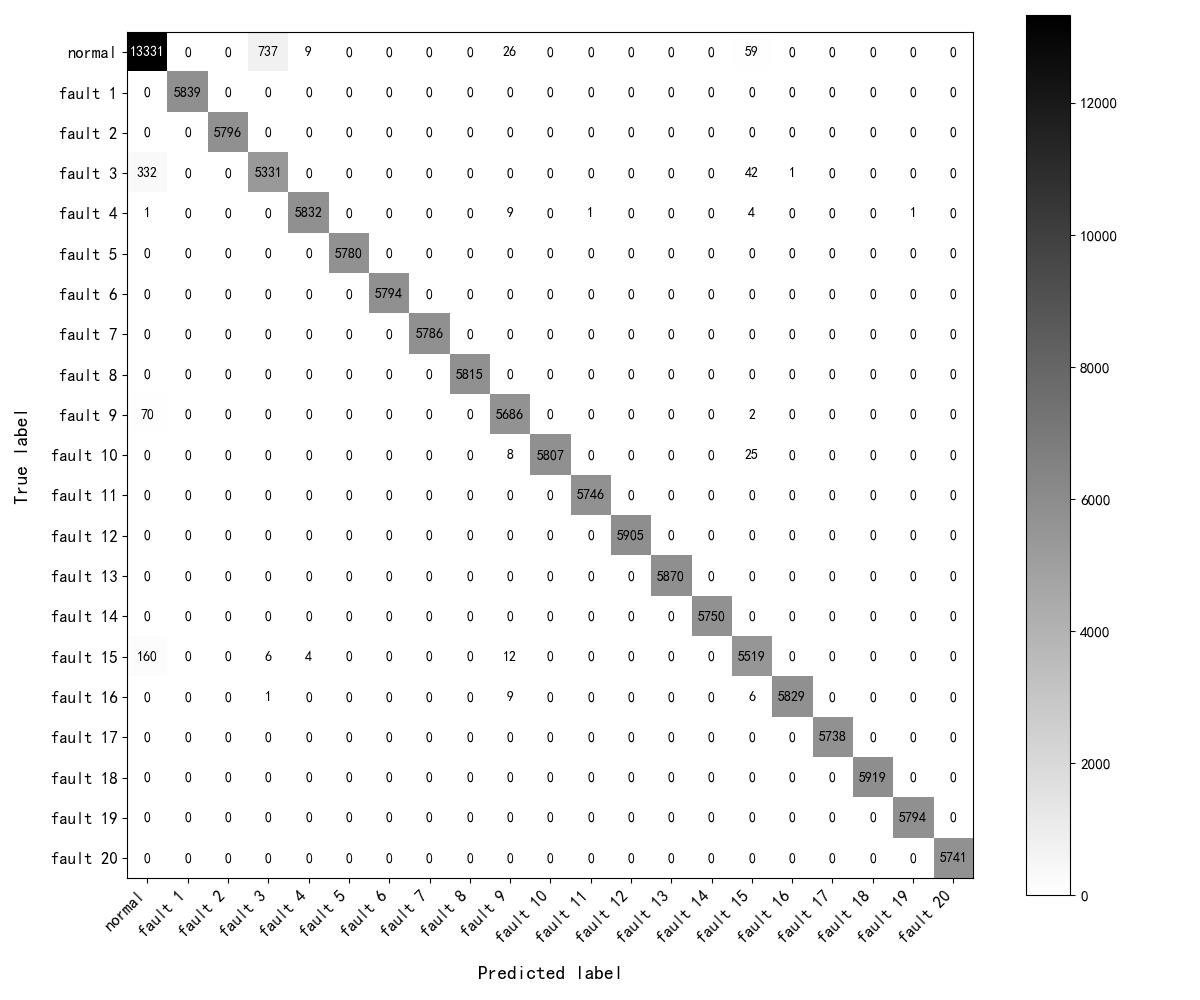
图5 最优参数下SlowFast- Transformer网络的混淆矩阵
Fig.5 Confusion matrix of the SlowFast-Transformer network under optimal parameters.
| 模型 | DCNN | LSTM | CNN-LSTM | DCRNN | SlowFast | SlowFast-Transformer |
|---|---|---|---|---|---|---|
| 平均FAR | - | 0.23% | 0.37% | 0.40% | 2.80% | 0.96% |
| 平均FDR | 88.20% | 95.37% | 96.64% | 91.70% | 97.51% | 99.14% |
| 检测准确率ACC | - | - | 95.85% | 91.56% | 94.31% | 98.44% |
表6 不同模型性能的比较
Table.6 Comparison of performance across different models.
| 模型 | DCNN | LSTM | CNN-LSTM | DCRNN | SlowFast | SlowFast-Transformer |
|---|---|---|---|---|---|---|
| 平均FAR | - | 0.23% | 0.37% | 0.40% | 2.80% | 0.96% |
| 平均FDR | 88.20% | 95.37% | 96.64% | 91.70% | 97.51% | 99.14% |
| 检测准确率ACC | - | - | 95.85% | 91.56% | 94.31% | 98.44% |
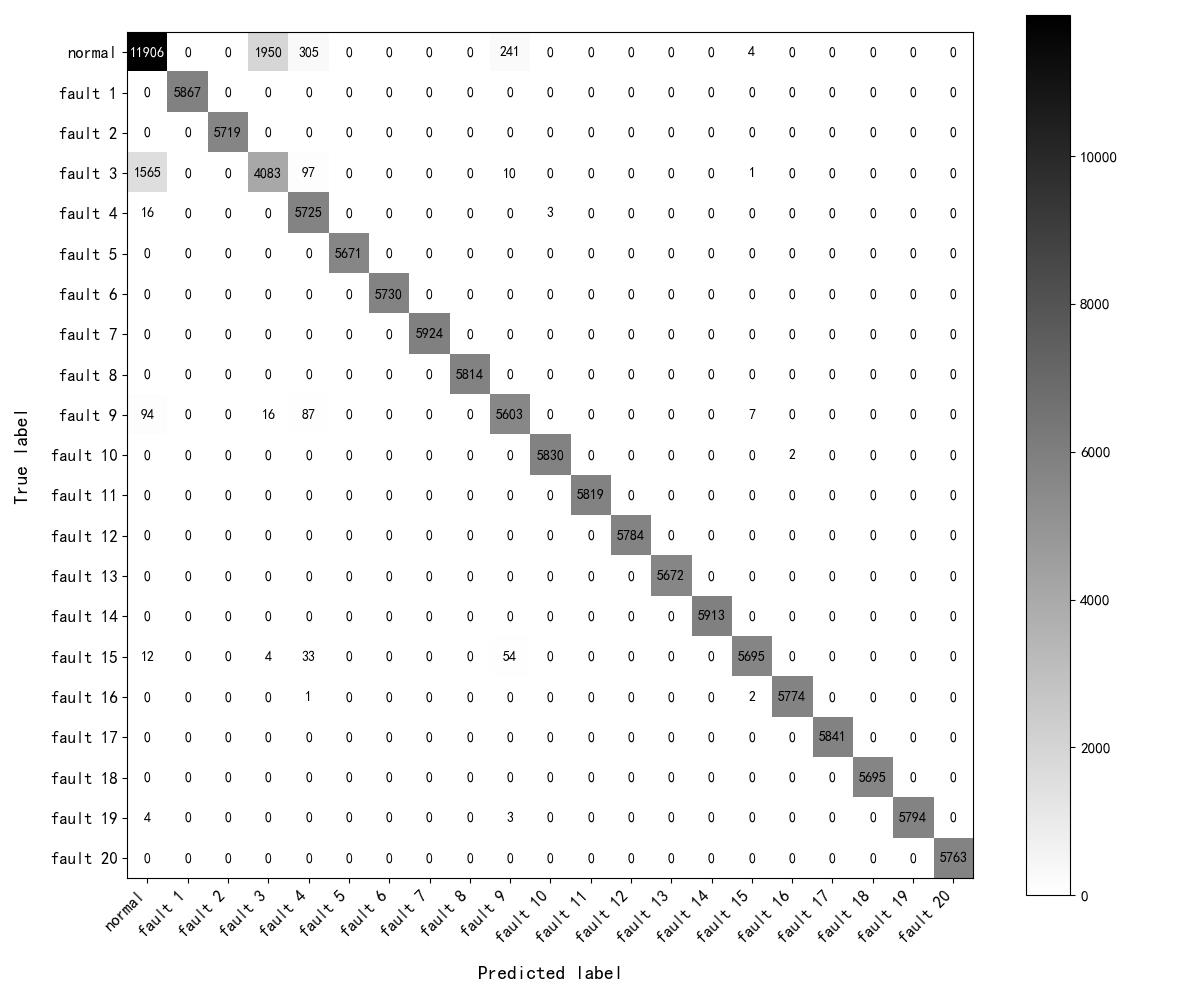
图6 最优参数下SlowFast网络的混淆矩阵
Fig.6 Confusion matrix of the SlowFast network under optimal parameters.
| 工况 | FAR | FDR | 工况 | FAR | FDR |
|---|---|---|---|---|---|
| 正常工况 | 0.1244 | 0.8265 | 故障11 | 0 | 1.0000 |
| 故障1 | 0 | 1.0000 | 故障12 | 0 | 1.0000 |
| 故障2 | 0 | 1.0000 | 故障13 | 0 | 1.0000 |
| 故障3 | 0.3255 | 0.7093 | 故障14 | 0 | 1.0000 |
| 故障4 | 0.0837 | 0.9967 | 故障15 | 0.0025 | 0.9822 |
| 故障5 | 0 | 1.0000 | 故障16 | 0.0003 | 0.9995 |
| 故障6 | 0 | 1.0000 | 故障17 | 0 | 1.0000 |
| 故障7 | 0 | 1.0000 | 故障18 | 0 | 1.0000 |
| 故障8 | 0 | 1.0000 | 故障19 | 0 | 0.9988 |
| 故障9 | 0.0526 | 0.9649 | 故障20 | 0 | 1.0000 |
| 故障10 | 0 | 0.9997 |
表7 最优参数下SlowFast网络对不同故障的误报率和检出率
Table.7 FAR and FDR of the SlowFast network for different faults under optimal parameters.
| 工况 | FAR | FDR | 工况 | FAR | FDR |
|---|---|---|---|---|---|
| 正常工况 | 0.1244 | 0.8265 | 故障11 | 0 | 1.0000 |
| 故障1 | 0 | 1.0000 | 故障12 | 0 | 1.0000 |
| 故障2 | 0 | 1.0000 | 故障13 | 0 | 1.0000 |
| 故障3 | 0.3255 | 0.7093 | 故障14 | 0 | 1.0000 |
| 故障4 | 0.0837 | 0.9967 | 故障15 | 0.0025 | 0.9822 |
| 故障5 | 0 | 1.0000 | 故障16 | 0.0003 | 0.9995 |
| 故障6 | 0 | 1.0000 | 故障17 | 0 | 1.0000 |
| 故障7 | 0 | 1.0000 | 故障18 | 0 | 1.0000 |
| 故障8 | 0 | 1.0000 | 故障19 | 0 | 0.9988 |
| 故障9 | 0.0526 | 0.9649 | 故障20 | 0 | 1.0000 |
| 故障10 | 0 | 0.9997 |
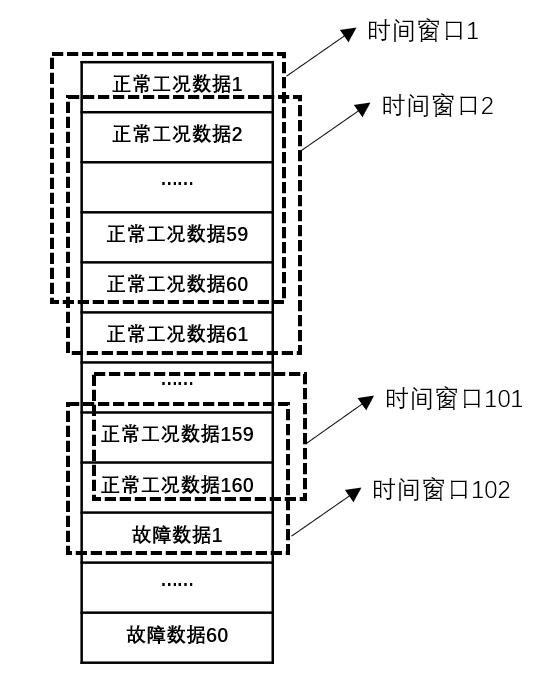
图7 时间窗口中正常工况与故障工况数据的混合
Fig.7 Mixed normal and fault operating conditions in time windows

图8 边缘窗口数据集格式
Fig.8 Format of Edge Window Dataset.
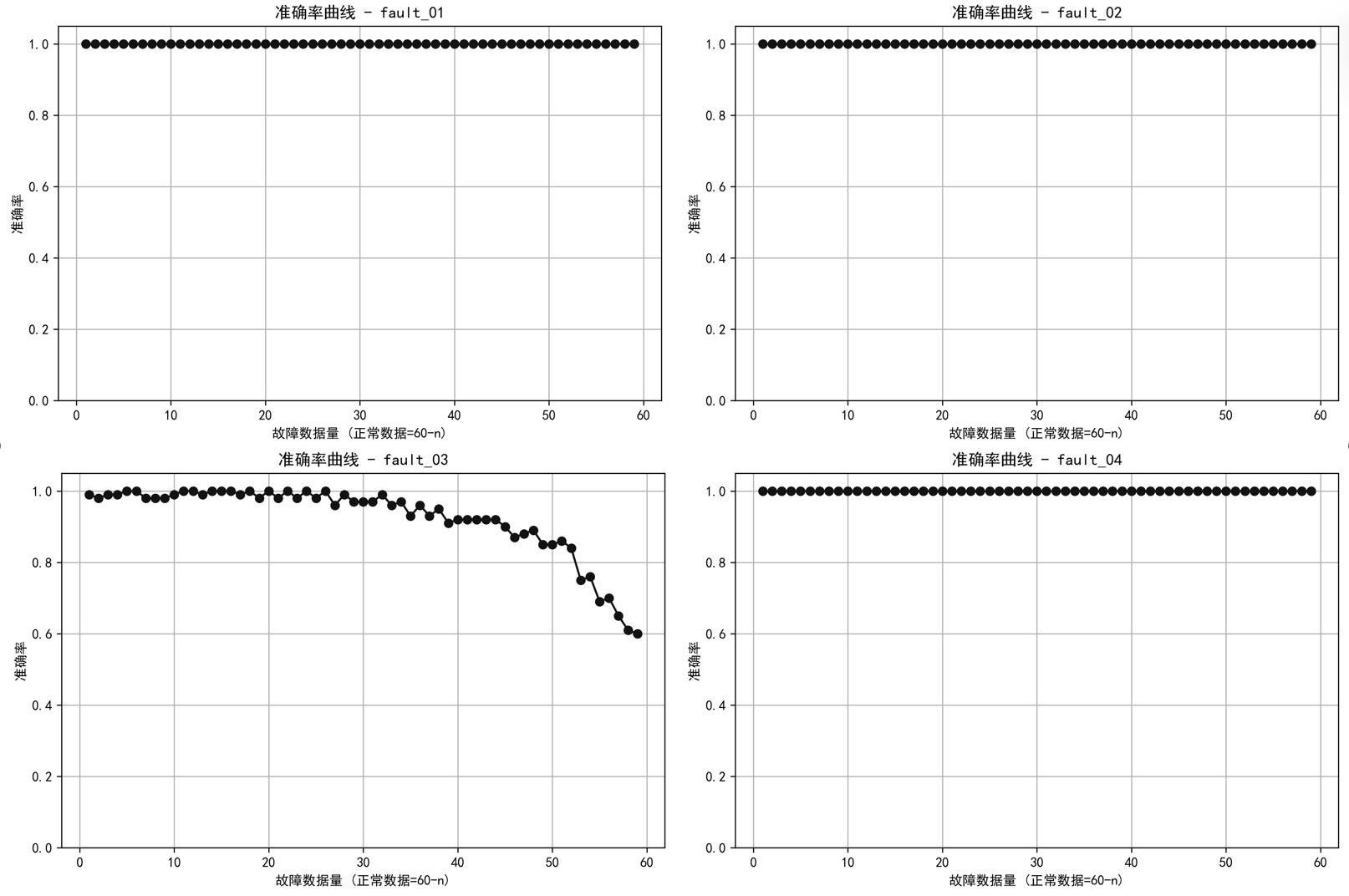
图9(a) 故障1-4随故障数据量递增的准确率曲线
Fig.9(a) Accuracy Curves of Faults 1-4 with Increasing Fault Data Volume.
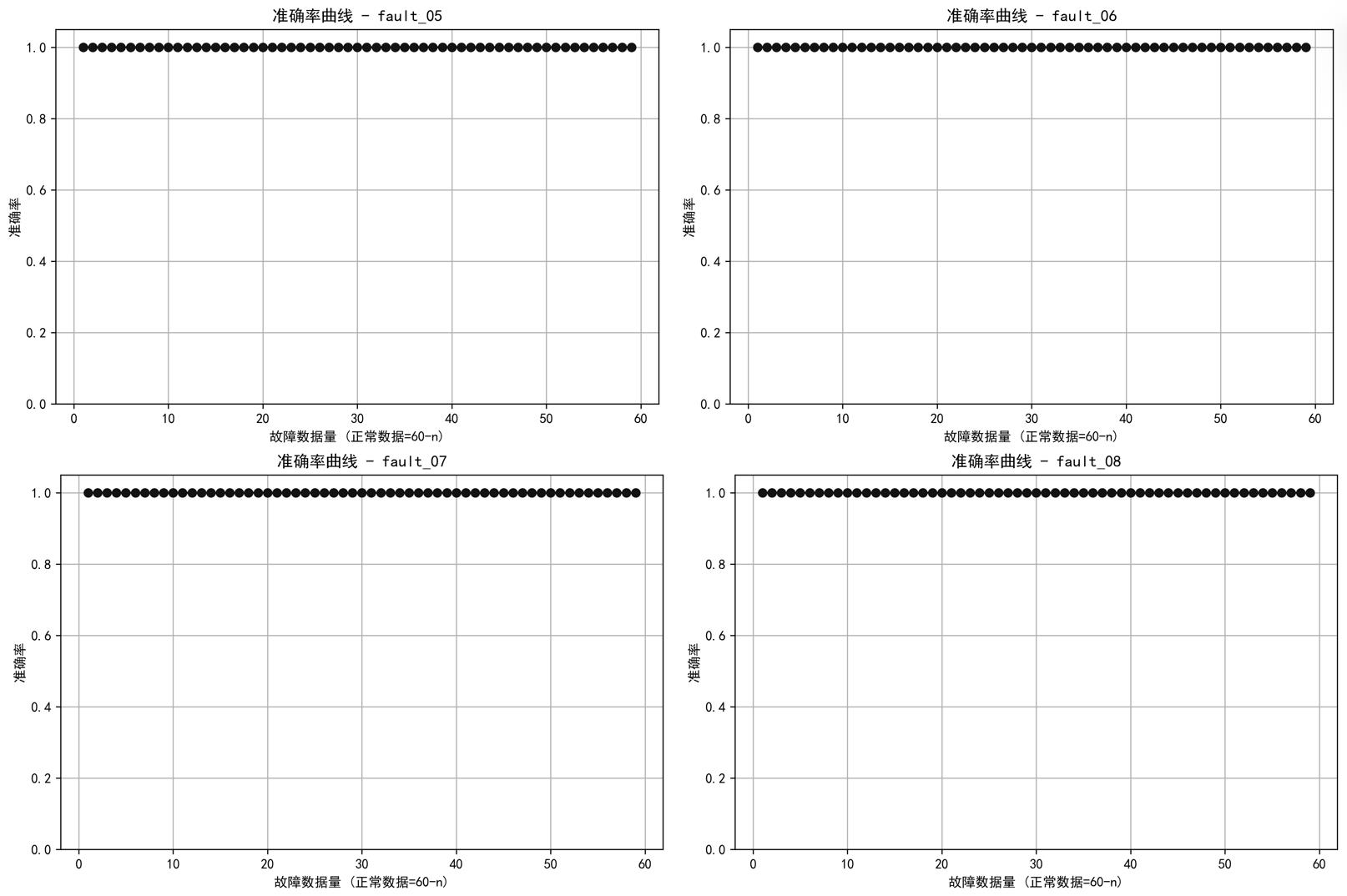
图9(b) 故障5-8随故障数据量递增的准确率曲线
Fig.9(b) Accuracy Curves of Faults 5-8 with Increasing Fault Data Volume.
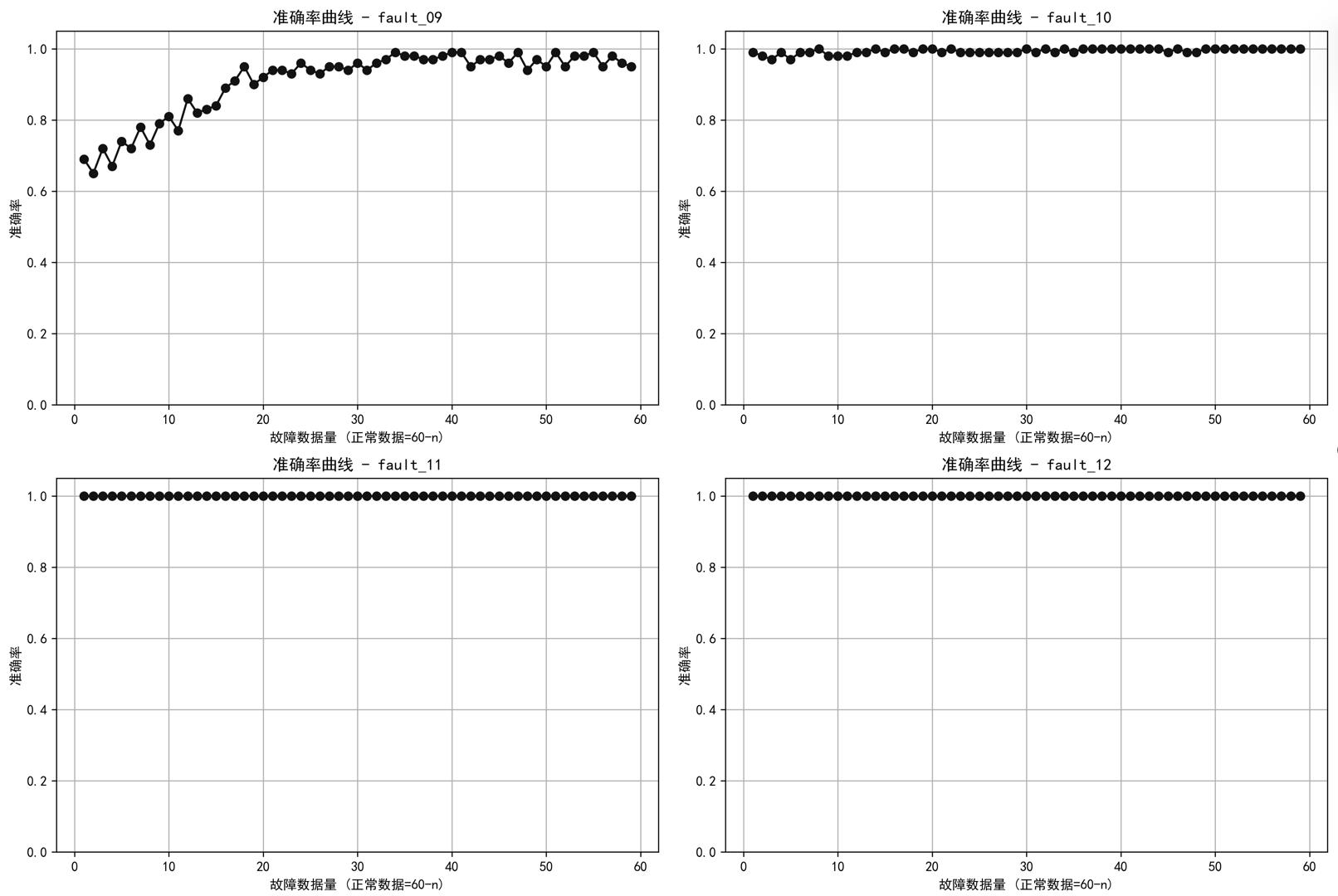
图9(c) 故障9-12随故障数据量递增的准确率曲线
Fig.9(c) Accuracy Curves of Faults 9-12 with Increasing Fault Data Volume.
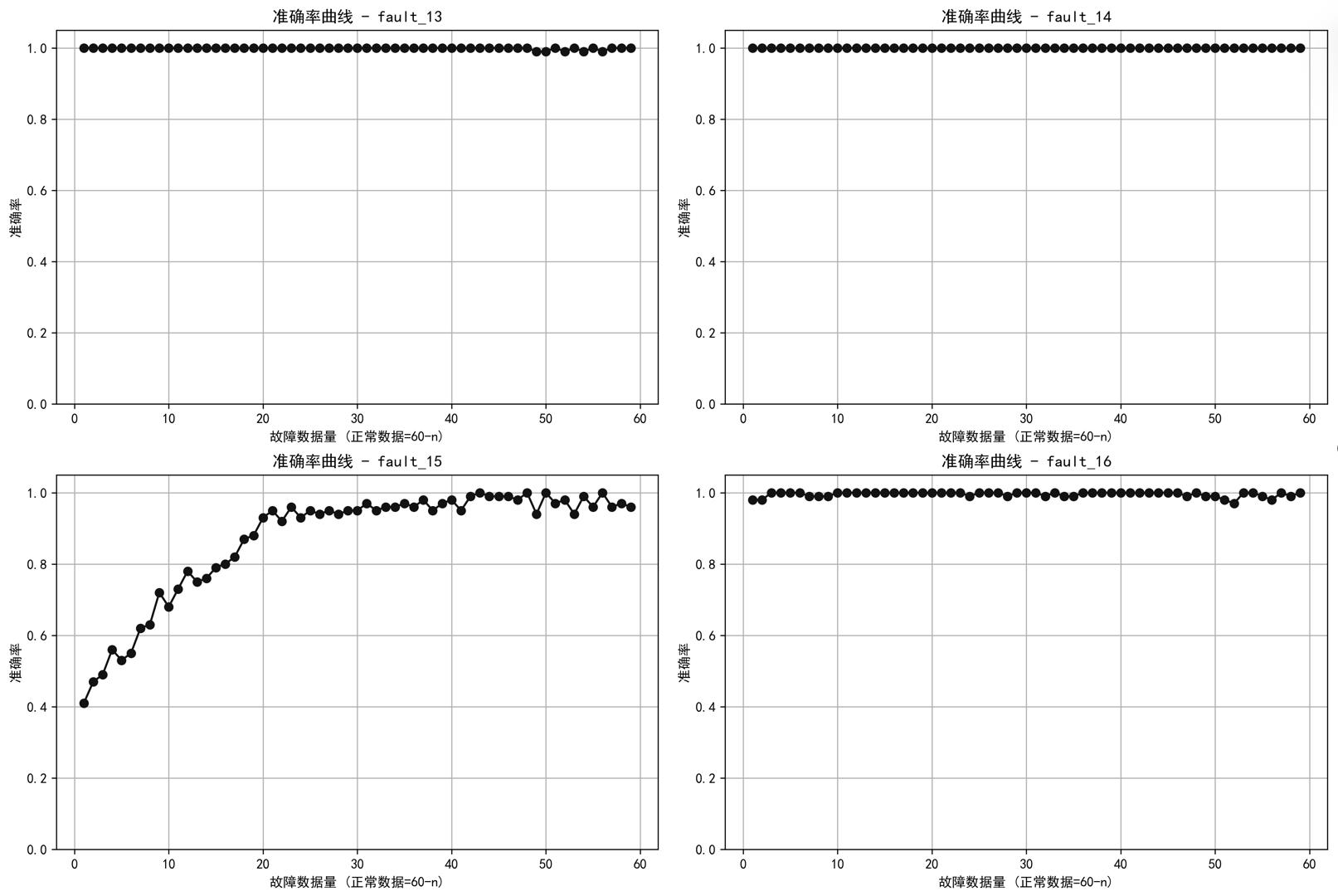
图9(d) 故障13-16随故障数据量递增的准确率曲线
Fig.9(d) Accuracy Curves of Faults 13-16 with Increasing Fault Data Volume
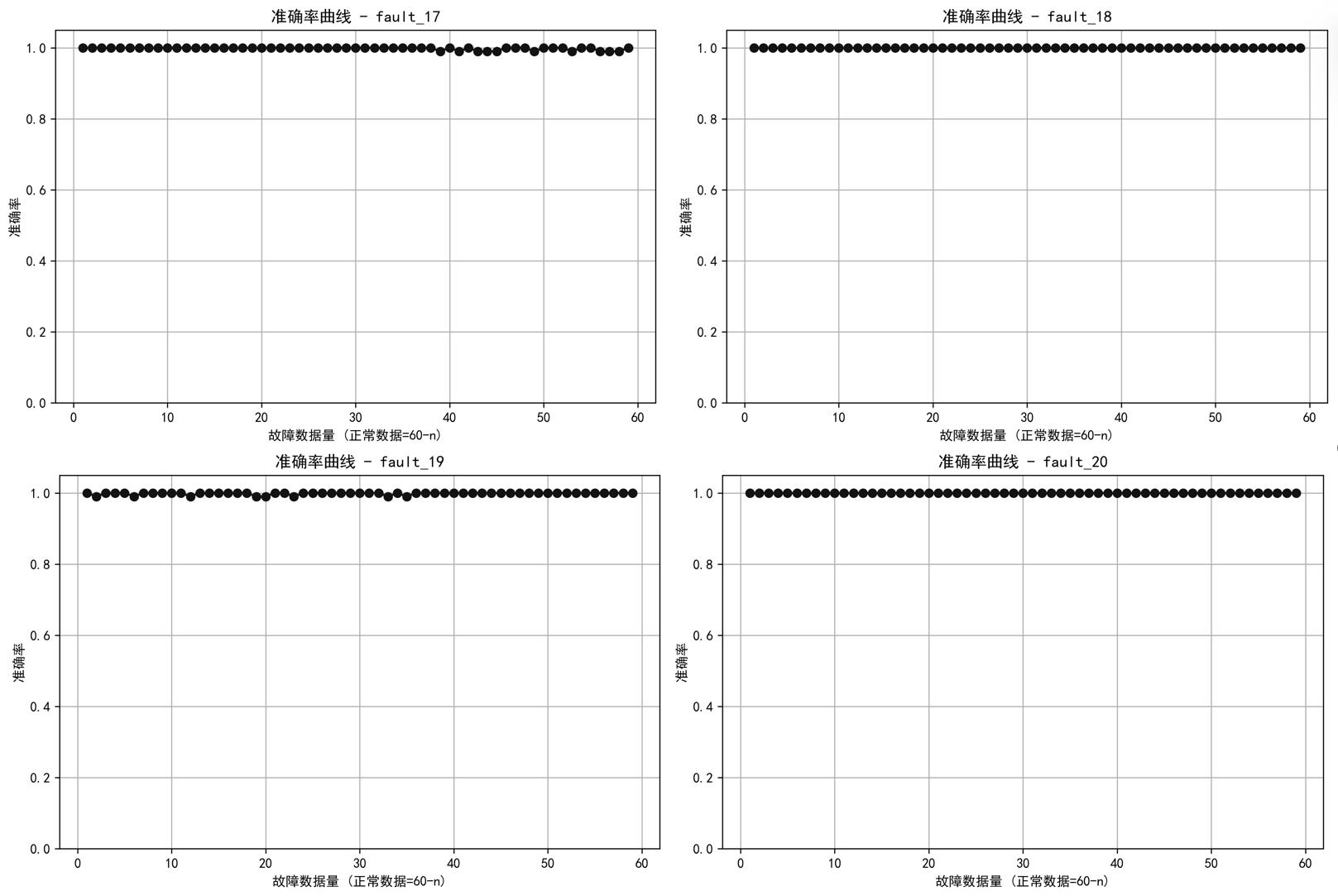
图9(e) 故障17-20随故障数据量递增的准确率曲线
Fig.9(e) Accuracy Curves of Faults 17-20 with Increasing Fault Data Volume
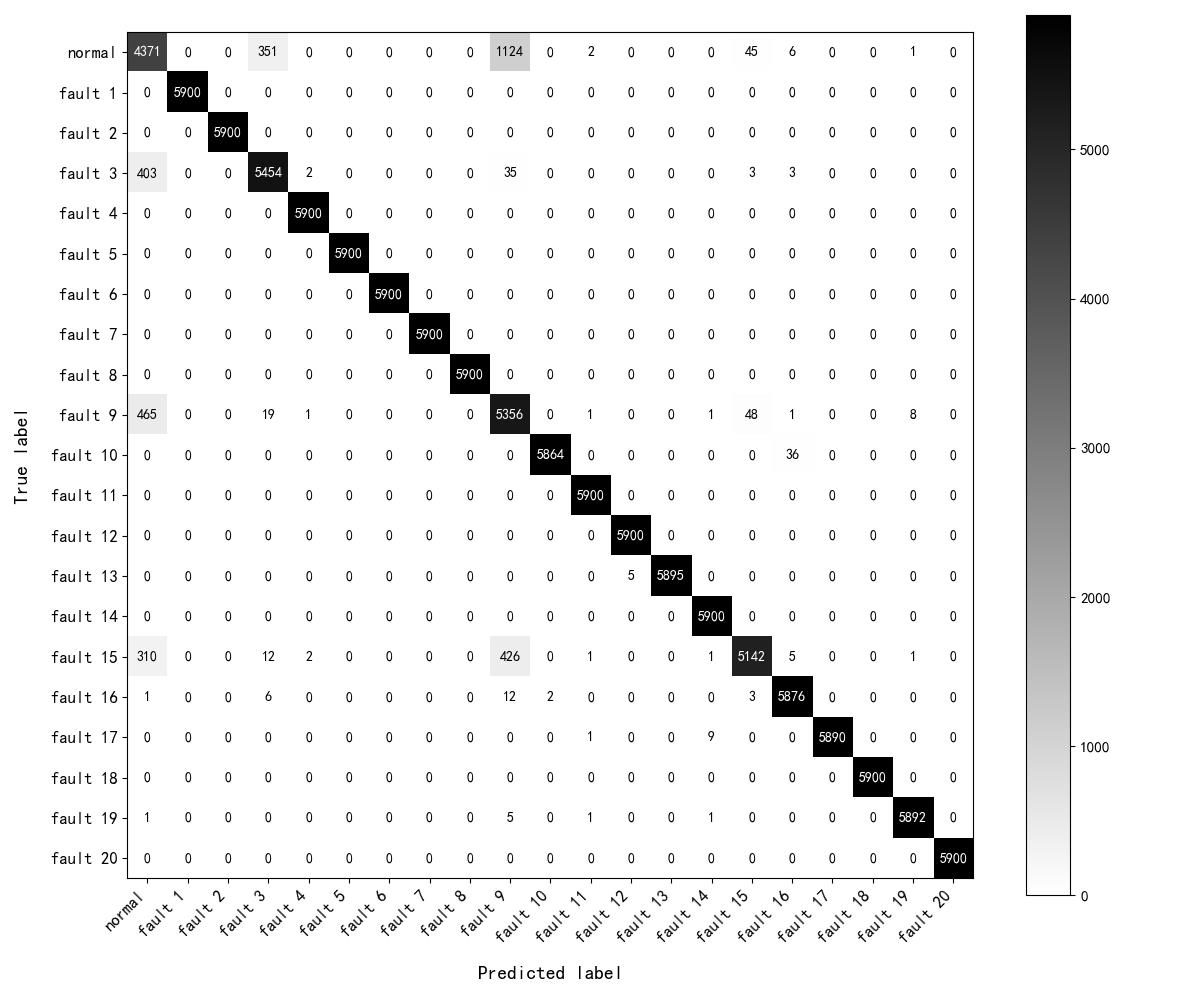
图9(f) 全部由混合矩阵组成的测试集所对应的混淆矩阵
Fig.9(f) Confusion Matrix Corresponding to the Test Set Composed Entirely of Mixed Matrices
| [1] | 人民网.国务院安委会对山东友道化学有限公司爆炸事故查处挂牌督办[EB/OL].[10月27日]. |
| [2] | 搜狐.辽宁某化工企业发生甲苯泄漏事故,致6人受伤[EB/OL].[10月27日]. |
| [3] | 江升. 基于长短期记忆网络的化工过程故障检测与诊断方法[D]. 广州: 华南理工大学, 2021.Jiang S. Guangzhou: South China University of Technology, 2021. |
| [4] | Bencheikh F, Harkat M F, Kouadri A, et al. New reduced kernel PCA for fault detection and diagnosis in cement rotary kiln[J]. Chemometrics and Intelligent Laboratory Systems, 2020, 204: 104091. |
| [5] | Li B, Delpha C, Diallo D, et al. Application of Artificial Neural Networks to photovoltaic fault detection and diagnosis: a review[J]. Renewable and Sustainable Energy Reviews, 2021, 138: 110512. |
| [6] | 戴一阳, 赵劲松, 陈丙珍. 化工过程混合故障诊断系统的应用[J]. 化工学报, 2010, 61(2): 342-346. |
| Dai Y Y, Zhao J S, Chen B Z. Application of hybrid diagnostic system for chemical processes[J]. CIESC Journal, 2010, 61(2): 342-346. | |
| [7] | Ku W F, Storer R H, Georgakis C. Disturbance detection and isolation by dynamic principal component analysis[J]. Chemometrics and Intelligent Laboratory Systems, 1995, 30(1): 179-196. |
| [8] | Jun B H, Park J H, Lee S I, et al. Kernel PCA based faults diagnosis for wastewater treatment system[M]//Advances in Neural Networks - ISNN 2006. Berlin, Heidelberg: Springer, 2006: 426-431. |
| [9] | Yoon S, MacGregor J F. Principal-component analysis of multiscale data for process monitoring and fault diagnosis[J]. AIChE Journal, 2004, 50(11): 2891-2903. |
| [10] | 戴一阳, 陈宁, 赵劲松, 等. 人工免疫系统在间歇化工过程故障诊断中的应用[J]. 化工学报, 2009, 60(1): 172-176. |
| Dai Y Y, Chen N, Zhao J S, et al. Application of AIS to batch chemical process fault diagnosis[J]. CIESC Journal, 2009, 60(1): 172-176. | |
| [11] | Zhao J S, Shu Y D, Zhu J F, et al. An online fault diagnosis strategy for full operating cycles of chemical processes[J]. Industrial & Engineering Chemistry Research, 2014, 53(13): 5015-5027. |
| [12] | 姚羽曼, 罗文嘉, 戴一阳. 数据驱动方法在化工过程故障诊断中的研究进展[J]. 化工进展, 2021, 40(4): 1755-1764. |
| Yao Y M, Luo W J, Dai Y Y. Research progress of data-driven methods in fault diagnosis of chemical process[J]. Chemical Industry and Engineering Progress, 2021, 40(4): 1755-1764. | |
| [13] | Venkatasubramanian V. The promise of artificial intelligence in chemical engineering: Is it here, finally?[J]. AIChE Journal, 2019, 65(2): 466-478. |
| [14] | Bagheri M, Akbari A, Ahmad Mirbagheri S. Advanced control of membrane fouling in filtration systems using artificial intelligence and machine learning techniques: a critical review[J]. Process Safety and Environmental Protection, 2019, 123: 229-252. |
| [15] | 文成林, 吕菲亚. 基于深度学习的故障诊断方法综述[J]. 电子与信息学报, 2020, 42(1): 234-248. |
| Wen C L, Lü F Y. Review on deep learning based fault diagnosis[J]. Journal of Electronics & Information Technology, 2020, 42(1): 234-248. | |
| [16] | Wu H, Zhao J S. Deep convolutional neural network model based chemical process fault diagnosis[J]. Computers & Chemical Engineering, 2018, 115: 185-197. |
| [17] | Bao Y, Wang B, Guo P D, et al. Chemical process fault diagnosis based on a combined deep learning method[J]. The Canadian Journal of Chemical Engineering, 2022, 100(1): 54-66. |
| [18] | Pascanu R, Mikolov T, Bengio Y. On the difficulty of training recurrent neural networks[C]//International Conference on Machine Learning, 2012. |
| [19] | Hochreiter S, Schmidhuber J. Long short-term memory[J]. Neural Computation, 1997, 9(8): 1735-1780. |
| [20] | Cho K, van Merrienboer B, Gulcehre C, et al. Learning phrase representations using RNN encoder-decoder for statistical machine translation[EB/OL]. 2014: arXiv: 1406.1078. |
| [21] | Ren J Y, Ni D. A batch-wise LSTM-encoder decoder network for batch process monitoring[J]. Chemical Engineering Research and Design, 2020, 164: 102-112. |
| [22] | Zhao H T, Sun S Y, Jin B. Sequential fault diagnosis based on LSTM neural network[J]. IEEE Access, 2018, 6: 12929-12939. |
| [23] | Zhang S Y, Bi K X, Qiu T. Bidirectional recurrent neural network-based chemical process fault diagnosis[J]. Industrial & Engineering Chemistry Research, 2020, 59(2): 824-834. |
| [24] | 王楠, 张日东, 吴胜. 一种基于LSTM和MLP结合的化工过程故障诊断方法: CN111123894B[P]. 2021-09-07. |
| [25] | 张晗筱, 王瑞琪, 张亚婷. 基于CNN-LSTM的换热器污垢因子预测研究[J]. 化工学报, 2025, 76(4): 1671-1679. |
| Zhang H X, Wang R Q, Zhang Y T. Prediction of scale factor of heat exchangers based on CNN-LSTM neural network[J]. CIESC Journal, 2025, 76(4): 1671-1679. | |
| [26] | Duvall P M, Riggs J B. On-line optimization of the Tennessee Eastman challenge problem[J]. Journal of Process Control, 2000, 10(1): 19-33. |
| [27] | LeCun Y, Bottou L, Bengio Y, et al. Gradient-based learning applied to document recognition[J]. Proceedings of the IEEE, 1998, 86(11): 2278-2324. |
| [28] | Feichtenhofer C, Fan H Q, Malik J, et al. SlowFast networks for video recognition[C]//2019 IEEE/CVF International Conference on Computer Vision (ICCV). October 27-November 2, 2019. Seoul, Korea. IEEE, 2019: 6201-6210. |
| [29] | Vaswani A., Shazeer N., Parmar N., Uszkoreit J., Jones L., Gomez A. N., Kaiser Ł., & Polosukhin I. Attention Is All You Need. Advances in Neural Information Processing Systems, 2017,30, 5998–6008. |
| [30] | Zou M X, Zhou Y Q, Jiang X H, et al. Spatio-temporal behavior detection in field manual labor based on improved SlowFast architecture[J]. Applied Sciences, 2024, 14(7): 2976. |
| [31] | Petersen P C, Sepliarskaia A. VC dimensions of group convolutional neural networks[J]. Neural Networks, 2024, 169: 462-474. |
| [32] | 李义, 刘颖慰, 都健, 等. 基于大数据建模的玉米淀粉糖工艺参数预测系统开发[J]. 当代化工研究, 2022(14): 145-152. |
| Li Y, Liu Y W, Du J, et al. System development for the prediction of key parameters in corn starch sugar process based on big data modeling[J]. Modern Chemical Research, 2022(14): 145-152. | |
| [33] | Garcia C I, Grasso F, Luchetta A, et al. A comparison of power quality disturbance detection and classification methods using CNN, LSTM and CNN-LSTM[J]. Applied Sciences, 2020, 10(19): 6755. |
| [34] | Barzegar R, Aalami M T, Adamowski J. Short-term water quality variable prediction using a hybrid CNN–LSTM deep learning model[J]. Stochastic Environmental Research and Risk Assessment, 2020, 34(2): 415-433. |
| [35] | Rieth C A, Amsel B D, Tran R, et al. Issues and advances in anomaly detection evaluation for joint human-automated systems[C]//Advances in Human Factors in Robots and Unmanned Systems. Cham: Springer, 2018: 52-63. |
| [36] | 吴婷婷, 许晓东, 吴云龙. 卷积神经网络中SPReLU激活函数的优化研究[J]. 计算机与数字工程, 2021, 49(8): 1637-1641. |
| Wu T T, Xu X D, Wu Y L. Research on optimization of SPReLU activation function in convolutional neural network[J]. Computer & Digital Engineering, 2021, 49(8): 1637-1641. | |
| [37] | Hosseini S, Khandakar A, Chowdhury M E H, et al. Novel and robust machine learning approach for estimating the fouling factor in heat exchangers[J]. Energy Reports, 2022, 8: 8767-8776. |
| [38] | Kim T Y, Cho S B. Predicting residential energy consumption using CNN-LSTM neural networks[J]. Energy, 2019, 182: 72-81. |
| [39] | Zha W S, Liu Y P, Wan Y J, et al. Forecasting monthly gas field production based on the CNN-LSTM model[J]. Energy, 2022, 260: 124889. |
| [40] | Mohanty D K, Singru P M. Fouling analysis of a shell and tube heat exchanger using local linear wavelet neural network[J]. International Journal of Heat and Mass Transfer, 2014, 77: 946-955. |
| [41] | McAvoy T J, Ye N. Base control for the Tennessee Eastman problem[J]. Computers & Chemical Engineering, 1994, 18(5): 383-413. |
| [1] | 王三一, 黄文来. 电化学合成氨流程建模与优化[J]. 化工学报, 2025, 76(9): 4474-4486. |
| [2] | 朱春梦, 李增, 柳楠, 赵云鹏, 石孝刚, 蓝兴英. 基于自编码器和多尺度符号转移熵的FCC沉降器跑剂故障检测[J]. 化工学报, 2025, 76(9): 4512-4523. |
| [3] | 何广汇, 王金江, 魏振强, 汪征, 张来斌. CSTR 工控安全虚实融合仿真方法研究[J]. 化工学报, 2025, 76(9): 4524-4538. |
| [4] | 刘奕扬, 邢志祥, 刘烨铖, 彭明, 李玉洋, 李云浩, 沈宁舟. 加氢站液氢泄漏扩散特性与安全监测数值模拟研究[J]. 化工学报, 2025, 76(9): 4694-4708. |
| [5] | 王一飞, 李玉星, 欧阳欣, 赵雪峰, 孟岚, 胡其会, 殷布泽, 郭雅琦. 基于裂尖减压特性的CO2管道断裂扩展数值计算[J]. 化工学报, 2025, 76(9): 4683-4693. |
| [6] | 郭旭, 贾继宁, 姚克俭. 基于优化CNN-BiLSTM神经网络的间歇精馏过程建模[J]. 化工学报, 2025, 76(9): 4613-4629. |
| [7] | 王芳, 马素霞, 田营, 刘众元. 基于LSTM动态修正一维机理模型的CFB机组NO x 排放浓度预测方法[J]. 化工学报, 2025, 76(7): 3416-3425. |
| [8] | 王金江, 鲁振杰, 安维峥, 杨风允, 秦小刚. ORC发电系统工艺过程预警诊断技术研究与展望[J]. 化工学报, 2025, 76(7): 3137-3152. |
| [9] | 范振宁, 梁海宁, 房茂立, 赫一凡, 于帅, 闫兴清, 安佳然, 乔帆帆, 喻健良. CO2管道不同相态节流放空特性研究与对比[J]. 化工学报, 2025, 76(7): 3742-3751. |
| [10] | 李文亮, 纪成, 梁晨, 吴思辰, 陈石林, 孙巍, 翟持. 基于TDMN的青霉素浓度在线软测量[J]. 化工学报, 2025, 76(6): 2848-2858. |
| [11] | 王富玉, 周晅毅. 结合非定常伴随方程和遗传算法的化工区反演[J]. 化工学报, 2025, 76(6): 3104-3114. |
| [12] | 王一非, 任婧杰, 毕明树, 叶昊天. 基于本质安全与经济性的环己烷氧化工艺参数多目标优化研究[J]. 化工学报, 2025, 76(6): 2722-2732. |
| [13] | 蒋敏, 邵翔宇, 郑立刚, 高建良, 雷刚. 膜片压力对氢-空气混合气体泄爆过程的影响[J]. 化工学报, 2025, 76(6): 2770-2780. |
| [14] | 李欣怡, 王功明, 王自鹏, 乔俊飞. 基于事件触发的污水处理过程水质智能预测研究[J]. 化工学报, 2025, 76(6): 2828-2837. |
| [15] | 吴与伦, 王振雷, 王昕. 基于对比学习的乙烯裂解炉运行工况识别方法[J]. 化工学报, 2025, 76(6): 2733-2742. |
| 阅读次数 | ||||||
|
全文 |
|
|||||
|
摘要 |
|
|||||
 京公网安备 11010102001995号