• •
高龙飞1,2( ), 白进1,2(), 刘星辰1,2, 孔令学1,2, 李怀柱1, 白宗庆1,2, 李文1,2
收稿日期:2025-08-04
修回日期:2025-11-10
出版日期:2025-11-11
通讯作者:
白进
作者简介:高龙飞(1995—),男,博士,助理研究员,gaolongfei@sxicc.ac.cn
基金资助:
Longfei GAO1,2(), Jin BAI1,2(), Xingchen LIU1,2, Lingxue KONG1,2, Huaizhu LI1, Zongqing BAI1,2, Wen LI1,2
Received:2025-08-04
Revised:2025-11-10
Online:2025-11-11
Contact:
Jin BAI
摘要:
煤炭清洁高效利用是我国能源转型的关键路径,气流床气化作为现代煤化工的核心工艺,熔渣流动性决定着气化炉运行稳定性。气化熔渣的结构特征决定了其黏度、熔点等关键物化性质,本文系统综述了熔渣从宏观、介观到微观的多尺度结构研究进展,论述了其多维结构特征,总结了各尺度结构参数的计算原理及分析方法,回顾了硅酸盐熔体领域的理论发展概况。论述了实验表征、分子模拟技术以及人工智能等方法在熔渣研究中的关键进展,以及各类方法的优势与局限。通过对聚合度理论、电荷补偿理论到氧键结构、环分布以及动态演化理论的梳理,论述了熔渣体系从静态统计描述到动态演化机制认知的范式转变。研究发现熔渣结构的动态演化主导流变行为,未来需发展原位表征技术耦合机器学习和多尺度模拟,构建高质量、标准化的物性与结构数据库,并发展融合物理机理的可解释机器学习模型,为熔渣性质的精准调控与气化工艺的优化提供坚实的理论基石。
中图分类号:
高龙飞, 白进, 刘星辰, 孔令学, 李怀柱, 白宗庆, 李文. 煤气化熔渣结构的多尺度研究进展[J]. 化工学报, DOI: 10.11949/0438-1157.20250864.
Longfei GAO, Jin BAI, Xingchen LIU, Lingxue KONG, Huaizhu LI, Zongqing BAI, Wen LI. Advances in multiscale study of coal gasification slag structure[J]. CIESC Journal, DOI: 10.11949/0438-1157.20250864.
| 离子 | 半径Å | 离子势 | 电负性 | 主配位数 | 类型 |
|---|---|---|---|---|---|
| Si4+ | 0.41 | 9.76 | 1.90 | 4 | 造网组分 |
| Al3+ | 0.50 | 6.00 | 1.50 | 4 | |
| Ti4+ | 0.68 | 5.88 | 1.54 | 4 | |
| P5+ | 0.34 | 14.71 | 2.15 | 4 | |
| Ca2+ | 1.06 | 1.89 | 1.00 | 6 | 修饰组分 |
| Na+ | 0.95 | 1.05 | 0.90 | 6 | |
| K+ | 1.39 | 0.72 | 0.80 | 6 | |
| Mn2+ | 0.91 | 2.20 | 1.50 | 6 | |
| Fe2+ | 0.75 | 2.67 | 1.80 | 6 | |
| Mg2+ | 0.65 | 3.08 | 1.20 | 6 |
表1 硅酸盐熔体中常见离子的主要参数[31-34]
Table 1 Main parameters of ions in silicate melts[31-34]
| 离子 | 半径Å | 离子势 | 电负性 | 主配位数 | 类型 |
|---|---|---|---|---|---|
| Si4+ | 0.41 | 9.76 | 1.90 | 4 | 造网组分 |
| Al3+ | 0.50 | 6.00 | 1.50 | 4 | |
| Ti4+ | 0.68 | 5.88 | 1.54 | 4 | |
| P5+ | 0.34 | 14.71 | 2.15 | 4 | |
| Ca2+ | 1.06 | 1.89 | 1.00 | 6 | 修饰组分 |
| Na+ | 0.95 | 1.05 | 0.90 | 6 | |
| K+ | 1.39 | 0.72 | 0.80 | 6 | |
| Mn2+ | 0.91 | 2.20 | 1.50 | 6 | |
| Fe2+ | 0.75 | 2.67 | 1.80 | 6 | |
| Mg2+ | 0.65 | 3.08 | 1.20 | 6 |

图1 硅酸盐熔体相图[30]:(A) CaO-SiO2-Al2O3; (B) Na2O-SiO2-Al2O3
Fig. 1 Phase diagram of silicate melts[30]: (A) CaO-SiO2-Al2O3; (B) Na2O-SiO2-Al2O3
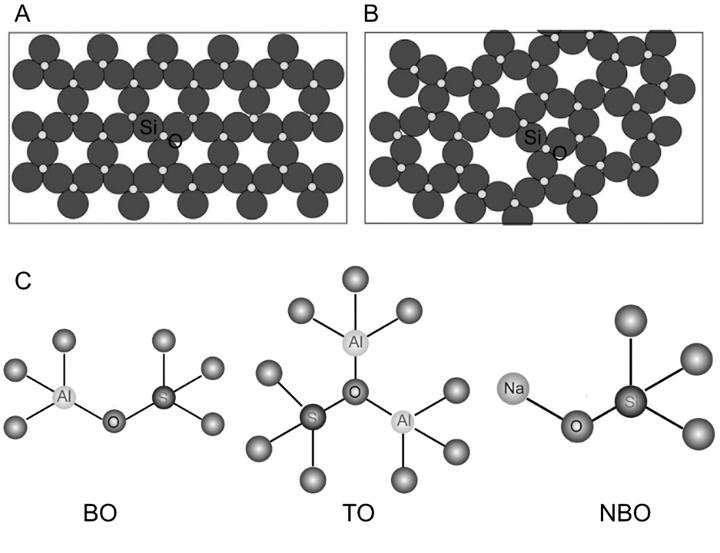
图2 硅酸盐熔体结构示意图:(A) 结晶态[37]; (B) 非晶态[37]; (C) 氧键结构注:(B) Amorphous state[37]; (C) Oxygen bond structure
Fig. 2 Schematic structure of silicate melts: (A) Crystalline state[37];
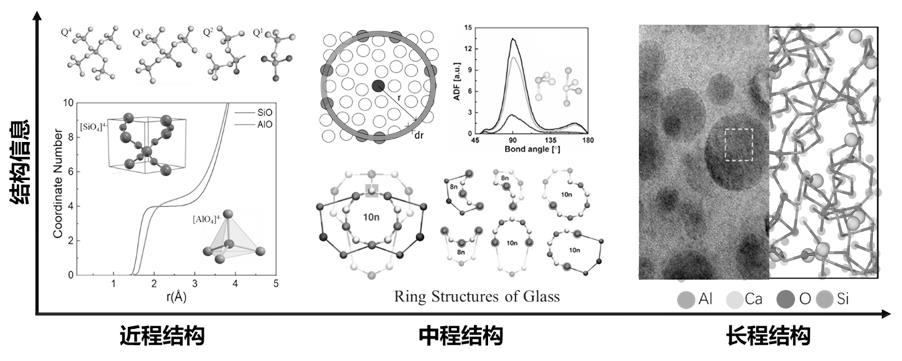
图3 熔渣各尺度结构示意图
Fig. 3 Multiscale structural schematic of molten slag
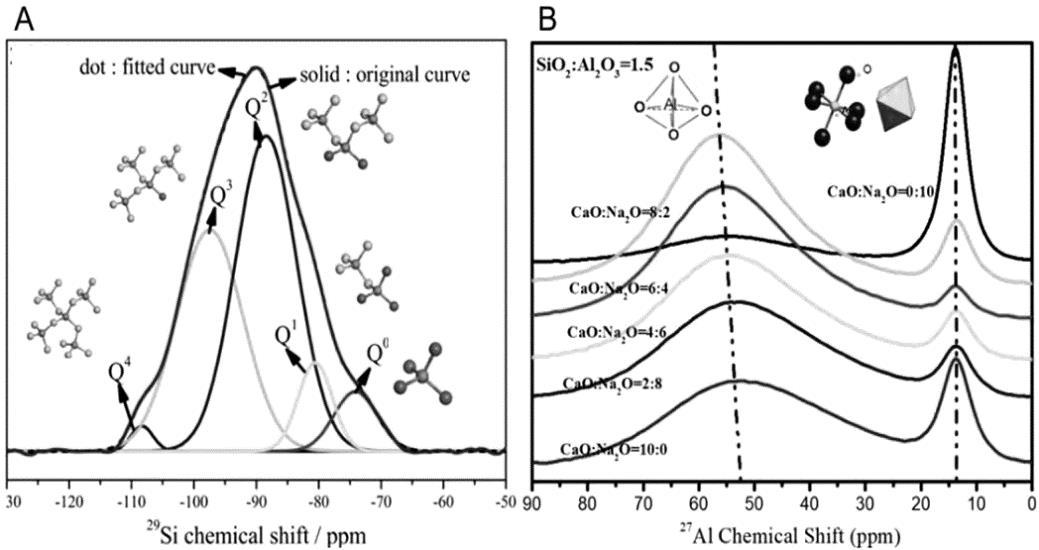
图4 核磁分析结果示意图:(A) 熔渣29Si-NMR谱图[54]; (B) 不同CaO/Na2O下熔渣27Al-NMR谱图[55]
Fig. 4 Schematic of NMR analysis results: (A) ²⁹Si-NMR spectrum of molten slag [54]; (B) ²⁷Al-NMR spectra of molten slag under different CaO/Na₂O ratios [55]
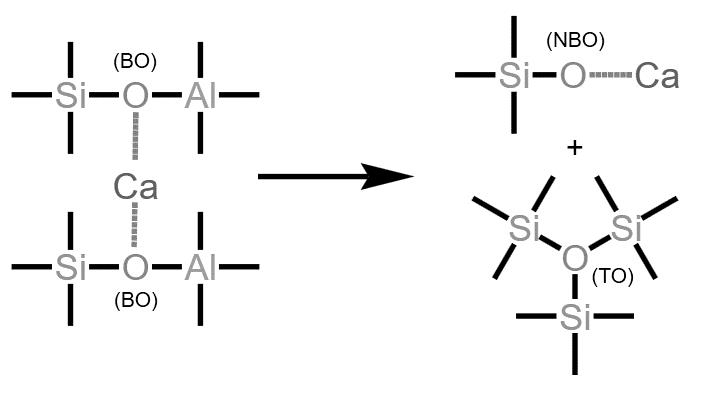
图5 非桥氧与团簇氧的生成机制[56]
Fig. 5 Formation mechanism of non-bridging oxygen and cluster oxygen[56]
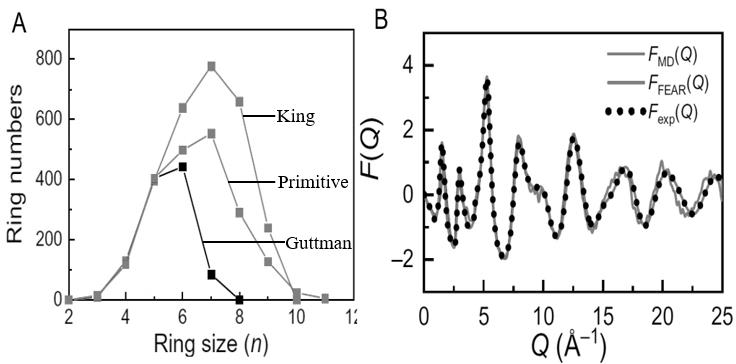
图6 环结构及中子衍射实验谱线[60]
Fig. 6 Ring structures and neutron diffraction patterns[60]
| Atom | z (e) | B (kJ/mol) | ρ (A) | C (A6 kJ/mol) |
|---|---|---|---|---|
| O | -0.945 (-1.20) | 870570.0 (889916.0) | 0.265 (0.265) | 8210.17 (8210.17) |
| Si | 1.89 (2.40) | 4853815.5 (5900530.0) | 0.161 (0.161) | 4467.07 (4467.07) |
| Ti | 1.89 | 4836495 | 0.178 | 4467.07 |
| Al | 1.4175 | 2753544.3 | 0.172 | 3336.26 |
| Fe3+ | 1.4175 | 773840 | 0.19 | 0 |
| Fe2+ | 0.945 (1.20) | 1257488.6 (1450950.0) | 0.190 (0.190) | 0.0 (0.0) |
| Mg | 0.945 | 3150507.4 | 0.178 | 2632.22 |
| Ca | 0.945 | 15019679.1 | 0.178 | 4077.45 |
| Na | 0.4725 | 11607587.5 | 0.17 | 0 |
| K | 0.4725 | 220447.4 | 0.29 | 0 |
| Mg | 0.945 | 870570.0 (889916.0) | 0.178 | 2632.22 |
表2 熔渣体系原子势参数[69]
Table 2 Parameter of potential function[69]
| Atom | z (e) | B (kJ/mol) | ρ (A) | C (A6 kJ/mol) |
|---|---|---|---|---|
| O | -0.945 (-1.20) | 870570.0 (889916.0) | 0.265 (0.265) | 8210.17 (8210.17) |
| Si | 1.89 (2.40) | 4853815.5 (5900530.0) | 0.161 (0.161) | 4467.07 (4467.07) |
| Ti | 1.89 | 4836495 | 0.178 | 4467.07 |
| Al | 1.4175 | 2753544.3 | 0.172 | 3336.26 |
| Fe3+ | 1.4175 | 773840 | 0.19 | 0 |
| Fe2+ | 0.945 (1.20) | 1257488.6 (1450950.0) | 0.190 (0.190) | 0.0 (0.0) |
| Mg | 0.945 | 3150507.4 | 0.178 | 2632.22 |
| Ca | 0.945 | 15019679.1 | 0.178 | 4077.45 |
| Na | 0.4725 | 11607587.5 | 0.17 | 0 |
| K | 0.4725 | 220447.4 | 0.29 | 0 |
| Mg | 0.945 | 870570.0 (889916.0) | 0.178 | 2632.22 |
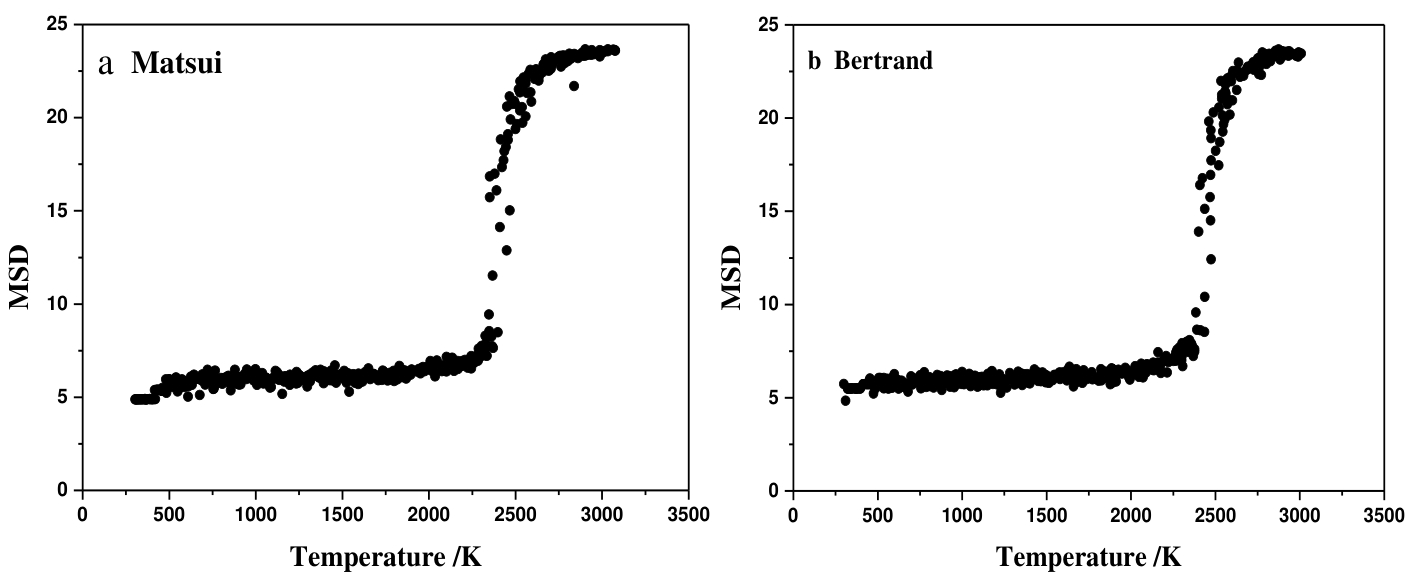
图7 不同势函数下Si-Al-O体系MSD随温度的变化规律[68]
Fig. 7 Temperature-dependent MSD evolution in Si-Al-O systems with different interatomic potentials [68]

图8 Si–O和Al–O多面体在不同压力下的配位结构[29]
Fig. 8 Pressure-dependent coordination of silicate/aluminate polyhedral[29]
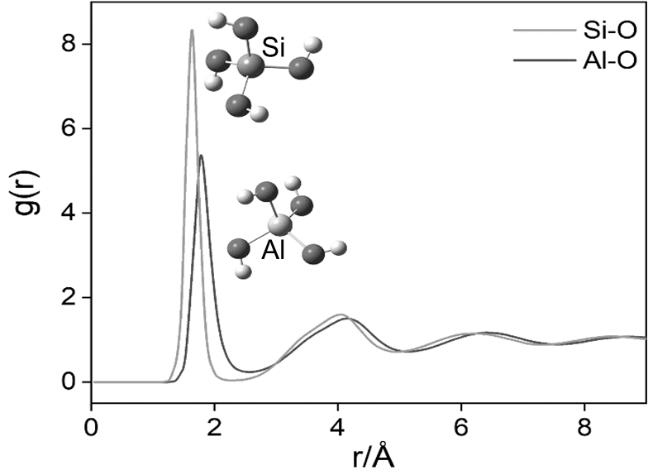
图9 Si和Al的径向分布函数
Fig. 9 Radial distribution function of Si and Al
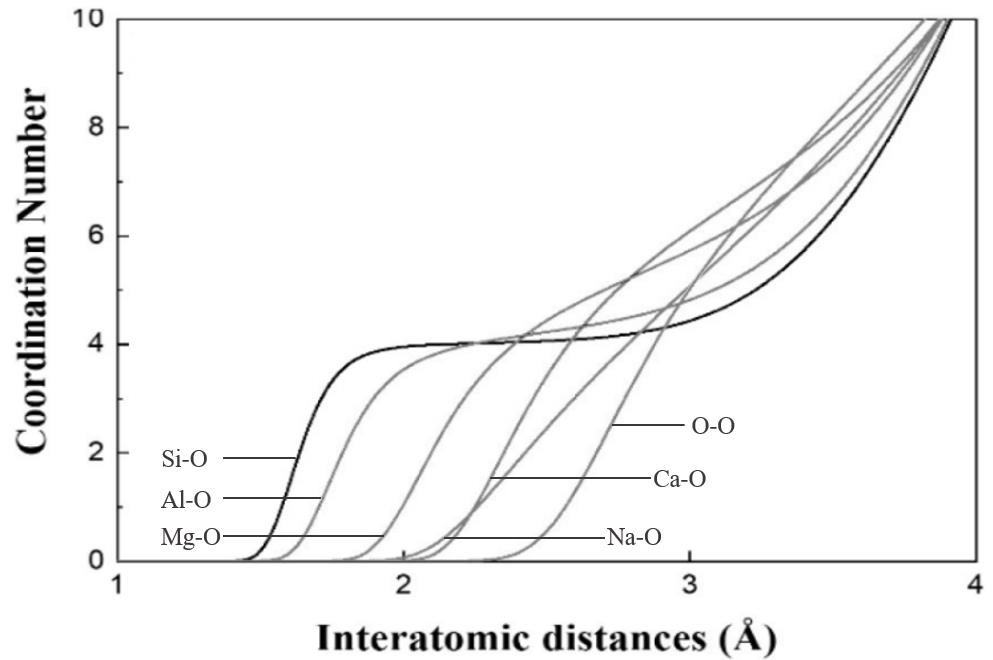
图10 熔渣中各原子的配位曲线[76]
Fig. 10 Coordination profiles of atomic species in molten slag [76]
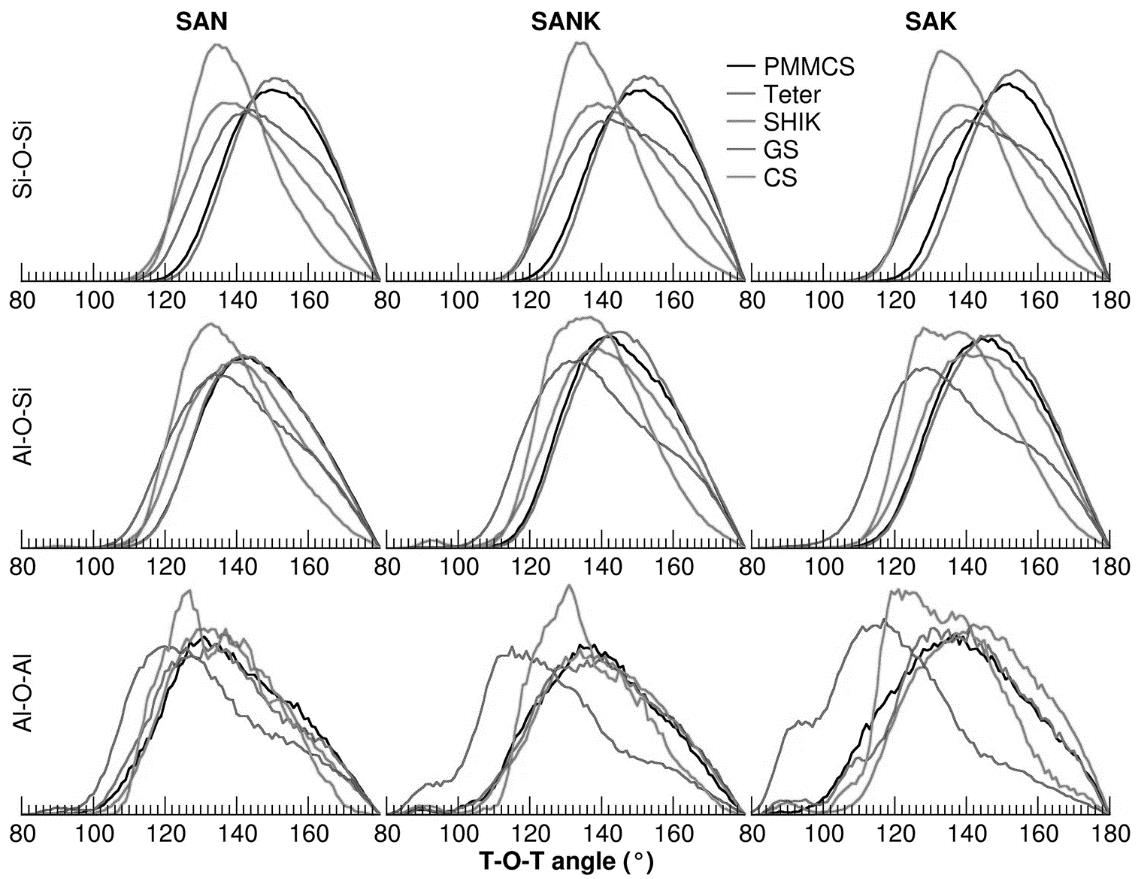
图11 采用不同原子间势函数研究的三种玻璃中不同T-O-T键角的键角分布[77]
Fig. 11 T-O-T angular distributions in glasses: Potential dependence[77]

图12 硅酸盐熔体的环状结构示意图[11]
Fig. 12 Schematic diagram of the ring structure of silicate melts [11]
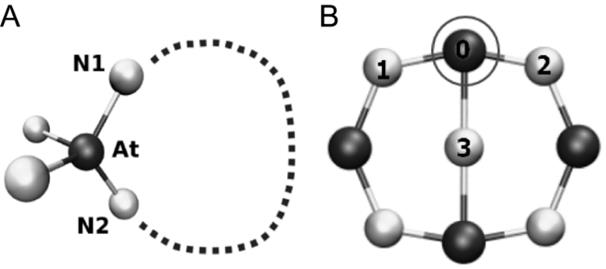
图13 King’ s shortest-path准则定义[83]
Fig. 13 King’ s shortest-path criterion [83]
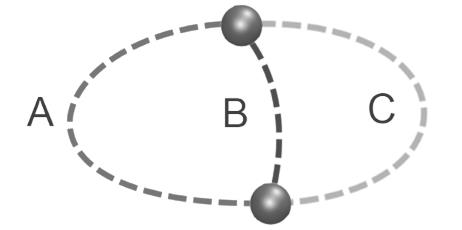
图14 Primitive rings准则定义[63]
Fig. 14 Primitive rings criterion [63]
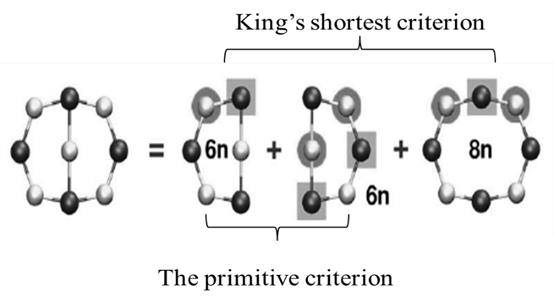
图15 环统计对比结果[83]
Fig. 15 Results comparison of the ring statistic [83]
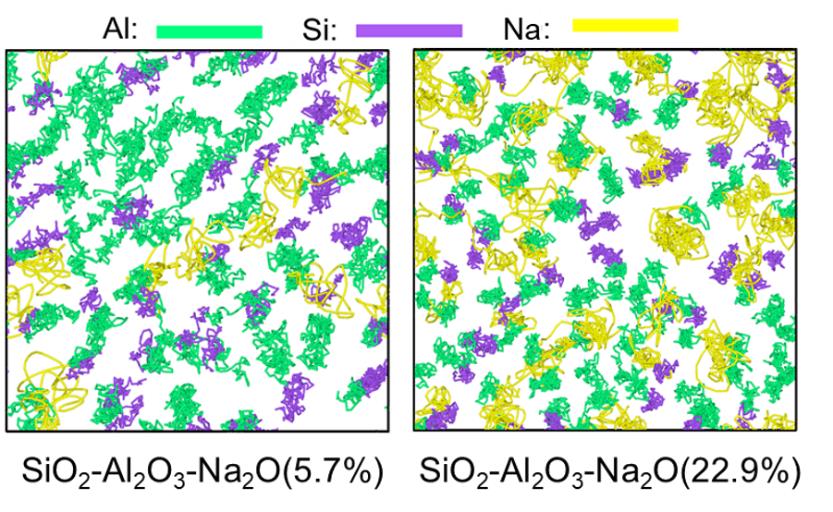
图16 Si4+, Al3+和Na+在熔体中的扩散迹线[84]
Fig. 16 Diffusion trajectories of Si⁴⁺, Al³⁺, and Na⁺ ions in melt[84]
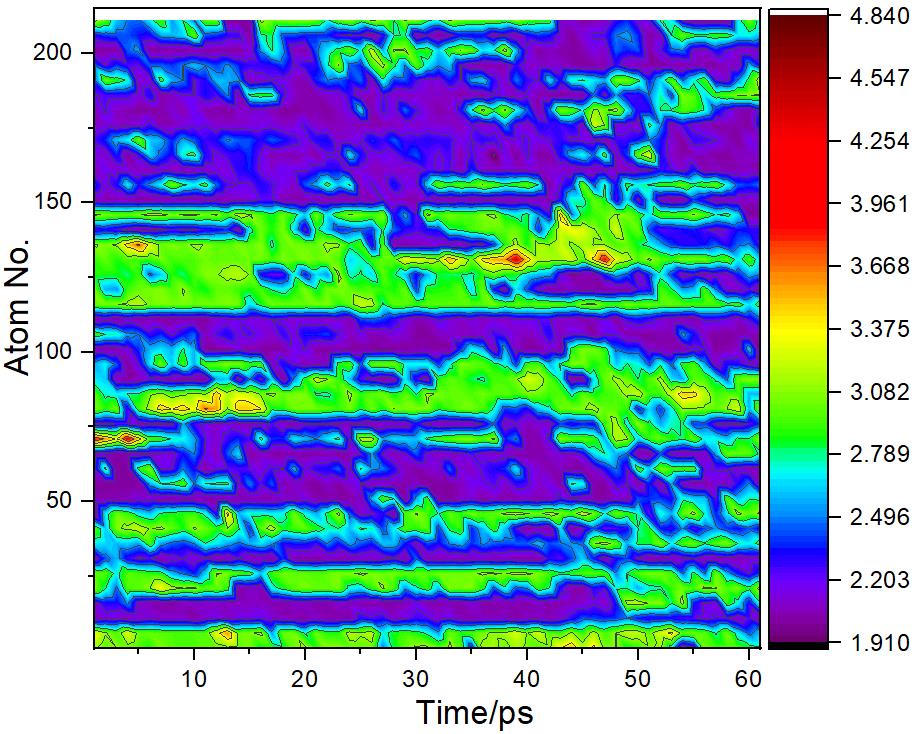
图17 瞬态配位分析示意图[12](X轴为时间轴,Y轴数字代表分子原子序号,颜色代表原子配位数)
Fig. 17 Schematic diagram of transient coordination analysis [12] (X-axis: time; Y-axis: atomic Number; Color: atomic Coordination Number)
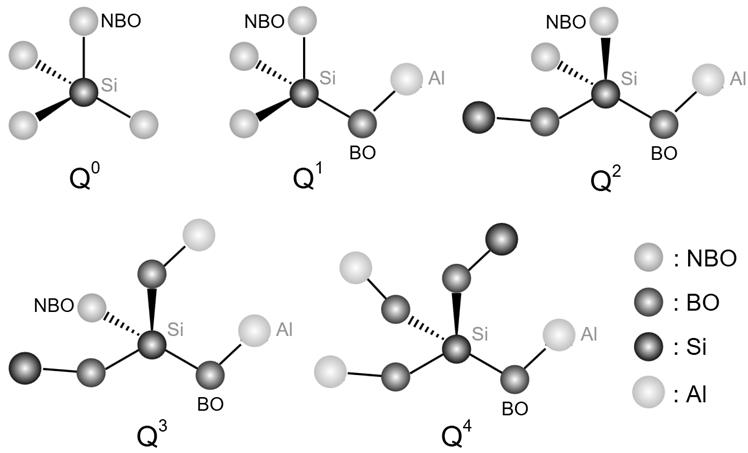
图18 Qn结构单元示意图
Fig. 18 Schematic diagram of Qn structural unit
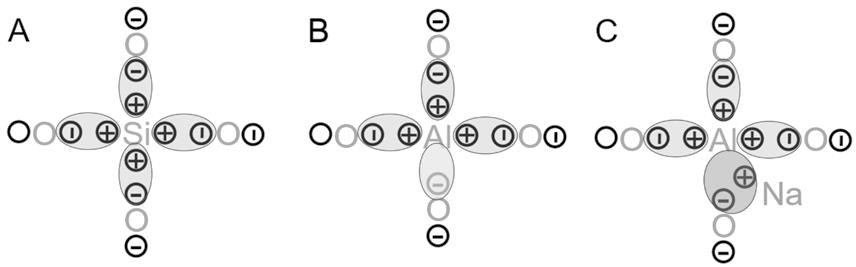
图19 电荷分布示意图:(A) [SiO4]4-; (B) [AlO4]5-; (C) [NaAlO4]4-
Fig. 19 Schematic diagram of charge distribution: (A) [SiO4]4-; (B) [AlO4]5-; (C) [NaAlO4]4-
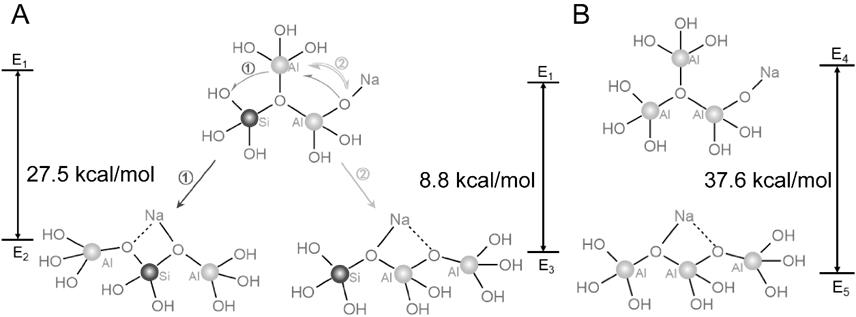
图20 反应机理示意图[84]
Fig. 20 Schematic diagram of the reaction mechanism[84]
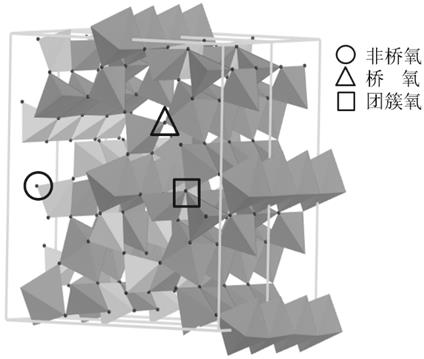
图21 氧键结构示意图[68]
Fig. 21 Oxygen bonding structural scheme [68]
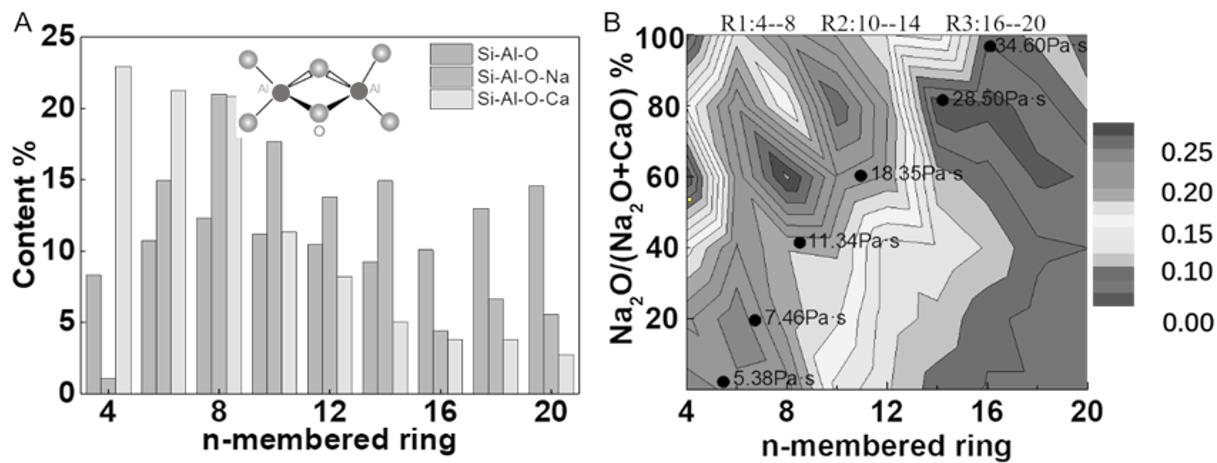
图22 熔渣环结构分布:(A)不同体系环分布结果; (B)环分布-组成-黏度关联结果[11]
Fig. 22 Ring structure distribution in slag: (A) Ring statistics across systems; (B) Ring-viscosity-composition correlation[11]
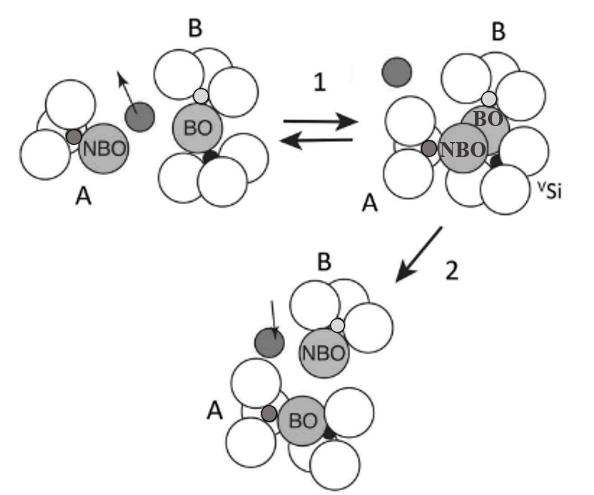
图23 BO与NBO的相互转化[37]
Fig. 23 BO-NBO interconversion [37]
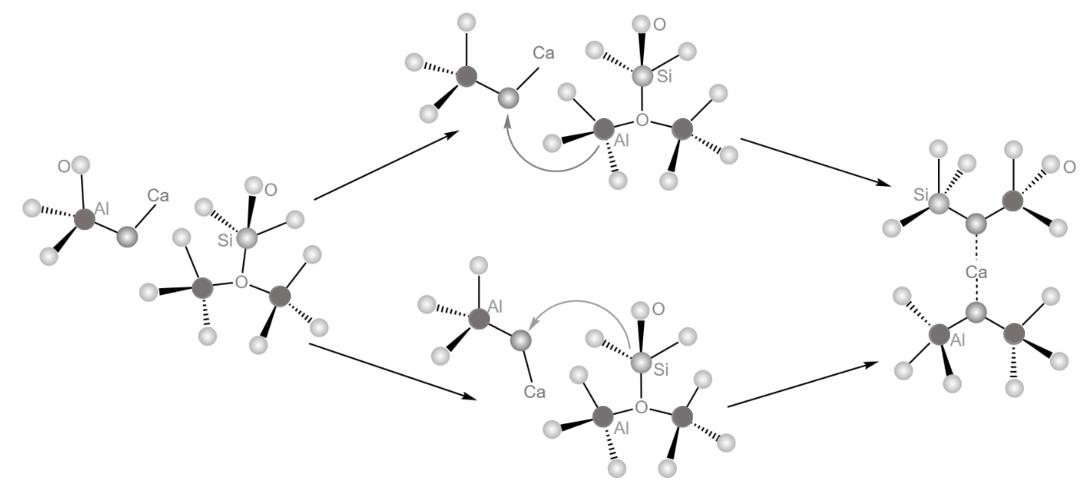
图24 SiOAl2向BO转化机理[12]
Fig. 24 Conversion mechanism of Si-O-Al₂ units to BO[12]
| [1] | 谢克昌. 新型能源体系发展思考与建议[J]. 中国工程科学, 2024, 26(4): 1-8. |
| Xie K C. Strategic thinking and suggestions on new energy system[J]. Strategic Study of Chinese Academy of Engineering, 2024, 26(4): 1-8. | |
| [2] | 谢克昌. 新型能源体系发展背景下煤炭清洁高效转化的挑战及途径[J]. 煤炭学报, 2024, 49(1): 47-56. |
| Xie K C. Develop new energy system and promote clean and efficient conversion of coal[J]. Journal of China Coal Society, 2024, 49(1): 47-56. | |
| [3] | 王辅臣. 煤气化技术在中国: 回顾与展望[J]. 洁净煤技术, 2021, 27(1): 1-33. |
| Wang F C. Coal gasification technologies in China: Review and prospect[J]. Clean Coal Technology, 2021, 27(1): 1-33. | |
| [4] | 吕清刚, 柴祯. "双碳"目标下的化石能源高效清洁利用[J]. 中国科学院院刊, 2022, 37(4): 541-548. |
| Lyu Q G, Chai Z. Highly efficient and clean utilization of fossil energy under carbon peak and neutrality targets[J]. Bulletin of Chinese Academy of Sciences, 2022, 37(4): 541-548. | |
| [5] | 李文, 白进. 煤的灰化学[M]. 北京: 科学出版社, 2013. |
| Li W, Bai J. Coal Ash Chemistry [M]. Beijing: Science Press, 2013. | |
| [6] | Zhang L M, Song X D, Wei J T, et al. Effect of iron on crystallization and flow properties of coal ash slag: a combined computational-experimental study[J]. Fuel, 2023, 334: 126751. |
| [7] | 王鑫, 李晓东, 李臣威, 等. 煤气化渣资源化利用现状及碳-灰分离技术研究进展[J/OL]. 煤炭学报, 2025: 1-21. (2025-04-30). . |
| Wang X, Li X D, Li C W, et al. Advances in the resource utilization of coal gasification slag and carbon-ash separation technology [J/OL]. Journal of China Coal Society, 2025: 1-21. (2025-04-30). . | |
| [8] | 袁刚, 孙宇, 苏梓慧, 等. 煤气化渣资源化利用研究进展、挑战与创新[J/OL]. 化工进展, 2025: 1-26. (2025-07-03). . |
| Yuan G, Sun Y, Su Z H, et al. Advances, challenges and innovations in resource utilization of coal gasification slag [J/OL]. Chemical Industry and Engineering Progress, 2025: 1-26. (2025-07-03). . | |
| [9] | Dai X, Bai J, Huang Q, et al. Coal ash fusion properties from molecular dynamics simulation: the role of calcium oxide[J]. Fuel, 2018, 216: 760-767. |
| [10] | Dai X, Bai J, Huang Q, et al. Viscosity temperature properties from molecular dynamics simulation: The role of calcium oxide, sodium oxide and ferrous oxide[J]. Fuel, 2019, 237: 163-169. |
| [11] | Gao L F, Liu X C, Bai J, et al. Structure and flow properties of coal ash slag using ring statistics and molecular dynamics simulation: Role of CaO/Na2O in SiO2–Al2O3–CaO–Na2O[J]. Chemical Engineering Science, 2021, 231: 116285. |
| [12] | Gao L F, Liu X C, Bai J, et al. The crucial role of transient tri-coordinated oxygen in the flow of silicate melts[J]. Physical Chemistry Chemical Physics, 2024, 26(9): 7920-7930. |
| [13] | Ni H W. Advances and application in physicochemical properties of silicate melts[J]. Chinese Science Bulletin, 2013, 58(10): 865-890. |
| [14] | An H Q, Liu Z, Tian F C. A machine learning framework for coal gasification process simulation and operation optimization[J]. Fuel, 2025, 401: 135934. |
| [15] | 刘东飞, 张帆, 刘铮, 等. 机器学习势及其在分子模拟中的应用综述[J]. 化工学报, 2024, 75(4): 1241-1255. |
| Liu D F, Zhang F, Liu Z, et al. A review of machine learning potentials and their applications to molecular simulation[J]. CIESC Journal, 2024, 75(4): 1241-1255. | |
| [16] | Sun Y Z, Sun K D, Liu Z, et al. Ash fusion temperature prediction based on a Bayesian-optimized ensemble learning algorithm[J]. Clean Energy, 2025, 9(5): 104-113. |
| [17] | Abdelrahim A I M, Yücel Ö. A machine learning based regression methods to predicting syngas composition for plasma gasification system[J]. Fuel, 2025, 381: 133575. |
| [18] | Chen J H, Feng Y F, Zhang Y X, Luan X, Lu X G, Yu Z G, Chou K. Viscosity prediction of refining slag based on machine learning with domain knowledge[J/OL]. International Journal of Minerals, Metallurgy and Materials 2025. (2025-5-30). . |
| [19] | 廖昌建, 王晶, 金平, 等. 煤气化渣理化特性及其所含重金属迁移规律综述[J]. 煤炭科学技术, 2025, 53(2): 426-443. |
| Liao C J, Wang J, Jin P, et al. Review of physical and chemical characteristics and heavy metal migration rules of coal gasification slag[J]. Coal Science and Technology, 2025, 53(2): 426-443. | |
| [20] | 钟巍, 鲍光达, 王海川, 等. 基于机器学习算法的熔渣液相线温度预测[J]. 炼钢, 2022, 38(3): 12-19. |
| Zhong W, Bao G D, Wang H C, et al. Prediction of slag liquidus temperature based on machine learning algorithm[J]. Steelmaking, 2022, 38(3): 12-19. | |
| [21] | Wang R Q, Rong B, Ma S, et al. Prediction of ash fusion temperatures of municipal solid waste incinerator ash based on support vector regression[J]. Journal of the Energy Institute, 2023, 111: 101438. |
| [22] | 吴永全. 硅酸盐熔体微观结构及其与宏观性质关系的理论研究[D]. 上海: 上海大学, 2004. |
| Wu Y Q. Theoretical studies on the micro-structure of molten silicates and its relation with the macro-properties[D]. Shanghai: Shanghai University, 2004. | |
| [23] | 陈晓东. 煤中碱金属钠对煤灰高温流动性的影响及机理[D]. 北京: 中国科学院大学, 2018. |
| Chen X D. Effect and mechanism of alkali metal sodium in coal on high temperature fluidity of coal ash[D]. Beijing: University of Chinese Academy of Sciences, 2018. | |
| [24] | 曲江山, 张建波, 孙志刚, 等. 煤气化渣综合利用研究进展[J]. 洁净煤技术, 2020, 26(1): 184-193. |
| Qu J S, Zhang J B, Sun Z G, et al. Research progress on comprehensive utilization of coal gasification slag[J]. Clean Coal Technology, 2020, 26(1): 184-193. | |
| [25] | Vorres K S. Prediction of ash melting behavior from coal ash composition[J]. Analytical Methods for Coal and Coal Products, 1979, Ⅲ: 481-487. |
| [26] | 鲁浩, 白进, 孔令学, 等. 气流床气化炉中煤气化熔渣的结晶行为研究进展[J]. 洁净煤技术, 2024, 30(6): 47-67. |
| Lu H, Bai J, Kong L X, et al. Research progress on the crystallization behavior of coal slag in entrained-flow gasifiers[J]. Clean Coal Technology, 2024, 30(6): 47-67. | |
| [27] | 李丽霞, 贾茹. 硅酸盐物理化学[M]. 天津: 天津大学出版社, 2010. |
| Li L X, Jia R. Physical chemistry of silicate[M]. Tianjin: Tianjin University Press, 2010. | |
| [28] | Toplis M J, Dingwell D B, Hess K U, et al. Viscosity, fragility, and configurational entropy of melts along the join SiO2-NaAlSiO4 [J]. American Mineralogist, 1997, 82(9/10): 979-990. |
| [29] | Majumdar A, Wu M, Pan Y M, et al. Structural dynamics of basaltic melt at mantle conditions with implications for magma oceans and superplumes[J]. Nature Communications, 2020, 11: 4815. |
| [30] | 代鑫. 煤灰结构及流动性关系的实验和理论研究[D]. 北京: 中国科学院大学, 2018. |
| Dai X. Experimental and theoretical study on the relationship between coal ash structure and fluidity[D]. Beijing: University of Chinese Academy of Sciences, 2018. | |
| [31] | Stebbins J F, Kroeker S, Lee S K, et al. Quantification of five- and six-coordinated aluminum ions in aluminosilicate and fluoride-containing glasses by high-field, high-resolution 27Al NMR[J]. Journal of Non-Crystalline Solids, 2000, 275(1/2): 1-6. |
| [32] | Neuville D R, Henderson G S, Cormier L, et al. The structure of crystals, glasses, and melts along the CaO-Al2O3 join: Results from Raman, Al L- and K-edge X-ray absorption, and 27Al NMR spectroscopy[J]. American Mineralogist, 2010, 95(10): 1580-1589. |
| [33] | Fang J L, Pang Z G, Xing X D, et al. Thermodynamic properties, viscosity, and structure of CaO–SiO2–MgO–Al2O3–TiO2-based slag[J]. Materials, 2021, 14(1): 124. |
| [34] | McMillan P, Piriou B, Navrotsky A. A Raman spectroscopic study of glasses along the joins silica-calcium aluminate, silica-sodium aluminate, and silica-potassium aluminate[J]. Geochimica et Cosmochimica Acta, 1982, 46(11): 2021-2037. |
| [35] | 严志明. 铝硅酸盐基高炉渣结构和性能基础研究[D]. 重庆: 重庆大学, 2019. |
| Yan Z M. Fundamental research on the structure and physicochemical properties of aluminosilicate based blast furnace slag[D]. Chongqing: Chongqing University, 2019. | |
| [36] | 刘吉辉. 高炉渣冶金性能与微观结构演变规律分析[D]. 鞍山: 辽宁科技大学, 2022. |
| Liu J H. Analysis on metallurgical properties and microstructure evolution behavior of blast furnace slag[D]. Anshan: University of Science and Technology Liaoning, 2022. | |
| [37] | Stebbins J F. Glass structure, melt structure, and dynamics: Some concepts for petrology[J]. American Mineralogist, 2016, 101(4): 753-768. |
| [38] | Qiu J R, L F, Zheng C G. Mineral transformation during combustion of coal blends[J]. International Journal of Energy Research, 1999, 23(5): 453-463. |
| [39] | Wu X J, Zhang Z X, Chen Y S, et al. Main mineral melting behavior and mineral reaction mechanism at molecular level of blended coal ash under gasification condition[J]. Fuel Processing Technology, 2010, 91(11): 1591-1600. |
| [40] | Stebbins J F, Farnan I. Effects of high temperature on silicate liquid structure: a multinuclear NMR study[J]. Science, 1992, 255(5044): 586-589. |
| [41] | Stebbins J F. NMR evidence for five-coordinated silicon in a silicate glass at atmospheric pressure[J]. Nature, 1991, 351(6328): 638-639. |
| [42] | Liu S B, Stebbins J F, Schneider E, et al. Diffusive motion in alkali silicate melts: an NMR study at high temperature[J]. Geochimica et Cosmochimica Acta, 1988, 52(2): 527-538. |
| [43] | 常翱飞, 丁兴. 热扩散驱动的元素分异和同位素分馏: 一种不容忽视的硅酸盐成分分异机制[J]. 岩石学报, 2020, 36(1): 99-112. |
| Chang A F, Ding X. Thermodiffusion driven element and isotope fractionations: a remarkable differentiation mechanism in silicate systems[J]. Acta Petrologica Sinica, 2020, 36(1): 99-112. | |
| [44] | Feng Z X, Bai J, Vassilev S V, et al. The insight into the fusion process and sintering behaviour of blended ash from co-gasification of coal and biomass feedstock[J]. Fuel, 2025, 388: 134462. |
| [45] | Shi W J, Laabs M, Reinmöller M, et al. In-situ analysis of the effect of CaO/Fe2O3 addition on ash melting and sintering behavior for slagging-type applications[J]. Fuel, 2021, 285: 119090. |
| [46] | 陈江明, 王学云, 张波涛. 固定床液态熔渣气化炉渣池液位控制方法探究[J]. 煤质技术, 2023, 35(8) 43-50. |
| Chen J M, Wang X Y, Zhang B T. Discussion of liquid level control method of slag pool in fixed-bed liquid slagging gasifier[J]. Coal Quality Technology, 2023, 35(8): 43-50. | |
| [47] | 曹欢欢, 赵思远, 张钢强. 煤气化粗渣中残碳对结晶固化特性的影响研究[J]. 化工设计通讯, 2025, 51(7): 1-3. |
| Cao H H, Zhao S Y, Zhang G Q. Research on the impact of residual carbon in coal gasification slag on crystallization and solidification characteristics[J]. Chemical Engineering Design Communications, 2025, 51(7): 1-3. | |
| [48] | 张林民, 宋旭东, 卫俊涛, 等. 气化渣中残炭形成机理及其对灰渣流动性影响[J]. 洁净煤技术, 2025, 31(7): 11-23. |
| Zhang L M, Song X D, Wei J T, et al. Formation mechanism of residual carbon in gasification slag and its effect on ash slag fluidity[J]. Clean Coal Technology, 2025, 31(7): 11-23. | |
| [49] | Wang J, Yuan Z S, Kong L X, et al. The critical condition and kinetics of interaction between residual char and slag in the coal slagging gasifier[J]. Fuel, 2023, 341: 127644. |
| [50] | Han Y L. Seeing crystal formation one particle at a time[J]. Nature Materials, 2020, 19(4): 377-378. |
| [51] | Hu Y C, Tanaka H. Revealing the role of liquid preordering in crystallisation of supercooled liquids[J]. Nature Communications, 2022, 13: 4519. |
| [52] | Lu H, Bai J, Wu G X, et al. The dissolution behavior of anorthite in partly crystallized slag of solid fuel at increasing temperature[J]. Chemical Engineering Journal, 2025, 505: 159668. |
| [53] | 吴永全, 蒋国昌, 尤静林, 等. 非晶态硅酸盐微观结构的研究进展[J]. 硅酸盐学报, 2004, 32(1): 57-62. |
| Wu Y Q, Jiang G C, You J L, et al. Progress of research on microstructure of amorphous silicate[J]. Journal of the Chinese Ceramic Society, 2004, 32(1): 57-62. | |
| [54] | 葛泽峰. 二元复合助剂对煤灰黏温特性和结晶的影响及机理研究[D]. 北京: 中国科学院大学, 2020. |
| Ge Z F. Influence and mechanism of binary fluxes on viscosity and crystallization of coal ash slag [D]. Beijing: University of Chinese Academy of Sciences, 2020. | |
| [55] | Ge Z F, Kong L X, Bai J, et al. Effect of CaO/Na2O on slag viscosity behavior under entrained flow gasification conditions[J]. Fuel Processing Technology, 2018, 181: 352-360. |
| [56] | Stebbins J F, Xu Z. NMR evidence for excess non-bridging oxygen in an aluminosilicate glass[J]. Nature, 1997, 390: 60-62. |
| [57] | Stebbins J F, Dubinsky E V, Kanehashi K, et al. Temperature effects on non-bridging oxygen and aluminum coordination number in calcium aluminosilicate glasses and melts[J]. Geochimica et Cosmochimica Acta, 2008, 72(3): 910-925. |
| [58] | Stebbins J F, Oglesby J V, Kroeker S, et al. Oxygen triclusters, non-bridging oxygens, and the properties of silicate melts: the view from 17O NMR[C]. Eleventh Annual V M Goldschmidt Conference 2001, 5: 3205. |
| [59] | Liao K, Haruta M, Masuno A, et al. Real-space mapping of oxygen coordination in phase-separated aluminosilicate glass: implication for glass stability[J]. ACS Applied Nano Materials, 2020, 3(6): 5053-5060. |
| [60] | Zhou Q, Shi Y, Deng B H, et al. Experimental method to quantify the ring size distribution in silicate glasses and simulation validation thereof[J]. Science Advances, 2021, 7(28): eabh1761. |
| [61] | Mysen B O. The structure of silicate melts[J]. Annual Review of Earth and Planetary Sciences, 1983, 11: 75-97. |
| [62] | Jones J E. On the determination of molecular fields—I. From the variation for molecular simulation[J]. Proc. Roy. Soc. Lond. A, 1924, 738(106): 441-462. |
| [63] | Buckingham R A. The classical equation of state of gaseous helium, neon and argon[J]. Proceedings of the Royal Society of London. Series A, Mathematical and Physical Sciences, 1938, 168(933): 264-283. |
| [64] | Morse P M. Diatomic molecules according to the wave mechanics. II. vibrational levels[J]. Physical Review, 1929, 34(1): 57-64. |
| [65] | Royce B S H. The creation of point point defects in alkali halides[J]. Progress in Solid State Chemistry, 1967,4: 213-243. |
| [66] | Zhang X B, Liu C J, Jiang M F. Molecular dynamics simulations of melt structure properties of CaO–Al2O3–Na2O slag[J]. Metallurgical and Materials Transactions B, 2021, 52(4): 2604-2611. |
| [67] | Jiang C H, Li K J, Zhang J L, et al. The effect of CaO and MgO on the structure and properties of coal ash in the blast furnace: a molecular dynamics simulation and thermodynamic calculation[J]. Chemical Engineering Science, 2019, 210: 115226. |
| [68] | Dai X, He J, Bai J, et al. Ash fusion properties from molecular dynamics simulation: role of the ratio of silicon and aluminum[J]. Energy & Fuels, 2016, 30(3): 2407-2413. |
| [69] | Matsui M. Computational modeling of crystals and liquids in the system Na2O–CaO–MgO–Al2O3–SiO2, Properties of Earth and Planetary Materials at High Pressure and Temperature[M]. United States of America: AGU Pbulications, 1998. |
| [70] | 李欣欣. Fe基合金液态中程有序结构演变及结构-磁性相关性的第一性原理研究[D]. 济南: 山东大学, 2019. |
| Li X X. Liquid structural evolution on medium-range scale and the correlation between structure and magnetic properties in Fe-based alloys by first principles simulations [D]. Jinan: Shandong University, 2019. | |
| [71] | Solomatova N V, Caracas R. Pressure-induced coordination changes in a pyrolitic silicate melt from ab initio molecular dynamics simulations[J]. Journal of Geophysical Research: Solid Earth, 2019, 124(11): 11232-11250. |
| [72] | Bajgain S K, Ashley A W, Mookherjee M, et al. Insights into magma ocean dynamics from the transport properties of basaltic melt[J]. Nature Communications, 2022, 13(1): 7590. |
| [73] | 张世良, 戚力, 高伟, 等. 分子模拟中常用的结构分析与表征方法综述[J]. 燕山大学学报, 2015, 39(3): 213-220. |
| Zhang S L, Qi L, Gao W, et al. Summary of methods for structural analysis and characterization in molecular modeling[J]. Journal of Yanshan University, 2015, 39(3): 213-220. | |
| [74] | Kim T H, Kelton K F. Structural study of supercooled liquid transition metals[J]. The Journal of Chemical Physics, 2007, 126(5): 054513. |
| [75] | Xuan W W, Wang H N, Xia D H. Deep structure analysis on coal slags with increasing silicon content and correlation with melt viscosity[J]. Fuel, 2019, 242: 362-367. |
| [76] | Jiang C H, Zhang H X, Xiong Z X, et al. Molecular dynamics investigations on the effect of Na2O on the structure and properties of blast furnace slag under different basicity conditions[J]. Journal of Molecular Liquids, 2020, 299: 112195. |
| [77] | Lodesani F, Menziani M C, Hijiya H, et al. Structural origins of the mixed alkali effect in alkali aluminosilicate glasses: molecular dynamics study and its assessment[J]. Scientific Reports, 2020, 10: 2906. |
| [78] | 王辅臣, 代正华. 煤气化-煤炭高效清洁利用的核心技术[J]. 化学世界, 2015, 56(1): 51-55. |
| Wang F C, Dai Z H. Coal gasification-core technology of the efficient and clean utilization of coal[J]. Chemical World, 2015, 56(1): 51-55. | |
| [79] | King S V. Ring configurations in a random network model of vitreous silica[J]. Nature, 1967, 213: 1112-1113. |
| [80] | Ebrahem F, Bamer F, Markert B. The influence of the network topology on the deformation and fracture behaviour of silica glass: a molecular dynamics study[J]. Computational Materials Science, 2018, 149: 162-169. |
| [81] | Goetzke K, Klein H J. Properties and efficient algorithmic determination of different classes of rings in finite and infinite polyhedral networks[J]. Journal of Non-Crystalline Solids, 1991, 127(2): 215-220. |
| [82] | Yuan X L, Cormack A N. Efficient algorithm for primitive ring statistics in topological networks[J]. Computational Materials Science, 2002, 24(3): 343-360. |
| [83] | Le Roux S, Jund P. Ring statistics analysis of topological networks: New approach and application to amorphous GeS2 and SiO2 systems[J]. Computational Materials Science, 2010, 49(1): 70-83. |
| [84] | Gao L F, Liu X C, Bai J, et al. Unveiling charge compensation effects in Na2O–Al2O3–SiO2 melts: atomic-scale mechanisms and implications for fluidity from AIMD simulations[J]. The Journal of Physical Chemistry C, 2024, 128(41): 17756-17766. |
| [85] | Vargas S, Frandsen F J, Dam-Johansen K. Rheological properties of high-temperature melts of coal ashes and other silicates[J]. Progress in Energy and Combustion Science, 2001, 27(3): 237-429. |
| [86] | Ni H W, Keppler H, Behrens H. Electrical conductivity of hydrous basaltic melts: implications for partial melting in the upper mantle[J]. Contributions to Mineralogy and Petrology, 2011, 162(3): 637-650. |
| [87] | Lee S K Stebbins J F. Nature of cation mixing and ordering in Na-Ca silicate glasses and melts[J]. The Journal of Physical Chemistry B, 2003, 107(14): 3141-3148. |
| [88] | Bi Z S, Li K J, Jiang C H, et al. New insights into the traditional charge compensation theory: amphoteric behavior of TiO2 under the guidance of supply–demand relationship[J]. ACS Omega, 2022, 7(24): 21225-21232. |
| [89] | Zachariasen W H. The atomic arrangement in glass[J]. Journal of the American Chemical Society, 1932, 54(10): 3841-3851. |
| [90] | Senior C L, Srinivasachar S. Viscosity of ash particles in combustion systems for prediction of particle sticking[J]. Energy & Fuels, 1995, 9(2): 277-283. |
| [91] | Machin J S, Hanna D L. Viscosity studies of system CaO–MgO–Al2O3–SiO2: 1, 40% SiO2[J]. Journal of the American Ceramic Society, 1945, 28(11): 310-316. |
| [92] | Mills K. the structure and properties of silicate slags, Treatise on Process Metallurgy[M]. Elsevier, 2014, 223-263. |
| [93] | Maekawa H., Nakao T., Shimokawa S.et al. Coordination of sodium ions in NaAlO2–SiO2 melts: a high temperature 23NaNMR study[J]. Physics and Chemistry of Minerals, 1997, 24: 53–65. |
| [94] | Wu G X, Yazhenskikh E, Hack K, et al. Viscosity model for oxide melts relevant to fuel slags. Part 2: the system SiO2–Al2O3–CaO–MgO–Na2O–K2O[J]. Fuel Processing Technology, 2015, 138: 520-533. |
| [95] | Wu G X, Yazhenskikh E, Hack K, et al. Viscosity model for oxide melts relevant to fuel slags. Part 1: Pure oxides and binary systems in the system SiO2–Al2O3–CaO–MgO–Na2O–K2O[J]. Fuel Processing Technology, 2015, 137: 93-103. |
| [96] | Toplis M J, Dingwell D B, Lenci T. Peraluminous viscosity maxima in Na2O–Al2O3–SiO2 liquids: The role of triclusters in tectosilicate melts[J]. Geochimica et Cosmochimica Acta, 1997, 61(13): 2605-2612. |
| [97] | Chartrand P, Pelton A D. Modeling the charge compensation effect in silica-rich Na2O-K2O-Al2O3-SiO2 melts[J]. Calphad, 1999, 23(2): 219-230. |
| [98] | Sreenivasan H, Kinnunen P, Adesanya E, et al. Field strength of network-modifying cation dictates the structure of (Na-Mg) aluminosilicate glasses[J]. Frontiers in Materials, 2020, 7: 267. |
| [99] | Bødker M S, Sørensen S S, Mauro J C, et al. Predicting composition-structure relations in alkali borosilicate glasses using statistical mechanics[J]. Frontiers in Materials, 2019, 6: 175. |
| [100] | Ge Z F, Kong L X, Bai J, et al. Effect of CaO/Fe2O3 ratio on slag viscosity behavior under entrained flow gasification conditions[J]. Fuel, 2019, 258: 116129. |
| [101] | Masson C R, Smith I B, Whiteway S G. Activities and ionic distributions in liquid silicates: application of polymer theory[J]. Canadian Journal of Chemistry, 1970, 48(9): 1456-1464. |
| [102] | Lee S K, Ryu S. Probing of triply coordinated oxygen in amorphous Al2O3 [J]. The Journal of Physical Chemistry Letters, 2018, 9(1): 150-156. |
| [103] | Welch R S, Lee K H, Wilkinson C J, et al. Topological hardening through oxygen triclusters in calcium aluminosilicate glasses[J]. Journal of the American Ceramic Society, 2021, 104(12): 6183-6193. |
| [104] | Bucher D, Guidoni L, Carloni P, et al. Coordination numbers of K+ and Na+ ions inside the selectivity filter of the KcsA potassium channel: insights from first principles molecular dynamics[J]. Biophysical Journal, 2010, 98(10): L47-L49. |
| [105] | Maekawa H, Nakao T, Shimokawa S, et al. Coordination of sodium ions in NaAlO2–SiO2 melts: a high temperature 23Na NMR study[J]. Physics and Chemistry of Minerals, 1997, 24(1): 53-65. |
| [106] | Wang Z, Yu L, Wen G H, et al. A combined computational-experimental study on the effect of Na2O on the fluoride volatilization in molten slags[J]. Journal of Molecular Liquids, 2021, 342: 117499. |
| [107] | Li K J, Khanna R, Zhang J L, et al. Determination of the accuracy and reliability of molecular dynamics simulations in estimating the melting point of iron: Roles of interaction potentials and initial system configurations[J]. Journal of Molecular Liquids, 2019, 290: 111204. |
| [108] | Xuan W W, Wang H N, Xia D H. Depolymerization mechanism of CaO on network structure of synthetic coal slags[J]. Fuel Processing Technology, 2019, 187: 21-27. |
| [109] | Bamer F, Ebrahem F, Markert B. Plasticity in vitreous silica induced by cyclic tension considering rate-dependence: Role of the network topology[J]. Journal of Non-Crystalline Solids, 2019, 503: 176-181. |
| [110] | Liu Q S, Wu J J, Shao Y C, et al. ANN-based model to predict the viscosity of molten blast furnace slag at high temperatures of > 1600 K[J]. Journal of Sustainable Metallurgy, 2023, 9(3): 1020-1032. |
| [1] | 张帅, 徐嘉宇, 华蕾娜, 葛蔚. 气固系统的CG-DPM与MP-PIC耦合模拟方法[J]. 化工学报, 2025, 76(9): 4412-4424. |
| [2] | 胡国祥, 朱忆魁, 龙华, 刘晓雯, 熊勤钢. 组分配比影响氯化胆碱-乳酸低共熔溶剂碱木质素溶解度的底层机理研究[J]. 化工学报, 2025, 76(9): 4449-4461. |
| [3] | 李相海, 赖德林, 孔纲, 周健. 双仿生表面水下疏油协同机制的分子动力学模拟研究[J]. 化工学报, 2025, 76(9): 4551-4562. |
| [4] | 高正, 汪辉, 屈治国. 数据驱动辅助高通量筛选阴离子柱撑金属有机框架储氢[J]. 化工学报, 2025, 76(8): 4259-4272. |
| [5] | 林嘉豪, 付芳忠, 叶昊辉, 胡金, 姚明灿, 范鹤林, 王旭, 王瑞祥, 徐志峰. NdF3含量对NdF3-LiF熔盐局域结构和输运性质的影响[J]. 化工学报, 2025, 76(8): 3834-3841. |
| [6] | 王小令, 王绍清, 赵云刚, 常方哲, 穆瑞峰. 基于ReaxFF MD模拟的煤加氢热解有机Ca转化机制研究[J]. 化工学报, 2025, 76(8): 4297-4309. |
| [7] | 郭铮铮, 赵一丹, 王辅强, 裴璐, 靳彦岭, 任芳, 任鹏刚. 异质结构MoS2/RGO/NiFe2O4复合材料的构筑及电磁波吸收性能研究[J]. 化工学报, 2025, 76(7): 3719-3732. |
| [8] | 乔亮, 李尚, 刘新亮, 王明, 张沛, 侯影飞. 三元共聚物稠油降黏剂的合成及分子模拟研究[J]. 化工学报, 2025, 76(7): 3686-3695. |
| [9] | 李姿睿, 齐凯, 王军, 夏国栋. 基于Janus纳米通道的脱盐过程分子动力学模拟研究[J]. 化工学报, 2025, 76(7): 3531-3538. |
| [10] | 李紫鹃, 谭晓艳, 吴永盛, 杨陈怡, 陈红, 毕小刚, 刘捷, 喻发全. 分子模拟研究三维扭曲催化芳烃-降冰片烯环化聚合物膜的CO2/N2分离机理[J]. 化工学报, 2025, 76(5): 2348-2357. |
| [11] | 齐昊, 王玉杰, 李申辉, 邹琦, 刘轶群, 赵之平. 双金属Co/Zn-ZIFs中C3H6和C3H8吸附和扩散行为分子模拟研究[J]. 化工学报, 2025, 76(5): 2313-2326. |
| [12] | 陈建兵, 常昊, 高明, 邢兵, 张磊, 刘奇磊. 基于反应模板与分子动力学的胺基相变吸收剂分相预测方法[J]. 化工学报, 2025, 76(5): 2387-2396. |
| [13] | 胡嘉朗, 姜明源, 金律铭, 张永刚, 胡鹏, 纪红兵. 机器学习辅助MOFs高通量计算筛选及气体分离研究进展[J]. 化工学报, 2025, 76(5): 1973-1996. |
| [14] | 朱峰, 赵跃, 马凤翔, 刘伟. 改性UIO-66对SF6/N2混合气体及其分解产物的吸附特性[J]. 化工学报, 2025, 76(4): 1604-1616. |
| [15] | 彭德其, 刘奎霖, 武洋, 俞天兰, 谭卓伟, 吴淑英, 陈莹, 唐明成, 彭建国. 振动往复螺旋强化传热性能及结晶垢微观形貌分析研究[J]. 化工学报, 2025, 76(4): 1559-1568. |
| 阅读次数 | ||||||
|
全文 |
|
|||||
|
摘要 |
|
|||||
 京公网安备 11010102001995号