• •
姚晓多1( ), 许强辉2, 张文强1,3()
收稿日期:2025-10-16
修回日期:2025-10-27
出版日期:2025-11-11
通讯作者:
张文强
作者简介:姚晓多(2001—),女,硕士研究生,E-mail:2418379269@qq.com。
基金资助:
Xiaoduo YAO1(), Qianghui XU2, Wenqiang ZHANG1,3()
Received:2025-10-16
Revised:2025-10-27
Online:2025-11-11
Contact:
Wenqiang ZHANG
摘要:
燃料电池凭借其高效率、零排放和长寿命等优势,在可持续能源体系中的地位日益凸显。而数字孪生技术作为理论向工程转化的关键人工智能工具,提供了一个虚拟建模平台,为燃料电池的全生命周期管理提供创新解决方案。首先论述了燃料电池的发展现状、工作原理,随后解释了数字孪生系统的功能、架构和结构以及其在燃料电池领域的发展潜力。探讨了数字孪生系统在燃料电池领域的应用,分别从质子交换膜燃料电池的多物理场预测、燃料电池数字孪生的管理系统以及数字孪生系统在燃料电池剩余使用寿命预测与健康管理三方面进行总结论述。最后阐述了数字孪生系统应用于燃料电池的挑战与发展前景。
中图分类号:
姚晓多, 许强辉, 张文强. 燃料电池数字孪生系统综述[J]. 化工学报, DOI: 10.11949/0438-1157.20251029.
Xiaoduo YAO, Qianghui XU, Wenqiang ZHANG. An Overview of Digital Twin Systems for Fuel Cells[J]. CIESC Journal, DOI: 10.11949/0438-1157.20251029.

图 1 近三年中国新能源汽车月度销量[7]
Fig. 1 Monthly Sales of New Energy Vehicles in China (For the Past Three Years)[7]
质子交换膜 燃料电池(PEMFCs) | 碱性燃料电池(AFCs) | 磷酸燃料电池(PAFCs) | 熔融碳酸盐燃料电池(MCFCs) | 固体氧化物燃料电池(SOFCs) | |
|---|---|---|---|---|---|
| 主要应用 | 便携式、交通运输、小规模固定式 | 便携式及固定式 | 固定式 | 固定式 | 固定式 |
| 电解质 | 聚合物膜 | 氢氧化钾 | 磷酸 | 熔融碳酸盐 | 陶瓷材料 |
| 电荷载体 | H⁺ | OH⁻ | H⁺ | CO₃²⁻ | O²⁻ |
| 工作温度 | -40~120°C (高温PEMFCs为150~180°C) | 50~200°C | 150~220°C | 600~700°C | 500~1000°C |
| 电效率 | 最高65~72% | 最高70% | 最高45% | 最高60% | 最高65% |
| 主要燃料 | 氢气、重整氢气、直接甲醇燃料电池中的甲醇 | 氢气或裂解氨气 | 氢气或重整氢气 | 氢气、生物气或甲烷 | 氢气、生物气或甲烷 |
表 1 FCs的主要类型[6]
Table 1 Classification of FCs[6]
质子交换膜 燃料电池(PEMFCs) | 碱性燃料电池(AFCs) | 磷酸燃料电池(PAFCs) | 熔融碳酸盐燃料电池(MCFCs) | 固体氧化物燃料电池(SOFCs) | |
|---|---|---|---|---|---|
| 主要应用 | 便携式、交通运输、小规模固定式 | 便携式及固定式 | 固定式 | 固定式 | 固定式 |
| 电解质 | 聚合物膜 | 氢氧化钾 | 磷酸 | 熔融碳酸盐 | 陶瓷材料 |
| 电荷载体 | H⁺ | OH⁻ | H⁺ | CO₃²⁻ | O²⁻ |
| 工作温度 | -40~120°C (高温PEMFCs为150~180°C) | 50~200°C | 150~220°C | 600~700°C | 500~1000°C |
| 电效率 | 最高65~72% | 最高70% | 最高45% | 最高60% | 最高65% |
| 主要燃料 | 氢气、重整氢气、直接甲醇燃料电池中的甲醇 | 氢气或裂解氨气 | 氢气或重整氢气 | 氢气、生物气或甲烷 | 氢气、生物气或甲烷 |

图 2 FCs的化学反应过程示意图[9]
Fig. 2 Schematic representation of the chemical reaction processes in FCs[9]
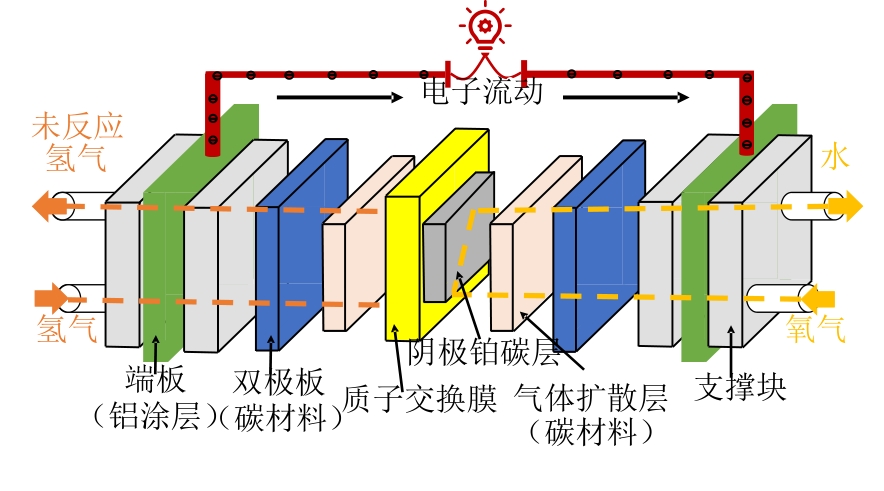
图 3 PEMFCs的基本结构[9]
Fig. 3 Basic Structure of PEMFCs [9]

图 4 DT的基本功能[25]
Fig. 4 Fundamental Functions of DT [25]

图 5 DT架构[25]
Fig. 5 DT Architecture[25]

图 6 闭环式DT四层结构
Fig. 6 Four-Layer Closed-Loop Architecture of DT
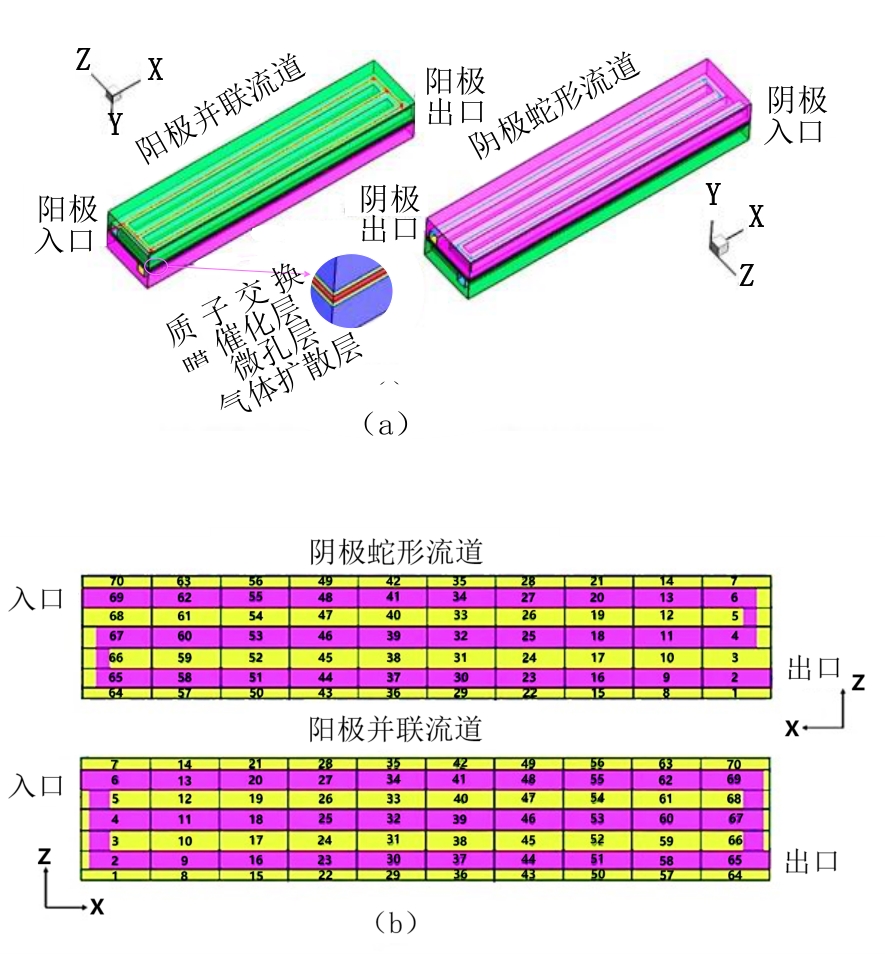
图 7 (a) PEMFCs模拟结构示意图;(b)阴极蛇形流道与阳极并联流道示意图,以及用于生成多物理场数据的网格节点划分[43]。图中紫色区域分别表示阴极蛇形流道与阳极并联流道的结构。
Fig. 7 (a) Schematic diagram of the simulated PEMFCs structure. (b) Schematic representation of the cathode serpentine flow field and the anode parallel flow field, along with the mesh node partition used for multi-physics field data generation[43]. The purple regions indicate the structural layouts of the cathode serpentine channel and the anode parallel channel.
| 管理模块 | 核心功能 | 技术价值 |
|---|---|---|
| 水管理 | 膜电极湿度控制 | 避免质子传导率衰减 |
| 热管理 | 温度场均衡调控 | 防止局部热点导致的材料老化 |
| 气管理 | 反应物供给优化 | 提升氢气利用率至>98% |
| 安全性管理 | 氢泄漏实时诊断 | 事故响应时间缩短至50ms |
| 健康管理 | 数据分析 | 性能优化与安全保障 |
| 监控管理 | 多源数据融合 | 提供系统级决策支持 |
表 2 HFCs管理模块[49]
Table 2 HFCs management module[49]
| 管理模块 | 核心功能 | 技术价值 |
|---|---|---|
| 水管理 | 膜电极湿度控制 | 避免质子传导率衰减 |
| 热管理 | 温度场均衡调控 | 防止局部热点导致的材料老化 |
| 气管理 | 反应物供给优化 | 提升氢气利用率至>98% |
| 安全性管理 | 氢泄漏实时诊断 | 事故响应时间缩短至50ms |
| 健康管理 | 数据分析 | 性能优化与安全保障 |
| 监控管理 | 多源数据融合 | 提供系统级决策支持 |
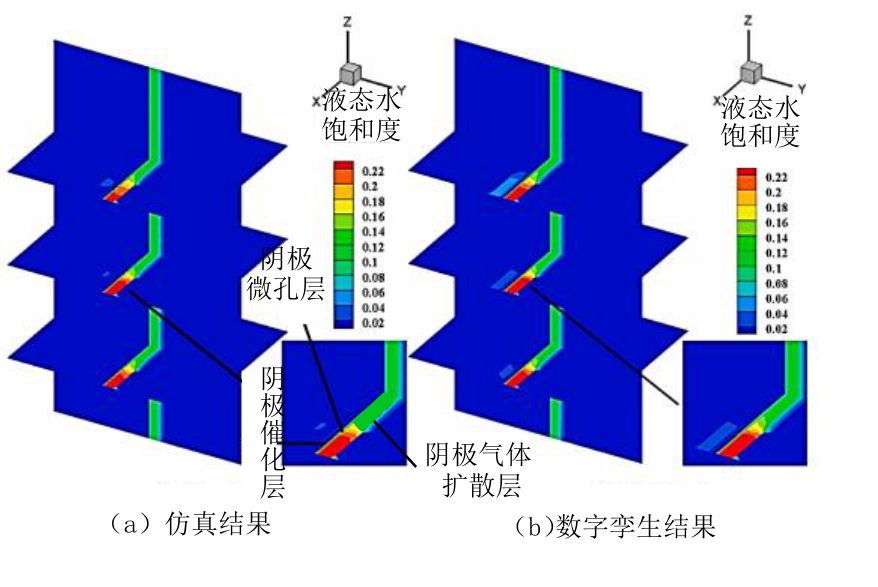
图 8 正交分解技术下液态水饱和度场的DT结果与仿真结果对比[44]
Fig. 8 DT versus Simulation of Liquid Water Saturation Field using POD Technique[44]
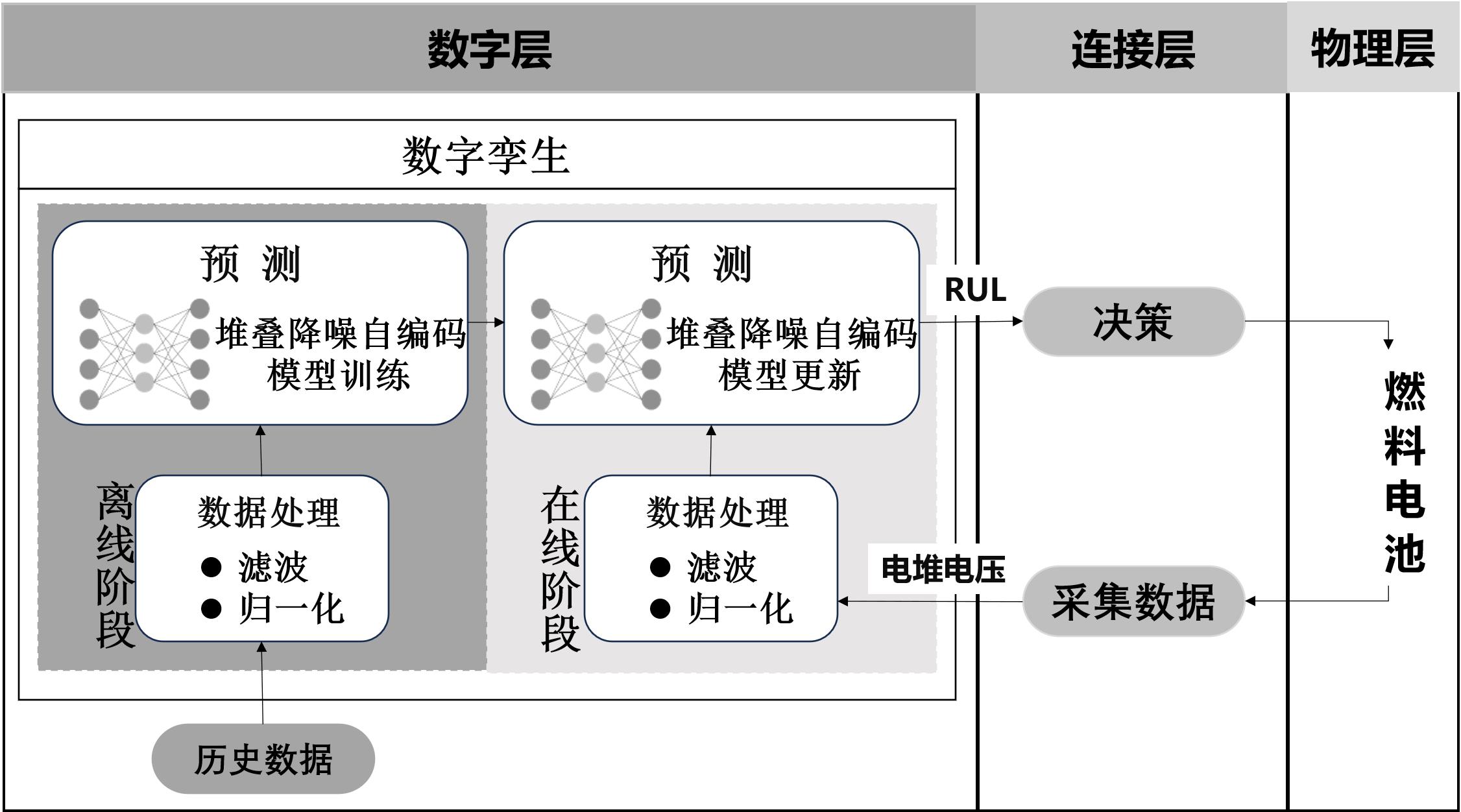
图 9 基于数据驱动的DT预测方法[79]
Fig. 9 Proposed data-driven DT prognostics method[79]
| [1] | Brief Carbon. 解码中国能源与气候变化相关表述[EB/OL].(2021-09-21)[2025-08-12]. |
| [2] | Ellis M W, Von Spakovsky M R, Nelson D J. Fuel cell systems: efficient, flexible energy conversion for the 21st century[J]. Proceedings of the IEEE, 2002, 89(12): 1808-1818. |
| [3] | Yue M L, Jemei S, Gouriveau R, et al. Review on health-conscious energy management strategies for fuel cell hybrid electric vehicles: Degradation models and strategies[J]. International Journal of Hydrogen Energy, 2019, 44(13): 6844-6861.[LinkOut] |
| [4] | Hermann A, Chaudhuri T, Spagnol P. Bipolar plates for PEM fuel cells: a review[J]. International Journal of Hydrogen Energy, 2005, 30(12): 1297-1302. |
| [5] | Lu Y Z, Cai Y X, Souamy L, et al. Solid oxide fuel cell technology for sustainable development in China: an over-view[J]. International Journal of Hydrogen Energy, 2018, 43(28): 12870-12891. |
| [6] | Yu Y, Tu Z K, Zhang H N, et al. Comparison of degradation behaviors for open-ended and closed proton exchange membrane fuel cells during startup and shutdown cycles[J]. Journal of Power Sources, 2011, 196(11): 5077-5083. |
| [7] | 中国汽车工业协会. 中国汽车工业统计数据集[EB/OL].(2023-12-31)[2025-08-15]. |
| [8] | Chau K T, Wong Y S, Chan C C. An overview of energy sources for electric vehicles[J]. Energy Conversion and Management, 1999, 40(10): 1021-1039. |
| [9] | Waseem M, Amir M, Lakshmi G S, et al. Fuel cell-based hybrid electric vehicles: an integrated review of current status, key challenges, recommended policies, and future prospects[J]. Green Energy and Intelligent Transportation, 2023, 2(6): 100121. |
| [10] | Aminudin M A, Kamarudin S K, Lim B H, et al. An overview: Current progress on hydrogen fuel cell vehicles[J]. International Journal of Hydrogen Energy, 2023, 48(11): 4371-4388. |
| [11] | A P M, Hradilek Z. Hydrogen production for solar energy storage[J]. Re&pqj, 2011, 9(1): 518-523. |
| [12] | Doğan E E. Hydrogen production and its storage from solar energy[J]. Advances in Materials Science, 2020, 20(2): 14-25. |
| [13] | Olabi A G. State of the art on renewable and sustainable energy[J]. Energy, 2013, 61: 2-5. |
| [14] | Asadi E, Sadjadi S J. Optimization methods applied to renewable and sustainable energy: a review[J]. Uncertain Supply Chain Management, 2017: 1-26. |
| [15] | Chen K, Zhu X, Anduv B, et al. Digital twins model and its updating method for heating, ventilation and air conditioning system using broad learning system algorithm[J]. Energy, 2022, 251: 124040. |
| [16] | Wang Y J, Xu R L, Zhou C J, et al. Digital twin and cloud-side-end collaboration for intelligent battery management system[J]. Journal of Manufacturing Systems, 2022, 62: 124-134. |
| [17] | Glaessgen E, Stargel D. The digital twin paradigm for future NASA and U.S. air force vehicles[C]//53rd AIAA/ASME/ASCE/AHS/ASC Structures, Structural Dynamics and Materials Conference. 23 April 2012 - 26 April 2012, Honolulu, Hawaii. Reston, Virginia: AIAA, 2012: 1818. |
| [18] | Singh S, Weeber M, Birke K P. Advancing digital twin implementation: a toolbox for modelling and simulation[J]. Procedia CIRP, 2021, 99: 567-572. |
| [19] | Semeraro C, Lezoche M, Panetto H, et al. Digital twin paradigm: a systematic literature review[J]. Computers in Industry, 2021, 130: 103469. |
| [20] | Zhao G J, Cui Z P, Xu J, et al. Hybrid modeling-based digital twin for performance optimization with flexible operation in the direct air-cooling power unit[J]. Energy, 2022, 254: 124492. |
| [21] | Tao F, Sui F Y, Liu A, et al. Digital twin-driven product design framework[J]. International Journal of Production Research, 2019, 57(12): 3935-3953. |
| [22] | Bhatti G, Mohan H, Raja Singh R. Towards the future of smart electric vehicles: Digital twin technology[J]. Renewable and Sustainable Energy Reviews, 2021, 141: 110801. |
| [23] | Yang W H, Tan Y F, Yoshida K, et al. Digital twin-driven simulation for a cyber-physical system in Industry 4.0[J]. DAAAM International Scientific Book, 2017, 201: 227-234. |
| [24] | Singh S, Weeber M, Birke K P. Implementation of battery digital twin: approach, functionalities and benefits[J]. Batteries, 2021, 7(4): 78. |
| [25] | Semeraro C, Olabi A G, Aljaghoub H, et al. Digital twin application in energy storage: Trends and challenges[J]. Journal of Energy Storage, 2023, 58: 106347. |
| [26] | Steindl G, Stagl M, Kasper L, et al. Generic digital twin architecture for industrial energy systems[J]. Applied Sciences, 2020, 10(24): 8903. |
| [27] | Segovia M, Garcia-Alfaro J. Design, modeling and implementation of digital twins[J]. Sensors, 2022, 22(14): 5396. |
| [28] | Pang Y, Wang Z Y, Guo Y F, et al. Application prospect and key technologies of digital twin technology in the integrated port energy system[J]. Frontiers in Energy Research, 2023, 10: 1044978. |
| [29] | Zhang H J, Zhao S H, Kou G, et al. An overview on feedback mechanisms with minimum adjustment or cost in consensus reaching in group decision making: Research paradigms and challenges[J]. Information Fusion, 2020, 60: 65-79. |
| [30] | Xing Y M, Wu J, Chiclana F, et al. A bargaining game based feedback mechanism to support consensus in dynamic social network group decision making[J]. Information Fusion, 2023, 93: 363-382. |
| [31] | Fan Y P, Yang J Z, Chen J H, et al. A digital-twin visualized architecture for Flexible Manufacturing System[J]. Journal of Manufacturing Systems, 2021, 60: 176-201. |
| [32] | Cano Z P, Banham D, Ye S Y, et al. Batteries and fuel cells for emerging electric vehicle markets[J]. Nature Energy, 2018, 3(4): 279-289. |
| [33] | Zhang C Z, Qiu Y Q, Chen J W, et al. A comprehensive review of electrochemical hybrid power supply systems and intelligent energy managements for unmanned aerial vehicles in public services[J]. Energy and AI, 2022, 9: 100175. |
| [34] | Fan E S, Li L, Wang Z P, et al. Sustainable recycling technology for Li-ion batteries and beyond: challenges and future prospects[J]. Chemical Reviews, 2020, 120(14): 7020-7063. |
| [35] | Xu J M, Zhang C Z, Wan Z M, et al. Progress and perspectives of integrated thermal management systems in PEM fuel cell vehicles: a review[J]. Renewable and Sustainable Energy Reviews, 2022, 155: 111908. |
| [36] | Tao F, Zhang H, Zhang C Y. Advancements and challenges of digital twins in industry[J]. Nature Computational Science, 2024, 4(3): 169-177. |
| [37] | Gu M, Li X P, Cao Y Y. Optical storage arrays: a perspective for future big data storage[J]. Light: Science & Applications, 2014, 3(5): e177. |
| [38] | Dingsoeyr T, Falessi D, Power K. Agile development at scale: the next frontier[J]. IEEE Software, 2019, 36(2): 30-38. |
| [39] | Jiao K, Xuan J, Du Q, et al. Designing the next generation of proton-exchange membrane fuel cells[J]. Nature, 2021, 595(7867): 361-369. |
| [40] | Tao F, Qi Q. Make more digital twins[J]. Nature, 2019, 573(7775): 490-491. |
| [41] | Kotaka T, Tabuchi Y, Pasaogullari U, et al. Investigation of interfacial water transport at the gas diffusion media by neutron radiography[J]. ECS Transactions, 2014, 64(3): 839-851. |
| [42] | Haffejee R A, Laubscher R. Application of machine learning to develop a real-time air-cooled condenser monitoring platform using thermofluid simulation data[J]. Energy and AI, 2021, 3: 100048. |
| [43] | Wang B W, Zhang G B, Wang H Z, et al. Multi-physics-resolved digital twin of proton exchange membrane fuel cells with a data-driven surrogate model[J]. Energy and AI, 2020, 1: 100004. |
| [44] | Bai F, Quan H B, Yin R J, et al. Three-dimensional multi-field digital twin technology for proton exchange membrane fuel cells[J]. Applied Energy, 2022, 324: 119763. |
| [45] | Niu T, Huang W F, Zhang C Z, et al. Study of degradation of fuel cell stack based on the collected high-dimensional data and clustering algorithms calculations[J]. Energy and AI, 2022, 10: 100184. |
| [46] | Hu Z Y, Xu L F, Li J Q, et al. A novel diagnostic methodology for fuel cell stack health: Performance, consistency and uniformity[J]. Energy Conversion and Management, 2019, 185: 611-621. |
| [47] | Huang Z P, Zhao J, Jian Q F. Voltage behavior improvement for proton exchange membrane fuel cell stack suffering fuel starvation[J]. Energy Sources, Part A: Recovery, Utilization, and Environmental Effects, 2023, 45(3): 6500-6514. |
| [48] | Bartolucci L, Cennamo E, Cordiner S, et al. Digital twin of a hydrogen Fuel Cell Hybrid Electric Vehicle: Effect of the control strategy on energy efficiency[J]. International Journal of Hydrogen Energy, 2023, 48(54): 20971-20985. |
| [49] | 洪吉超, 马世琨, 梁峰伟, 等. 氢燃料电池数字孪生技术的系统集成与智能管理:研究进展与未来挑战[J]. 工程科学学报, 2025. |
| Hong J C, Ma S K, Liang F W, et al. System integration and intelligent management of hydrogen fuel cell digital twin technology: Research progress and future challenges. Journal of Engineering Science.2025. | |
| [50] | Şefkat G, Ali Özel M. Experimental and numerical study of energy and thermal management system for a hydrogen fuel cell-battery hybrid electric vehicle[J]. Energy, 2022, 238: 121794. |
| [51] | Luo Y Q, Jiao K. Cold start of proton exchange membrane fuel cell[J]. Progress in Energy and Combustion Science, 2018, 64: 29-61. |
| [52] | 张依民,梁满志.基于Matlab/Simulink燃料电池系统数字孪生模型开发[J].时代汽车,2023(12):175-179. |
| Zhang Y M, Liang M Z. The development of digital twin based on the Matlab/Simulink fuel cell system[J]. Auto Time, 2023(12): 175-179. | |
| [53] | Han C L, Jiang T, Shang K, et al. Heat and mass transfer performance of proton exchange membrane fuel cells with electrode of anisotropic thermal conductivity[J]. International Journal of Heat and Mass Transfer, 2022, 182: 121957. |
| [54] | Kim K, Kim J, Choi H, et al. Pre-diagnosis of flooding and drying in proton exchange membrane fuel cells by bagging ensemble deep learning models using long short-term memory and convolutional neural networks[J]. Energy, 2023, 266: 126441. |
| [55] | Kandlikar S G, Lu Z J. Thermal management issues in a PEMFC stack–A brief review of current status[J]. Applied Thermal Engineering, 2009, 29(7): 1276-1280. |
| [56] | Yang L, Nik-Ghazali N N, Ali M A H, et al. A review on thermal management in proton exchange membrane fuel cells: Temperature distribution and control[J]. Renewable and Sustainable Energy Reviews, 2023, 187: 113737. |
| [57] | Cao J S, Yin C, Wang R K, et al. Dynamic thermal management of proton exchange membrane fuel cell vehicle system using the tube-based model predictive control[J]. International Journal of Hydrogen Energy, 2024, 70: 493-509. |
| [58] | Kandidayeni M, Macias A, Boulon L, et al. Investigating the impact of ageing and thermal management of a fuel cell system on energy management strategies[J]. Applied Energy, 2020, 274: 115293. |
| [59] | Zhu D, Ait-Amirat Y, N'Diaye A, et al. Active thermal management between proton exchange membrane fuel cell and metal hydride hydrogen storage tank considering long-term operation[J]. Energy Conversion and Management, 2019, 202: 112187. |
| [60] | 张振旺, 王佳, 柴结实. 一种基于数字孪生燃料电池供氢系统压力控制系统和方法: CN116666697A[P]. 2023-08-29. |
| Zhang Z W, Wang J, Chai J S. A pressure control system and method for hydrogen supply system of fuel cell based on digital twin: CN116666697A[P]. 2023-08-29. | |
| [61] | De Lorenzo G, Piraino F, Longo F, et al. Modelling and performance analysis of an autonomous marine vehicle powered by a fuel cell hybrid powertrain[J]. Energies, 2022, 15(19): 6926. |
| [62] | 刘忠勇. 基于数据驱动的氢燃料电池智能故障诊断方法研究[D]. 合肥: 中国科学技术大学, 2023. |
| Liu Z Y. Research on intelligent fault diagnosis of proton exchange membrane fuel cell based on data-driven techniques[D]. Hefei: University of Science and Technology of China, 2023. | |
| [63] | Bartolucci L, Cennamo E, Cordiner S, et al. Digital Twin of Fuel Cell Hybrid Electric Vehicle: a detailed modelling approach of the hydrogen powertrain and the auxiliary systems[J]. E3S Web of Conferences, 2022, 334: 06003. |
| [64] | Khalatbarisoltani A, Zhou H T, Tang X L, et al. Energy management strategies for fuel cell vehicles: a comprehensive review of the latest progress in modeling, strategies, and future prospects[J]. IEEE Transactions on Intelligent Transportation Systems, 2024, 25(1): 14-32. |
| [65] | 朱静, 赵静欣. 质子交换膜燃料电池系统数字孪生故障诊断模型研究[J]. 控制理论与应用, 2022, 39(3): 527-534. |
| Zhu J, Zhao J X. Digital twin fault diagnosis model analysis of proton exchange membrane fuel cell systems[J]. Control Theory & Applications, 2022, 39(3): 527-534. | |
| [66] | Sun Z D, Wang Y J, Chen Z H. Fault diagnosis method for proton exchange membrane fuel cell system based on digital twin and unsupervised domain adaptive learning[J]. International Journal of Hydrogen Energy, 2024, 50: 1207-1219. |
| [67] | Gong Z C, Wang B W, Benbouzid M, et al. Cross-domain diagnosis for polymer electrolyte membrane fuel cell based on digital twins and transfer learning network✰[J]. Energy and AI, 2024, 17: 100412. |
| [68] | Wang L J, Li X Y, Guo P Y, et al. Bibliometric analysis of prognostics and health management (PHM) in hydrogen fuel cell engines[J]. International Journal of Hydrogen Energy, 2022, 47(80): 34216-34243. |
| [69] | Qin Y, Arunan A, Yuen C. Digital twin for real-time Li-ion battery state of health estimation with partially discharged cycling data[J]. IEEE Transactions on Industrial Informatics, 2023, 19(5): 7247-7257. |
| [70] | Jafari S, Byun Y C. Prediction of the battery state using the digital twin framework based on the battery management system[J]. IEEE Access, 2022, 10: 124685-124696. |
| [71] | Hua Z G, Li X L, Bai H, et al. Nonintrusive condition monitoring of FCEV using system-level digital twin model[J]. IEEE Transactions on Transportation Electrification, 2024, 10(1): 1314-1323. |
| [72] | Amaitik N, Zhang M, Xu Y C, et al. Utilising digital twins for smart maintenance planning of fuel cell in electric vehicles[J]. MATEC Web of Conferences, 2024, 401: 10010. |
| [73] | Mus J, Mylle S, Schotte S, et al. CFD modelling and simulation of PEMFCs in STAR-CCM+[C]//2022 11th International Conference on Renewable Energy Research and Application (ICRERA). September 18-21, 2022. Istanbul, Turkey. IEEE, 2022: 260-267. |
| [74] | Meraghni S, Terrissa L S, Yue M L, et al. A data-driven digital-twin prognostics method for proton exchange membrane fuel cell remaining useful life prediction[J]. International Journal of Hydrogen Energy, 2021, 46(2): 2555-2564. |
| [75] | Morando S, Jemei S, Gouriveau R, et al. Fuel Cells prognostics using echo state network[C]//IECON 2013 - 39th Annual Conference of the IEEE Industrial Electronics Society. November 10-13, 2013. Vienna, Austria. IEEE, 2013: 1632-1637. |
| [76] | Silva R E, Gouriveau R, Jemeï S, et al. Proton exchange membrane fuel cell degradation prediction based on Adaptive Neuro-Fuzzy Inference Systems[J]. International Journal of Hydrogen Energy, 2014, 39(21): 11128-11144. |
| [77] | Javed K, Gouriveau R, Zerhouni N, et al. Improving accuracy of long-term prognostics of PEMFC stack to estimate remaining useful life[C]//2015 IEEE International Conference on Industrial Technology (ICIT). March 17-19, 2015, Seville, Spain. IEEE, 2015: 1047-1052. |
| [78] | Bouzidi Z, Terrissa L S, Zerhouni N, et al. An efficient cloud prognostic approach for aircraft engines fleet trending[J]. International Journal of Computers and Applications, 2020, 42(5): 514-529. |
| [79] | Vuković M, Jorg O, Hosseinifard M, et al. Low-cost digitalization solution through scalable IIoT prototypes[J]. Applied Sciences, 2022, 12(17): 8571. |
| [80] | Byrne R H, Nguyen T A, Copp D A, et al. Energy management and optimization methods for grid energy storage systems[J]. IEEE Access, 2017, 6: 13231-13260. |
| [81] | Zhao J, Li X G. A review of polymer electrolyte membrane fuel cell durability for vehicular applications: Degradation modes and experimental techniques[J]. Energy Conversion and Management, 2019, 199: 112022. |
| [82] | Lee C Y, Lee S J, Hu Y C, et al. Real time monitoring of temperature of a micro proton exchange membrane fuel cell[J]. Sensors, 2009, 9(3): 1423-1432. |
| [83] | Mihai S, Yaqoob M, Hung D V, et al. Digital twins: a survey on enabling technologies, challenges, trends and future prospects[J]. IEEE Communications Surveys & Tutorials, 2022, 24(4): 2255-2291. |
| [1] | 段浩磊, 陈浩远, 梁坤峰, 王林, 陈彬, 曹勇, 张晨光, 李硕鹏, 朱登宇, 何亚茹, 杨大鹏. 纯电动车热管理系统低GWP工质替代方案性能分析与综合评价[J]. 化工学报, 2025, 76(S1): 54-61. |
| [2] | 佟丽丽, 陈英, 艾敏华, 舒玉美, 张香文, 邹吉军, 潘伦. ZnO/WO3异质结光催化环烯烃[2+2]环加成制备高能量密度燃料[J]. 化工学报, 2025, 76(9): 4882-4892. |
| [3] | 刘奕扬, 邢志祥, 刘烨铖, 彭明, 李玉洋, 李云浩, 沈宁舟. 加氢站液氢泄漏扩散特性与安全监测数值模拟研究[J]. 化工学报, 2025, 76(9): 4694-4708. |
| [4] | 张彬怡, 孙少东, 姚谦, 蔡文河, 张惠宇, 李成新. 煤制甲醇耦合固体氧化物燃料电池混合系统研究[J]. 化工学报, 2025, 76(9): 4658-4669. |
| [5] | 黄荣廷, 陶奕淳, 陈江林, 李世航, 杨子系, 王仕远, 罗祥轩. 矿井除湿溶液再生速率预测研究[J]. 化工学报, 2025, 76(7): 3572-3584. |
| [6] | 唐羽丰, 陶春珲, 王永正, 李印辉, 段然, 赵泽一, 马和平. 超高比表面积碳基多孔吸附剂制备及其Kr气存储性能研究[J]. 化工学报, 2025, 76(7): 3339-3349. |
| [7] | 王珺仪, 夏章讯, 景粉宁, 王素力. 基于重整气的高温聚合物电解质膜燃料电池电化学阻抗谱弛豫时间分布研究[J]. 化工学报, 2025, 76(7): 3509-3520. |
| [8] | 郭梁, 陈烨, 贾启明, 谢秀娟. 液氦贮罐的自增压理论模拟及实验研究[J]. 化工学报, 2025, 76(7): 3561-3571. |
| [9] | 段浩, 王文超, 刘栋, 尹晓军, 胡二江, 曾科. 甲醇喷射时刻对甲醇/柴油双直喷发动机性能的影响[J]. 化工学报, 2025, 76(7): 3552-3560. |
| [10] | 王涛, 李光明, 胡秋霞, 徐静. 基于时序演变粒子群算法的双色注射产品翘曲工艺优化[J]. 化工学报, 2025, 76(7): 3403-3415. |
| [11] | 王子恒, 李文怀, 周嵬. 图形电极在固体氧化物燃料电池中的应用[J]. 化工学报, 2025, 76(7): 3153-3171. |
| [12] | 陆学瑞, 周帼彦, 方琦, 俞孟正, 张秀成, 涂善东. 固体氧化物燃料电池外重整器积炭效应数值模拟研究[J]. 化工学报, 2025, 76(7): 3295-3304. |
| [13] | 李文亮, 纪成, 梁晨, 吴思辰, 陈石林, 孙巍, 翟持. 基于TDMN的青霉素浓度在线软测量[J]. 化工学报, 2025, 76(6): 2848-2858. |
| [14] | 张京新, 何皎洁, 蔡庆旺, 康子怡, 杨玉思, 王彤, 曹仙桃, 杨利伟. 基于二次分解和BiLSTM的污水厂出水COD浓度预测[J]. 化工学报, 2025, 76(6): 2859-2871. |
| [15] | 张涵川, 尚超, 吕文祥, 黄德先, 张亚宁. 基于无监督时序聚类的催化裂化装置工况划分识别与产率预测方法[J]. 化工学报, 2025, 76(6): 2781-2790. |
| 阅读次数 | ||||||
|
全文 |
|
|||||
|
摘要 |
|
|||||
 京公网安备 11010102001995号