• •
李良君( ), 张芮萌, 庄钰, 都健, 刘琳琳()
收稿日期:2025-10-15
修回日期:2025-12-07
出版日期:2026-01-04
通讯作者:
刘琳琳
作者简介:李良君(1999—),男,硕士研究生,llj@mail.dlut.edu.cn
基金资助:
Liangjun LI(), Ruimeng ZHANG, Yu ZHUANG, Jian DU, Linlin LIU()
Received:2025-10-15
Revised:2025-12-07
Online:2026-01-04
Contact:
Linlin LIU
摘要:
为提升电厂-碳捕集系统的运行效能,本研究建立了碳捕集过程的稳态与动态机理模型,通过阶跃响应实验辨识其动态特性及关键输入变量,并将关键响应时间常数作为约束引入调度模型。在此基础上,提出了一种协调调度策略,该策略计及电厂负荷波动与碳捕集系统的动态延迟响应,通过引入储罐、烟气旁路等灵活运行手段,在充分挖掘碳捕集系统调节潜力、提升电厂经济性与实现减排目标的同时,确保了调度方案与各单元动态运行特性的相容性及实际可行性。算例结果表明,相较于传统不考虑延迟的调度策略,本研究提出的方法不仅在日运行成本上略有降低,并且可针对系统动态惯性问题实现前瞻性调度,在第一个用电高峰期及之前时段(1~10h),富液储罐主动储存CO2的能力提高40.3%,有效避免了储罐液位触及安全运行下限;在第二个用电高峰期及之前时段(18~24h),将前期储存的CO2主动释放,使同期CO2产量较传统策略提升93.8%,其全天产量占比由19.68%提高至38.13%,显著的平滑了产品输出波动,保障CO2产品流量的稳定供应,提升与下游碳利用产业链的协同效率。
中图分类号:
李良君, 张芮萌, 庄钰, 都健, 刘琳琳. 考虑延迟特性的电厂-碳捕集系统优化调度[J]. 化工学报, DOI: 10.11949/0438-1157.20251139.
Liangjun LI, Ruimeng ZHANG, Yu ZHUANG, Jian DU, Linlin LIU. Optimal scheduling of power plant carbon capture system considering delay characteristics[J]. CIESC Journal, DOI: 10.11949/0438-1157.20251139.
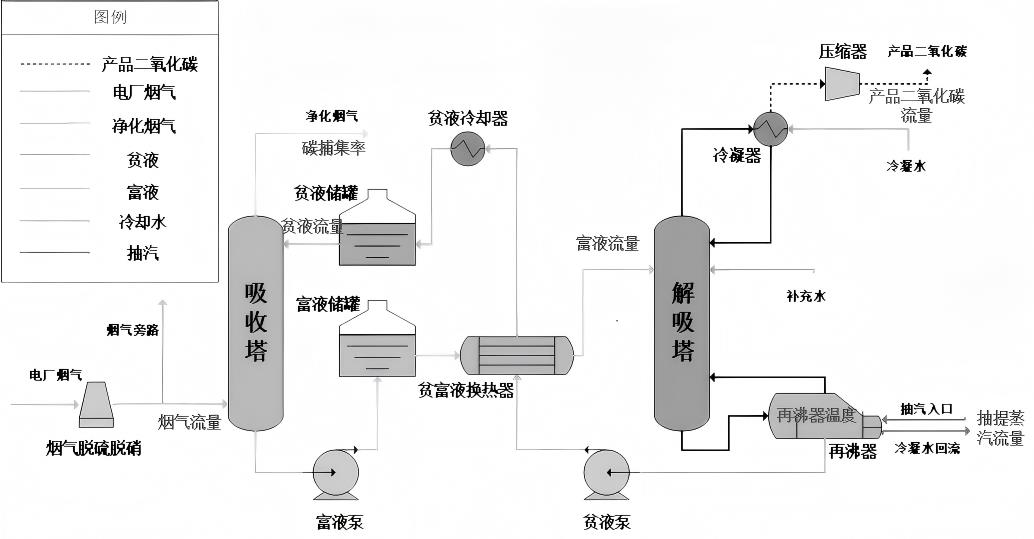
图1 基于MEA溶剂吸收法的碳捕集流程图
Fig.1 Flow diagram of carbon capture based on MEA solvent absorption method
| 反应类型 | 化学方程式 |
|---|---|
| 还原氨基甲酸盐 | |
| MEA去质子化 | |
| 生成碳酸氢盐 | |
| 生成碳酸盐 | |
| 水解离 |
表1 吸收/解吸塔中平衡反应方程式
Table 1 Equilibrium reaction equation in absorption/desorption tower
| 反应类型 | 化学方程式 |
|---|---|
| 还原氨基甲酸盐 | |
| MEA去质子化 | |
| 生成碳酸氢盐 | |
| 生成碳酸盐 | |
| 水解离 |
| 塔设备 | 参数 | 数值 |
|---|---|---|
| 吸收塔 | 塔高 | 18 m |
| 塔径 | 12 m | |
| 温度(塔釜) | 318.5 K | |
| 压力 | 101.3 kPa | |
| 填料类型 | IMTP#50 | |
| 填料信息 | NORTON-METAL | |
| 填料规格 | 2-IN OR 50-MM | |
| 解吸塔 | 塔高 | 18 m |
| 塔径 | 10 m | |
| 温度(塔釜) | 389 K | |
| 压力 | 150 kPa | |
| 填料类型 | SULZER-STANDARD | |
| 填料信息 | MELLAPAK | |
| 填料规格 | 250Y |
表2 PCC系统的主要设备参数
Table 2 Equipment parameters of PCC system
| 塔设备 | 参数 | 数值 |
|---|---|---|
| 吸收塔 | 塔高 | 18 m |
| 塔径 | 12 m | |
| 温度(塔釜) | 318.5 K | |
| 压力 | 101.3 kPa | |
| 填料类型 | IMTP#50 | |
| 填料信息 | NORTON-METAL | |
| 填料规格 | 2-IN OR 50-MM | |
| 解吸塔 | 塔高 | 18 m |
| 塔径 | 10 m | |
| 温度(塔釜) | 389 K | |
| 压力 | 150 kPa | |
| 填料类型 | SULZER-STANDARD | |
| 填料信息 | MELLAPAK | |
| 填料规格 | 250Y |
| 主要参数 | 数值 |
|---|---|
| CO2捕集率 | 89% |
| 换热器热负荷 | 69.7 MW |
| 再沸器热负荷 | 318.6 MW |
| 冷凝器热负荷 | -165.9 MW |
| 富液CO2负荷 | 0.538 molCO2/molMEA |
| 温度(贫液) | 313 K |
| 压力 | 150 kPa |
| 质量流量 | 660 kg/s |
| 各组分质量分数 | 0.0618 CO2 |
| 0.6334 H2O | |
| 0.3048 MEA | |
| CO2负荷(解吸后) | 0.286 molCO2/molMEA |
| 温度(烟气) | 333 K |
| 压力 | 110 kPa |
| 质量流量 | 200 kg/s |
| 组分质量分数[ | 0.209 CO2 |
| 0.042 H2O | |
| 0.748 N2 | |
| 0.001 O2 |
表3 PCC系统的主要运行参数
Table 3 Operating parameters of PCC system
| 主要参数 | 数值 |
|---|---|
| CO2捕集率 | 89% |
| 换热器热负荷 | 69.7 MW |
| 再沸器热负荷 | 318.6 MW |
| 冷凝器热负荷 | -165.9 MW |
| 富液CO2负荷 | 0.538 molCO2/molMEA |
| 温度(贫液) | 313 K |
| 压力 | 150 kPa |
| 质量流量 | 660 kg/s |
| 各组分质量分数 | 0.0618 CO2 |
| 0.6334 H2O | |
| 0.3048 MEA | |
| CO2负荷(解吸后) | 0.286 molCO2/molMEA |
| 温度(烟气) | 333 K |
| 压力 | 110 kPa |
| 质量流量 | 200 kg/s |
| 组分质量分数[ | 0.209 CO2 |
| 0.042 H2O | |
| 0.748 N2 | |
| 0.001 O2 |
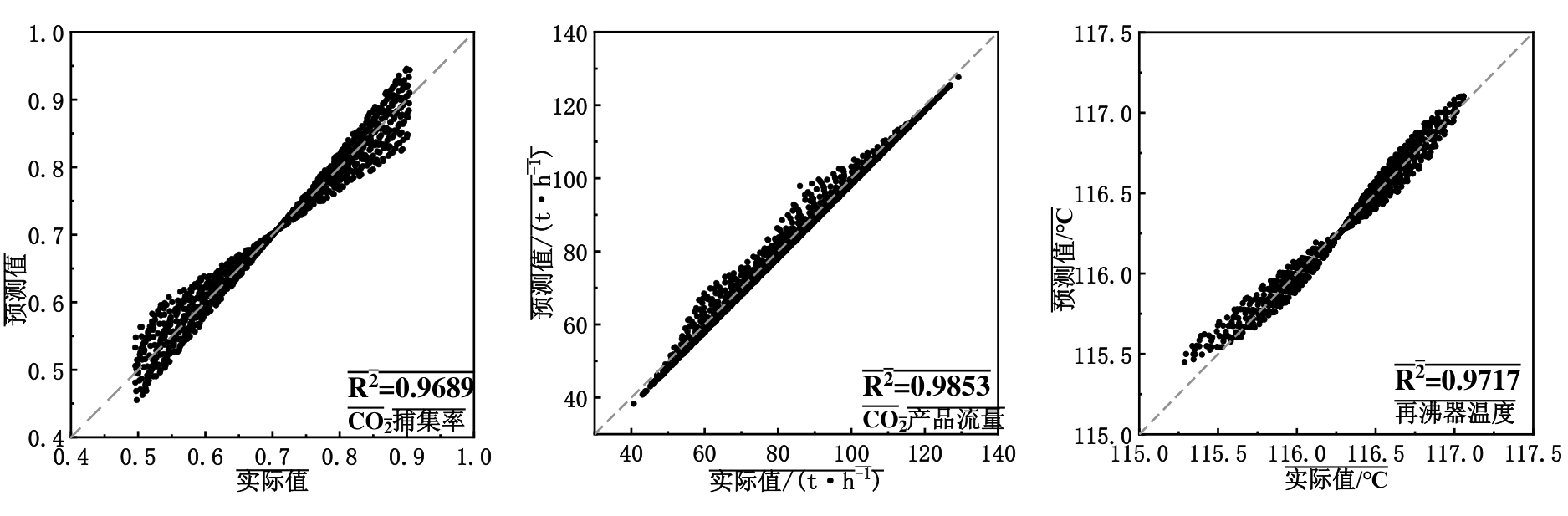
图2 多元线性回归模型验证
Fig.2 Verification of multiple linear regression model
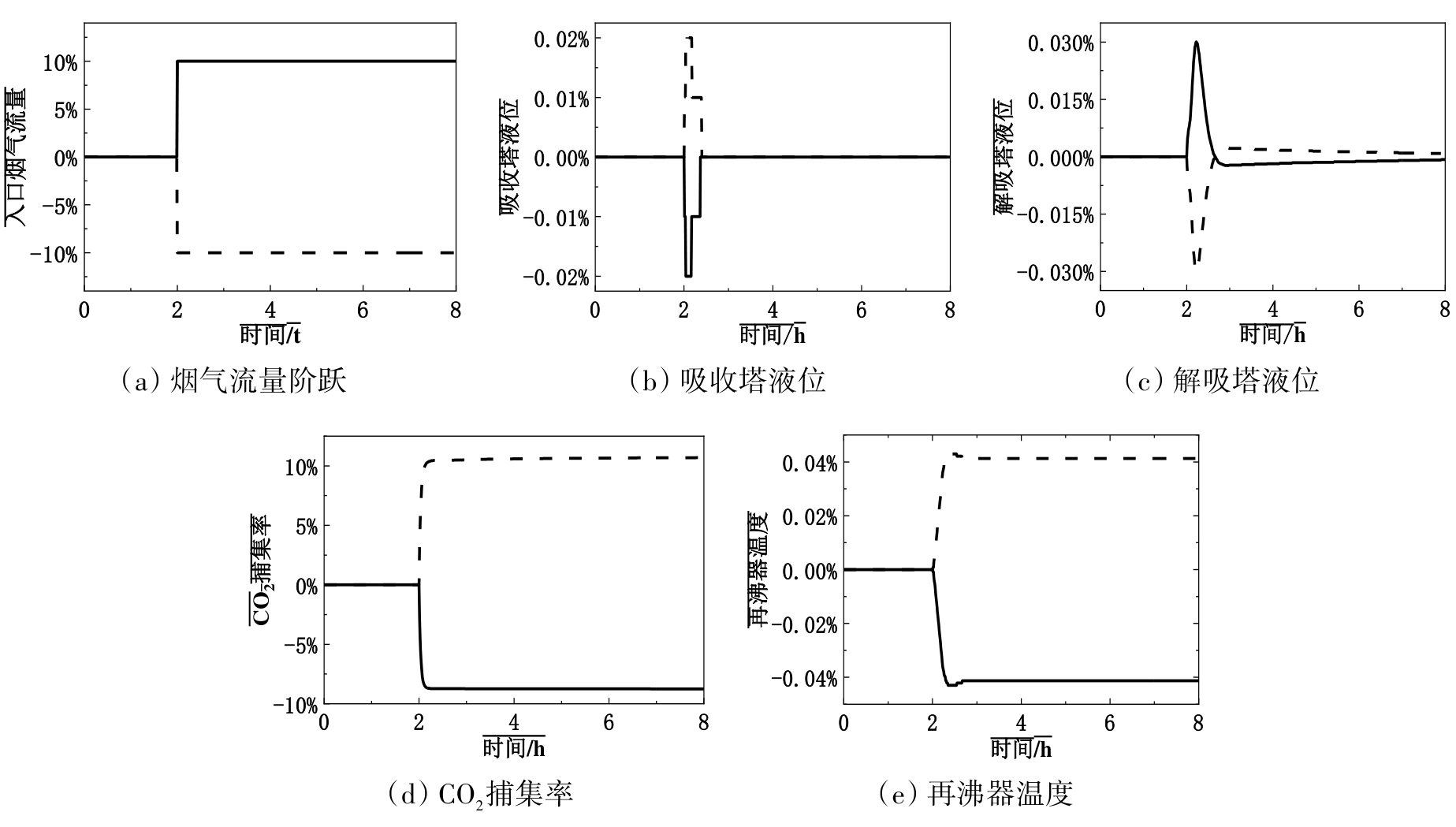
图3 烟气流量±10%响应图
Fig.3 Response diagram of flue gas flow ±10%
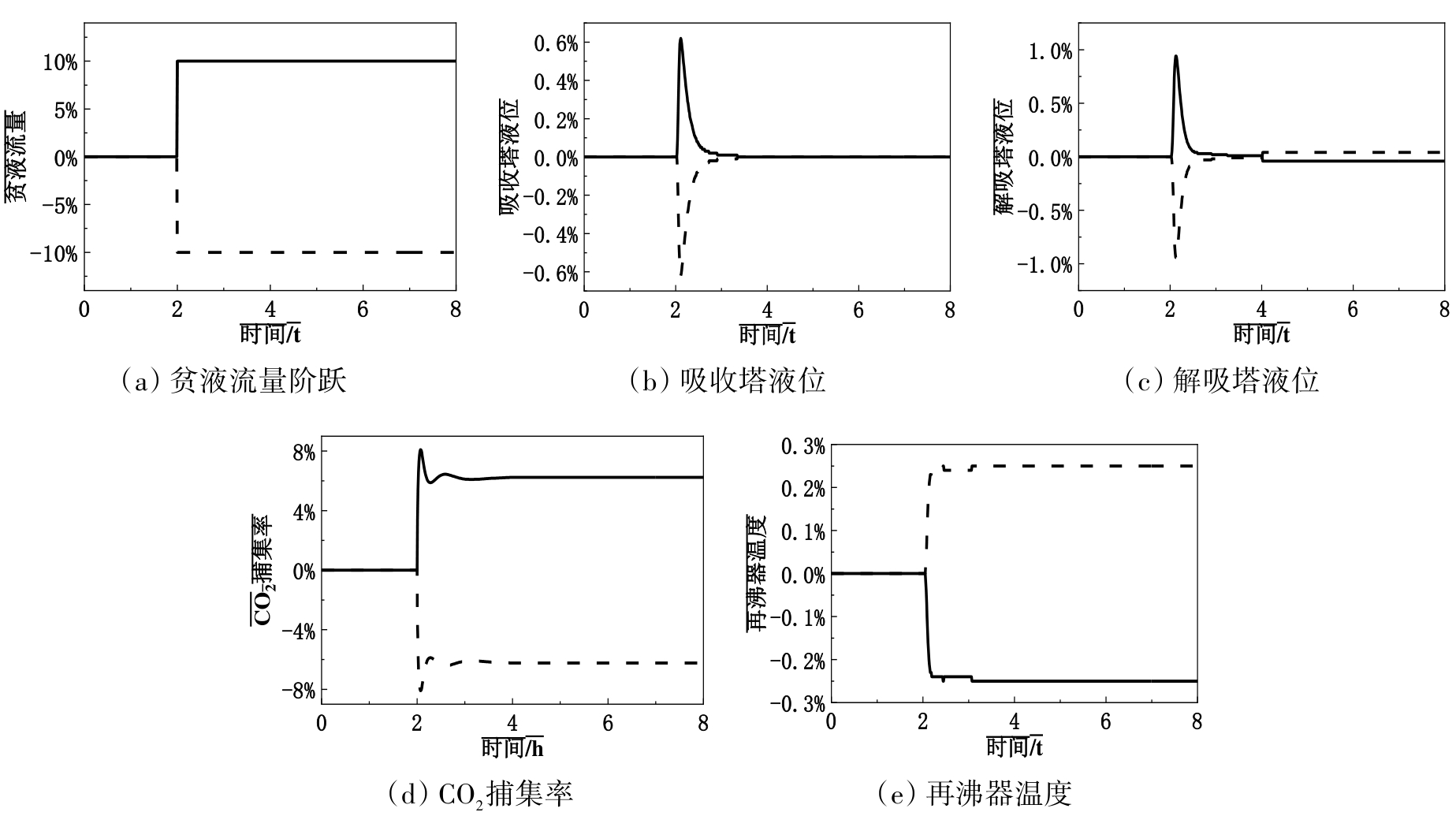
图4 贫液流量±10%响应图
Fig.4 Response diagram of lean solution flow ±10%
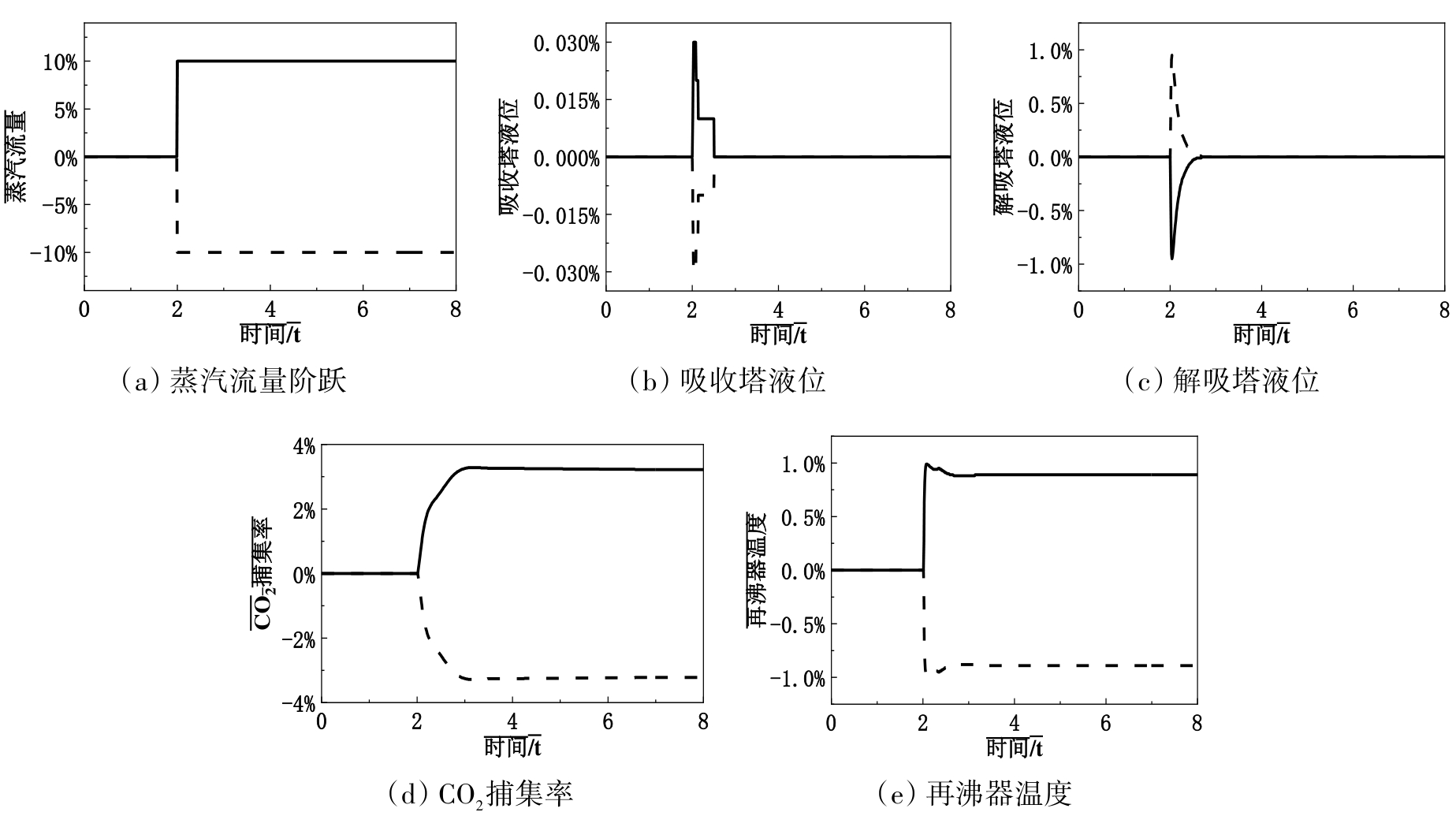
图5 抽汽流量±10%响应图
Fig.5 Response diagram of extraction flow ±10%
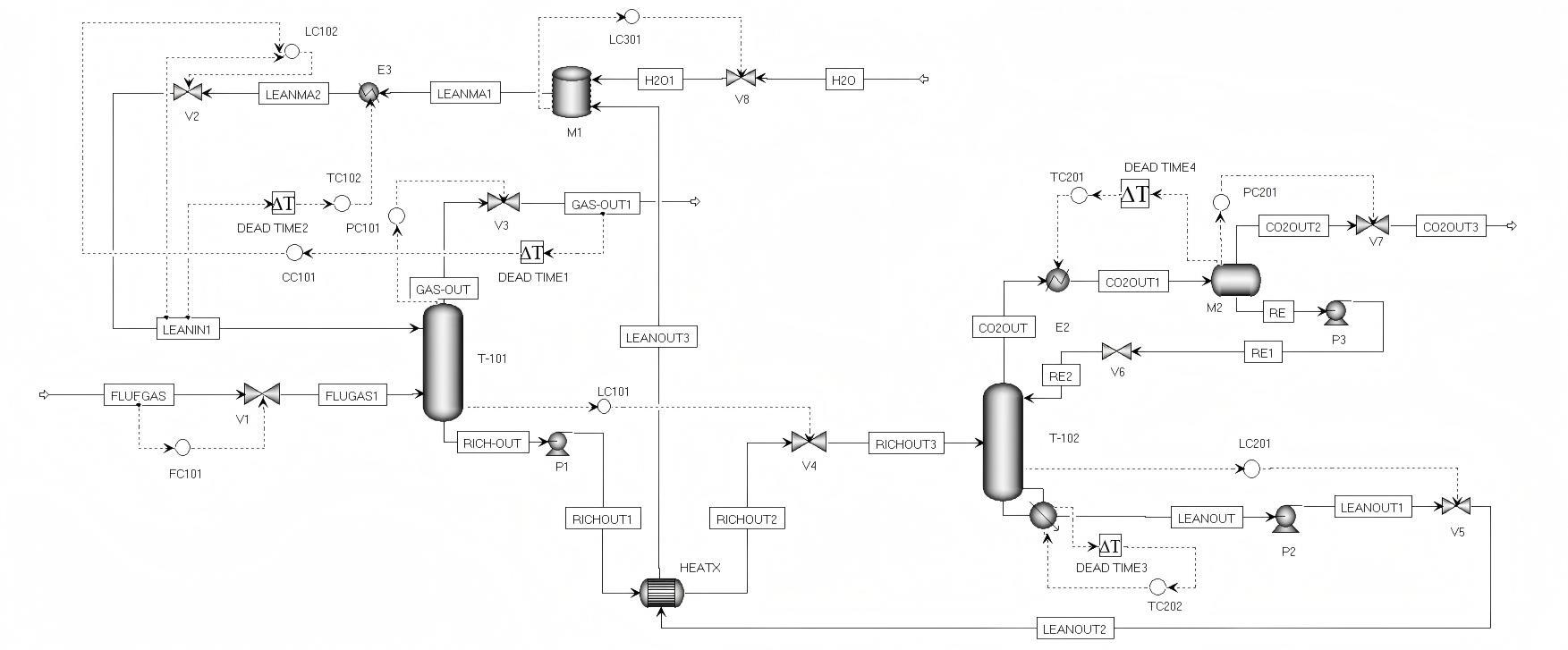
图6 添加完整控制回路的动态模型
Fig.6 Dynamic model with complete control loop
| 时间/h | 1 | 2 | 3 | 4 | 5 | 6 | 7 | 8 | 9 | 10 | 11 | 12 |
|---|---|---|---|---|---|---|---|---|---|---|---|---|
| 电负荷/MW | 112.5 | 120.8 | 127.3 | 132.3 | 148.7 | 161.7 | 185.3 | 198.8 | 191.1 | 175.1 | 162.9 | 151.9 |
表4 日电负荷需求波动
Table.4 Electric load demand fluctuation
| 时间/h | 1 | 2 | 3 | 4 | 5 | 6 | 7 | 8 | 9 | 10 | 11 | 12 |
|---|---|---|---|---|---|---|---|---|---|---|---|---|
| 电负荷/MW | 112.5 | 120.8 | 127.3 | 132.3 | 148.7 | 161.7 | 185.3 | 198.8 | 191.1 | 175.1 | 162.9 | 151.9 |
| 相关项目 | 结果/(USD·day-1) | |
|---|---|---|
| 不考虑延迟的传统调度的电厂 | 考虑延迟调度的电厂 | |
| 燃煤成本 | 374568.16 | 374193.30 |
| CO2排放惩罚成本 | 121946.49 | 121714.92 |
| 购电成本 | 11707.90 | 11707.90 |
| 操作成本 | 29617.50 | 29591.95 |
| 日成本 | 537840.05 | 537208.09 |
表5 计算结果表
Table.5 Calculation results
| 相关项目 | 结果/(USD·day-1) | |
|---|---|---|
| 不考虑延迟的传统调度的电厂 | 考虑延迟调度的电厂 | |
| 燃煤成本 | 374568.16 | 374193.30 |
| CO2排放惩罚成本 | 121946.49 | 121714.92 |
| 购电成本 | 11707.90 | 11707.90 |
| 操作成本 | 29617.50 | 29591.95 |
| 日成本 | 537840.05 | 537208.09 |
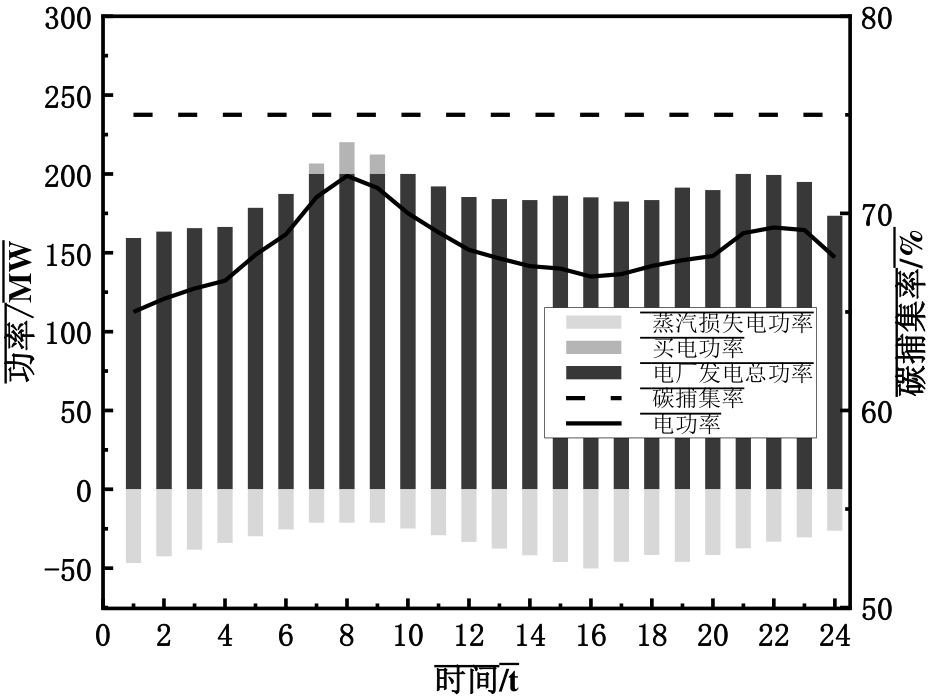
图7 电厂发电功率调度
Fig.7 Power generation schedule of power plant
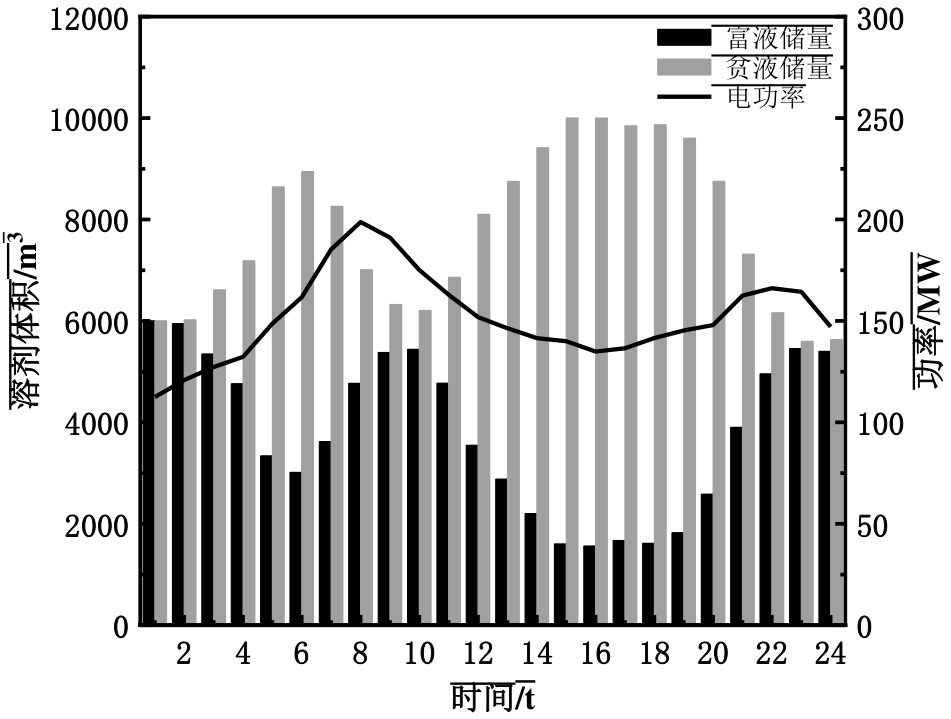
图8 储罐中储液量调度
Fig.8 Liquid storage volume schedule in storage tank
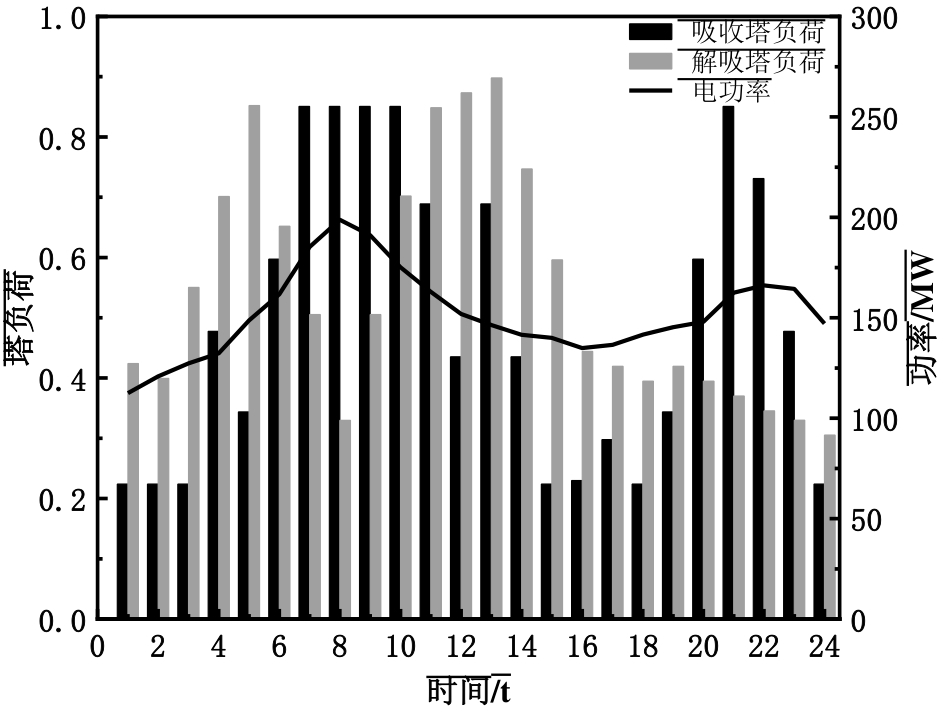
图9 CO2吸收/解吸塔负荷调度
Fig.9 CO2 absorption/desorption tower load scheduling
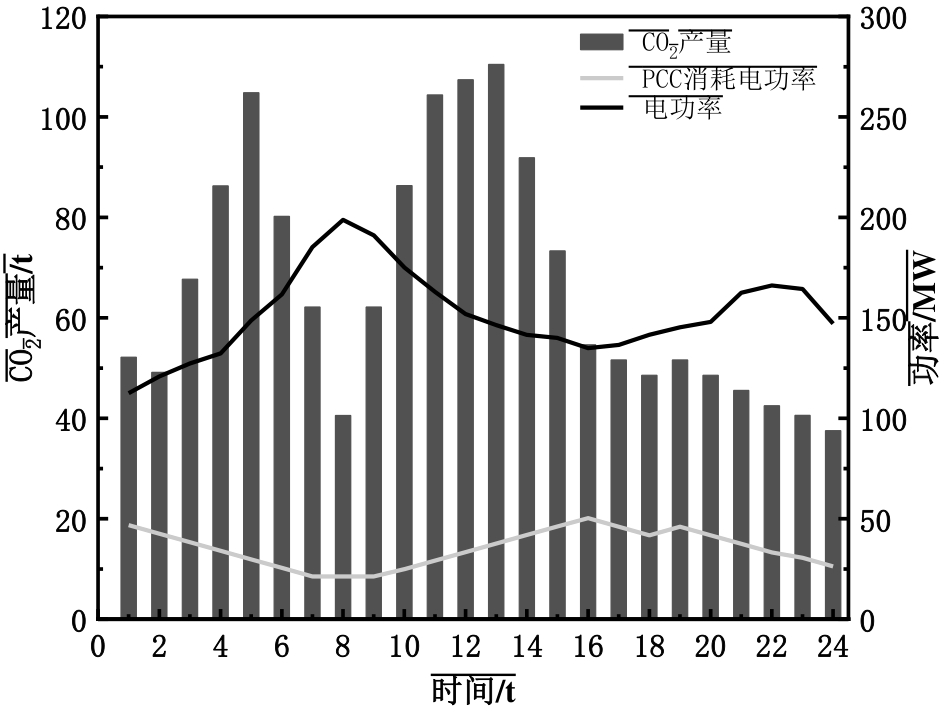
图10 CO2产量调度
Fig.10 CO2 production scheduling
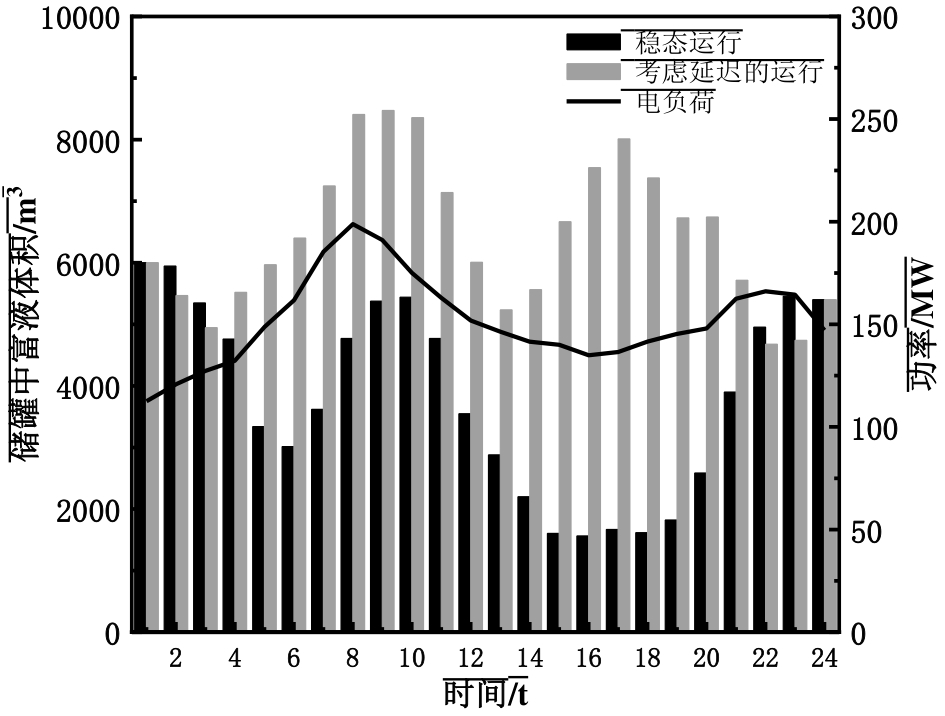
图11 富液储罐不考虑延迟和考虑延迟运行调度比较
Fig.11 Comparison of rich liquid storage tank operation scheduling under different cases
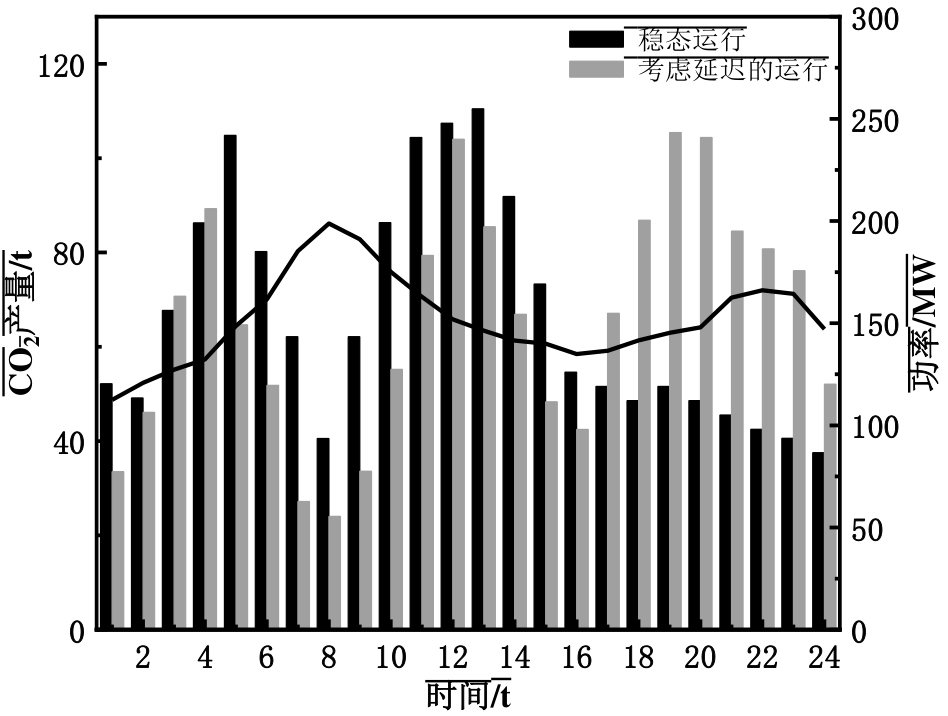
图12 CO2产量不考虑延迟和考虑延迟运行调度比较
Fig.12 Comparison of CO2 production scheduling under different cases
| [1] | 张建宇, 潘荔, 杨帆, 等. 中国燃煤电厂大气污染物控制现状分析[J]. 环境工程技术学报, 2011, 1(3): 185-196. |
| Zhang J Y, Pan L, Yang F, et al. Current status of air pollutant control in China's coal-fired power plants[J]. Journal of Environmental Engineering Technology, 2011, 1(3): 185-196. | |
| [2] | 贾子奕, 刘卓, 张力小, 等. 中国碳捕集、利用与封存技术发展与展望[J]. 中国环境管理, 2022, 14(6): 81-87. |
| Jia Z Y, Liu Z, Zhang L X, et al. Development and prospect of carbon capture, utilization and storage technology in China[J]. Chinese Journal of Environmental Management, 2022, 14(6): 81-87. | |
| [3] | Fragkos P. Assessing the role of carbon capture and storage in mitigation pathways of developing economies[J]. Energies, 2021, 14(7): 1879-1899. |
| [4] | Leung D Y C, Caramanna G, Maroto-Valer M M. An overview of current status of carbon dioxide capture and storage technologies[J]. Renewable and Sustainable Energy Reviews, 2014, 39: 426-443. |
| [5] | 季东, 王健, 王可, 等. 不同CO2捕集技术的CO2耦合绿氢制甲醇工艺研究[J]. 化工学报, 2022, 73(10): 4565-4575. |
| Ji D, Wang J, Wang K, et al. Process research of methanol production by CO2 coupled green hydrogen with different CO2 capture technologies[J]. CIESC Journal, 2022, 73(10): 4565-4575. | |
| [6] | Jiang K, Ashworth P. The development of Carbon Capture Utilization and Storage (CCUS) research in China: a bibliometric perspective[J]. Renewable and Sustainable Energy Reviews, 2021, 138: 110521. |
| [7] | 陈婉. 搭建碳循环模式 提升碳减排能力 中国石化开建我国首个百万吨级CCUS项目[J]. 环境经济, 2021(13): 58-59. |
| Chen W. Build a carbon cycle model to enhance carbon emission reduction capacity. China Petrochemical started the first million-ton CCUS project in China[J]. Environmental Economy, 2021(13): 58-59. | |
| [8] | Veluturla S, Singh S, Fatima S, et al. A comprehensive review of carbon dioxide sequestration: Exploring diverse methods for effective post combustion CO2 capture, transport, and storage[J]. Environmental Engineering Research, 2024, 30(1): 230452. |
| [9] | 李贵贤, 王可, 王健, 等. 膜分离捕集燃煤电厂烟气CO2过程优化设计[J]. 化工学报, 2022, 73(11): 5065-5077. |
| Li G X, Wang K, Wang J, et al. Optimal design of membrane separation process for capturing CO2 from flue gas of coal-fired power plant[J]. CIESC Journal, 2022, 73(11): 5065-5077. | |
| [10] | Wang S, Wang N N, Jia Z G, et al. Thermal economy simulation study for a carbon capture power plant with combined heat and power based on absorption heat pump technology[J]. Energy Conversion and Management, 2024, 300: 117958. |
| [11] | Van P, Delarue E. Opportunities for applying solvent storage to power plants with post-combustion carbon capture[J]. International Journal of Greenhouse Gas Control, 2014, 21: 203-213. |
| [12] | Cohen S M, Rochelle G T, Webber M E. Optimal operation of flexible post-combustion CO2 capture in response to volatile electricity prices[J]. Energy Procedia, 2011, 4: 2604-2611. |
| [13] | 于雪菲, 张帅, 刘琳琳, 等. 电厂和碳捕集装置同步集成与调度优化研究[J]. 化工学报, 2021, 72(3): 1447-1456. |
| Yu X F, Zhang S, Liu L L, et al. Simultaneous integration and scheduling of power plant and carbon capture device[J]. CIESC Journal, 2021, 72(3): 1447-1456. | |
| [14] | 焦竞, 刘琳琳, 都健. 基于代理模型的碳捕集与电厂集成调度优化[J]. 化工进展, 2024, 43(11): 6059-6067. |
| Jiao J, Liu L L, Du J. Optimization of carbon capture and power plant integrated scheduling based on proxy model[J]. Chemical Industry and Engineering Progress, 2024, 43(11): 6059-6067. | |
| [15] | Wang M, Lawal A, Stephenson P, et al. Post-combustion CO2 capture with chemical absorption: a state-of-the-art review[J]. Chemical Engineering Research and Design, 2011, 89(9): 1609-1624. |
| [16] | Nittaya T, Douglas P L, Croiset E, et al. Dynamic modelling and control of MEA absorption processes for CO2 capture from power plants[J]. Fuel, 2014, 116: 672-691. |
| [17] | Wu X, Shen J, Li Y G, et al. Flexible operation of post-combustion solvent-based carbon capture for coal-fired power plants using multi-model predictive control: a simulation study[J]. Fuel, 2018, 220: 931-941. |
| [18] | 康重庆, 季震, 陈启鑫. 碳捕集电厂灵活运行方法评述与展望[J]. 电力系统自动化, 2012, 36(6): 1-10. |
| Kang C /Z)Q, Ji Z, Chen Q X. Review and prospects of flexible operation of carbon capture power plants[J]. Automation of Electric Power Systems, 2012, 36(6): 1-10. | |
| [19] | Chatziasteriou C C, Kikkinides E S, Georgiadis M C. Recent advances on the modeling and optimization of CO2 capture processes[J]. Computers Chemical Engineering, 2022, 165: 107938. |
| [20] | Akula P, Lee A, Eslick J, et al. A modified electrolyte non-random two-liquid model with analytical expression for excess enthalpy: Application to the MEA-H2O-CO2 system[J]. AIChE Journal, 2023, 69(1): e17935. |
| [21] | 郑婷婷. 燃煤电厂燃烧后二氧化碳捕集系统的性能模拟与集成优化[D]. 上海: 上海交通大学, 2017. |
| Zheng T T. Performance simulation and integrated optimization of post-combustion CO2 capture system in coal-fired power plants[D]. Shanghai: Shanghai Jiao Tong University, 2017. | |
| [22] | 贾东晓. 基于化学吸附的燃烧后CO2捕集系统非线性分析及控制研究[D]. 南京: 东南大学, 2019. |
| Jia D X. Nonlinearity analysis and control of solvent-based post-combustion CO2 capture system[D]. Nanjing: Southeast University, 2019. | |
| [23] | 王亚男, 刘琳琳, 庄钰, 等. 基于代理模型的环氧乙烷制乙二醇工艺优化同步热集成[J]. 化工进展, 2024, 43(9): 5234-5241. |
| Wang Y N, Liu L L, Zhuang Y, et al. Synchronous optimization and heat integration of the production process from EO to EG based on surrogate model[J]. Chemical Industry and Engineering Progress, 2024, 43(9): 5234-5241. | |
| [24] | Xi H, Zhu M J, Lee K Y, et al. Multi-timescale and control-perceptive scheduling approach for flexible operation of power plant-carbon capture system[J]. Fuel, 2023, 331: 125695. |
| [25] | 孙兰义. 化工流程模拟实训: Aspen Plus教程[M]. 北京: 化学工业出版社, 2012: 527 |
| Sun L Y. Chemical Engineering Process Simulation Using Aspen Plus[M]. Beijing: Chemical Industry Press, 2012: 527 | |
| [26] | Rodriguez J, Andrade A, Lawal A, et al. An integrated framework for the dynamic modelling of solvent-based CO2 capture processes[J]. Energy Procedia, 2014, 63: 1206-1217. |
| [27] | Luu M T, Abdul Manaf N, Abbas A. Dynamic modelling and control strategies for flexible operation of amine-based post-combustion CO2 capture systems[J]. International Journal of Greenhouse Gas Control, 2015, 39: 377-389. |
| [28] | 陈时熠,曹欣欣,陈姝屹,等.基于燃烧前CO2捕集与封存的IGCC全生命周期碳排放及环境评价[J/OL].化工学报,1-20. |
| Chen Shiyi, Cao Xinxin, Chen Shuyi, et al. Life cycle carbon emission and environment assessment of pre-combustion IGCC power plant[J/OL]. CIESC Journal, 1-20. | |
| 陈时熠, 曹欣欣, 陈姝屹, 等. 基于燃烧前CO2捕集与封存的IGCC全生命周期碳排放及环境评价[J/OL]. 化工学报, 2025:1-20. (2025-10-27). . | |
| Chen S Y, Cao X X, Chen S Y, et al. Life cycle carbon emission and environment assessment of pre-combustion IGCC power plant[J/OL]. CIESC Journal, 2025: 1-20. (2025-10-27). . | |
| [29] | Dugas R E. Pilot plant study of carbon dioxide capture by aqueous monoethanolamine[D]. Austin: The University of Texas at Austin,2006. |
| [30] | Liao P Z, Wu X, Li Y G, et al. Application of piece-wise linear system identification to solvent-based post-combustion carbon capture[J]. Fuel, 2018, 234: 526-537. |
| [31] | Taqvi S A A, Zabiri H, Singh S K M, et al. Investigation of control performance on an absorption/stripping system to remove CO2 achieving clean energy systems[J]. Fuel, 2023, 347: 128394. |
| [32] | Chen X H, Wu X, Lee K Y. The mutual benefits of renewables and carbon capture: Achieved by an artificial intelligent scheduling strategy[J]. Energy Conversion and Management, 2021, 233: 113856. |
| [33] | Chen Q X, Kang C Q, Xia Q, et al. Optimal flexible operation of a CO2 capture power plant in a combined energy and carbon emission market[J]. IEEE Transactions on Power Systems, 2012, 27(3): 1602-1609. |
| [34] | Wei C J, Wang H, Xie X M, et al. GAMS User Guide[M]. Beijing: China Water Power Press, 2009 |
| [1] | 马爱华, 赵帅, 王林, 常明慧. 太阳能吸收制冷循环动态特性仿真方法研究[J]. 化工学报, 2025, 76(S1): 318-325. |
| [2] | 王三一, 黄文来. 电化学合成氨流程建模与优化[J]. 化工学报, 2025, 76(9): 4474-4486. |
| [3] | 刘沁雯, 叶恒冰, 张逸伟, 朱法华, 钟文琪. 煤与禽类粪便混合燃料的加压富氧燃烧特性研究[J]. 化工学报, 2025, 76(7): 3487-3497. |
| [4] | 陈佳祥, 周伟, 张学伟, 王丽杰, 黄玉明, 于洋, 孙苗婷, 李宛静, 袁骏舒, 张宏博, 孟晓晓, 高继慧, 赵广播. 脉冲电压下二维PEMWE模型的制氢特性仿真研究[J]. 化工学报, 2025, 76(7): 3521-3530. |
| [5] | 王芳, 马素霞, 田营, 刘众元. 基于LSTM动态修正一维机理模型的CFB机组NO x 排放浓度预测方法[J]. 化工学报, 2025, 76(7): 3416-3425. |
| [6] | 娄嘉诚, 常福城, 刘也铭, 李志斌, 李熙, 李会雄. 1000 MW超超临界直流锅炉水冷壁瞬态响应特性的建模与仿真研究[J]. 化工学报, 2025, 76(6): 2638-2651. |
| [7] | 陈建兵, 常昊, 高明, 邢兵, 张磊, 刘奇磊. 基于反应模板与分子动力学的胺基相变吸收剂分相预测方法[J]. 化工学报, 2025, 76(5): 2387-2396. |
| [8] | 赵俊德, 周爱国, 陈彦霖, 郑家乐, 葛天舒. 吸附法CO2直接空气捕集技术能耗现状[J]. 化工学报, 2025, 76(4): 1375-1390. |
| [9] | 王法正, 隋璘, 熊伟丽. 面向多采样率数据的TTPA-LSTM软测量建模[J]. 化工学报, 2025, 76(4): 1635-1646. |
| [10] | 张新梅, 张傲, 邱德华, 刘晓爽, 陈晨. 基于热响应机理的罐区池火灾动态多米诺效应评估方法[J]. 化工学报, 2025, 76(4): 1885-1897. |
| [11] | 张履胜, 王治红, 柳青, 李雪雯, 谭仁敏. 液-液相变吸收剂捕集二氧化碳研究进展[J]. 化工学报, 2025, 76(3): 933-950. |
| [12] | 肖俊兵, 钟湘宇, 任建地, 钟芳芳, 刘昌会, 贾传坤. 基于生物碳材料强化的硬脂酸相变材料储热性能研究[J]. 化工学报, 2025, 76(3): 1312-1322. |
| [13] | 齐珂, 王迪, 谢喆, 陈东升, 周云龙, 孙灵芳. 考虑多物理场耦合特性的固体氧化物燃料电池瞬态特性研究[J]. 化工学报, 2025, 76(3): 1264-1274. |
| [14] | 杨晋宁, 王卫凡, 徐冬, 刘毅, 翁小涵, 原野, 王志. 工业烟道气碳捕集膜技术放大研究进展[J]. 化工学报, 2025, 76(2): 504-518. |
| [15] | 姚佳逸, 张东辉, 唐忠利, 李文彬. 基于二级双回流的变压吸附捕碳工艺研究[J]. 化工学报, 2025, 76(2): 744-754. |
| 阅读次数 | ||||||
|
全文 |
|
|||||
|
摘要 |
|
|||||
 京公网安备 11010102001995号