• •
魏纪元1,2( ), 李盛平2, 赵华莉2, 王兆文2(), 鞠洪玲1,2
收稿日期:2025-05-23
修回日期:2025-09-29
出版日期:2026-02-02
通讯作者:
王兆文
作者简介:魏纪元(2000—),男,硕士研究生,weijiyuan109@163.com
Jiyuan WEI1,2(), Shengping LI2, Huali ZHAO2, Zhaowen WANG2(), Hongling JU1,2
Received:2025-05-23
Revised:2025-09-29
Online:2026-02-02
Contact:
Zhaowen WANG
摘要:
低温条件下启动时,质子交换膜燃料电池(PEMFC)内液态水结冰堵塞通道,严重影响电池启动性能及寿命。针对这一问题,本文采用MATLAB Simulink建立了基于新型传热模型的PEMFC准二维模型,探究了冷启动时PEMFC单电池的宏观和微观性能。论文首先深入研究了低温启动工况下电池内部的温度分布、水-冰的演变以及扩散层堵塞等特性,随后探索了不同辅助加热方式对PEMFC冷启动性能的影响规律。结果表明,PEMFC在-20 ℃温度下无法成功自启动,阴极催化层内反应生成的水发生相变堵塞传质通道,化学反应停止,启动失败。最终提出了一种能够改善PEMFC冷启动性能的可调的冷却液辅助加热策略,在此策略下,电池在-20 ℃温度下启动时,阴极催化层堵塞冰能自熔解,启动15 s后含冰量接近0%,含水量不断增加,电池温度始终保持在0 ℃以上,冷启动成功。
中图分类号:
魏纪元, 李盛平, 赵华莉, 王兆文, 鞠洪玲. 基于准二维模型的PEMFC冷启动特性研究[J]. 化工学报, DOI: 10.11949/0438-1157.20250566.
Jiyuan WEI, Shengping LI, Huali ZHAO, Zhaowen WANG, Hongling JU. Cold-start characterization of PEMFC based on quasi-two-dimensional modeling[J]. CIESC Journal, DOI: 10.11949/0438-1157.20250566.

图1 PEMFC准二维模型
Fig. 1 PEMFC quasi-two-dimensional model

图2 PEMFC准二维模型示意图
Fig. 2 Schematic diagram of the PEMFC quasi-two-dimensional model
| 参数 | 数值 | 参数 | 数值 |
|---|---|---|---|
| 活性表面积/ m2 | 2.5×10⁻³ | GDL密度/ kg·m-3 | 1000 |
| GDL孔隙率 | 0.7 | MPL密度/ kg·m-3 | 1000 |
| MPL孔隙率 | 0.4 | 双极板密度/ kg·m-3 | 1000 |
| CL孔隙率 | 0.3 | PEM密度/ kg·m-3 | 1980 |
| 双极板厚度/m | 0.005 | CL密度/ kg·m-3 | 1000 |
| GDL厚度/m | 2×10⁻⁴ | 双极板比热容/J·kg-1·K-1 | 1580 |
| MPL厚度/m | 3×10⁻⁵ | GDL比热容/ J·kg-1·K-1 | 2000 |
| CL厚度/m | 1×10⁻⁵ | MPL比热容/ J·kg-1·K-1 | 568 |
| GDL渗透率 | 6.2×10⁻¹² | PEM比热容/ J·kg-1·K-1 | 833 |
| MPL渗透率 | 8.3×10⁻¹³ | CL比热容/ J·kg-1·K-1 | 3300 |
| CL渗透率 | 6.2×10⁻¹³ | 双极板热导率/W·m-1·K-1 | 15 |
| 双极板电导率/ S m-1 | 2×10⁴ | GDL、CL热导率/ W·m-1·K-1 | 1 |
| GDL电导率/ S m-1 | 300 | PEM热导率/ W·m-1·K-1 | 0.95 |
| MPL电导率/ S m-1 | 300 | 阳极气体热导率/ W·m-1·K-1 | 0.17 |
| CL电导率/ S m-1 | 300 | 阴极气体热导率W·m-1·K-1 | 0.024 |
表1 模型参数
Table 1 Model parameters
| 参数 | 数值 | 参数 | 数值 |
|---|---|---|---|
| 活性表面积/ m2 | 2.5×10⁻³ | GDL密度/ kg·m-3 | 1000 |
| GDL孔隙率 | 0.7 | MPL密度/ kg·m-3 | 1000 |
| MPL孔隙率 | 0.4 | 双极板密度/ kg·m-3 | 1000 |
| CL孔隙率 | 0.3 | PEM密度/ kg·m-3 | 1980 |
| 双极板厚度/m | 0.005 | CL密度/ kg·m-3 | 1000 |
| GDL厚度/m | 2×10⁻⁴ | 双极板比热容/J·kg-1·K-1 | 1580 |
| MPL厚度/m | 3×10⁻⁵ | GDL比热容/ J·kg-1·K-1 | 2000 |
| CL厚度/m | 1×10⁻⁵ | MPL比热容/ J·kg-1·K-1 | 568 |
| GDL渗透率 | 6.2×10⁻¹² | PEM比热容/ J·kg-1·K-1 | 833 |
| MPL渗透率 | 8.3×10⁻¹³ | CL比热容/ J·kg-1·K-1 | 3300 |
| CL渗透率 | 6.2×10⁻¹³ | 双极板热导率/W·m-1·K-1 | 15 |
| 双极板电导率/ S m-1 | 2×10⁴ | GDL、CL热导率/ W·m-1·K-1 | 1 |
| GDL电导率/ S m-1 | 300 | PEM热导率/ W·m-1·K-1 | 0.95 |
| MPL电导率/ S m-1 | 300 | 阳极气体热导率/ W·m-1·K-1 | 0.17 |
| CL电导率/ S m-1 | 300 | 阴极气体热导率W·m-1·K-1 | 0.024 |

图3 模拟结果与实验数据对比
Fig. 3 Comparison between simulation results and experimental data
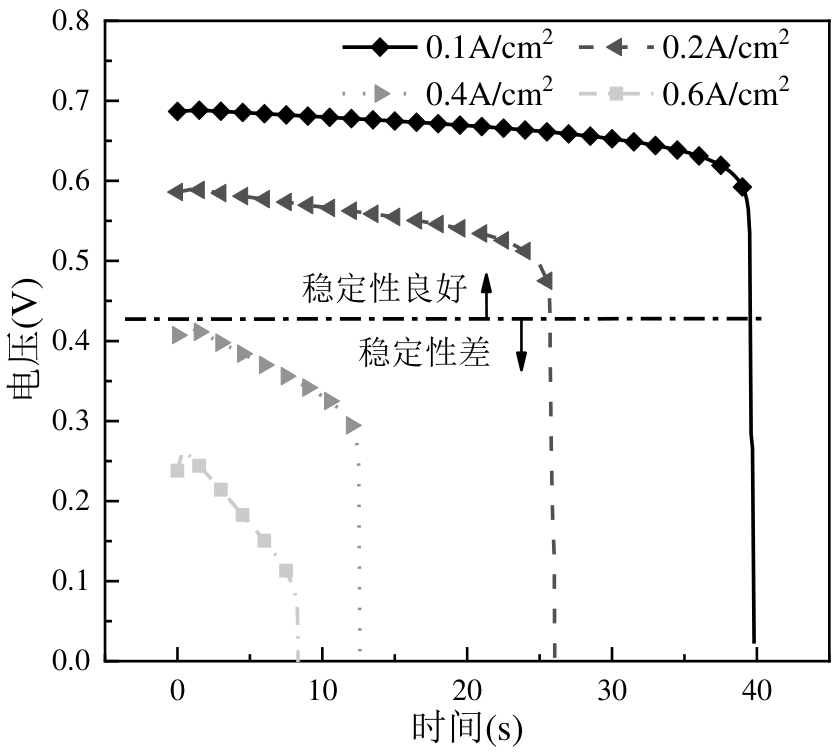
图4 不同启动电流密度下的电压曲线
Fig. 4 Voltage profile at different starting current densities
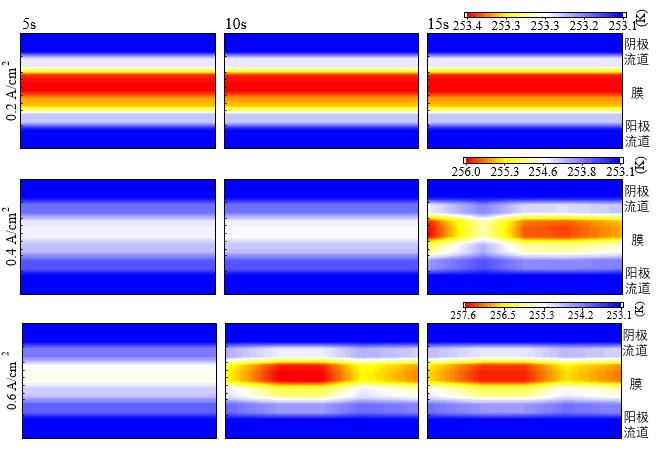
图5 不同启动电流密度下的温度分布
Fig. 5 Temperature distribution at different starting current densities
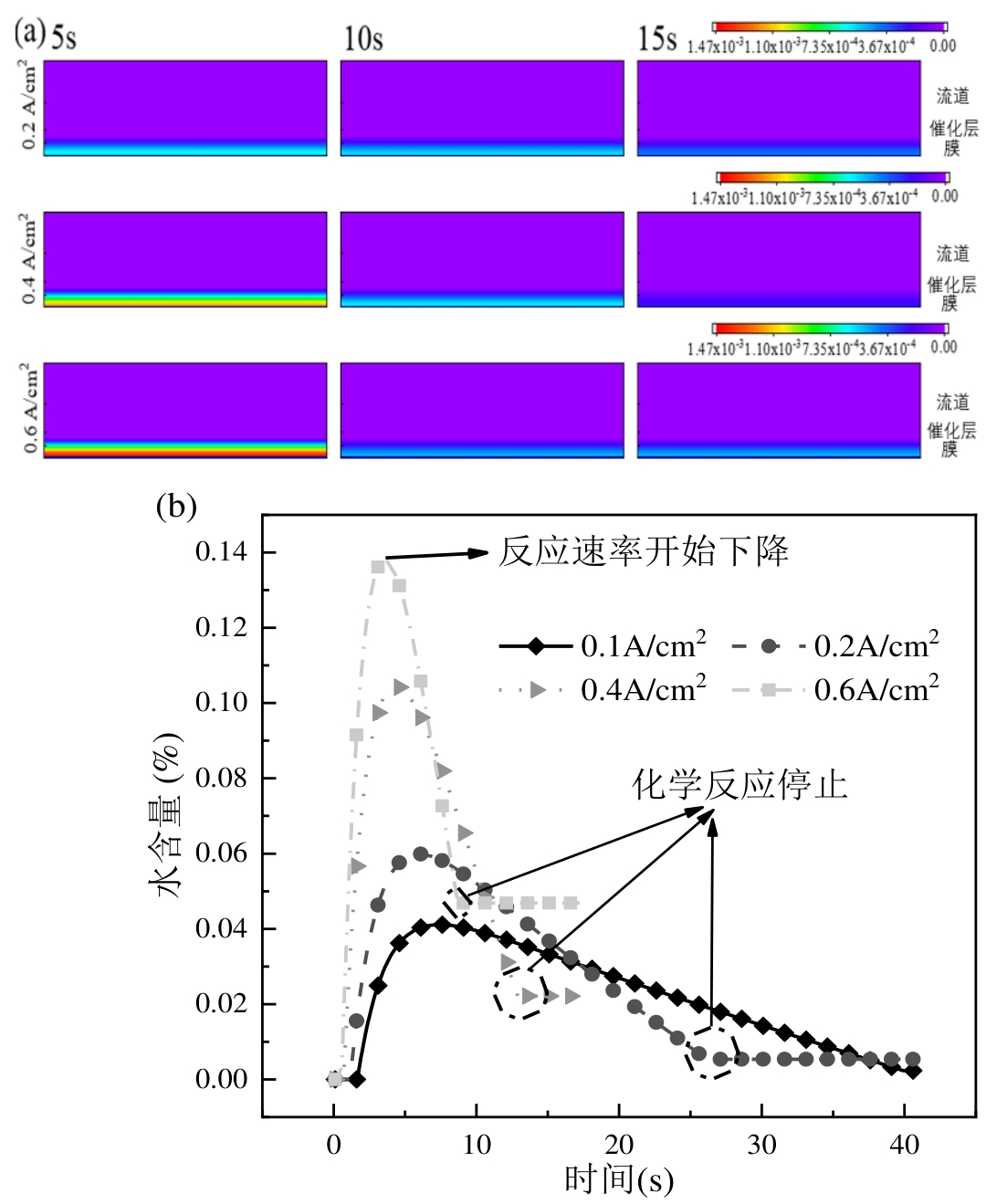
图6 阴极内水分布(a)和CCL内水含量变化(b)
Fig. 6 Distribution of water in the cathode (a) and variation of water content in CCL (b)
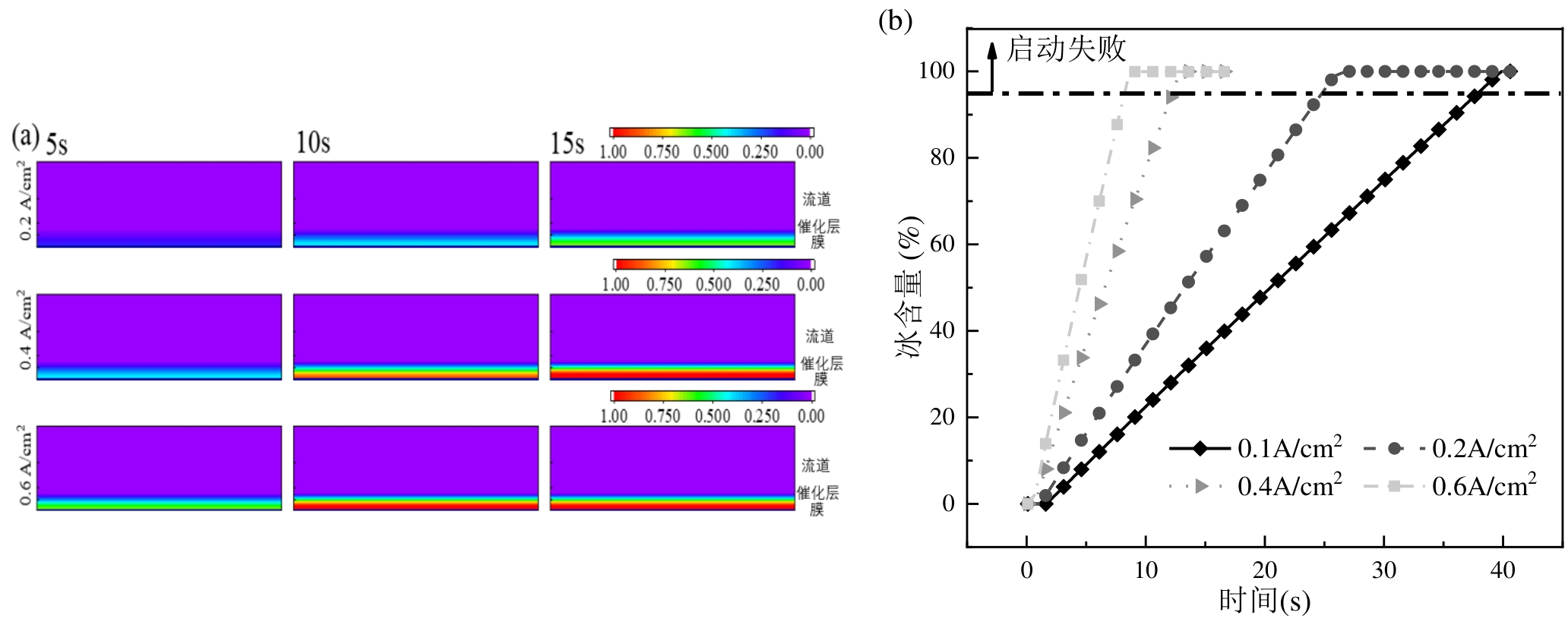
图7 阴极内冰分布(a)和阴极CCL内冰含量变化(b)
Fig. 7 Ice distribution within the cathode (a) and ice content variation within CCL (b)
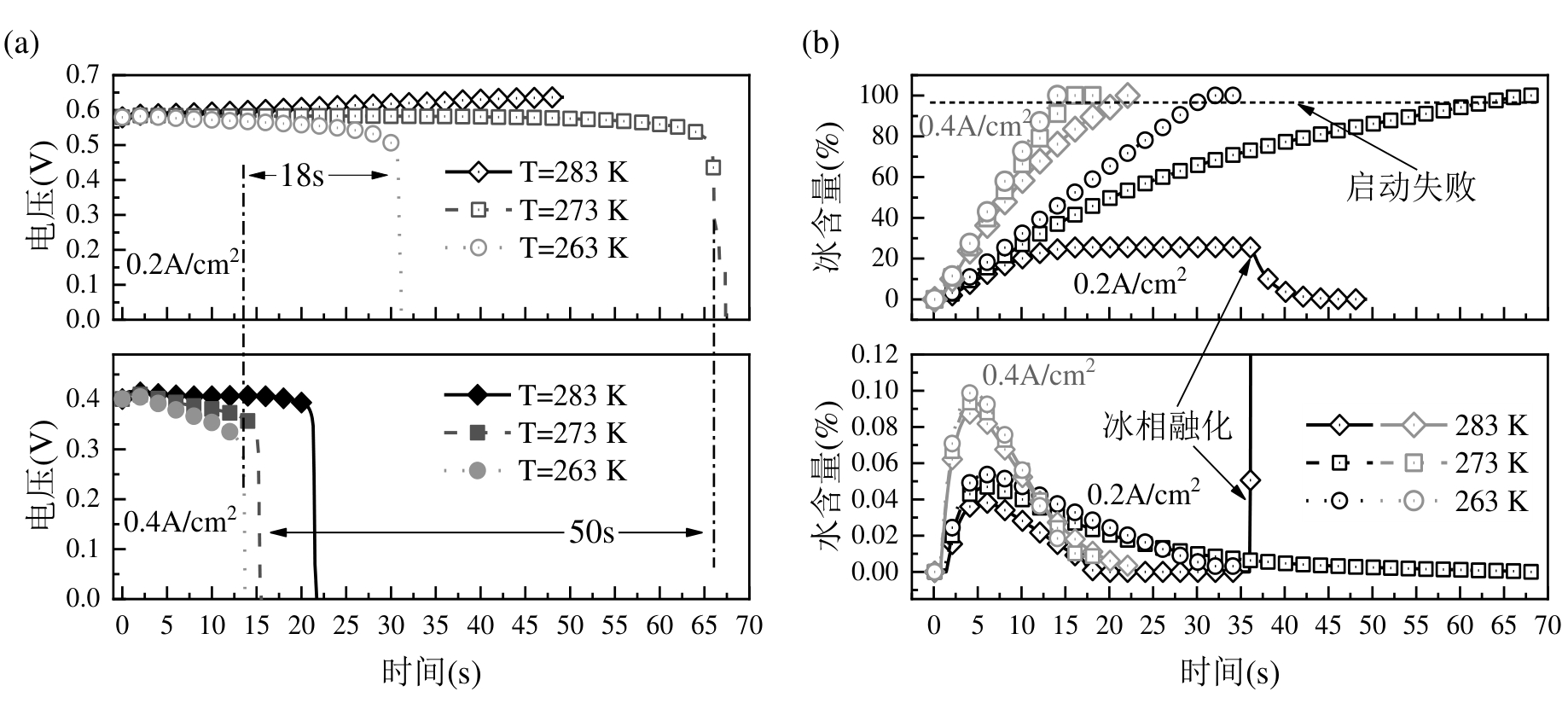
图8 采用辅助加热后的电池冷启动电压曲线(a)和阴极催化层中液态水和冰的含量(b)
Fig. 8 Voltage curves (a) and liquid water and ice content (b) in CCL of the battery with auxiliary heating
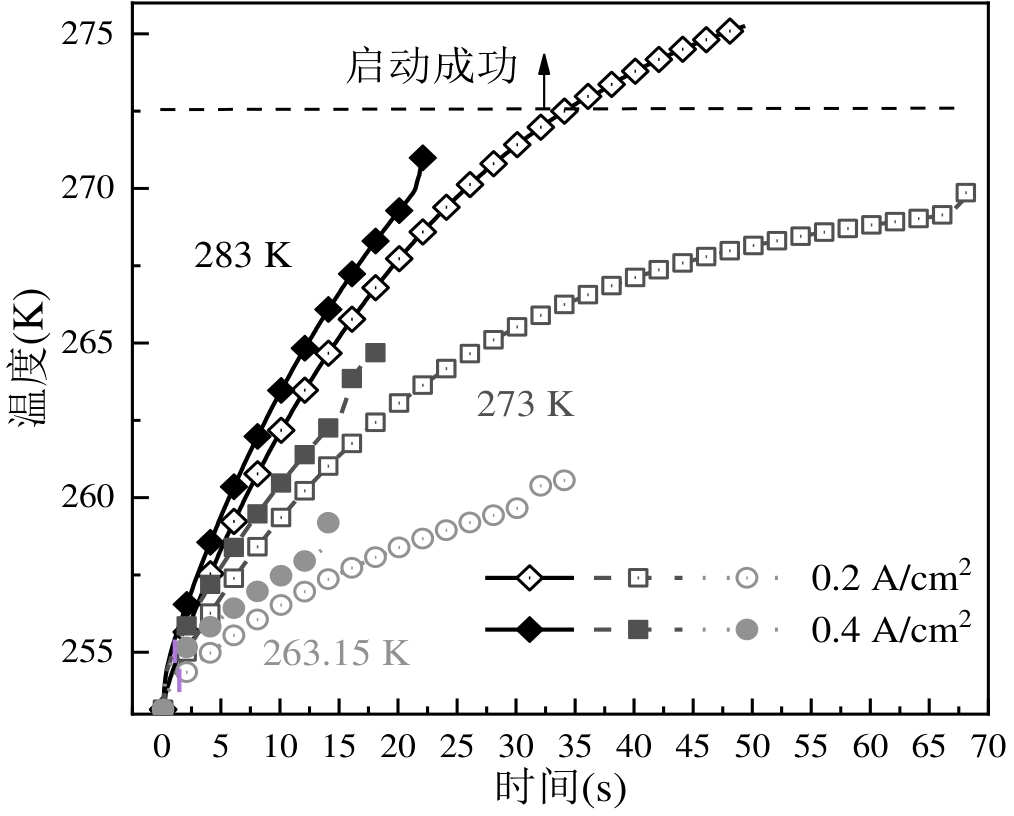
图9 燃料电池采用进气辅助加热时冷启动的温度曲线
Fig. 9 Temperature profile for cold start of fuel cell with intake air assisted heating
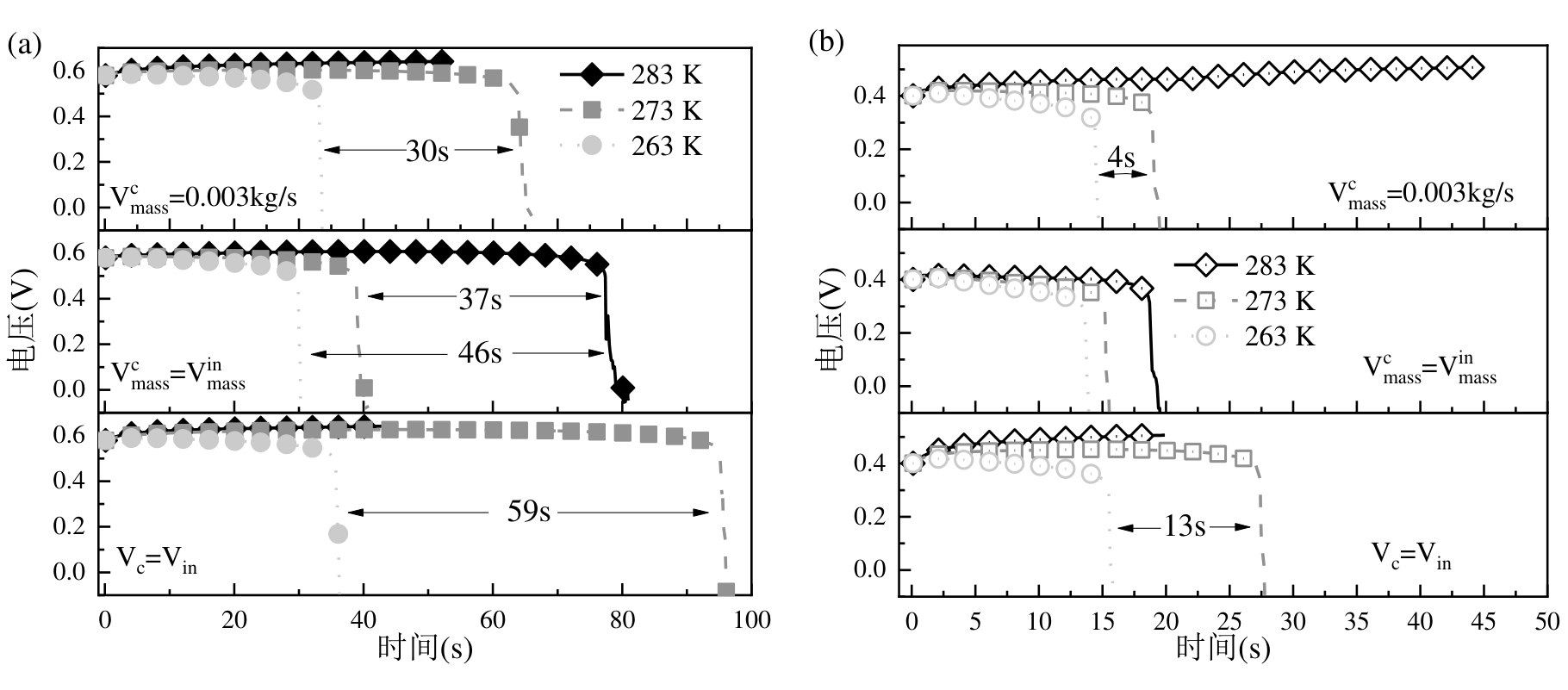
图10 在I=0.2 A/cm²(a)和I=0.4 A/cm²(b)条件下,带冷却液加热的燃料电池的输出电压
Fig. 10 Output voltage of fuel cell with coolant heating at I = 0.2 A/cm² (a) and I = 0.4 A/cm² (b)

图11 在I=0.2A/cm²(a)和I=0.4A/cm²(b)条件下,带冷却液加热的电池催化层温度
Fig. 11 Temperature of the catalytic layer of the cell with coolant heating at I=0.2A/cm² (a) and I=0.4A/cm² (b)
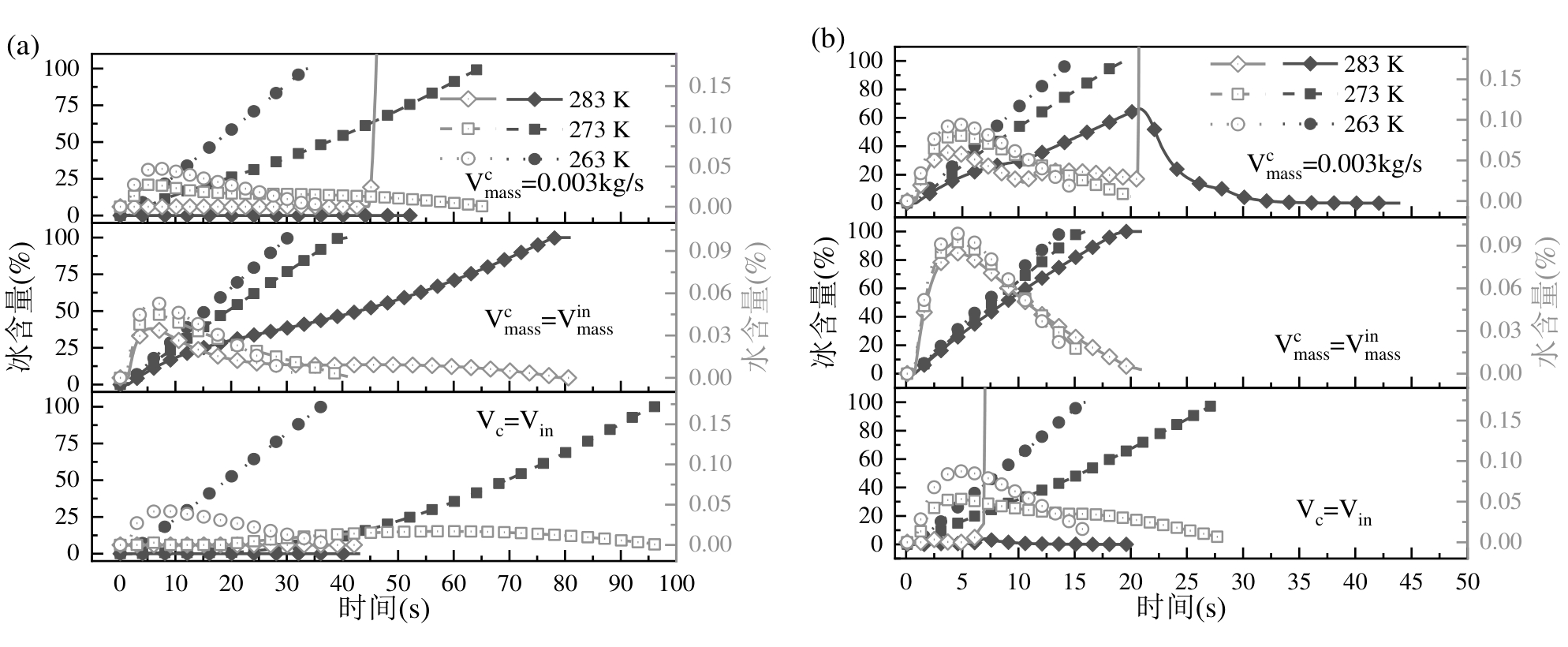
图12 在I=0.2A/cm²(a)和I=0.4A/cm²(b)条件下,催化层中水和冰的含量
Fig. 12 Water and ice content in the catalytic layer at I = 0.2 A/cm² (a) and I = 0.4 A/cm² (b)
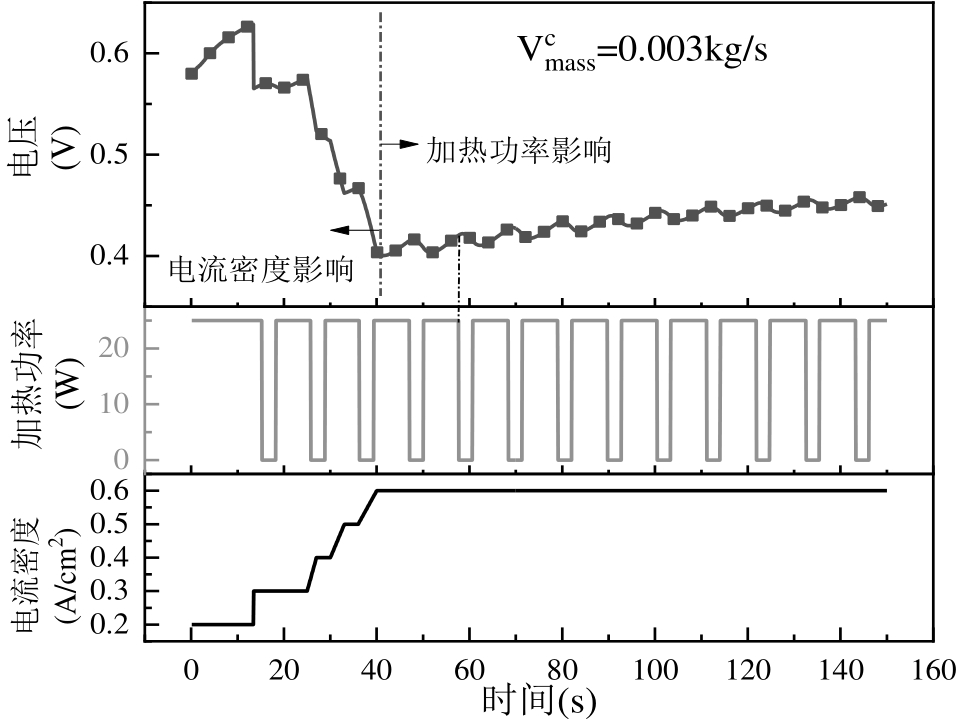
图13 电流密度、电压和冷却液加热功率随时间的变化
Fig. 13 Current density, voltage and coolant heating power over time
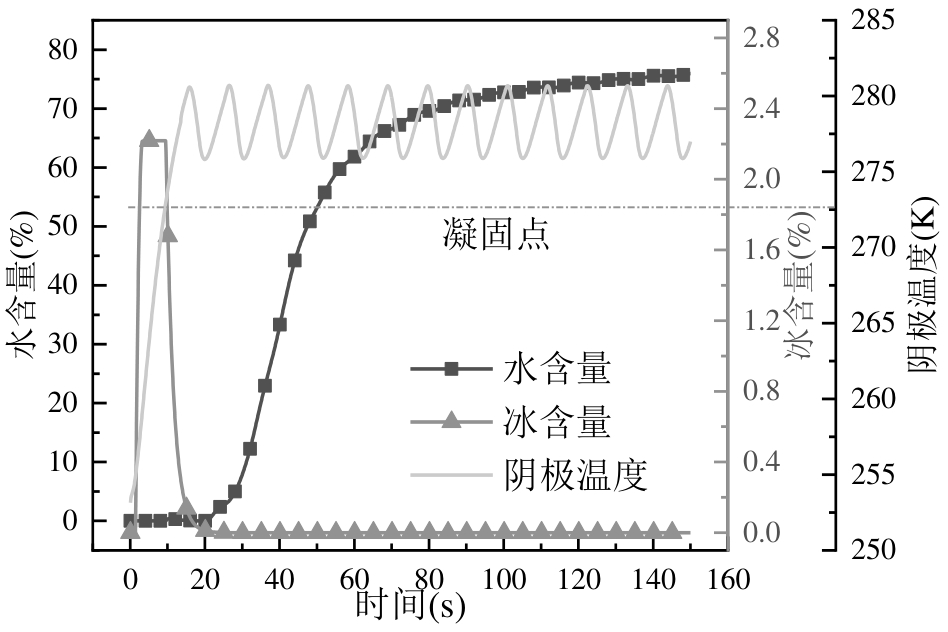
图14 电池阴极内部温度、冰和水含量变化
Fig. 14 Variation of temperature, ice and water content inside the cell cathode
| [1] | 陈琪, 许骏龙. 浅谈我国低碳经济发展现状[J]. 上海节能, 2024(5): 827-830. |
| Chen Q, Xu J L. Discussion on the current situation of low carbon economy in China[J]. Shanghai Energy Saving, 2024(5): 827-830. | |
| [2] | Gao F, Blunier B, Miraoui A, et al. Proton exchange membrane fuel cell multi-physical dynamics and stack spatial non-homogeneity analyses[J]. Journal of Power Sources, 2010, 195(22): 7609-7626. |
| [3] | Hu K F, Chu T K, Li F, et al. Effect of different control strategies on rapid cold start-up of a 30-cell proton exchange membrane fuel cell stack[J]. International Journal of Hydrogen Energy, 2021, 46(62): 31788-31797. |
| [4] | Tao J J, Wei X Z, Ming P W, et al. Order reduction, simplification and parameters identification for cold start model of PEM fuel cell[J]. Energy Conversion and Management, 2022, 274: 116465. |
| [5] | 刘威. 质子交换膜燃料电池吹扫除水与低温冷启动研究[D]. 武汉: 武汉理工大学, 2009. |
| Liu W. Research on prepurge and cold start of proton exchange membrane fuel cells[D]. Wuhan: Wuhan University of Technology,2009. | |
| [6] | Wang F J, Zhang H L, Ming P, et al. Experimental study on rapid cold start-up performance of PEMFC system[J]. International Journal of Hydrogen Energy, 2023, 48(57): 21898-21907. |
| [7] | Weber A Z, Borup R L, Darling R M, et al. Electrolytes; Findings from University of Alberta in Electrolytes Reported (A Critical Review of Modeling Transport Phenomena in Polymer-Electrolyte Fuel Cells) [J]. Journal of the Electrochemical Society, 2014, 161(12): F1254-F1299. |
| [8] | 王学科, 孙铁生, 高彦峰, 等. 不同电流密度下的PEMFC自升温冷启动仿真[J]. 电池, 2022, 52(4): 406-410. |
| Wang X K, Sun T S, Gao Y F, et al. Simulation of PEMFC self-heating cold start under different current densities[J]. Battery Bimonthly, 2022, 52(4): 406-410. | |
| [9] | 魏琳, 廖梓豪, 蒋方明. PEMFC冷却剂循环条件下冷启动数值模拟[J]. 化工学报, 2019, 70(S2): 146-154. |
| Wei L, Liao Z H, Jiang F M. Numerical study on cold start of PEMFC with coolant circulation[J]. CIESC Journal, 2019, 70(S2): 146-154. | |
| [10] | Kulikovsky A A. Quasi-2D model of a fuel cell[M].Analytical Modelling of Fuel Cells. Amsterdam: Elsevier, 2010: 117-192. |
| [11] | Murschenhofer D, Kuzdas D, Braun S, et al. A real-time capable quasi-2D proton exchange membrane fuel cell model[J]. Energy Conversion and Management, 2018, 162: 159-175. |
| [12] | Wang B W, Wu K C, Yang Z R, et al. A quasi-2D transient model of proton exchange membrane fuel cell with anode recirculation[J]. Energy Conversion and Management, 2018, 171: 1463-1475. |
| [13] | Li S P, Zhao H Let al. Optimization of material-energy Co-management in a proton exchange membrane fuel cell [J]. International Journal of Hydrogen Energy, 2025, 101: 391-402. |
| [14] | Gwak G, Ju H. A rapid start-up strategy for polymer electrolyte fuel cells at subzero temperatures based on control of the operating current density[J]. International Journal of Hydrogen Energy, 2015, 40(35): 11989-11997. |
| [15] | Jiang F M, Wang C Y. Potentiostatic start-up of PEMFCs from subzero temperatures[J]. Journal of the Electrochemical Society, 2008, 155(7): B743. |
| [16] | Luo Y Q, Jiao K, Jia B. Elucidating the constant power, current and voltage cold start modes of proton exchange membrane fuel cell[J]. International Journal of Heat and Mass Transfer, 2014, 77: 489-500. |
| [17] | Pan M Z, Li D, Pan C J, et al. Maximum power tracking-based adaptive cold start strategy for proton exchange membrane fuel cell[J]. Energy Conversion and Management, 2022, 273: 116387. |
| [18] | Lei L, He P, He P, et al. A comparative study: The effect of current loading modes on the cold start-up process of PEMFC stack[J]. Energy Conversion and Management, 2022, 251: 114991. |
| [19] | Liu J, Chen H C, Zhang T. Analysis of cold start characteristics in a PEMFC stack with different current loading modes[J]. International Journal of Hydrogen Energy, 2024, 51: 1456-1476. |
| [20] | 邵佳雄, 牛志刚, 陈醒, 等. 阶梯电流密度加载模式对PEMFC冷启动性能的影响[J]. 武汉科技大学学报, 2024, 47(4): 298-304. |
| Shao J X, Niu Z G, Chen X, et al. Effect of stepped current density loading mode on PEMFC cold start performance[J]. Journal of Wuhan University of Science and Technology (Natural Science Edition), 2024, 47(4): 298-304. | |
| [21] | Tsai S W, Chen Y S. A mathematical model to study the energy efficiency of a proton exchange membrane fuel cell with a dead-ended anode[J]. Applied Energy, 2017, 188: 151-159. |
| [22] | 杨小康, 孟海军, 俞红梅, 等. 质子交换膜燃料电池低温启动策略研究进展[J]. 电源技术, 2022, 46(5): 471-475. |
| Yang X K, Meng H J, Yu H M, et al. Review of cold start strategies of proton exchange membrane fuel cells[J]. Chinese Journal of Power Sources, 2022, 46(5): 471-475. | |
| [23] | Yang Z R, Jiao K, Wu K C, et al. Numerical investigations of assisted heating cold start strategies for proton exchange membrane fuel cell systems[J]. Energy, 2021, 222: 119910. |
| [24] | Kim S, Jeong H, Lee H. Cold-start performance investigation of fuel cell electric vehicles with heat pump-assisted thermal management systems[J]. Energy, 2021, 232: 121001. |
| [25] | Du Q, Jia B, Luo Y Q, et al. Maximum power cold start mode of proton exchange membrane fuel cell[J]. International Journal of Hydrogen Energy, 2014, 39(16): 8390-8400. |
| [26] | Amamou A, Boulon L, et al. Comparison of self cold start strategies of automotive Proton Exchange Membrane Fuel Cell[C].2018 IEEE International Conference on Industrial Technology (ICIT). Lyon, France: IEEE, 2018: 904-908. |
| [27] | Lin R, Zhu Y K, Ni M, et al. Consistency analysis of polymer electrolyte membrane fuel cell stack during cold start[J]. Applied Energy, 2019, 241: 420-432. |
| [28] | Li Y C, Xu S Cet al. Experiment and simulation study on cold start of automotive PEMFC[C].2011 International Conference on Electric Information and Control Engineering. Wuhan: IEEE, 2011: 2166-2170. |
| [29] | Wexel D, Goebel S G. Fuel cell heating: US8313871[P]. 2012-11-20. |
| [30] | Ahn G Y, Kim S H. Fuel cell system to preheat fuel cell stack: US8343678[P]. 2013-01-01. |
| [31] | Zhan Z G, Yuan C, Hu Z R, et al. Experimental study on different preheating methods for the cold-start of PEMFC stacks[J]. Energy, 2018, 162: 1029-1040. |
| [32] | Xia L, Yu Z T, Xu G P, et al. Design and optimization of a novel composite bionic flow field structure using three-dimensional multiphase computational fluid dynamic method for proton exchange membrane fuel cell[J]. Energy Conversion and Management, 2021, 247: 114707. |
| [33] | Hazar H, Yilmaz M, Sevinc H. A comparative analysis of a novel flow field pattern with different channel size configurations[J]. Fuel, 2022, 319: 123867. |
| [34] | Cho M K, Lee D N, Kim Y Y, et al. Analysis of the spatially distributed performance degradation of a polymer electrolyte membrane fuel cell stack[J]. International Journal of Hydrogen Energy, 2014, 39(29): 16548-16555. |
| [35] | Thompson E Let al. Investigation of low-temperature proton transport in nafion using direct current conductivity and differential scanning calorimetry[J]. Journal of the Electrochemical Society, 2006, 153(12): A2351. |
| [36] | 王振威. 质子交换膜燃料电池冷启动结冰机理与影响因素研究[D]. 淄博: 山东理工大学, 2024. |
| Wang Z W. Study on the icing mechanism and influencing factors of proton exchange membrane fuel cell cold start[D]. Zibo: Shandong University of Technology, 2024. | |
| [37] | 张禄昱. 质子交换膜燃料电池低温启动特性及控制策略研究[D]. 成都: 电子科技大学, 2023. |
| Zhang L Y. Investigations on the cold-start characteristics and control strategy of proton exchange membrane fuel cells[D]. Chengdu: University of Electronic Science and Technology of China, 2023. | |
| [38] | DOE. Fuel cell technical team road map[EB/OL]. (2017).[] |
| [39] | DOE. DOE technical targets for fuel cell systems and stacks for transportation Applications[EB/OL]. (2017). [] |
| [40] | Tajiri K, Tabuchi Y, Kagami F, et al. Effects of operating and design parameters on PEFC cold start[J]. Journal of Power Sources, 2007, 165(1): 279-286. |
| [41] | Springer T E, Zawodzinski T A, Gottesfeld S. Polymer electrolyte fuel cell model[J]. Journal of the Electrochemical Society, 1991, 138(8): 2334-2342. |
| [1] | 段浩磊, 陈浩远, 梁坤峰, 王林, 陈彬, 曹勇, 张晨光, 李硕鹏, 朱登宇, 何亚茹, 杨大鹏. 纯电动车热管理系统低GWP工质替代方案性能分析与综合评价[J]. 化工学报, 2025, 76(S1): 54-61. |
| [2] | 王俊鹏, 冯佳琪, 张恩搏, 白博峰. 曲折式与阵列式迷宫阀芯结构内流动与空化特性研究[J]. 化工学报, 2025, 76(S1): 93-105. |
| [3] | 赵子祥, 段钟弟, 孙浩然, 薛鸿祥. 大温差两相流动诱导水锤冲击的数值模型[J]. 化工学报, 2025, 76(S1): 170-180. |
| [4] | 黄灏, 王文, 贺隆坤. LNG船薄膜型液货舱预冷过程模拟与分析[J]. 化工学报, 2025, 76(S1): 187-194. |
| [5] | 汪思远, 刘国强, 熊通, 晏刚. 窗式空调器轴流风机的风速非均匀分布特性及其对冷凝器流路优化设计的影响规律[J]. 化工学报, 2025, 76(S1): 205-216. |
| [6] | 曹庆泰, 郭松源, 李建强, 蒋赞, 汪彬, 耑锐, 吴静怡, 杨光. 负过载下多孔隔板对液氧贮箱蓄液性能的影响研究[J]. 化工学报, 2025, 76(S1): 217-229. |
| [7] | 孙九春, 桑运龙, 王海涛, 贾浩, 朱艳. 泥水盾构仓体内射流对泥浆输送特性影响研究[J]. 化工学报, 2025, 76(S1): 246-257. |
| [8] | 何婷, 黄舒阳, 黄坤, 陈利琼. 基于余热利用的天然气化学吸收脱碳-高温热泵耦合流程研究[J]. 化工学报, 2025, 76(S1): 297-308. |
| [9] | 段炼, 周星睿, 袁文君, 陈飞. 连续相速度脉动对微通道内聚合物液滴生成和形貌的影响规律[J]. 化工学报, 2025, 76(9): 4578-4585. |
| [10] | 陈昇, 李子争, 苗超, 白学刚, 李飞, 刘家璇, 李天天, 杨爽, 吕蓉蓉, 王江云. 大尺度密集场景高危氯气非均匀湍流扩散特性三维CFD模拟[J]. 化工学报, 2025, 76(9): 4630-4643. |
| [11] | 杨开源, 陈锡忠. 颗粒破碎的离散元及有限离散元模拟方法比较[J]. 化工学报, 2025, 76(9): 4398-4411. |
| [12] | 刘奕扬, 邢志祥, 刘烨铖, 彭明, 李玉洋, 李云浩, 沈宁舟. 加氢站液氢泄漏扩散特性与安全监测数值模拟研究[J]. 化工学报, 2025, 76(9): 4694-4708. |
| [13] | 张彬怡, 孙少东, 姚谦, 蔡文河, 张惠宇, 李成新. 煤制甲醇耦合固体氧化物燃料电池混合系统研究[J]. 化工学报, 2025, 76(9): 4658-4669. |
| [14] | 黄正宗, 刘科成, 李泽方, 曾平生, 刘永富, 闫红杰, 刘柳. 锌精馏炉砖砌式换热室数值模拟与场协同优化[J]. 化工学报, 2025, 76(9): 4425-4439. |
| [15] | 贾志勇, 沈宪琨, 蓝晓程, 王铁峰. 气体密度对高压流态化影响的CFD-DEM模拟[J]. 化工学报, 2025, 76(9): 4383-4397. |
| 阅读次数 | ||||||
|
全文 |
|
|||||
|
摘要 |
|
|||||
 京公网安备 11010102001995号