• •
曾福葆1( ), 程锐钦2, 陈鸿初2()
收稿日期:2025-06-11
修回日期:2025-10-12
出版日期:2025-11-27
通讯作者:
陈鸿初
作者简介:曾福葆(2004—),男,本科生,3220101774@zju.edu.cn
基金资助:
Fubao ZENG1(), Reiqin CHENG2, Hongchu CHEN2()
Received:2025-06-11
Revised:2025-10-12
Online:2025-11-27
Contact:
Hongchu CHEN
摘要:
针对一维线性有限区域下的背表面恒温的导热反问题,建立了数学模型,通过拉氏变换和标定消参,推导了对应的标定积分方程,用于预测表面热流。为验证其准确性与可行性,搭建了电加热实验平台,采用内置了热电偶的不锈钢304物块作为实验样品,通过氮化铝加热片施加可控热流,利用冰水冷却系统维持背表面恒温。利用标定实验和重建实验所得数据求解了预测的表面热流,同时通过对实验中各部分吸收热流的分析,得出了实际的样品表面热流。将预测的与实际的表面热流进行对比,两者的相对均方根误差为7.3552%。结果表明,在背表面恒温条件下,采用标定积分方程方法预测表面热流的拟合度很高,具有较好的准确性。此外,实验的不确定性分析表明,加热片热容为主要误差来源,计算得出的实际热流的不确定度百分比控制在8%以内;仿真模拟结果显示背表面恒温误差较小,能满足实验要求。
中图分类号:
曾福葆, 程锐钦, 陈鸿初. 用于求解背表面恒温导热反问题的标定方法和实验验证[J]. 化工学报, DOI: 10.11949/0438-1157.20250632.
Fubao ZENG, Reiqin CHENG, Hongchu CHEN. Calibration method and experimental validation for resolving inverse heat conduction problem with constant temperature on back surface[J]. CIESC Journal, DOI: 10.11949/0438-1157.20250632.
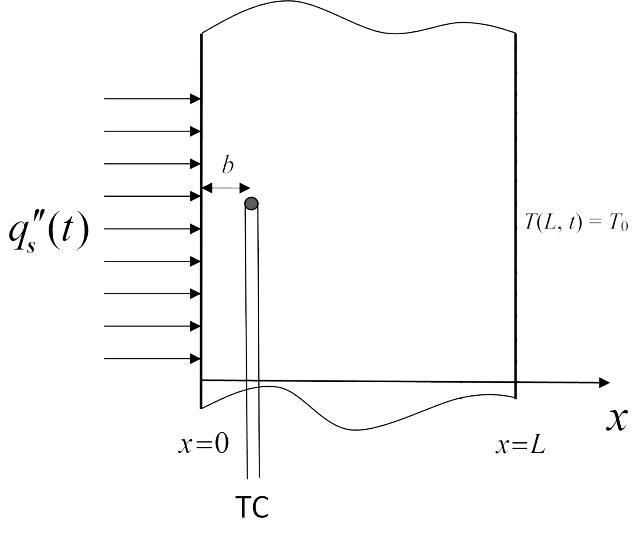
图1 有限区域一维线性热传导示意图
Fig.1 Schematic diagram of one-dimensional linear heat conduction in finite region

图2 实验仪器与材料
Fig.2 Experimental instruments and materials
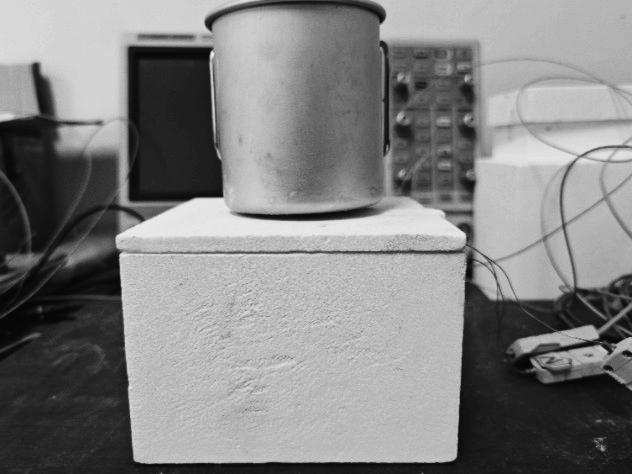
图3 实验平台整体布置图
Fig.3 The overall layout of the experimental platform
| 材料 | 密度ρ/(kg·m-3) | 比热容c/(J·kg-1·K-1) |
|---|---|---|
| Al2O3 | 3900 | 785 |
| SiO2 | 2650 | 700 |
| 空气 | 1.29 | 1005 |
表1 莫来石HM 1800组分的物性参数
Table 1 Physical parameters of mullite HM 1800 components
| 材料 | 密度ρ/(kg·m-3) | 比热容c/(J·kg-1·K-1) |
|---|---|---|
| Al2O3 | 3900 | 785 |
| SiO2 | 2650 | 700 |
| 空气 | 1.29 | 1005 |
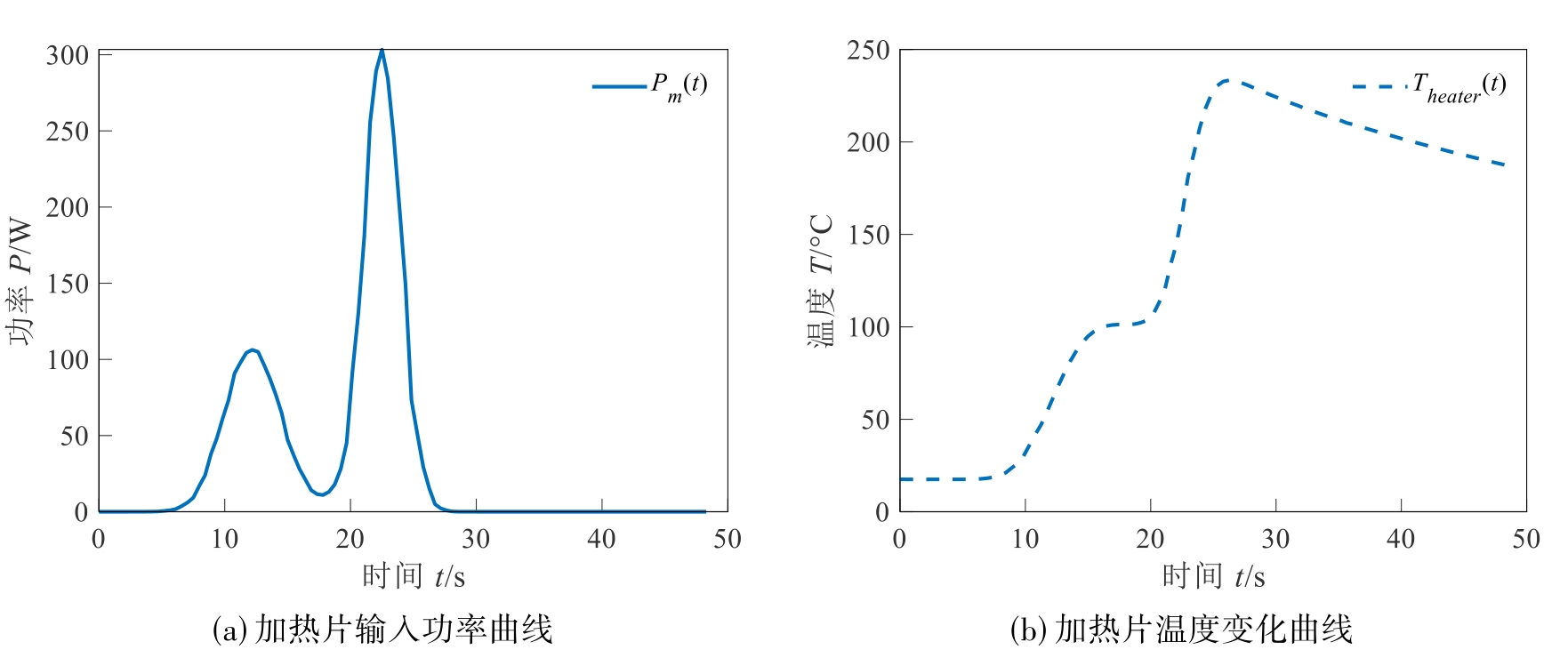
图4 加热片热容测定实验的数据
Fig.4 Data in thermal capacity measurement experiment of heater
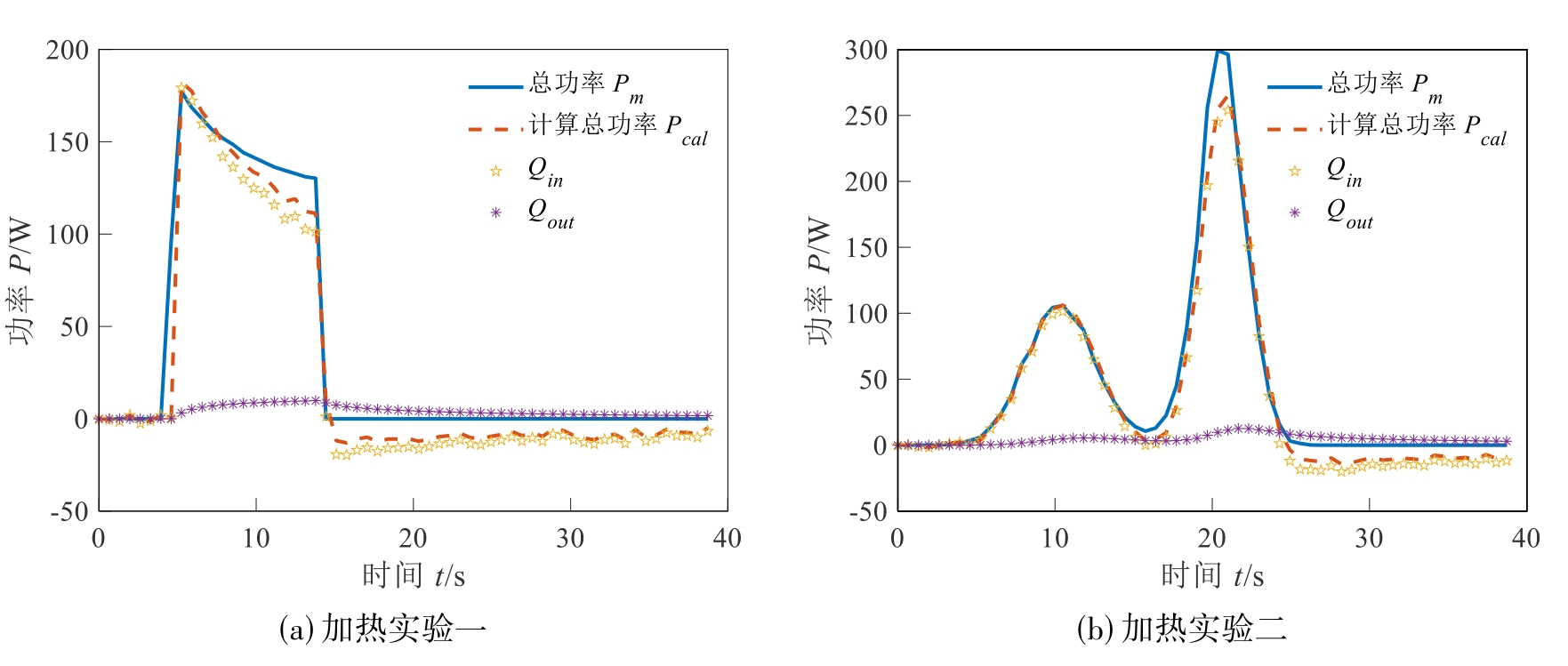
图5 热物性参数验证加热实验结果
Fig. 5 Results of Heating experiments for thermophysical parameters verification
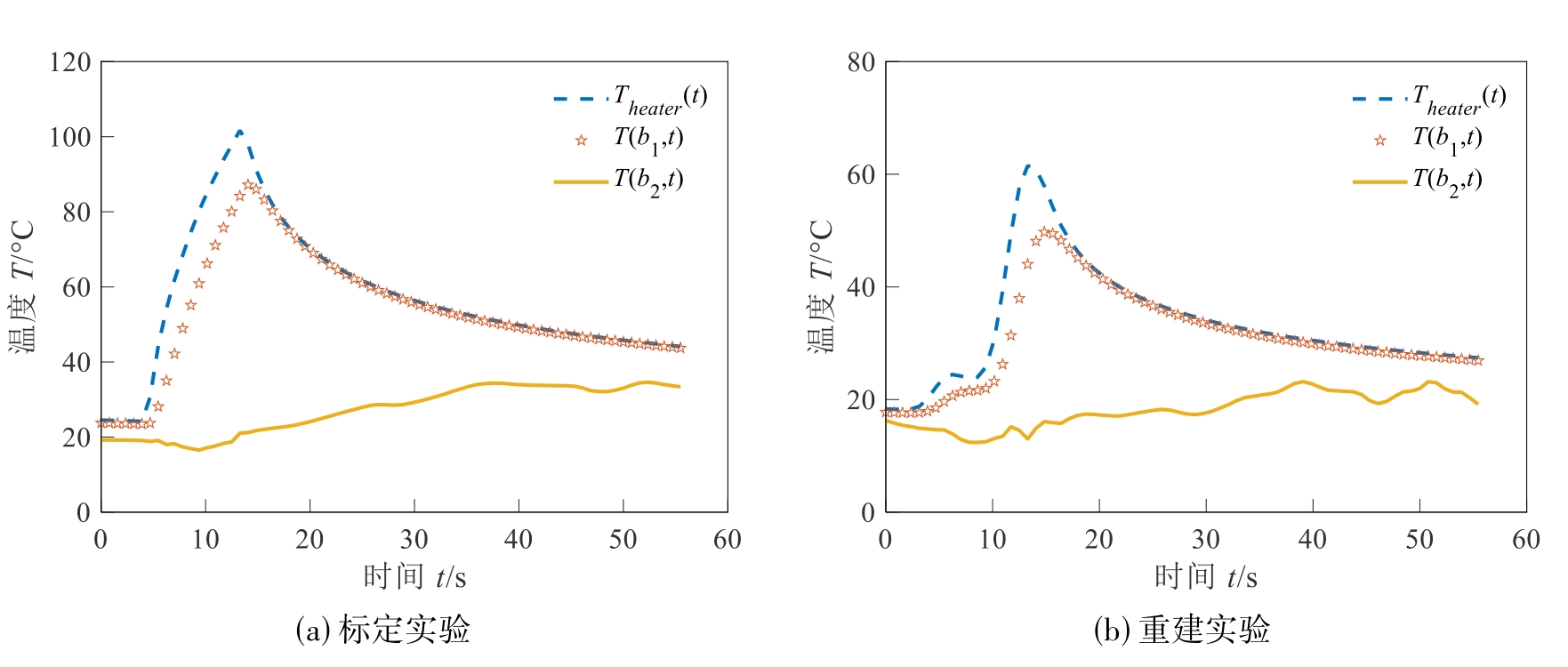
图6 各测量点温度变化曲线
Fig.6 Temperature change curves of different measurement points

图7 各部分功率变化曲线
Fig.7 Power change curves of four parts
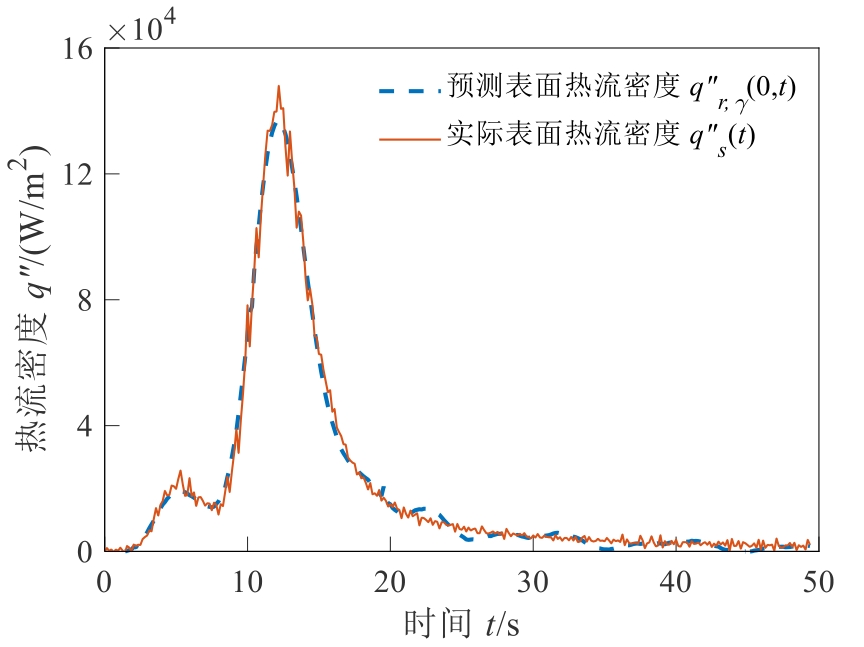
图8 表面热流预测结果对比图
Fig.8 Comparison chart of surface heat flux prediction result
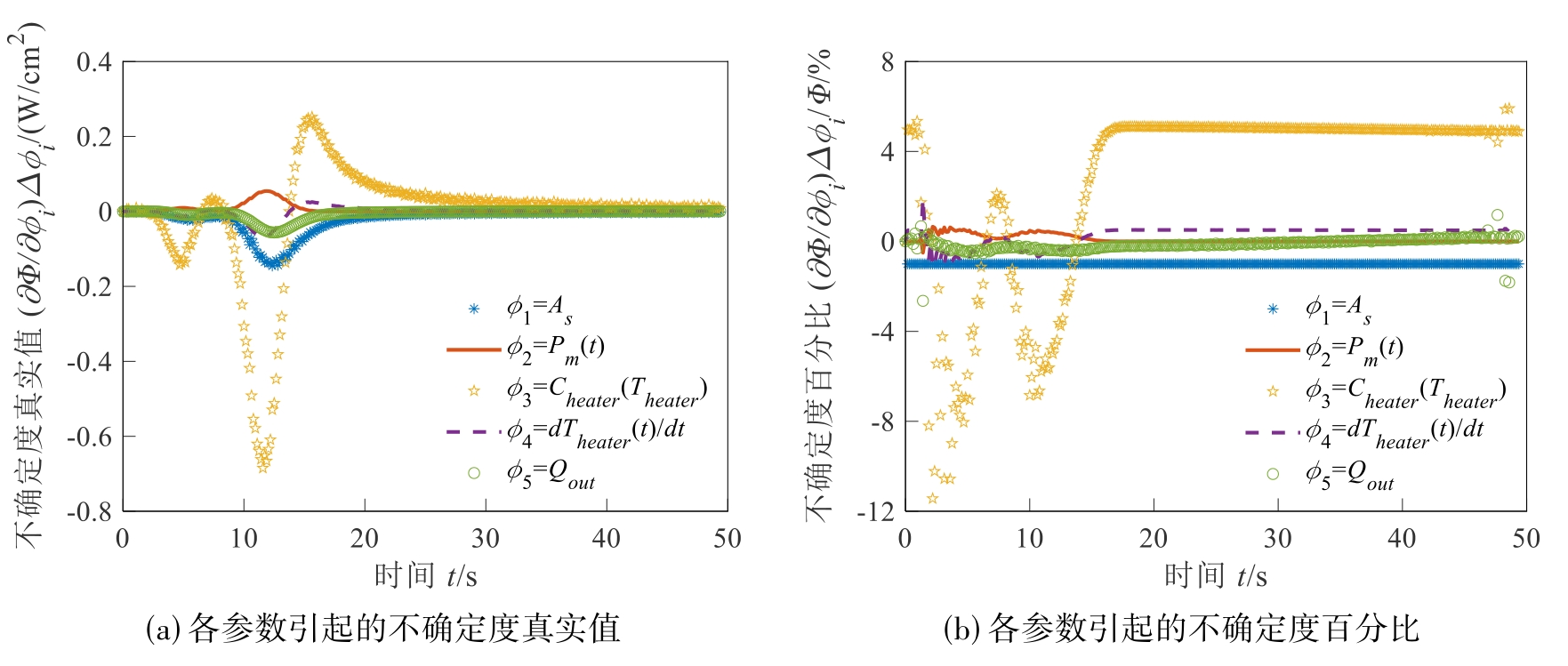
图9 各参数引起的不确定度
Fig.9 Uncertainties caused by different parameters
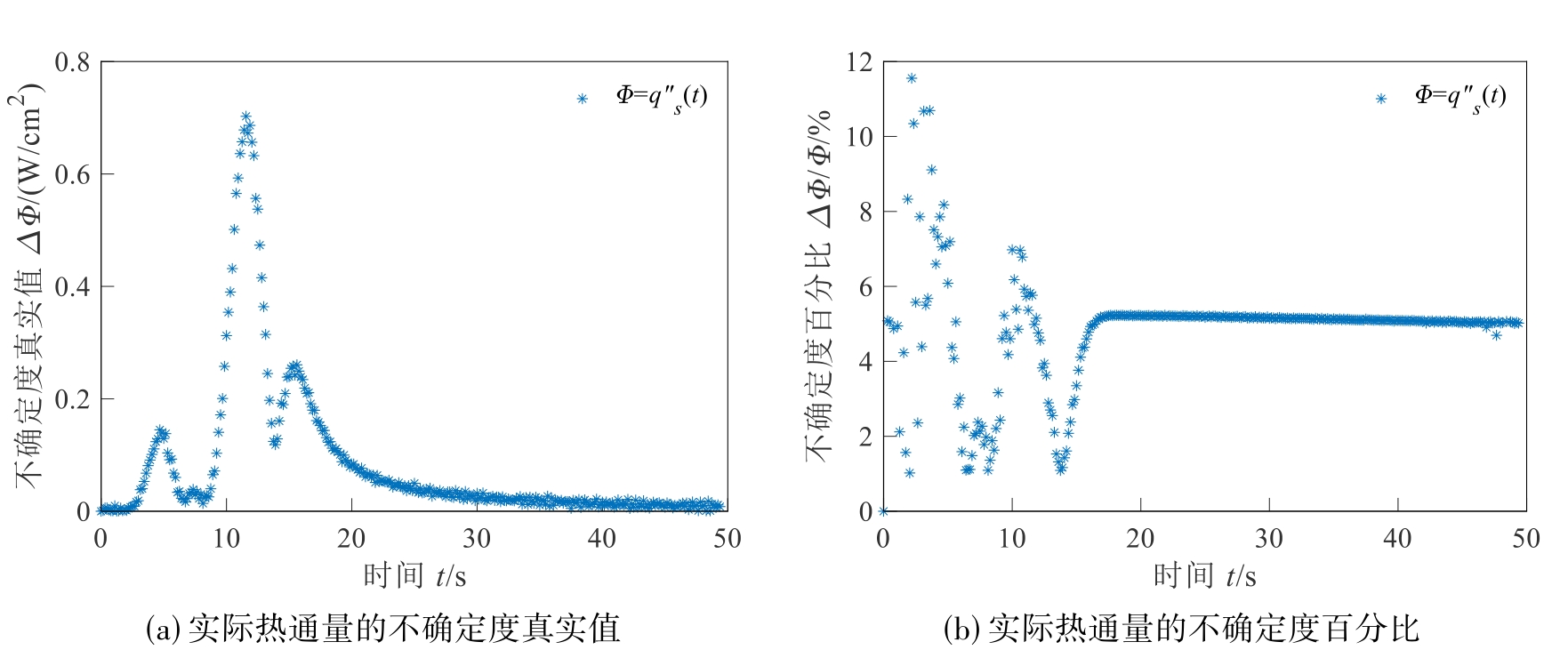
图10 实际表面热通量的不确定度
Fig.10 Uncertainty of the actual surface heat flux
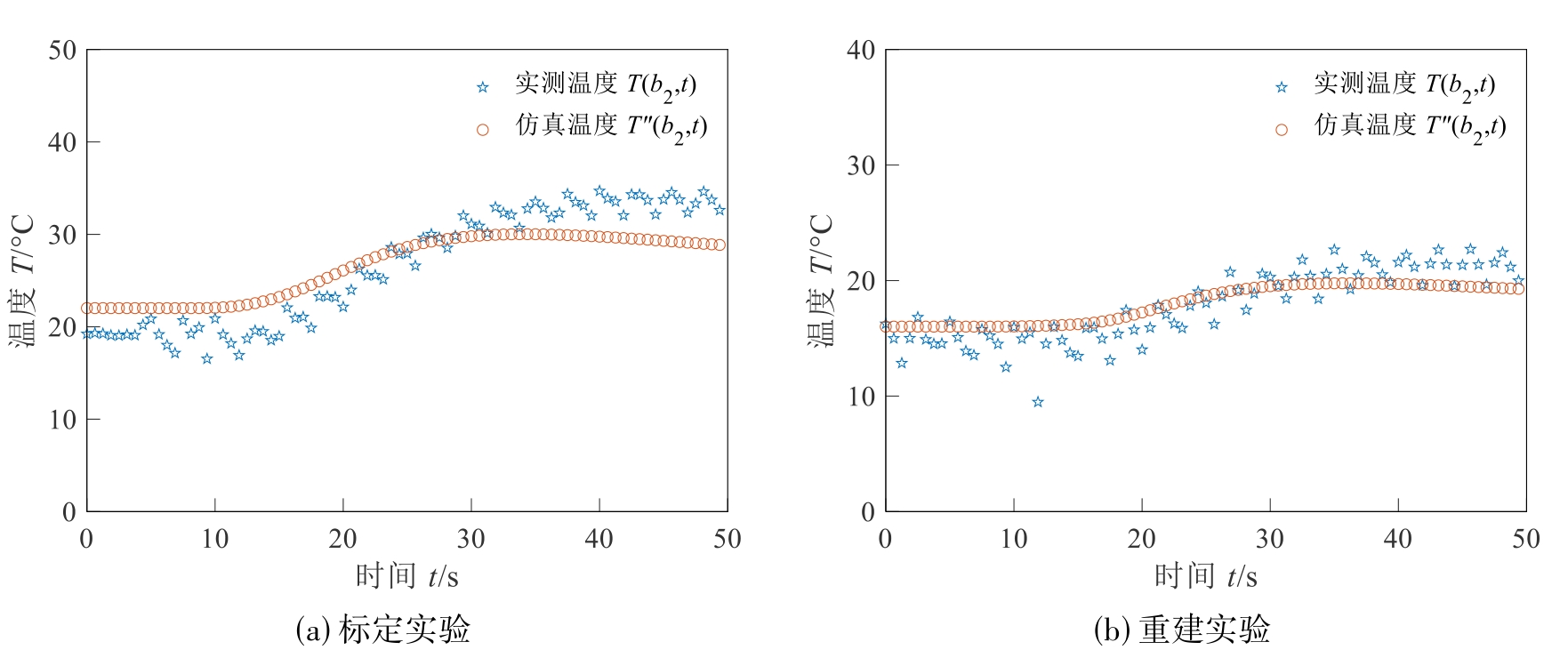
图11 背表面恒温仿真验证结果
Fig.11 Simulation validation results of constant temperature on back surface
| [1] | Siavashi M, Kowsary F, Abbasi-Shavazi E. Detection of flaws in a two-dimensional body through measurement of surface temperatures and use of conjugate gradient method[J]. Computational Mechanics, 2010, 46(4): 597-607. |
| [2] | Fazeli H, Mirzaei M. Shape identification problems on detecting of defects in a solid body using inverse heat conduction approach[J]. Journal of Mechanical Science and Technology, 2012, 26(11): 3681-3690. |
| [3] | 苟小龙, 张建涛, 王广军. 基于导热反问题的管道内部缺陷诊断[J]. 重庆大学学报, 2010, 33(2): 42-46. |
| Gou X L, Zhang J T, Wang G J. Defects detection in the inner surface of pipes based on inverse heat conduction problem[J]. Journal of Chongqing University, 2010, 33(2): 42-46. | |
| [4] | 张经豪, 熊平, 郝睿智, 等. 基于导热反问题圆管内壁腐蚀减薄及污垢增厚的识别[J]. 北京化工大学学报(自然科学版), 2022, 49(1): 98-105. |
| Zhang J H, Xiong P, Hao R Z, et al. Identification of corrosion thinning and fouling thickening on the inner wall of a circular tube based on the inverse heat conduction problem[J]. Journal of Beijing University of Chemical Technology (Natural Science Edition), 2022, 49(1): 98-105. | |
| [5] | 吕事桂, 杨立, 范春利. 基于有限元离散的不规则管道几何边界红外瞬态检测识别[J]. 化工学报, 2012, 63(12): 3805-3811. |
| Lü S G, Yang L, Fan C L. Identification of irregular pipeline geometry boundary using infrared transient inspection based on finite element discretization[J]. CIESC Journal, 2012, 63(12): 3805-3811. | |
| [6] | Yang Y C, Lee H L, Chang W J, et al. An inverse problem in estimating the laser irradiance and thermal damage in laser-irradiated biological tissue with a dual-phase-lag model[J]. Computer Methods in Biomechanics and Biomedical Engineering, 2017, 20(4): 446-456. |
| [7] | Xu C H, Leng S, Li D, et al. A symplectic approach for the fractional heat transfer and thermal damage in 2D biological tissues[J]. International Journal of Numerical Methods for Heat & Fluid Flow, 2023, 33(9): 3073-3093. |
| [8] | 黄鉴, 卢玫, 李博汉, 等. 基于红外检测乳腺肿瘤的多参数反演研究[J]. 生物医学工程研究, 2015, 34(2): 74-79. |
| Huang J, Lu M, Li B H, et al. Investigation of multivariable estimation in breast tumor diagnosis by infrared thermography[J]. Journal of Biomedical Engineering Research, 2015, 34(2): 74-79. | |
| [9] | 王琳琳, 卢玫, 黄鉴. 基于最小二乘法预测的导热反问题求解[J]. 化工学报, 2016, 67(S1): 103-110. |
| Wang L L, Lu M, Huang J. Inverse heat conduction problem based on least squares prediction[J]. CIESC Journal, 2016, 67(S1): 103-10. | |
| [10] | 龚靖棠, 屈惠明, 陈钱, 等. 体内异常热源信息的红外无损探测模拟[J]. 红外与激光工程, 2014, 43(8): 2477-2481. |
| Gong J T, Qu H M, Chen Q, et al. Infrared non-destructive detection of abnormal heat information inside body by simulation[J]. Infrared and Laser Engineering, 2014, 43(8): 2477-2481. | |
| [11] | Cheng C H, Chang M H. Predictions of shape and temperature for heating elements in an electronic package by inverse heat transfer method[C]//Proceedings of the 5th Electronics Packaging Technology Conference (EPTC 2003). December 12-12, 2003, Singapore. IEEE, 2003: 611-619. |
| [12] | Hsu P T, Chu Y H. An inverse non-Fourier heat conduction problem approach for estimating the boundary condition in electronic device[J]. Applied Mathematical Modelling, 2004, 28(7): 639-652. |
| [13] | 崔苗, 高效伟, 刘云飞. 基于瞬态热传导反问题反演材料随温度变化的导热系数[J]. 中国电机工程学报, 2012, 32(14): 82-87. |
| Cui M, Gao X W, Liu Y F. Inversion of temperature-dependent thermal conductivity based on transient inverse heat conduction problems[J]. Proceedings of the CSEE, 2012, 32(14): 82-87. | |
| [14] | Niu R P, Liu G R, Li M. Inverse analysis of heat transfer across a multilayer composite wall with Cauchy boundary conditions[J]. International Journal of Heat and Mass Transfer, 2014, 79: 727-735. |
| [15] | 文爽, 齐宏, 刘少斌, 等. 基于EKF和UKF算法非均匀介质热物性参数重建[J]. 化工学报, 2020, 71(4): 1432-1439. |
| Wen S, Qi H, Liu S B, et al. Reconstruction of thermophysical parameters in inhomogeneous media using extended Kalman filter and unscented Kalman filter[J]. CIESC Journal, 2020, 71(4): 1432-1439. | |
| [16] | Chen H C, Frankel J I, Keyhani M. Nonlinear inverse heat conduction: Digitally filtered space marching with phase-plane and cross-correlation analyses[J]. Numerical Heat Transfer, Part B: Fundamentals, 2017, 72(2): 109-129. |
| [17] | 宋馨, 张有为, 刘自军. 反演航天器在轨瞬态外热流的导热反问题[J]. 北京航空航天大学学报, 2015, 41(11): 2061-1066. |
| Song X, Zhang Y W, Liu Z J. Inverse heat conduction problem for transient external heat flux inversion of spacecraft on orbit[J]. Journal of Beijing University of Aeronautics and Astronautics, 2015, 41(11): 2061-2066. | |
| [18] | 俞智超, 陈鸿初. 考虑传感器动态响应的气动热反演辨识方法研究[J]. 空天技术, 2024, (2): 119-127. |
| Yu Z C, Chen H C. Investigation of aerodynamic heat prediction method considering sensor dynamic response[J]. Aerospace Technology, 2024, (2): 119-127. | |
| [19] | Zhou J H, Zhang Y W, Chen J K, et al. Inverse heat conduction using measured back surface temperature and heat flux[J]. Journal of Thermophysics and Heat Transfer, 2010, 24(1): 95-103. |
| [20] | 韩雯雯. 基于共轭梯度法的瞬态多参量导热反问题研究及在核电中的应用[D]. 北京: 北京化工大学, 2017. |
| Han W W. Research about transient inverse heat conduction problem with multi-variables based on conjugate gradient methods and applications in nuclear power[D]. Beijing: Beijing University of Chemical Technology, 2017. | |
| [21] | 朱丽娜, 王广军, 陈红. 采用共轭梯度法求解多变量稳态传热反问题[J]. 中国电机工程学报, 2011, 31(8): 58-61. |
| Zhu L N, Wang G J, Chen H. Estimating steady multi-variables inverse heat conduction problem by using conjugate gradient method[J]. Proceedings of the CSEE, 2011, 31(8): 58-61. | |
| [22] | Liu F B. A hybrid method for the inverse heat transfer of estimating fluid thermal conductivity and heat capacity[J]. International Journal of Thermal Sciences, 2011, 50(5): 718-724. |
| [23] | Xie T, He Y L, Tong Z X, et al. An inverse analysis to estimate the endothermic reaction parameters and physical properties of aerogel insulating material[J]. Applied Thermal Engineering, 2015, 87: 214-224. |
| [24] | Zhang B W, Mei J, Zhang C Y, et al. A general method for predicting the bank thickness of a smelting furnace with phase change[J]. Applied Thermal Engineering, 2019, 162: 114219. |
| [25] | Beck J V. Filter solutions for the nonlinear inverse heat conduction problem[J]. Inverse Problems in Science and Engineering, 2008, 16(1): 3-20. |
| [26] | Beck J V, Blackwell B, Haji-Sheikh A. Comparison of some inverse heat conduction methods using experimental data[J]. International Journal of Heat and Mass Transfer, 1996, 39(17): 3649-3657. |
| [27] | Khan A I, Billah M M, Ying C H, et al. Bayesian method for parameter estimation in transient heat transfer problem[J]. International Journal of Heat and Mass Transfer, 2021, 166: 120746. |
| [28] | Khatoon S, Phirani J, Bahga S S. Fast Bayesian inference for inverse heat conduction problem using polynomial chaos and Karhunen–Loeve expansions[J]. Applied Thermal Engineering, 2023, 219: 119616. |
| [29] | Carasso A S. Slowly divergent space marching schemes in the inverse heat conduction problem[J]. Numerical Heat Transfer, Part B: Fundamentals, 1993, 23(1): 111-126. |
| [30] | Taler J. A new space marching method for solving inverse heat conduction problems[J]. Forschung Im Ingenieurwesen, 1999, 64(11): 296-306. |
| [31] | Cheng R Q, Chen H C, Yu Z T. A novel nonlinear calibration method for surface heat flux prediction with unknown thermal conductivity[J]. ASME Journal of Heat and Mass Transfer, 2025, 147(8): 081401. |
| [32] | Cheng R Q, Munir T, Chen H C. Surface heat flux prediction using gradient and multilayer materials with position-dependent thermophysical properties and interfacial thermal resistance[J]. Thermal Science and Engineering Progress, 2025, 60: 103366. |
| [33] | Elkins B S, Keyhani M, Frankel J I. Surface heat flux prediction through physics-based calibration, part 2: experimental validation[J]. Journal of Thermophysics and Heat Transfer, 2013, 27(2): 206-216. |
| [34] | Frankel J I, Keyhani M, Elkins B E. Surface heat flux prediction through physics-based calibration, part 1: theory[J]. Journal of Thermophysics and Heat Transfer, 2013, 27(2): 189-205. |
| [35] | Frankel J I, Keyhani M. Calibration integral equation method for two-probe inverse heat conduction analysis[J]. Journal of Thermophysics and Heat Transfer, 2014, 28(3): 548-553. |
| [36] | Chen H C, Frankel J I, Keyhani M. Two-probe calibration integral equation method for nonlinear inverse heat conduction problem of surface heat flux estimation[J]. International Journal of Heat and Mass Transfer, 2018, 121: 246-264. |
| [37] | Frankel J I, Keyhani M. Theoretical development of a new surface heat flux calibration method for thin-film resistive temperature gauges and co-axial thermocouples[J]. Shock Waves, 2013, 23(2): 177-188. |
| [38] | Chen Y Y, Frankel J I, Keyhani M. A new nonlinear surface heat flux calibration method based on Kirchhoff transformation and rescaling principles[J]. Inverse Problems in Science and Engineering, 2014, 22(8): 1394-1421. |
| [39] | Chen Y Y, Frankel J I, Keyhani M. A new front surface heat flux calibration method for a 1-D nonlinear thermal system with a time-varying back boundary condition[J]. Journal of Engineering Mathematics, 2017, 105(1): 157-187. |
| [40] | Chen H C, Frankel J I, Keyhani M. Nonlinear inverse heat conduction problem of surface temperature estimation by calibration integral equation method[J]. Numerical Heat Transfer, Part B: Fundamentals, 2018, 73(5): 263-291. |
| [41] | Myrick J A, Keyhani M, Frankel J I. Determination of surface heat flux and temperature using in-depth temperature data–Experimental verification[J]. International Journal of Heat and Mass Transfer, 2017, 111: 982-998. |
| [42] | Pande A S. Investigation of the one-probe and two-probe calibration integral equation methods using experimental data[D]. Knoxville, TN, USA; University of Tennessee, 2013. |
| [43] | Özışık M N. Heat Conduction[M]. New York: Chichester: Wiley, 1980: 1-29. |
| [44] | Churchill R V. Operational Mathematics[M]. 3rd ed. New York: McGraw-Hill Companies, 1972: 1-78. |
| [45] | Linz P. Analytical and Numerical Methods for Volterra Equations[M]. Philadelphia: Society for Industrial and Applied Mathematics, 1985: 207-211. |
| [46] | Lamm P K. A Survey of Regularization Methods for First Kind Volterra Equations, Surveys on Solution Methods for Inverse Problems[M]. Vienna Austria: Springer Vienna, 2000: 53-82. |
| [47] | Moffat R J. Describing the uncertainties in experimental results[J]. Experimental Thermal and Fluid Science, 1988, 1(1): 3-17. |
| [1] | 沙鑫权, 胡然, 丁磊, 蒋珍华, 吴亦农. 空间用单机两级有阀线性压缩机研制及测试[J]. 化工学报, 2025, 76(S1): 114-122. |
| [2] | 孙浩然, 吴成云, 王艳蒙, 孙静楠, 胡仞与, 段钟弟. 热对流影响下液滴蒸发特性模型与实验研究[J]. 化工学报, 2025, 76(S1): 123-132. |
| [3] | 燕子腾, 詹飞龙, 丁国良. 空调用套管式分流器结构设计及分流效果验证[J]. 化工学报, 2025, 76(S1): 152-159. |
| [4] | 密晓光, 孙国刚, 程昊, 张晓慧. 印刷电路板式天然气冷却器性能仿真模型和验证[J]. 化工学报, 2025, 76(S1): 426-434. |
| [5] | 任现超, 谷雅秀, 段少斌, 贾文竹, 李汉林. 翅片式椭圆套管蒸发式冷凝器传热传质性能实验研究[J]. 化工学报, 2025, 76(S1): 75-83. |
| [6] | 袁琳慧, 王瑜. 单服务器浸没射流式液冷系统散热性能[J]. 化工学报, 2025, 76(S1): 160-169. |
| [7] | 赵子祥, 段钟弟, 孙浩然, 薛鸿祥. 大温差两相流动诱导水锤冲击的数值模型[J]. 化工学报, 2025, 76(S1): 170-180. |
| [8] | 黄博, 黄灏, 王文, 贺隆坤. 薄膜型LNG船液货舱温度场计算分析[J]. 化工学报, 2025, 76(S1): 195-204. |
| [9] | 汪思远, 刘国强, 熊通, 晏刚. 窗式空调器轴流风机的风速非均匀分布特性及其对冷凝器流路优化设计的影响规律[J]. 化工学报, 2025, 76(S1): 205-216. |
| [10] | 孔俊龙, 毕扬, 赵耀, 代彦军. 储能电池直冷热管理系统的模拟实验[J]. 化工学报, 2025, 76(S1): 289-296. |
| [11] | 吴迪, 胡斌, 姜佳彤. R1233zd(E)高温热泵实验研究与应用分析[J]. 化工学报, 2025, 76(S1): 377-383. |
| [12] | 黄国瑞, 赵耀, 谢明熹, 陈尔健, 代彦军. 一种新型数据中心余热回收系统实验与分析[J]. 化工学报, 2025, 76(S1): 409-417. |
| [13] | 罗海梅, 王泓, 孙照明, 尹艳华. 同向双螺杆传热系数计算模型的分析与验证[J]. 化工学报, 2025, 76(9): 4809-4823. |
| [14] | 胡金琦, 闵春华, 李小龙, 范元鸿, 王坤. 振动叶片耦合柔性板强化流体混沌混合与传热研究[J]. 化工学报, 2025, 76(9): 4824-4837. |
| [15] | 吴林凯, 林志敏, 王良璧. 基于热质传递效应的准稳态结霜模型改进及数值验证[J]. 化工学报, 2025, 76(8): 4004-4016. |
| 阅读次数 | ||||||
|
全文 |
|
|||||
|
摘要 |
|
|||||
 京公网安备 11010102001995号