• •
孙思涵1,2( ), 张计梅1, 石艳春1,2(), 李加旺3, 敖艳波3, 李兴贵3, 张连永3, 马海悦3, 张琪4, 石昕4, 王磊1
收稿日期:2025-06-19
修回日期:2025-09-10
出版日期:2025-12-30
通讯作者:
石艳春
作者简介:孙思涵(1996—),男,博士,助理研究员,sunsihan1996@qq.com
基金资助:
Sihan SUN1,2(), Jimei ZHANG1, Yanchun SHI1,2(), Jiawang LI3, Yanbo AO3, Xinggui LI3, Lianyong ZHANG3, Haiyue MA3, qi ZHANG4, Xin SHI4, Lei WANG1
Received:2025-06-19
Revised:2025-09-10
Online:2025-12-30
Contact:
Yanchun SHI
摘要:
有机硅高沸物(HBRs),作为甲基氯硅烷单体生产中的主要副产物,其复杂化学组成的解析是制约资源化利用的关键瓶颈。本研究提出一种针对有机硅高沸物复杂组分化学结构解析方法。以某企业的高沸物样品为案例,通过分子离子峰识别、同位素峰簇分析及特征碎片离子解析,详细解析了其中42种组分(含37种新识别化合物),涵盖Si-Si、Si-Si-Si、Si-Cn、Si-CH2-Si和Si-O-Si等5类骨架结构。研究发现,Si-CH2-Si和Si-O-Si骨架稳定性高于Si-Si,氯原子数目可通过同位素峰比例精准推断;此外,揭示了甲基和氯的迁移机制源于氯原子的电负性诱导效应。本研究建立的解析方法为高沸物形成机理研究、合成工艺优化及催化转化技术开发提供了分子级数据支撑,助力有机硅产业绿色可持续发展。
中图分类号:
孙思涵, 张计梅, 石艳春, 李加旺, 敖艳波, 李兴贵, 张连永, 马海悦, 张琪, 石昕, 王磊. 有机硅高沸物复杂组分化学结构解析[J]. 化工学报, DOI: 10.11949/0438-1157.20250661.
Sihan SUN, Jimei ZHANG, Yanchun SHI, Jiawang LI, Yanbo AO, Xinggui LI, Lianyong ZHANG, Haiyue MA, qi ZHANG, Xin SHI, Lei WANG. Chemical structure analysis of complex components in organosilicone high-boiling residues[J]. CIESC Journal, DOI: 10.11949/0438-1157.20250661.
| 序号 | 保留时间 (min) | 峰面积 | 化学式 | 匹配情况 |
|---|---|---|---|---|
| 1 | 1.89 | 6.92 | CH2Cl2 [溶剂峰] | 86 |
| 2 | 8.26 | 1.31 | Si(CH3)3-SiCl(CH3)2 | 93 |
| 3 | 11.34 | 0.32 | SiCl(CH3)2-O-SiCl2H | 解析 |
| 4 | 11.52 | 0.85 | Si(CH3)3-Si(CH3)Cl2 | 解析 |
| 5 | 12.31 | 3.6 | SiCl(CH3)2-SiCl(CH3)2 | 91 |
| 6 | 12.92 | 0.58 | SiCl2(CH3)-CH2CH2CH2CH3 | 解析 |
| 7 | 15.35 | 12.62 | SiCl(CH3)2-SiCl2(CH3) | 解析 |
| 8 | 16.72 | 20.38 | SiCl2(CH3)-SiCl2(CH3) | 94 |
| 9 | 19.53 | 4.79 | Si(CH3)3-CH2-SiCl2(CH3) | 解析 |
| 10 | 20.16 | 1.36 | Si(CH3)3-CH2-SiCl3 | 解析 |
| 11 | 23.76 | 2.1 | SiCl(CH3)2-CH2-SiCl(CH3)2 | 93 |
| 12 | 28.30 | 4.66 | SiCl(CH3)H-CH2-SiCl3 | 解析 |
| 13 | 28.54 | 0.54 | SiCl2(CH3)-SiCl2(CH2CH3) | 解析 |
| 14 | 32.21 | 8.66 | SiCl2(CH3)-CH2-SiCl2H | 解析 |
| 15 | 33.84 | 0.57 | Si(CH3)3-Si(CH3)2-SiCl(CH3)H | 解析 |
| 16 | 37.83 | 0.48 | SiCl2(CH3)-SiCl2(CH2CH2CH3) | 解析 |
| 17 | 40.27 | 0.49 | Si(CH3)3-SiCl(CH3)-SiCl(CH3)2 | 解析 |
| 18 | 40.55 | 0.33 | SiCl(CH3)2-O-SiCl(CH3)-SiCl(CH3)H | 解析 |
| 19 | 41.21 | 0.77 | Si(CH3)3-SiCl(CH2CH3)-SiCl(CH3)H | 解析 |
| 20 | 43.71 | 1.85 | SiCl(CH3)2-O-SiCl(CH3)-SiCl2H | 解析 |
| 21 | 44.13 | 1.66 | SiCl(CH3)2-Si(CH3)2-SiCl2(CH3) | 解析 |
| 22 | 45.95 | 1.06 | SiCl2(CH3)-SiCl(CH3)-Si(CH3)3 | 解析 |
| 23 | 46.68 | 1.19 | SiCl2(CH3)-O-SiCl(CH3)-SiCl2H | 解析 |
| 24 | 48.96 | 0.74 | Si(CH3)3-SiCl(CH3)-SiCl2H | 解析 |
| 25 | 50.02 | 0.63 | Si(CH3)3-Si(CH3)2-SiCl3 | 解析 |
| 26 | 52.82 | 1.03 | Si(CH3)3-SiCl2-SiCl2H | 解析 |
| 27 | 53.55 | 2.41 | Si(CH3)3-SiCl2-SiCl2(CH3) | 解析 |
| 28 | 54.67 | 0.83 | SiCl2(CH3)-Si(CH3)H-SiCl2(CH3) | 解析 |
| 29 | 55.34 | 0.34 | Si(CH3)3-Si(CH3)Cl-SiCl2(CH3) | 解析 |
| 30 | 56.24 | 5.3 | SiCl3-Si(CH3)Cl-SiCl(CH3)2 | 解析 |
| 31 | 57.12 | 0.64 | Si(CH3)3-CH2-SiCl(CH3)-SiCl(CH3)H | 解析 |
| 32 | 58.47 | 1.61 | SiCl(CH3)2-CH2-SiCl(CH3)-SiCl2H | 解析 |
| 33 | 63.65 | 0.51 | SiCl(CH3)2-CH2-SiCl(CH3)-SiCl3 | 解析 |
| 34 | 67.31 | 0.71 | Si(CH3)3-CH2-SiCl(CH3)-CH2-SiCl(CH3)H | 解析 |
| 35 | 68.97 | 0.32 | SiCl(CH3)2-CH2-SiCl2-SiCl2H | 解析 |
| 36 | 71.52 | 0.48 | SiCl(CH3)2-CH2-SiCl2-SiCl(CH3)2 | 解析 |
| 37 | 72.33 | 0.54 | Si(CH3)3-CH2-SiCl(CH3)-CH2-SiCl2H | 解析 |
| 38 | 73.19 | 0.31 | Si(CH3)3-CH2-SiCl(CH3)-CH2-SiCl3 | 解析 |
| 39 | 77.50 | 0.38 | Si(CH3)3-O-SiCl(CH3)-SiCl2-Si(CH3)2H | 解析 |
| 40 | 80.38 | 1.85 | Si(CH3)3-O-SiCl2-SiCl(CH3)-SiCl(CH3)H | 解析 |
| 41 | 83.11 | 3.27 | SiCl(CH3)2-O-SiCl(CH3)-SiCl2-SiCl(CH3)H | 解析 |
| 42 | 94.46 | 0.63 | Si(CH3)3-SiCl(CH3)-CH2-SiCl2-SiCl2(CH3) | 解析 |
| 43 | 98.33 | 0.39 | Si(CH3)3-SiCl2-CH2-SiCl2-SiCl(CH3)2 | 解析 |
表1 HBRs样品质谱解析的可能结果分析
Table 1 MS analysis (manual analysis and matching) of samples in HBRs
| 序号 | 保留时间 (min) | 峰面积 | 化学式 | 匹配情况 |
|---|---|---|---|---|
| 1 | 1.89 | 6.92 | CH2Cl2 [溶剂峰] | 86 |
| 2 | 8.26 | 1.31 | Si(CH3)3-SiCl(CH3)2 | 93 |
| 3 | 11.34 | 0.32 | SiCl(CH3)2-O-SiCl2H | 解析 |
| 4 | 11.52 | 0.85 | Si(CH3)3-Si(CH3)Cl2 | 解析 |
| 5 | 12.31 | 3.6 | SiCl(CH3)2-SiCl(CH3)2 | 91 |
| 6 | 12.92 | 0.58 | SiCl2(CH3)-CH2CH2CH2CH3 | 解析 |
| 7 | 15.35 | 12.62 | SiCl(CH3)2-SiCl2(CH3) | 解析 |
| 8 | 16.72 | 20.38 | SiCl2(CH3)-SiCl2(CH3) | 94 |
| 9 | 19.53 | 4.79 | Si(CH3)3-CH2-SiCl2(CH3) | 解析 |
| 10 | 20.16 | 1.36 | Si(CH3)3-CH2-SiCl3 | 解析 |
| 11 | 23.76 | 2.1 | SiCl(CH3)2-CH2-SiCl(CH3)2 | 93 |
| 12 | 28.30 | 4.66 | SiCl(CH3)H-CH2-SiCl3 | 解析 |
| 13 | 28.54 | 0.54 | SiCl2(CH3)-SiCl2(CH2CH3) | 解析 |
| 14 | 32.21 | 8.66 | SiCl2(CH3)-CH2-SiCl2H | 解析 |
| 15 | 33.84 | 0.57 | Si(CH3)3-Si(CH3)2-SiCl(CH3)H | 解析 |
| 16 | 37.83 | 0.48 | SiCl2(CH3)-SiCl2(CH2CH2CH3) | 解析 |
| 17 | 40.27 | 0.49 | Si(CH3)3-SiCl(CH3)-SiCl(CH3)2 | 解析 |
| 18 | 40.55 | 0.33 | SiCl(CH3)2-O-SiCl(CH3)-SiCl(CH3)H | 解析 |
| 19 | 41.21 | 0.77 | Si(CH3)3-SiCl(CH2CH3)-SiCl(CH3)H | 解析 |
| 20 | 43.71 | 1.85 | SiCl(CH3)2-O-SiCl(CH3)-SiCl2H | 解析 |
| 21 | 44.13 | 1.66 | SiCl(CH3)2-Si(CH3)2-SiCl2(CH3) | 解析 |
| 22 | 45.95 | 1.06 | SiCl2(CH3)-SiCl(CH3)-Si(CH3)3 | 解析 |
| 23 | 46.68 | 1.19 | SiCl2(CH3)-O-SiCl(CH3)-SiCl2H | 解析 |
| 24 | 48.96 | 0.74 | Si(CH3)3-SiCl(CH3)-SiCl2H | 解析 |
| 25 | 50.02 | 0.63 | Si(CH3)3-Si(CH3)2-SiCl3 | 解析 |
| 26 | 52.82 | 1.03 | Si(CH3)3-SiCl2-SiCl2H | 解析 |
| 27 | 53.55 | 2.41 | Si(CH3)3-SiCl2-SiCl2(CH3) | 解析 |
| 28 | 54.67 | 0.83 | SiCl2(CH3)-Si(CH3)H-SiCl2(CH3) | 解析 |
| 29 | 55.34 | 0.34 | Si(CH3)3-Si(CH3)Cl-SiCl2(CH3) | 解析 |
| 30 | 56.24 | 5.3 | SiCl3-Si(CH3)Cl-SiCl(CH3)2 | 解析 |
| 31 | 57.12 | 0.64 | Si(CH3)3-CH2-SiCl(CH3)-SiCl(CH3)H | 解析 |
| 32 | 58.47 | 1.61 | SiCl(CH3)2-CH2-SiCl(CH3)-SiCl2H | 解析 |
| 33 | 63.65 | 0.51 | SiCl(CH3)2-CH2-SiCl(CH3)-SiCl3 | 解析 |
| 34 | 67.31 | 0.71 | Si(CH3)3-CH2-SiCl(CH3)-CH2-SiCl(CH3)H | 解析 |
| 35 | 68.97 | 0.32 | SiCl(CH3)2-CH2-SiCl2-SiCl2H | 解析 |
| 36 | 71.52 | 0.48 | SiCl(CH3)2-CH2-SiCl2-SiCl(CH3)2 | 解析 |
| 37 | 72.33 | 0.54 | Si(CH3)3-CH2-SiCl(CH3)-CH2-SiCl2H | 解析 |
| 38 | 73.19 | 0.31 | Si(CH3)3-CH2-SiCl(CH3)-CH2-SiCl3 | 解析 |
| 39 | 77.50 | 0.38 | Si(CH3)3-O-SiCl(CH3)-SiCl2-Si(CH3)2H | 解析 |
| 40 | 80.38 | 1.85 | Si(CH3)3-O-SiCl2-SiCl(CH3)-SiCl(CH3)H | 解析 |
| 41 | 83.11 | 3.27 | SiCl(CH3)2-O-SiCl(CH3)-SiCl2-SiCl(CH3)H | 解析 |
| 42 | 94.46 | 0.63 | Si(CH3)3-SiCl(CH3)-CH2-SiCl2-SiCl2(CH3) | 解析 |
| 43 | 98.33 | 0.39 | Si(CH3)3-SiCl2-CH2-SiCl2-SiCl(CH3)2 | 解析 |
| 骨架结构序号 | 类别 | 骨架结构 | 峰序号 |
|---|---|---|---|
| 1 | Si-Si | Si-Si | 2、4、5、7、8 |
| 2 | Si-Si-Si | Si-Si-Si | 15、17、19、21、22、24、25、26、27、28、29、30、 |
| 3 | Si-CH2-Si | Si-CH2-Si | 9、10、11、12、14 |
| 4 | Si-CH2-Si-Si | 31、32、33、35、36 | |
| 5 | Si-CH2-Si-CH2-Si | 34、37、38 | |
| 6 | Si-Si-CH2-Si-Si | 42、43 | |
| 7 | Si-Cn | Si-CH2-CH2-CH2-CH3 | 6 |
| 8 | Si-Si-CH2-CH3 | 13 | |
| 9 | Si-Si-CH2-CH2-CH3 | 16 | |
| 10 | Si-O-Si | Si-O-Si | 3 |
| 11 | Si-O-Si-Si | 18、20、23 | |
| 12 | Si-O-Si-Si-Si | 39、40、41 |
表2 HBRs样品骨架结构类型
Table 2 Type of framework structure of HBRs
| 骨架结构序号 | 类别 | 骨架结构 | 峰序号 |
|---|---|---|---|
| 1 | Si-Si | Si-Si | 2、4、5、7、8 |
| 2 | Si-Si-Si | Si-Si-Si | 15、17、19、21、22、24、25、26、27、28、29、30、 |
| 3 | Si-CH2-Si | Si-CH2-Si | 9、10、11、12、14 |
| 4 | Si-CH2-Si-Si | 31、32、33、35、36 | |
| 5 | Si-CH2-Si-CH2-Si | 34、37、38 | |
| 6 | Si-Si-CH2-Si-Si | 42、43 | |
| 7 | Si-Cn | Si-CH2-CH2-CH2-CH3 | 6 |
| 8 | Si-Si-CH2-CH3 | 13 | |
| 9 | Si-Si-CH2-CH2-CH3 | 16 | |
| 10 | Si-O-Si | Si-O-Si | 3 |
| 11 | Si-O-Si-Si | 18、20、23 | |
| 12 | Si-O-Si-Si-Si | 39、40、41 |
质量峰 (m/z) | 相对丰度 (%) | 可能碎片及断裂路径 | 式量计算 |
|---|---|---|---|
| 186 | 1.63 | [Si(CH3)3-SiCl2(CH3)]+(分子离子峰) | 2 × 28.09 + 4 × 15.04 + 2 × 35.45 = 187.24 |
| 171 | 1.59 | [M-(CH3)]+(分子离子失去1个甲基) | 2 × 28.09 + 3 × 15.04 + 2 × 35.45 = 172.2 |
| 151 | 1.12 | [M-Cl]+(分子离子失去1个Cl) | 2 × 28.09 + 4 × 15.04 + 1 × 35.45 = 151.79 |
| 135 | 0.65 | [M-Cl-(CH3)]+(分子离子失去1个Cl和1个甲基) | 2 × 28.09 + 3 × 15.04 + 1 × 35.45 = 136.75 |
| 105 | 0.78 | [SiCl(CH3)3]+(Si-Si键断裂,1个Cl重排) | 1 × 28.09 + 3 × 15.04 + 1 × 35.45 = 108.66 |
| 93 | 5.87 | [SiCl(CH3)2]+(Si-Si键断裂,失去1个Cl,同时1个甲基重排) | 1 × 28.09 + 2 × 15.04 + 1 × 35.45 = 93.62 |
| 73 | 100.00 | [Si(CH3)3]+(Si-Si键断裂,基峰) | 1 × 28.09 + 3 × 15.04 + 0 × 35.45 = 73.21 |
| 63 | 2.70 | [SiCl]+(碎片次级裂解) | 28.09 + 15.04 + 35.45 = 63.54 |
| 45 | 7.63 | [Si(CH3)]+(碎片次级裂解) | 28.09 + 15.04= 43.13 |
表3 4#物质质谱分析中的可能碎片及断裂路径
Table 3 Possible fragments and breakage paths in MS analysis of substance 4#
质量峰 (m/z) | 相对丰度 (%) | 可能碎片及断裂路径 | 式量计算 |
|---|---|---|---|
| 186 | 1.63 | [Si(CH3)3-SiCl2(CH3)]+(分子离子峰) | 2 × 28.09 + 4 × 15.04 + 2 × 35.45 = 187.24 |
| 171 | 1.59 | [M-(CH3)]+(分子离子失去1个甲基) | 2 × 28.09 + 3 × 15.04 + 2 × 35.45 = 172.2 |
| 151 | 1.12 | [M-Cl]+(分子离子失去1个Cl) | 2 × 28.09 + 4 × 15.04 + 1 × 35.45 = 151.79 |
| 135 | 0.65 | [M-Cl-(CH3)]+(分子离子失去1个Cl和1个甲基) | 2 × 28.09 + 3 × 15.04 + 1 × 35.45 = 136.75 |
| 105 | 0.78 | [SiCl(CH3)3]+(Si-Si键断裂,1个Cl重排) | 1 × 28.09 + 3 × 15.04 + 1 × 35.45 = 108.66 |
| 93 | 5.87 | [SiCl(CH3)2]+(Si-Si键断裂,失去1个Cl,同时1个甲基重排) | 1 × 28.09 + 2 × 15.04 + 1 × 35.45 = 93.62 |
| 73 | 100.00 | [Si(CH3)3]+(Si-Si键断裂,基峰) | 1 × 28.09 + 3 × 15.04 + 0 × 35.45 = 73.21 |
| 63 | 2.70 | [SiCl]+(碎片次级裂解) | 28.09 + 15.04 + 35.45 = 63.54 |
| 45 | 7.63 | [Si(CH3)]+(碎片次级裂解) | 28.09 + 15.04= 43.13 |
质量峰 (m/z) | 相对丰度 (%) | 可能碎片及断裂路径 | 式量计算 |
|---|---|---|---|
| 244 | 0.98 | [Si(CH3)3-SiCl(CH3)-SiCl(CH3)2]+(分子离子峰) (Molecular ion peak) | 3 × 28.09 + 6 × 15.04 + 2 × 35.45 = 245.41 |
| 229 | 4.22 | [M-(CH3)]+(分子离子失去1个甲基) | 3 × 28.09 + 5 × 15.04 + 2 × 35.45 = 230.37 |
| 209 | 1.16 | [M-Cl]+(分子离子失去1个Cl) | 3 × 28.09 + 6 × 15.04 + 1 × 35.45 = 209.96 |
| 193 | 0.38 | [M-Cl-(CH3)]+(分子离子失去1个Cl和1个甲基) | 3 × 28.09 + 5 × 15.04 + 1 × 35.45 = 194.92 |
| 180 | 0.40 | [M-Cl-2(CH3)]+(分子离子失去1个Cl和2个甲基) | 3 × 28.09 + 4 × 15.04 + 1 × 35.45 = 179.88 |
| 165 | 1.24 | [M-Cl-3(CH3)]+(分子离子失去1个Cl和3个甲基) | 3 × 28.09 + 3 × 15.04 + 1 × 35.45 = 164.84 |
| 151 | 3.78 | [M-Cl-4(CH3)]+(分子离子失去1个Cl和4个甲基) | 3 × 28.09 + 2 × 15.04 + 1 × 35.45 =149.8 |
| 136 | 41.74 | [M-Cl-5(CH3)]+(分子离子失去1个Cl和5个甲基) | 3 × 28.09 + 1 × 15.04 + 1 × 35.45 =134.76 |
| 131 | 36.41 | [Si(CH3)3-Si(CH3)2]+(Si-Si键断裂,1个甲基重排) | 2 × 28.09 + 5 × 15.04 = 131.38 |
| 116 | 1.42 | [Si(CH3)3-Si(CH3)]+或[Si(CH3)2-Si(CH3)2]+(Si-Si键断裂) | 2 × 28.09 + 4 × 15.04 = 116.34 |
| 93 | 5.34 | [SiCl(CH3)2]+(碎片次级裂解) | 1 × 28.09 + 2 × 15.04 + 1 × 35.45 = 93.62 |
| 73 | 100.00 | [Si(CH3)3]+(Si-Si键断裂) | 28.09 + 3 × 15.04 = 73.21 |
| 59 | 3.55 | [Si(CH3)2]+(碎片次级裂解) | 28.09 + 2 × 15.04 = 58.17 |
| 45 | 9.95 | [Si(CH3)]+(碎片次级裂解) | 28.09 + 15.04 = 43.13 |
表4 17#物质质谱分析中的可能碎片及断裂路径
Table 4 Possible fragments and breakage paths in MS analysis of substance 17#
质量峰 (m/z) | 相对丰度 (%) | 可能碎片及断裂路径 | 式量计算 |
|---|---|---|---|
| 244 | 0.98 | [Si(CH3)3-SiCl(CH3)-SiCl(CH3)2]+(分子离子峰) (Molecular ion peak) | 3 × 28.09 + 6 × 15.04 + 2 × 35.45 = 245.41 |
| 229 | 4.22 | [M-(CH3)]+(分子离子失去1个甲基) | 3 × 28.09 + 5 × 15.04 + 2 × 35.45 = 230.37 |
| 209 | 1.16 | [M-Cl]+(分子离子失去1个Cl) | 3 × 28.09 + 6 × 15.04 + 1 × 35.45 = 209.96 |
| 193 | 0.38 | [M-Cl-(CH3)]+(分子离子失去1个Cl和1个甲基) | 3 × 28.09 + 5 × 15.04 + 1 × 35.45 = 194.92 |
| 180 | 0.40 | [M-Cl-2(CH3)]+(分子离子失去1个Cl和2个甲基) | 3 × 28.09 + 4 × 15.04 + 1 × 35.45 = 179.88 |
| 165 | 1.24 | [M-Cl-3(CH3)]+(分子离子失去1个Cl和3个甲基) | 3 × 28.09 + 3 × 15.04 + 1 × 35.45 = 164.84 |
| 151 | 3.78 | [M-Cl-4(CH3)]+(分子离子失去1个Cl和4个甲基) | 3 × 28.09 + 2 × 15.04 + 1 × 35.45 =149.8 |
| 136 | 41.74 | [M-Cl-5(CH3)]+(分子离子失去1个Cl和5个甲基) | 3 × 28.09 + 1 × 15.04 + 1 × 35.45 =134.76 |
| 131 | 36.41 | [Si(CH3)3-Si(CH3)2]+(Si-Si键断裂,1个甲基重排) | 2 × 28.09 + 5 × 15.04 = 131.38 |
| 116 | 1.42 | [Si(CH3)3-Si(CH3)]+或[Si(CH3)2-Si(CH3)2]+(Si-Si键断裂) | 2 × 28.09 + 4 × 15.04 = 116.34 |
| 93 | 5.34 | [SiCl(CH3)2]+(碎片次级裂解) | 1 × 28.09 + 2 × 15.04 + 1 × 35.45 = 93.62 |
| 73 | 100.00 | [Si(CH3)3]+(Si-Si键断裂) | 28.09 + 3 × 15.04 = 73.21 |
| 59 | 3.55 | [Si(CH3)2]+(碎片次级裂解) | 28.09 + 2 × 15.04 = 58.17 |
| 45 | 9.95 | [Si(CH3)]+(碎片次级裂解) | 28.09 + 15.04 = 43.13 |
质量峰 (m/z) | 相对丰度 (%) | 可能碎片及断裂路径 | 式量计算 |
|---|---|---|---|
| 170 | 3.82 | [SiCl2(CH3)-CH2CH2CH2CH3]⁺(分子离子峰) | 1 × 28.09 + 5 × 15.04 + 2 × 35.45 -3.03 = 171.16 |
| 155 | 2.09 | [M-(CH3)]+(分子离子失去1个甲基) | 1 × 28.09 + 4 × 15.04 + 2 × 35.45 -3.03 = 156.12 |
| 141 | 0.55 | [M-(CH2CH3)]+(分子离子失去1个乙基) | 1 × 28.09 + 3 × 15.04 + 2 × 35.45 -2.02 = 142.09 |
| 127 | 2.11 | [M-(CH2CH2CH3)]+(分子离子失去1个丙基) | 1 × 28.09 + 2 × 15.04 + 2 × 35.45 -1.01 = 128.06 |
| 113 | 42.01 | [SiCl2(CH3)]+(Si-C键断裂,分子离子失去1个正丁基) | 1 × 28.09 + 1 × 15.04 + 2 × 35.45 = 114.03 |
| 93 | 2.54 | [SiCl(CH3)(CH2)]+(Si-C键断裂,失去1个Cl和1个丙基) | 1 × 28.09 + 2 × 15.04 + 1 × 35.45 - 1.01= 92.61 |
| 79 | 3.56 | [SiCl(CH3)]+(碎片次级裂解) | 28.09 + 15.04 + 35.45 = 78.58 |
| 63 | 6.58 | [SiCl]+(碎片次级裂解) | 28.09 + 35.45 = 63.54 |
| 56 | 100.00 | [CH2CH2CH2CH3]+(Si-C键断裂,正丁基,基峰) | 4×12.01 + 9×1.01 = 57.13 |
| 41 | 18.97 | [C3H5]⁺(丁基链次级断裂) | 3×12.01 + 5×1.008 = 41.07 |
表5 6#物质质谱分析中的可能碎片及断裂路径
Table 5 Possible fragments and breakage paths in MS analysis of substance 6#
质量峰 (m/z) | 相对丰度 (%) | 可能碎片及断裂路径 | 式量计算 |
|---|---|---|---|
| 170 | 3.82 | [SiCl2(CH3)-CH2CH2CH2CH3]⁺(分子离子峰) | 1 × 28.09 + 5 × 15.04 + 2 × 35.45 -3.03 = 171.16 |
| 155 | 2.09 | [M-(CH3)]+(分子离子失去1个甲基) | 1 × 28.09 + 4 × 15.04 + 2 × 35.45 -3.03 = 156.12 |
| 141 | 0.55 | [M-(CH2CH3)]+(分子离子失去1个乙基) | 1 × 28.09 + 3 × 15.04 + 2 × 35.45 -2.02 = 142.09 |
| 127 | 2.11 | [M-(CH2CH2CH3)]+(分子离子失去1个丙基) | 1 × 28.09 + 2 × 15.04 + 2 × 35.45 -1.01 = 128.06 |
| 113 | 42.01 | [SiCl2(CH3)]+(Si-C键断裂,分子离子失去1个正丁基) | 1 × 28.09 + 1 × 15.04 + 2 × 35.45 = 114.03 |
| 93 | 2.54 | [SiCl(CH3)(CH2)]+(Si-C键断裂,失去1个Cl和1个丙基) | 1 × 28.09 + 2 × 15.04 + 1 × 35.45 - 1.01= 92.61 |
| 79 | 3.56 | [SiCl(CH3)]+(碎片次级裂解) | 28.09 + 15.04 + 35.45 = 78.58 |
| 63 | 6.58 | [SiCl]+(碎片次级裂解) | 28.09 + 35.45 = 63.54 |
| 56 | 100.00 | [CH2CH2CH2CH3]+(Si-C键断裂,正丁基,基峰) | 4×12.01 + 9×1.01 = 57.13 |
| 41 | 18.97 | [C3H5]⁺(丁基链次级断裂) | 3×12.01 + 5×1.008 = 41.07 |
质量峰 (m/z) | 相对丰度 (%) | 可能碎片及断裂路径 | 式量计算 |
|---|---|---|---|
| 207 | 100.00 | [Si(CH3)2-CH2-SiCl3]+(分子离子峰失去1个甲基) | 2 × 28.09 + 3 × 15.04 + 3 × 35.45 = 207.65 |
| 189 | 2.59 | [M-Cl]+(分子离子失去1个Cl) | 2 × 28.09 + 4 × 15.04 + 2 × 35.45 = 187.24 |
| 169 | 18.32 | [SiCl4]+(Si-C键断裂,同时1个Cl重排) | 1 × 28.09 + 0 × 15.04 + 4 × 35.45 = 169.89 |
| 153 | 0.95 | [M-2Cl]+(分子离子失去2个Cl) | 2 × 28.09 + 4 × 15.04 + 1 × 35.45 = 151.79 |
| 139 | 1.17 | [M-2Cl-(CH3)]+(分子离子失去2个Cl和1个甲基) | 2 × 28.09 + 3 × 15.04 + 1 × 35.45 = 136.75 |
| 113 | 2.36 | [SiCl2(CH3)]+(Si-C键断裂,同时1个甲基重排) | 1 × 28.09 + 1 × 15.04 + 2 × 35.45 = 114.03 |
| 93 | 13.38 | [SiCl(CH3)2)]+(Si-C键断裂,1个Cl重排) | 1 × 28.09 + 2 × 15.04 + 1 × 35.45 = 93.62 |
| 73 | 54.50 | [Si(CH3)3]+(Si-Si键断裂) | 1 × 28.09 + 3 × 15.04 = 73.21 |
| 63 | 9.77 | [SiCl]+(碎片次级裂解) | 28.09 + 35.45 = 63.54 |
| 57 | 4.75 | [Si(CH3)2]+(碎片次级裂解) | 28.09 + 2 × 15.04 = 58.17 |
| 45 | 6.54 | [Si(CH3)]+(碎片次级裂解) | 28.09 + 15.04= 43.13 |
表6 10#物质质谱分析中的可能碎片及断裂路径
Table 6 Possible fragments and breakage paths in MS analysis of substance 10#
质量峰 (m/z) | 相对丰度 (%) | 可能碎片及断裂路径 | 式量计算 |
|---|---|---|---|
| 207 | 100.00 | [Si(CH3)2-CH2-SiCl3]+(分子离子峰失去1个甲基) | 2 × 28.09 + 3 × 15.04 + 3 × 35.45 = 207.65 |
| 189 | 2.59 | [M-Cl]+(分子离子失去1个Cl) | 2 × 28.09 + 4 × 15.04 + 2 × 35.45 = 187.24 |
| 169 | 18.32 | [SiCl4]+(Si-C键断裂,同时1个Cl重排) | 1 × 28.09 + 0 × 15.04 + 4 × 35.45 = 169.89 |
| 153 | 0.95 | [M-2Cl]+(分子离子失去2个Cl) | 2 × 28.09 + 4 × 15.04 + 1 × 35.45 = 151.79 |
| 139 | 1.17 | [M-2Cl-(CH3)]+(分子离子失去2个Cl和1个甲基) | 2 × 28.09 + 3 × 15.04 + 1 × 35.45 = 136.75 |
| 113 | 2.36 | [SiCl2(CH3)]+(Si-C键断裂,同时1个甲基重排) | 1 × 28.09 + 1 × 15.04 + 2 × 35.45 = 114.03 |
| 93 | 13.38 | [SiCl(CH3)2)]+(Si-C键断裂,1个Cl重排) | 1 × 28.09 + 2 × 15.04 + 1 × 35.45 = 93.62 |
| 73 | 54.50 | [Si(CH3)3]+(Si-Si键断裂) | 1 × 28.09 + 3 × 15.04 = 73.21 |
| 63 | 9.77 | [SiCl]+(碎片次级裂解) | 28.09 + 35.45 = 63.54 |
| 57 | 4.75 | [Si(CH3)2]+(碎片次级裂解) | 28.09 + 2 × 15.04 = 58.17 |
| 45 | 6.54 | [Si(CH3)]+(碎片次级裂解) | 28.09 + 15.04= 43.13 |
质量峰 (m/z) | 相对丰度 (%) | 可能碎片及断裂路径 | 式量计算 |
|---|---|---|---|
| 325 | 3.90 | [Si(CH3)3-O-SiCl(CH3)-SiCl2-Si(CH3)2H]+(分子离子峰) | 4 × 28.09 + 6 × 15.04 + 3 × 35.45 + 16 + 1.01 = 325.96 |
| 309 | 1.05 | [M-(CH3)]+(分子离子失去1个甲基) | 4 × 28.09 + 5 × 15.04 + 3 × 35.45 + 16 + 1.01 = 310.92 |
| 303 | 23.62 | [M-Cl+(CH3)]+(分子离子失去1个Cl,同时1个甲基重排) | 4 × 28.09 + 7 × 15.04 + 2 × 35.45 + 16 + 1.01 = 305.55 |
| 283 | 1.90 | [M-2Cl+2(CH3)]+(分子离子失去2个Cl,同时2个甲基重排) | 4 × 28.09 + 8 × 15.04 + 1 × 35.45 + 16 + 1.01 = 285.14 |
| 265 | 42.48 | [Si(CH3)3-O-SiCl(CH3)-SiCl2]+(Si-Si键断裂,分子离子失去1个Si(CH3)2H基团) | 3 × 28.09 + 4 × 15.04 + 3 × 35.45 + 16 = 266.78 |
| 245 | 6.48 | [Si(CH3)3-O-SiCl(CH3)-SiCl(CH3)]+(Si-Si键断裂,失去1个Cl,同时1个甲基重排) | 3 × 28.09 + 5 × 15.04 + 2 × 35.45 + 16 = 246.37 |
| 225 | 5.05 | [Si(CH3)3-O-SiCl(CH3)-Si(CH3)2]+(Si-Si键断裂,失去2个Cl,同时2个甲基重排) | 3 × 28.09 + 6 × 15.04 + 1 × 35.45 + 16 = 225.96 |
| 207 | 2.76 | [Si(CH3)3-SiCl3]+(Si-Si键断裂,1个甲基和1个Cl重排) | 2 × 28.09 + 3 × 15.04 + 3 × 35.45 = 207.65 |
| 187 | 13.05 | [Si(CH3)3-O-SiCl2]+(Si-Si键断裂,失去1个甲基,同时1个Cl重排) | 2 × 28.09 + 3 × 15.04 + 2 × 35.45 + 16 = 188.2 |
| 167 | 100.00 | [Si(CH3)3-O-SiCl(CH3)]+(Si-Si键断裂,基峰) | 2 × 28.09 + 4 × 15.04 + 1 × 35.45 + 16 = 167.79 |
| 151 | 9.62 | [Si(CH3)3-O-SiCl]+(Si-Si键断裂,失去1个甲基) | 2 × 28.09 + 3 × 15.04 + 1 × 35.45 + 16 = 152.75 |
| 137 | 23.90 | [Si(CH3)2-O-SiCl]+(Si-Si键断裂,失去2个甲基) | 2 × 28.09 + 2 × 15.04 + 1 × 35.45 + 16 = 137.71 |
| 117 | 17.62 | [Si(CH3)2-O-Si(CH3)]+(Si-Si键断裂,失去1个Cl和1个甲基) | 2 × 28.09 + 3 × 15.04 + 0 × 35.45 + 16 = 117.3 |
| 107 | 4.48 | [O-SiCl(CH3)2]+(Si-O键断裂,1个甲基重排) | 1 × 28.09 + 2 × 15.04 + 1 × 35.45 + 16 = 109.62 |
| 93 | 47.05 | [SiCl(CH3)2]+(Si-Si键断裂,1个Cl重排) | 28.09 + 2 × 15.04 + 1 × 35.45 = 93.62 |
| 73 | 49.05 | [Si(CH3)3]+(Si-O键断裂) | 28.09 + 3 × 15.04 = 73.21 |
| 65 | 7.33 | [SiCl]+(碎片次级裂解) | 28.09 + 35.45 = 63.54 |
| 45 | 3.62 | [Si(CH3)]+(碎片次级裂解) | 28.09 + 15.04 = 43.13 |
表7 39#物质质谱分析中的可能碎片及断裂路径
Table 7 Possible fragments and breakage paths in MS analysis of substance 39#
质量峰 (m/z) | 相对丰度 (%) | 可能碎片及断裂路径 | 式量计算 |
|---|---|---|---|
| 325 | 3.90 | [Si(CH3)3-O-SiCl(CH3)-SiCl2-Si(CH3)2H]+(分子离子峰) | 4 × 28.09 + 6 × 15.04 + 3 × 35.45 + 16 + 1.01 = 325.96 |
| 309 | 1.05 | [M-(CH3)]+(分子离子失去1个甲基) | 4 × 28.09 + 5 × 15.04 + 3 × 35.45 + 16 + 1.01 = 310.92 |
| 303 | 23.62 | [M-Cl+(CH3)]+(分子离子失去1个Cl,同时1个甲基重排) | 4 × 28.09 + 7 × 15.04 + 2 × 35.45 + 16 + 1.01 = 305.55 |
| 283 | 1.90 | [M-2Cl+2(CH3)]+(分子离子失去2个Cl,同时2个甲基重排) | 4 × 28.09 + 8 × 15.04 + 1 × 35.45 + 16 + 1.01 = 285.14 |
| 265 | 42.48 | [Si(CH3)3-O-SiCl(CH3)-SiCl2]+(Si-Si键断裂,分子离子失去1个Si(CH3)2H基团) | 3 × 28.09 + 4 × 15.04 + 3 × 35.45 + 16 = 266.78 |
| 245 | 6.48 | [Si(CH3)3-O-SiCl(CH3)-SiCl(CH3)]+(Si-Si键断裂,失去1个Cl,同时1个甲基重排) | 3 × 28.09 + 5 × 15.04 + 2 × 35.45 + 16 = 246.37 |
| 225 | 5.05 | [Si(CH3)3-O-SiCl(CH3)-Si(CH3)2]+(Si-Si键断裂,失去2个Cl,同时2个甲基重排) | 3 × 28.09 + 6 × 15.04 + 1 × 35.45 + 16 = 225.96 |
| 207 | 2.76 | [Si(CH3)3-SiCl3]+(Si-Si键断裂,1个甲基和1个Cl重排) | 2 × 28.09 + 3 × 15.04 + 3 × 35.45 = 207.65 |
| 187 | 13.05 | [Si(CH3)3-O-SiCl2]+(Si-Si键断裂,失去1个甲基,同时1个Cl重排) | 2 × 28.09 + 3 × 15.04 + 2 × 35.45 + 16 = 188.2 |
| 167 | 100.00 | [Si(CH3)3-O-SiCl(CH3)]+(Si-Si键断裂,基峰) | 2 × 28.09 + 4 × 15.04 + 1 × 35.45 + 16 = 167.79 |
| 151 | 9.62 | [Si(CH3)3-O-SiCl]+(Si-Si键断裂,失去1个甲基) | 2 × 28.09 + 3 × 15.04 + 1 × 35.45 + 16 = 152.75 |
| 137 | 23.90 | [Si(CH3)2-O-SiCl]+(Si-Si键断裂,失去2个甲基) | 2 × 28.09 + 2 × 15.04 + 1 × 35.45 + 16 = 137.71 |
| 117 | 17.62 | [Si(CH3)2-O-Si(CH3)]+(Si-Si键断裂,失去1个Cl和1个甲基) | 2 × 28.09 + 3 × 15.04 + 0 × 35.45 + 16 = 117.3 |
| 107 | 4.48 | [O-SiCl(CH3)2]+(Si-O键断裂,1个甲基重排) | 1 × 28.09 + 2 × 15.04 + 1 × 35.45 + 16 = 109.62 |
| 93 | 47.05 | [SiCl(CH3)2]+(Si-Si键断裂,1个Cl重排) | 28.09 + 2 × 15.04 + 1 × 35.45 = 93.62 |
| 73 | 49.05 | [Si(CH3)3]+(Si-O键断裂) | 28.09 + 3 × 15.04 = 73.21 |
| 65 | 7.33 | [SiCl]+(碎片次级裂解) | 28.09 + 35.45 = 63.54 |
| 45 | 3.62 | [Si(CH3)]+(碎片次级裂解) | 28.09 + 15.04 = 43.13 |
| Cl原子数量 | 理论丰度比例 | |
|---|---|---|
| 1 | [M]+: [M+2]+ = 3: 1 | |
| 2 | [M]+: [M+2]+: [M+4]+ = 9: 6: 1 | |
| 3 | [M]+: [M+2]+: [M+4]+: [M+6]+ = 27:27:9:1 | |
| 4 | [M]+: [M+2]+: [M+4]+: [M+6]+: [M+8]+ = 81: 108: 54: 12: 1 | |
| 5 | [M]+: [M+2]+: [M+4]+: [M+6]+: [M+8]+: [M+10]+ = 243: 405: 270: 90: 15: 1 | |
表8 Cl原子数量与同位素峰及相对丰度比例的关系分析
Table 8 The relationship between the number of Cl, isotopic peaks and the proportion of relative abundances
| Cl原子数量 | 理论丰度比例 | |
|---|---|---|
| 1 | [M]+: [M+2]+ = 3: 1 | |
| 2 | [M]+: [M+2]+: [M+4]+ = 9: 6: 1 | |
| 3 | [M]+: [M+2]+: [M+4]+: [M+6]+ = 27:27:9:1 | |
| 4 | [M]+: [M+2]+: [M+4]+: [M+6]+: [M+8]+ = 81: 108: 54: 12: 1 | |
| 5 | [M]+: [M+2]+: [M+4]+: [M+6]+: [M+8]+: [M+10]+ = 243: 405: 270: 90: 15: 1 | |
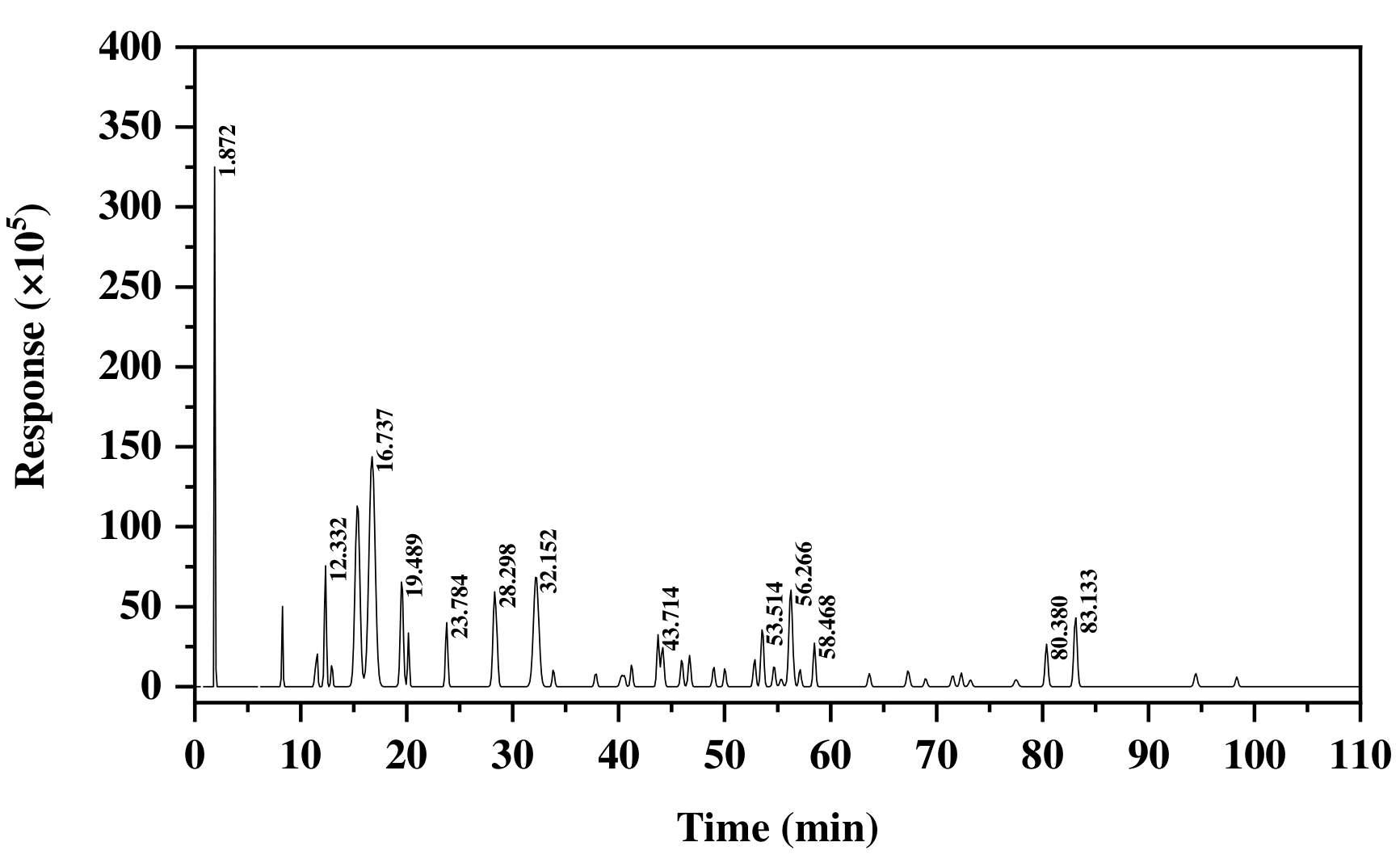
图1 某企业一段工艺所得高沸物HBRs的总离子流图
Fig.1 The total ion chromatogram of HBRs
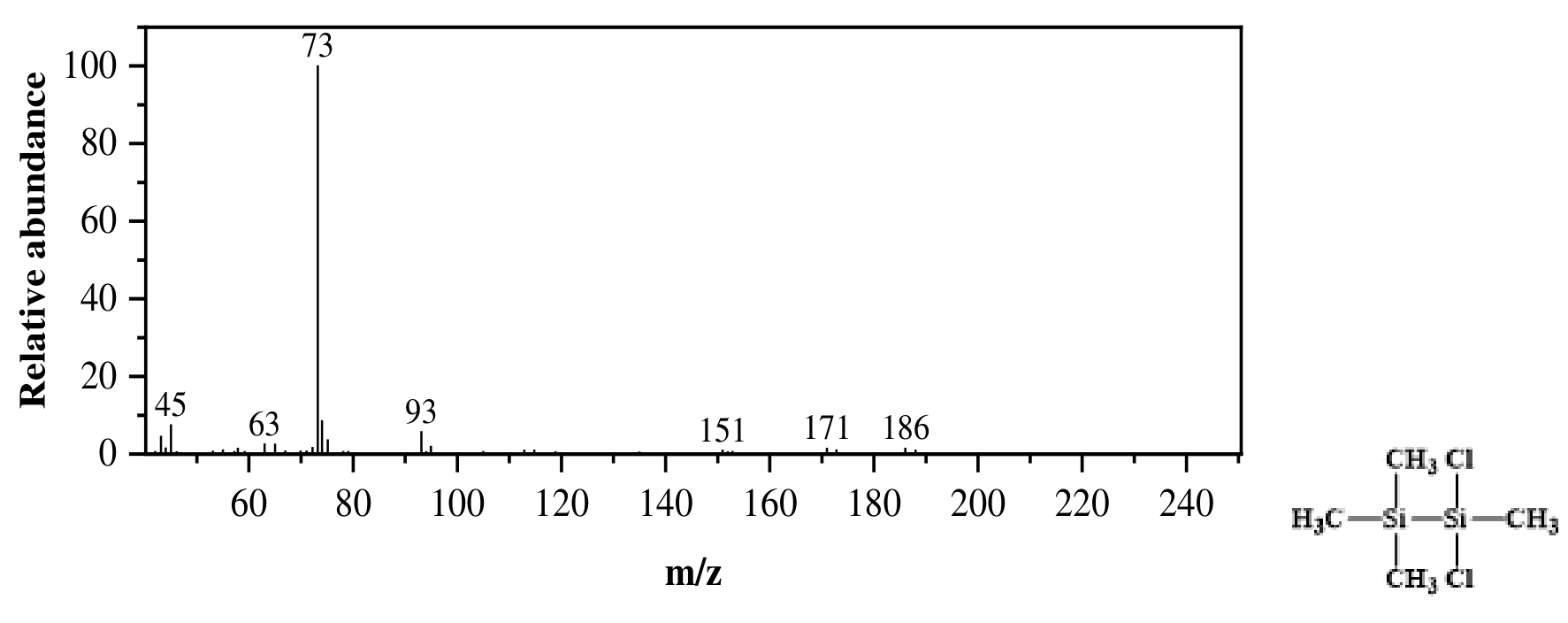
图2 4#物质的质谱图
Fig.2 Mass spectrum of substance 4#
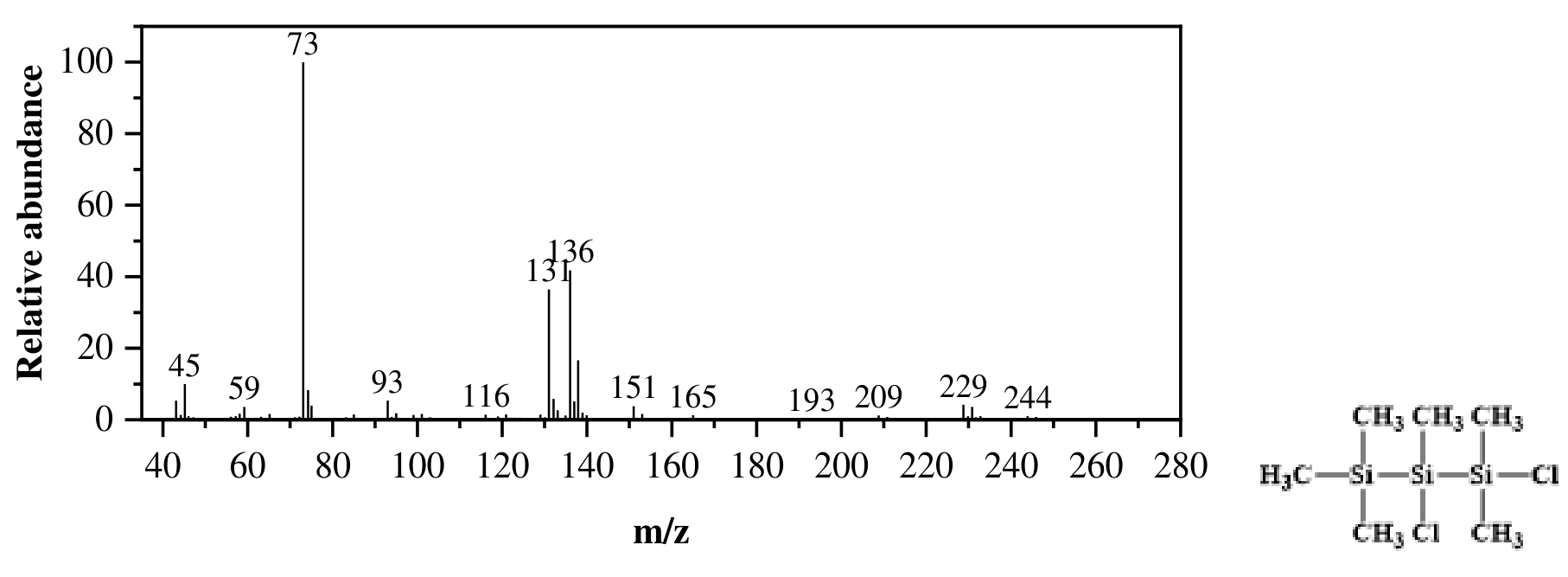
图3 17#物质的质谱图
Fig.3 Mass spectrum of substance 17#
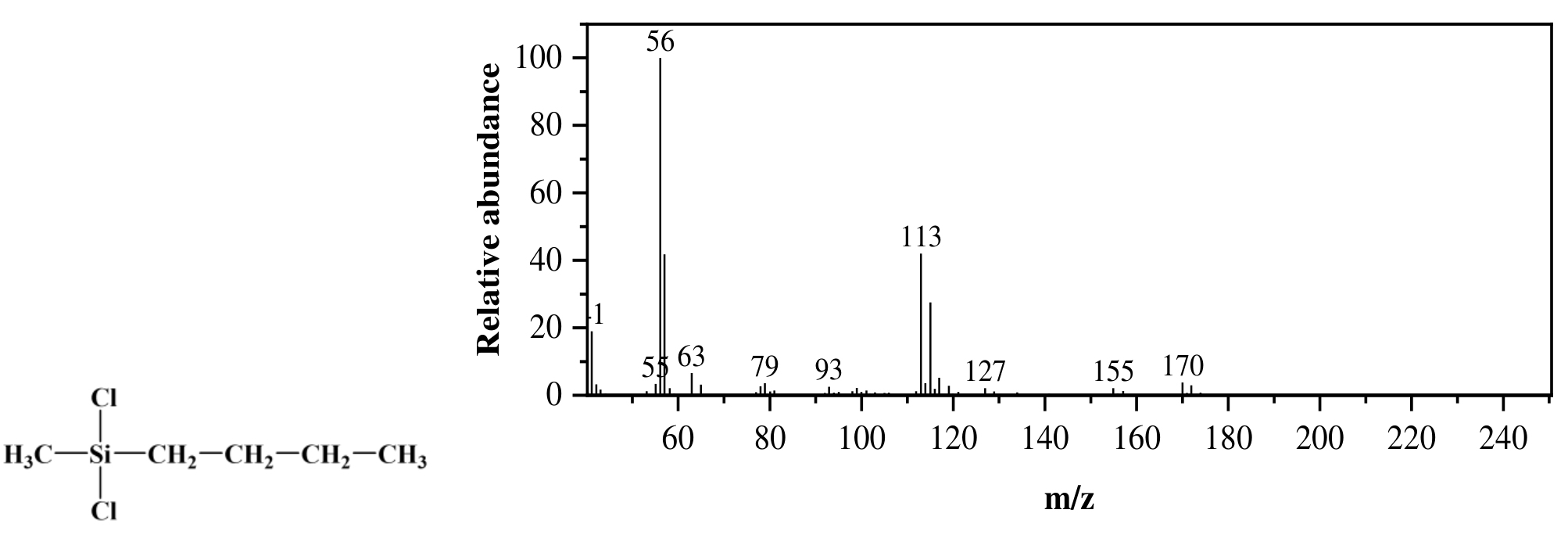
图4 6#物质的质谱图
Fig.4 Mass spectrum of substance 6#
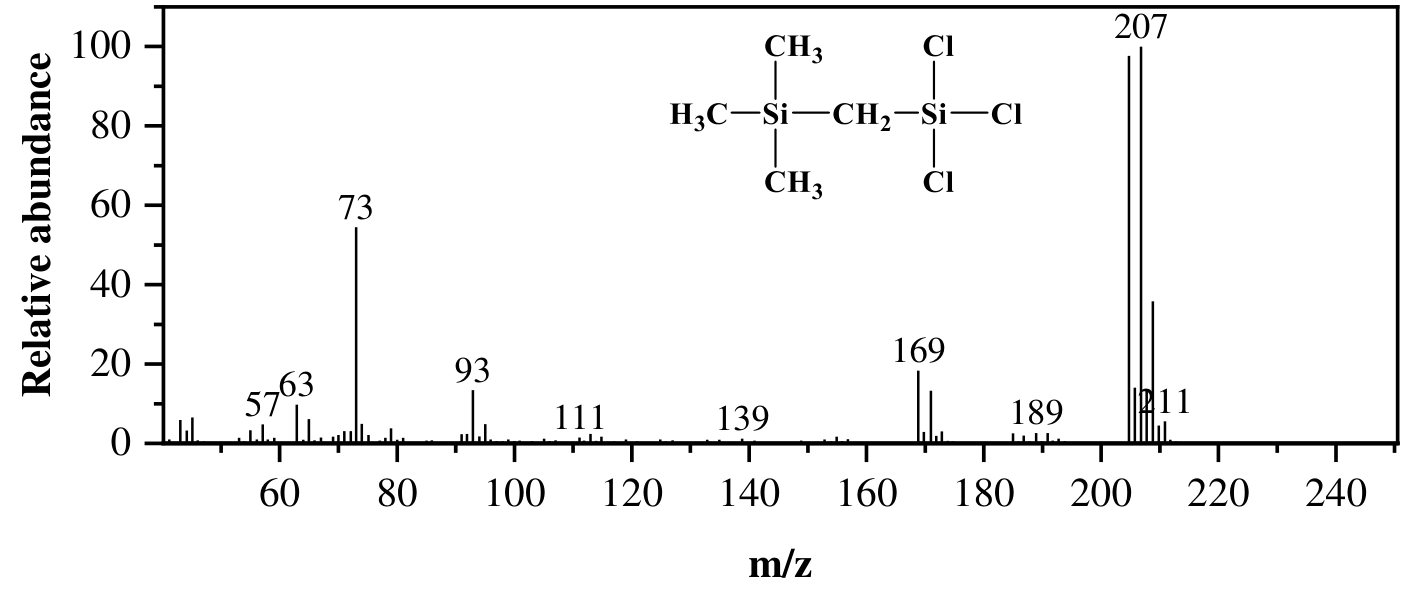
图5 10#物质的质谱图
Fig.5 Mass spectrum of substance 10#
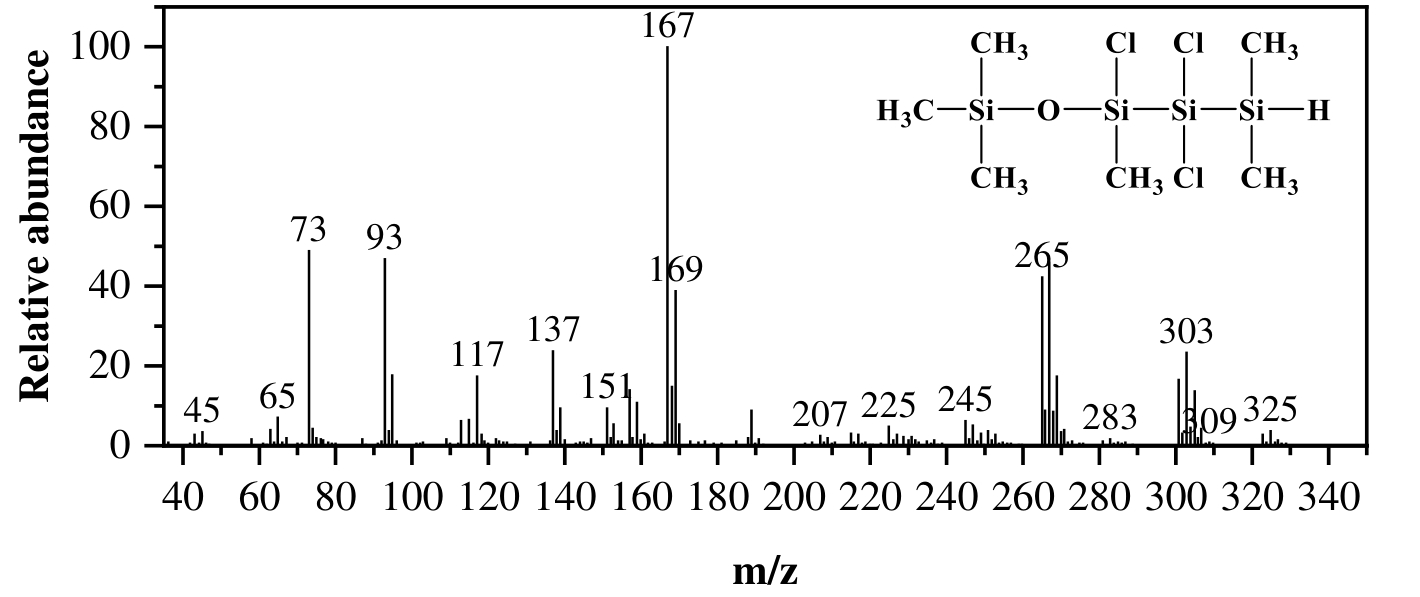
图6 39#物质的质谱图
Fig.6 Mass spectrum of substance 39#
| 式量差异 | 可能代表的官能团转移历程 |
|---|---|
| 14 | 失去1个甲基 |
| 35 | 失去1个Cl |
| 20 | 失去1个Cl,同时1个甲基重排 |
| 25 | 失去2个Cl,同时3个甲基重排 |
| 50 | 失去1个Cl和1个甲基 |
| 55 | 失去2个Cl,同时1个甲基重排 |
表9 特定式量差异可能代表的官能团转移历程
Table 9 The process of functional group migration that specific formula differences may represent
| 式量差异 | 可能代表的官能团转移历程 |
|---|---|
| 14 | 失去1个甲基 |
| 35 | 失去1个Cl |
| 20 | 失去1个Cl,同时1个甲基重排 |
| 25 | 失去2个Cl,同时3个甲基重排 |
| 50 | 失去1个Cl和1个甲基 |
| 55 | 失去2个Cl,同时1个甲基重排 |
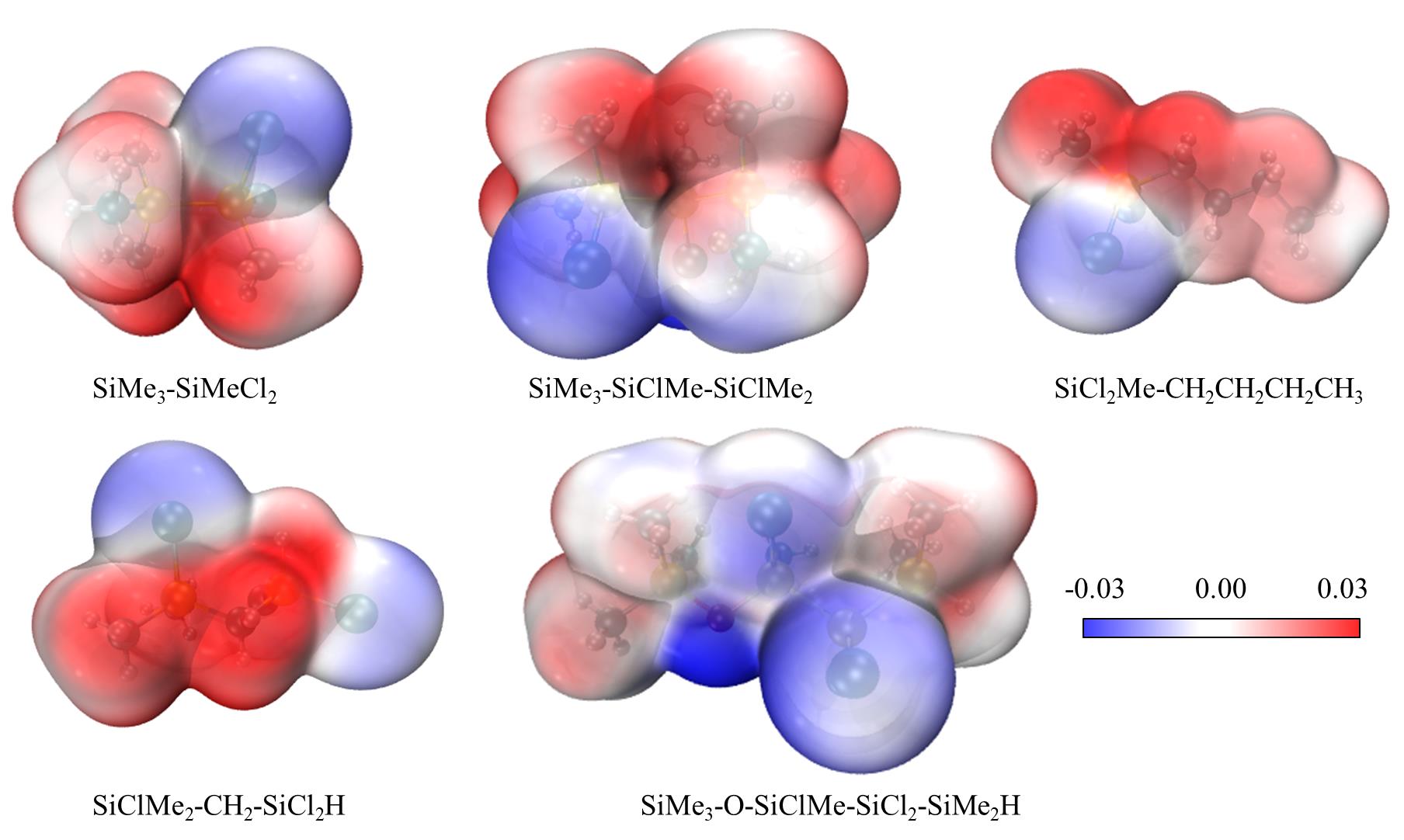
图7 5种典型高沸物组分物质电子分布图
Figure 7 Electron distribution maps of 5 typical HBRs
| [1] | Miller H C, Schreiber R S. Compounds: US2379821[P]. 1945-07-03. |
| [2] | Rochow E G. Preparation of tetramethyl silicate: US2473260[P]. 1949-06-14. |
| [3] | Barry A J, Gilkey J W, De Pree L. Preparation of silicon halides: US2474087[P]. 1949-06-21. |
| [4] | Bailey D L, Wagner G E. Production of methylchlorosilanes: US2532387[P]. 1950-12-05. |
| [5] | Harding W A, Shalit H. Trimethylsilane treatment of dry calcined silica-alumina: US3207699[P]. 1965-09-21. |
| [6] | Borner D, Koerner G, Rossmy G. Process for the hydrolysis and condensation of alkyl/aryl-trichlorosilanes: US4161487[P]. 1979-07-17. |
| [7] | Wang L T, Zhuo J S, Peng J B, et al. A stretchable soft pump driven by a heterogeneous dielectric elastomer actuator[J]. Advanced Functional Materials, 2024, 34(52): 2411160. |
| [8] | Lv K H, Tian G H, Yan Y T, et al. Stretchable carbon nanotube/Ecoflex conductive elastomer films toward multifunctional wearable electronics[J]. Chemical Engineering Journal, 2024, 500: 157534. |
| [9] | Gu Y R, Li T H, Zhao L, et al. Zirconium-modified organosiloxane resin for high-temperature-resistant coatings[J]. Polymer, 2024, 307: 127302. |
| [10] | Wu J, Niu K F, Su B L, et al. Effect of combined UV thermal and hydrolytic aging on micro-contact properties of silicone elastomer[J]. Polymer Degradation and Stability, 2018, 151: 126-135. |
| [11] | Ciubotaru B I, Zaltariov M F, Tugui C, et al. Silicones with different crosslinking patterns: Assessment from the perspective of their suitability for biomaterials[J]. Surfaces and Interfaces, 2022, 32: 102168. |
| [12] | Coulter F B, Schaffner M, Faber J A, et al. Bioinspired heart valve prosthesis made by silicone additive manufacturing[J]. Matter, 2019, 1(1): 266-279. |
| [13] | Zhang Y, Li J, Liu H Z, et al. Recent advances in rochow-Müller process research: driving to molecular catalysis and to a more sustainable silicone industry[J]. ChemCatChem, 2019, 11(12): 2757-2779. |
| [14] | Chekina N A, Pavlyuchenko V N, Danilichev V F, et al. A new polymeric silicone hydrogel for medical applications: synthesis and properties[J]. Polymers for Advanced Technologies, 2006, 17(11/12): 872-877. |
| [15] | Yilgör E, Yilgör I. Silicone containing copolymers: Synthesis, properties and applications[J]. Progress in Polymer Science, 2014, 39(6): 1165-1195. |
| [16] | 中国硅业. 我国有机硅甲基单体产能达500万吨[EB]. (2023-02-14)[2025-05-25]. . |
| Industry C S. The production capacity of organosilicon methyl monomers in China has reached 5 million tons[EB]. (2023-02-14)[2025-05-25]. . | |
| [17] | Rochow E G. Preparation of organosilicon halides: US2380995. 1941-09-26. |
| [18] | Müller R. Verfahren zur Herstellung von Kohlenstoff-Silicium-Halogenverbindungen: DD5348[P]. 1942-06-06. |
| [19] | Mohler D, Sellers J E. Process for treating organo-polysilanes: US2598435[P]. 1952-05-27. |
| [20] | Bluestein B A. Cleavage of organohalogenopolysilanes: US2709176[P]. 1954-05-24. |
| [21] | Guinet P A E, PUTHET R R. Process for splitting silanes: US3432537[P]. 1969-03-11. |
| [22] | Chadwick K M, Dhaul A K, Halm R L, et al. Catalytic conversion of direct process high-boiling component to chlorosilane monomers in the presence of hydrogen chloride and hydrogen: US5292909[P]. 1994-03-08. |
| [23] | Pachaly B, Schinabeck A. Separation of methylchlorosilanes from high boiling residues of methylchlorosilane synthesis: US5288892[P]. 1994-02-22. |
| [24] | Brinson J A, Freeburne S K, Jarvis R F, et al. Conversion of high-boiling residue from direct process to monosilanes: US5606090[P]. 1997-02-25. |
| [25] | 范宏, 邵月刚, 谭军, 等. 一种合成甲基氯硅烷的组合方法: CN1634936[P]. 2005-07-06. |
| Fan H, Shao Y G, Tan J, et al. Combined method for synthesizing methyl chlorosilane: CN1634936[P]. 2005-07-06. | |
| [26] | 冯玉红. 现代仪器分析实用教程[M]. 北京: 北京大学出版社, 2008: 187-197. |
| Feng Y H. Practical course of modern instrument analysis[M]. Beijing: Peking University Press, 2008: 187-197. | |
| [27] | Lu T, Chen F W. Multiwfn: a multifunctional wavefunction analyzer[J]. Journal of Computational Chemistry, 2012, 33(5): 580-592. |
| [28] | Lu T, Chen Q X. Partial Charges, Chapter 6 in Exploring Chemical Concepts Through Theory and Computation[M]. Weinheim: Wiley-VCH GmbH, 2024: 161-188. DOI: 10.1002/9783527843435.ch6 . |
| [29] | Hehre W J, Ditchfield R, Pople J A. Self: consistent molecular orbital methods. XII. further extensions of Gaussian: type basis sets for use in molecular orbital studies of organic molecules[J]. The Journal of Chemical Physics, 1972, 56(5): 2257-2261. |
| [30] | Krishnan R, Binkley J S, Seeger R, et al. Self-consistent molecular orbital methods. XX. A basis set for correlated wave functions[J]. The Journal of Chemical Physics, 1980, 72(1): 650-654. |
| [31] | McLean A D, Chandler G S. Contracted Gaussian basis sets for molecular calculations. I. Second row atoms, Z=11–18[J]. The Journal of Chemical Physics, 1980, 72(10): 5639-5648. |
| [32] | Clark T, Chandrasekhar J, Spitznagel G W, et al. Efficient diffuse function-augmented basis sets for anion calculations. III. The 3-21+G basis set for first-row elements, Li–F[J]. Journal of Computational Chemistry, 1983, 4(3): 294-301. |
| [33] | Frisch M J, Pople J A, Binkley J S. Self-consistent molecular orbital methods 25. Supplementary functions for Gaussian basis sets[J]. The Journal of Chemical Physics, 1984, 80(7): 3265-3269. |
| [34] | 来国桥,等. 有机硅化学与工艺[M]. 北京: 化学工业出版社, 2011: 7-8. |
| Lai G Q. Organic silicon chemistry and technology[M]. Beijing: Chemical Industry Press, 2011: 7-8. |
| [1] | 卢煦旸, 徐强, 康浩鹏, 史健, 曹泽水, 郭烈锦. 化学链制氢系统中磁铁矿氧载体的CO还原特性研究[J]. 化工学报, 2025, 76(7): 3286-3294. |
| [2] | 李奕菲, 苏沿霏, 尹甜, 姜浩强, 许志明, 张霖宙, 史权, 徐春明. 基于GC×GC-TOF MS的煤液化产物油分子组成结构表征[J]. 化工学报, 2025, 76(2): 543-553. |
| [3] | 钟声亮, 张军, 单锐, 孙勇. 废海绵衍生碳基固体酸催化热解木薯渣制备左旋葡萄糖酮[J]. 化工学报, 2023, 74(11): 4559-4569. |
| [4] | 唐茹意, 潘罕骞, 郑侠俊, 张广欣, 汪星平, 崔希利, 邢华斌. Z型全氟聚醚的结构表征[J]. 化工学报, 2023, 74(1): 479-486. |
| [5] | 陈晨, 杨倩, 陈云, 张睿, 刘冬. 不同氧浓度下煤挥发分燃烧的化学动力学研究[J]. 化工学报, 2022, 73(9): 4133-4146. |
| [6] | 李彬, 宋文明, 杨坤龙, 姜爽, 张天永. 水系有机液流电池活性材料的分子工程研究进展[J]. 化工学报, 2022, 73(7): 2806-2818. |
| [7] | 江龙, 王开杰, 孔晴, 陆晟, 陈小强. 基于金刚烷-二氧杂环丁烷化学发光探针的研究进展[J]. 化工学报, 2021, 72(1): 229-246. |
| [8] | 雷德会, 彭同江, 孙红娟, 汤光平, 杨建召, 任亚周, 王丽丽. 还原温度对氧化石墨烯的湿度-甲醛交叉敏感性能的影响[J]. 化工学报, 2019, 70(1): 309-318. |
| [9] | 曾明国, 李永生, 赵炀, 杜鑫. 基于流动注射光度法同时测定催化剂浸渍液中CoO/MoO3[J]. 化工学报, 2017, 68(8): 3056-3063. |
| [10] | 凌慧, 郑成, 毛桃嫣, 魏渊, 刘颖. 响应面法优化微波辅助合成中碳链甘油三酯工艺[J]. 化工学报, 2016, 67(S2): 231-244. |
| [11] | 王思佳, 何品晶, 邵立明, 章骅. 树脂纽扣废物的焚烧污染特征[J]. 化工学报, 2016, 67(9): 4004-4012. |
| [12] | 曹丽娜, 李珑, 张楠, 郭亚飞, 邓天龙. 四元体系LiCl-LiBO2-Li2SO4-H2O在298.15K时的相平衡[J]. 化工学报, 2016, 67(4): 1117-1122. |
| [13] | 张世玲, 彭孝军. 氟离子荧光探针的研究进展[J]. 化工学报, 2016, 67(1): 191-201. |
| [14] | 霍江波, 王小逸, 赵靖强, 任海荣. 离子液体空气采样管的应用[J]. 化工学报, 2015, 66(S1): 326-331. |
| [15] | 杨洪宝, 杜健军, 邹立, 朱浩, 姜娜, 彭孝军. 染料探针分子对水中铜离子的可视化识别及试纸化应用[J]. 化工学报, 2015, 66(2): 591-596. |
| 阅读次数 | ||||||
|
全文 |
|
|||||
|
摘要 |
|
|||||
 京公网安备 11010102001995号