• •
车志凯1( ), 张谭1,2, 宋芋茹1, 李晋平1,2, 刘光1()
收稿日期:2025-09-16
修回日期:2025-10-28
出版日期:2025-11-27
通讯作者:
刘光
作者简介:车志凯(2002—),男,硕士研究生,chezhikai1214@163.com
基金资助:
Zhikai CHE1(), Tan ZHANG1,2, Yuru SONG1, Jinping LI1,2, Guang LIU1()
Received:2025-09-16
Revised:2025-10-28
Online:2025-11-27
Contact:
Guang LIU
摘要:
电催化CO2和NO3-偶联合成尿素被认为是一种清洁可持续的绿色生产途径,有助于碳中和和人工氮循环。然而,因其反应复杂、反应物吸附慢、副反应竞争等多方面因素,导致电催化合成尿素面临法拉第效率低、尿素选择性差、难以满足工业需求等问题。本文综述了电催化CO2和NO3-合成尿素的研究进展,深入讨论了C-N耦联的反应机理,分析总结了催化剂性能提升策略,包括尺寸调控、晶面调控、空位工程等催化剂设计策略以及H型槽、流动池、MEA(膜电极组件)等反应器设计方法。最后,提出了该领域未来的研究以及工业化应用所面临的挑战与展望。
车志凯, 张谭, 宋芋茹, 李晋平, 刘光. 电催化二氧化碳和硝酸根合成尿素研究进展[J]. 化工学报, DOI: 10.11949/0438-1157.20251045.
Zhikai CHE, Tan ZHANG, Yuru SONG, Jinping LI, Guang LIU. Research progress in electrocatalytic synthesis of urea from carbon dioxide and nitrate[J]. CIESC Journal, DOI: 10.11949/0438-1157.20251045.
| Bosch-Meiser 工艺 | 电催化合成尿素工艺 | |
|---|---|---|
| 反应条件 | 高温、高压且需要大型、耐高压的抗腐蚀设备 | 常温常压,对设备要求低,安全性高 |
| 原料来源 | 高纯度NH3和CO2(NH3来自高能耗的哈伯法合成氨,CO2通常来自化石燃料重整或其它工业过程) | 广泛且直接,N2(直接来自空气)、CO2(工业废气)、NO3-(工业废水) |
| 环境影响 | 大(巨大的碳排放以及工业废水排放) | 绿色合成(清洁无污染) |
| 主要优点 | 1.技术可靠、工艺成熟2.高选择性和高收率3.强大的规模效应 | 1.反应条件温和,安全节能2.原料绿色,可直接利用N2和废弃CO23.流程简单,易于模块化 |
| 主要缺点 | 1.高能耗、高碳排放,对环境不友好2.依赖化石燃料作为原料和能源3.集中式生产,基础设施要求高4.工艺复杂 | 1.技术不成熟,距离实用化遥远2.选择性/法拉第效率低3.产物分离困难,成本高昂4.催化剂的活性和稳定性不足 |
表1 传统尿素合成工艺与电催化尿素合成工艺对比
Table 1 Comparison of traditional urea synthesis process and electrocatalytic urea synthesis process
| Bosch-Meiser 工艺 | 电催化合成尿素工艺 | |
|---|---|---|
| 反应条件 | 高温、高压且需要大型、耐高压的抗腐蚀设备 | 常温常压,对设备要求低,安全性高 |
| 原料来源 | 高纯度NH3和CO2(NH3来自高能耗的哈伯法合成氨,CO2通常来自化石燃料重整或其它工业过程) | 广泛且直接,N2(直接来自空气)、CO2(工业废气)、NO3-(工业废水) |
| 环境影响 | 大(巨大的碳排放以及工业废水排放) | 绿色合成(清洁无污染) |
| 主要优点 | 1.技术可靠、工艺成熟2.高选择性和高收率3.强大的规模效应 | 1.反应条件温和,安全节能2.原料绿色,可直接利用N2和废弃CO23.流程简单,易于模块化 |
| 主要缺点 | 1.高能耗、高碳排放,对环境不友好2.依赖化石燃料作为原料和能源3.集中式生产,基础设施要求高4.工艺复杂 | 1.技术不成熟,距离实用化遥远2.选择性/法拉第效率低3.产物分离困难,成本高昂4.催化剂的活性和稳定性不足 |
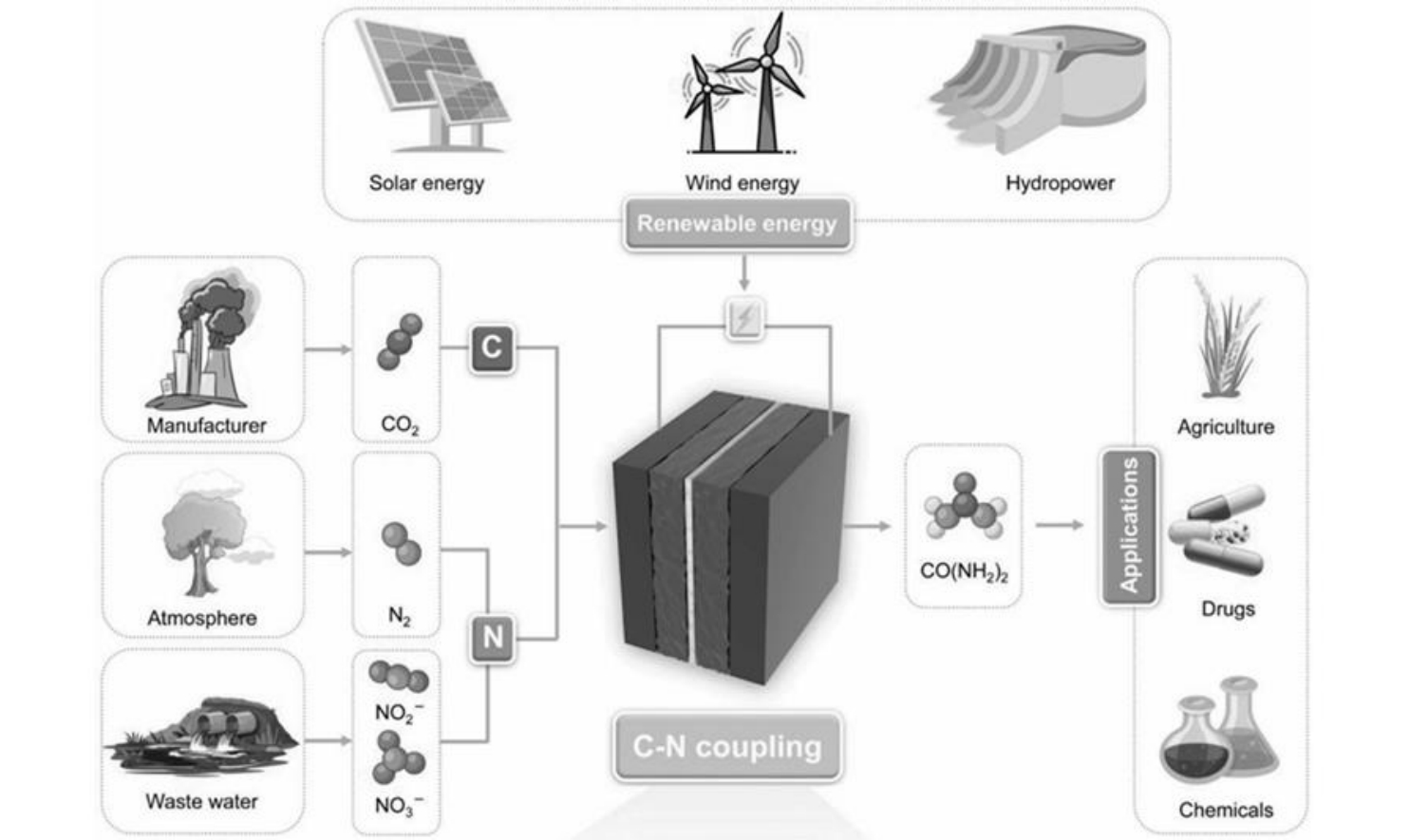
图1 电催化C-N耦合示意图[4]
Fig.1 Electrocatalytic C-N coupling diagram[4]

图2 C-N偶联机理分析示例图[28-30, 35]
Fig.2 Example diagram of C-N coupling mechanism analysis[28-30, 35]
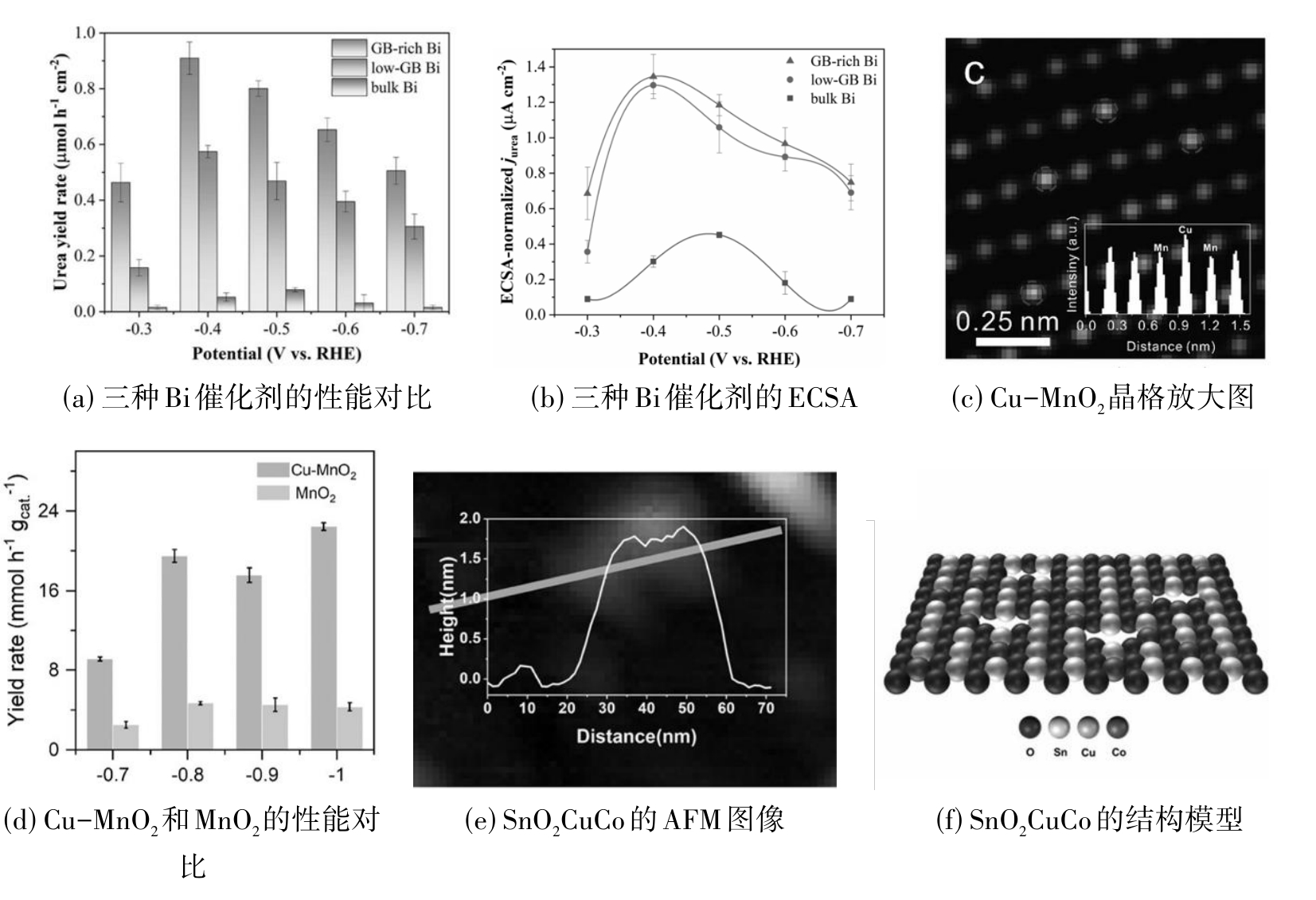
图3 尺寸调控设计策略示例图[39-41]
Fig.3 Size control design strategy example diagram[39-41]

图4 晶面调控设计策略示例图[42-44]
Fig.4 Example diagram of crystal plane control design strategy[42-44]

图5 空位工程设计策略示例图[45-48]
Fig.5 Vacancy engineering design strategy example diagram[45-48]
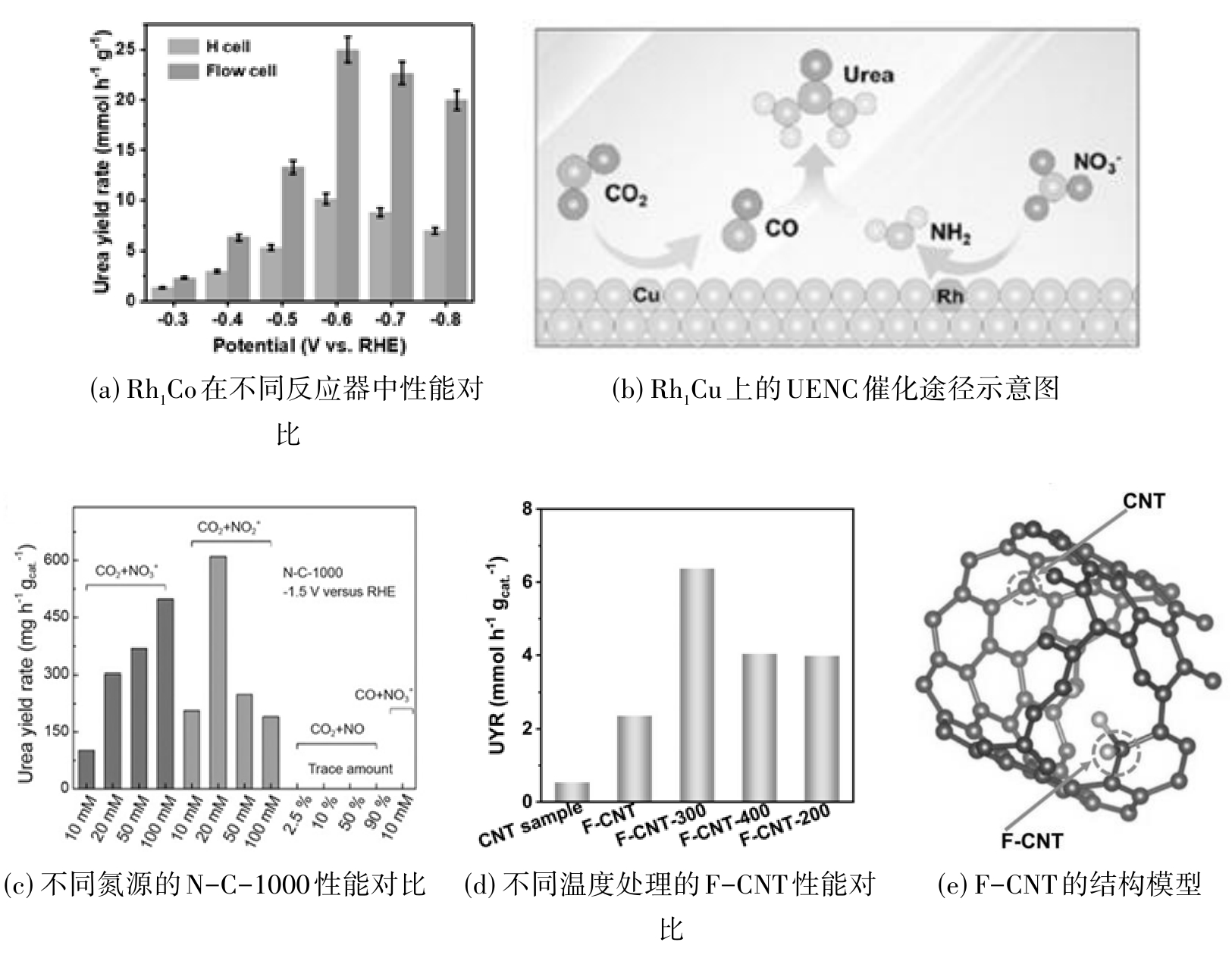
图6 关于掺杂设计策略的示例图[49-52]
Fig.6 Example diagram of doping design strategy[49-52]
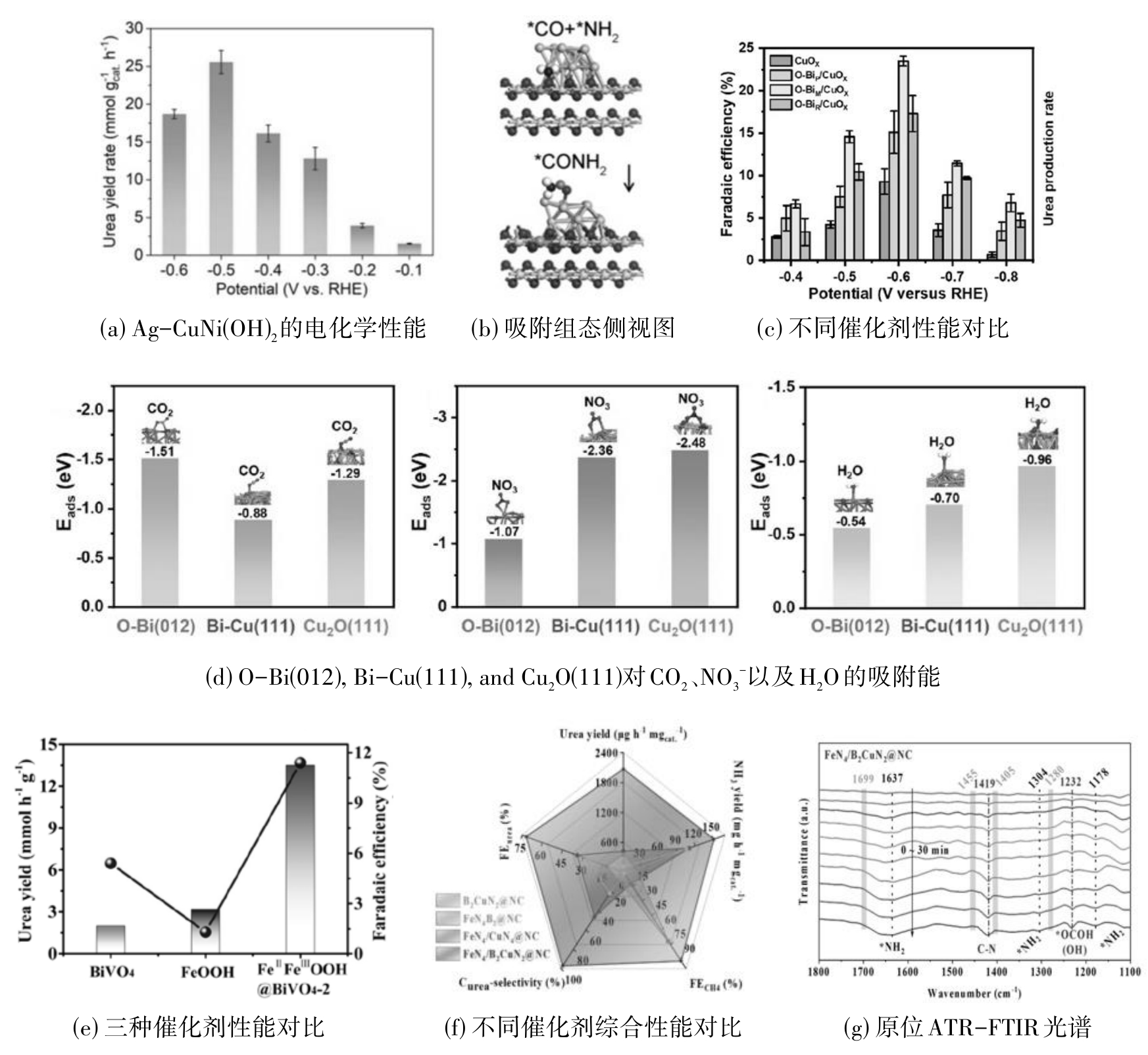
图7 异质结构设计策略示例图[53-56]
Fig.7 Heterogeneous structure design strategy example diagram[53-56]
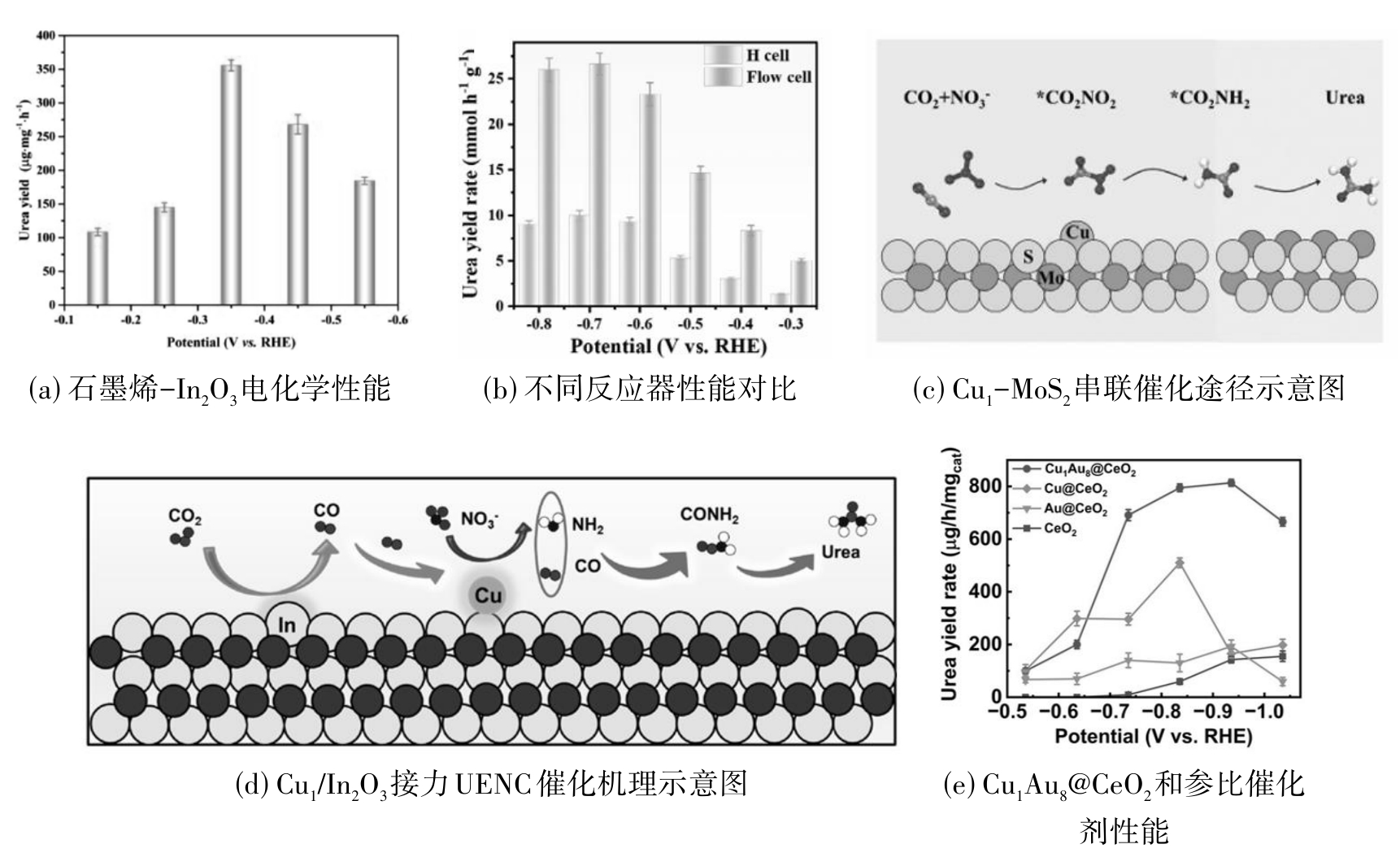
图8 载体工程设计策略示例图[57-60]
Fig.8 Example diagram of carrier engineering design strategy[57-60]
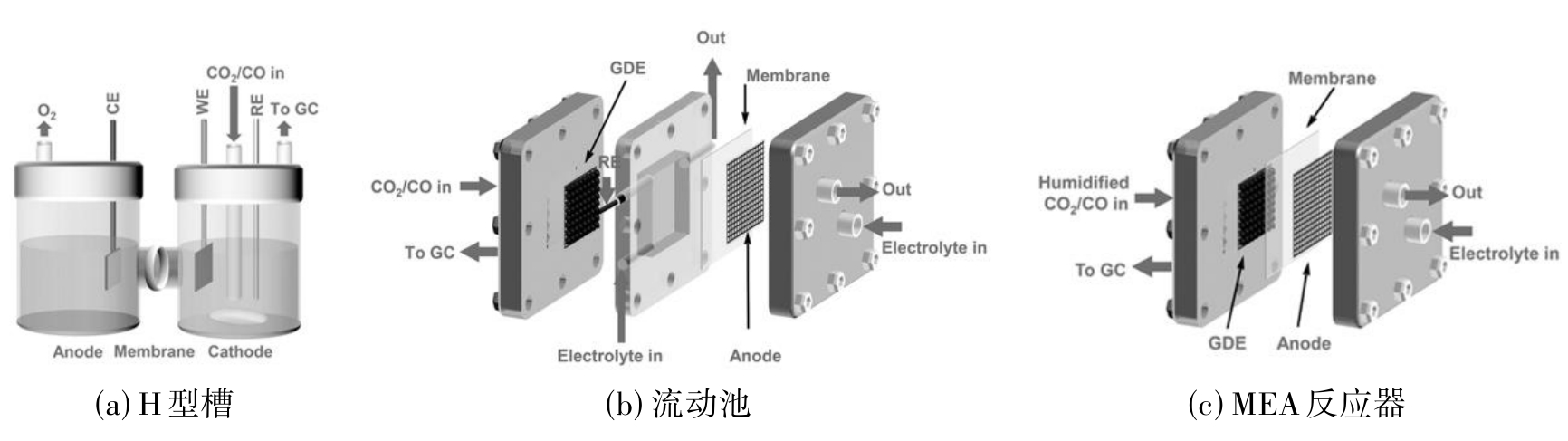
图9 三种类型电催化反应器的示意图[63]
Fig.9 Schematic illustration of three types of electrocatalytic reactors[63]
| 催化剂 | 电解质 | 最佳电位 | 产率 | 法拉第效率 | 参考文献 |
|---|---|---|---|---|---|
| W800-Cu | 0.1 M KHCO3+0.01 M KNO3 | -0.6 V vs. RHE | 1373.5 µg h-1 mgcat-1 | 12.8% | [ |
| Co1-TiO2 | 含 1.0 M K+ 的PBS和 KNO3 | -0.8 V vs. RHE | 212.8 mmol h-1 g-1 | 36.2% | [ |
| RhCu | 0.1M KNO3 | -0.6 V vs. RHE | 26.81 mmol g-1 h-1 | 34.82% | [ |
| FeNC-Fe1N4/C | 0.1 M KHCO3+0.1 M KNO3 | — | 38.2 mmol gcat-1 h-1 | 66.5% | [ |
| Cu@Zn纳米线 | 0.2 M KHCO3+0.1 M KNO3 | -1.02 V vs. RHE | 7.29 μmol cm-2 h-1 | 9.28% | [ |
| RP-AuCu | 0.1 M KHCO3+0.1 M KNO3 | -0.6 V vs. RHE | 22.9 mmol gcat-1 h-1 | 88.5% | [ |
| Ru1Co | 0.1 M KHCO3+0.1 M KNO3 | -0.5 V vs. RHE | 22.34 mmol h-1 g-1 | 50.1% | [ |
| CuPc-Amino | 0.1 M KHCO3+0.05 M KNO3 | -1.6 V vs. RHE | 103.1 mmol h-1 g-1 | 11.9% | [ |
| TiO2-C | 0.1M KNO3 | -0.9 V vs. RHE | 43.37 mmol g-1 h-1 | 48.88% | [ |
| Cu/PI-500 | 0.1 M KHCO3+0.1 M KNO3 | -1.4 V vs. RHE | 255.0 mmol h-1 g-1 | 14.3% | [ |
| Cu2O | 0.1M KNO3 | -0.017 V vs. RHE | 29.71 μmol g-1 h-1 | 12.9% | [ |
| Vo-CeO2-750 | 0.1 M KHCO3+0.05 M KNO3 | -1.6 V vs. RHE | 943.6 mg h-1 g-1 | — | [ |
| CuO50ZnO50 | 0.1 M Na2SO4+0.1 M NaNO3 | -0.8 V vs. RHE | — | 41% | [ |
| h-Cu/Cu2O MPs | 0.5 M KHCO3+0.05 M KNO3 | -0.3 V vs. RHE | 632.1 µg h-1 mgcat-1 | 43.2% | [ |
| CuWO4 | 0.1M KNO3 | -0.2 V vs. RHE | 98.5 µg h-1 mgcat-1 | 70.1% | [ |
| OL-Cu | 0.9 M KHCO3+0.1 M KNO3 | -0.7 V vs. RHE | 298.67 mmol h-1 g-1 | 28.64% | [ |
| Pd2Au1/RuO2 | 1 M KOH+0.1 M KNO3 | -0.5 V vs. RHE | 237.8 mmol gcat-1 h-1 | 68.0% | [ |
表2 不同电催化CO2和NO3-合成尿素催化剂的电化学性能
Table 2 Electrochemical performance of different electrocatalysts for CO2 and NO3- synthesis of urea
| 催化剂 | 电解质 | 最佳电位 | 产率 | 法拉第效率 | 参考文献 |
|---|---|---|---|---|---|
| W800-Cu | 0.1 M KHCO3+0.01 M KNO3 | -0.6 V vs. RHE | 1373.5 µg h-1 mgcat-1 | 12.8% | [ |
| Co1-TiO2 | 含 1.0 M K+ 的PBS和 KNO3 | -0.8 V vs. RHE | 212.8 mmol h-1 g-1 | 36.2% | [ |
| RhCu | 0.1M KNO3 | -0.6 V vs. RHE | 26.81 mmol g-1 h-1 | 34.82% | [ |
| FeNC-Fe1N4/C | 0.1 M KHCO3+0.1 M KNO3 | — | 38.2 mmol gcat-1 h-1 | 66.5% | [ |
| Cu@Zn纳米线 | 0.2 M KHCO3+0.1 M KNO3 | -1.02 V vs. RHE | 7.29 μmol cm-2 h-1 | 9.28% | [ |
| RP-AuCu | 0.1 M KHCO3+0.1 M KNO3 | -0.6 V vs. RHE | 22.9 mmol gcat-1 h-1 | 88.5% | [ |
| Ru1Co | 0.1 M KHCO3+0.1 M KNO3 | -0.5 V vs. RHE | 22.34 mmol h-1 g-1 | 50.1% | [ |
| CuPc-Amino | 0.1 M KHCO3+0.05 M KNO3 | -1.6 V vs. RHE | 103.1 mmol h-1 g-1 | 11.9% | [ |
| TiO2-C | 0.1M KNO3 | -0.9 V vs. RHE | 43.37 mmol g-1 h-1 | 48.88% | [ |
| Cu/PI-500 | 0.1 M KHCO3+0.1 M KNO3 | -1.4 V vs. RHE | 255.0 mmol h-1 g-1 | 14.3% | [ |
| Cu2O | 0.1M KNO3 | -0.017 V vs. RHE | 29.71 μmol g-1 h-1 | 12.9% | [ |
| Vo-CeO2-750 | 0.1 M KHCO3+0.05 M KNO3 | -1.6 V vs. RHE | 943.6 mg h-1 g-1 | — | [ |
| CuO50ZnO50 | 0.1 M Na2SO4+0.1 M NaNO3 | -0.8 V vs. RHE | — | 41% | [ |
| h-Cu/Cu2O MPs | 0.5 M KHCO3+0.05 M KNO3 | -0.3 V vs. RHE | 632.1 µg h-1 mgcat-1 | 43.2% | [ |
| CuWO4 | 0.1M KNO3 | -0.2 V vs. RHE | 98.5 µg h-1 mgcat-1 | 70.1% | [ |
| OL-Cu | 0.9 M KHCO3+0.1 M KNO3 | -0.7 V vs. RHE | 298.67 mmol h-1 g-1 | 28.64% | [ |
| Pd2Au1/RuO2 | 1 M KOH+0.1 M KNO3 | -0.5 V vs. RHE | 237.8 mmol gcat-1 h-1 | 68.0% | [ |
| [1] | He F, Tong S R, Luo Z Y, et al. Accelerating net-zero carbon emissions by electrochemical reduction of carbon dioxide[J]. Journal of Energy Chemistry, 2023, 79: 398-409. |
| [2] | Zhang S R, Bai X Y, Zhao C W, et al. China's carbon budget inventory from 1997 to 2017 and its challenges to achieving carbon neutral strategies[J]. Journal of Cleaner Production, 2022, 347: 130966. |
| [3] | Zhang Z Z, Li S J, Zhang Z, et al. A review on electrocatalytic CO2 conversion via C–C and C–N coupling[J]. Carbon Energy, 2024, 6(2): e513. |
| [4] | Wan Y C, Zheng M Y, Yan W, et al. Fundamentals and rational design of heterogeneous C-N coupling electrocatalysts for urea synthesis at ambient conditions[J]. Advanced Energy Materials, 2024, 14(28): 2303588. |
| [5] | Wang C, Gao W Q, Hu W, et al. Recent advances in electrochemical synthesis of urea via C–N coupling[J]. Journal of Energy Chemistry, 2024, 98: 294-310. |
| [6] | Lim J, Fernández C A, Lee S W, et al. Ammonia and nitric acid demands for fertilizer use in 2050[J]. ACS Energy Letters, 2021, 6(10): 3676-3685. |
| [7] | Gruber N, Galloway J N. An Earth-system perspective of the global nitrogen cycle[J]. Nature, 2008, 451(7176): 293-296. |
| [8] | Liu S, Yang H B, Su X, et al. Rational design of carbon-based metal-free catalysts for electrochemical carbon dioxide reduction: a review[J]. Journal of Energy Chemistry, 2019, 36: 95-105. |
| [9] | Luo Y T, Xie K, Ou P F, et al. Selective electrochemical synthesis of urea from nitrate and CO2 via relay catalysis on hybrid catalysts[J]. Nature Catalysis, 2023, 6(10): 939-948. |
| [10] | Jiang M H, Zhu M F, Wang M J, et al. Review on electrocatalytic coreduction of carbon dioxide and nitrogenous species for urea synthesis[J]. ACS Nano, 2023, 17(4): 3209-3224. |
| [11] | Kohlhaas Y, Tschauder Y S, Plischka W, et al. Electrochemical urea synthesis[J]. Joule, 2024, 8(6): 1579-1600. |
| [12] | Zhu X R, Zhou X C, Jing Y, et al. Electrochemical synthesis of urea on MBenes[J]. Nature Communications, 2021, 12: 4080. |
| [13] | Ma L J, Yuan J L, Liu Z T, et al. Mesoporous electrocatalysts with p–n heterojunctions for efficient electroreduction of CO2 and N2 to urea[J]. ACS Applied Materials & Interfaces, 2024, 16(20): 26015-26024. |
| [14] | Yu Y D, Lv Z, Liu Z Y, et al. Activation of Ga liquid catalyst with continuously exposed active sites for electrocatalytic C-N coupling[J]. Angewandte Chemie International Edition, 2024, 63(18): e202402236. |
| [15] | Hu Q, Zhou W L, Qi S, et al. Pulsed co-electrolysis of carbon dioxide and nitrate for sustainable urea synthesis[J]. Nature Sustainability, 2024, 7(4): 442-451. |
| [16] | Jiao Y R, Li H B, Jiao Y, et al. Activity and selectivity roadmap for C–N electro-coupling on MXenes[J]. Journal of the American Chemical Society, 2023, 145(28): 15572-15580. |
| [17] | Ying Y R, Fan K, Qiao J L, et al. Rational design of atomic site catalysts for electrocatalytic nitrogen reduction reaction: one step closer to optimum activity and selectivity[J]. Electrochemical Energy Reviews, 2022, 5(3): 6. |
| [18] | Liu X, Jiao Y, Zheng Y, et al. Mechanism of C-N bonds formation in electrocatalytic urea production revealed by ab initio molecular dynamics simulation[J]. Nature Communications, 2022, 13: 5471. |
| [19] | Wei X X, Liu S Q, Liu H J, et al. Lattice oxygen-driven co-adsorption of carbon dioxide and nitrate on copper: a pathway to efficient urea electrosynthesis[J]. Journal of the American Chemical Society, 2025, 147(7): 6049-6057. |
| [20] | Li J Y, Li Y F, Li L S, et al. Remote carbon monoxide spillover improves tandem urea electrosynthesis[J]. Angewandte Chemie International Edition, 2025, 64(10): e202421266. |
| [21] | Meng N N, Ma X M, Wang C H, et al. Oxide-derived core–shell Cu@Zn nanowires for urea electrosynthesis from carbon dioxide and nitrate in water[J]. ACS Nano, 2022, 16(6): 9095-9104. |
| [22] | Wang Y, Xia S, Zhang J F, et al. Spatial management of CO diffusion on tandem electrode promotes NH2 intermediate formation for efficient urea electrosynthesis[J]. ACS Energy Letters, 2023, 8(8): 3373-3380. |
| [23] | Chen S B, Hai G T, Cheng H, et al. Efficient urea electrosynthesis via coordination of the reaction rate of carbon dioxide and nitrate co-reduction[J]. AIChE Journal, 2024, 70(10): e18515. |
| [24] | Fu J J, Yang Y, Hu J S. Dual-sites tandem catalysts for C–N bond formation via electrocatalytic coupling of CO2 and nitrogenous small molecules[J]. ACS Materials Letters, 2021, 3(10): 1468-1476. |
| [25] | Zhang S B, Geng J, Zhao Z, et al. High-efficiency electrosynthesis of urea over bacterial cellulose regulated Pd–Cu bimetallic catalyst[J]. EES Catalysis, 2023, 1(1): 45-53. |
| [26] | Gao W T, Wu Q Y, Fan X F, et al. Promoting electrocatalytic reduction of CO2 and nitrate to urea on N-doped porous hollow carbon spheres[J]. ACS Applied Materials & Interfaces, 2024, 16(38): 50726-50735. |
| [27] | Zhao J M, Yuan Y, Zhao F, et al. Identifying the facet-dependent active sites of Cu2O for selective C-N coupling toward electrocatalytic urea synthesis[J]. Applied Catalysis B: Environmental, 2024, 340: 123265. |
| [28] | Xu M Q, Wu F F, Zhang Y, et al. Kinetically matched C–N coupling toward efficient urea electrosynthesis enabled on copper single-atom alloy[J]. Nature Communications, 2023, 14: 6994. |
| [29] | Geng J, Ji S H, Jin M, et al. Ambient electrosynthesis of urea with nitrate and carbon dioxide over iron-based dual-sites[J]. Angewandte Chemie International Edition, 2023, 62(6): e202210958. |
| [30] | Zhang C, Zhou Q, Li Z Y, et al. Promoting the intermediates hydrogenation for urea electrosynthesis over an "active hydrogen pump" catalyst[J]. Angewandte Chemie International Edition, 2025, 64(29): e202507869. |
| [31] | Song X N, Jin X Y, Chen T H, et al. Boosting urea electrosynthesis via asymmetric oxygen vacancies in Zn-doped Fe2O3 catalysts[J]. Angewandte Chemie International Edition, 2025, 64(28): e202501830. |
| [32] | Wei X X, Liu Y Y, Zhu X R, et al. Dynamic reconstitution between copper single atoms and clusters for electrocatalytic urea synthesis[J]. Advanced Materials, 2023, 35(18): 2300020. |
| [33] | Zhao Y L, Ding Y X, Li W L, et al. Efficient urea electrosynthesis from carbon dioxide and nitrate via alternating Cu–W bimetallic C–N coupling sites[J]. Nature Communications, 2023, 14: 4491. |
| [34] | Li Y, Zheng S S, Liu H, et al. Sequential co-reduction of nitrate and carbon dioxide enables selective urea electrosynthesis[J]. Nature Communications, 2024, 15: 176. |
| [35] | Hu B H, Lu R H, Wang W L, et al. Directing the C–N coupling pathway enables efficient urea electrosynthesis[J]. Journal of the American Chemical Society, 2025, 147(25): 21764-21777. |
| [36] | Huang X M, Li Y F, Xie S J, et al. The tandem nitrate and CO2 reduction for urea electrosynthesis: role of surface N-intermediates in CO2 capture and activation[J]. Angewandte Chemie International Edition, 2024, 63(24): e202403980. |
| [37] | Ma X Y, Mao B G, Yu Z Q, et al. Elucidating relay catalysis on copper clusters with satellite single atoms for enhanced urea electrosynthesis[J]. Angewandte Chemie International Edition, 2025, 64(19): e202423706. |
| [38] | Zhao Q L, Lu X X, Wang Y N, et al. Sustainable and high-rate electrosynthesis of nitrogen fertilizer[J]. Angewandte Chemie International Edition, 2023, 62(33): e202307123. |
| [39] | Wang Y, Xia S, Cai R, et al. Dynamic reconstruction of two-dimensional defective Bi nanosheets for efficient electrocatalytic urea synthesis[J]. Angewandte Chemie International Edition, 2024, 63(16): e202318589. |
| [40] | Yang Y D, Wu G Z, Jiang J D, et al. Stabilization of Cuδ+ sites within MnO2 for superior urea electro-synthesis[J]. Advanced Materials, 2024, 36(41): 2409697. |
| [41] | Zhang T B, Wang P, Yang C, et al. Sub-2 nm Cu and co codoping SnO2 ultrathin nanosheet with mesoporous structure for efficient electrocatalytic urea synthesis[J]. Journal of the American Chemical Society, 2025, 147(36): 33108-33119. |
| [42] | Lv C D, Zhong L X, Liu H J, et al. Selective electrocatalytic synthesis of urea with nitrate and carbon dioxide[J]. Nature Sustainability, 2021, 4(10): 868-876. |
| [43] | Li Z Y, Zhou P, Zhou M, et al. Synergistic electrocatalysis of crystal facet and O-vacancy for enhancive urea synthesis from nitrate and CO2 [J]. Applied Catalysis B: Environmental, 2023, 338: 122962. |
| [44] | Wu Q, Dai C C, Meng F X, et al. Potential and electric double-layer effect in electrocatalytic urea synthesis[J]. Nature Communications, 2024, 15: 1095. |
| [45] | Huang R, Xue F, Wang P F, et al. Multi-orbital electronic coupling mediated by integrating multiple-metal hybridizations at ultrafast heating accumulation for efficient electrochemical urea synthesis[J]. Journal of Energy Chemistry, 2025, 103: 657-664. |
| [46] | Liang J Y, Deng S J, Li Z Y, et al. Spin state modulation with oxygen vacancy orientates C/N intermediates for urea electrosynthesis of ultrahigh efficiency[J]. Advanced Materials, 2025, 37(9): 2418828. |
| [47] | Lv C D, Lee C, Zhong L X, et al. A defect engineered electrocatalyst that promotes high-efficiency urea synthesis under ambient conditions[J]. ACS Nano, 2022, 16(5): 8213-8222. |
| [48] | Zhang Y, Li Z H, Chen K, et al. Promoting electroreduction of CO2 and NO3 - to urea via tandem catalysis of Zn single atoms and In2O3-x [J]. Advanced Energy Materials, 2024, 14(47): 2402309. |
| [49] | Wan Y Y, Zhang Z Y, Qian J M, et al. Single-atom Rh1 alloyed co for urea electrosynthesis from CO2 and NO3 – [J]. Nano Letters, 2024, 24(35): 10928-10935. |
| [50] | Xiang J Q, Qiang C F, Shang S Y, et al. Relay catalysis of isolated rhodium-alloyed copper boosts urea electrosynthesis from nitrate and CO2 [J]. ACS Nano, 2024, 18(43): 29856-29863. |
| [51] | Chen C, Li S, Zhu X R, et al. Balancing sub-reaction activity to boost electrocatalytic urea synthesis using a metal-free electrocatalyst[J]. Carbon Energy, 2023, 5(10): e345. |
| [52] | Liu X W, Kumar P V, Chen Q, et al. Carbon nanotubes with fluorine-rich surface as metal-free electrocatalyst for effective synthesis of urea from nitrate and CO2 [J]. Applied Catalysis B: Environmental, 2022, 316: 121618. |
| [53] | Ye W, Zhang Y, Chen L, et al. A strongly coupled metal/hydroxide heterostructure cascades carbon dioxide and nitrate reduction reactions toward efficient urea electrosynthesis[J]. Angewandte Chemie International Edition, 2024, 63(48): e202410105. |
| [54] | Song X N, Ma X D, Chen T H, et al. Urea synthesis via coelectrolysis of CO2 and nitrate over heterostructured Cu–Bi catalysts[J]. Journal of the American Chemical Society, 2024, 146(37): 25813-25823. |
| [55] | Yin H Q, Sun Z S, Zhao Q P, et al. Electrochemical urea synthesis by co-reduction of CO2 and nitrate with FeII-FeIIIOOH@BiVO4 heterostructures[J]. Journal of Energy Chemistry, 2023, 84: 385-393. |
| [56] | Zhou M, Zhang Y, Li H, et al. Tailoring O-monodentate adsorption of CO2 initiates C-N coupling for efficient urea electrosynthesis with ultrahigh carbon atom economy[J]. Angewandte Chemie International Edition, 2025, 64(2): e202414392. |
| [57] | Mao Y N, Jiang Y, Liu H, et al. Ambient electrocatalytic synthesis of urea by co-reduction of NO3 - and CO2 over graphene-supported In2O3 [J]. Chinese Chemical Letters, 2024, 35(3): 108540. |
| [58] | Du W Y, Sun Z Y, Chen K, et al. Synergistic Cu single atoms and MoS2-edges for tandem electrocatalytic reduction of NO3 - and CO2 to urea[J]. Advanced Energy Materials, 2024, 14(43): 2401765. |
| [59] | Zhang Y, Li Z H, Qiang C F, et al. Atomically dispersed Cu on In2O3 for relay electrocatalytic conversion of nitrate and CO2 to urea[J]. ACS Nano, 2024, 18(36): 25316-25324. |
| [60] | Zhan P, Zhuang J J, Yang S, et al. Efficient electrosynthesis of urea over single-atom alloy with electronic metal support interaction[J]. Angewandte Chemie International Edition, 2024, 63(33): e202409019. |
| [61] | Niu Z Z, Chi L P, Liu R, et al. Rigorous assessment of CO2 electroreduction products in a flow cell[J]. Energy & Environmental Science, 2021, 14(8): 4169-4176. |
| [62] | Lin L, He X Y, Xie S J, et al. Electrocatalytic CO2 conversion toward large-scale deployment[J]. Chinese Journal of Catalysis, 2023, 53: 1-7. |
| [63] | Ma W C, He X Y, Wang W, et al. Electrocatalytic reduction of CO2 and CO to multi-carbon compounds over Cu-based catalysts[J]. Chemical Society Reviews, 2021, 50(23): 12897-12914. |
| [64] | Tu X J, Zhu X R, Bo S W, et al. A universal approach for sustainable urea synthesis via intermediate assembly at the electrode/electrolyte interface[J]. Angewandte Chemie International Edition, 2024, 63(3): e202317087. |
| [65] | Fu S Y, Chu K B, Guo M H, et al. Ultrasonic-assisted hydrothermal synthesis of RhCu alloy nanospheres for electrocatalytic urea production[J]. Chemical Communications, 2023, 59(29): 4344-4347. |
| [66] | Li Z W, Xu M Q, Wang J Q, et al. Boosting up electrosynthesis of urea with nitrate and carbon dioxide via synergistic effect of metallic iron cluster and single-atom[J]. Small, 2024, 20(38): 2400036. |
| [67] | Zhao C, Jin Y, Yuan J K, et al. Tailoring activation intermediates of CO2 initiates C–N coupling for highly selective urea electrosynthesis[J]. Journal of the American Chemical Society, 2025, 147(10): 8871-8880. |
| [68] | Wan Y Y, Zhang Z Y, Wang X M, et al. Electrocatalytic urea production with nitrate and CO2 on a Ru-dispersed co catalyst[J]. Advanced Functional Materials, 2024, 34(41): 2406438. |
| [69] | Li H, Xu L T, Bo S W, et al. Ligand engineering towards electrocatalytic urea synthesis on a molecular catalyst[J]. Nature Communications, 2024, 15: 8858. |
| [70] | Wang Y J, Zhu X R, An Q Z, et al. Electron deficiency is more important than conductivity in C-N coupling for electrocatalytic urea synthesis[J]. Angewandte Chemie International Edition, 2024, 63(49): e202410938. |
| [71] | Li M, Shi Q J, Li Z H, et al. Photoelectrocatalytic synthesis of urea from carbon dioxide and nitrate over a Cu2O photocathode[J]. Angewandte Chemie International Edition, 2024, 63(33): e202406515. |
| [72] | Wei X X, Wen X J, Liu Y Y, et al. Oxygen vacancy-mediated selective C–N coupling toward electrocatalytic urea synthesis[J]. Journal of the American Chemical Society, 2022, 144(26): 11530-11535. |
| [73] | Anastasiadou D, Ligt B, He Y Y, et al. Carbon dioxide and nitrate co-electroreduction to urea on CuOxZnOy[J]. Communications Chemistry, 2023, 6: 199. |
| [74] | Dai Z C, Chen Y X, Zhang H K, et al. Surface engineering on bulk Cu2O for efficient electrosynthesis of urea[J]. Nature Communications, 2025, 16: 3271. |
| [1] | 孙云龙, 徐肖肖, 黄永方, 郭纪超, 陈卫卫. 水平光滑管内CO2流动沸腾的非绝热可视化研究[J]. 化工学报, 2025, 76(S1): 230-236. |
| [2] | 郭纪超, 徐肖肖, 孙云龙. 基于植物工厂中的CO2浓度气流模拟及优化研究[J]. 化工学报, 2025, 76(S1): 237-245. |
| [3] | 孔繁臣, 张硕, 唐明生, 邹慧明, 胡舟航, 田长青. 二氧化碳直线压缩机气体轴承模拟[J]. 化工学报, 2025, 76(S1): 281-288. |
| [4] | 何婷, 张开, 林文胜, 陈利琼, 陈家富. 沼气超临界压力低温脱碳-液化耦合流程研究[J]. 化工学报, 2025, 76(S1): 418-425. |
| [5] | 娄岚浩, 杨立鹏, 杨晓光. 锂离子电池电化学机理模型参数辨识研究综述[J]. 化工学报, 2025, 76(9): 4369-4382. |
| [6] | 张建民, 何美贵, 贾万鑫, 赵静, 金万勤. 聚氧化乙烯/冠醚共混膜及其二氧化碳分离性能[J]. 化工学报, 2025, 76(9): 4862-4871. |
| [7] | 王一飞, 李玉星, 欧阳欣, 赵雪峰, 孟岚, 胡其会, 殷布泽, 郭雅琦. 基于裂尖减压特性的CO2管道断裂扩展数值计算[J]. 化工学报, 2025, 76(9): 4683-4693. |
| [8] | 赵维, 邢文乐, 韩朝旭, 袁兴中, 蒋龙波. g-C3N4基非金属异质结光催化降解水中有机污染物的研究进展[J]. 化工学报, 2025, 76(9): 4752-4769. |
| [9] | 王三一, 黄文来. 电化学合成氨流程建模与优化[J]. 化工学报, 2025, 76(9): 4474-4486. |
| [10] | 钱慧慧, 王文婕, 陈文尧, 周兴贵, 张晶, 段学志. 聚丙烯定向转化制芳烃:金属-分子筛协同催化机制[J]. 化工学报, 2025, 76(9): 4838-4849. |
| [11] | 佟丽丽, 陈英, 艾敏华, 舒玉美, 张香文, 邹吉军, 潘伦. ZnO/WO3异质结光催化环烯烃[2+2]环加成制备高能量密度燃料[J]. 化工学报, 2025, 76(9): 4882-4892. |
| [12] | 王御风, 罗小雪, 范鸿亮, 吴白婧, 李存璞, 魏子栋. 耦合电解水制氢的绿色有机电合成——电极界面调控策略综述[J]. 化工学报, 2025, 76(8): 3753-3771. |
| [13] | 刘世昌, 李一白, 王靖, 刘永忠. 氢气驱动电化学捕碳系统的模块化设计与优化[J]. 化工学报, 2025, 76(8): 4108-4118. |
| [14] | 周运桃, 崔丽凤, 张杰, 于富红, 李新刚, 田野. Ga2O3调控CuCeO催化CO2加氢制甲醇的研究[J]. 化工学报, 2025, 76(8): 4042-4051. |
| [15] | 巢欣旖, 陈文尧, 张晶, 钱刚, 周兴贵, 段学志. 甲醇和乙酸甲酯一步法制丙酸甲酯催化剂的可控制备与性能调控[J]. 化工学报, 2025, 76(8): 4030-4041. |
| 阅读次数 | ||||||
|
全文 |
|
|||||
|
摘要 |
|
|||||
 京公网安备 11010102001995号