• •
王佳豪( ), 黄玥程, 张一帆, 张家略, 韦德生, 苏若熙, 黄坤, 李乃良()
收稿日期:2025-11-13
修回日期:2025-12-31
出版日期:2026-01-21
通讯作者:
李乃良
作者简介:王佳豪(2004—),男,本科生,wangjiahao@cumt.edu.cn
基金资助:
Jiahao WANG(), Yuecheng HUANG, Yifan ZHANG, Jialue ZHANG, Desheng WEI, Ruoxi SU, Kun HUANG, Nailiang LI()
Received:2025-11-13
Revised:2025-12-31
Online:2026-01-21
Contact:
Nailiang LI
摘要:
针对集输-上升管路系统内气液两相流流型识别困难的问题,提出一种融合压差数据递归图和卷积神经网络的流型识别方法。在集输-上升管路系统利用空气和水为介质开展了两相流实验,观察到泡状流、环状流、弹状流和严重段塞流4类典型流型。基于相空间重构方法构建了各流型压差信号的递归图,发现4种流型的递归图均呈现不同的特征。构建了3种不同的经典卷积神经网络( LeNet、AlexNet、ResNet),用于提取流型压差数据递归图的对角线结构与网格状结构特征,并采用ROC(受试者工作特征曲线,Receiver Operating Characteristic Curve)的AUC(曲线下的面积,Area Under Curve)对模型性能进行评价。结果表明:LeNet对各流型的识别取得了最高的精确率、灵敏度和特异度。
中图分类号:
王佳豪, 黄玥程, 张一帆, 张家略, 韦德生, 苏若熙, 黄坤, 李乃良. 基于递归特性和CNN的上升管内气液两相流型识别研究[J]. 化工学报, DOI: 10.11949/0438-1157.20251261.
Jiahao WANG, Yuecheng HUANG, Yifan ZHANG, Jialue ZHANG, Desheng WEI, Ruoxi SU, Kun HUANG, Nailiang LI. Identification of gas-liquid two-phase flow patterns in a riser based on recursive characteristics and CNN[J]. CIESC Journal, DOI: 10.11949/0438-1157.20251261.
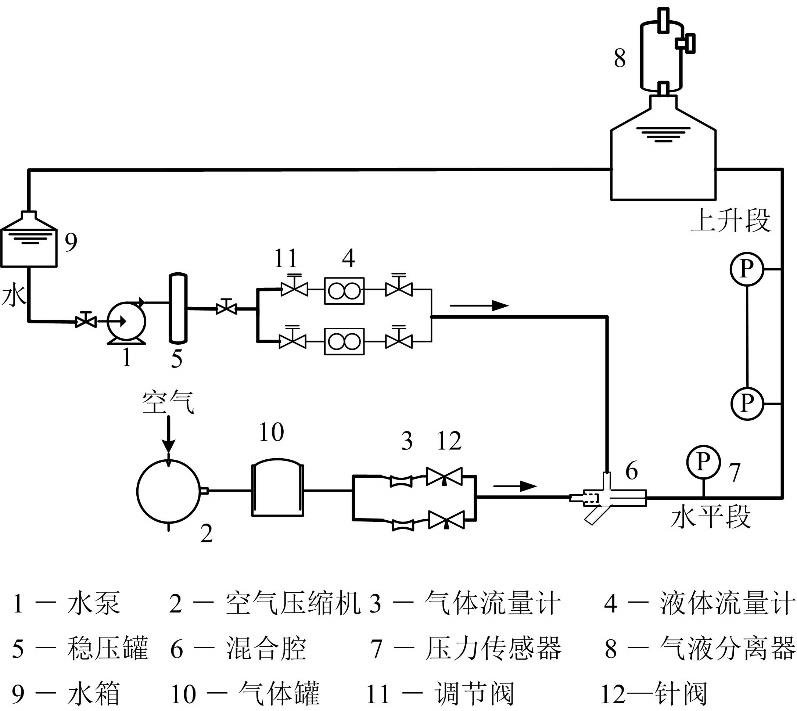
图1 实验系统示意图
Fig. 1 Schematic diagram of experimental system
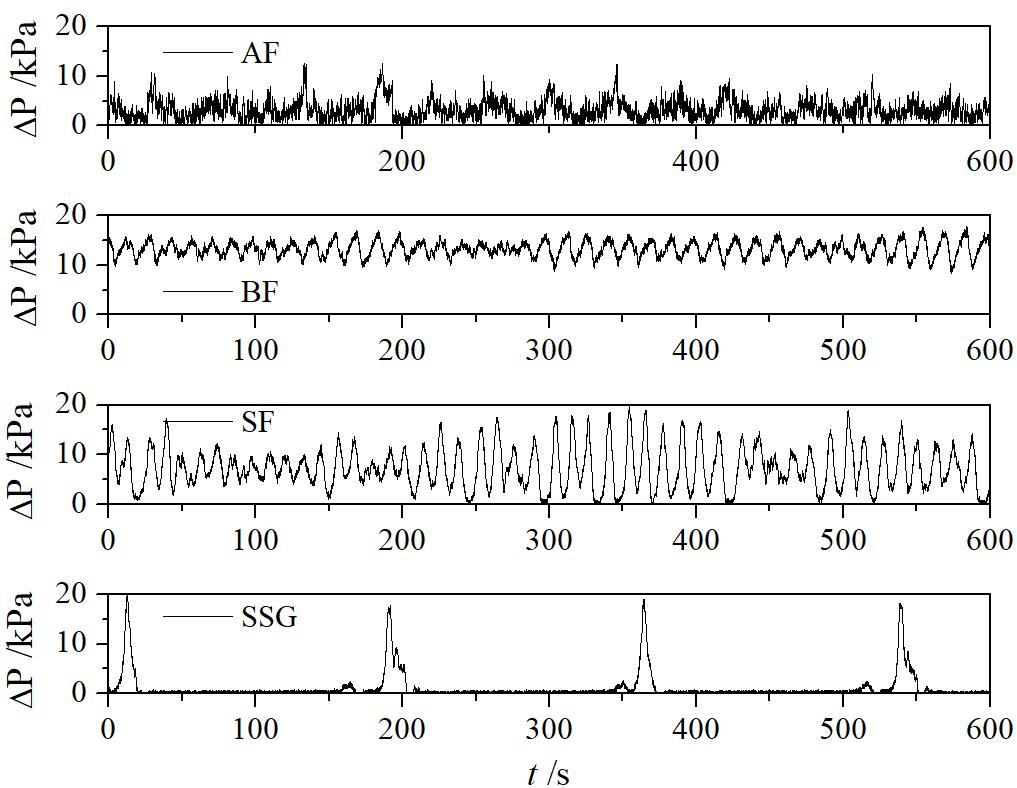
图2 实验中观察到的四种典型流型
Fig.2 Four typical flow patterns observed in the experiment
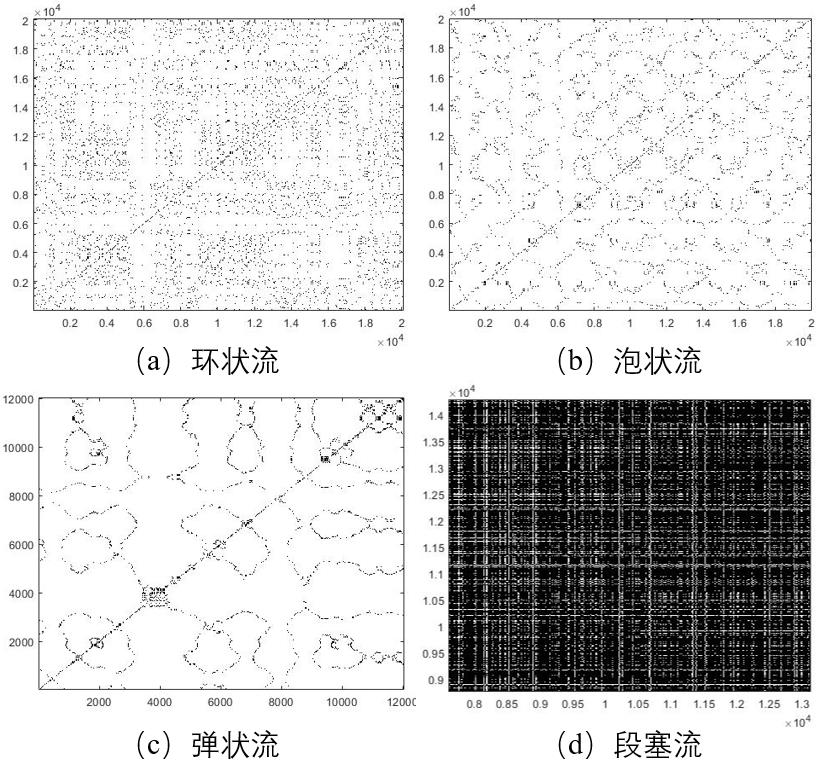
图3 四种典型流型的递归图
Fig.3 Recurrence plots of the four typical flow patterns
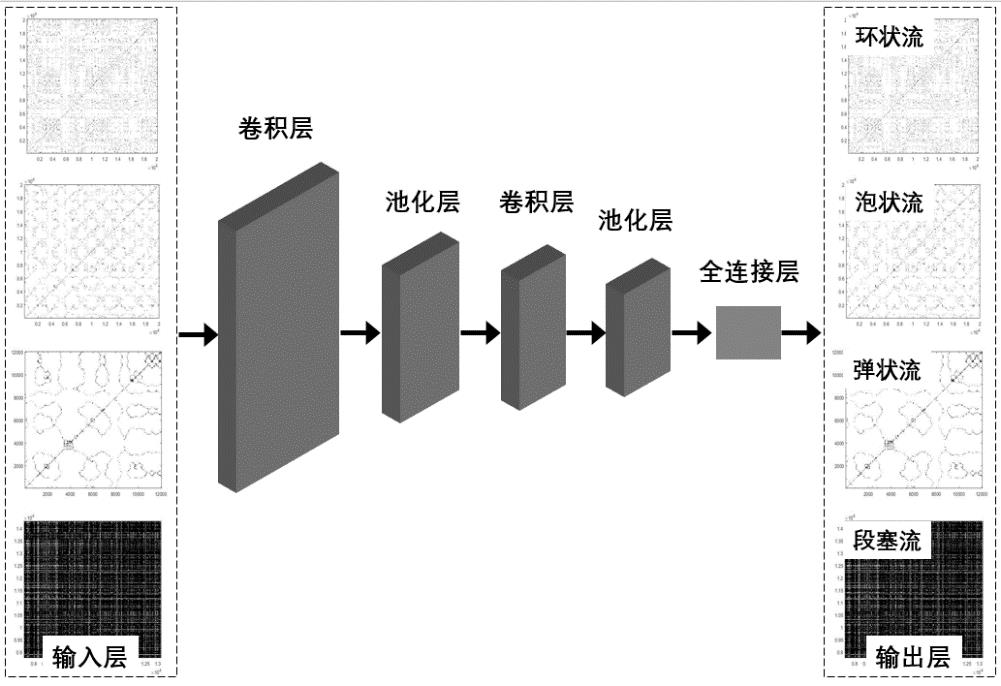
图4 基于LeNet网络的流型识别模型
Fig.4 Flow pattern recognition model based on LeNet network
| 模型类型 | 输入层尺寸 | 卷积核尺寸 | 池化核尺寸 | 全连接层正则化参数 | 输出层维度 |
|---|---|---|---|---|---|
| LeNet | 32,32,1 | 5×5 | 2×2 | 0.3 | 4 |
| AlexNet | 224,224,1 | 3×3 | 2×2 | 0.6 | 4 |
| ResNet | 224,224,3 | 7×7 | 7×7 | 0.6 | 4 |
表1 三种模型的结构尺寸
Table 1 Structure and size of the three models
| 模型类型 | 输入层尺寸 | 卷积核尺寸 | 池化核尺寸 | 全连接层正则化参数 | 输出层维度 |
|---|---|---|---|---|---|
| LeNet | 32,32,1 | 5×5 | 2×2 | 0.3 | 4 |
| AlexNet | 224,224,1 | 3×3 | 2×2 | 0.6 | 4 |
| ResNet | 224,224,3 | 7×7 | 7×7 | 0.6 | 4 |
| 神经网络 | 迭代次数 | 批次大小 | 学习率 |
|---|---|---|---|
| LeNet | 200 | 10 | 0.00010 |
| AlexNet | 200 | 8 | 0.00010 |
| ResNet | 200 | 8 | 0.00002 |
表2 三种模型的超参数
Table 2 Hyperparameters of the three models
| 神经网络 | 迭代次数 | 批次大小 | 学习率 |
|---|---|---|---|
| LeNet | 200 | 10 | 0.00010 |
| AlexNet | 200 | 8 | 0.00010 |
| ResNet | 200 | 8 | 0.00002 |
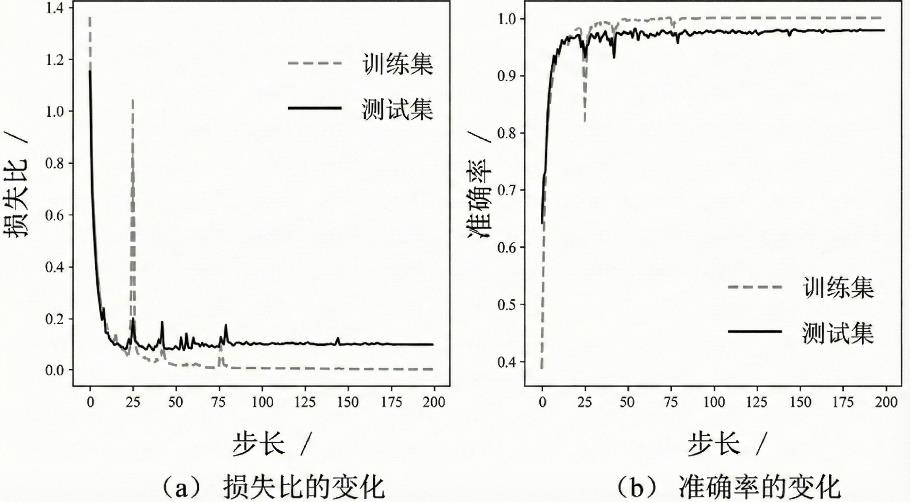
图5 LeNet模型在训练集与验证集上的损失率和准确率曲线
Fig.5 Loss and accuracy curves of LeNet model on training and validation data set
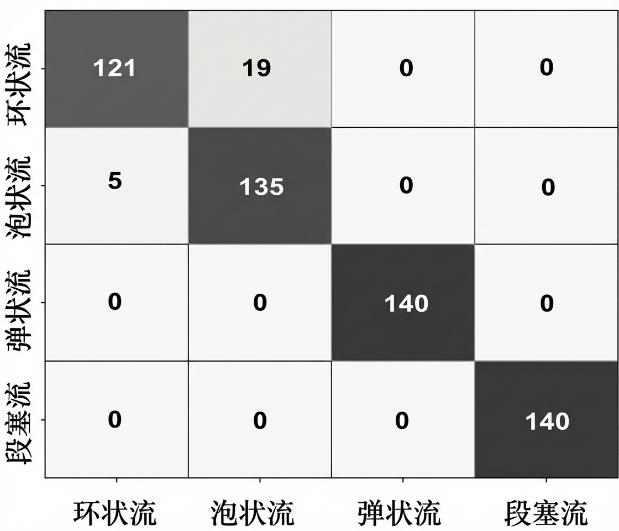
图6 LeNet模型的混淆矩阵
Fig.6 Confusion matrix of LeNet model
| 流型 | 样本数量 | 精确率 | Recall | 特异度 | 灵敏度 | F1 |
|---|---|---|---|---|---|---|
| 环状流 | 1400 | 0.86 | 0.86 | 0.98 | 0.96 | 0.90 |
| 泡状流 | 1400 | 0.96 | 0.96 | 0.95 | 0.87 | 0.91 |
| 弹状流 | 1400 | 1.00 | 1.00 | 1.00 | 1.00 | 1.00 |
| 段塞流 | 1400 | 1.00 | 1.00 | 1.00 | 1.00 | 1.00 |
| 总数 | 5600 |
表3 LeNet模型的流型识别效果
Table 3 Flow pattern recognition performance of LeNet model
| 流型 | 样本数量 | 精确率 | Recall | 特异度 | 灵敏度 | F1 |
|---|---|---|---|---|---|---|
| 环状流 | 1400 | 0.86 | 0.86 | 0.98 | 0.96 | 0.90 |
| 泡状流 | 1400 | 0.96 | 0.96 | 0.95 | 0.87 | 0.91 |
| 弹状流 | 1400 | 1.00 | 1.00 | 1.00 | 1.00 | 1.00 |
| 段塞流 | 1400 | 1.00 | 1.00 | 1.00 | 1.00 | 1.00 |
| 总数 | 5600 |
| 模型 | 精确率 | 特异性 | 灵敏度 | F1 |
|---|---|---|---|---|
| LeNet | 0.967 | 0.967 | 0.969 | 0.977 |
| AlexNet | 0.966 | 0.966 | 0.967 | 0.966 |
| ResNet | 0.873 | 0.873 | 0.909 | 0.866 |
表4 三种模型的识别性能对比
Table 4 Comparison of recognition performance of the three models
| 模型 | 精确率 | 特异性 | 灵敏度 | F1 |
|---|---|---|---|---|
| LeNet | 0.967 | 0.967 | 0.969 | 0.977 |
| AlexNet | 0.966 | 0.966 | 0.967 | 0.966 |
| ResNet | 0.873 | 0.873 | 0.909 | 0.866 |
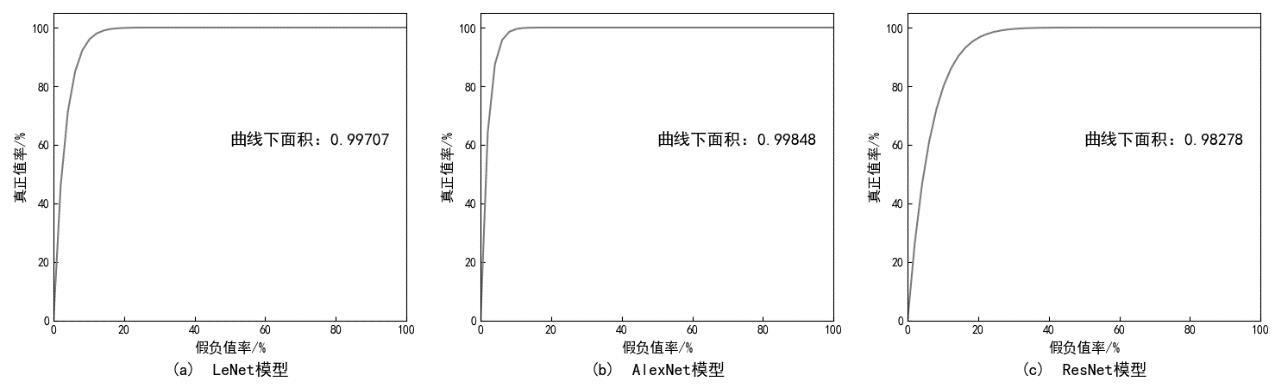
图7 三种模型的ROC曲线
Fig.7 ROC curves of the three models
| [1] | 李志军, 宁靓, 陈任霖. 中国国际海底区域资源勘查开发: 现状分析与战略研究[J]. 科学技术与工程, 2024, 24(27): 11558-11564. |
| Li Z J, Ning J, Chen R L. Exploration and development of international seabed area resources in China: current situation analysis and strategic research[J]. Science Technology and Engineering, 2024, 24(27): 11558-11564. | |
| [2] | 杨建民, 刘磊, 吕海宁, 等. 我国深海矿产资源开发装备研发现状与展望[J]. 中国工程科学, 2020, 22(6): 1-9. |
| Yang J M, Liu L, Lyu H N, et al. Deep-sea mining equipment in China: current status and prospect[J]. Strategic Study of CAE, 2020, 22(6): 1-9. | |
| [3] | 李清平, 周守为, 赵佳飞, 等. 天然气水合物开采技术研究现状与展望[J]. 中国工程科学, 2022, 24(3): 214-224. |
| Li Q P, Zhou S W, Zhao J F, et al. Research status and prospects of natural gas hydrate exploitation technology[J]. Strategic Study of CAE, 2022, 24(3): 214-224. | |
| [4] | 王国荣, 黄泽奇, 周守为, 等. 深海矿产资源开发装备现状及发展方向[J]. 中国工程科学, 2023, 25(3): 1-12. |
| Wang G R, Huang Z Q, Zhou S W, et al. Current status and development direction of deep-sea mineral resource exploitation equipment[J]. Strategic Study of CAE, 2023, 25(3): 1-12. | |
| [5] | 李乃良, 李文升, 郭烈锦. 集输-S型立管内气液两相流流型的PSD特征[J]. 工程热物理学报, 2012, 33(7): 1160-1162. |
| Li N L, Li W S, Guo L J. PSD characteristics of gas-liquid two-phase flow in pipeline S-shaped flexible riser[J]. Journal of Engineering Thermophysics, 2012, 33(7): 1160-1162. | |
| [6] | 姚添, 郭烈锦, 徐强, 等. 基于压差信号融合特征的集输立管流型识别研究[J]. 工程热物理学报, 2020, 41(12): 3014-3019. |
| Yao T, Guo L J, Xu Q, et al. Investigation on flow regimes recognition in pipeline-riser based on fusion features of differential pressure signals[J]. Journal of Engineering Thermophysics, 2020, 41(12): 3014-3019. | |
| [7] | Li N L, Guo L J, Li W S. Gas–liquid two-phase flow patterns in a pipeline–riser system with an S-shaped riser[J]. International Journal of Multiphase Flow, 2013, 55: 1-10. |
| [8] | 吴志成, 熊珍琴, 顾汉洋. 水平与微倾斜管内气液两相流长气泡形状实验和模型研究[J]. 动力工程学报, 2018, 38(2): 163-168. |
| Wu Z C, Xiong Z Q, Gu H Y. Experimental and theoretical study on the shape of long bubbles in horizontal and near horizontal two-phase slug flows[J]. Journal of Chinese Society of Power Engineering, 2018, 38(2): 163-168. | |
| [9] | 王冬旭, 胡其会, 李玉星, 等. 大起伏角度下V形管道段塞流流型特性[J]. 科学技术与工程, 2020, 20(28): 11574-11579. |
| Wang D X, Hu Q H, Li Y X, et al. Study on the characteristics of slug flow in V-type pipeline with great angle[J]. Science Technology and Engineering, 2020, 20(28): 11574-11579. | |
| [10] | 郭伟, 刘传平, 童莉葛, 等. 新型热扩散式测量技术助力气液多相流监测[J]. 化工进展, 2025, 44(4): 1781-1785. |
| Guo W, Liu C P, Tong L G, et al. Novel thermal diffusion measurement technique for enhanced monitoring of gas-liquid multiphase flows[J]. Chemical Industry and Engineering Progress, 2025, 44(4): 1781-1785. | |
| [11] | 孙采鹰, 闫勇, 张文彪. 基于电容传感器的CO2气液两相流流型识别[J]. 传感器与微系统, 2024, 43(6): 145-148. |
| Sun C Y, Yan Y, Zhang W B. Flow pattern identification of CO2 gas-liquid two-phase flow based on capacitive sensor[J]. Transducer and Microsystem Technologies, 2024, 43(6): 145-148. | |
| [12] | 史雪薇, 谭超, 董峰. 基于环形电导传感器的气液两相流流型识别与过程参数测量[J]. 化工进展, 2024, 43(2): 637-648. |
| Shi X W, Tan C, Dong F. Gas-liquid two-phase flow pattern identification and flow parameters measurement based on the ring-shape conductance sensor[J]. Chemical Industry and Engineering Progress, 2024, 43(2): 637-648. | |
| [13] | 徐一, 李轶, 马志扬, 等. 基于电容层析测量的油气两相流动态信号时频分析方法[J]. 化工进展, 2024, 43(2): 855-864. |
| Xu Y, Li Y, Ma Z Y, et al. Dynamic signal analysis for gas-oil two-phase flow in time-frequency domain based on electrical capacitance tomography[J]. Chemical Industry and Engineering Progress, 2024, 43(2): 855-864. | |
| [14] | Zhou W, Miwa S, Tsujimura R, et al. Development of the AI-assisted thermal hydraulic analysis method for condensing bubbles in vertical subcooled flow boiling[J]. International Journal of Multiphase Flow, 2025, 189: 105246. |
| [15] | 周贯旭, 姜红, 徐雪芳. 高光谱结合卷积神经网络对食源性致病菌的快速识别[J]. 浙江大学学报(理学版), 2025, 52(4): 489-495, 507. |
| Zhou G X, Jiang H, Xu X F. Rapid identification of foodborne pathogenic bacteria using hyperspectral imaging combined with convolutional neural networks[J]. Journal of Zhejiang University (Science Edition), 2025, 52(4): 489-495, 507. | |
| [16] | 孙海蓉, 唐振超, 张洪玮, 等. 融合持续同调-CNN的灰度化光伏红外图像的识别和分类[J]. 太阳能学报, 2025, 46(6): 321-328. |
| Sun H R, Tang Z C, Zhang H W, et al. Recognition and classification of grayscale photovoltaic images using convolutional neural networks fused with persistent homology[J]. Acta Energiae Solaris Sinica, 2025, 46(6): 321-328. | |
| [17] | 缪炳荣, 徐松源, 吴啸林, 等. 多传感器数据融合和改进卷积神经网络的车轮踏面损伤识别方法[J]. 振动工程学报, 2025, 38(6): 1221-1231. |
| Miao B R, Xu S Y, Wu X L, et al. A method for wheel tread damage identification using multi-sensor data fusion and improved convolutional neural networks[J]. Journal of Vibration Engineering, 2025, 38(6): 1221-1231. | |
| [18] | 向艳芳, 石红, 张家臣, 等. 便携式拉曼光谱仪结合CGAN-Multi-CNN模型的矿物精确识别方法研究[J]. 分析测试学报, 2025, 44(6): 1075-1085. |
| Xiang Y F, Shi H, Zhang J C, et al. Rapid mineral identification based on portable Raman spectroscopy equipment combined with CGAN-multi-CNN model[J]. Journal of Instrumental Analysis, 2025, 44(6): 1075-1085. | |
| [19] | 张立峰, 王智. 基于递归图的两相流流动特性分析与流型识别[J]. 计量学报, 2022, 43(11): 1438-1444. |
| Zhang L F, Wang Z. Flow characteristics analysis and flow pattern recognition of two-phase flow based on recurrent plot[J]. Acta Metrologica Sinica, 2022, 43(11): 1438-1444. | |
| [20] | 何永勃, 董玉珊, 薛荣荣. 基于交互式递归分析的两相流流型识别方法[J]. 系统仿真学报, 2019, 31(4): 720-726. |
| He Y B, Dong Y S, Xue R R. Recognition method on two-phase flow regime based on cross recursive analysis[J]. Journal of System Simulation, 2019, 31(4): 720-726. | |
| [21] | 李乃良, 张一帆, 杜雪平, 等. 集输系统内空气-油两相流型能量谱图分析[J]. 工程热物理学报, 2025, 46(4): 1181-1187. |
| Li N L, Zhang Y F, Du X P, et al. Study on energy spectrum of air-oil two-phase flow patterns in pipeline-riser[J]. Journal of Engineering Thermophysics, 2025, 46(4): 1181-1187. | |
| [22] | 李乃良, 陈聚凯, 韩骏楷, 等. 静态及摇摆条件下弹状流壁面切应力实验研究[J]. 化工学报, 2023, 74(12): 4852-4862. |
| Li N L, Chen J K, Han J K, et al. Experimental study on the wall shear stress of slug flow under static and rolling conditions[J]. CIESC Journal, 2023, 74(12): 4852-4862. | |
| [23] | 常英杰, 赵向远, 吴全红, 等. 长距离集输立管中严重段塞流频率特性研究[J]. 工程热物理学报, 2022, 43(1): 98-103. |
| Chang Y J, Zhao X Y, Wu Q H, et al. Study on severe slugging frequency characteristics in a long pipeline-riser system[J]. Journal of Engineering Thermophysics, 2022, 43(1): 98-103. | |
| [24] | 高岳, 唐堂, 朱红钧, 等. 严重段塞流动与悬链线型柔性立管振动间的耦合作用研究[J]. 水动力学研究与进展A辑, 2025, 40(1): 89-99. |
| Gao Y, Tang T, Zhu H J, et al. Study on interaction between severe slug flow and vibration response of catenary flexible riser[J]. Journal of Hydrodynamics, 2025, 40(1): 89-99. | |
| [25] | 李乃良, 刘常松, 杜雪平, 等. 基于Hurst指数的严重段塞流多尺度分形特性[J]. 化工学报, 2024, 75(2): 484-492. |
| Li N L, Liu C S, Du X P, et al. Analysis of multi-scale fractal characteristics of severe slugging based on Hurst exponent[J]. CIESC Journal, 2024, 75(2): 484-492. | |
| [26] | 张兵, 魏利平, 滕海鹏. 隔板式内循环流化床压力脉动信号递归分析[J]. 化工学报, 2020, 71(S1): 106-113. |
| Zhang B, Wei L P, Teng H P. Recurrence analysis of pressure fluctuations inclapboard-type internally circulating fluidized bed[J]. CIESC Journal, 2020, 71(S1): 106-113. | |
| [27] | 白雯琪, 钱伟军, 蒋新新, 等. 多序列优化VBQs与QCT对骨质疏松诊断效能分析[J]. 磁共振成像, 2025, 16(8): 106-115. |
| Bai W Q, Qian W J, Jiang X X, et al. Analysis of the diagnostic efficacy of multi-sequence optimized VBQs and QCT for osteoporosis[J]. Chinese Journal of Magnetic Resonance Imaging, 2025, 16(8): 106-115. | |
| [28] | 苏世玉, 于炯, 李姝, 等. 基于双重分类和重建的跨域图异常检测[J]. 计算机科学, 2025, 52(8): 374-384. |
| Su S Y, Yu J, Li S, et al. Cross-domain graph anomaly detection via dual classification and reconstruction[J]. Computer Science, 2025, 52(8): 374-384. | |
| [29] | 王进, 臧明东, 许冲, 等. 基于层次分析与受试者工作特征曲线下面积耦合算法的2022年泸定地震滑坡易发性评估[J]. 工程地质学报, 2024, 32(5): 1696-1711. |
| Wang J, Zang M D, Xu C, et al. Landslide susceptibility assessment following the 2022 Luding earthquake: a coupled analytic hierarchy process and area under the receiver operating characteristic curve algorithm[J]. Journal of Engineering Geology, 2024, 32(5): 1696-1711. | |
| [30] | 刘山东, 李军, 江兴元, 等. 基于数学统计与机器学习模型耦合的滑坡易发性评价方法优化[J]. 科学技术与工程, 2025, 25(5): 1827-1839. |
| Liu S D, Li J, Jiang X Y, et al. Optimization of landslide susceptibility assessment method coupling mathematical statistics and machine learning models[J]. Science Technology and Engineering, 2025, 25(5): 1827-1839. |
| [1] | 沙鑫权, 胡然, 丁磊, 蒋珍华, 吴亦农. 空间用单机两级有阀线性压缩机研制及测试[J]. 化工学报, 2025, 76(S1): 114-122. |
| [2] | 孙浩然, 吴成云, 王艳蒙, 孙静楠, 胡仞与, 段钟弟. 热对流影响下液滴蒸发特性模型与实验研究[J]. 化工学报, 2025, 76(S1): 123-132. |
| [3] | 燕子腾, 詹飞龙, 丁国良. 空调用套管式分流器结构设计及分流效果验证[J]. 化工学报, 2025, 76(S1): 152-159. |
| [4] | 密晓光, 孙国刚, 程昊, 张晓慧. 印刷电路板式天然气冷却器性能仿真模型和验证[J]. 化工学报, 2025, 76(S1): 426-434. |
| [5] | 段浩磊, 陈浩远, 梁坤峰, 王林, 陈彬, 曹勇, 张晨光, 李硕鹏, 朱登宇, 何亚茹, 杨大鹏. 纯电动车热管理系统低GWP工质替代方案性能分析与综合评价[J]. 化工学报, 2025, 76(S1): 54-61. |
| [6] | 任现超, 谷雅秀, 段少斌, 贾文竹, 李汉林. 翅片式椭圆套管蒸发式冷凝器传热传质性能实验研究[J]. 化工学报, 2025, 76(S1): 75-83. |
| [7] | 王俊鹏, 冯佳琪, 张恩搏, 白博峰. 曲折式与阵列式迷宫阀芯结构内流动与空化特性研究[J]. 化工学报, 2025, 76(S1): 93-105. |
| [8] | 袁琳慧, 王瑜. 单服务器浸没射流式液冷系统散热性能[J]. 化工学报, 2025, 76(S1): 160-169. |
| [9] | 赵子祥, 段钟弟, 孙浩然, 薛鸿祥. 大温差两相流动诱导水锤冲击的数值模型[J]. 化工学报, 2025, 76(S1): 170-180. |
| [10] | 曹庆泰, 郭松源, 李建强, 蒋赞, 汪彬, 耑锐, 吴静怡, 杨光. 负过载下多孔隔板对液氧贮箱蓄液性能的影响研究[J]. 化工学报, 2025, 76(S1): 217-229. |
| [11] | 吴迪, 胡斌, 姜佳彤. R1233zd(E)高温热泵实验研究与应用分析[J]. 化工学报, 2025, 76(S1): 377-383. |
| [12] | 黄国瑞, 赵耀, 谢明熹, 陈尔健, 代彦军. 一种新型数据中心余热回收系统实验与分析[J]. 化工学报, 2025, 76(S1): 409-417. |
| [13] | 刘奕扬, 邢志祥, 刘烨铖, 彭明, 李玉洋, 李云浩, 沈宁舟. 加氢站液氢泄漏扩散特性与安全监测数值模拟研究[J]. 化工学报, 2025, 76(9): 4694-4708. |
| [14] | 罗海梅, 王泓, 孙照明, 尹艳华. 同向双螺杆传热系数计算模型的分析与验证[J]. 化工学报, 2025, 76(9): 4809-4823. |
| [15] | 梁晓江, 陈薇薇, 罗佳南, 费浩天, 叶雪蕾, 李文豪, 聂勇. 电分散管式填充床中荷电气泡的分散特性研究[J]. 化工学报, 2025, 76(8): 3915-3931. |
| 阅读次数 | ||||||
|
全文 |
|
|||||
|
摘要 |
|
|||||
 京公网安备 11010102001995号