化工学报 ›› 2020, Vol. 71 ›› Issue (7): 3151-3164.DOI: 10.11949/0438-1157.20191139
于仙毅1( ),巫江虹1(),高云辉2
收稿日期:2019-10-08
修回日期:2019-12-24
出版日期:2020-07-05
发布日期:2020-07-05
通讯作者:
巫江虹
作者简介:于仙毅(1994—),男,硕士研究生,基金资助:
Xianyi YU1(),Jianghong WU1(),Yunhui GAO2
Received:2019-10-08
Revised:2019-12-24
Online:2020-07-05
Published:2020-07-05
Contact:
Jianghong WU
摘要:
为了研究热泵系统制冷剂泄漏识别的数据挖掘理论方法和实验验证,首先建立空气源热泵系统制冷剂泄漏实验台,进行热泵系统正常工况、干扰工况、泄漏工况的实验参数测试;其次,采用主成分分析法对测试数据进行特征提取处理,采用支持向量机对数据进行分类识别,建立了用于热泵系统的制冷剂泄漏识别的主成分分析-支持向量机模型,在二分类和多分类模式下验证了模型的性能,并研究了泄漏速率和不同故障工况对模型的影响。采用RefliefF特征选择算法对原始特征参数进行筛选,简化了识别模型的特征参数。研究结果表明:对于空气源热泵热水系统,PCA-SVM泄漏识别模型在多种验证集中对泄漏工况的识别准确度达100%,缓慢泄漏的诊断识别性能弱于快速泄漏,同一模型在不同故障诊断识别中性能不同,对系统运行影响轻微的故障诊断识别性能弱于其他故障。RefliefF特征选择方法将原始41个系统特征参数精简至10个特征参数,参数筛选优化后的泄漏识别模型识别精度也维持在较高水平,优化的泄漏识别模型更利于实际应用。
中图分类号:
于仙毅, 巫江虹, 高云辉. 基于主成分分析与支持向量机的热泵系统制冷剂泄漏识别研究[J]. 化工学报, 2020, 71(7): 3151-3164.
Xianyi YU, Jianghong WU, Yunhui GAO. Research on refrigerant leakage identification for heat pump system based on PCA-SVM models[J]. CIESC Journal, 2020, 71(7): 3151-3164.
| 系统 | 部件 | 规格型号 |
|---|---|---|
| 制冷循环系统 | 压缩机 | BSA645CV-R1EN型 R134a制冷剂 |
| 冷凝器 | U型套管式 | |
| 节流阀 | 丹佛斯TN2型热力膨胀阀 | |
| 蒸发器(含小型风扇组) | 单流层微通道换热器 | |
| 水路循环系统 | 保温水箱 | 30 L、?20 mm进出水口 |
| 水泵 | 1个 自吸式磁力循环泵 | |
| 水流量计 | 1个 LWGY型涡轮流量计 | |
| 制冷剂泄漏控制及收集部件 | 手阀 | 4个 |
| 开度阀 | 4个 | |
| 气体收集袋 | 1个 20 L超高密封袋 | |
| 测试部件 | 热电偶 | 若干 J型热电偶 |
| 压力变送器 | 8个 0~0.6 MPa、0~4 MPa | |
| 电子秤 | 100 g/0.02 g 15 kg/0.2 g | |
| 功率仪 | 1个 HOPI型 | |
| 安捷伦 | 1台 34972型 | |
| 计算机 | 1台 |
表1 制冷剂泄漏实验系统部件信息
Table 1 Refrigerant leak test system component information
| 系统 | 部件 | 规格型号 |
|---|---|---|
| 制冷循环系统 | 压缩机 | BSA645CV-R1EN型 R134a制冷剂 |
| 冷凝器 | U型套管式 | |
| 节流阀 | 丹佛斯TN2型热力膨胀阀 | |
| 蒸发器(含小型风扇组) | 单流层微通道换热器 | |
| 水路循环系统 | 保温水箱 | 30 L、?20 mm进出水口 |
| 水泵 | 1个 自吸式磁力循环泵 | |
| 水流量计 | 1个 LWGY型涡轮流量计 | |
| 制冷剂泄漏控制及收集部件 | 手阀 | 4个 |
| 开度阀 | 4个 | |
| 气体收集袋 | 1个 20 L超高密封袋 | |
| 测试部件 | 热电偶 | 若干 J型热电偶 |
| 压力变送器 | 8个 0~0.6 MPa、0~4 MPa | |
| 电子秤 | 100 g/0.02 g 15 kg/0.2 g | |
| 功率仪 | 1个 HOPI型 | |
| 安捷伦 | 1台 34972型 | |
| 计算机 | 1台 |
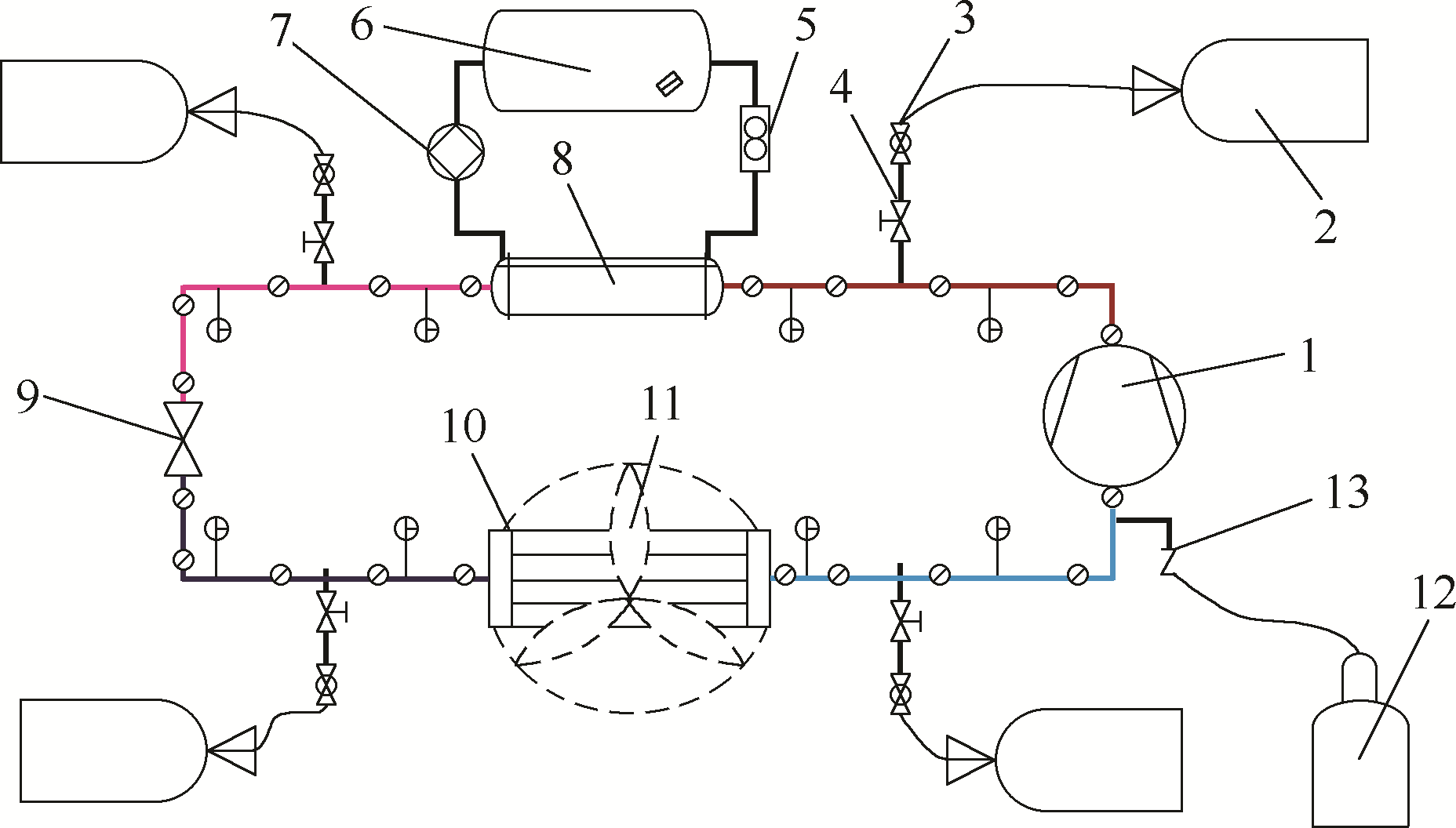
图1 泄漏实验系统及测点布置示意图温度测点; 压力测点;1—压缩机;2—防爆气囊;3—可调开度阀;4—开度阀;5—水流量计;6—水箱;7—水泵;8—套管冷凝器;9—热力膨胀阀;10—蒸发器;11—风机;12—制冷剂气瓶;13—开度阀
Fig.1 Schematic diagram of leakage test system and arrangement of measurement points

图2 制冷剂泄漏实验实物图
Fig.2 Refrigerant leakage experimental
| 工况类型 | 工况详情及引入方法 |
|---|---|
| 正常工况(normal) | 系统开机后,恒定30℃水温,系统稳定运行 |
| 泄漏工况(Refleak) | 以正常工况为基准,在其开机平稳运行一小段时间后,系统趋于稳定的一个时间点作为泄漏工况的开始点,开始控制泄漏口阀门开度 |
| 冷凝器脏污工况(ReduCF) | 调节冷凝器水泵,降低冷凝器水流量 |
| 蒸发器脏污工况(ReduEF) | 通过遮挡蒸发器,降低蒸发器换热面积 |
| 热力膨胀阀预紧力过小工况(loosTV) | 人为调松热力膨胀阀预紧弹簧 |
| 热力膨胀阀预紧力过大工况(ClosTV) | 人为调紧热力膨胀阀预紧弹簧 |
| 冷凝温度变化工况(IncrTW)(DecrTW) | 分别恒定6号大水箱内的水温为25℃和35℃ |
表2 恒定水温热泵系统测试工况
Table 2 Test conditions of the heat pump system with constant water temperature
| 工况类型 | 工况详情及引入方法 |
|---|---|
| 正常工况(normal) | 系统开机后,恒定30℃水温,系统稳定运行 |
| 泄漏工况(Refleak) | 以正常工况为基准,在其开机平稳运行一小段时间后,系统趋于稳定的一个时间点作为泄漏工况的开始点,开始控制泄漏口阀门开度 |
| 冷凝器脏污工况(ReduCF) | 调节冷凝器水泵,降低冷凝器水流量 |
| 蒸发器脏污工况(ReduEF) | 通过遮挡蒸发器,降低蒸发器换热面积 |
| 热力膨胀阀预紧力过小工况(loosTV) | 人为调松热力膨胀阀预紧弹簧 |
| 热力膨胀阀预紧力过大工况(ClosTV) | 人为调紧热力膨胀阀预紧弹簧 |
| 冷凝温度变化工况(IncrTW)(DecrTW) | 分别恒定6号大水箱内的水温为25℃和35℃ |
| 序号 | 变量 符号 | 变量名称 | 意义 |
|---|---|---|---|
| 1 | Tci1 | 冷凝器进口温度1 | 测点温度 |
| 2 | Tci2 | 冷凝器进口温度2 | 测点温度 |
| 3 | Tci3 | 冷凝器进口温度3 | 测点温度 |
| 4 | Tci4 | 冷凝器进口温度4 | 测点温度 |
| 5 | Tci5 | 冷凝器进口温度5 | 测点温度 |
| 6 | Tco1 | 冷凝器出口温度1 | 测点温度 |
| 7 | Tco2 | 冷凝器出口温度2 | 测点温度 |
| 8 | Tco3 | 冷凝器出口温度3 | 测点温度 |
| 9 | Tco4 | 冷凝器出口温度4 | 测点温度 |
| 10 | Tco5 | 冷凝器出口温度5 | 测点温度 |
| 11 | Tei1 | 蒸发器进口温度1 | 测点温度 |
| 12 | Tei2 | 蒸发器进口温度2 | 测点温度 |
| 13 | Tei3 | 蒸发器进口温度3 | 测点温度 |
| 14 | Tei4 | 蒸发器进口温度4 | 测点温度 |
| 15 | Tei5 | 蒸发器进口温度5 | 测点温度 |
| 16 | Teo1 | 蒸发器出口温度1 | 测点温度 |
| 17 | Teo2 | 蒸发器出口温度2 | 测点温度 |
| 18 | Teo3 | 蒸发器出口温度3 | 测点温度 |
| 19 | Teo4 | 蒸发器出口温度4 | 测点温度 |
| 20 | Teo5 | 蒸发器出口温度5 | 测点温度 |
| 21 | Tesu | 蒸发器风冷出口环温 | 蒸发端环境温度 |
| 22 | Twat | 水箱水温 | 冷凝端环境温度 |
| 23 | POcom | 压缩机耗功 | 系统输入耗功 |
| 24 | Tesub | 过热度 | Teo1-Tgsat |
| 25 | Tcsub | 过冷度 | Tlsat-Tco1 |
| 26 | P01 | 压缩机出口压力 | 压力测点 |
| 27 | P02 | 冷凝器进口压力 | 压力测点 |
| 28 | P03 | 冷凝器出口压力 | 压力测点 |
| 29 | P04 | 节流阀入口压力 | 压力测点 |
| 30 | P05 | 节流阀出口压力 | 压力测点 |
| 31 | P06 | 蒸发器进口压力 | 压力测点 |
| 32 | P07 | 蒸发器出口压力 | 压力测点 |
| 33 | P08 | 压缩机进口压力 | 压力测点 |
| 34 | ΔTcom | 压缩机进出口温差 | Tci1-Teo5 |
| 35 | ΔTcon | 冷凝器进出口温差 | Tci5-Tco1 |
| 36 | ΔTvel | 节流阀温差 | Tco5-Tei1 |
| 37 | ΔPcom | 压缩机进出口压差 | P01-P08 |
| 38 | ΔPcon | 冷凝器进出口压差 | P02-P03 |
| 39 | ΔPvel | 节流阀压差 | P04-P05 |
| 40 | ΔPeva | 蒸发器进出口压差 | P06-P07 |
| 41 | ΔHcon | 冷凝器进出口焓差 | Hci-Hco |
表3 特征变量名称符号及对应的系统表征含义
Table 3 Name symbols of characteristic variables and their corresponding system representation meanings
| 序号 | 变量 符号 | 变量名称 | 意义 |
|---|---|---|---|
| 1 | Tci1 | 冷凝器进口温度1 | 测点温度 |
| 2 | Tci2 | 冷凝器进口温度2 | 测点温度 |
| 3 | Tci3 | 冷凝器进口温度3 | 测点温度 |
| 4 | Tci4 | 冷凝器进口温度4 | 测点温度 |
| 5 | Tci5 | 冷凝器进口温度5 | 测点温度 |
| 6 | Tco1 | 冷凝器出口温度1 | 测点温度 |
| 7 | Tco2 | 冷凝器出口温度2 | 测点温度 |
| 8 | Tco3 | 冷凝器出口温度3 | 测点温度 |
| 9 | Tco4 | 冷凝器出口温度4 | 测点温度 |
| 10 | Tco5 | 冷凝器出口温度5 | 测点温度 |
| 11 | Tei1 | 蒸发器进口温度1 | 测点温度 |
| 12 | Tei2 | 蒸发器进口温度2 | 测点温度 |
| 13 | Tei3 | 蒸发器进口温度3 | 测点温度 |
| 14 | Tei4 | 蒸发器进口温度4 | 测点温度 |
| 15 | Tei5 | 蒸发器进口温度5 | 测点温度 |
| 16 | Teo1 | 蒸发器出口温度1 | 测点温度 |
| 17 | Teo2 | 蒸发器出口温度2 | 测点温度 |
| 18 | Teo3 | 蒸发器出口温度3 | 测点温度 |
| 19 | Teo4 | 蒸发器出口温度4 | 测点温度 |
| 20 | Teo5 | 蒸发器出口温度5 | 测点温度 |
| 21 | Tesu | 蒸发器风冷出口环温 | 蒸发端环境温度 |
| 22 | Twat | 水箱水温 | 冷凝端环境温度 |
| 23 | POcom | 压缩机耗功 | 系统输入耗功 |
| 24 | Tesub | 过热度 | Teo1-Tgsat |
| 25 | Tcsub | 过冷度 | Tlsat-Tco1 |
| 26 | P01 | 压缩机出口压力 | 压力测点 |
| 27 | P02 | 冷凝器进口压力 | 压力测点 |
| 28 | P03 | 冷凝器出口压力 | 压力测点 |
| 29 | P04 | 节流阀入口压力 | 压力测点 |
| 30 | P05 | 节流阀出口压力 | 压力测点 |
| 31 | P06 | 蒸发器进口压力 | 压力测点 |
| 32 | P07 | 蒸发器出口压力 | 压力测点 |
| 33 | P08 | 压缩机进口压力 | 压力测点 |
| 34 | ΔTcom | 压缩机进出口温差 | Tci1-Teo5 |
| 35 | ΔTcon | 冷凝器进出口温差 | Tci5-Tco1 |
| 36 | ΔTvel | 节流阀温差 | Tco5-Tei1 |
| 37 | ΔPcom | 压缩机进出口压差 | P01-P08 |
| 38 | ΔPcon | 冷凝器进出口压差 | P02-P03 |
| 39 | ΔPvel | 节流阀压差 | P04-P05 |
| 40 | ΔPeva | 蒸发器进出口压差 | P06-P07 |
| 41 | ΔHcon | 冷凝器进出口焓差 | Hci-Hco |
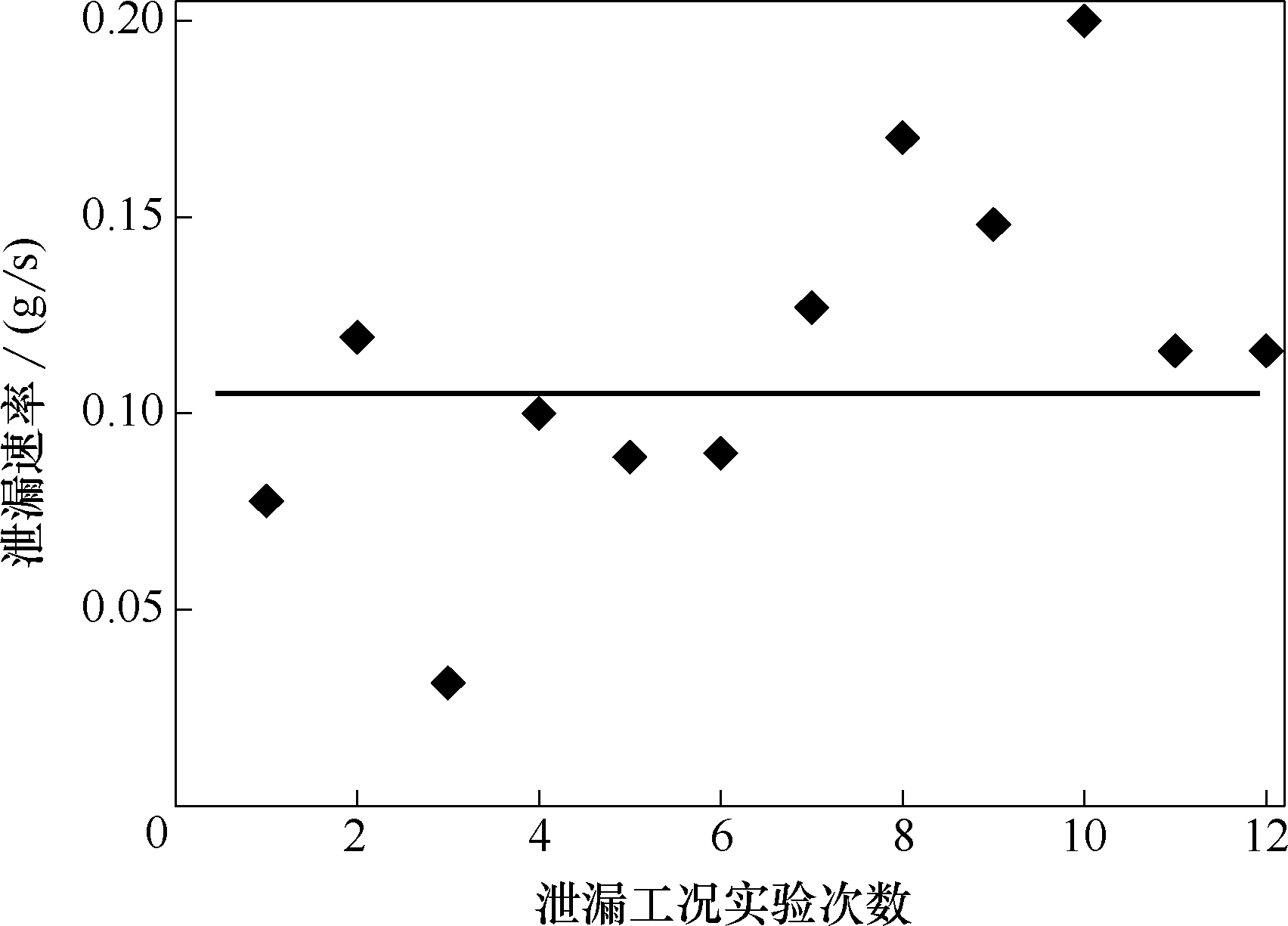
图3 泄漏工况实验制冷剂泄漏速率
Fig.3 Refrigerant leakage rate of experimental in leakage condition
| 名称 | 表达式 | 参数 |
|---|---|---|
| 线性核 | ||
| 多项式核 | ||
| 高斯核 | ||
| 拉普拉斯核 | ||
| Sigmoid核 |
表4 不同核函数类型的SVM模型表达式及其参数
Table 4 SVM model expressions and parameters of different kernel function types
| 名称 | 表达式 | 参数 |
|---|---|---|
| 线性核 | ||
| 多项式核 | ||
| 高斯核 | ||
| 拉普拉斯核 | ||
| Sigmoid核 |
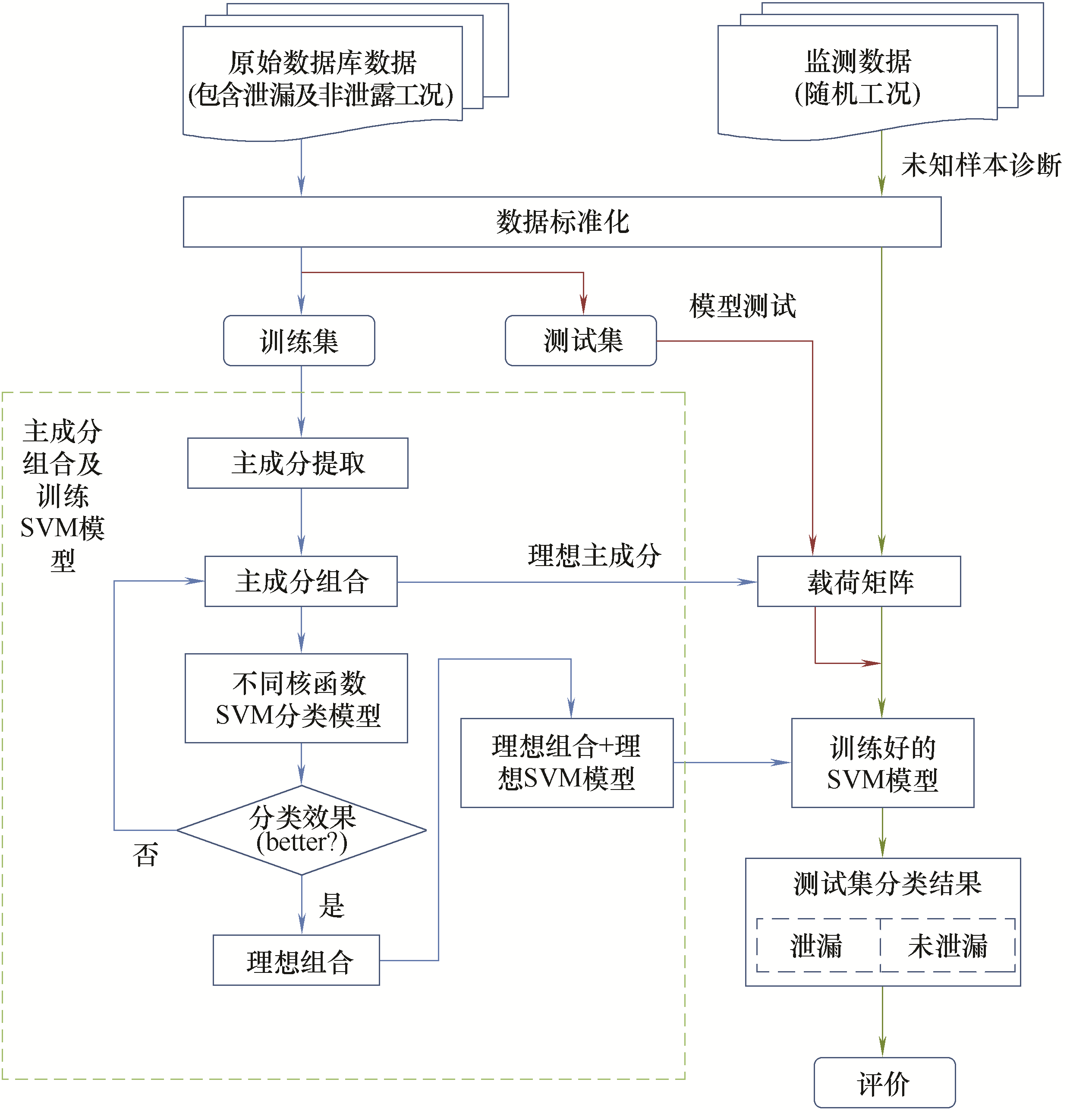
图4 基于PCA-SVM的制冷剂泄漏识别模型
Fig.4 Refrigerant leak identification model based on PCA-SVM
| 真实结果 | 识别结果 | |
|---|---|---|
| 泄漏 | 非泄漏 | |
| 泄漏 | TP | FN |
| 非泄露 | FP | TN |
表5 二分类结果的混淆矩阵
Table 5 Confusion matrix of binary classification results
| 真实结果 | 识别结果 | |
|---|---|---|
| 泄漏 | 非泄漏 | |
| 泄漏 | TP | FN |
| 非泄露 | FP | TN |
| 评价指标 | 定义 | 计算公式 | |
|---|---|---|---|
| 按类性能 | 命中率TPR | 对于给定类,发生且正确预测的样本占总发生样本的比率 | |
| 虚警率FPR | 对于给定类,没发生但被预测为发生的样本占没发生样本总数的比率 | ||
| 总体性能 | 准确率Acc | 正确分类数占总样本数的比率 | |
| 错误分类率Mcr | 错误分类样本数占总样本数的比率 | ||
表6 泄漏识别模型评级评价指标及其定义
Table 6 Leak identification model rating evaluation index and its definition
| 评价指标 | 定义 | 计算公式 | |
|---|---|---|---|
| 按类性能 | 命中率TPR | 对于给定类,发生且正确预测的样本占总发生样本的比率 | |
| 虚警率FPR | 对于给定类,没发生但被预测为发生的样本占没发生样本总数的比率 | ||
| 总体性能 | 准确率Acc | 正确分类数占总样本数的比率 | |
| 错误分类率Mcr | 错误分类样本数占总样本数的比率 | ||
| 主元编号 | 特征值 | 主元方差贡献率/% | 累计方差贡献率/% | Tci1 | Tci2 | Tci3 | Tci4 | … | ΔPvel | ΔPeva | ΔHcon | |
|---|---|---|---|---|---|---|---|---|---|---|---|---|
| 1 | 15.80 | 38.55 | 38.55 | 0.052 | 0.220 | 0.246 | -0.135 | … | -0.289 | 0.249 | 0.112 | |
| 2 | 9.64 | 23.51 | 62.06 | 0.048 | 0.213 | 0.253 | -0.143 | … | -0.000 | 0.000 | -0.000 | |
| 3 | 7.12 | 17.36 | 79.42 | 0.048 | 0.216 | 0.250 | -0.142 | … | -0.000 | 0.000 | -0.000 | |
| 4 | 3.12 | 7.61 | 87.03 | 0.045 | 0.213 | 0.254 | -0.145 | … | 0.000 | 0.000 | 0.000 | |
| 5 | 2.37 | 5.78 | 92.81 | 0.034 | 0.216 | 0.254 | -0.148 | … | -0.121 | 0.312 | 0.446 | |
| 6 | 0.82 | 2.01 | 94.82 | -0.173 | 0.214 | -0.072 | 0.036 | … | 0.054 | -0.140 | -0.200 | |
| 7 | 0.71 | 1.74 | 96.56 | -0.208 | 0.157 | -0.052 | 0.036 | … | -0.000 | -0.000 | -0.000 | |
| … | … | … | … | … | … | … | … | … | … | … | … | |
表7 泄漏特征的主成分分析结果
Table 7 Principal component analysis results of leakage characteristics
| 主元编号 | 特征值 | 主元方差贡献率/% | 累计方差贡献率/% | Tci1 | Tci2 | Tci3 | Tci4 | … | ΔPvel | ΔPeva | ΔHcon | |
|---|---|---|---|---|---|---|---|---|---|---|---|---|
| 1 | 15.80 | 38.55 | 38.55 | 0.052 | 0.220 | 0.246 | -0.135 | … | -0.289 | 0.249 | 0.112 | |
| 2 | 9.64 | 23.51 | 62.06 | 0.048 | 0.213 | 0.253 | -0.143 | … | -0.000 | 0.000 | -0.000 | |
| 3 | 7.12 | 17.36 | 79.42 | 0.048 | 0.216 | 0.250 | -0.142 | … | -0.000 | 0.000 | -0.000 | |
| 4 | 3.12 | 7.61 | 87.03 | 0.045 | 0.213 | 0.254 | -0.145 | … | 0.000 | 0.000 | 0.000 | |
| 5 | 2.37 | 5.78 | 92.81 | 0.034 | 0.216 | 0.254 | -0.148 | … | -0.121 | 0.312 | 0.446 | |
| 6 | 0.82 | 2.01 | 94.82 | -0.173 | 0.214 | -0.072 | 0.036 | … | 0.054 | -0.140 | -0.200 | |
| 7 | 0.71 | 1.74 | 96.56 | -0.208 | 0.157 | -0.052 | 0.036 | … | -0.000 | -0.000 | -0.000 | |
| … | … | … | … | … | … | … | … | … | … | … | … | |
| SVM模型编号 | 名称 | 意义 |
|---|---|---|
| 1 | Linear SVM | 线性核函数 |
| 2 | Quadratic SVM | 二次多项式核函数 d=2 |
| 3 | Cubic SVM | 三次多项式核函数 d=3 |
| 4 | Fine Gaussian SVM | 精细高斯核函数 |
| 5 | Medium Gaussian SVM | 中位高斯核函数 |
| 6 | Coarse Gaussisn SVM | 粗糙高斯核函数 |
表8 不同核函数类型的SVM模型信息
Table 8 SVM model information of different kernel function types
| SVM模型编号 | 名称 | 意义 |
|---|---|---|
| 1 | Linear SVM | 线性核函数 |
| 2 | Quadratic SVM | 二次多项式核函数 d=2 |
| 3 | Cubic SVM | 三次多项式核函数 d=3 |
| 4 | Fine Gaussian SVM | 精细高斯核函数 |
| 5 | Medium Gaussian SVM | 中位高斯核函数 |
| 6 | Coarse Gaussisn SVM | 粗糙高斯核函数 |

图5 泄漏识别模型训练过程识别准确率变化
Fig.5 Change of recognition accuracy in the training process of leak recognition model

图6 泄漏识别模型训练过程识别命中率和虚警率变化
Fig.6 Changes in the TPR and FPR during the training process of the leak recognition model
| CPVa | 主元组合 | SVM核函数 | Acc/% | Mcr/% | TPR/% | FPR/% | 测试集混淆矩阵 |
|---|---|---|---|---|---|---|---|
| 87.02% | [1,2,3,4] | Fine Gaussian SVM | 100 | 0 | 99.5 | 0 |
表9 泄漏/非泄漏模式下PCA-SVM识别模型及性能
Table 9 PCA-SVM leak identification model and performance
| CPVa | 主元组合 | SVM核函数 | Acc/% | Mcr/% | TPR/% | FPR/% | 测试集混淆矩阵 |
|---|---|---|---|---|---|---|---|
| 87.02% | [1,2,3,4] | Fine Gaussian SVM | 100 | 0 | 99.5 | 0 |

图7 不同模型在各个故障的诊断识别准确率
Fig.7 Diagnosis and recognition accuracy of different models in each fault
| 工况 | Model-o | Model-pca4 |
|---|---|---|
Refleak normal ReduCF ReduEF loosTV ClosTV IncrTW DecrTW | ||
| 工况 | Model-pca5 | Model-pca6 |
Refleak normal ReduCF ReduEF loosTV ClosTV IncrTW DecrTW | ||
| 工况 | Model-pca7 | |
Refleak normal ReduCF ReduEF loosTV ClosTV IncrTW DecrTW |
表10 不同模型在各个故障的诊断识别的混淆矩阵
Table 10 Confusion matrix of different models in each fault diagnosis identification
| 工况 | Model-o | Model-pca4 |
|---|---|---|
Refleak normal ReduCF ReduEF loosTV ClosTV IncrTW DecrTW | ||
| 工况 | Model-pca5 | Model-pca6 |
Refleak normal ReduCF ReduEF loosTV ClosTV IncrTW DecrTW | ||
| 工况 | Model-pca7 | |
Refleak normal ReduCF ReduEF loosTV ClosTV IncrTW DecrTW |

图8 四种模型各泄漏故障的诊断识别准确率对比
Fig.8 Comparison of the diagnostic and identification accuracy of each leakage fault of the four models
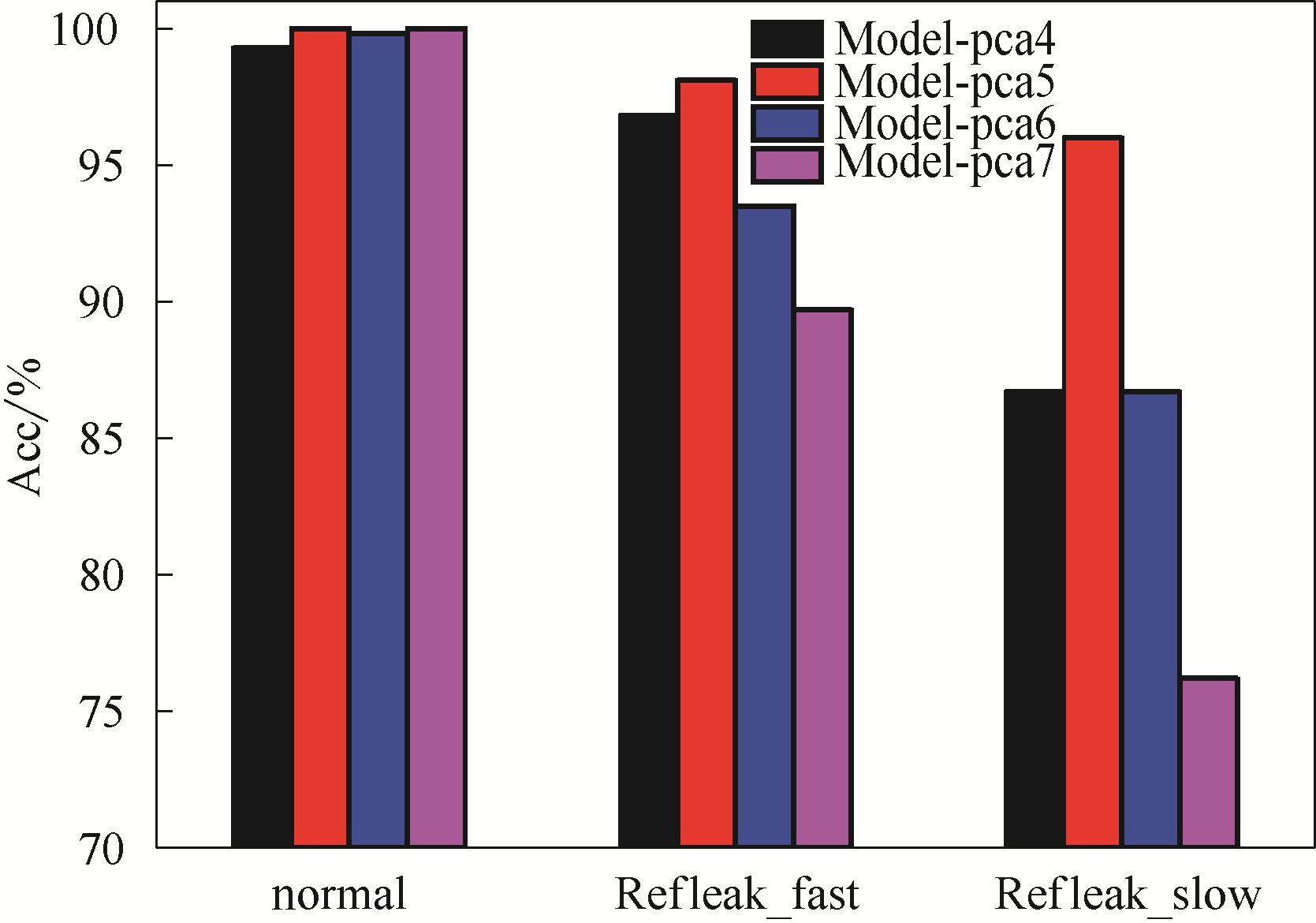
图9 四种模型在相同数据集中的各泄漏诊断识别准确率对比
Fig.9 Comparison of leakage diagnosis and identification accuracy of four models in the same data set
| 工况 | Model-pca4 | Model-pca5 | Model-pca6 | Model-pca7 |
|---|---|---|---|---|
Refleak_slow Refleak_fast normal |
表11 四种模型在相同数据集的各泄漏诊断识别结果混淆矩阵
Table 11 Confusion matrix of leakage diagnosis and identification results of four models in the same data set
| 工况 | Model-pca4 | Model-pca5 | Model-pca6 | Model-pca7 |
|---|---|---|---|---|
Refleak_slow Refleak_fast normal |
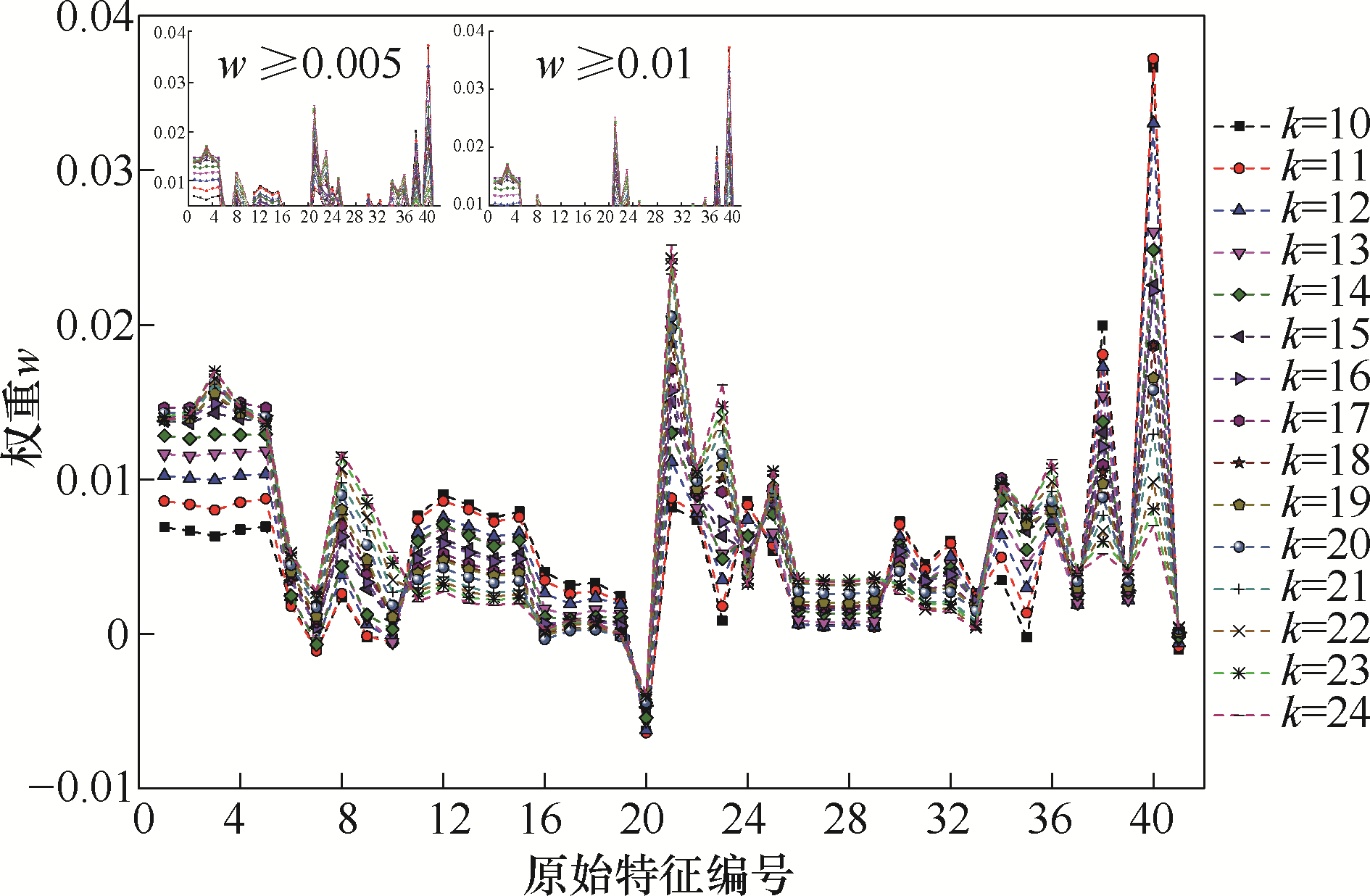
图10 RefliefF特征选择权重结果
Fig.10 RefliefF feature selection weight result
| 方式 | 序号 | 主元组合 | SVM核函数 | Acc/% | Mcr/% | TPR/% | FPR/% | 测试集混淆矩阵 |
|---|---|---|---|---|---|---|---|---|
| PCA-SVM | 1 | [ | Fine Gaussian SVM | 100 | 0 | 99.5 | 0 | |
| 2 | [ | 100 | 0 | 99.5 | 0 | |||
| 3 | [ | 99.1 | 0.9 | 97.6 | 0.2 | |||
RefliefF PCA-SVM | 4 | [1r,2r,3r,4r] | Fine Gaussian SVM | 97.8 | 2.2 | 97.1 | 1.8 | |
| 5 | [1r,2r,3r,4r,5r] | 97.4 | 2.6 | 95.6 | 1.8 | |||
| 6 | [1r,2r,3r,4r,5r,6r] | 97.4 | 2.6 | 93.7 | 0.9 |
表12 RefliefF特征选择前后的PCA-SVM泄漏识别模型及性能结果对比
Table 12 Comparison of PCA-SVM leak identification model and performance results before and after RefliefF FS
| 方式 | 序号 | 主元组合 | SVM核函数 | Acc/% | Mcr/% | TPR/% | FPR/% | 测试集混淆矩阵 |
|---|---|---|---|---|---|---|---|---|
| PCA-SVM | 1 | [ | Fine Gaussian SVM | 100 | 0 | 99.5 | 0 | |
| 2 | [ | 100 | 0 | 99.5 | 0 | |||
| 3 | [ | 99.1 | 0.9 | 97.6 | 0.2 | |||
RefliefF PCA-SVM | 4 | [1r,2r,3r,4r] | Fine Gaussian SVM | 97.8 | 2.2 | 97.1 | 1.8 | |
| 5 | [1r,2r,3r,4r,5r] | 97.4 | 2.6 | 95.6 | 1.8 | |||
| 6 | [1r,2r,3r,4r,5r,6r] | 97.4 | 2.6 | 93.7 | 0.9 |
| 1 | Mohanraj M, Muraleedharan C, Jayaraj S. A review on recent developments in new refrigerant mixtures for vapour compression-based refrigeration, air-conditioning and heat pump units[J]. International Journal of Energy Research, 2011, 35(8): 647-669. |
| 2 | 王晓明. 制冷系统故障先兆分析和故障预报技术研究[D]. 上海: 上海交通大学, 1998. |
| Wang X M. Analysis of refrigeration system failure predication and failure prediction technology [D]. Shanghai: Shanghai Jiaotong University, 1998. | |
| 3 | Koronaki I P, Cowan D, Maidment G, et al. Refrigerant emissions and leakage prevention across Europe-results from the RealSkillsEurope project[J]. Energy, 2012, 45(1): 71-80. |
| 4 | Francis C, Maidment G, Davies G. An investigation of refrigerant leakage in commercial refrigeration[J]. International Journal of Refrigeration, 2017, 74: 12-21. |
| 5 | Cowan D, Maidment G, Churchyard B, et al. Maintenance and long-term operation of supermarkets and minimizing refrigerant leakage[M]// Sustainable Retail Refrigeration. New York: John Wiley & Sons Ltd., 2015: 14-20. |
| 6 | Chantant M, Lambert R, Gargiulo L, et al. Leak tightness tests on actively cooled plasma facing components: lessons learned from Tore Supra experience and perspectives for the new fusion machines[J]. Fusion Engineering & Design, 2015, 98: 92-96. |
| 7 | Tassou S A, Grace I N. Fault diagnosis and refrigerant leak detection in vapour compression refrigeration systems[J]. International Journal of Refrigeration, 2005, 28(5): 680-688. |
| 8 | 任能. 制冷系统故障检测、诊断及预测研究[D]. 上海: 上海交通大学, 2008. |
| Ren N. Fault detection, diagnosis and prediction of refrigeration system [D]. Shanghai: Shanghai Jiaotong University, 2008. | |
| 9 | Beshr M, Aute V, Sharma V, et al. A comparative study on the environmental impact of supermarket refrigeration systems using low GWP refrigerants[J]. International Journal of Refrigeration, 2015, 56: 154-164. |
| 10 | Coulomb D. Refrigeration and cold chain serving the global food industry and creating a better future: two key IIR challenges for improved health and environment[J]. Trends in Food Science & Technology, 2008, 19(8): 409-417. |
| 11 | 郭军峰. 汽车空调性能衰减研究[D].重庆: 重庆大学, 2012. |
| Guo J F. Research on performance attenuation of automobile air conditioner [D]. Chongqing: Chongqing University, 2012. | |
| 12 | Yoo J W, Hong S B, Kim M S. Refrigerant leakage detection in an EEV installed residential air conditioner with limited sensor installations[J]. International Journal of Refrigeration, 2017, 78: 157-165. |
| 13 | Yu Y, Woradechjumroen D, Yu D. A review of fault detection and diagnosis methodologies on air-handling units[J]. Energy and Buildings, 2014, 82: 550-562. |
| 14 | Grace I N, Datta D, Tassou S A. Sensitivity of refrigeration system performance to charge levels and parameters for on-line leak detection[J]. Applied Thermal Engineering, 2005, 25(4): 557-566. |
| 15 | Grace I N, Datta D, Tassou S A. Sensitivity of refrigeration system performance to charge levels and parameters for on-line leak detection[J]. Applied Thermal Engineering, 2005, 25(4): 557-566. |
| 16 | Yoon S H, Payne W V, Domanski P A. Residential heat pump heating performance with single faults imposed[J]. Applied Thermal Engineering, 2011, 31(5): 765-771. |
| 17 | Han H, Gu B, Wang T, et al. Important sensors for chiller fault detection and diagnosis (FDD) from the perspective of feature selection and machine learning[J]. International Journal of Refrigeration, 2011, 34(2): 586-599. |
| 18 | Han H, Cao Z, Gu B, et al. PCA-SVM-based automated fault detection and diagnosis (AFDD) for vapor-compression refrigeration systems[J]. HVAC&R Research, 2010, 16(3): 295-313. |
| 19 | 齐咏生, 张海利, 王林, 等.基于MSPCA-KECA的冷水机组故障监测及诊断[J].化工学报, 2017, 68(4): 1499-1508. |
| Qi Y S, Zhang H L, Wang L, et al. Fault monitoring and diagnosis of chiller based on MSPCA-KECA [J]. CIESC Journal, 2017, 68(4): 1499-1508. | |
| 20 | 韩华, 谷波, 任能. 基于主元分析与支持向量机的制冷系统故障诊断方法[J]. 上海交通大学学报, 2011, (9): 108-114+126. |
| Han H, Gu B, Ren N. Fault diagnosis method of refrigeration system based on principal component analysis and support vector machine [J]. Journal of Shanghai Jiaotong University, 2011, (9): 108-114+126. | |
| 21 | 洪迎春. 基于多变量统计分析的制冷系统故障检测与诊断[D]. 上海: 上海交通大学, 2012. |
| Hong Y C. Fault detection and diagnosis of refrigeration system based on multivariate statistical analysis [D]. Shanghai: Shanghai Jiaotong University, 2012. | |
| 22 | 梁晴晴, 韩华, 崔晓钰, 等. 基于主元分析-概率神经网络的制冷系统故障诊断[J]. 化工学报, 2016, 67(3): 1022-1031. |
| Liang Q Q, Han H, Cui X Y, et al. Fault diagnosis of refrigeration system based on PCA-PNN [J]. CIESC Journal, 2016, 67(3): 1022-1031. | |
| 23 | 王路瑶, 吴斌, 杜志敏, 等.基于长短期记忆神经网络的数据中心空调系统传感器故障诊断[J].化工学报, 2018, 69: 252-259. |
| Wang L Y, Wu B, Du Z M, et al. Sensor fault diagnosis of air conditioning system in data center based on neural network of long and short term memory [J]. CIESC Journal, 2018, 69: 252-259. | |
| 24 | 韩华. 基于顺序集成方法的制冷系统故障检测与诊断研究[D].上海: 上海交通大学, 2012. |
| Han H. Study on fault detection and diagnosis of refrigeration system based on sequential integration method [D]. Shanghai: Shanghai Jiaotong University, 2012. | |
| 25 | 赵旭, 阎威武, 邵惠鹤, 等. 基于核Fisher判别分析方法的非线性统计过程监控与故障诊断[J]. 化工学报, 2007, 58(4): 951-956. |
| Zhao X, Yan W W, Shao H H, et al. Nonlinear statistical process monitoring and fault diagnosis based on nuclear Fisher discriminant analysis [J]. Journal of Chemical Industry and Engineering(China), 2007, 58(4): 951-956. | |
| 26 | 周志华, 王珏. 机器学习及其应用2009[M]. 北京: 清华大学出版社, 2009. |
| Zhou Z H, Wang J. Machine Learning and Its Application 2009[M]. Beijing: Tsinghua University Press, 2009. | |
| 27 | Valle S, Li W, Qin S J. Selection of the number of principal components: the variance of the reconstruction error criterion with a comparison to other methods[J]. Industrial & Engineering Chemistry Research, 1999, 38(11): 4389-4401. |
| 28 | Jos B, Draper B A. Feature selection from huge feature sets[C]// Proceedings. Eighth IEEE International Conference on Computer Vision. IEEE, 2001. |
| 29 | Robnik M, Kononenko I. Theoretical and empirical analysis of ReliefF and RReliefF[J]. Machine Learning, 2003, 53(1/2): 23-69. |
| 30 | Deng X, Li Y, Weng J, et al. Feature selection for text classification: a review[J]. Multimedia Tools and Applications, 2018, 78: 3797-3816. |
| [1] | 曹跃, 余冲, 李智, 杨明磊. 工业数据驱动的加氢裂化装置多工况切换过渡状态检测[J]. 化工学报, 2023, 74(9): 3841-3854. |
| [2] | 尹刚, 李伊惠, 何飞, 曹文琦, 王民, 颜非亚, 向禹, 卢剑, 罗斌, 卢润廷. 基于KPCA和SVM的铝电解槽漏槽事故预警方法[J]. 化工学报, 2023, 74(8): 3419-3428. |
| [3] | 诸程瑛, 王振雷. 基于改进深度强化学习的乙烯裂解炉操作优化[J]. 化工学报, 2023, 74(8): 3429-3437. |
| [4] | 高学金, 姚玉卓, 韩华云, 齐咏生. 基于注意力动态卷积自编码器的发酵过程故障监测[J]. 化工学报, 2023, 74(6): 2503-2521. |
| [5] | 周继鹏, 何文军, 李涛. 异形催化剂上乙烯催化氧化失活动力学反应工程计算[J]. 化工学报, 2023, 74(6): 2416-2426. |
| [6] | 郑书闽, 郭鹏程, 颜建国, 王帅, 李文博, 周淇. 微小通道内过冷流动沸腾阻力特性实验及预测研究[J]. 化工学报, 2023, 74(4): 1549-1560. |
| [7] | 顾学荣, 刘硕士, 杨思宇. 基于并行EGO和代理模型辅助的多参数优化方法研究[J]. 化工学报, 2023, 74(3): 1205-1215. |
| [8] | 张生安, 刘桂莲. 高效太阳能电解水制氢系统及其性能的多目标优化[J]. 化工学报, 2023, 74(3): 1260-1274. |
| [9] | 陈家辉, 杨鑫泽, 陈顾中, 宋震, 漆志文. 以离子液体密度为例的分子性质预测模型建模方法探讨[J]. 化工学报, 2023, 74(2): 630-641. |
| [10] | 袁海鸥, 叶方俊, 张硕, 罗祎青, 袁希钢. 考虑中间换热器的能量集成精馏序列合成[J]. 化工学报, 2023, 74(2): 796-806. |
| [11] | 高学金, 程琨, 韩华云, 高慧慧, 齐咏生. 基于中心损失的条件生成式对抗网络的冷水机组故障诊断[J]. 化工学报, 2022, 73(9): 3950-3962. |
| [12] | 王雅琳, 潘雨晴, 刘晨亮. 基于GSA-LSTM动态结构特征提取的间歇过程监测方法[J]. 化工学报, 2022, 73(9): 3994-4002. |
| [13] | 王琨, 侍洪波, 谭帅, 宋冰, 陶阳. 局部时差约束邻域保持嵌入算法在故障检测中的应用[J]. 化工学报, 2022, 73(7): 3109-3119. |
| [14] | 孙哲, 金华强, 李康, 顾江萍, 黄跃进, 沈希. 基于知识数据化表达的制冷空调系统故障诊断方法[J]. 化工学报, 2022, 73(7): 3131-3144. |
| [15] | 杨岭, 崔国民, 周志强, 肖媛. 精细搜索策略应用于质量交换网络综合[J]. 化工学报, 2022, 73(7): 3145-3155. |
| 阅读次数 | ||||||
|
全文 |
|
|||||
|
摘要 |
|
|||||
 京公网安备 11010102001995号