化工学报 ›› 2025, Vol. 76 ›› Issue (9): 4644-4657.DOI: 10.11949/0438-1157.20250147
范龙飞1( ), 史旭东1,2,3, 熊伟丽1,2()
收稿日期:2025-02-17
修回日期:2025-04-07
出版日期:2025-09-25
发布日期:2025-10-23
通讯作者:
熊伟丽
作者简介:范龙飞(2000—),男,硕士研究生,6231913011@stu.jiangnan.edu.cn
基金资助:
Longfei FAN1(), Xudong SHI1,2,3, Weili XIONG1,2()
Received:2025-02-17
Revised:2025-04-07
Online:2025-09-25
Published:2025-10-23
Contact:
Weili XIONG
摘要:
工业过程工况改变时,新旧工况的数据分布不一致,导致软测量模型失配;且新工况样本稀缺,难以准确建立新的软测量模型。为此,提出了一种基于参数迁移的域适应宽度学习软测量建模方法,以提升模型的跨工况场景适配能力。在宽度学习系统框架下,设计了可学习的源域-目标域参数转换映射,最大限度地减少分布差异,对齐目标域与源域的预测输出分布,实现域间共享知识的迁移。构建了输出参数正则项、迁移参数正则项与基于最大均值差异准则的分布对齐正则项,避免跨域软测量模型的知识负迁移与过拟合。提出了模型参数的交替优化算法,实现输出参数和迁移参数的自适应学习。基于工业青霉素发酵和三相流工业过程验证所提方法的有效性与准确性,结果表明所提方法与现有迁移软测量方法相比具有更优的预测精度和泛化性能。
中图分类号:
范龙飞, 史旭东, 熊伟丽. 跨工况下基于参数迁移的域适应宽度学习软测量建模[J]. 化工学报, 2025, 76(9): 4644-4657.
Longfei FAN, Xudong SHI, Weili XIONG. Domain adaptive broad learning system with parameter transferring for cross-condition soft sensor modeling[J]. CIESC Journal, 2025, 76(9): 4644-4657.

图1 宽度学习系统的结构
Fig.1 Structure of broad learning system
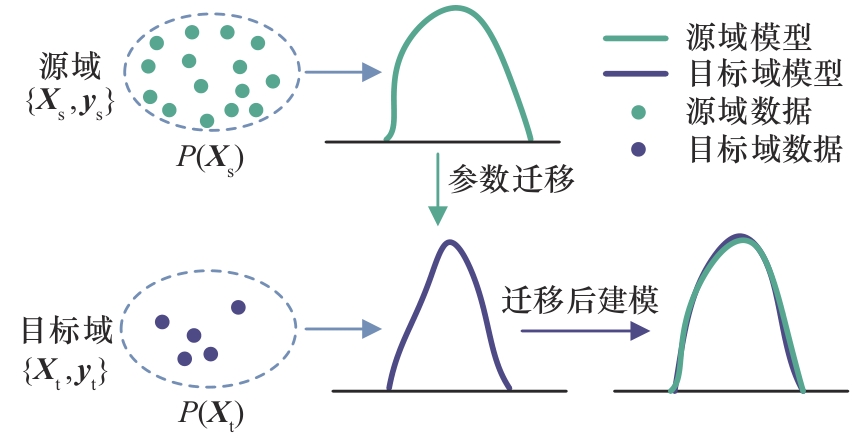
图2 参数迁移建模
Fig.2 Parameter transfer modeling

图3 DABLS-PT模型结构
Fig.3 DABLS-PT model structure
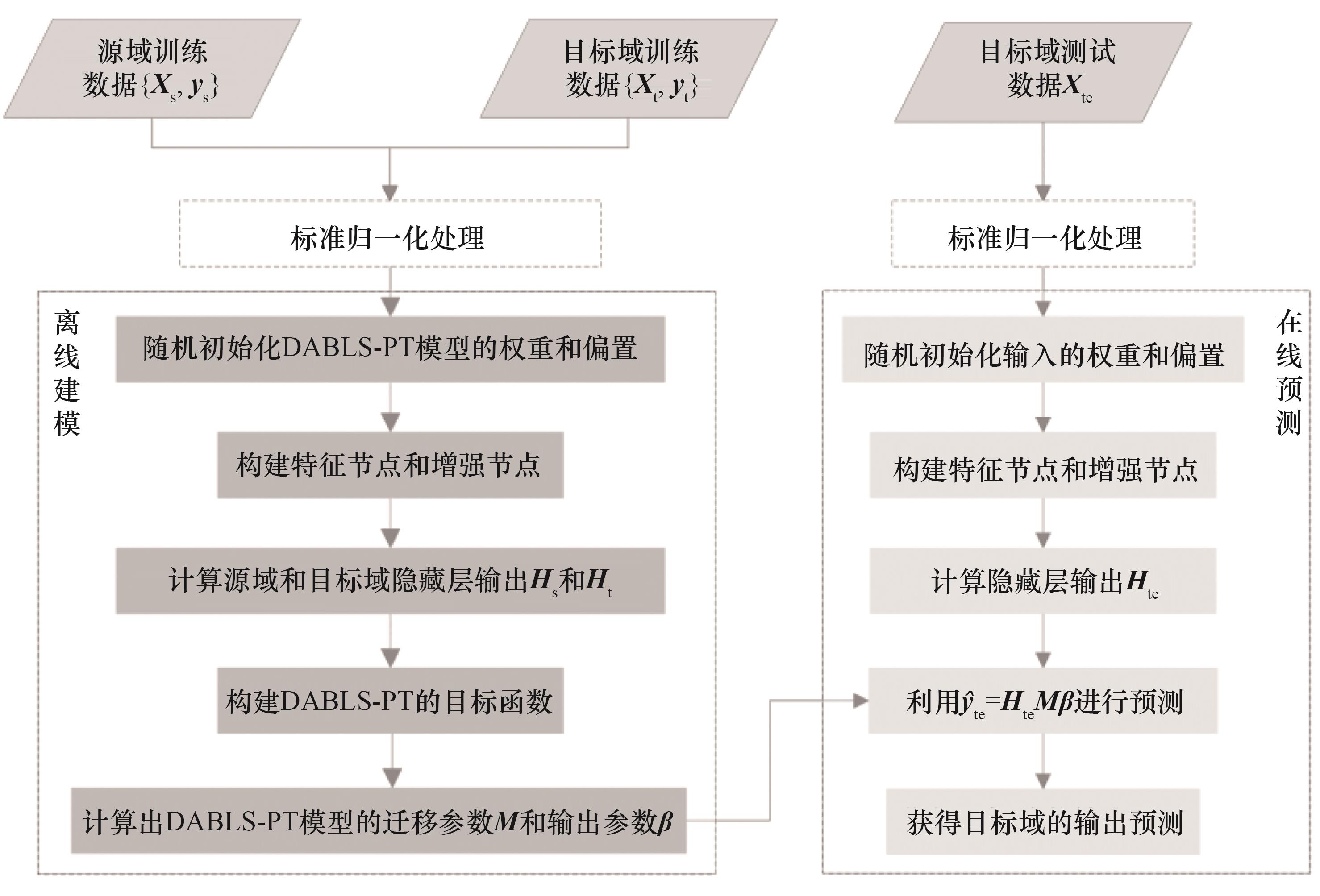
图4 DABLS-PT的软测量建模框架
Fig.4 Soft measurement modeling framework of DABLS-PT
算法1基于DABLS-PT的软测量建模方法 |
|---|
输入:源域数据 |
输出:预测输出 |
流程: |
1:随机初始化权重 |
2:构建建模阶段源域和目标域隐藏层输出 |
3:构建测试阶段隐藏层输出 |
4:初始化转换矩阵 |
5:for |
6:根据 |
7:根据 |
8:end for |
9:根据 |
表1 基于DABLS-PT的软测量建模方法
Table 1 Soft sensing modeling method based on DABLS-PT
算法1基于DABLS-PT的软测量建模方法 |
|---|
输入:源域数据 |
输出:预测输出 |
流程: |
1:随机初始化权重 |
2:构建建模阶段源域和目标域隐藏层输出 |
3:构建测试阶段隐藏层输出 |
4:初始化转换矩阵 |
5:for |
6:根据 |
7:根据 |
8:end for |
9:根据 |
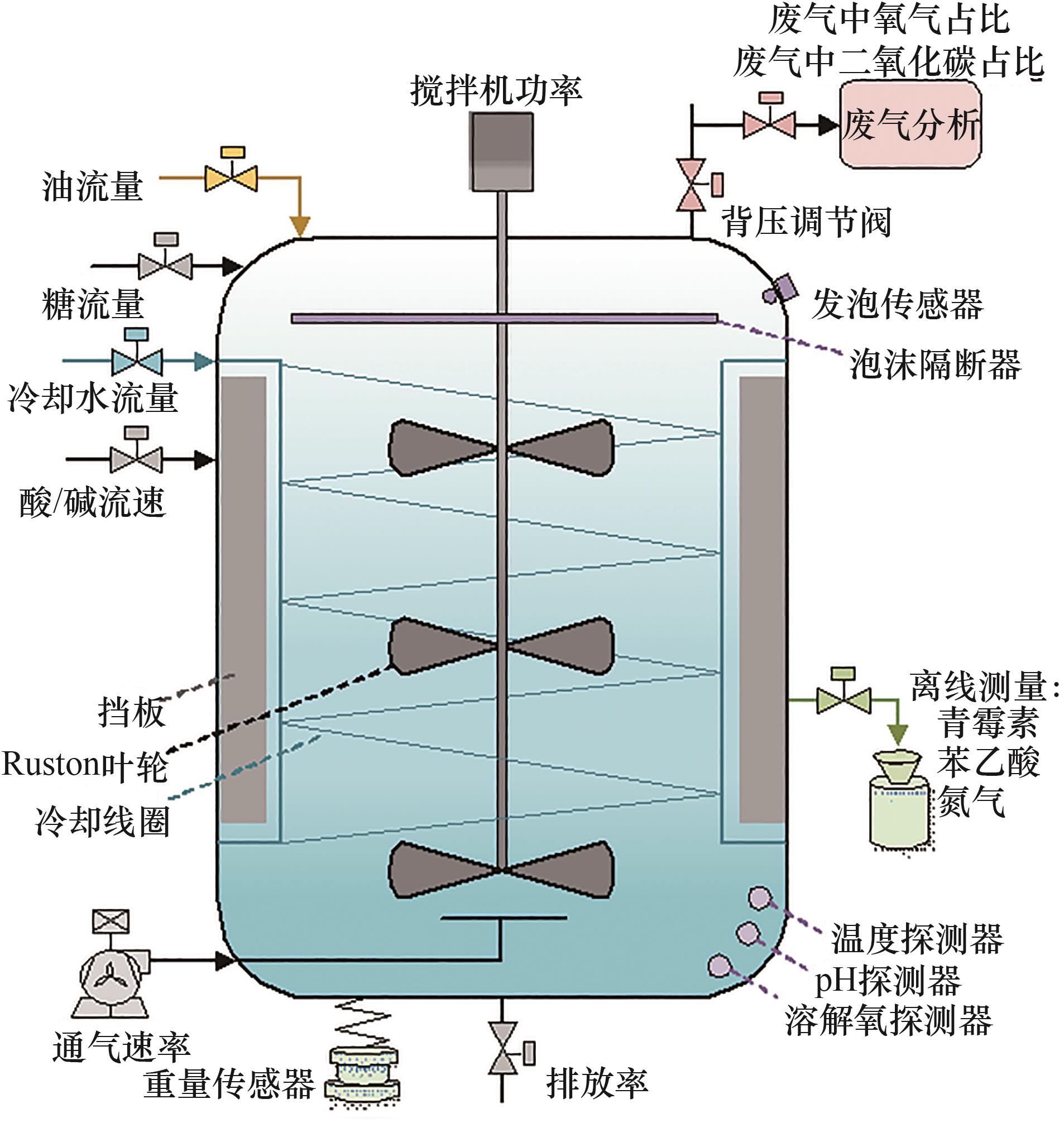
图5 所用的100000 L生物反应器示意图
Fig.5 Schematic diagram of the 100000 L bioreactor used
| 变量序号 | 符号 | 描述 | 单位 |
|---|---|---|---|
| 1 | Fc | 冷却水流量 | L/h |
| 2 | DO2 | 溶解氧浓度 | mg/L |
| 3 | V | 容积体积 | L |
| 4 | Wt | 容积质量 | kg |
| 5 | 废气中二氧化碳的百分比 | % | |
| 6 | 废气中氧气的百分比 | % | |
| 7 | CER | 碳吸收速率 | g/h |
表2 工业青霉素过程中输入变量
Table 2 Input variables in the industrial penicillin process
| 变量序号 | 符号 | 描述 | 单位 |
|---|---|---|---|
| 1 | Fc | 冷却水流量 | L/h |
| 2 | DO2 | 溶解氧浓度 | mg/L |
| 3 | V | 容积体积 | L |
| 4 | Wt | 容积质量 | kg |
| 5 | 废气中二氧化碳的百分比 | % | |
| 6 | 废气中氧气的百分比 | % | |
| 7 | CER | 碳吸收速率 | g/h |
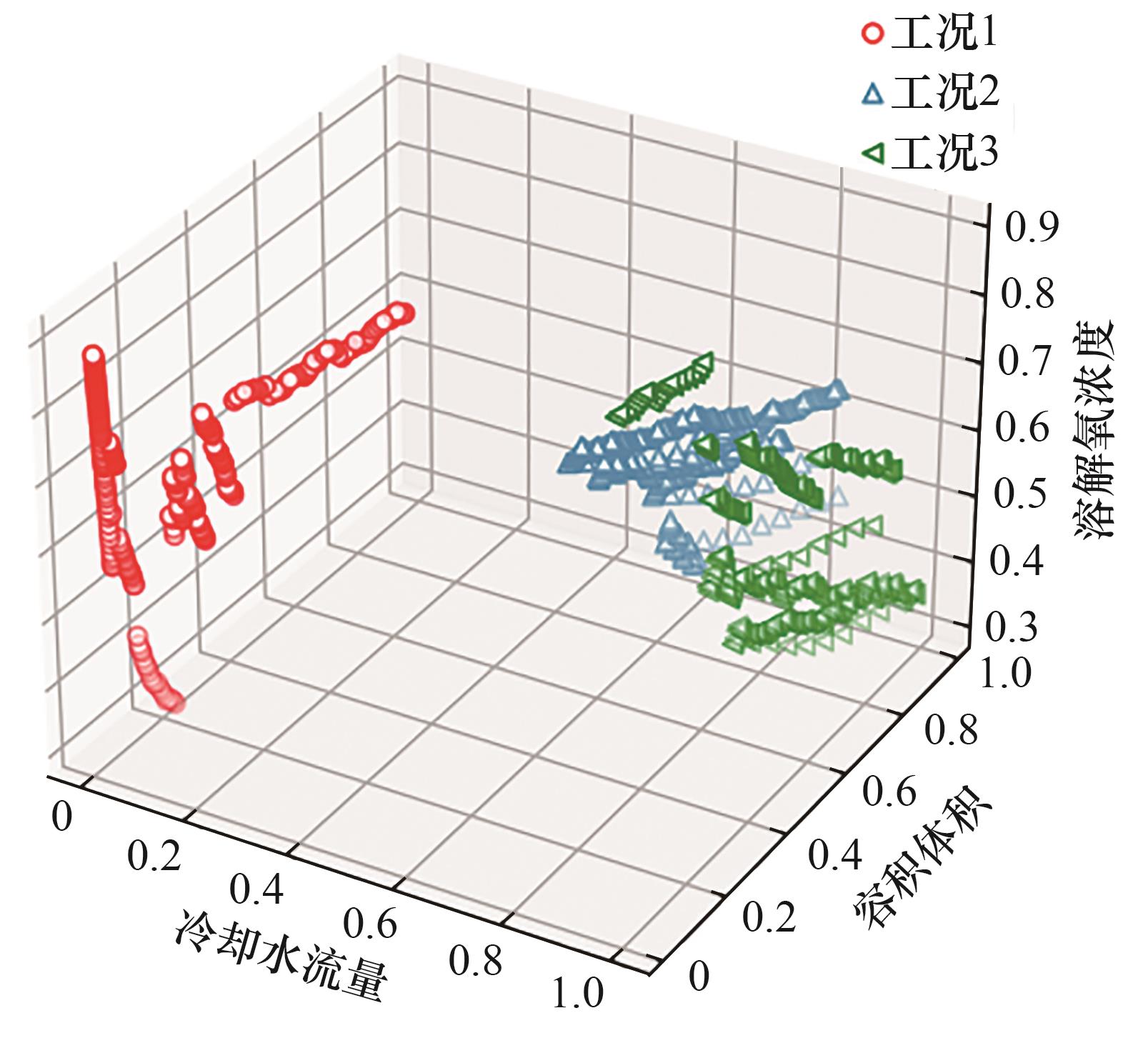
图6 不同工况三维数据分布图
Fig.6 3D data distribution map under different operating conditions
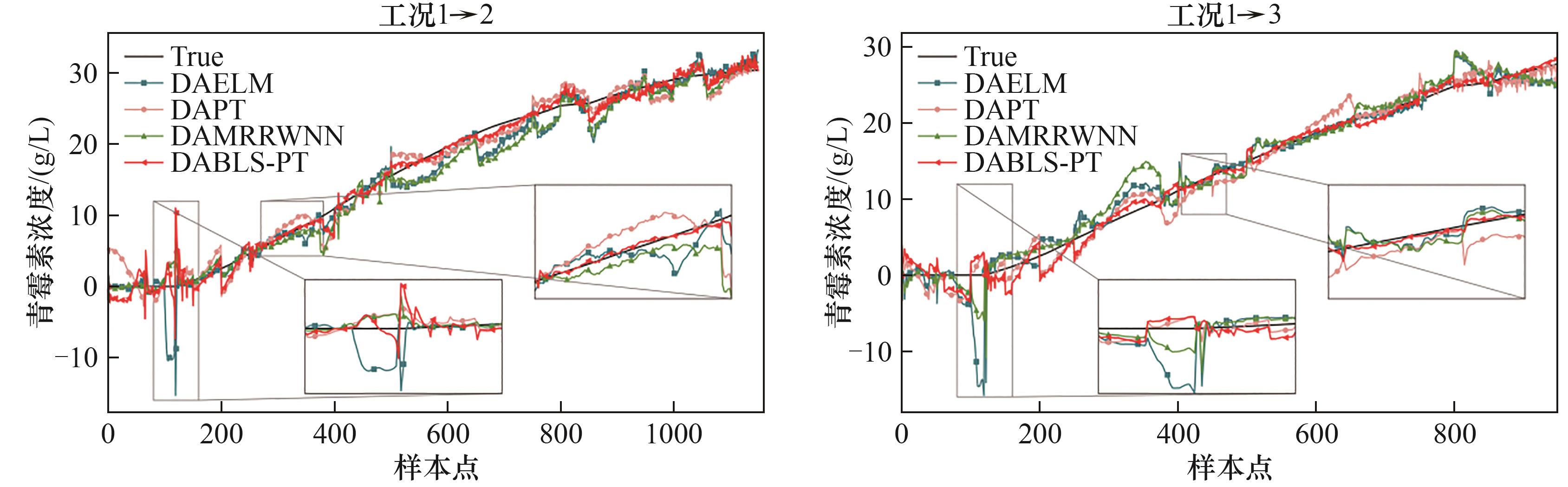
图7 各模型对青霉素浓度的预测效果
Fig.7 Prediction performance of different models for penicillin concentration
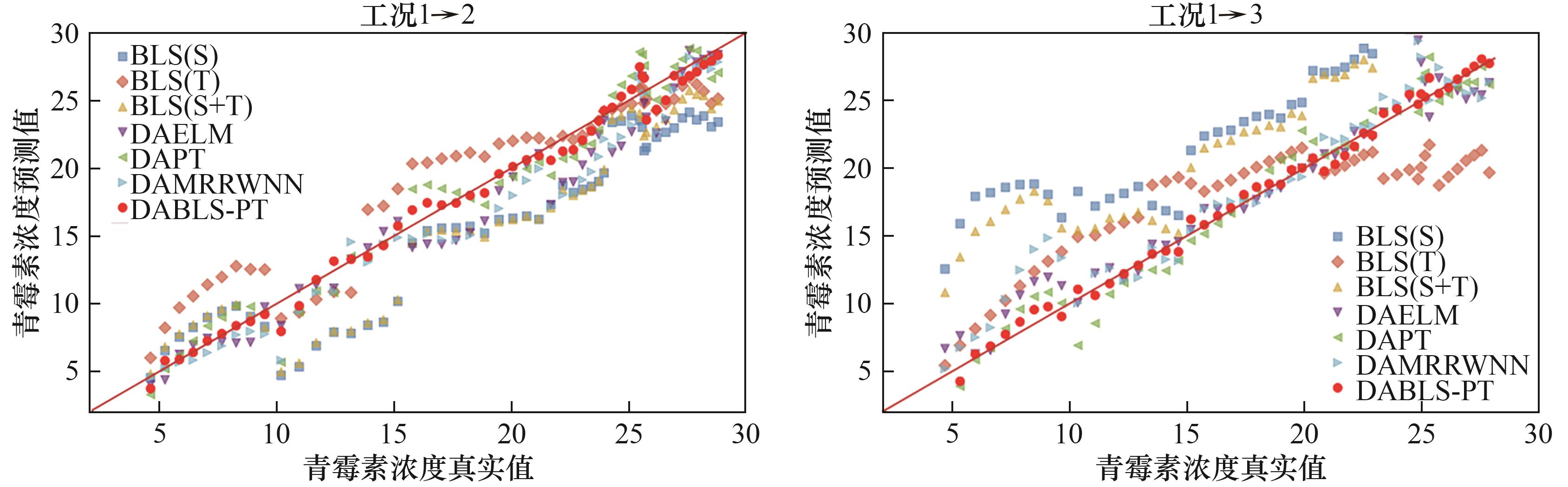
图8 各模型预测青霉素浓度散点图对比
Fig.8 Comparison of scatter plots for penicillin concentration predictions by different models
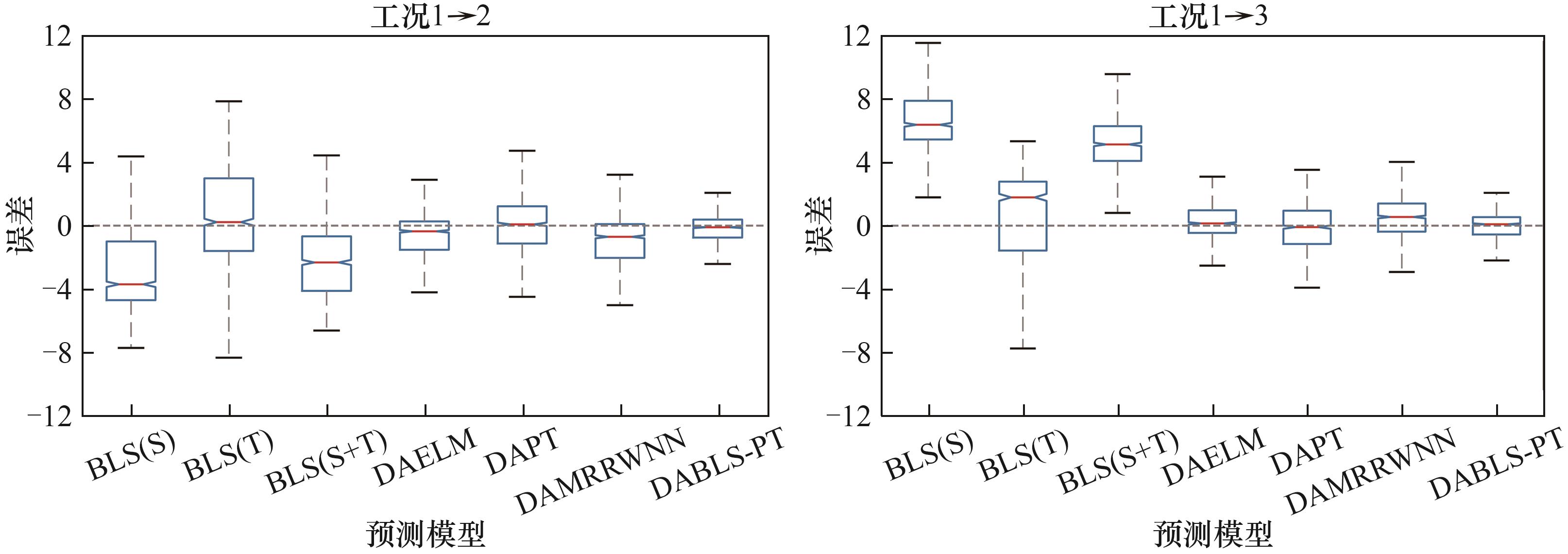
图9 各模型预测青霉素浓度误差箱线图对比
Fig.9 Comparison of box plots for prediction errors of penicillin concentration by different models
| 工况 | 指标 | BLS(S) | BLS(T) | BLS(S+T) | DAELM | DAPT | DAMRRWNN | DABLS-PT |
|---|---|---|---|---|---|---|---|---|
| 1→2 | RMSE | 3.8778 | 3.4294 | 3.2569 | 2.0112 | 1.7682 | 1.8989 | 1.2326 |
| MAE | 3.4282 | 2.7444 | 2.8481 | 1.2854 | 1.3944 | 1.4254 | 0.8277 | |
| R2 | 0.8250 | 0.8448 | 0.8853 | 0.9660 | 0.9714 | 0.9659 | 0.9870 | |
| 1→3 | RMSE | 6.9196 | 3.5281 | 5.7169 | 2.2765 | 1.5416 | 1.9427 | 1.0878 |
| MAE | 6.7098 | 3.1214 | 5.2006 | 1.2779 | 1.2261 | 1.3814 | 0.7880 | |
| R2 | 0.5532 | 0.7957 | 0.6735 | 0.9476 | 0.9756 | 0.9595 | 0.9874 | |
| 2→1 | RMSE | 4.6149 | 3.9143 | 3.3174 | 2.1246 | 1.8320 | 2.0043 | 1.3151 |
| MAE | 3.3175 | 3.0936 | 1.9453 | 1.3832 | 1.3881 | 1.4481 | 0.9757 | |
| R2 | 0.7333 | 0.7835 | 0.8541 | 0.9610 | 0.9643 | 0.9620 | 0.9847 | |
| 2→3 | RMSE | 4.3404 | 3.8518 | 4.3035 | 1.6541 | 1.7040 | 1.7182 | 0.9994 |
| MAE | 3.8733 | 3.1813 | 3.8501 | 1.1973 | 1.1895 | 1.1900 | 0.7463 | |
| R2 | 0.7971 | 0.7201 | 0.8045 | 0.9715 | 0.9663 | 0.9680 | 0.9891 | |
| 3→1 | RMSE | 6.0014 | 3.9876 | 5.3643 | 2.5908 | 2.5668 | 2.0851 | 1.5569 |
| MAE | 4.5785 | 3.2030 | 4.0307 | 1.8176 | 1.8743 | 1.4030 | 1.1904 | |
| R2 | 0.4022 | 0.7589 | 0.5315 | 0.9321 | 0.92465 | 0.9495 | 0.9734 | |
| 3→2 | RMSE | 6.6192 | 3.1944 | 5.8549 | 1.8016 | 1.5657 | 1.5595 | 1.1130 |
| MAE | 5.3324 | 2.5453 | 4.6363 | 1.3861 | 1.1498 | 1.1639 | 0.8434 | |
| R2 | 0.3528 | 0.8723 | 0.5079 | 0.9715 | 0.9791 | 0.9784 | 0.9895 |
表3 各模型对青霉素浓度预测评价指标对比
Table 3 Comparison of evaluation metrics for penicillin concentration predictions by different models
| 工况 | 指标 | BLS(S) | BLS(T) | BLS(S+T) | DAELM | DAPT | DAMRRWNN | DABLS-PT |
|---|---|---|---|---|---|---|---|---|
| 1→2 | RMSE | 3.8778 | 3.4294 | 3.2569 | 2.0112 | 1.7682 | 1.8989 | 1.2326 |
| MAE | 3.4282 | 2.7444 | 2.8481 | 1.2854 | 1.3944 | 1.4254 | 0.8277 | |
| R2 | 0.8250 | 0.8448 | 0.8853 | 0.9660 | 0.9714 | 0.9659 | 0.9870 | |
| 1→3 | RMSE | 6.9196 | 3.5281 | 5.7169 | 2.2765 | 1.5416 | 1.9427 | 1.0878 |
| MAE | 6.7098 | 3.1214 | 5.2006 | 1.2779 | 1.2261 | 1.3814 | 0.7880 | |
| R2 | 0.5532 | 0.7957 | 0.6735 | 0.9476 | 0.9756 | 0.9595 | 0.9874 | |
| 2→1 | RMSE | 4.6149 | 3.9143 | 3.3174 | 2.1246 | 1.8320 | 2.0043 | 1.3151 |
| MAE | 3.3175 | 3.0936 | 1.9453 | 1.3832 | 1.3881 | 1.4481 | 0.9757 | |
| R2 | 0.7333 | 0.7835 | 0.8541 | 0.9610 | 0.9643 | 0.9620 | 0.9847 | |
| 2→3 | RMSE | 4.3404 | 3.8518 | 4.3035 | 1.6541 | 1.7040 | 1.7182 | 0.9994 |
| MAE | 3.8733 | 3.1813 | 3.8501 | 1.1973 | 1.1895 | 1.1900 | 0.7463 | |
| R2 | 0.7971 | 0.7201 | 0.8045 | 0.9715 | 0.9663 | 0.9680 | 0.9891 | |
| 3→1 | RMSE | 6.0014 | 3.9876 | 5.3643 | 2.5908 | 2.5668 | 2.0851 | 1.5569 |
| MAE | 4.5785 | 3.2030 | 4.0307 | 1.8176 | 1.8743 | 1.4030 | 1.1904 | |
| R2 | 0.4022 | 0.7589 | 0.5315 | 0.9321 | 0.92465 | 0.9495 | 0.9734 | |
| 3→2 | RMSE | 6.6192 | 3.1944 | 5.8549 | 1.8016 | 1.5657 | 1.5595 | 1.1130 |
| MAE | 5.3324 | 2.5453 | 4.6363 | 1.3861 | 1.1498 | 1.1639 | 0.8434 | |
| R2 | 0.3528 | 0.8723 | 0.5079 | 0.9715 | 0.9791 | 0.9784 | 0.9895 |
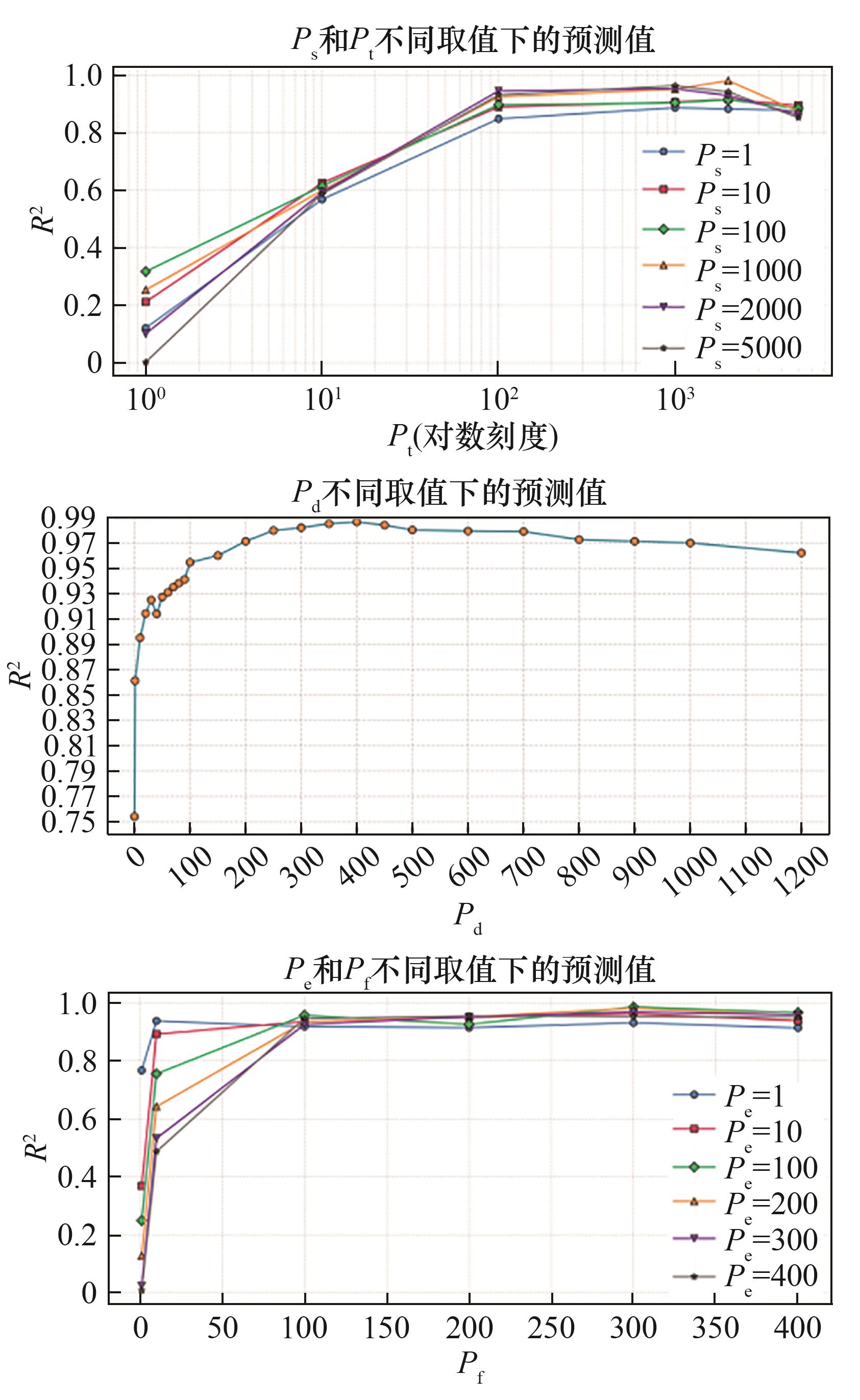
图10 不同参数组合下的预测结果
Fig.10 Prediction results under different parameter combinations
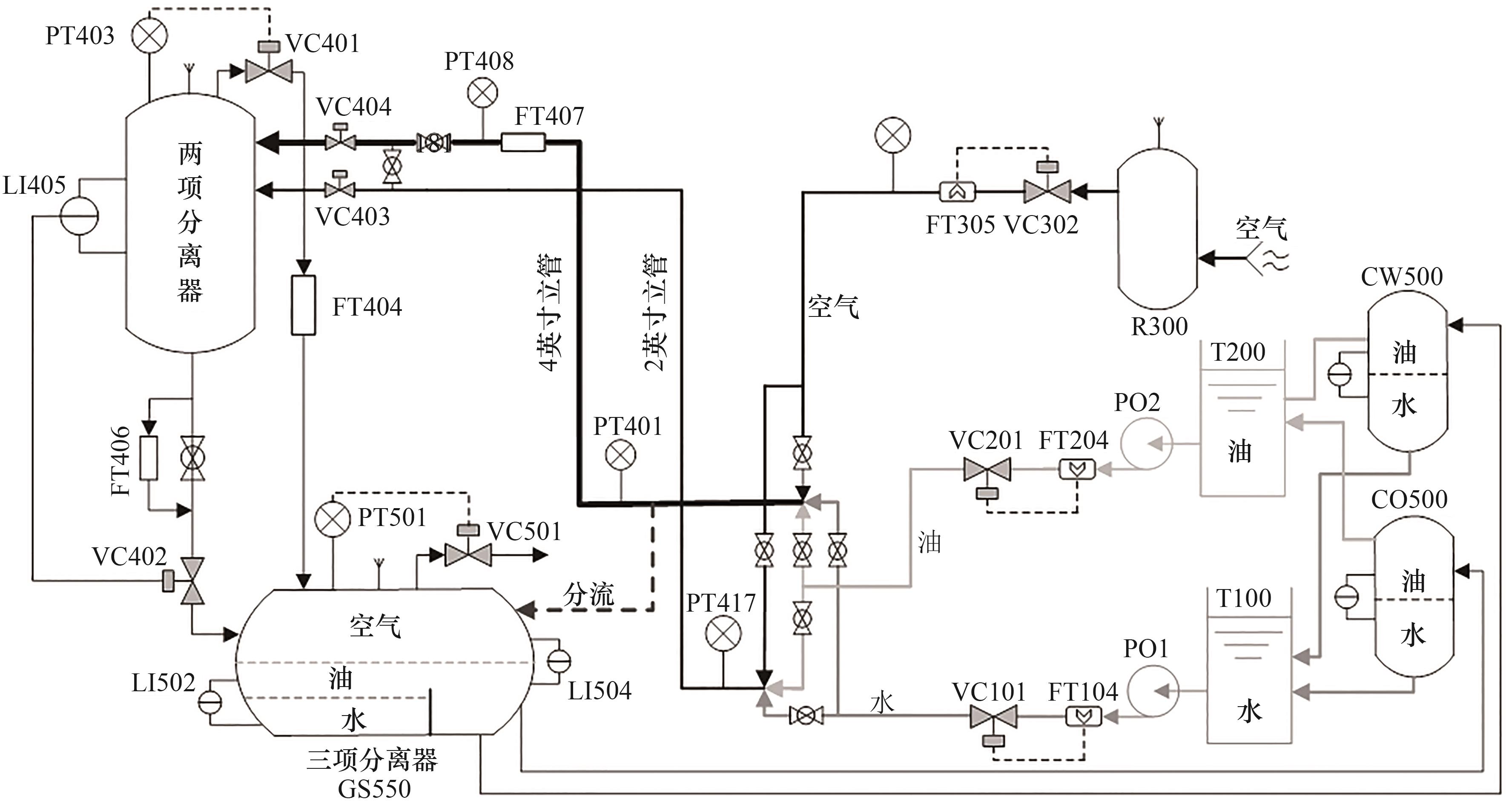
图11 三相流过程结构示意图(1英寸=2.54 cm)
Fig.11 Schematic diagram of three-phase flow process
| 变量序号 | 位置 | 描述 | 单位 |
|---|---|---|---|
| 1 | PT312 | 输气压力 | MPa |
| 2 | PT401 | 立管底部压力 | MPa |
| 3 | PT408 | 立管顶部压力 | MPa |
| 4 | PT403 | 顶部分离器压力 | MPa |
| 5 | PT408 | PT401和PT408压差 | MPa |
| 6 | PT403 | VC404上压差 | MPa |
| 7 | FT305 | 输气流量 | m3/s |
| 8 | FT104 | 输水流量 | kg/s |
| 9 | LI405 | 顶部分离器液面高度 | m |
| 10 | FT407 | 立管顶部密度 | kg/m3 |
| 11 | FT104 | 输水密度 | kg/m3 |
| 12 | LI504 | 三相分离器气液占比 | % |
| 13 | VC501 | VC501阀门开度 | % |
| 14 | VC302 | VC302阀门开度 | % |
| 15 | VC101 | VC101阀门开度 | % |
| 16 | PO1 | 水泵电流 | A |
表4 三相流过程中输入变量
Table 4 Input variables in the three-phase flow process
| 变量序号 | 位置 | 描述 | 单位 |
|---|---|---|---|
| 1 | PT312 | 输气压力 | MPa |
| 2 | PT401 | 立管底部压力 | MPa |
| 3 | PT408 | 立管顶部压力 | MPa |
| 4 | PT403 | 顶部分离器压力 | MPa |
| 5 | PT408 | PT401和PT408压差 | MPa |
| 6 | PT403 | VC404上压差 | MPa |
| 7 | FT305 | 输气流量 | m3/s |
| 8 | FT104 | 输水流量 | kg/s |
| 9 | LI405 | 顶部分离器液面高度 | m |
| 10 | FT407 | 立管顶部密度 | kg/m3 |
| 11 | FT104 | 输水密度 | kg/m3 |
| 12 | LI504 | 三相分离器气液占比 | % |
| 13 | VC501 | VC501阀门开度 | % |
| 14 | VC302 | VC302阀门开度 | % |
| 15 | VC101 | VC101阀门开度 | % |
| 16 | PO1 | 水泵电流 | A |

图12 三相流数据分布图
Fig.12 Data distribution map of three-phase flow
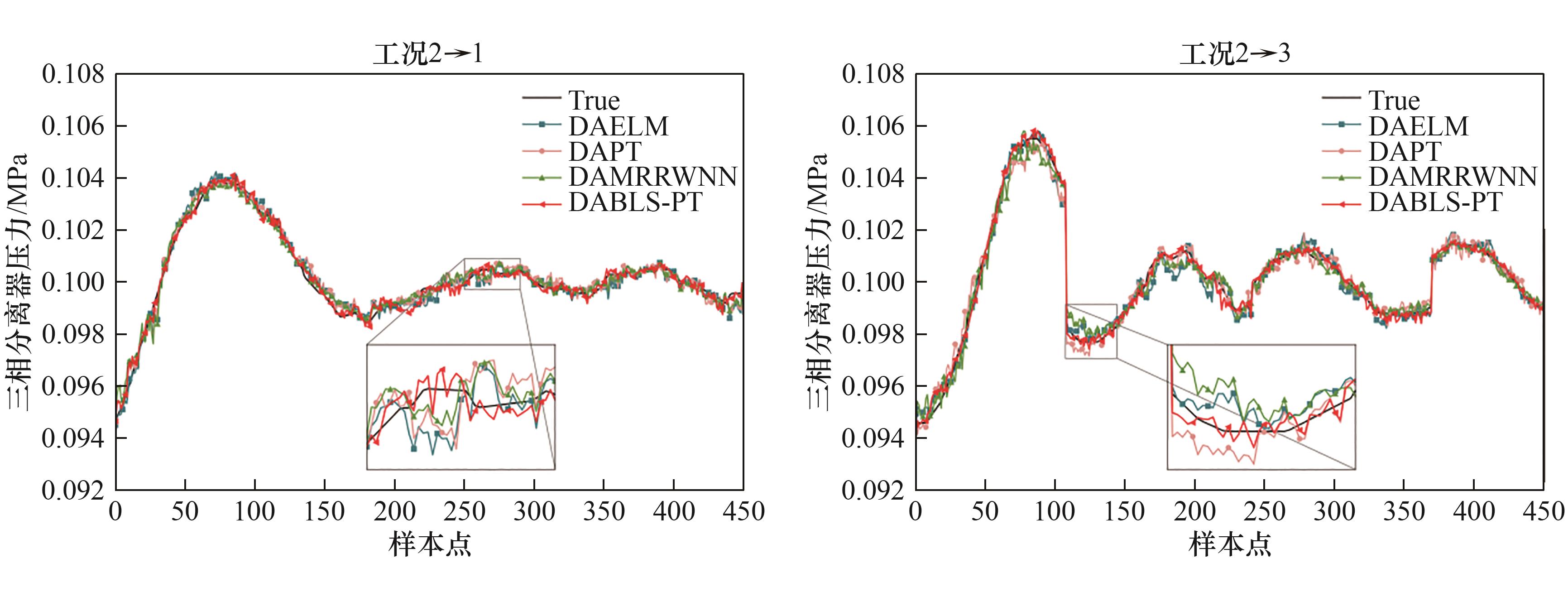
图13 各模型对三相分离器压力的预测效果
Fig.13 Prediction performance of different models for pressure in three-phase separators
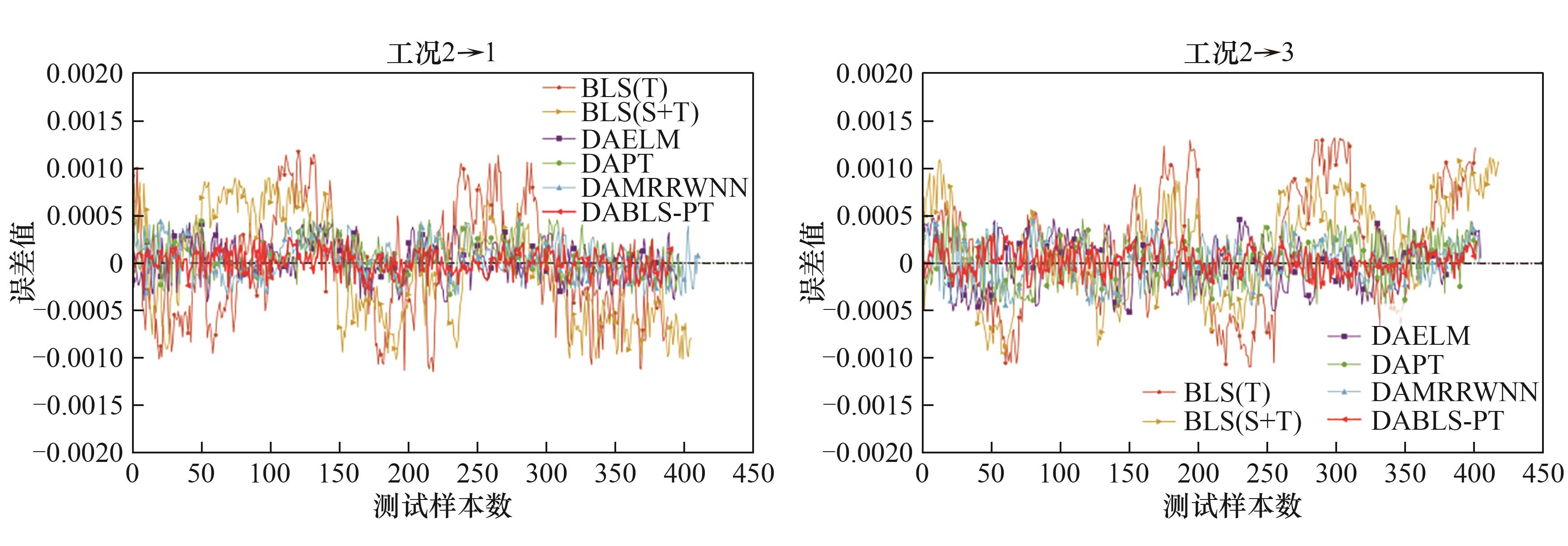
图14 各模型预测三相分离器压力误差曲线图对比
Fig.14 Comparison of error curves for pressure predictions in three-phase separators by different models
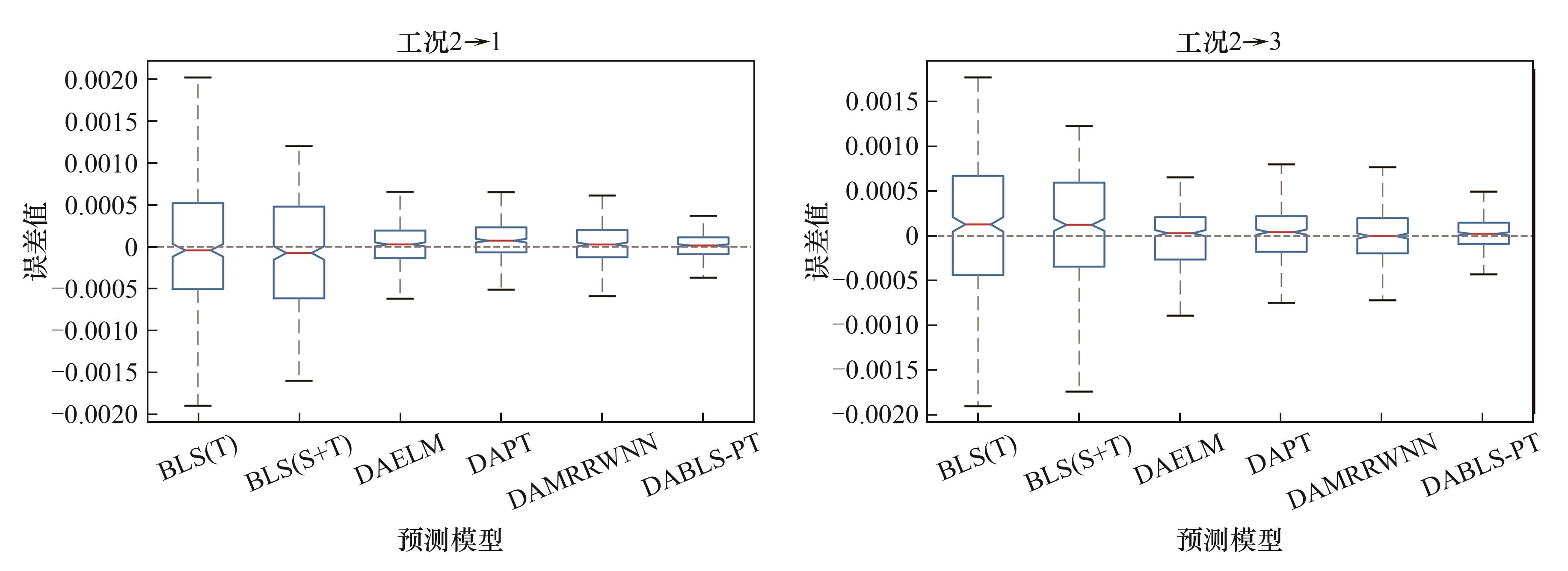
图15 各模型预测三相分离器压力误差箱线图对比
Fig.15 Comparison of box plots for prediction errors of pressure in three-phase separators by different models
| 工况 | 指标 | BLS(T) | BLS(S+T) | DAELM | DAPT | DAMRRWNN | DABLS-PT |
|---|---|---|---|---|---|---|---|
| 1→2 | RMSE(×10-4) | 3.001 | 2.116 | 1.270 | 1.517 | 1.375 | 1.197 |
| MAE(×10-4) | 2.360 | 1.521 | 0.9661 | 1.191 | 1.007 | 0.9244 | |
| R2 | 0.7671 | 0.8694 | 0.9645 | 0.9492 | 0.9552 | 0.9732 | |
| 1→3 | RMSE(×10-4) | 8.094 | 6.647 | 3.012 | 3.267 | 3.092 | 1.882 |
| MAE(×10-4) | 6.434 | 5.258 | 2.397 | 2.373 | 2.223 | 1.307 | |
| R2 | 0.8058 | 0.8689 | 0.9795 | 0.9763 | 0.9798 | 0.9931 | |
| 2→1 | RMSE(×10-4) | 7.781 | 6.458 | 2.808 | 2.790 | 2.737 | 1.869 |
| MAE(×10-4) | 6.203 | 5.592 | 2.153 | 2.118 | 2.033 | 1.383 | |
| R2 | 0.7748 | 0.8825 | 0.9729 | 0.9709 | 0.9701 | 0.9870 | |
| 2→3 | RMSE(×10-4) | 8.412 | 7.138 | 3.343 | 3.214 | 3.073 | 1.966 |
| MAE(×10-4) | 6.699 | 5.547 | 2.716 | 2.533 | 2.385 | 1.476 | |
| R2 | 0.7858 | 0.8492 | 0.9765 | 0.9773 | 0.9788 | 0.9924 | |
| 3→1 | RMSE(×10-4) | 7.781 | 6.780 | 3.059 | 3.614 | 2.854 | 2.801 |
| MAE(×10-4) | 6.203 | 5.609 | 2.446 | 2.808 | 2.133 | 2.137 | |
| R2 | 0.7748 | 0.8988 | 0.9649 | 0.9534 | 0.9698 | 0.9732 | |
| 3→2 | RMSE(×10-4) | 3.071 | 2.972 | 1.701 | 1.910 | 1.597 | 1.393 |
| MAE(×10-4) | 2.419 | 2.397 | 1.340 | 1.506 | 1.258 | 1.097 | |
| R2 | 0.7394 | 0.8778 | 0.9449 | 0.9368 | 0.9498 | 0.9624 |
表5 各模型对三相分离器压力预测评价指标对比
Table 5 Comparison of evaluation metrics for pressure predictions in three-phase separators by different models
| 工况 | 指标 | BLS(T) | BLS(S+T) | DAELM | DAPT | DAMRRWNN | DABLS-PT |
|---|---|---|---|---|---|---|---|
| 1→2 | RMSE(×10-4) | 3.001 | 2.116 | 1.270 | 1.517 | 1.375 | 1.197 |
| MAE(×10-4) | 2.360 | 1.521 | 0.9661 | 1.191 | 1.007 | 0.9244 | |
| R2 | 0.7671 | 0.8694 | 0.9645 | 0.9492 | 0.9552 | 0.9732 | |
| 1→3 | RMSE(×10-4) | 8.094 | 6.647 | 3.012 | 3.267 | 3.092 | 1.882 |
| MAE(×10-4) | 6.434 | 5.258 | 2.397 | 2.373 | 2.223 | 1.307 | |
| R2 | 0.8058 | 0.8689 | 0.9795 | 0.9763 | 0.9798 | 0.9931 | |
| 2→1 | RMSE(×10-4) | 7.781 | 6.458 | 2.808 | 2.790 | 2.737 | 1.869 |
| MAE(×10-4) | 6.203 | 5.592 | 2.153 | 2.118 | 2.033 | 1.383 | |
| R2 | 0.7748 | 0.8825 | 0.9729 | 0.9709 | 0.9701 | 0.9870 | |
| 2→3 | RMSE(×10-4) | 8.412 | 7.138 | 3.343 | 3.214 | 3.073 | 1.966 |
| MAE(×10-4) | 6.699 | 5.547 | 2.716 | 2.533 | 2.385 | 1.476 | |
| R2 | 0.7858 | 0.8492 | 0.9765 | 0.9773 | 0.9788 | 0.9924 | |
| 3→1 | RMSE(×10-4) | 7.781 | 6.780 | 3.059 | 3.614 | 2.854 | 2.801 |
| MAE(×10-4) | 6.203 | 5.609 | 2.446 | 2.808 | 2.133 | 2.137 | |
| R2 | 0.7748 | 0.8988 | 0.9649 | 0.9534 | 0.9698 | 0.9732 | |
| 3→2 | RMSE(×10-4) | 3.071 | 2.972 | 1.701 | 1.910 | 1.597 | 1.393 |
| MAE(×10-4) | 2.419 | 2.397 | 1.340 | 1.506 | 1.258 | 1.097 | |
| R2 | 0.7394 | 0.8778 | 0.9449 | 0.9368 | 0.9498 | 0.9624 |
| [1] | 夏恒, 汤健, 崔璨麟, 等. 基于宽度混合森林回归的城市固废焚烧过程二𫫇英排放软测量[J]. 自动化学报, 2023, 49(2): 343-365. |
| Xia H, Tang J, Cui C L, et al. Soft sensing method of dioxin emission in municipal solid waste incineration process based on broad hybrid forest regression[J]. Acta Automatica Sinica, 2023, 49(2): 343-365. | |
| [2] | 李祥宇, 隋璘, 马君霞, 等. 基于时序迁移与双流加权的ONLSTM软测量建模[J]. 化工学报, 2023, 74(11): 4622-4633. |
| Li X Y, Sui L, Ma J X, et al. ONLSTM soft sensor modeling based on time series transfer and dual stream weighting[J]. CIESC Journal, 2023, 74(11): 4622-4633. | |
| [3] | 王法正, 隋璘, 熊伟丽. 面向多采样率数据的TTPA-LSTM软测量建模[J]. 化工学报, 2025, 76(4): 1635-1646. |
| Wang F Z, Sui L, Xiong W L. TTPA-LSTM soft sensor modeling for multi-sampling data[J]. CIESC Journal, 2025, 76(4): 1635-1646. | |
| [4] | Sun Q Q, Ge Z Q. A survey on deep learning for data-driven soft sensors[J]. IEEE Transactions on Industrial Informatics, 2021, 17(9): 5853-5866. |
| [5] | 田业. 面向复杂流程工业的数据驱动软测量建模研究及应用[D]. 北京: 北京化工大学, 2023. |
| Tian Y. Research and application of data-driven soft sensor modeling for complex process industry[D]. Beijing: Beijing University of Chemical Technology, 2023. | |
| [6] | 杜康萍, 隋璘, 熊伟丽. 基于自适应稀疏宽度学习系统的软测量建模[J]. 系统仿真学报, 2025, 37(6): 1449-1461. |
| Du K P, Sui L, Xiong W L. Soft sensor modeling based on adaptive sparse width learning system[J]. Journal of System Simulation, 2025, 37(6): 1449-1461. | |
| [7] | Philip Chen C L, Liu Z L. Broad learning system: an effective and efficient incremental learning system without the need for deep architecture[J]. IEEE Transactions on Neural Networks and Learning Systems, 2018, 29(1): 10-24. |
| [8] | Philip Chen C L, Liu Z L. Broad learning system: a new learning paradigm and system without going deep[C]//2017 32nd Youth Academic Annual Conference of Chinese Association of Automation (YAC). Hefei, China: IEEE, 2017: 1271-1276. |
| [9] | 任长娥, 袁超, 孙彦丽, 等. 宽度学习系统研究进展[J]. 计算机应用研究, 2021, 38(8): 2258-2267. |
| Ren C E, Yuan C, Sun Y L, et al. Research of broad learning system[J]. Application Research of Computers, 2021, 38(8): 2258-2267. | |
| [10] | Jin J W, Philip Chen C L. Regularized robust broad learning system for uncertain data modeling[J]. Neurocomputing, 2018, 322: 58-69. |
| [11] | Liu Z, Huang S L, Jin W, et al. Broad learning system for semi-supervised learning[J]. Neurocomputing, 2021, 444: 38-47. |
| [12] | 郑云飞, 陈霸东. 基于最小p-范数的宽度学习系统[J]. 模式识别与人工智能, 2019, 32(1): 51-57. |
| Zheng Y F, Chen B D. Least p-norm based broad learning system[J]. Pattern Recognition and Artificial Intelligence, 2019, 32(1): 51-57. | |
| [13] | Han M, Feng S B, Philip Chen C L, et al. Structured manifold broad learning system: a manifold perspective for large-scale chaotic time series analysis and prediction[J]. IEEE Transactions on Knowledge and Data Engineering, 2019, 31(9): 1809-1821. |
| [14] | 柴铮, 汪嘉业, 赵春晖, 等. 面向工业监控典型监督任务的深度迁移学习方法: 现状、挑战与展望[J]. 中国科学: 信息科学, 2023, 53(5): 821-840. |
| Chai Z, Wang J Y, Zhao C H, et al. Deep transfer learning methods for typical supervised tasks in industrial monitoring: state-of-the-art, challenges, and perspectives[J]. Scientia Sinica (Informationis), 2023, 53(5): 821-840. | |
| [15] | 张景欣, 周东华, 陈茂银, 等. 数据驱动的多工况过程异常监测方法: 综述与展望[J]. 中国科学: 信息科学, 2023, 53(11): 2087-2106. |
| Zhang J X, Zhou D H, Chen M Y, et al. Data-driven anomaly monitoring methods for multimode processes: overview and perspectives[J]. Scientia Sinica (Informationis), 2023, 53(11): 2087-2106. | |
| [16] | Zhang L, Gao X B. Transfer adaptation learning: a decade survey[J]. IEEE Transactions on Neural Networks and Learning Systems, 2024, 35(1): 23-44. |
| [17] | 柴铮. 面向工业监控典型欠数据场景的知识迁移方法研究[D]. 杭州: 浙江大学, 2022. |
| Chai Z. Research on knowledge transfer method for typical underdata scenarios of industrial monitoring[D]. Hangzhou: Zhejiang University, 2022. | |
| [18] | Wang W X, Zhang G X, Zhong P. Domain adaptation with contrastive and adversarial oriented transferable semantic augmentation[J]. Knowledge-Based Systems, 2023, 282: 111092. |
| [19] | 支恩玮, 闫飞, 任密蜂, 等. 基于迁移变分自编码器-标签映射的湿式球磨机负荷参数软测量[J]. 化工学报, 2019, 70(S1): 150-157. |
| Zhi E W, Yan F, Ren M F, et al. Soft sensor of wet ball mill load parameters based on transfer variational autoencoder-label mapping[J]. CIESC Journal, 2019, 70(S1): 150-157. | |
| [20] | Curreri F, Patanè L C, Xibilia M G. Soft sensor transferability: a survey[J]. Applied Sciences, 2021, 11(16): 7710. |
| [21] | Zhao S C, Yue X Y, Zhang S H, et al. A review of single-source deep unsupervised visual domain adaptation[J]. IEEE Transactions on Neural Networks and Learning Systems, 2022, 33(2): 473-493. |
| [22] | 庄福振, 罗平, 何清, 等. 迁移学习研究进展[J]. 软件学报, 2015, 26(1): 26-39. |
| Zhuang F Z, Luo P, He Q, et al. Survey on transfer learning research[J]. Journal of Software, 2015, 26(1): 26-39. | |
| [23] | 黄晟, 杨万里, 张译, 等. 基于间接域适应特征生成的直推式零样本学习方法[J]. 软件学报, 2022, 33(11): 4268-4284. |
| Huang S, Yang W L, Zhang Y, et al. Feature generation approach with indirect domain adaptation for transductive zero-shot learning[J]. Journal of Software, 2022, 33(11): 4268-4284. | |
| [24] | Xiao Y S, Liang F, Liu B. A transfer learning-based multi-instance learning method with weak labels[J]. IEEE Transactions on Cybernetics, 2022, 52(1): 287-300. |
| [25] | 范苍宁, 刘鹏, 肖婷, 等. 深度域适应综述: 一般情况与复杂情况[J]. 自动化学报, 2021, 47(3): 515-548. |
| Fan C N, Liu P, Xiao T, et al. A review of deep domain adaptation: general situation and complex situation[J]. Acta Automatica Sinica, 2021, 47(3): 515-548. | |
| [26] | Gong B Q, Shi Y, Sha F, et al. Geodesic flow kernel for unsupervised domain adaptation[C]//2012 IEEE Conference on Computer Vision and Pattern Recognition. Providence, RI, USA: IEEE, 2012: 2066-2073. |
| [27] | Zhang L, Zhang D. Domain adaptation extreme learning machines for drift compensation in E-nose systems[J]. IEEE Transactions on Instrumentation and Measurement, 2015, 64(7): 1790-1801. |
| [28] | 许夙晖, 慕晓冬, 柴栋, 等. 基于极限学习机参数迁移的域适应算法[J]. 自动化学报, 2018, 44(2): 311-317. |
| Xu S H, Mu X D, Chai D, et al. Domain adaption algorithm with ELM parameter transfer[J]. Acta Automatica Sinica, 2018, 44(2): 311-317. | |
| [29] | 贺敏, 汤健, 郭旭琦, 等. 基于流形正则化域适应随机权神经网络的湿式球磨机负荷参数软测量[J]. 自动化学报, 2019, 45(2): 398-406. |
| He M, Tang J, Guo X Q, et al. Soft sensor for ball mill load using DAMRRWNN model[J]. Acta Automatica Sinica, 2019, 45(2): 398-406. | |
| [30] | Goldrick S, Andrei Ş, Lovett D, et al. The development of an industrial-scale fed-batch fermentation simulation[J]. Journal of Biotechnology, 2015, 193: 70-82. |
| [31] | Jia M W, Xu D Y, Yang T, et al. Graph convolutional network soft sensor for process quality prediction[J]. Journal of Process Control, 2023, 123: 12-25. |
| [32] | Ruiz-Cárcel C, Cao Y, Mba D, et al. Statistical process monitoring of a multiphase flow facility[J]. Control Engineering Practice, 2015, 42: 74-88. |
| [1] | 刘翌晗, 王艳, 马浩, 王团结, 戴翠红. 基于分布式非线性映射和并行输入的BiLSTM软测量建模方法[J]. 化工学报, 2025, 76(7): 3373-3387. |
| [2] | 李征, 庄铠泽, 赵东杰, 宋燕星, 王功明. 事件驱动的深度信念网络软测量模型设计方法[J]. 化工学报, 2025, 76(4): 1693-1701. |
| [3] | 徐芳萍, 杨辉, 陈俊, 朱建勇, 陆荣秀. 基于迁移学习与残差注意力卷积网络的稀土元素组分含量软测量[J]. 化工学报, 2025, 76(4): 1647-1660. |
| [4] | 王法正, 隋璘, 熊伟丽. 面向多采样率数据的TTPA-LSTM软测量建模[J]. 化工学报, 2025, 76(4): 1635-1646. |
| [5] | 王大芬, 唐莉丽, 张鑫焱, 聂春雨, 李明珠, 吴菁. 基于时差的多输出tri-training异构软测量建模[J]. 化工学报, 2025, 76(3): 1143-1155. |
| [6] | 马君霞, 李林涛, 熊伟丽. 基于Tri-training GPR的半监督软测量建模方法[J]. 化工学报, 2024, 75(7): 2613-2623. |
| [7] | 黎宏陶, 王振雷, 王昕. 基于即时学习的改进条件高斯回归软测量[J]. 化工学报, 2024, 75(6): 2299-2312. |
| [8] | 张晗, 张淑宁, 刘珂, 邓冠龙. 基于慢特征分析与最小二乘支持向量回归集成的草酸钴合成过程粒度预报[J]. 化工学报, 2024, 75(6): 2313-2321. |
| [9] | 李文华, 叶洪涛, 罗文广, 刘乙奇. 基于MHSA-LSTM的软测量建模及其在化工过程中的应用[J]. 化工学报, 2024, 75(12): 4654-4665. |
| [10] | 闫琳琦, 王振雷. 基于STA-BiLSTM-LightGBM组合模型的多步预测软测量建模[J]. 化工学报, 2023, 74(8): 3407-3418. |
| [11] | 邵伟明, 韩文学, 宋伟, 杨勇, 陈灿, 赵东亚. 基于分布式贝叶斯隐马尔可夫回归的动态软测量建模方法[J]. 化工学报, 2023, 74(6): 2495-2502. |
| [12] | 李祥宇, 隋璘, 马君霞, 熊伟丽. 基于时序迁移与双流加权的ONLSTM软测量建模[J]. 化工学报, 2023, 74(11): 4622-4633. |
| [13] | 罗顺桦, 王振雷, 王昕. 基于二子空间协同训练算法的半监督软测量建模[J]. 化工学报, 2022, 73(3): 1270-1279. |
| [14] | 邬云飞, 栾小丽, 刘飞. 基于迁移学习的2,6-二甲酚纯度近红外光谱在线检测[J]. 化工学报, 2022, 73(2): 782-791. |
| [15] | 褚菲, 彭闯, 贾润达, 陈韬, 陆宁云. 基于多尺度核JYMKPLS迁移模型的间歇过程产品质量的在线预测方法[J]. 化工学报, 2021, 72(4): 2178-2189. |
| 阅读次数 | ||||||
|
全文 |
|
|||||
|
摘要 |
|
|||||
 京公网安备 11010102001995号


