• •
孙涵( ), 董延茂(), 张旖, 袁妍, 吴海涛, 庞舒蕾
收稿日期:2025-09-25
修回日期:2025-11-24
出版日期:2025-12-26
通讯作者:
董延茂
作者简介:孙涵(2001-),男,硕士研究生,主要研究方向为微通道反应器,E-mail:18114358070@163.com
基金资助:
Han SUN(), Yanmao DONG(), Yi ZHANG, Yan YUAN, Haitao WU, Shulei PANG
Received:2025-09-25
Revised:2025-11-24
Online:2025-12-26
Contact:
Yanmao DONG
摘要:
通过高温煅烧法成功制备了g-C₃N₄/Fe₃O₄异质结复合光催化剂,并将其负载于全氟烷氧基聚合物(PFA)微通道内壁,构建了一种新型光催化微通道反应器(MPR)。SEM-EDS结果表明催化剂均匀负载在管壁,并对不同前驱体浓度下形成的催化层厚度进行了表征。结合XRD、ESR、PL、XPS和FTIR等技术,系统分析了复合材料的物相结构与化学组成。以TC为目标污染物,系统评估了该微通道反应器的光催化降解性能。并深入探究了催化剂前驱体悬浮液浓度、反应器操作流速等关键参数对反应器效能的影响规律。结果表明,在紫外光照条件下,当水力停留时间为70.5s时,MPR对TC的降解率超过90%;且在经历96个小时重复使用后,仍能保持接近90%的催化活性。本研究为高浓度有机废水的高效、环境友好型处理提供了一种具有工程应用潜力的新策略。
中图分类号:
孙涵, 董延茂, 张旖, 袁妍, 吴海涛, 庞舒蕾. g-C₃N₄/Fe₃O₄微通道反应器构建与盐酸四环素降解性能[J]. 化工学报, DOI: 10.11949/0438-1157.20251069.
Han SUN, Yanmao DONG, Yi ZHANG, Yan YUAN, Haitao WU, Shulei PANG. Construction and Tetracycline Hydrochloride Degradation Performance of g-C₃N₄/Fe₃O₄ Microchannel Reactor[J]. CIESC Journal, DOI: 10.11949/0438-1157.20251069.
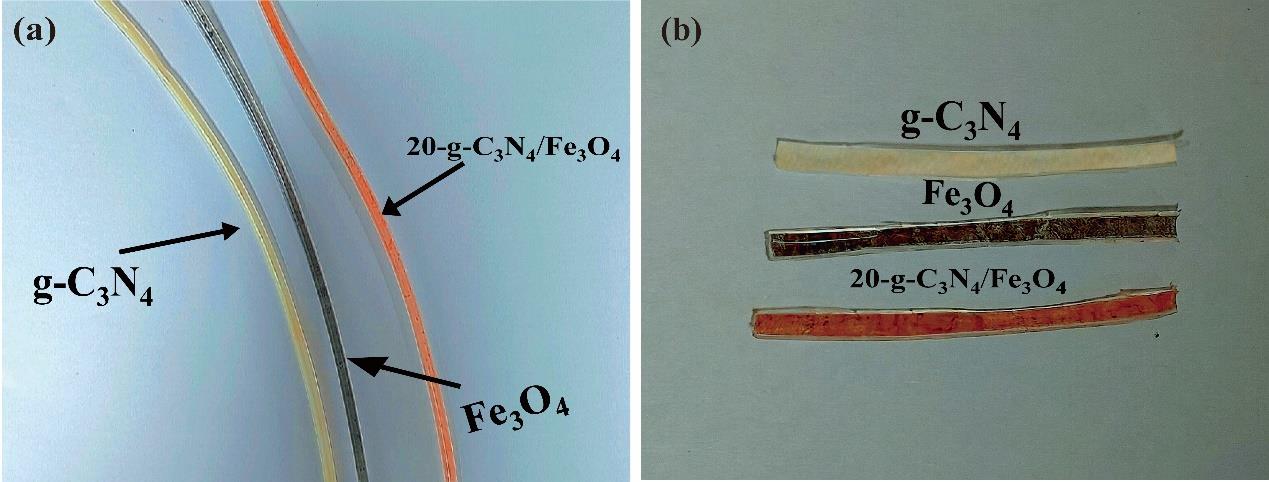
图1 (a)微通道管道示意图;(b)微通道内壁示意图
Fig.1 (a) Schematic diagram of the microchannel pipeline; (b) Schematic diagram of the inner wall of the microchannel
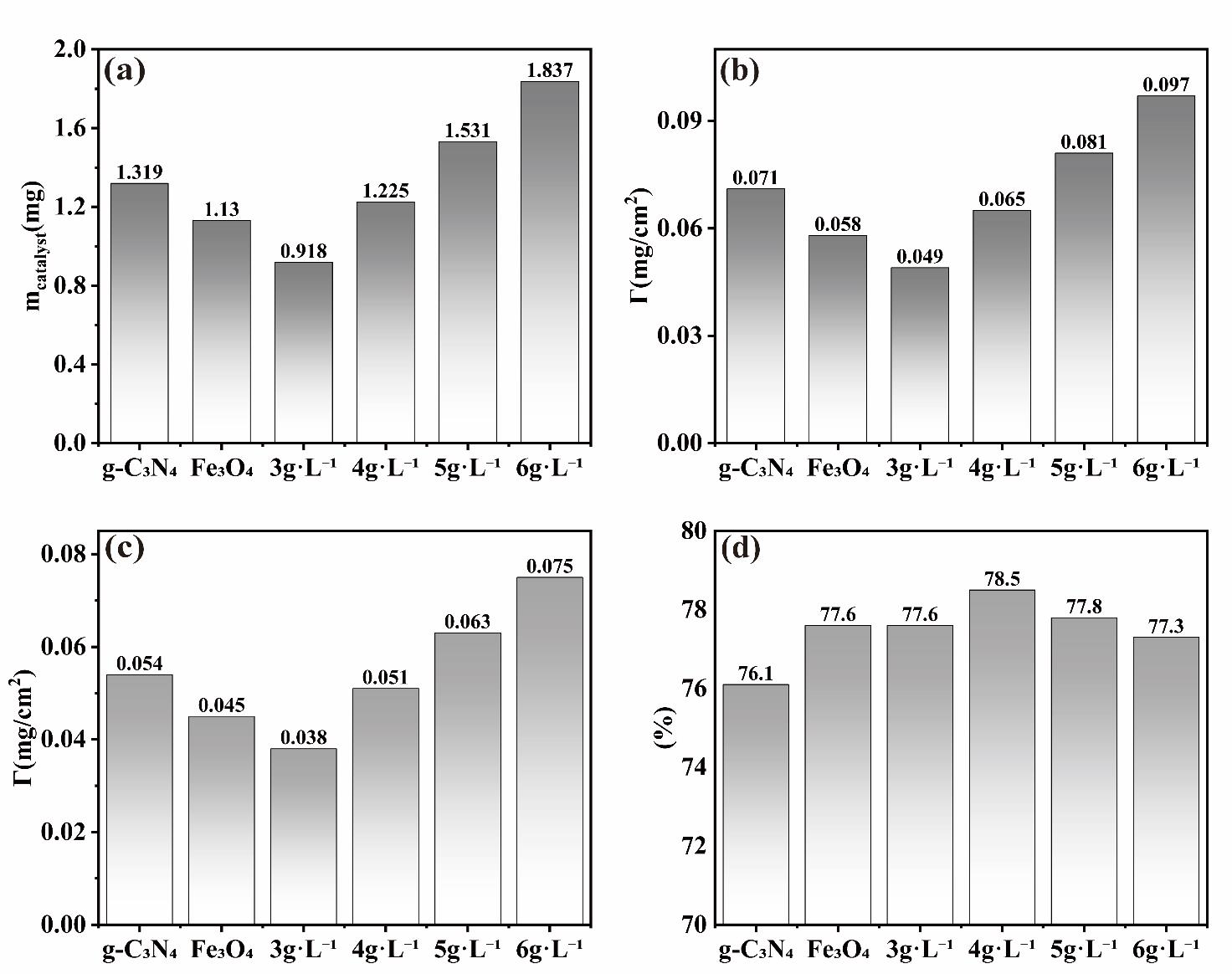
图2 (a)催化剂填充质量示意图;(b)理论负载量示意图;(c)实际负载量示意图;(d)催化剂保留率
Fig.2 (a) Schematic diagram of catalyst filling mass; (b) Schematic diagram of theoretical loading capacity; (c) Schematic diagram of actual loading capacity; (d) Catalyst retention rate
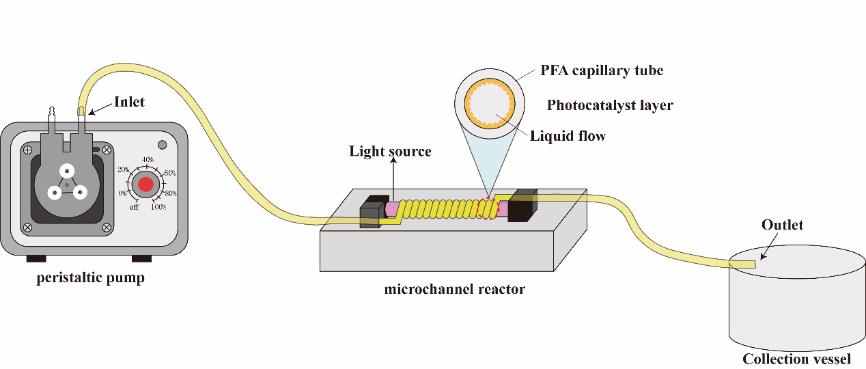
图3 实验流程示意图
Fig.3 Schematic diagram of the experimental process
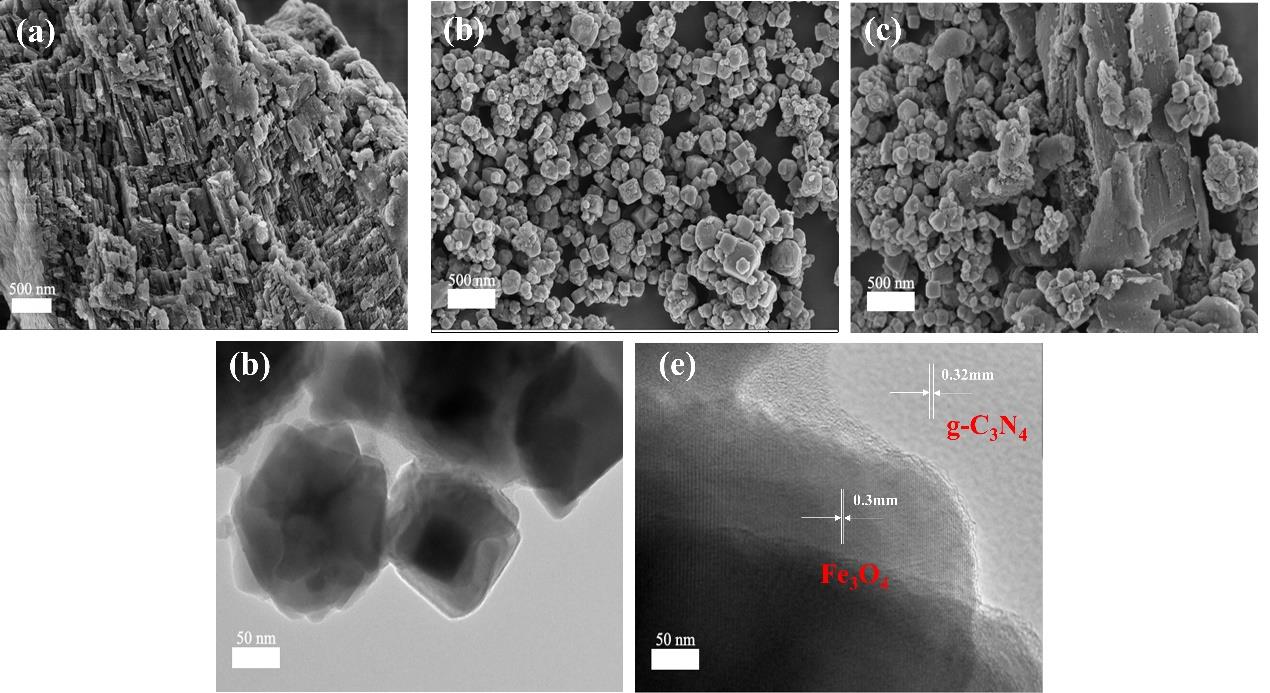
图4 微通道内壁上的光催化剂的FE-SEM形貌:(a)g-C₃N₄, (b)Fe₃O₄, (c)20-Fe₃O₄/g-C₃N₄的SEM图; 20-Fe₃O₄/g-C₃N₄的(d)TEM图像,(e) HR TEM图像
Fig.4 FE-SEM morphology of the photocatalyst on the microchannel inner wall: SEM of (a)g-C₃N₄, (b)Fe₃O₄, (c)20-Fe₃O₄/g-C₃N₄ ;(d) TEM, (e) HRTEM of 20-Fe₃O₄/g-C₃N₄
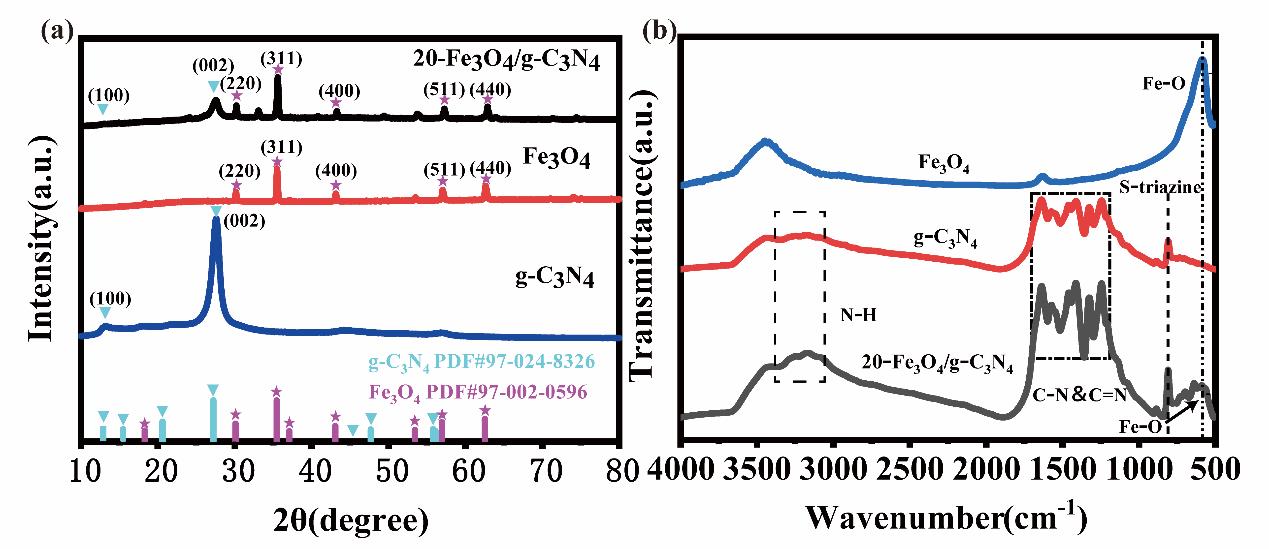
图5 制备的g-C₃N₄、Fe₃O₄及其20-Fe₃O₄/g-C₃N₄复合材料的(a)XRD图 ,(b) FTIR光谱
Fig.5 (a) XRD patterns, (b) FTIR spectra of the prepared g-C₃N₄, Fe₃O₄, and 20-Fe₃O₄/g-C₃N₄ composite
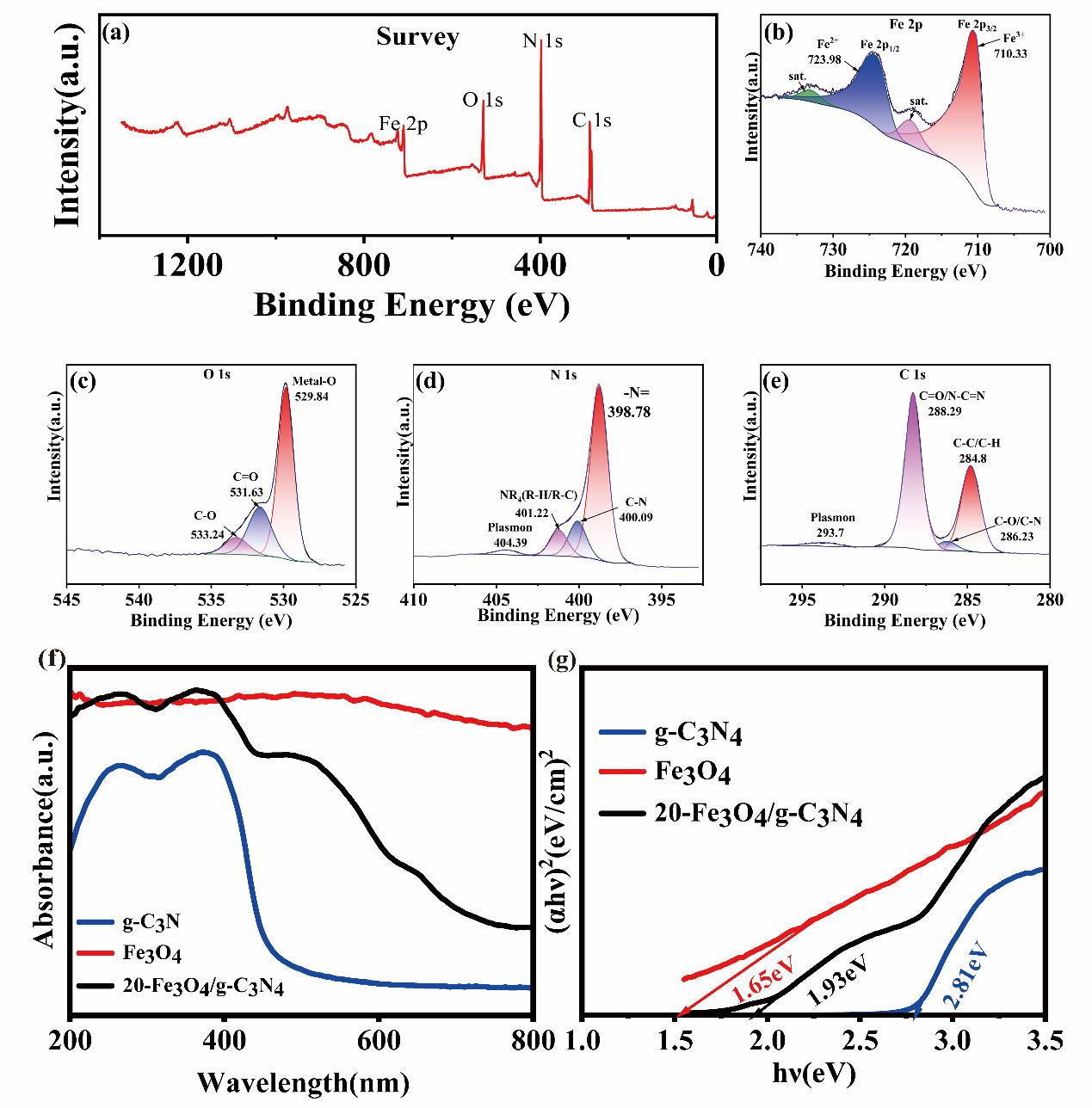
图 6 (a)20-Fe₃O₄/g-C₃N₄样品的XPS全谱扫描谱图;( b) Fe 2p, (c)O 1s, (d) N 1s 和 (e) C 1s的高分辨率 XPS 谱图;(f)催化剂的紫外可见光谱; (g)催化剂的能隙计算图
Fig.6 (a) XPS survey spectrum of the 20-Fe₃O₄/g-C₃N₄ sample; high-resolution XPS spectra of (b) Fe 2p, (c) O 1s, (d) N 1s, and (e) C 1s; (f) UV-vis spectrum of the catalyst; (g) band gap calculation plot of the catalyst
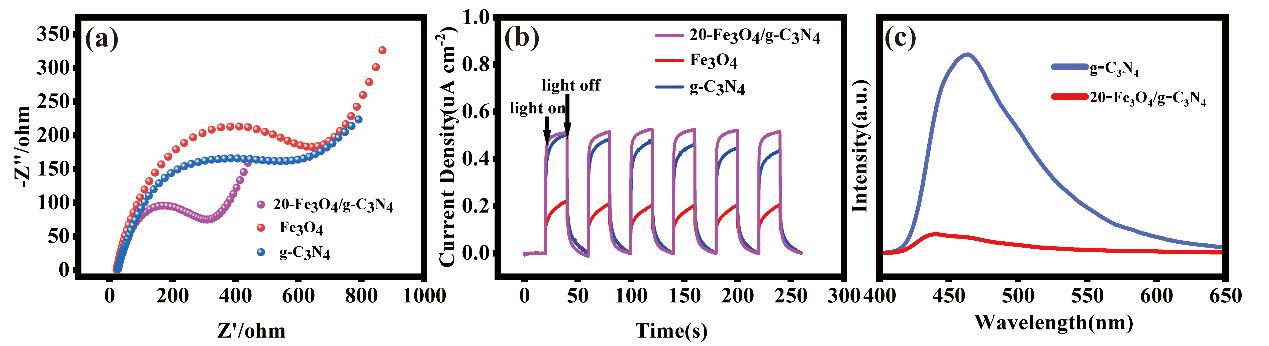
图7 (a)催化剂的EIS图;(b) 催化剂的的光电流;(c) 催化剂的的PL光谱
Fig.7 (a) EIS plot of the catalyst; (b) photocurrent response of the catalyst; (c) PL spectrum of the catalyst
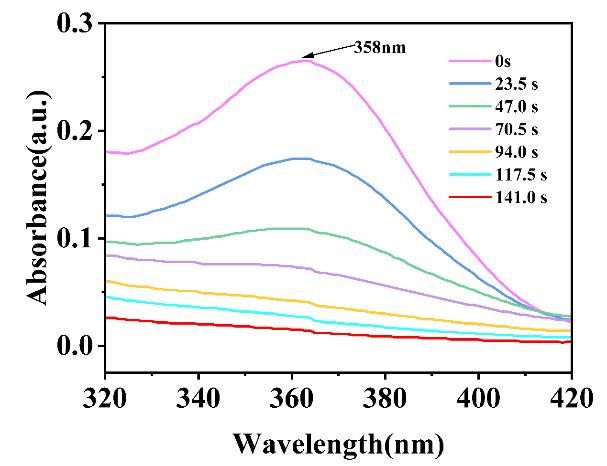
图8 Fe₃O₄/g-C₃N₄催化剂作用下TC溶液的可见光吸收光谱
Fig.8 Visible light absorption spectrum of TC solution with Fe₃O₄/g-C₃N₄ catalyst
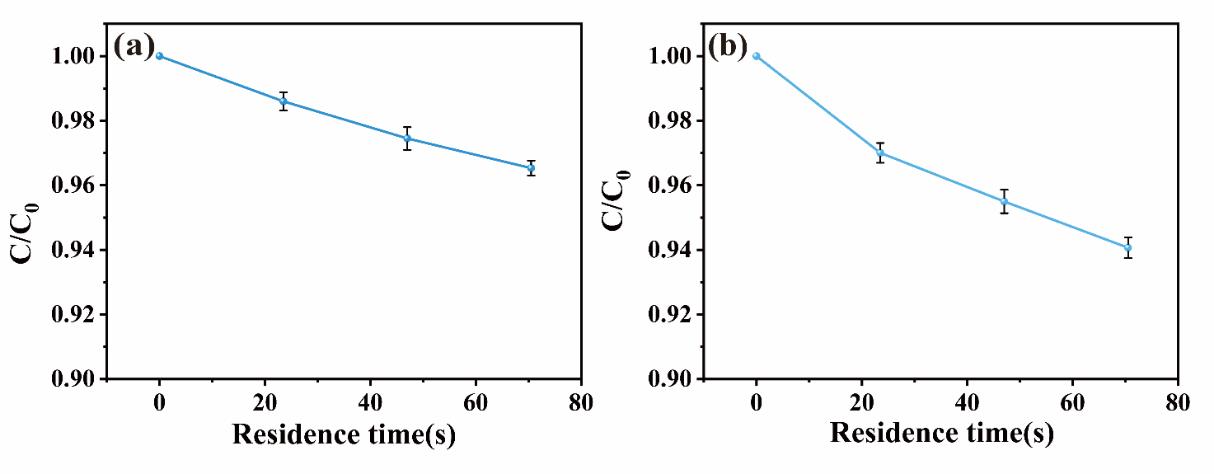
图 9 空白对照实验示意图:(a) 紫外光照和管道吸附对结果影;(b) 催化剂吸附对结果影响
Fig.9 Schematic diagram of blank control experiments: (a) Effect of UV irradiation and pipeline adsorption on results; (b) Effect of catalyst adsorption on results
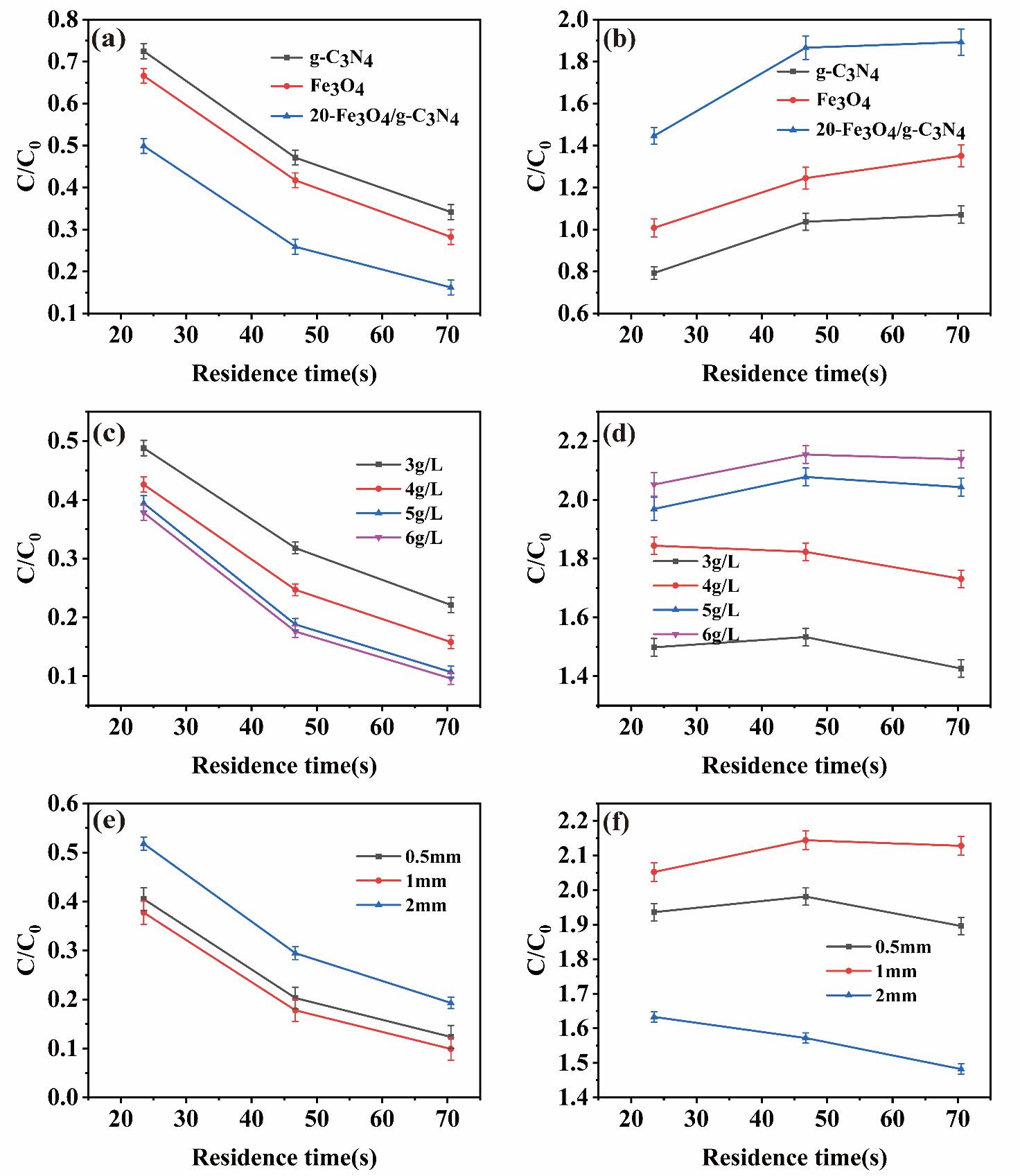
图 10 (a) 不同催化剂对TC的降解率;(b) 不同催化剂降解TC的表观反应速率;(c) 不同浓度的催化剂对TC的降解率;(d) 不同浓度的催化剂降解TC的表观反应速率;(e) 不同管径对TC的降解率;(f) 不同g管径降解TC的表观反应速率
Fig.9 (a) Degradation rates of TC by different catalysts; (b) Apparent reaction rates of TC degradation by different catalysts; (c) Degradation rate of TC by catalysts at different concentrations; (d) Apparent reaction rate of TC degradation by catalysts at different concentrations; (e) Degradation rate of TC by different pipe diameters; (f) Apparent reaction rate of TC degradation by different pipe diameters.
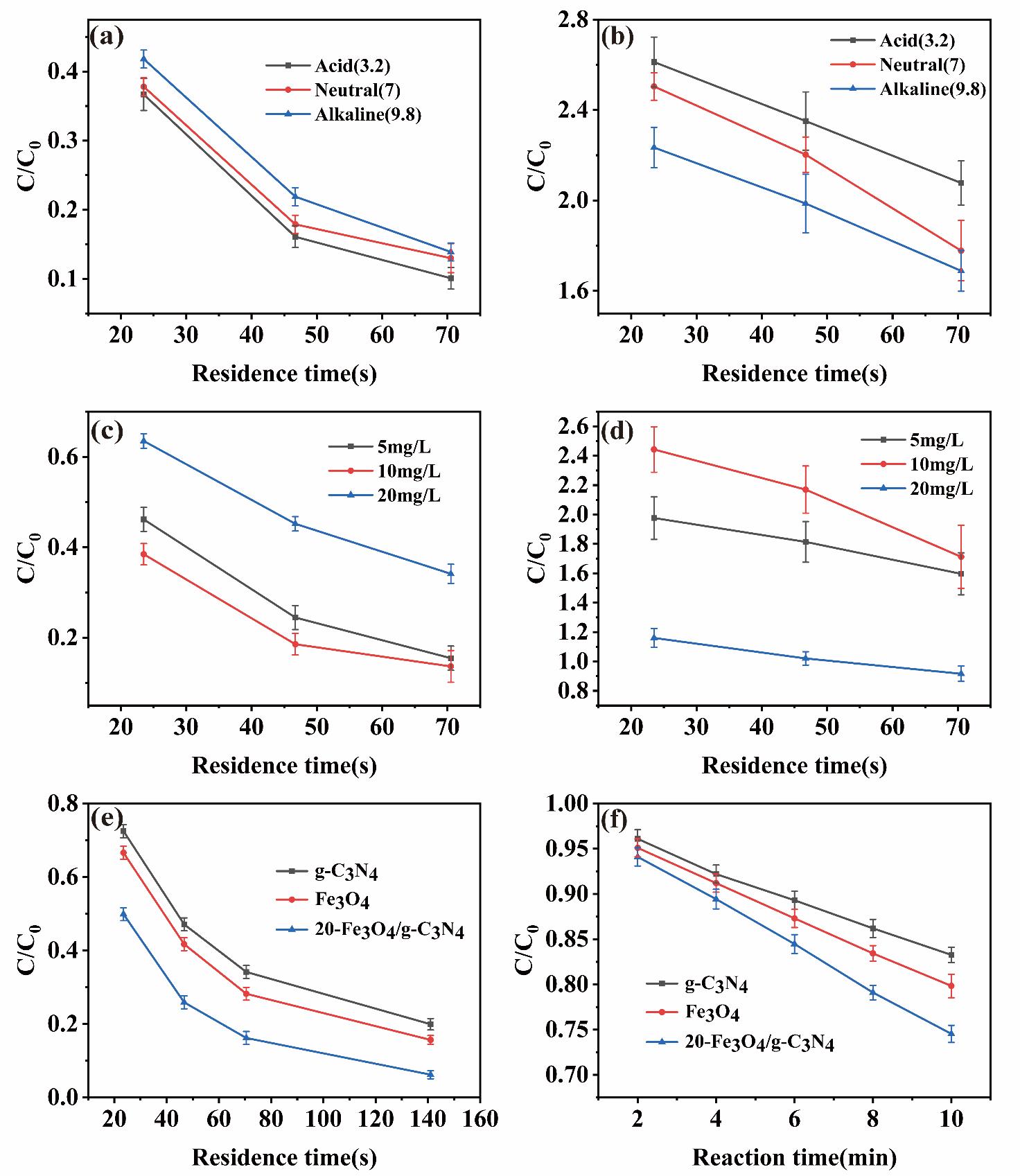
图 11 (a) 不同ph对TC的降解率;(b) 不同ph降解TC的表观反应速率;(c) 对不同浓度的TC的降解率;(d) 降解不同浓度的TC的表观反应速率;(e)、(f) 不同反应器降解TC的效率对比
Fig.11 (a) Degradation rate of TC at different pH levels; (b) Apparent reaction rate of TC degradation at different pH levels; (c) Degradation rate of TC at different concentrations; (d) Apparent reaction rate of degrading TC at different concentrations; (e), (f) Comparison of TC degradation efficiency among different reactors.
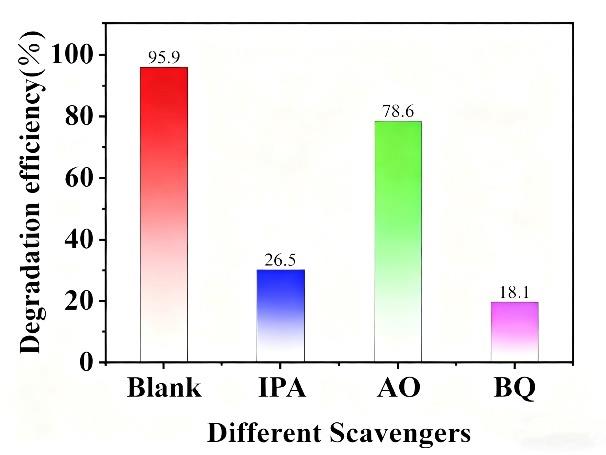
图 12 自由基清除剂对复合催化剂降解TC的影响
Fig.12 Effect of radical scavengers on TC degradation by composite catalyst
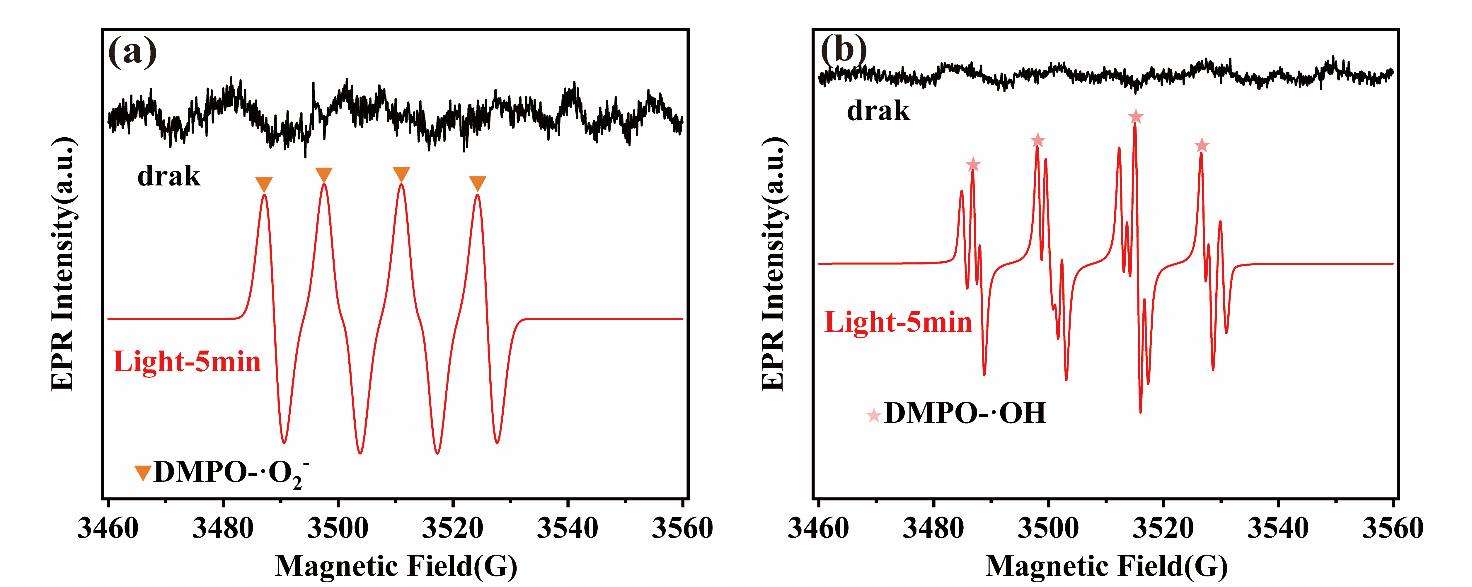
图 13 光催化机理中的EPR光谱分析:(a) DMPO-•O₂⁻;(b) DMPO-•OH
Fig.13 EPR Spectral Analysis in the Photocatalytic Mechanism: (a) DMPO-•O₂⁻;(b) DMPO-•OH
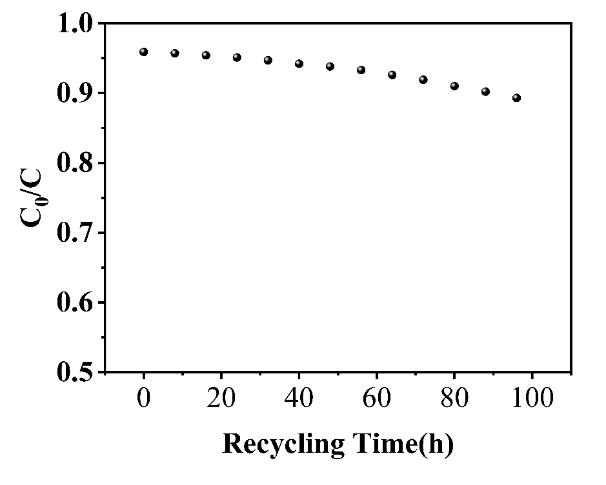
图 14 光催化微通道反应器的耐久性
Fig.14 Durability of the photocatalytic microchannel reactor
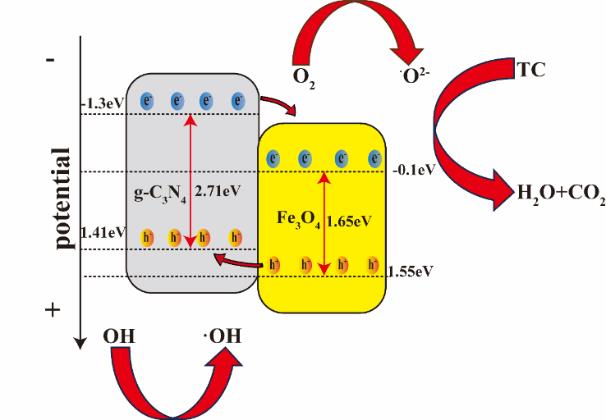
图15 TC的降解机理
Fig.15 Degradation mechanism of TC
| [1] | Klein E Y, Impalli I, Poleon S, et al. Global trends in antibiotic consumption during 2016–2023 and future projections through 2030[J]. Proceedings of the National Academy of Sciences of the United States of America, 2024, 121(49): e2411919121. |
| [2] | Wang F, Xu J, Wang Z P, et al. Unprecedentedly efficient mineralization performance of photocatalysis-self-Fenton system towards organic pollutants over oxygen-doped porous g-C3N4 nanosheets[J]. Applied Catalysis B: Environmental, 2022, 312: 121438. |
| [3] | Khan M A, Mutahir S, Shaheen I, et al. Recent advances over the doped g-C3N4 in photocatalysis: a review[J]. Coordination Chemistry Reviews, 2025, 522: 216227. |
| [4] | Kumari M, Kumar N, Sharma R K, et al. Construction, characterization, and DFT analysis of Li, P Co-doped g-C₃N₄ multifunctional materials with boosted performance as photocatalyst and supercapacitor electrode[J]. Sustainable Materials and Technologies, 2025, 45: e01426. |
| [5] | Mubashir M, Dumée L F, Fong Y Y, et al. Cellulose acetate-based membranes by interfacial engineering and integration of ZIF-62 glass nanoparticles for CO2 separation[J]. Journal of Hazardous Materials, 2021, 415: 125639. |
| [6] | He S A, Li W, Wang X, et al. High-efficient precious-metal-free g-C3N4-Fe3O4/β-FeOOH photocatalyst based on double-heterojunction for visible-light-driven hydrogen evolution[J]. Applied Surface Science, 2020, 506: 144948. |
| [7] | Tennakone K, Tilakaratne C T K, Kottegoda I R M. Photocatalytic degradation of organic contaminants in water with TiO2 supported on polythene films[J]. Journal of Photochemistry and Photobiology A: Chemistry, 1995, 87(2): 177-179. |
| [8] | Jayswal S, Mohapatra S. ZnO-modified glass capillaries as a portable photocatalytic reactor for real-time measurements[J]. Materials Research Express, 2024, 11(9): 096401. |
| [9] | He Z Y, Li Y G, Zhang Q H, et al. Capillary microchannel-based microreactors with highly durable ZnO/TiO2 nanorod arrays for rapid, high efficiency and continuous-flow photocatalysis[J]. Applied Catalysis B: Environmental, 2010, 93(3/4): 376-382. |
| [10] | Ramos B, Ookawara S, Matsushita Y, et al. Low-cost polymeric photocatalytic microreactors: Catalyst deposition and performance for phenol degradation[J]. Journal of Environmental Chemical Engineering, 2014, 2(3): 1487-1494. |
| [11] | Bongiovanni R, Nelson A, Vitale A, et al. Ultra-thin films based on random copolymers containing perfluoropolyether side chains[J]. Thin Solid Films, 2012, 520(17): 5627-5632. |
| [12] | Li X R, Chen Y, Tao Y, et al. Challenges of photocatalysis and their coping strategies[J]. Chem Catalysis, 2022, 2(6): 1315-1345. |
| [13] | Geyer K, Codée J D C, Seeberger P H. Microreactors as tools for synthetic chemists: the chemists' round-bottomed flask of the 21st century?[J]. Chemistry – A European Journal, 2006, 12(33): 8434-8442. |
| [14] | Singh S, Mahalingam H, Singh P K. Polymer-supported titanium dioxide photocatalysts for environmental remediation: a review[J]. Applied Catalysis A: General, 2013, 462/463: 178-195. |
| [15] | ROBERGE D M, GOTTSPONER M, EYHOLZER M, et al. Industrial design, scale-up, and use of microreactors [J]. Chimica Oggi, 2009, 27(4): 8-11. |
| [16] | HESSEL V, RENKEN A, SCHOUTEN J C, et al. Micro Process Engineering (A Comprehensive Handbook) || Development and Scale-Up of a Microreactor Pilot Plant Using the Concept of Numbering-Up [J]. 2009, 10.1002/9783527631445: 255-61. |
| [17] | 朱艳, 刘海龙, 贾仕奎, 等. Fe3O4/g-C3N4复合异质结的构建及紫外光降解罗丹明B[J]. 材料导报, 2024, 38(23):39-45. |
| Zhu Y, Liu H L, Jia S K, et al. Preparation of Fe3O4/g-C3N4 composite heterojunction and its photodegradation of rhodamine B[J]. Materials Reports, 2024, 38(23): 39-45. | |
| [18] | Zhou X S, Jin B, Chen R Q, et al. Synthesis of porous Fe3O4/g-C3N4 nanospheres as highly efficient and recyclable photocatalysts[J]. Materials Research Bulletin, 2013, 48(4): 1447-1452. |
| [19] | Fabiyi M E, Skelton R L. Photocatalytic mineralisation of methylene blue using buoyant TiO2-coated polystyrene beads[J]. Journal of Photochemistry and Photobiology A: Chemistry, 2000, 132(1/2): 121-128. |
| [20] | Sahar Shafaq, Zeb Akif, 刘亚男, 等. Fe3O4/g-C3N4复合催化剂增强芬顿/光-芬顿和类过氧化酶反应的活性及稳定性[J]. 催化学报, 2017, 38(12): 2110-2119. |
| Sahar S, Zeb A, Liu Y N, et al. Fe3O4/g-C3N4 composite catalyst enhances the activity and stability of Fenton/photo-Fenton and peroxidase-like reaction[J]. Chinese Journal of Catalysis, 2017, 38(12): 2110-2119. | |
| [21] | 周银, 张平, 邹赛, 等. 可磁分离Fe3O4/g-C3N4复合材料的制备及其性能[J]. 复合材料学报, 2018(11): 3189-3195. |
| Zhou Y, Zhang P, Zou S, et al. Preparation and properties of magnetically separable Fe3O4/g-C3N4 composites[J]. Acta Materiae Compositae Sinica, 2018(11): 3189-3195. | |
| [22] | 舒适, 王元有, 封娜, 等. 球片型Fe3O4/g-C3N4复合材料光催化性能研究[J]. 化学研究与应用, 2019, 31(8): 1558-1562. |
| Shu S, Wang Y Y, Feng N, et al. Study on photocatalytic performance of spherical Fe3O4/g-C3N4 composites[J]. Chemical Research and Application, 2019, 31(8): 1558-1562. | |
| [23] | Alshammari M, Alhassan S, Alshammari K, et al. Hydrogen catalytic performance of hybrid Fe3O4/FeS2/g-C3N4 nanocomposite structures[J]. Diamond and Related Materials, 2023, 138: 110214. |
| [24] | Pei J X, Li H F, Yu D C, et al. G-C3N4-based heterojunction for enhanced photocatalytic performance: a review of fabrications, applications, and perspectives[J]. Catalysts, 2024, 14(11): 825. |
| [25] | 于笑潇. 分等级纳米复合光催化材料的制备及其光催化性能研究[D]. 武汉: 武汉理工大学, 2010. |
| Yu X X. Study on Preparation and Photocatalytic Performance of Hierarchical Nanocomposite Photocatalytic Materials[D]. Wuhan: Wuhan University of Technology, 2010. | |
| [26] | WEI X, WEN X, LIU Y, et al. Oxygen Vacancy-Mediated Selective C-N Coupling toward Electrocatalytic Urea Synthesis [J]. J Am Chem Soc, 2022, 144(26): 11530-5. |
| [27] | Che Y P, Liu Q Q, Lu B X, et al. Plasmonic ternary hybrid photocatalyst based on polymeric g-C3N4 towards visible light hydrogen generation[J]. Scientific Reports, 2020, 10: 721. |
| [28] | Vavilapalli D S, Peri R G, Sharma R K, et al. G-C3N4/Ca2Fe2O5 heterostructures for enhanced photocatalytic degradation of organic effluents under sunlight[J]. Scientific Reports, 2021, 11: 19639. |
| [29] | Iqbal N, Afzal A, Khan I, et al. Molybdenum impregnated g-C3N4 nanotubes as potentially active photocatalyst for renewable energy applications[J]. Scientific Reports, 2021, 11: 16886. |
| [30] | Chandrakanta K, Jena R, Pal P, et al. Enhanced magnetic and magnetodielectric properties of Co-doped brownmillerite KBiFe2O5 at room temperature[J]. Journal of Alloys and Compounds, 2021, 886: 161294. |
| [31] | LOW J, YU J, JARONIEC M, et al. Heterojunction Photocatalysts [J]. Adv Mater, 2017, 29(20). |
| [32] | Lianos P. Production of electricity and hydrogen by photocatalytic degradation of organic wastes in a photoelectrochemical cell: the concept of the Photofuelcell: a review of a re-emerging research field[J]. Journal of Hazardous Materials, 2011, 185(2/3): 575-590. |
| [33] | Zhang L W, Mohamed H H, Dillert R, et al. Kinetics and mechanisms of charge transfer processes in photocatalytic systems: a review[J]. Journal of Photochemistry and Photobiology C: Photochemistry Reviews, 2012, 13(4): 263-276. |
| [34] | Cui P P, Hu Y, Zheng M M, et al. Enhancement of visible-light photocatalytic activities of BiVO4 coupled with g-C3N4 prepared using different precursors[J]. Environmental Science and Pollution Research, 2018, 25(32): 32466-32477. |
| [35] | Jia L Y, Jin Y, Li J, et al. Study on high-efficiency photocatalytic degradation of oxytetracycline based on a spiral microchannel reactor[J]. Industrial & Engineering Chemistry Research, 2022, 61(1): 554-565. |
| [36] | Ren Z L, Zhao Z W, Ma X, et al. Construction of magnetically retrievable g-C3N4/CeO2-Fe3O4-reduced graphene oxide composites with enhanced visible-light photocatalytic activity and antibacterial properties[J]. Catalysis Letters, 2024, 154(12): 6271-6289. |
| [37] | 安小英, 蔡漪, 姜韵婕, 等. g-C3N4/HNTs复合光催化剂的制备及其降解盐酸四环素研究[J]. 化工新型材料, 2017, 45(5): 161-163, 172. |
| An X Y, Cai Y, Jiang Y J, et al. Preparation of g-C3N4/HNTs composite photocatalyst and its degradation of tetracycline hydrochloride[J]. New Chemical Materials, 2017, 45(5): 161-163, 172. | |
| [38] | Charles G, Roques-Carmes T, Becheikh N, et al. Determination of kinetic constants of a photocatalytic reaction in micro-channel reactors in the presence of mass-transfer limitation and axial dispersion[J]. Journal of Photochemistry and Photobiology A: Chemistry, 2011, 223(2/3): 202-211. |
| [39] | Chen S Y, Lv Q R, Li F J, et al. Flat-plate mesophotoreactor with a serpentine channel and inclined baffles for balancing mixing performance and reaction throughput[J]. Reaction Chemistry & Engineering, 2025, 10(4): 894-905. |
| [40] | Sayed M, Ren B X, Ali A M, et al. Solar light induced photocatalytic activation of peroxymonosulfate by ultra-thin Ti3+ self-doped Fe2O3/TiO2 nanoflakes for the degradation of naphthalene[J]. Applied Catalysis B: Environmental, 2022, 315: 121532. |
| [41] | González-Galán C, Luna-Triguero A, Vicent-Luna J M, et al. Exploiting the π-bonding for the separation of benzene and cyclohexane in zeolites[J]. Chemical Engineering Journal, 2020, 398: 125678. |
| [42] | Shi Z X, Zhao J W, Li C F, et al. Fully exposed edge/corner active sites in Fe substituted-Ni(OH)2 tube-in-tube arrays for efficient electrocatalytic oxygen evolution[J]. Applied Catalysis B: Environmental, 2021, 298: 120558. |
| [43] | Samuel M S, Selvarajan E, Sarswat A, et al. Nanomaterials as adsorbents for As(III) and As(V) removal from water: a review[J]. Journal of Hazardous Materials, 2022, 424: 127572. |
| [44] | Liu T C, Yin K, Liu C B, et al. The role of reactive oxygen species and carbonate radical in oxcarbazepine degradation via UV, UV/H2O2: Kinetics, mechanisms and toxicity evaluation[J]. Water Research, 2018, 147: 204-213. |
| [45] | 谢钦崟, 黄晓连, 李元, 等. TiO2平板微反应器设计优化及光催化性能研究[J]. 化工学报, 2021, 72(7): 3626-3636. |
| Xie Q Y, Huang X L, Li Y, et al. Design optimization and photocatalytic performance research of TiO2 planar microreactor[J]. CIESC Journal, 2021, 72(7): 3626-3636. | |
| [46] | Priya A, Arumugam M, Arunachalam P, et al. Fabrication of visible-light active BiFeWO6/ZnO nanocomposites with enhanced photocatalytic activity[J]. Colloids and Surfaces A: Physicochemical and Engineering Aspects, 2020, 586: 124294. |
| [47] | Song Y, Mei Z H, Kang Y H, et al. Recyclable ternary composite photocatalyst Fe3O4@mTiO2/carbon deficient g-C3N4 for efficient degrading sodium ethyl xanthate in mining wastewater[J]. Journal of Alloys and Compounds, 2025, 1022: 179818. |
| [48] | Girish Y R, Udayabhanu, Alnaggar G, et al. Facile and rapid synthesis of solar-driven TiO2/g-C3N4 heterostructure photocatalysts for enhanced photocatalytic activity[J]. Journal of Science: Advanced Materials and Devices, 2022, 7(2): 100419. |
| [49] | Adeleke J T, Theivasanthi T, Thiruppathi M, et al. Photocatalytic degradation of methylene blue by ZnO/NiFe2O4 nanoparticles[J]. Applied Surface Science, 2018, 455: 195-200. |
| [50] | Qiu L, Pang D D, Zhang C L, et al. In situ IR studies of Co and Ce doped Mn/TiO2 catalyst for low-temperature selective catalytic reduction of NO with NH3[J]. Applied Surface Science, 2015, 357: 189-196. |
| [51] | Kumar S, Surendar T, Kumar B, et al. Synthesis of magnetically separable and recyclable g-C3N4–Fe3O4 hybrid nanocomposites with enhanced photocatalytic performance under visible-light irradiation[J]. The Journal of Physical Chemistry C, 2013, 117(49): 26135-26143. |
| [52] | Xi G C, Yue B, Cao J Y, et al. Fe3O4/WO3 hierarchical core–shell structure: high-performance and recyclable visible-light photocatalysis[J]. Chemistry – A European Journal, 2011, 17(18): 5145-5154. |
| [53] | Wang J L, Zhuan R. Degradation of antibiotics by advanced oxidation processes: an overview[J]. Science of the Total Environment, 2020, 701: 135023. |
| [54] | Gligorovski S, Strekowski R, Barbati S, et al. Environmental implications of hydroxyl radicals (•OH)[J]. Chemical Reviews, 2015, 115(24): 13051-13092. |
| [1] | 苏伟, 赵大海, 金旭, 刘忠彦, 李静, 张小松. 吸湿液滴与混合润湿性表面协同抑霜特性研究[J]. 化工学报, 2025, 76(S1): 140-151. |
| [2] | 赵子祥, 段钟弟, 孙浩然, 薛鸿祥. 大温差两相流动诱导水锤冲击的数值模型[J]. 化工学报, 2025, 76(S1): 170-180. |
| [3] | 任现超, 谷雅秀, 段少斌, 贾文竹, 李汉林. 翅片式椭圆套管蒸发式冷凝器传热传质性能实验研究[J]. 化工学报, 2025, 76(S1): 75-83. |
| [4] | 赵维, 邢文乐, 韩朝旭, 袁兴中, 蒋龙波. g-C3N4基非金属异质结光催化降解水中有机污染物的研究进展[J]. 化工学报, 2025, 76(9): 4752-4769. |
| [5] | 佟丽丽, 陈英, 艾敏华, 舒玉美, 张香文, 邹吉军, 潘伦. ZnO/WO3异质结光催化环烯烃[2+2]环加成制备高能量密度燃料[J]. 化工学报, 2025, 76(9): 4882-4892. |
| [6] | 段炼, 周星睿, 袁文君, 陈飞. 连续相速度脉动对微通道内聚合物液滴生成和形貌的影响规律[J]. 化工学报, 2025, 76(9): 4578-4585. |
| [7] | 陈科拯, 高蓬辉, 焉富春, 程博. 考虑液滴动态行为的亲-疏水复合结构表面冷凝特性影响因素分析[J]. 化工学报, 2025, 76(8): 3976-3989. |
| [8] | 吴林凯, 林志敏, 王良璧. 基于热质传递效应的准稳态结霜模型改进及数值验证[J]. 化工学报, 2025, 76(8): 4004-4016. |
| [9] | 周航, 张斯婧, 刘剑, 张小松. 小通道内非共沸工质流动沸腾换热数值分析[J]. 化工学报, 2025, 76(8): 3864-3872. |
| [10] | 佘海龙, 胡光忠, 崔晓钰, 柳忠彬, 彭帝, 李航. 不同节流工质下叠层微通道分布式节流制冷器性能研究[J]. 化工学报, 2025, 76(8): 4017-4029. |
| [11] | 郭铮铮, 赵一丹, 王辅强, 裴璐, 靳彦岭, 任芳, 任鹏刚. 异质结构MoS2/RGO/NiFe2O4复合材料的构筑及电磁波吸收性能研究[J]. 化工学报, 2025, 76(7): 3719-3732. |
| [12] | 陈培强, 郑群, 姜玉廷, 熊春华, 陈今茂, 王旭东, 黄龙, 阮曼, 徐万里. 电液流量及电流密度对海水激活电池输出特性的影响[J]. 化工学报, 2025, 76(7): 3235-3245. |
| [13] | 黄荣廷, 陶奕淳, 陈江林, 李世航, 杨子系, 王仕远, 罗祥轩. 矿井除湿溶液再生速率预测研究[J]. 化工学报, 2025, 76(7): 3572-3584. |
| [14] | 米晓天, 刘宏臣, 王克军, 唐文娜, 徐永伟, 杨梅. 微通道内两相吸收剂TETA/DEEA吸收CO2过程的传质研究[J]. 化工学报, 2025, 76(6): 2667-2677. |
| [15] | 郭明钢, 杨晓航, 代岩, 米盼盼, 马世鑫, 贺高红, 肖武, 崔福军. 贫氦管输天然气提氦多元化产品耦合工艺优化设计[J]. 化工学报, 2025, 76(5): 2251-2261. |
| 阅读次数 | ||||||
|
全文 |
|
|||||
|
摘要 |
|
|||||
 京公网安备 11010102001995号