化工学报 ›› 2025, Vol. 76 ›› Issue (10): 5076-5092.DOI: 10.11949/0438-1157.20250374
刘子琦1,2( ), 王吉1,2(), 俞海1, 张宇宁1,2
收稿日期:2025-04-10
修回日期:2025-05-14
出版日期:2025-10-25
发布日期:2025-11-25
通讯作者:
王吉
作者简介:刘子琦(1999—),女,博士研究生,liuziqi0212@163.com
基金资助:
Ziqi LIU1,2(), Ji WANG1,2(), Hai YU1, Yuning ZHANG1,2
Received:2025-04-10
Revised:2025-05-14
Online:2025-10-25
Published:2025-11-25
Contact:
Ji WANG
摘要:
针对FC-72在具有可弹性变形壁面的PDMS矩形微通道中的冷凝流动特性进行了实验研究,采用截面为300 μm×150 μm的微通道,质量流率为290和482 kg/(m²·s)、入口干度为0.1~0.9。通过高速摄像系统捕捉两相流型的演变过程,并采用白光共焦同轴位移计实时测量壁面变形量。实验结果表明,流型为间歇流时,液塞流经位置的壁面呈现显著的厚度增加现象,且壁厚变化率与质量流率及干度呈正相关。分析发现,表面张力作用不足以解释实验中观测到的壁面变形程度。进一步研究表明,弹性壁面厚度的变化主要来源于液塞内部的局部压降,这种压降是由冷凝过程中气体液化导致细长气泡收缩所引发的。当冷凝速率达到一定程度时,液塞内部将产生显著的局部压降,从而驱动弹性壁向通道内部移动。基于上述机理,建立了预测由于内部流动凝结导致微通道弹性壁面变形的理论模型,该模型在高干度条件下与实验测量结果表现出良好的一致性。
中图分类号:
刘子琦, 王吉, 俞海, 张宇宁. PDMS微通道冷凝流动导致弹性壁面变形的研究[J]. 化工学报, 2025, 76(10): 5076-5092.
Ziqi LIU, Ji WANG, Hai YU, Yuning ZHANG. Condensation flow in PDMS microchannels with detectable wall deformation caused by flow condensation[J]. CIESC Journal, 2025, 76(10): 5076-5092.
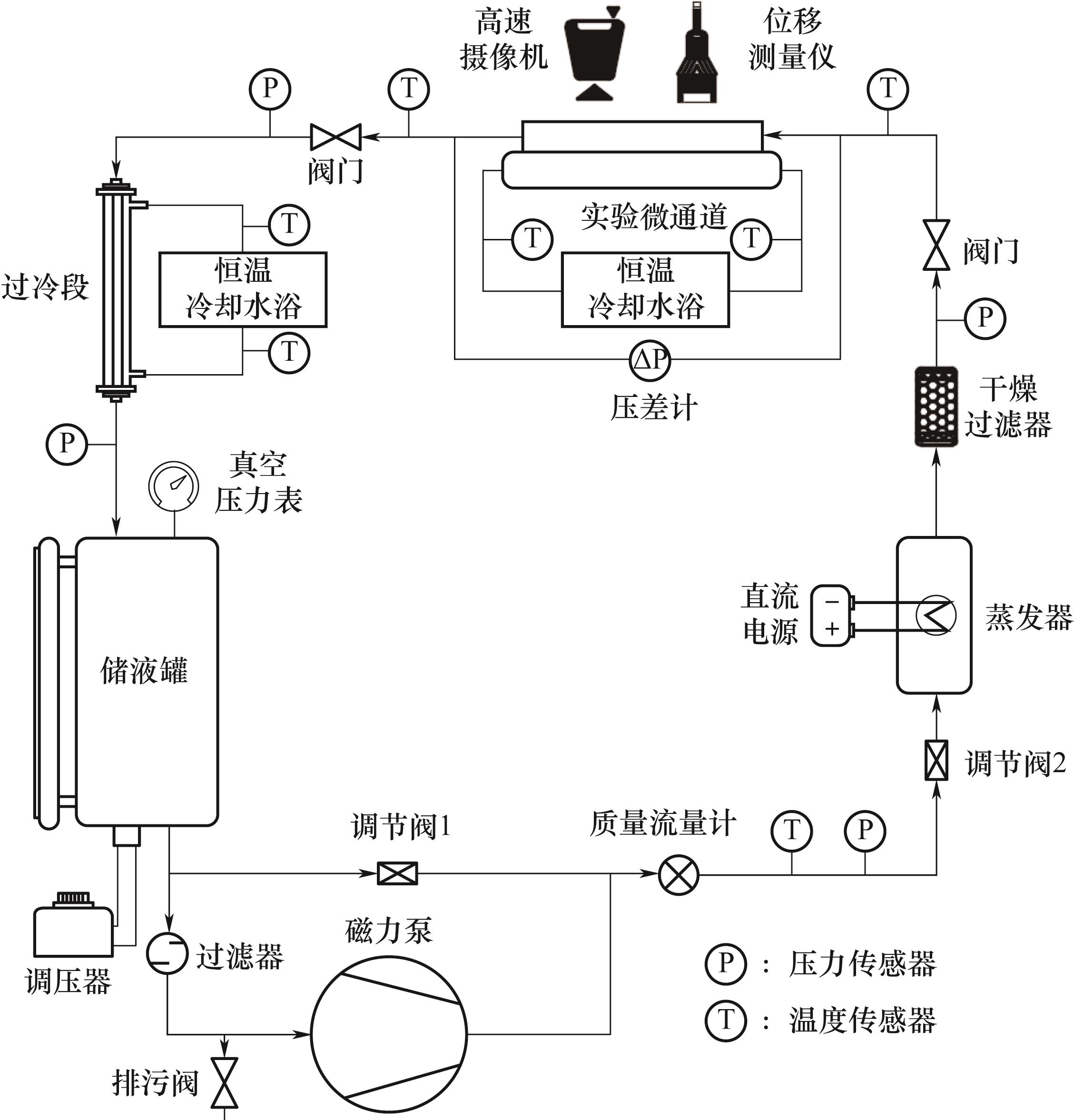
图1 实验装置示意图
Fig.1 Schematic of the experimental setup
| 设备 | 型号 | 基本参数和精确度 |
|---|---|---|
| 磁力驱动齿轮泵 | 3030-045-B-MK11 | 最大耐压1.2 MPa,2900 r/min |
| 恒温水浴 | THX-0510 | -5~100℃,±0.1℃ |
| 直流电源 | SS-K6010SPD | 60 V±0.1 V,10 A±0.1 A |
| 科里奥利质量流量计 | DMF-1-B | 30 kg/h,±0.2% |
| 压力变送器 | EJA110A | 0~100 kPa,±0.1% |
| 数据采集器 | Agilent 34970A | ±0.004% |
| 高速摄像机 | Photron Mini UX50 | 最大像素1280×1024,最大拍摄速率2000 帧/s |
表1 实验装置
Table 1 Experimental apparatuses
| 设备 | 型号 | 基本参数和精确度 |
|---|---|---|
| 磁力驱动齿轮泵 | 3030-045-B-MK11 | 最大耐压1.2 MPa,2900 r/min |
| 恒温水浴 | THX-0510 | -5~100℃,±0.1℃ |
| 直流电源 | SS-K6010SPD | 60 V±0.1 V,10 A±0.1 A |
| 科里奥利质量流量计 | DMF-1-B | 30 kg/h,±0.2% |
| 压力变送器 | EJA110A | 0~100 kPa,±0.1% |
| 数据采集器 | Agilent 34970A | ±0.004% |
| 高速摄像机 | Photron Mini UX50 | 最大像素1280×1024,最大拍摄速率2000 帧/s |
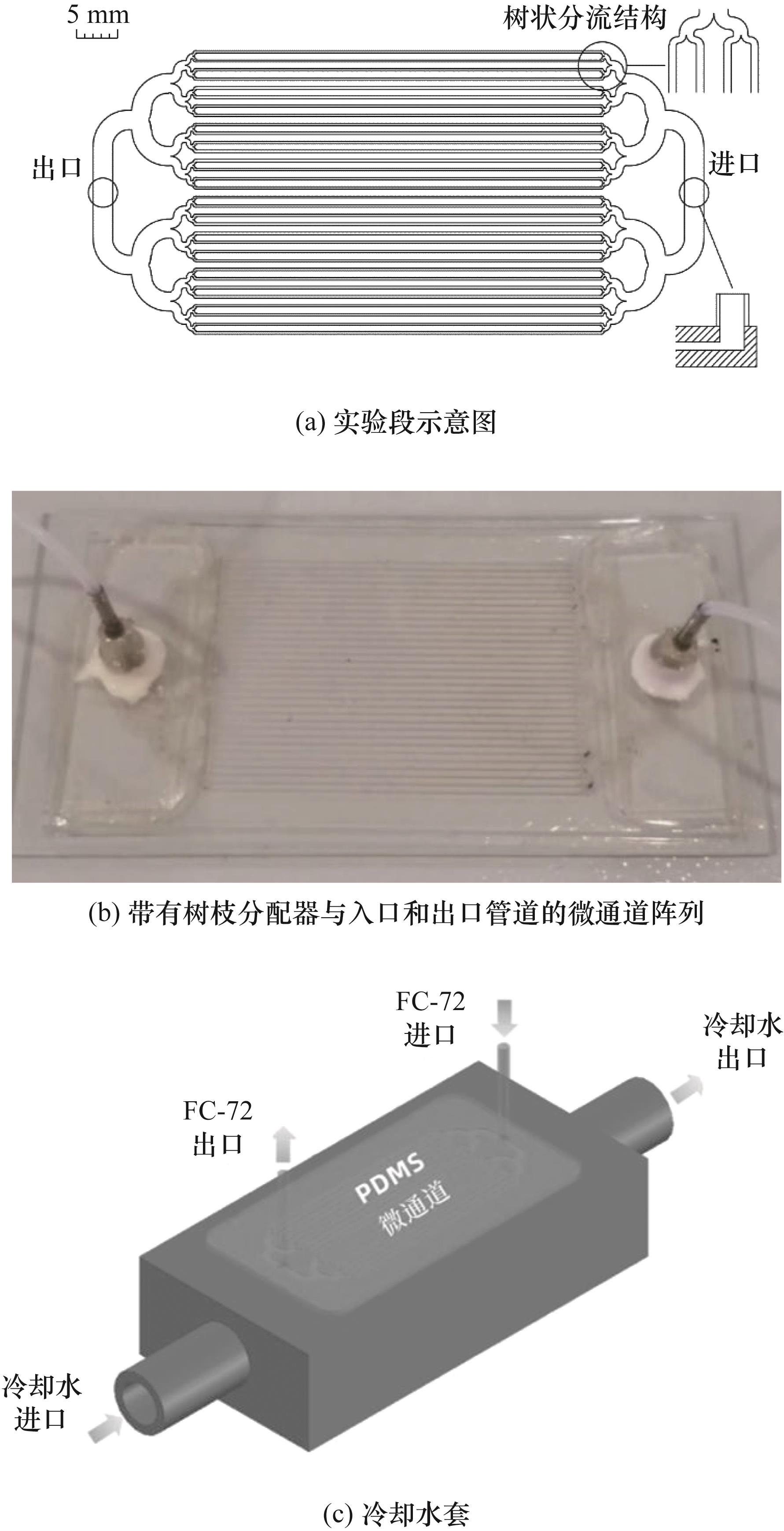
图2 实验段
Fig.2 Test section

图3 壁面变形量测量系统
Fig.3 Soft wall deformation measurement system
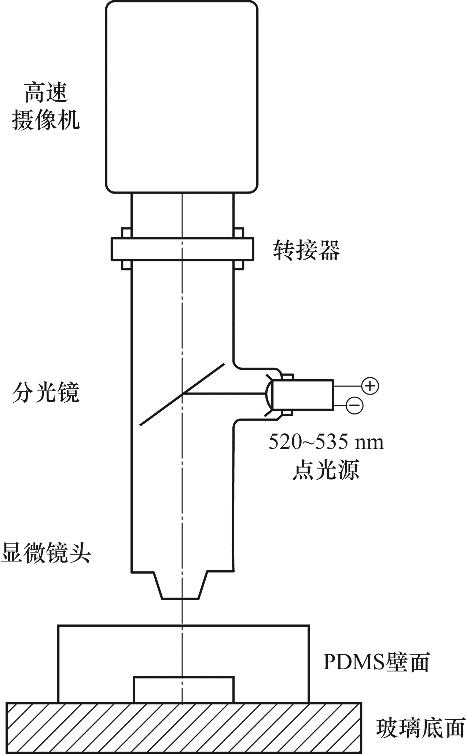
图4 可视化拍摄系统
Fig.4 Optical visualization system
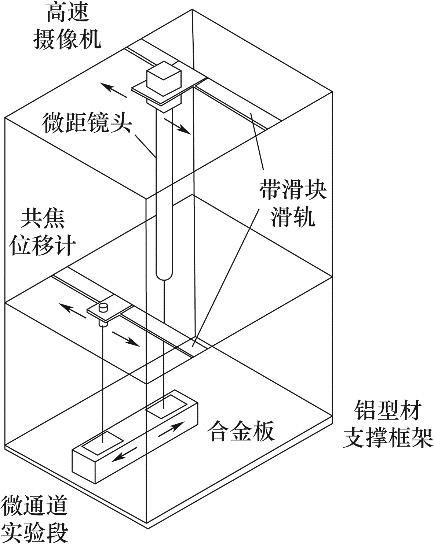
图5 测量段示意图
Fig.5 Schematic diagram of the measurement section
| 参数 | 不确定性 |
|---|---|
| 温度(RTD) | ±0.1℃ |
| 质量流速 | ±0.2%[0~1000 kg/(m2‧s)] |
| 压力 | ±0.3%(0~6 MPa) |
| 时间 | ±18.5 ns |
| 长度 | ±0.1 mm |
| 变形量 | ±0.001 mm |
表2 误差分析
Table 2 Uncertainties for all measurements
| 参数 | 不确定性 |
|---|---|
| 温度(RTD) | ±0.1℃ |
| 质量流速 | ±0.2%[0~1000 kg/(m2‧s)] |
| 压力 | ±0.3%(0~6 MPa) |
| 时间 | ±18.5 ns |
| 长度 | ±0.1 mm |
| 变形量 | ±0.001 mm |
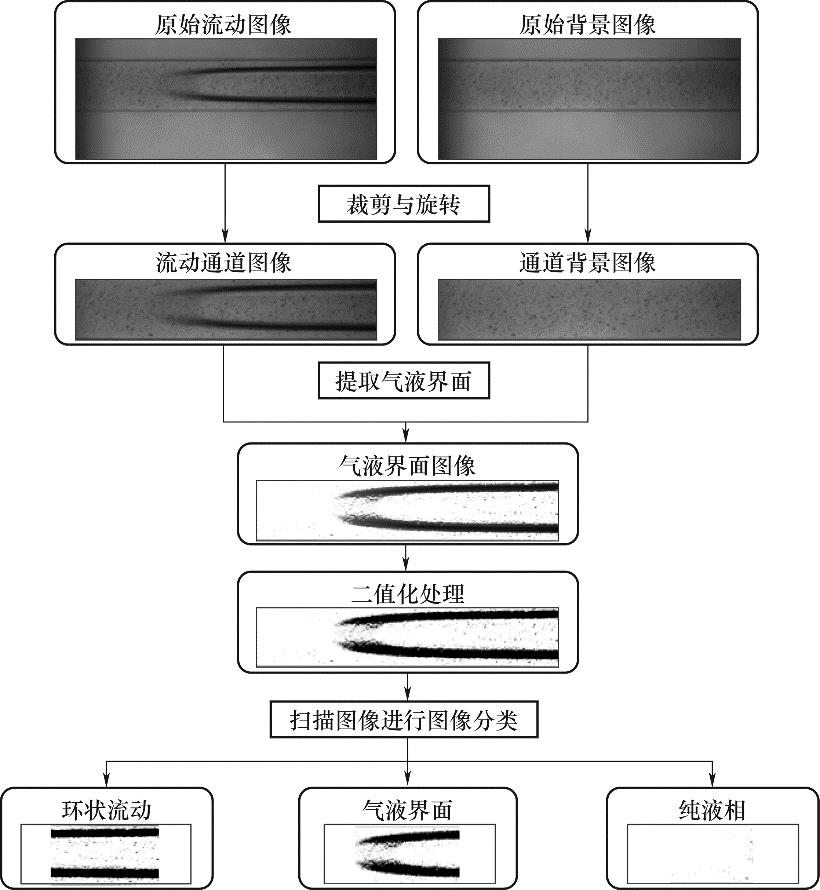
图6 图像处理流程
Fig.6 Flow chart of image processing
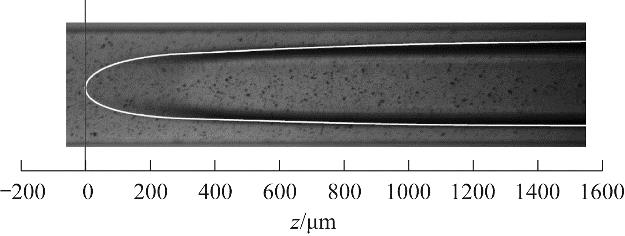
图7 气液界面的几何形状(可视图像)
Fig.7 Liquid-vapor interface morphology(visible image)
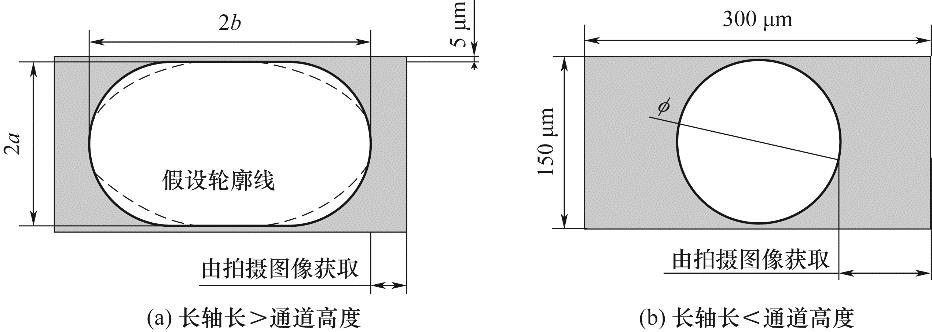
图8 气液界面几何形状——假设面
Fig.8 Geometry shape of gas-liquid interface (hypothetical surface)
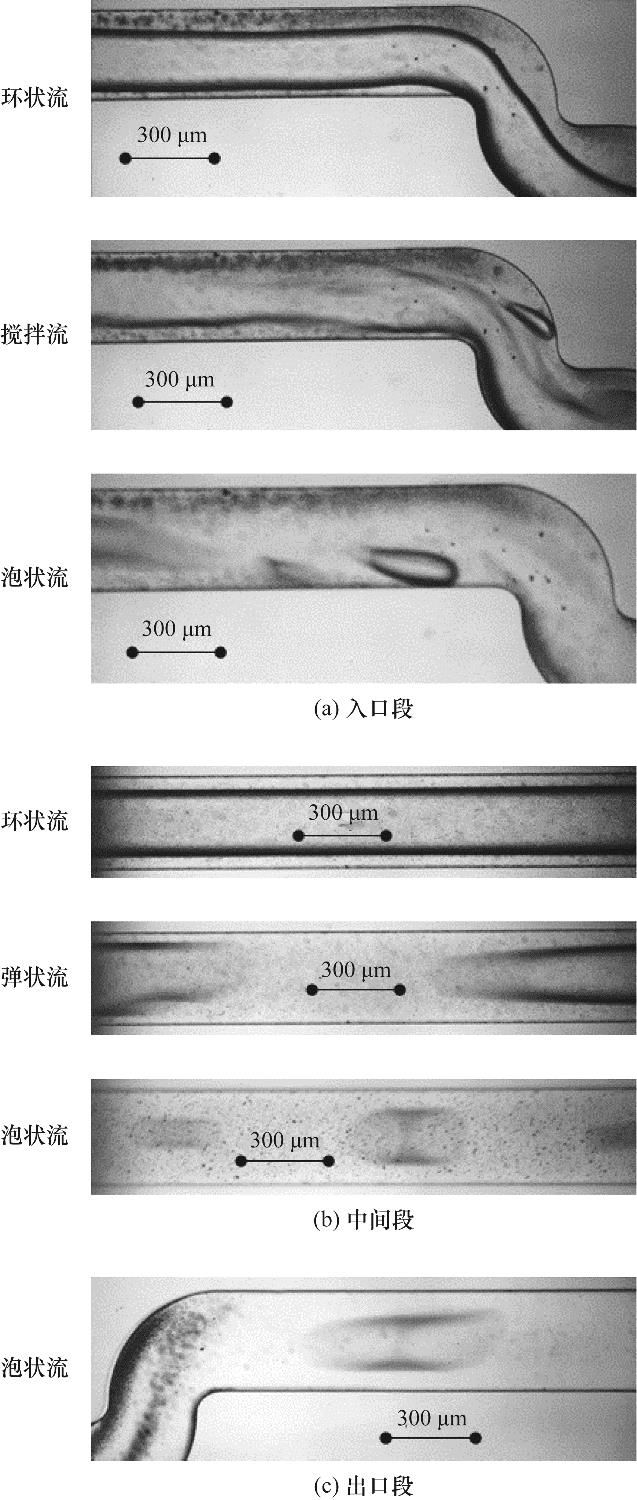
图9 流动凝结流型
Fig.9 Condensation flow regimes
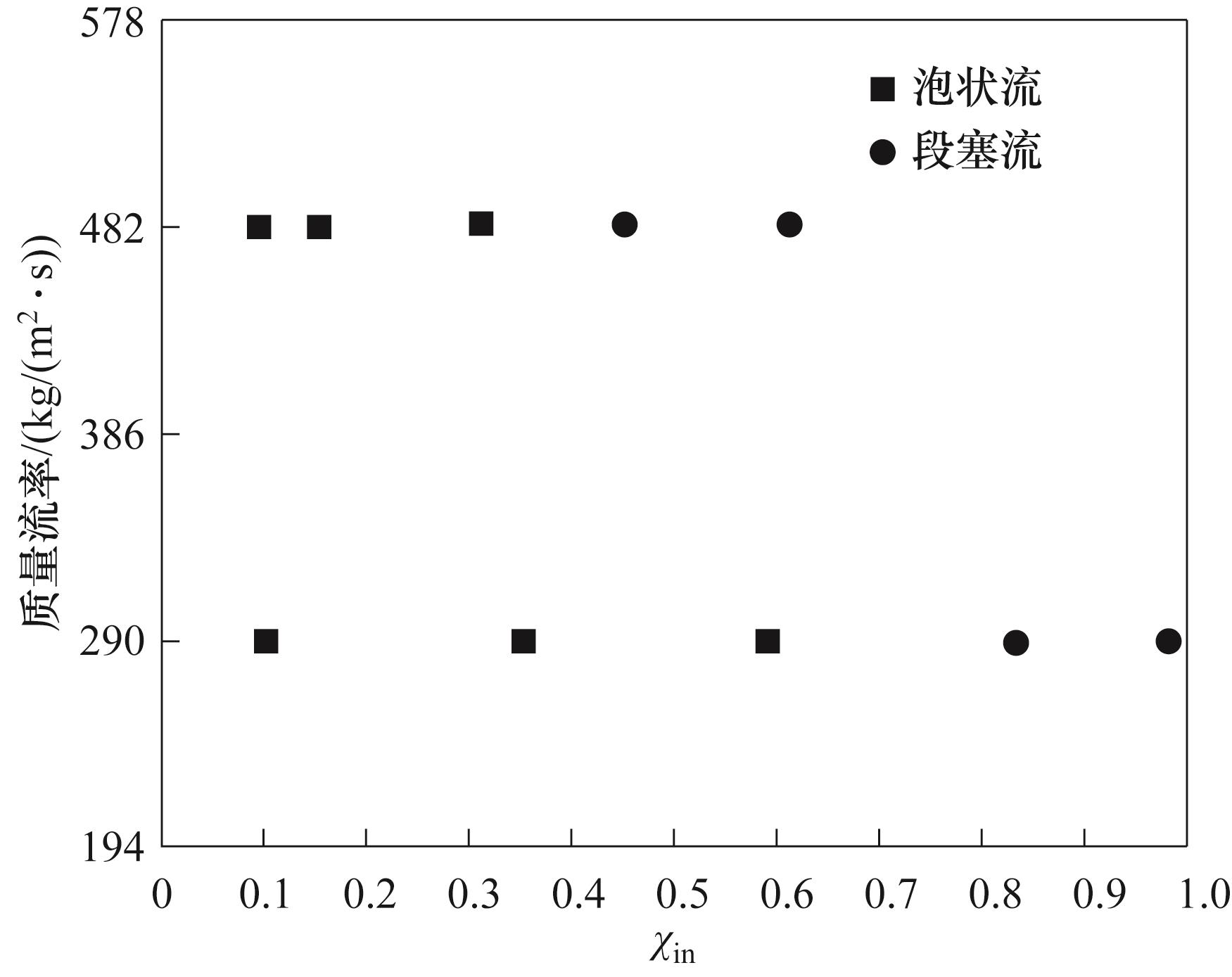
图10 流型分布
Fig.10 Flow pattern map
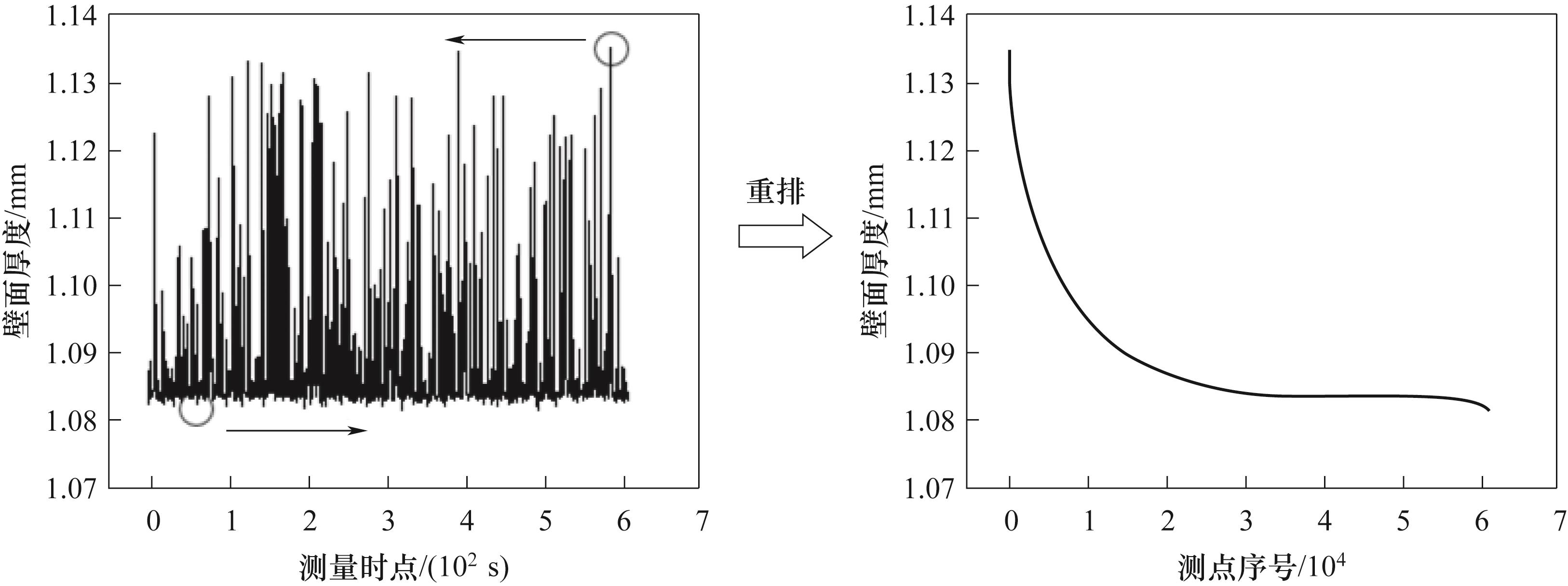
图11 变形数据处理
Fig.11 Deformation data processing

图12 质量流率482 kg/(m2·s)时测试点的PDMS壁厚分布
Fig.12 PDMS wall thickness distribution of test points for mass flux 482 kg/(m2‧s)

图13 质量流率482 kg/(m2·s)时的PDMS壁厚变化量分布
Fig.13 PDMS wall deformation distribution for mass flux 482 kg/(m2‧s)
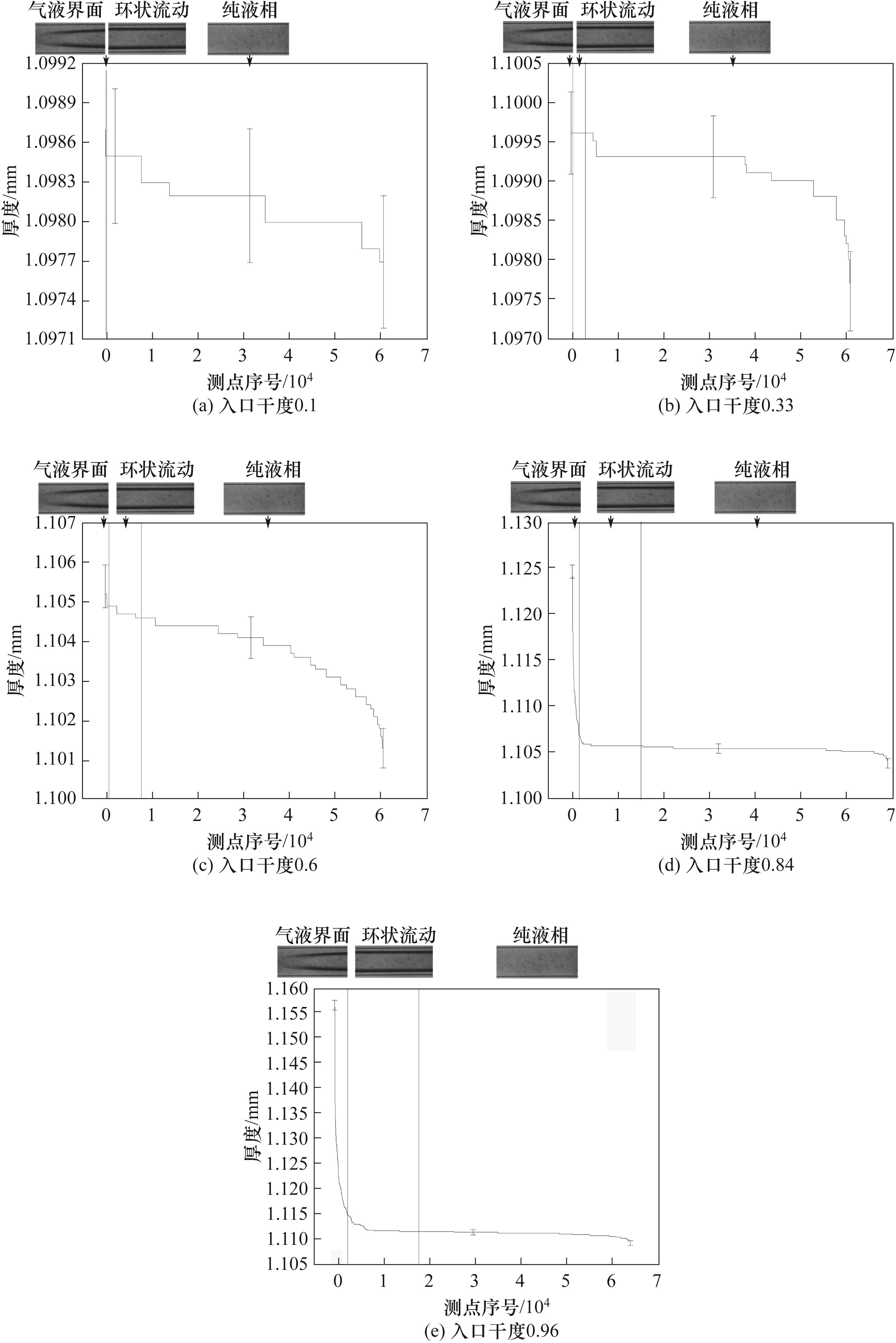
图14 质量流率290 kg/(m2·s)时测试点的PDMS壁厚分布
Fig.14 PDMS wall thickness distribution of test points for mass flux 290 kg/(m2‧s)
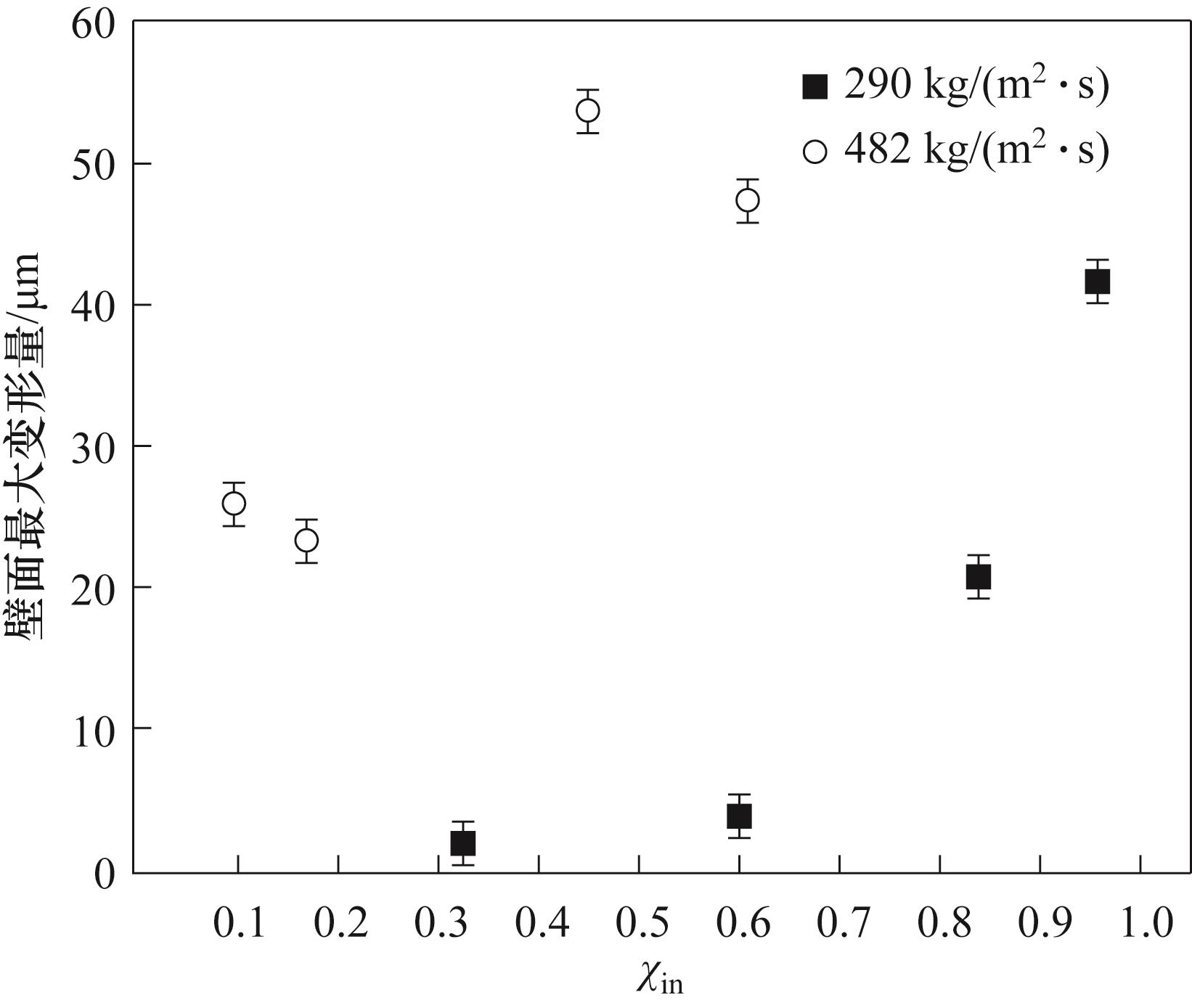
图15 质量流率与入口干度对壁面最大变形量的影响
Fig.15 Effects of mass flux and inlet vapor mass quality on the maximum wall deformation
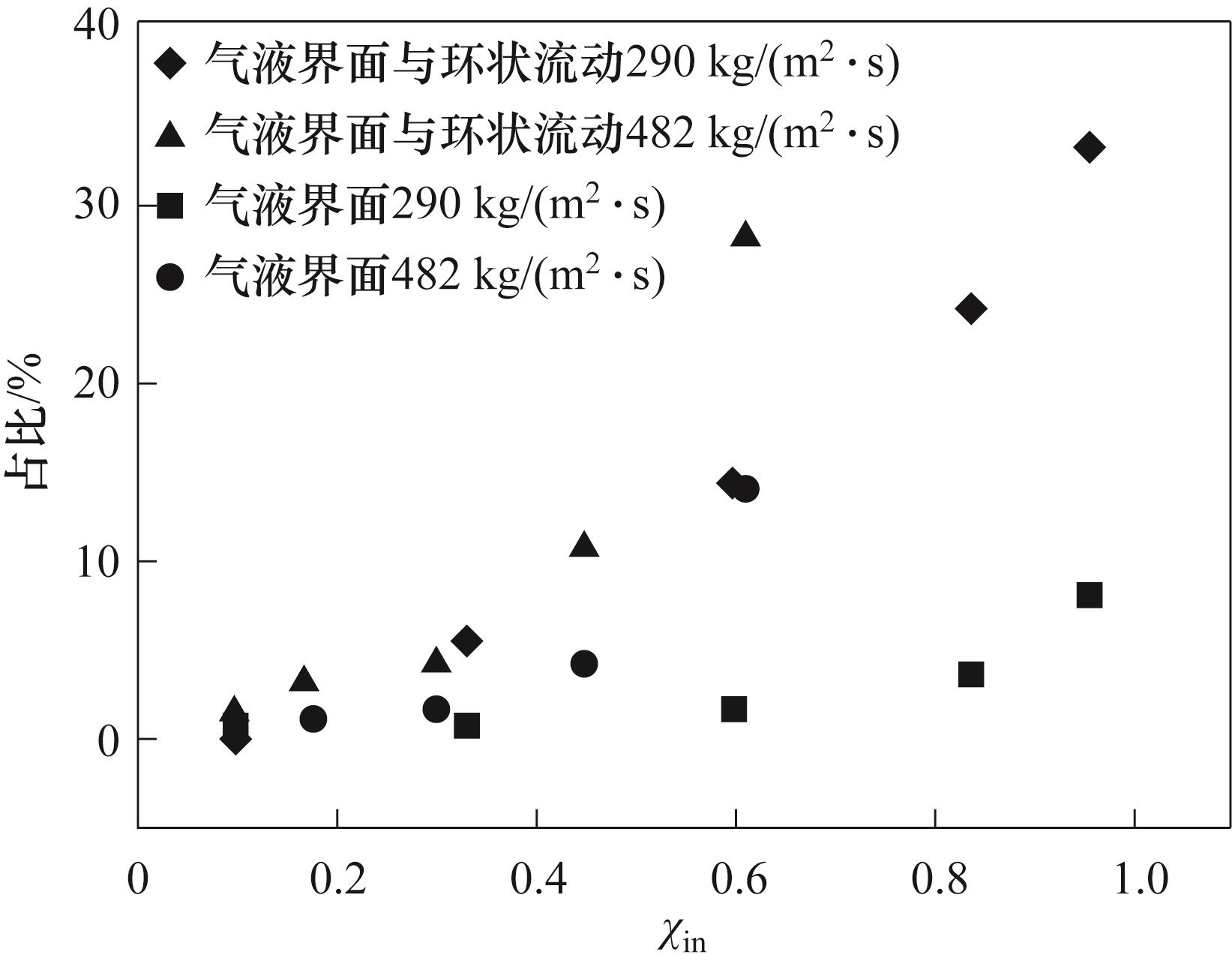
图16 质量流率和入口干度对流动状态占比的影响
Fig.16 Effect of mass flux and inlet vapor mass quality on flow pattern percentage
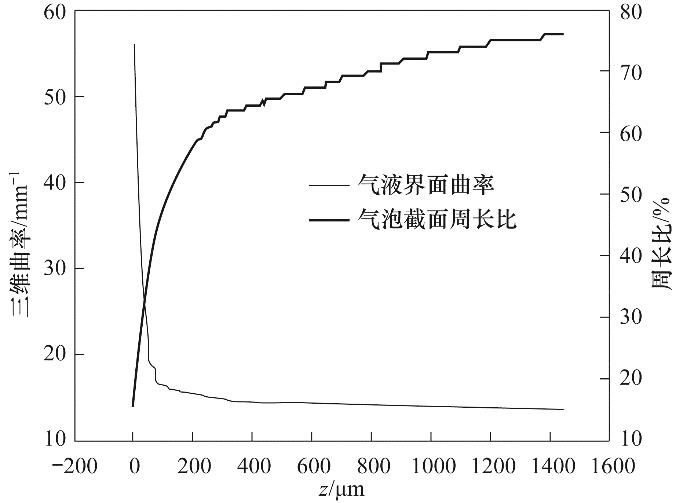
图17 气液界面的曲率和周长比随液体向蒸气方向的变化
Fig.17 The curvature and perimeter ratio of gas-liquid interface varing with the direction of liquid towards vapor
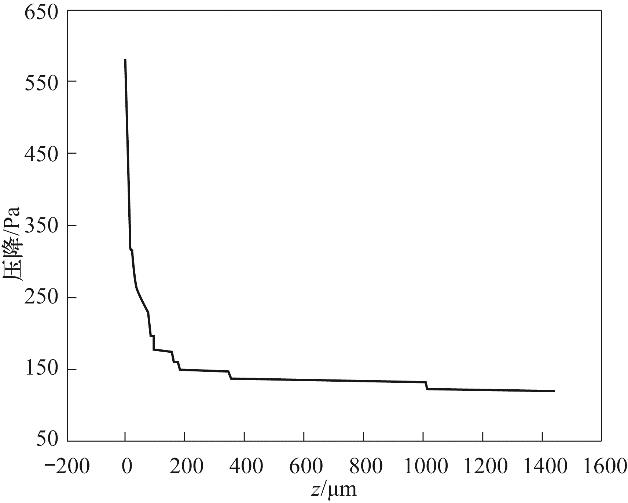
图18 表面张力引起的压降沿液体向蒸气方向的变化
Fig.18 The pressure drop of the liquid-vapor interface due to surface tension
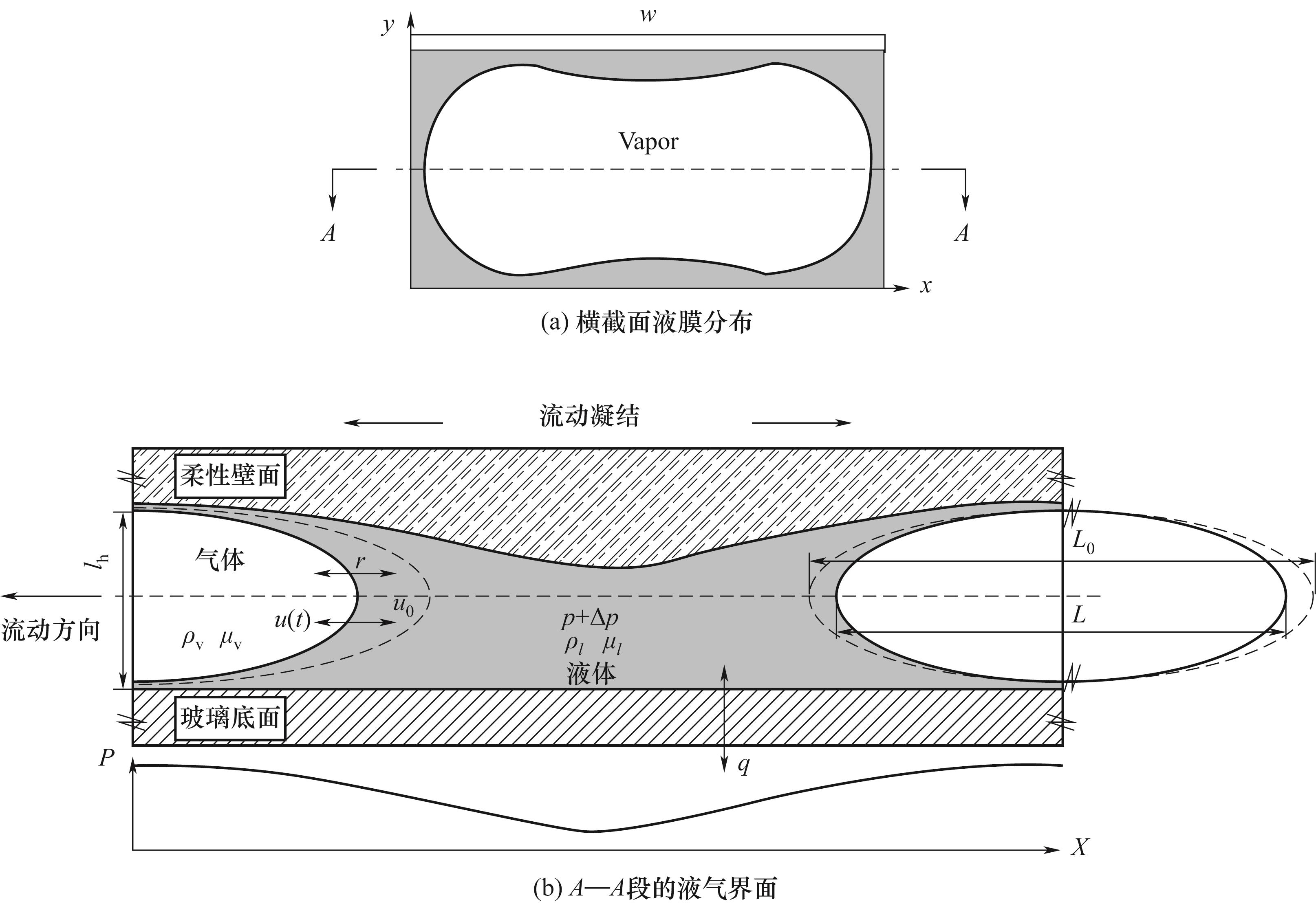
图19 微通道液的液塞理论模型
Fig.19 Liquid slug theoretical model in microchannel
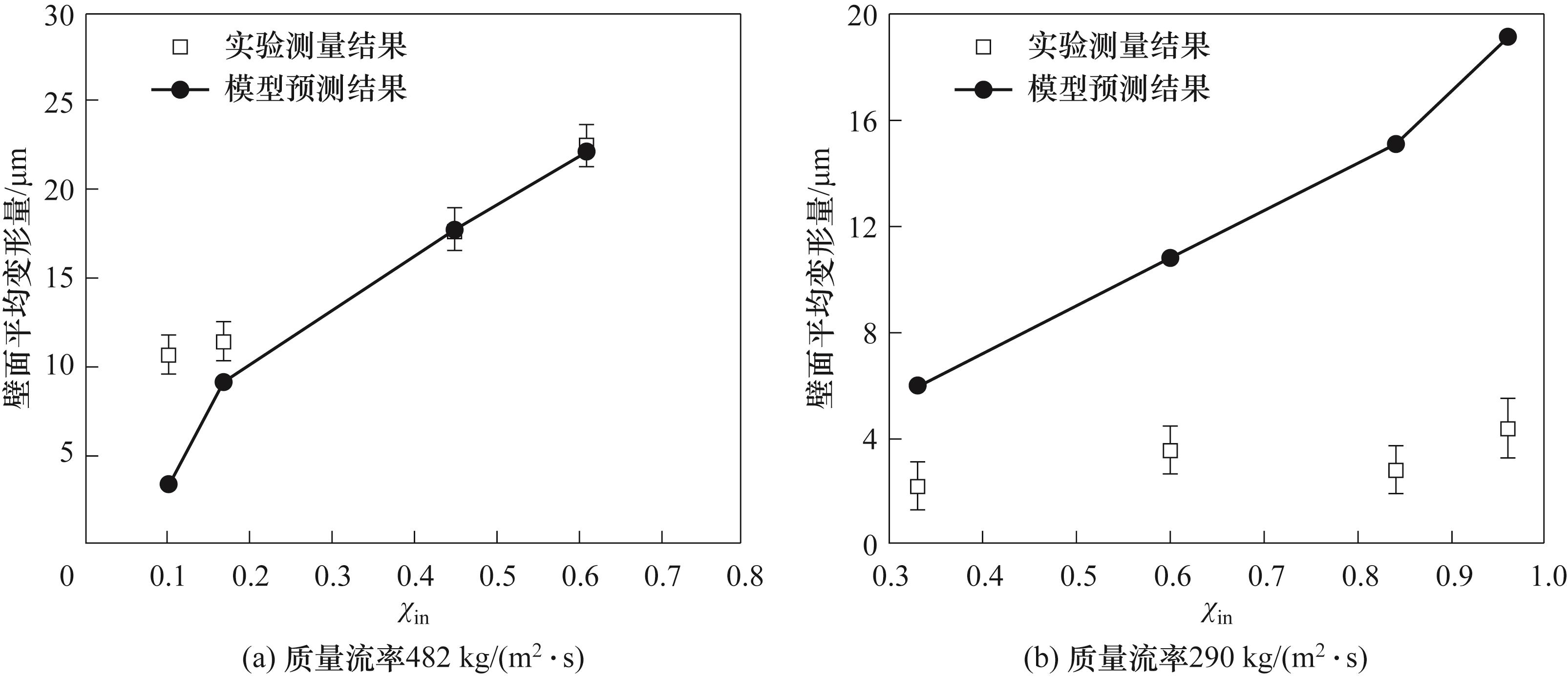
图20 壁面变形均值的预测结果与实验数据对比
Fig.20 Comparison of predicted and measured wall thickness variation
| [1] | Wang H S, Rose J W. Film condensation in horizontal microchannels: effect of channel shape[J]. International Journal of Thermal Sciences, 2006, 45(12): 1205-1212. |
| [2] | Wang H S, Rose J W. Condensation in microchannels: detailed comparisons of annular laminar flow theory with measurements[J]. Journal of Heat Transfer, 2017, 139(7): 072403. |
| [3] | Gu X, Wen J, Zhang X, et al. Effect of tube shape on the condensation patterns of R1234ze (E) in horizontal mini-channels[J]. International Journal of Heat and Mass Transfer, 2019, 131: 121-139. |
| [4] | Garimella S, Agarwal A, Fronk B M. Condensation heat transfer in rectangular microscale geometries[J]. International Journal of Heat and Mass Transfer, 2016, 100: 98-110. |
| [5] | Wu H Y, Wu X Y, Qu J, et al. Condensation heat transfer and flow friction in silicon microchannels[J]. Journal of Micromechanics and Microengineering, 2008, 18(11): 115024. |
| [6] | Agarwal A, Bandhauer T M, Garimella S. Measurement and modeling of condensation heat transfer in non-circular microchannels[J]. International Journal of Refrigeration, 2010, 33(6): 1169-1179. |
| [7] | Liu N, Li J M, Sun J, et al. Heat transfer and pressure drop during condensation of R152a in circular and square microchannels[J]. Experimental Thermal and Fluid Science, 2013, 47: 60-67. |
| [8] | Quan X J, Cheng P, Wu H Y. An experimental investigation on pressure drop of steam condensing in silicon microchannels[J]. International Journal of Heat and Mass Transfer, 2008, 51(21/22): 5454-5458. |
| [9] | Thorsen T, Maerkl S J, Quake S R. Microfluidic large-scale integration[J]. Science, 2002, 298(5593): 580-584. |
| [10] | Khaled A A, Vafai K. Flow and heat transfer inside thin films supported by soft seals in the presence of internal and external pressure pulsations[J]. International Journal of Heat and Mass Transfer, 2002, 45(26): 5107-5115. |
| [11] | Khaled A A, Vafai K. Control of exit flow and thermal conditions using two-layered thin films supported by flexible complex seals[J]. International Journal of Heat and Mass Transfer, 2004, 47(8/9): 1599-1611. |
| [12] | Gervais T, El-Ali J, Günther A, et al. Flow-induced deformation of shallow microfluidic channels[J]. Lab on a Chip, 2006, 6(4): 500-507. |
| [13] | Zheng Y, Fujioka H, Bian S, et al. Liquid plug propagation in flexible microchannels: a small airway model[J]. Physics of Fluids, 2009, 21(7): 71903. |
| [14] | Hardy B S, Uechi K, Zhen J, et al. The deformation of flexible PDMS microchannels under a pressure driven flow[J]. Lab on a Chip, 2009, 9(7): 935-938. |
| [15] | Verma M, Kumaran V. A dynamical instability due to fluid-wall coupling lowers the transition Reynolds number in the flow through a flexible tube[J]. Journal of Fluid Mechanics, 2012, 705: 322-347. |
| [16] | Verma M, Kumaran V. A multifold reduction in the transition Reynolds number, and ultra-fast mixing, in a micro-channel due to a dynamical instability induced by a soft wall[J]. Journal of Fluid Mechanics, 2013, 727: 407-455. |
| [17] | Kang C, Roh C, Overfelt R A. Pressure-driven deformation with soft polydimethylsiloxane (PDMS) by a regular syringe pump: challenge to the classical fluid dynamics by comparison of experimental and theoretical results[J]. RSC Advances, 2014, 4(7): 3102-3112. |
| [18] | Cheung P, Toda-Peters K, Shen A Q. In situ pressure measurement within deformable rectangular polydimethylsiloxane microfluidic devices[J]. Biomicrofluidics, 2012, 6(2): 26501. |
| [19] | Srinivas S S, Kumaran V. Transitions to different kinds of turbulence in a channel with soft walls[J]. Journal of Fluid Mechanics, 2017, 822: 267-306. |
| [20] | Srinivas S S, Kumaran V. After transition in a soft-walled microchannel[J]. Journal of Fluid Mechanics, 2015, 780: 649-686. |
| [21] | Ozsun O, Yakhot V, Ekinci K L. Non-invasive measurement of the pressure distribution in a deformable micro-channel[J]. Journal of Fluid Mechanics, 2013, 734: R1. |
| [22] | Li G, Xu S Y. Small diameter microchannel of PDMS and complex three-dimensional microchannel network[J]. Materials & Design, 2015, 81: 82-86. |
| [23] | Raj A, Sen A K. Flow-induced deformation of compliant microchannels and its effect on pressure-flow characteristics[J]. Microfluidics and Nanofluidics, 2016, 20(2): 31. |
| [24] | Raj M K, DasGupta S, Chakraborty S. Hydrodynamics in deformable microchannels[J]. Microfluidics and Nanofluidics, 2017, 21(4): 70. |
| [25] | Shidhore T C, Christov I C. Static response of deformable microchannels: a comparative modelling study[J]. Journal of Physics. Condensed Matter, 2018, 30(5): 054002. |
| [26] | Patne R, Giribabu D, Shankar V. Consistent formulations for stability of fluid flow through deformable channels and tubes[J]. Journal of Fluid Mechanics, 2017, 827: 31-66. |
| [27] | Niu P F, Nablo B J, Bhadriraju K, et al. Uncovering the contribution of microchannel deformation to impedance-based flow rate measurements[J]. Analytical Chemistry, 2017, 89(21): 11372-11377. |
| [28] | Raj A, Suthanthiraraj P P A, Sen A K. Pressure-driven flow through PDMS-based flexible microchannels and their applications in microfluidics[J]. Microfluidics and Nanofluidics, 2018, 22(11): 128. |
| [29] | Christov I C, Cognet V, Shidhore T C, et al. Flow rate-pressure drop relation for deformable shallow microfluidic channels[J]. Journal of Fluid Mechanics, 2018, 841: 267-286. |
| [30] | Wang X J, Christov I C. Reduced modelling and global instability of finite-Reynolds-number flow in compliant rectangular channels[J]. Journal of Fluid Mechanics, 2022, 802: 950-A26. |
| [31] | Wang X J, Christov I C. Theory of the flow-induced deformation of shallow compliant microchannels with thick walls[J]. Proceedings of the Royal Society A: Mathematical, Physical, and Engineering Sciences, 2019, 475(2231): 20190513. |
| [32] | Martínez-Calvo A, Sevilla A, Peng G G, et al. Start-up flow in shallow deformable microchannels[J]. Journal of Fluid Mechanics, 2020, 885: A25. |
| [33] | Anand V, David J, Christov I C. Non-Newtonian fluid-structure interactions: static response of a microchannel due to internal flow of a power-law fluid[J]. Journal of Non-Newtonian Fluid Mechanics, 2019, 264: 62-72. |
| [34] | Kiran R M, Chakraborty J, DasGupta S, et al. Flow-induced deformation in a microchannel with a non-Newtonian fluid[J]. Biomicrofluidics, 2018, 12(3): 034116. |
| [35] | Kang C, Overfelt R A, Roh C. Deformation properties between fluid and periodic circular obstacles in polydimethylsiloxane microchannels: experimental and numerical investigations under various conditions[J]. Biomicrofluidics, 2013, 7(5): 54102. |
| [36] | Roh C, Lee J, Kang C. The deformation of polydimethylsiloxane (PDMS) microfluidic channels filled with embedded circular obstacles under certain circumstances[J]. Molecules, 2016, 21(6): 798. |
| [37] | He X F, Chen R, Liao Q, et al. IR laser assisted photothermal condensation in a microchannel[J]. Chemical Engineering Science, 2014, 119: 288-294. |
| [38] | Korniliou S, Mackenzie-Dover C, Christy J R E, et al. Two-dimensional heat transfer coefficients with simultaneous flow visualisations during two-phase flow boiling in a PDMS microchannel[J]. Applied Thermal Engineering, 2018, 130: 624-636. |
| [39] | Li W M, Joshi Y. Capillary-assisted evaporation/boiling in PDMS microchannel integrated with wicking microstructures[J]. Langmuir, 2020, 36(41): 12143-12149. |
| [40] | 章熙民, 任泽霈, 梅飞鸣. 传热学[M]. 5版. 北京: 中国建筑工业出版社, 2007: 168-170. |
| Zhang X M, Ren Z P, Mei F M. Heat Transmission Science[M]. 5th ed. Beijing: China Architecture & Building Press, 2007: 168-170. | |
| [41] | Dittus F W, Boelter L M K. Heat transfer in automobile radiators of the tubular type[J]. International Communications in Heat and Mass Transfer, 1985, 12(1): 3-22. |
| [42] | 丁勇. 矩形微通道内制冷剂流动冷凝传热特性研究[D]. 北京: 北京交通大学, 2019. |
| Ding Y. Study on heat transfer characteristics of refrigerant flow condensation in rectangular microchannel[D]. Beijing: Beijing Jiaotong University, 2019. | |
| [43] | Wang Z X. Polydimethylsiloxane mechanical properties measured by macroscopic compression and nanoindentation techniques[D]. Tampa: University of South Florida, 2011. |
| [44] | Fuard D, Tzvetkova-Chevolleau T, Decossas S, et al. Optimization of poly-di-methyl-siloxane (PDMS) substrates for studying cellular adhesion and motility[J]. Microelectronic Engineering, 2008, 85(5/6): 1289-1293. |
| [45] | Koyama S, Kuwahara K, Nakashita K. Condensation of refrigerant in a multi-port channel[C]//ASME International Conference on Microchannels & Minichannels. Rochester, New York, USA, 2003: 193-205. |
| [1] | 苏伟, 赵大海, 金旭, 刘忠彦, 李静, 张小松. 吸湿液滴与混合润湿性表面协同抑霜特性研究[J]. 化工学报, 2025, 76(S1): 140-151. |
| [2] | 赵子祥, 段钟弟, 孙浩然, 薛鸿祥. 大温差两相流动诱导水锤冲击的数值模型[J]. 化工学报, 2025, 76(S1): 170-180. |
| [3] | 段炼, 周星睿, 袁文君, 陈飞. 连续相速度脉动对微通道内聚合物液滴生成和形貌的影响规律[J]. 化工学报, 2025, 76(9): 4578-4585. |
| [4] | 刘璐, 杨莹, 杨浩文, 王太, 王腾, 董新宇, 闫润. 星形亲水区组合表面冷凝液滴脱落特性实验研究[J]. 化工学报, 2025, 76(8): 3905-3914. |
| [5] | 龚路远, 果正龙, 赵登辉, 郭亚丽, 周健, 韩倩倩, 沈胜强. 不同疏水性表面冷凝传热性能及动力学特征研究[J]. 化工学报, 2025, 76(8): 3932-3943. |
| [6] | 陈科拯, 高蓬辉, 焉富春, 程博. 考虑液滴动态行为的亲-疏水复合结构表面冷凝特性影响因素分析[J]. 化工学报, 2025, 76(8): 3976-3989. |
| [7] | 佘海龙, 胡光忠, 崔晓钰, 柳忠彬, 彭帝, 李航. 不同节流工质下叠层微通道分布式节流制冷器性能研究[J]. 化工学报, 2025, 76(8): 4017-4029. |
| [8] | 王涛, 李光明, 胡秋霞, 徐静. 基于时序演变粒子群算法的双色注射产品翘曲工艺优化[J]. 化工学报, 2025, 76(7): 3403-3415. |
| [9] | 米晓天, 刘宏臣, 王克军, 唐文娜, 徐永伟, 杨梅. 微通道内两相吸收剂TETA/DEEA吸收CO2过程的传质研究[J]. 化工学报, 2025, 76(6): 2667-2677. |
| [10] | 郭乃胜, 朱小波, 王双, 陈平, 褚召阳, 王志臣. 聚氨酯改性沥青高低温性能及影响因素的研究进展[J]. 化工学报, 2025, 76(6): 2505-2523. |
| [11] | 刘润健, 林刚, 张玲, 徐栋, 李明, 韩路长. 考虑气泡表面变形影响的靠近-减薄过程耦合模型[J]. 化工学报, 2025, 76(4): 1504-1512. |
| [12] | 吴罗长, 杨泽宇, 颜建国, 朱旭涛, 陈阳, 王子辰. 微小方形通道内近超临界压力二氧化碳流动换热特性实验研究[J]. 化工学报, 2025, 76(4): 1583-1594. |
| [13] | 田浩辰, 马志先, 王之浩. R1234ze(E)水平三维肋管外膜状凝结特性实验研究[J]. 化工学报, 2025, 76(3): 975-984. |
| [14] | 侯亚祺, 张玮, 张鸿, 高飞雨, 胡嘉华. 基于机器学习与粒子群算法的LBM多相流模型优化[J]. 化工学报, 2025, 76(3): 1120-1132. |
| [15] | 张珂, 任维杰, 王梦娜, 范凯锋, 常丽萍, 李佳斌, 马涛, 田晋平. Bunsen反应产物在微通道中的液-液两相混合特性[J]. 化工学报, 2025, 76(2): 623-636. |
| 阅读次数 | ||||||
|
全文 |
|
|||||
|
摘要 |
|
|||||
 京公网安备 11010102001995号