化工学报 ›› 2025, Vol. 76 ›› Issue (5): 2169-2185.DOI: 10.11949/0438-1157.20240985
李家顺1( ), 李旺1, 秦祖赠1, 苏通明1, 谢新玲1(), 纪红兵1,2
收稿日期:2024-09-02
修回日期:2024-12-10
出版日期:2025-05-25
发布日期:2025-06-13
通讯作者:
谢新玲
作者简介:李家顺(2003—),男,本科生,2168351466@qq.com
基金资助:
Jiashun LI1(), Wang LI1, Zuzeng QIN1, Tongming SU1, Xinling XIE1(), Hongbing JI1,2
Received:2024-09-02
Revised:2024-12-10
Online:2025-05-25
Published:2025-06-13
Contact:
Xinling XIE
摘要:
木质纤维素纳米纤丝(LCNF)气凝胶具有高孔隙率、低密度、原料可再生及可重复利用等优点,但力学性能不足限制了其在油水分离领域的应用。通过冷冻干燥和化学气相沉积法制备了LCNF/聚酰亚胺(PI)复合气凝胶。结果表明,PI与LCNF之间的强氢键作用赋予了气凝胶良好的力学和油水分离性能,其弹性模量为9.69~11.88 kPa,吸油倍率为73.0~103.4 g∙g-1。相较M-LCNF气凝胶,M-LCNF/PI气凝胶的弹性模量提升了1.459~2.015倍,吸油倍率提升了1.6~21.0 g∙g-1。M-LCNF/PI-1.00气凝胶保持了低密度(8.66 g∙cm-3)、优异的疏水性(水接触角达140.6°)、高热稳定性(最大分解速率温度达363.1℃)及良好的隔热性能(热导率0.04436 W∙m-1∙K-1)。M-LCNF/PI-1.00对真空泵油的吸附更符合准二级动力学模型。M-LCNF/PI-1.00挤压吸附无水乙醇5次后,仍保持原吸附倍率的79.1%,表现出良好的可重复使用性,为制备高性能吸油材料提供了新策略。
中图分类号:
李家顺, 李旺, 秦祖赠, 苏通明, 谢新玲, 纪红兵. 聚酰亚胺增强木质纤维素纳米纤丝气凝胶制备及其油水分离性能研究[J]. 化工学报, 2025, 76(5): 2169-2185.
Jiashun LI, Wang LI, Zuzeng QIN, Tongming SU, Xinling XIE, Hongbing JI. Preparation of polyimide-reinforced lignocellulosic nanofibril aerogel and its oil-water separation performance[J]. CIESC Journal, 2025, 76(5): 2169-2185.
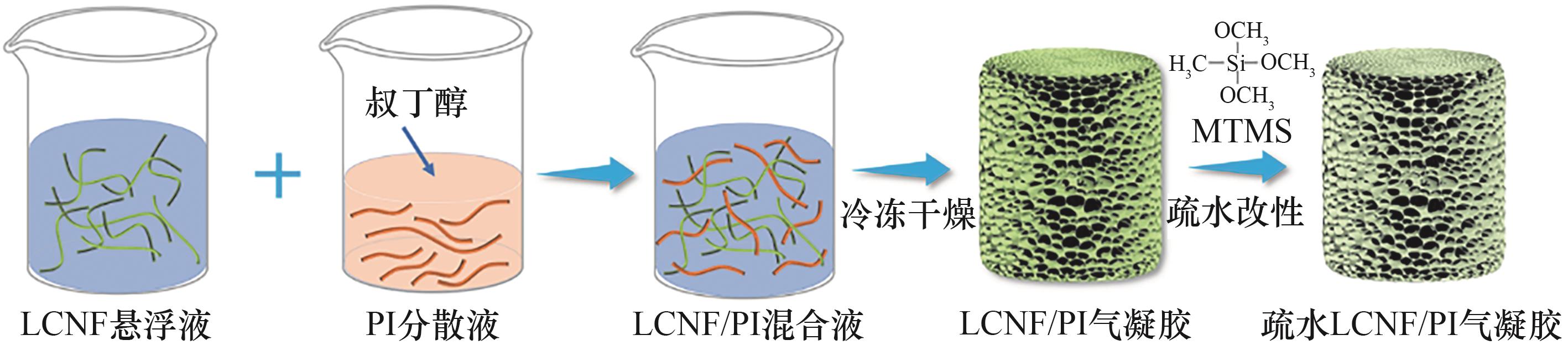
图1 LCNF/PI复合气凝胶的制备过程
Fig.1 Preparation process of LCNF/PI composite aerogel
| 样品 | VLCNF/ml | VPI/ml | mLCNF:mPI |
|---|---|---|---|
| M-LCNF | 10.00 | 0 | — |
| M-LCNF/PI-0.25 | 9.75 | 0.25 | 39∶1 |
| M-LCNF/PI-0.50 | 9.50 | 0.50 | 38∶2 |
| M-LCNF/PI-0.75 | 9.25 | 0.75 | 37∶3 |
| M-LCNF/PI-1.00 | 9.00 | 1.00 | 36∶4 |
表1 疏水气凝胶的组成成分
Table 1 Composition of hydrophobic aerogels
| 样品 | VLCNF/ml | VPI/ml | mLCNF:mPI |
|---|---|---|---|
| M-LCNF | 10.00 | 0 | — |
| M-LCNF/PI-0.25 | 9.75 | 0.25 | 39∶1 |
| M-LCNF/PI-0.50 | 9.50 | 0.50 | 38∶2 |
| M-LCNF/PI-0.75 | 9.25 | 0.75 | 37∶3 |
| M-LCNF/PI-1.00 | 9.00 | 1.00 | 36∶4 |
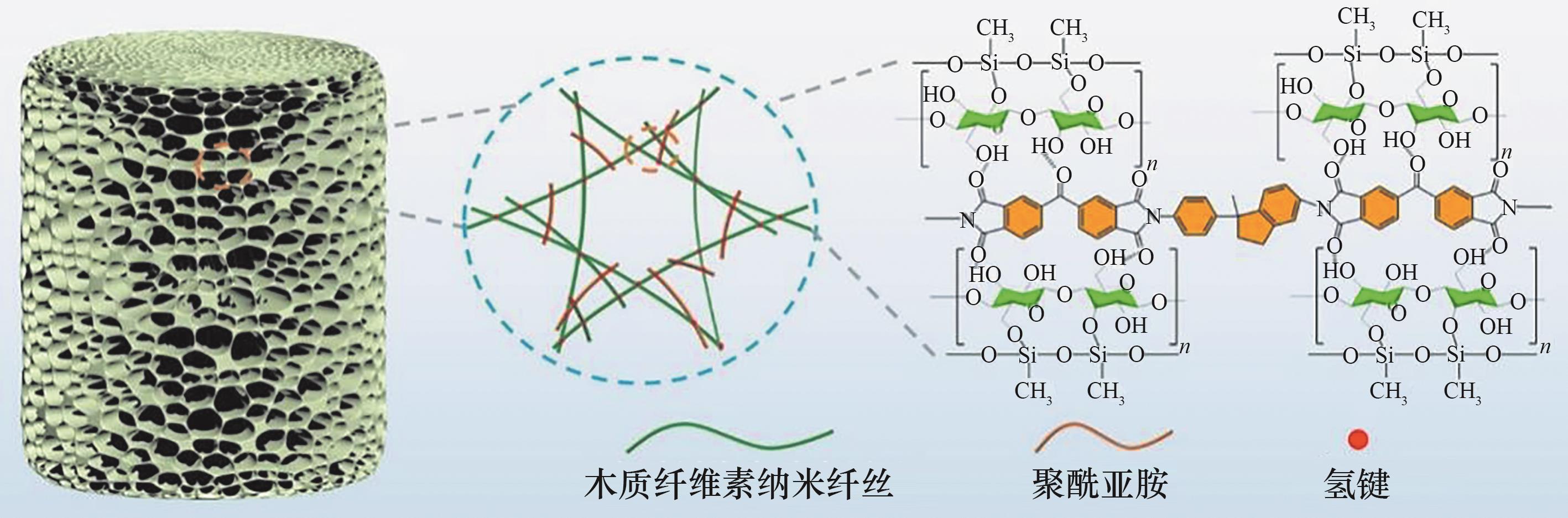
图2 气凝胶的制备示意图
Fig.2 Schematic diagram of the construction of aerogel
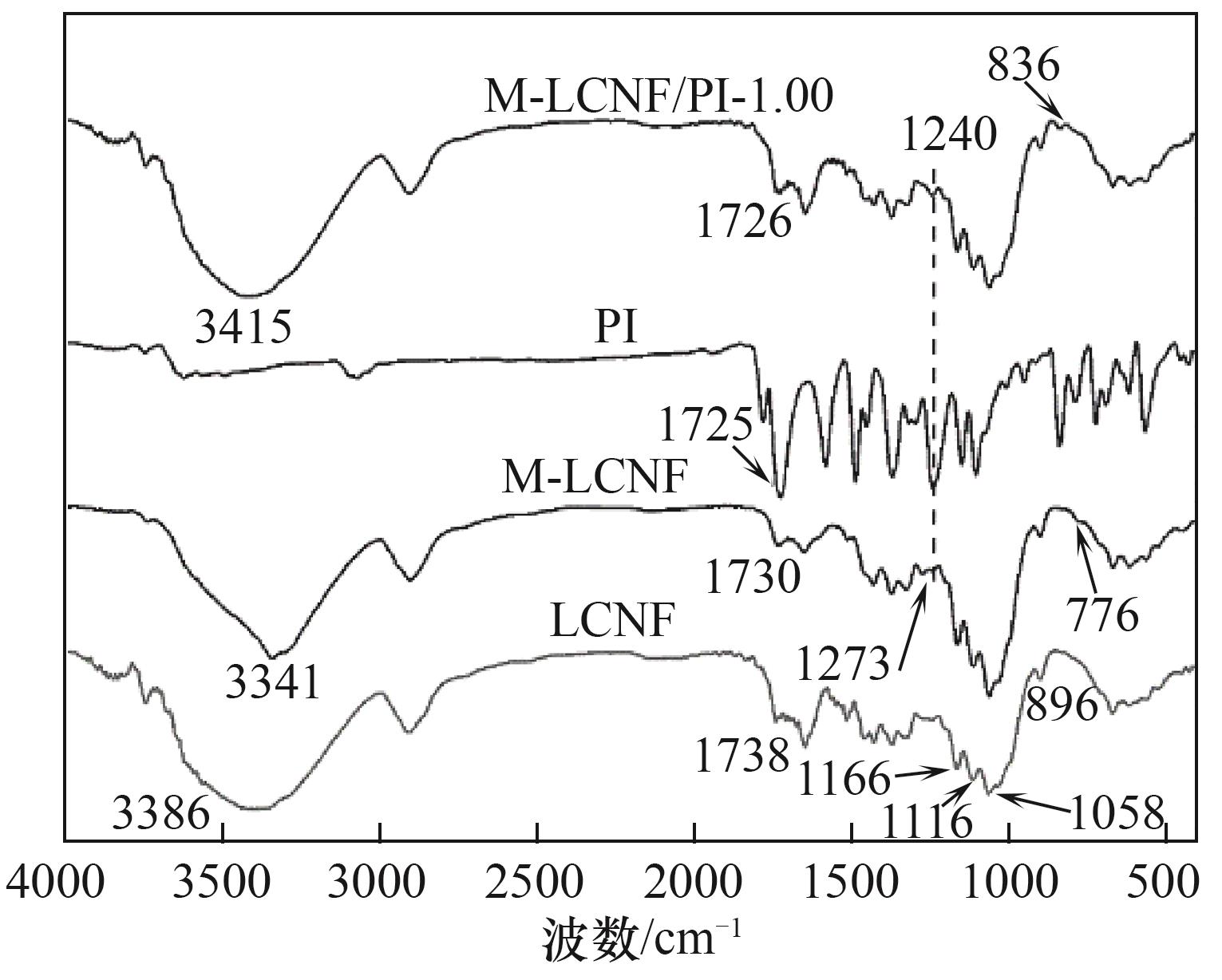
图3 原料和气凝胶的红外光谱图
Fig.3 FTIR spectra of raw materials and aerogels
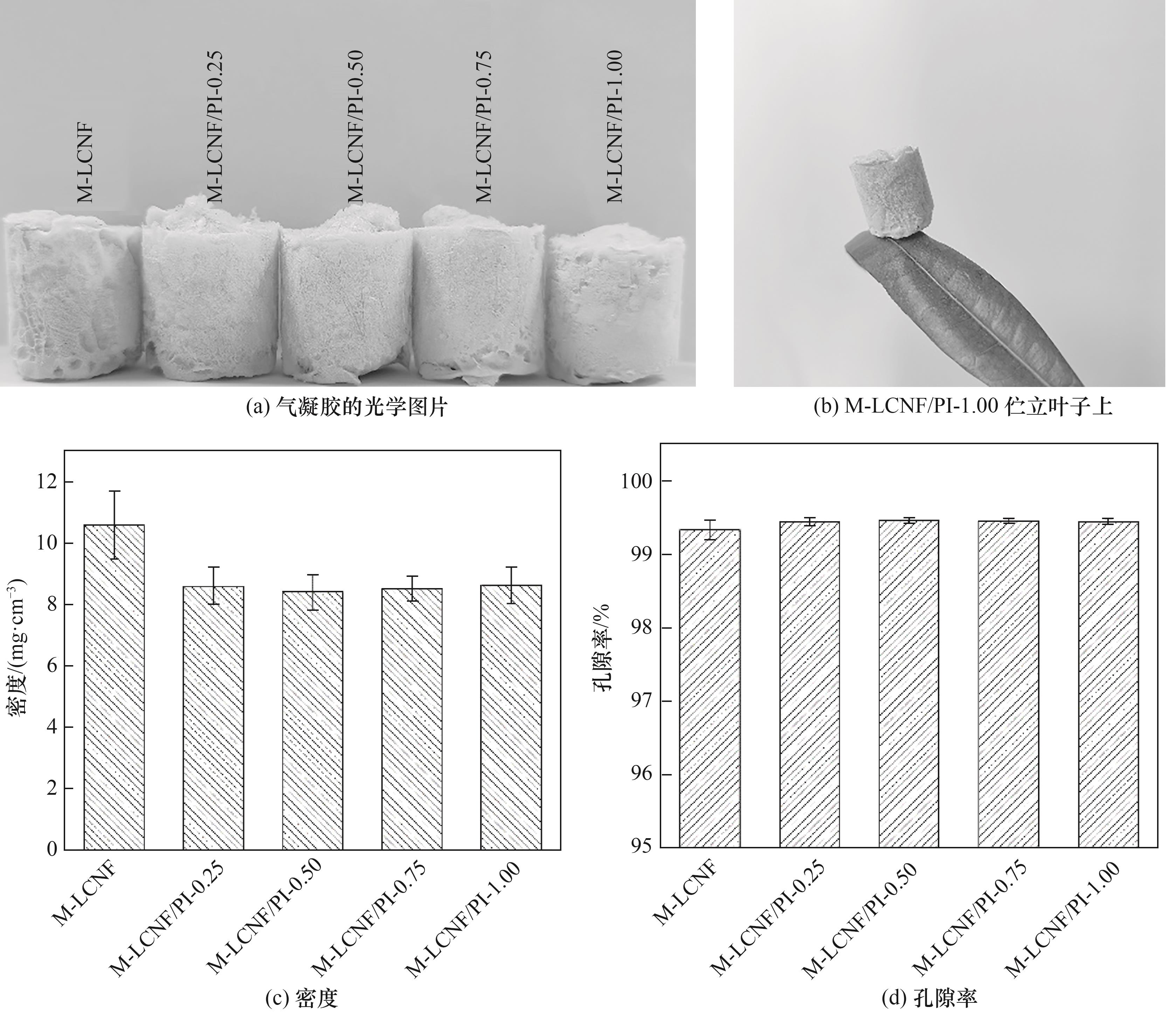
图4 气凝胶的宏观形貌和物理结构参数
Fig.4 Macroscopic morphology and physical structure parameters of aerogel
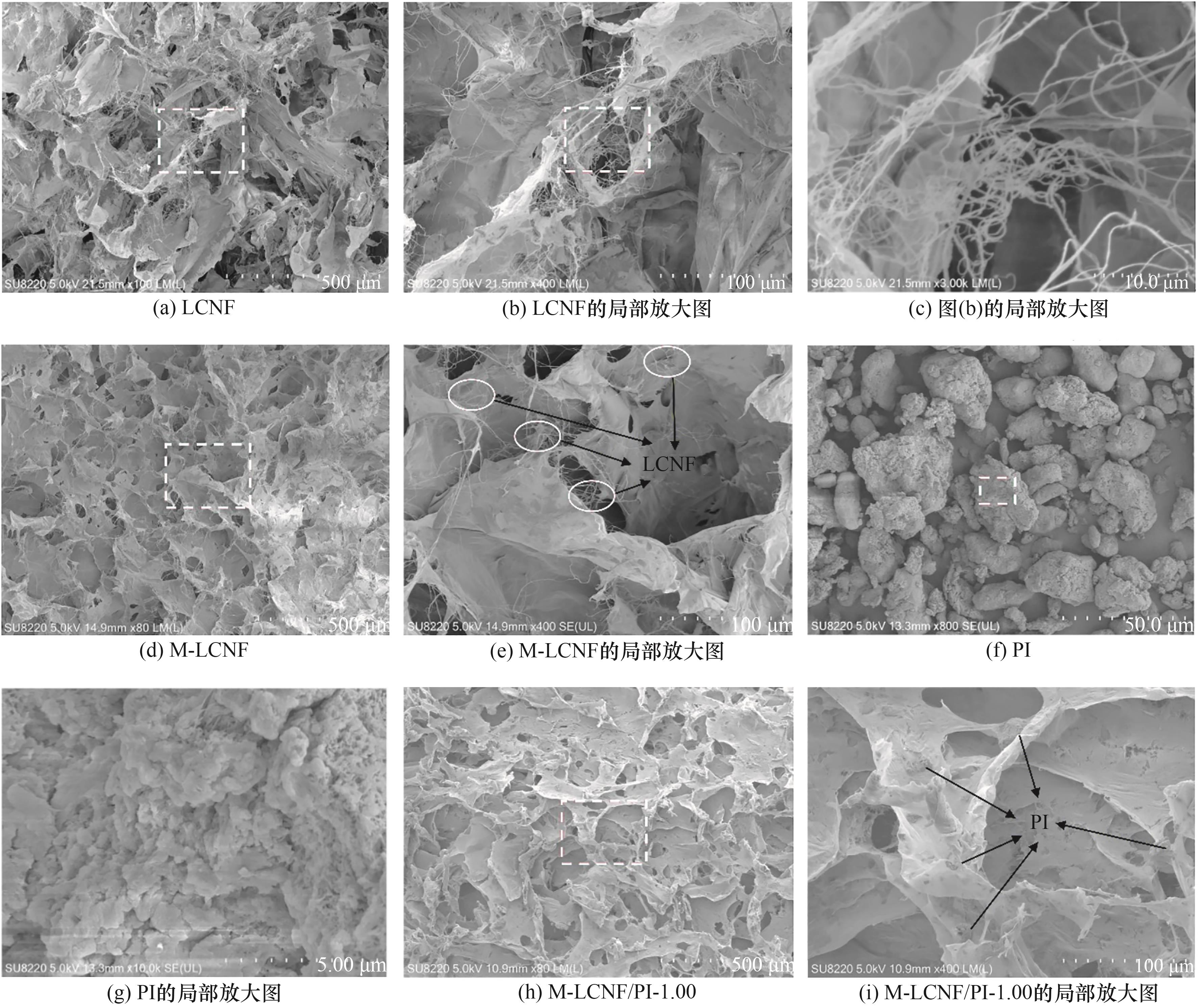
图5 气凝胶的扫描电镜图
Fig.5 SEM images of aerogels
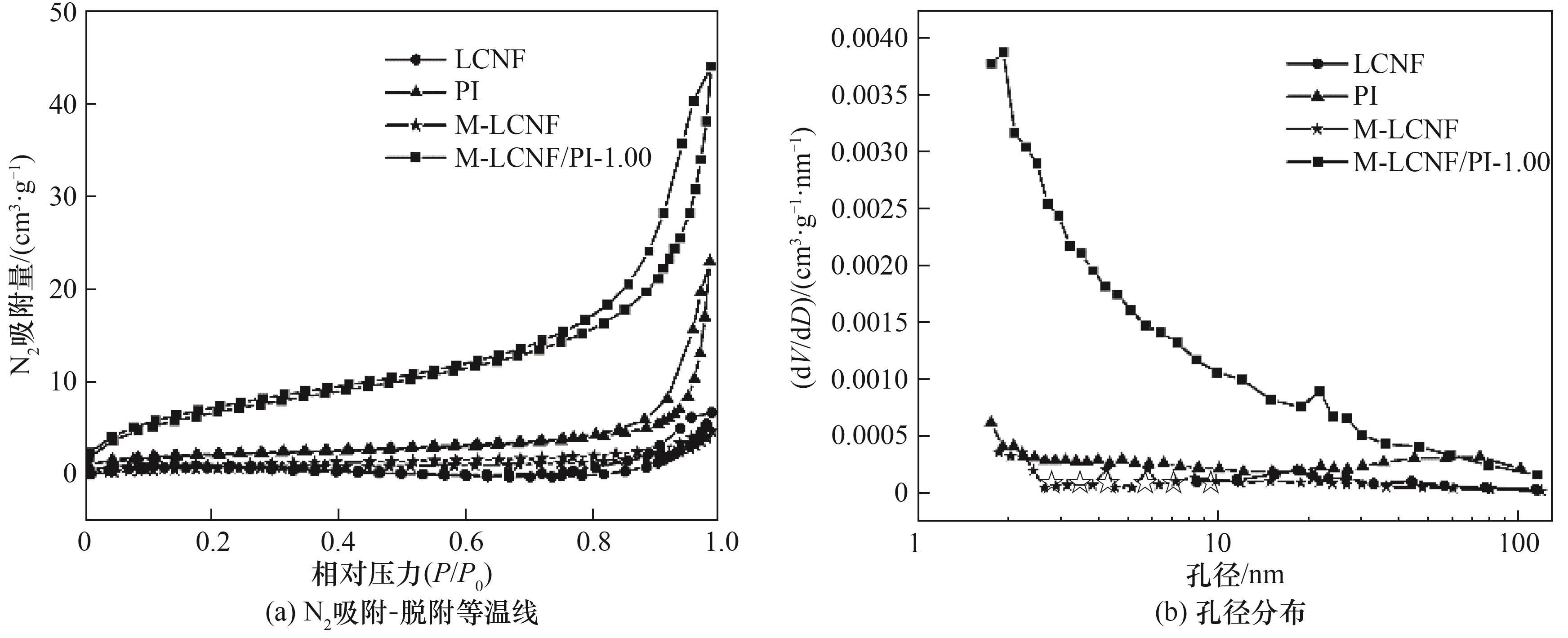
图6 原料和气凝胶的孔结构
Fig.6 Pore structure of raw materials and aerogels
| 样品 | 比表面积/ (m2∙g-1) | 孔体积/ (cm3∙g-1) | 平均孔直径/ nm |
|---|---|---|---|
| LCNF | 2.27 | 0.0091 | 32.49 |
| PI | 7.50 | 0.0335 | 28.61 |
| M-LCNF | 2.89 | 0.0065 | 16.74 |
| M-LCNF/PI-1.00 | 26.29 | 0.0622 | 11.97 |
表2 气凝胶的孔结构参数
Table 2 Pore structure parameters of aerogels
| 样品 | 比表面积/ (m2∙g-1) | 孔体积/ (cm3∙g-1) | 平均孔直径/ nm |
|---|---|---|---|
| LCNF | 2.27 | 0.0091 | 32.49 |
| PI | 7.50 | 0.0335 | 28.61 |
| M-LCNF | 2.89 | 0.0065 | 16.74 |
| M-LCNF/PI-1.00 | 26.29 | 0.0622 | 11.97 |
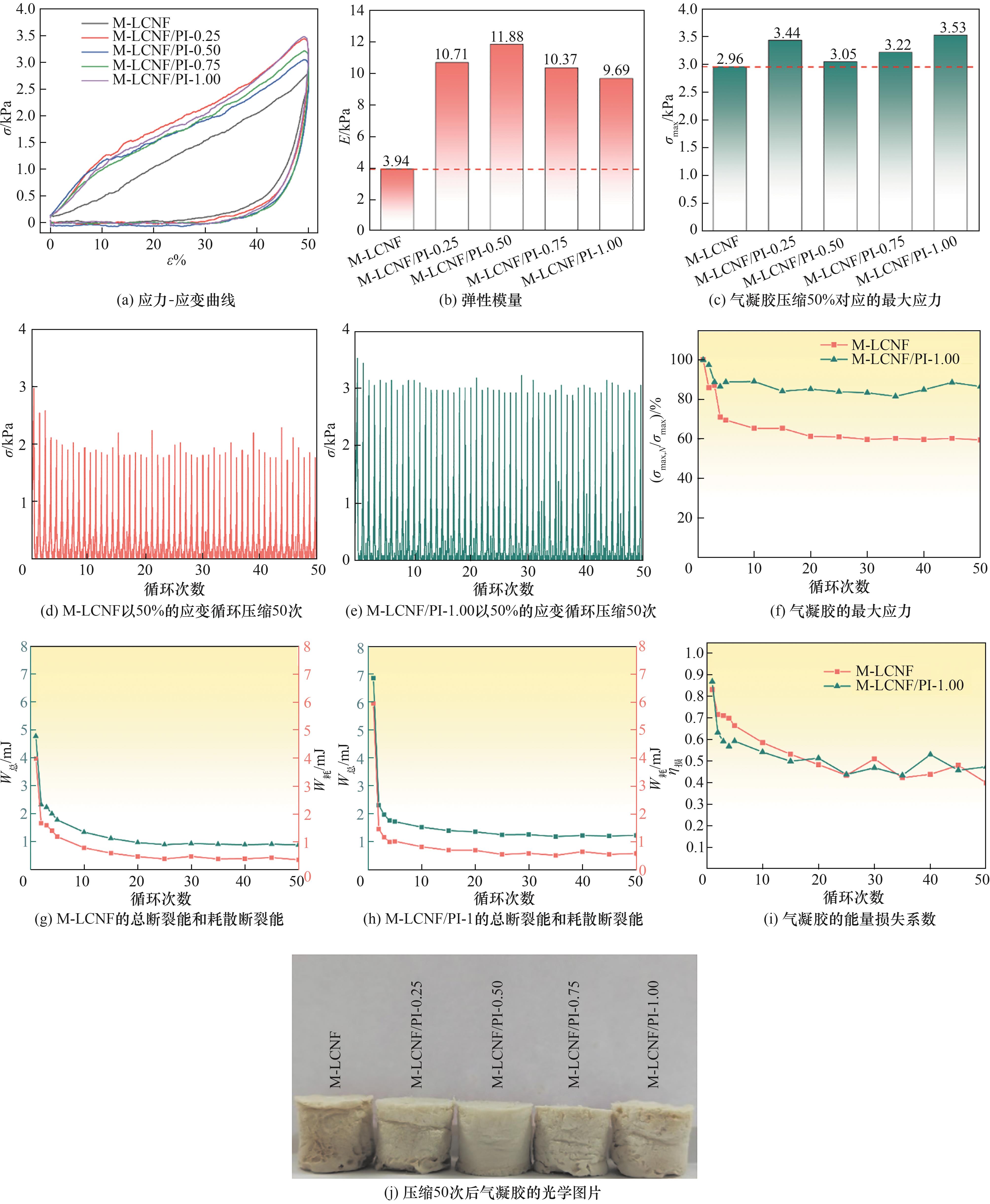
图7 气凝胶的力学性能
Fig.7 Mechanical properties of aerogels
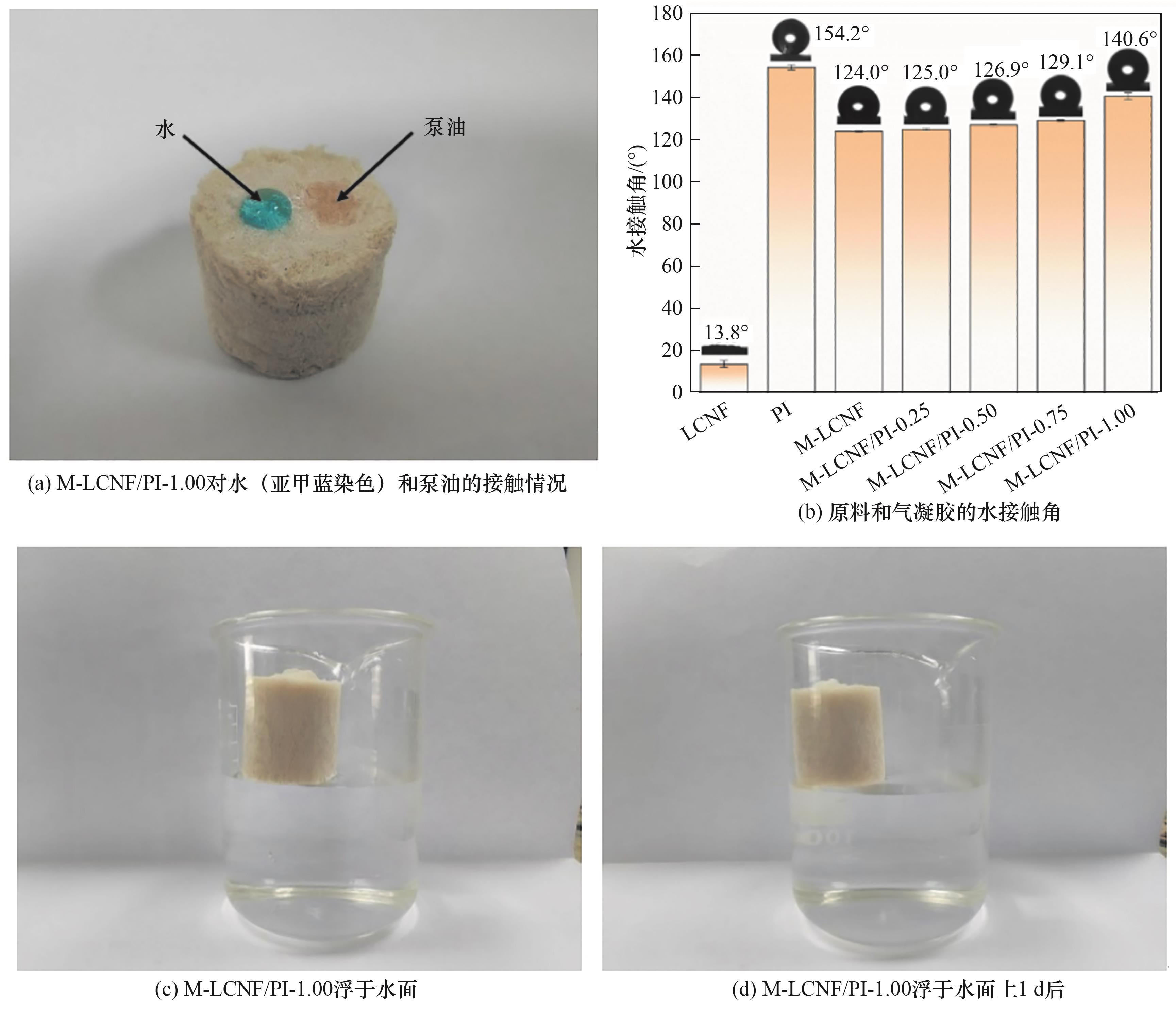
图8 气凝胶的疏水性能
Fig.8 Hydrophobic properties of aerogels
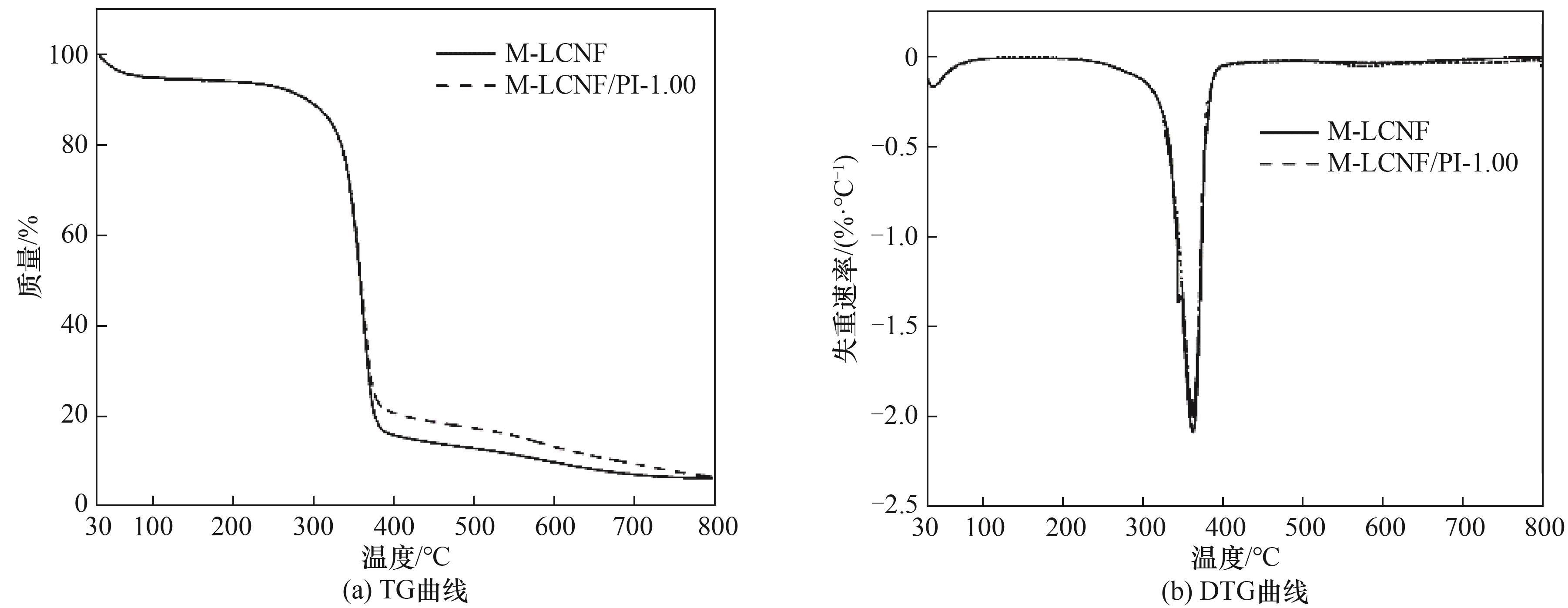
图9 气凝胶的热稳定性
Fig.9 Thermal stability of aerogels
| 样品 | 最大分解速率温度/℃ | 最大分解速率/(%·℃-1) | 残留量/% | 水含量/% |
|---|---|---|---|---|
| M-LCNF | 362.5 | -2.053 | 6.204 | 5.513 |
| M-LCNF/PI-1.00 | 363.1 | -1.970 | 6.590 | 5.644 |
表3 气凝胶的热参数
Table 3 Thermal parameters of aerogel
| 样品 | 最大分解速率温度/℃ | 最大分解速率/(%·℃-1) | 残留量/% | 水含量/% |
|---|---|---|---|---|
| M-LCNF | 362.5 | -2.053 | 6.204 | 5.513 |
| M-LCNF/PI-1.00 | 363.1 | -1.970 | 6.590 | 5.644 |
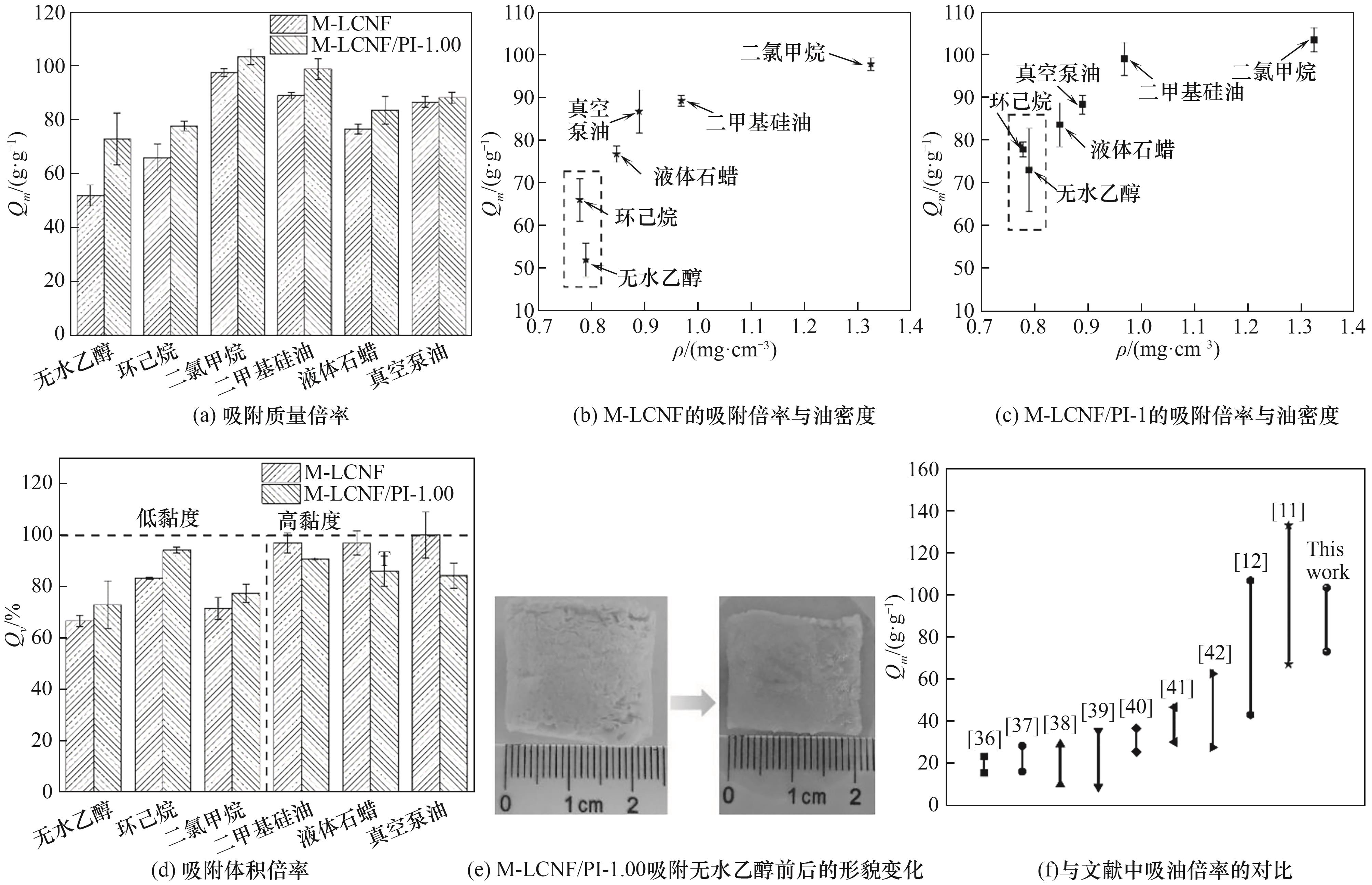
图10 M-LCNF和M-LCNF/PI-1.00的吸油性能
Fig.10 Oil absorption properties of M-LCNF and M-LCNF/PI-1.00
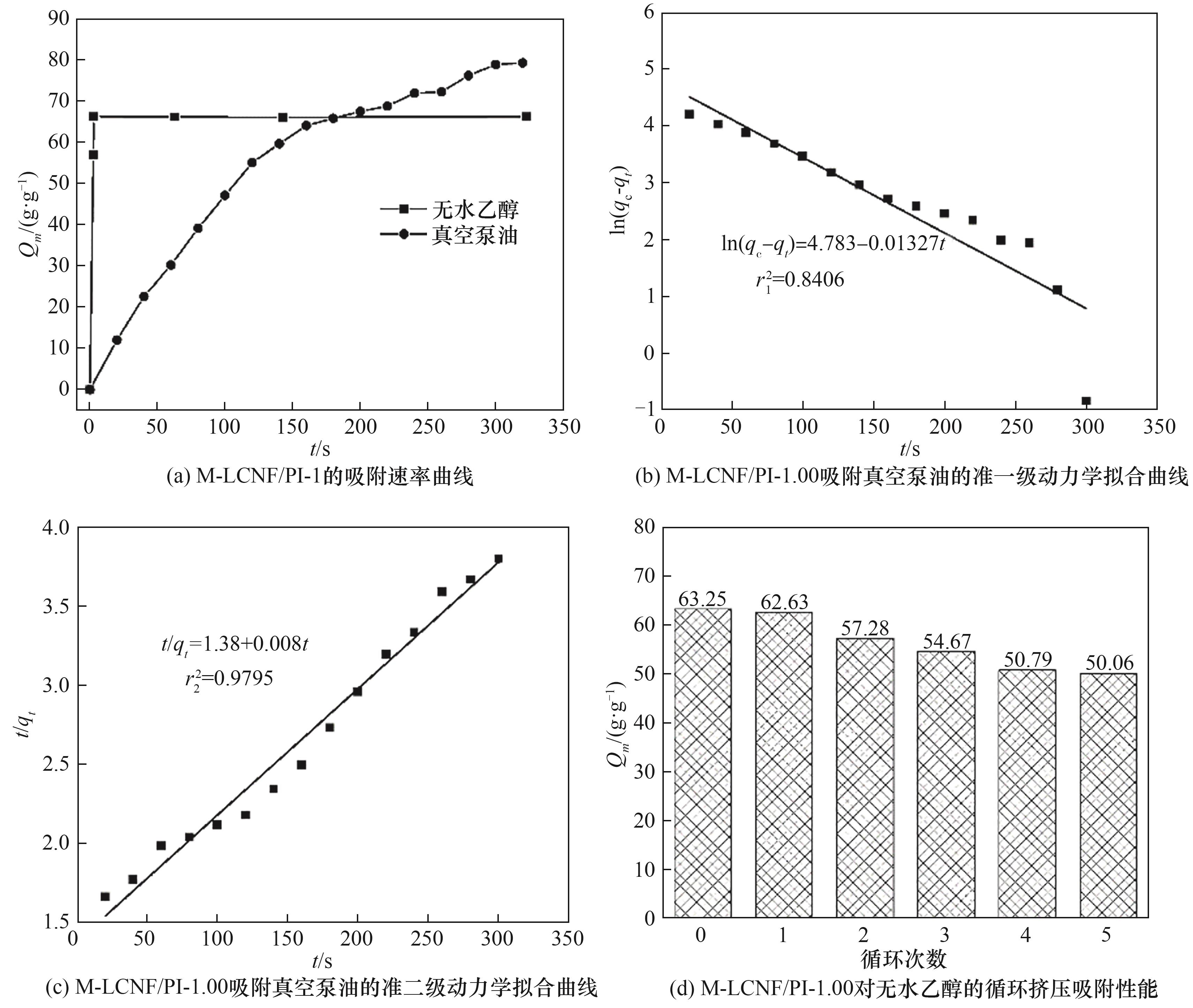
图11 气凝胶的吸油速率和循环使用性能
Fig.11 Oil absorption rate and recycling performance of aerogels
qe,exp/ (g·g-1) | 准一级动力学模型 | 准二级动力学模型 | ||||
|---|---|---|---|---|---|---|
| k1/s-1 | qe,cal/(g·g-1) | k2/(g·g-1∙s-1) | qe,cal/(g·g-1) | |||
| 79.36 | 0.01327 | 119.4 | 0.8406 | 4.637×10⁻⁵ | 81.22 | 0.9795 |
表4 M-LCNF/PI-1.00吸附真空泵油的动力学参数
Table 4 Kinetic parameters of vacuum pump oils adsorbed by M-LCNF/PI-1.00
qe,exp/ (g·g-1) | 准一级动力学模型 | 准二级动力学模型 | ||||
|---|---|---|---|---|---|---|
| k1/s-1 | qe,cal/(g·g-1) | k2/(g·g-1∙s-1) | qe,cal/(g·g-1) | |||
| 79.36 | 0.01327 | 119.4 | 0.8406 | 4.637×10⁻⁵ | 81.22 | 0.9795 |
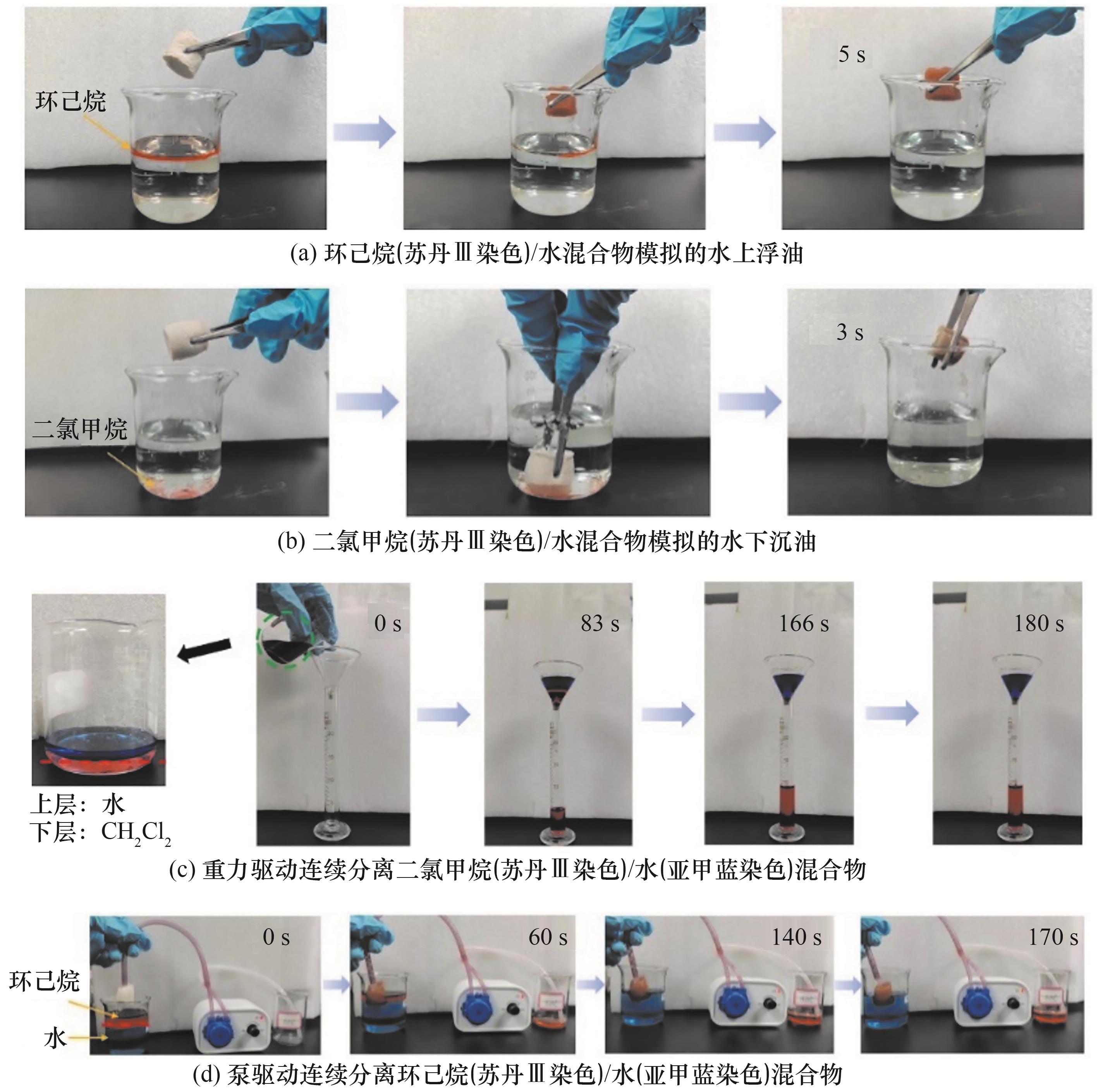
图12 利用M-LCNF/PI-1.00模拟油水分离
Fig.12 Simulation of oil-water separation by M-LCNF/PI-1.00

图13 M-LCNF/PI-1.00气凝胶油水分离的机理
Fig.13 Mechanism of oil-water separation of M-LCNF/PI-1.00 aerogel
| 1 | Cherukupally P, Sun W, Williams D R, et al. Wax-wetting sponges for oil droplets recovery from frigid waters[J]. Science Advances, 2021, 7(11): eabc7926. |
| 2 | Tian G D, Duan C, Lu W L, et al. Cellulose acetate-based electrospun nanofiber aerogel with excellent resilience and hydrophobicity for efficient removal of drug residues and oil contaminations from wastewater[J]. Carbohydrate Polymers, 2024, 329: 121794. |
| 3 | Qiao A H, Huang R L, Penkova A, et al. Superhydrophobic, elastic and anisotropic cellulose nanofiber aerogels for highly effective oil/water separation[J]. Separation and Purification Technology, 2022, 295: 121266. |
| 4 | Fan B J, Bao X M, Pan S S, et al. High capillary effect and solar dual-drive nanofibrillated cellulose aerogels for efficient crude oil spill cleanup[J]. Chemical Engineering Journal, 2024, 480: 148149. |
| 5 | Miao Y, Liang Y P, Wang E F, et al. Magnetic superhydrophobic cellulose nanofibril based aerogel with rope-ladder like structure incorporating both superelasticity and excellent oil absorption[J]. Journal of Environmental Management, 2024, 358: 120909. |
| 6 | Xu H, Zhang Z, Jiang W, et al. Multifunctional amphibious superhydrophilic-oleophobic cellulose nanofiber aerogels for oil and water purification[J]. Carbohydrate Polymers, 2024, 330: 121774. |
| 7 | Liu Z S, Sheng Z Z, Bao Y Q, et al. Ionic liquid directed spinning of cellulose aerogel fibers with superb toughness for weaved thermal insulation and transient impact protection[J]. ACS Nano, 2023, 17(18): 18411-18420. |
| 8 | Sivaraman D, Nagel Y, Siqueira G, et al. Additive manufacturing of nanocellulose aerogels with structure-oriented thermal, mechanical, and biological properties[J]. Advanced Science, 2024, 11(24): 2307921. |
| 9 | Rafieian F, Hosseini M, Jonoobi M, et al. Development of hydrophobic nanocellulose-based aerogel via chemical vapor deposition for oil separation for water treatment[J]. Cellulose, 2018, 25(8): 4695-4710. |
| 10 | Zhang M L, Jiang S, Han F Y, et al. Anisotropic cellulose nanofiber/chitosan aerogel with thermal management and oil absorption properties[J]. Carbohydrate Polymers, 2021, 264: 118033. |
| 11 | Chen B Y, Hu Y C. Hierarchical aerogels based on cellulose nanofibers and long-chain polymers for enhancing oil-water separation efficiency[J]. Materials Today Nano, 2024, 26: 100469. |
| 12 | Chen X Y, Yang M Y, Cai X D, et al. Fabrication of wheat straw-based lignin containing nanofibril aerogels as recyclable absorbents for oil-water separation[J]. Cellulose, 2024, 31(1): 497-514. |
| 13 | Tang R, Xu S Q, Hu Y, et al. Multifunctional nano-cellulose aerogel for efficient oil-water separation: vital roles of magnetic exfoliated bentonite and polyethyleneimine[J]. Separation and Purification Technology, 2023, 314: 123557. |
| 14 | 李明星, 谢慧红, 李帅, 等. 高疏水型纤维素纳米纤/聚乳酸杂化气凝胶用于高效油水分离[J]. 高分子材料科学与工程, 2022, 38(8): 104-112. |
| Li M X, Xie H H, Li S, et al. Highly hydrophobic cellulose nanofiber/polylactic acid hybrid aerogel for efficient oil-water separation[J]. Polymer Materials Science & Engineering, 2022, 38(8): 104-112. | |
| 15 | Liaw D J, Wang K L, Huang Y C, et al. Advanced polyimide materials: syntheses, physical properties and applications[J]. Progress in Polymer Science, 2012, 37(7): 907-974. |
| 16 | 高端辉, 肖卫强, 高峰, 等. 聚酰亚胺基气凝胶材料的制备与应用[J]. 化工学报, 2022, 73(7): 2757-2773. |
| Gao D H, Xiao W Q, Gao F, et al. Preparation and application of polyimide-based aerogels[J]. CIESC Journal, 2022, 73(7): 2757-2773. | |
| 17 | Zheng R N, Hu J Y, Lin Z C, et al. Anisotropic polyimide/cellulose nanofibril composite aerogels for thermal insulation and flame retardancy[J]. ACS Applied Polymer Materials, 2023, 5(6): 4180-4189. |
| 18 | Wu T T, Dong J, Gan F, et al. Low dielectric constant and moisture-resistant polyimide aerogels containing trifluoromethyl pendent groups[J]. Applied Surface Science, 2018, 440: 595-605. |
| 19 | 谢新玲, 李旺, 秦祖赠, 等. 一种疏水改性木质纤维素纳米纤丝及其制备方法: 116463873A[P]. 2023-07-21. |
| Xie X X, Li W, Qin Z Z, et al. A hydrophobically modified lignocellulosic nanofibril and its preparation method: 116463873A[P]. 2023-07-21. | |
| 20 | Fan B J, Wu L L, Ming A X, et al. Highly compressible and hydrophobic nanofibrillated cellulose aerogels for cyclic oil/water separation[J]. International Journal of Biological Macromolecules, 2023, 242: 125066. |
| 21 | 刘会娥, 黄扬帆, 马雁冰, 等. 石墨烯基气凝胶对有机物的饱和吸附能力[J]. 化工学报, 2019, 70(1): 280-289. |
| Liu H E, Huang Y F, Ma Y B, et al. Saturated adsorption capacities of graphene aerogels on organics[J]. CIESC Journal, 2019, 70(1): 280-289. | |
| 22 | Chen W W, Zhou X M, Wan M M, et al. Recent progress on polyimide aerogels against shrinkage: a review[J]. Journal of Materials Science, 2022, 57(28): 13233-13263. |
| 23 | Tang R, Hu Y, Yan J Y, et al. Multifunctional carboxylated cellulose nanofibers/exfoliated bentonite/Ti3C2 aerogel for efficient oil adsorption and recovery: the dual effect of exfoliated bentonite and MXene[J]. Chemical Engineering Journal, 2023, 473: 145412. |
| 24 | Vimonses V, Lei S M, Jin B, et al. Kinetic study and equilibrium isotherm analysis of Congo Red adsorption by clay materials[J]. Chemical Engineering Journal, 2009, 148(2/3): 354-364. |
| 25 | Liu Y X, Wei H X, Liu Z W, et al. Ultrafast and energy-saving extraction of cellulose nanocrystals[J]. Green Chemistry, 2022, 24(18): 6823-6829. |
| 26 | Ji H, Xiang Z Y, Qi H S, et al. Strategy towards one-step preparation of carboxylic cellulose nanocrystals and nanofibrils with high yield, carboxylation and highly stable dispersibility using innocuous citric acid[J]. Green Chemistry, 2019, 21(8): 1956-1964. |
| 27 | Wang N N, Wang H, Wang Y Y, et al. Robust, lightweight, hydrophobic, and fire-retarded polyimide/MXene aerogels for effective oil/water separation[J]. ACS Applied Materials & Interfaces, 2019, 11(43): 40512-40523. |
| 28 | Wang Y M, Zeng X Y, Wang W, et al. Superhydrophobic polyimide/cattail-derived active carbon composite aerogels for effective oil/water separation[J]. Separation and Purification Technology, 2023, 308: 122994. |
| 29 | Luo B, Cai C C, Liu T, et al. Multiscale structural nanocellulosic triboelectric aerogels induced by hofmeister effect[J]. Advanced Functional Materials, 2023, 33(42): 2306810. |
| 30 | Zhu P H, Yu Z Y, Sun H, et al. 3D printed cellulose nanofiber aerogel scaffold with hierarchical porous structures for fast solar-driven atmospheric water harvesting[J]. Advanced Materials, 2024, 36(1): 2306653. |
| 31 | Yang X, Jiang P J, Xiao R, et al. Elastic agarose nanowire aerogels for oil-water separation and thermal insulation[J]. ACS Applied Nano Materials, 2022, 5(9): 12423-12434. |
| 32 | Li Y Z, Grishkewich N, Liu L L, et al. Construction of functional cellulose aerogels via atmospheric drying chemically cross-linked and solvent exchanged cellulose nanofibrils[J]. Chemical Engineering Journal, 2019, 366: 531-538. |
| 33 | Wang Y X, He T J, Liu M Y, et al. Fast and efficient oil-water separation under harsh conditions of the flexible polyimide aerogel containing benzimidazole structure[J]. Colloids and Surfaces A: Physicochemical and Engineering Aspects, 2019, 581: 123809. |
| 34 | Liao Y R, Zhang S Z, Yu S, et al. Microstructural evolution of bio-based chitosan aerogels for thermal insulator with superior moisture/fatigue resistance and anti-thermal-shock[J]. International Journal of Biological Macromolecules, 2024, 278: 134681. |
| 35 | Apostolopoulou-Kalkavoura V, Munier P, Bergström L. Thermally insulating nanocellulose-based materials[J]. Advanced Materials, 2021, 33(28): 2001839. |
| 36 | Li C J, Guo J X, Xu P K, et al. Facile preparation of superior compressibility and hydrophobic reduced graphene oxide@cellulose nanocrystals/EPDM composites for highly efficient oil/organic solvent adsorption and enhanced electromagnetic interference shielding[J]. Separation and Purification Technology, 2023, 307: 122775. |
| 37 | Sankhla S, Neogi S. Ambient-dried, scalable and biodegradable cellulose nanofibers aerogel for oil-spill cleanup[J]. Journal of Environmental Chemical Engineering, 2024, 12(3): 112745. |
| 38 | Lyu P, Xia L J, Liu X, et al. Self-cleaning superhydrophobic aerogels from waste hemp noil for ultrafast oil absorption and highly efficient PM removal[J]. Separation and Purification Technology, 2023, 306: 122503. |
| 39 | Mei J F, Ding Z L, Sun X Y, et al. A solvent-template ethyl cellulose-polydimethylsiloxane crosslinking sponge for rapid and efficient oil adsorption[J]. International Journal of Biological Macromolecules, 2023, 244: 125399. |
| 40 | Peng D, Zhao J, Liang X J, et al. Corn stalk pith-based hydrophobic aerogel for efficient oil sorption[J]. Journal of Hazardous Materials, 2023, 448: 130954. |
| 41 | Hou Y S, Liao J M, Li L, et al. A novel eco-friendly lightweight cellulose-based foam with superior resilience and hydrophobicity for selective oil/water separation[J]. Cellulose, 2024, 31(7): 4409-4420. |
| 42 | Huang B J, Jiang J C. Construction of super-hydrophobic lignocellulosic nanofibrils aerogels as speedy oil absorbents[J]. Applied Biochemistry and Biotechnology, 2024, 196(1): 220-232. |
| 43 | Guan Y H, Qiao D, Dong L M, et al. Efficient recovery of highly viscous crude oil spill by superhydrophobic ocean biomass-based aerogel assisted with solar energy[J]. Chemical Engineering Journal, 2023, 467: 143532. |
| 44 | Feng J D, Nguyen S T, Fan Z, et al. Advanced fabrication and oil absorption properties of super-hydrophobic recycled cellulose aerogels[J]. Chemical Engineering Journal, 2015, 270: 168-175. |
| 45 | Dilamian M, Noroozi B. Rice straw agri-waste for water pollutant adsorption: relevant mesoporous super hydrophobic cellulose aerogel[J]. Carbohydrate Polymers, 2021, 251: 117016. |
| [1] | 张耀辉, 班宇杰, 杨维慎. 以蒸气加工法制备和修饰金属-有机框架膜[J]. 化工学报, 2025, 76(5): 2070-2086. |
| [2] | 杨雅南, 常胜然, 薛松林, 潘建明, 邢卫红. 基于光、电驱动促进海水中铀和锂提取的研究进展[J]. 化工学报, 2025, 76(5): 1927-1942. |
| [3] | 杨紫博, 王有发, 岳寒松, 远双杰, 耿付江, 李晴晴, 奥德, 李斌, 叶茂, 顾振杰, 乔志华. MOF玻璃基气体分离膜的研究进展[J]. 化工学报, 2025, 76(5): 2158-2168. |
| [4] | 牛宏斌, 邱丽, 杨景轩, 张忠林, 郝晓刚, 赵忠凯, 阿布里提, 官国清. 筒体直径对旋风分离器性能的影响及其流场机制[J]. 化工学报, 2025, 76(5): 2367-2376. |
| [5] | 朱迪, 高守建, 方望熹, 靳健. 水蒸气诱导相分离构筑海绵孔结构超亲水聚醚砜膜及其油/水乳液分离性能研究[J]. 化工学报, 2025, 76(5): 2397-2409. |
| [6] | 茅雨洁, 路晓飞, 锁显, 杨立峰, 崔希利, 邢华斌. 工业气体中微量氧深度脱除催化剂研究进展[J]. 化工学报, 2025, 76(5): 1997-2010. |
| [7] | 时任泽, 丁秋燕, 袁振军, 那健, 刘见华, 郭树虎, 赵雄, 李洪, 高鑫. 4N电子级二乙氧基甲基硅烷的纯化技术研究[J]. 化工学报, 2025, 76(5): 2186-2197. |
| [8] | 郭彭涛, 王婷, 薛波, 应允攀, 刘大欢. 用于CH4/N2分离的多吸附位点超微孔MOF[J]. 化工学报, 2025, 76(5): 2304-2312. |
| [9] | 李紫鹃, 谭晓艳, 吴永盛, 杨陈怡, 陈红, 毕小刚, 刘捷, 喻发全. 分子模拟研究三维扭曲催化芳烃-降冰片烯环化聚合物膜的CO2/N2分离机理[J]. 化工学报, 2025, 76(5): 2348-2357. |
| [10] | 花敬贤, 罗宇荣, 顾亚伟, 吴婷婷, 潘宜昌, 邢卫红. 超薄取向ZIF-8膜的制备及乙烯/乙烷高效分离[J]. 化工学报, 2025, 76(5): 2209-2218. |
| [11] | 李艳, 雷美丽, 李鑫钢. 基于分离性能的顺序式模拟移动床结构调控策略[J]. 化工学报, 2025, 76(5): 2219-2229. |
| [12] | 巴雅琪, 吴涛, 邸安頔, 陆安慧. 多孔炭材料用于低碳烃分离的研究进展[J]. 化工学报, 2025, 76(5): 2136-2157. |
| [13] | 谈朋, 李雪梅, 刘晓勤, 孙林兵. 基于柔性MOFs的磁响应复合材料及其丙烯吸附性能研究[J]. 化工学报, 2025, 76(5): 2230-2240. |
| [14] | 向昕辰, 鲁丹, 赵影, 姚之侃, 寇瑞强, 郑丹军, 周志军, 张林. 聚酰胺纳滤膜表面季铵化提高荷正电性及其锂镁分离性能[J]. 化工学报, 2025, 76(5): 2377-2386. |
| [15] | 胡嘉朗, 姜明源, 金律铭, 张永刚, 胡鹏, 纪红兵. 机器学习辅助MOFs高通量计算筛选及气体分离研究进展[J]. 化工学报, 2025, 76(5): 1973-1996. |
| 阅读次数 | ||||||
|
全文 |
|
|||||
|
摘要 |
|
|||||
 京公网安备 11010102001995号