化工学报 ›› 2025, Vol. 76 ›› Issue (5): 2136-2157.DOI: 10.11949/0438-1157.20241222
巴雅琪( ), 吴涛, 邸安頔, 陆安慧()
收稿日期:2024-10-31
修回日期:2024-11-30
出版日期:2025-05-25
发布日期:2025-06-13
通讯作者:
陆安慧
作者简介:巴雅琪(1999—),女,博士研究生,bayaqi@mail.dlut.edu.cn
基金资助:
Yaqi BA(), Tao WU, Andi DI, Anhui LU()
Received:2024-10-31
Revised:2024-11-30
Online:2025-05-25
Published:2025-06-13
Contact:
Anhui LU
摘要:
低碳烃(C1~C3)混合物的分离与纯化是石油化工行业可持续发展的关键技术环节之一。物理吸附分离技术由于能耗低、易再生和操作简便的特点,在这一领域具有应用潜力。而研发温和条件下低能耗、高选择性吸附分离C1~C3的固体吸附材料是关键。多孔炭因其优异的化学稳定性、可调控的孔隙结构和表面化学性质,在低碳烃分离和纯化领域受到广泛关注。结合本课题组研究工作,综述了多孔炭材料在C1~C3的天然气(包含煤层气)及烯烃烷烃分离体系的研究进展及分离机理,总结了孔隙结构与表面极性调控方面的研究成果。最后,分析了多孔炭材料在分离低碳烃时所面临的挑战,展望了未来发展方向。
中图分类号:
巴雅琪, 吴涛, 邸安頔, 陆安慧. 多孔炭材料用于低碳烃分离的研究进展[J]. 化工学报, 2025, 76(5): 2136-2157.
Yaqi BA, Tao WU, Andi DI, Anhui LU. Progress in porous carbons for efficient separation of gaseous light hydrocarbon[J]. CIESC Journal, 2025, 76(5): 2136-2157.
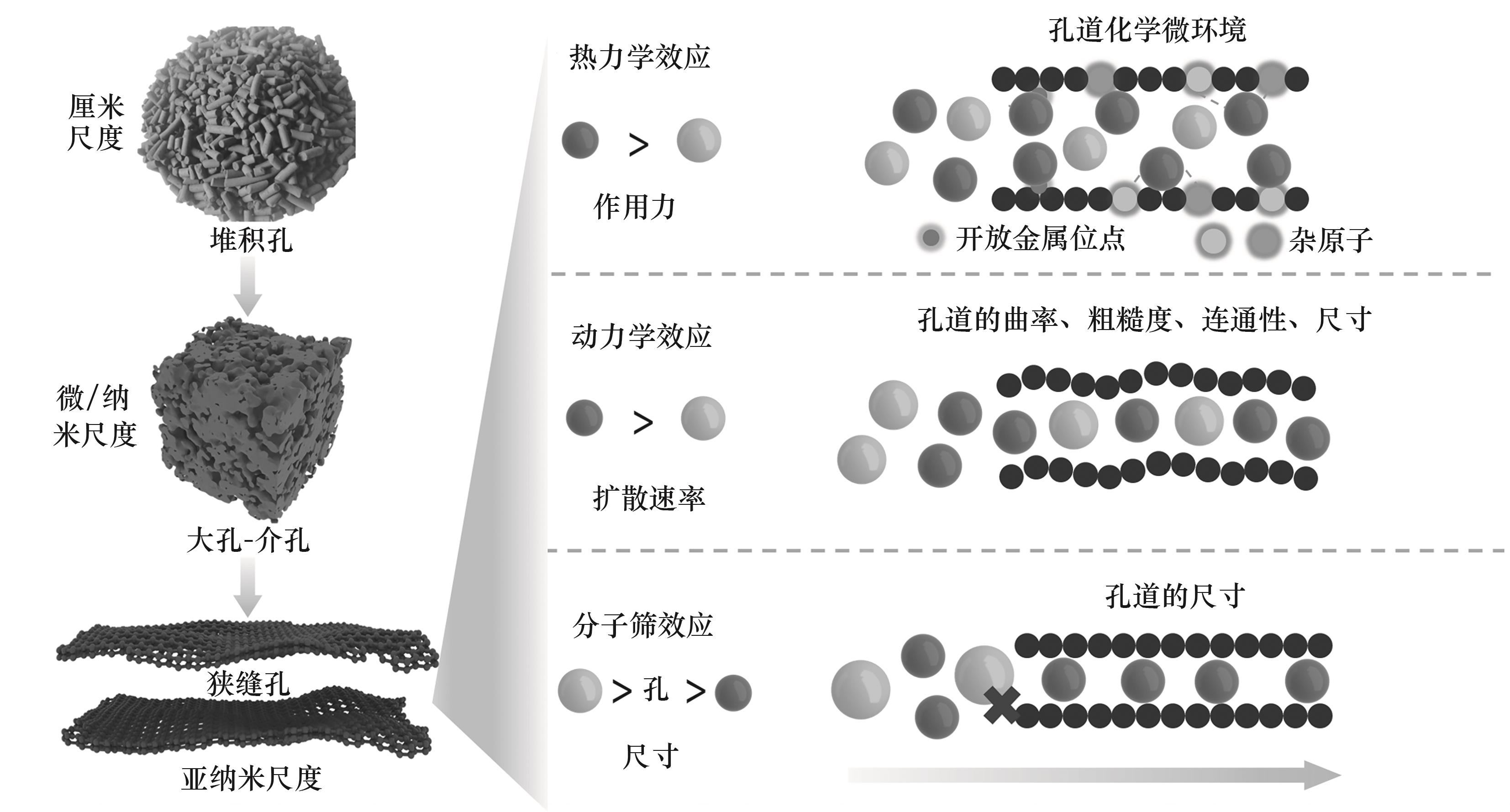
图1 炭质吸附剂对气体分子的分离机制示意图
Fig.1 Schematic diagram of the separation mechanism of gas molecules by carbon adsorbents
| 组分 | 体积分数/% | ||||||
|---|---|---|---|---|---|---|---|
| 天然气 | 沼气 | 炼厂气 | 裂解气 | 油田气 | 煤层气 | 页岩气 | |
| CO2 | 0~10 | 25~65 | 1~2 | — | 1~36 | <5 | 0~10 |
| CH4 | 60~70 | 40~75 | 3~25 | 20~25 | 30~65 | 20~50 | 69~95 |
| C2H4 | — | — | — | 20~25 | — | — | — |
| C2H6 | 5~20 | — | 2~15 | 0~5 | 5~20 | — | 0-2 |
| C3H6 | — | — | — | — | — | — | — |
| C3H8 | 2~15 | — | 2~15 | 0-5 | 2~20 | — | 0~2 |
| H2 | — | — | 50~90 | 10~20 | — | — | 0~1 |
| N2 | 0~25 | — | — | — | 0~5 | 39~70 | 0~30 |
| 其他 | 0~15 | 0~10 | 0~10 | 25~30 | 5~25 | 10~16 | 0~1 |
表1 不同气源中CH4及其他气体组分比例[9-15]
Table 1 Ratio of CH4 and other gas components in different gas sources [9-15]
| 组分 | 体积分数/% | ||||||
|---|---|---|---|---|---|---|---|
| 天然气 | 沼气 | 炼厂气 | 裂解气 | 油田气 | 煤层气 | 页岩气 | |
| CO2 | 0~10 | 25~65 | 1~2 | — | 1~36 | <5 | 0~10 |
| CH4 | 60~70 | 40~75 | 3~25 | 20~25 | 30~65 | 20~50 | 69~95 |
| C2H4 | — | — | — | 20~25 | — | — | — |
| C2H6 | 5~20 | — | 2~15 | 0~5 | 5~20 | — | 0-2 |
| C3H6 | — | — | — | — | — | — | — |
| C3H8 | 2~15 | — | 2~15 | 0-5 | 2~20 | — | 0~2 |
| H2 | — | — | 50~90 | 10~20 | — | — | 0~1 |
| N2 | 0~25 | — | — | — | 0~5 | 39~70 | 0~30 |
| 其他 | 0~15 | 0~10 | 0~10 | 25~30 | 5~25 | 10~16 | 0~1 |
| 吸附质 | 沸点/K | 动力学直径/nm | 偶极矩/(10-18 esu·cm) | 四极矩/(10-26 esu·cm2) | 极化率/(10-25 cm3) |
|---|---|---|---|---|---|
| CO2 | 194.7 | 0.33 | 0 | 4.3 | 29.1 |
| CH4 | 111.6 | 0.38 | 0 | 0 | 26.0 |
| C2H4 | 169.4 | 0.42 | 0 | 1.5 | 42.5 |
| C2H6 | 184.6 | 0.44 | 0 | 0.65 | 44.3~44.7 |
| C3H6 | 225.5 | 0.46 | 0.366 | — | 62.6 |
| C3H8 | 231.0 | 0.43~0.52 | 0.084 | — | 62.9~63.7 |
表2 C1~C3气体分子物化性质[23]
Table 2 Table of physical and chemical properties of C1—C3 gas molecules[23]
| 吸附质 | 沸点/K | 动力学直径/nm | 偶极矩/(10-18 esu·cm) | 四极矩/(10-26 esu·cm2) | 极化率/(10-25 cm3) |
|---|---|---|---|---|---|
| CO2 | 194.7 | 0.33 | 0 | 4.3 | 29.1 |
| CH4 | 111.6 | 0.38 | 0 | 0 | 26.0 |
| C2H4 | 169.4 | 0.42 | 0 | 1.5 | 42.5 |
| C2H6 | 184.6 | 0.44 | 0 | 0.65 | 44.3~44.7 |
| C3H6 | 225.5 | 0.46 | 0.366 | — | 62.6 |
| C3H8 | 231.0 | 0.43~0.52 | 0.084 | — | 62.9~63.7 |
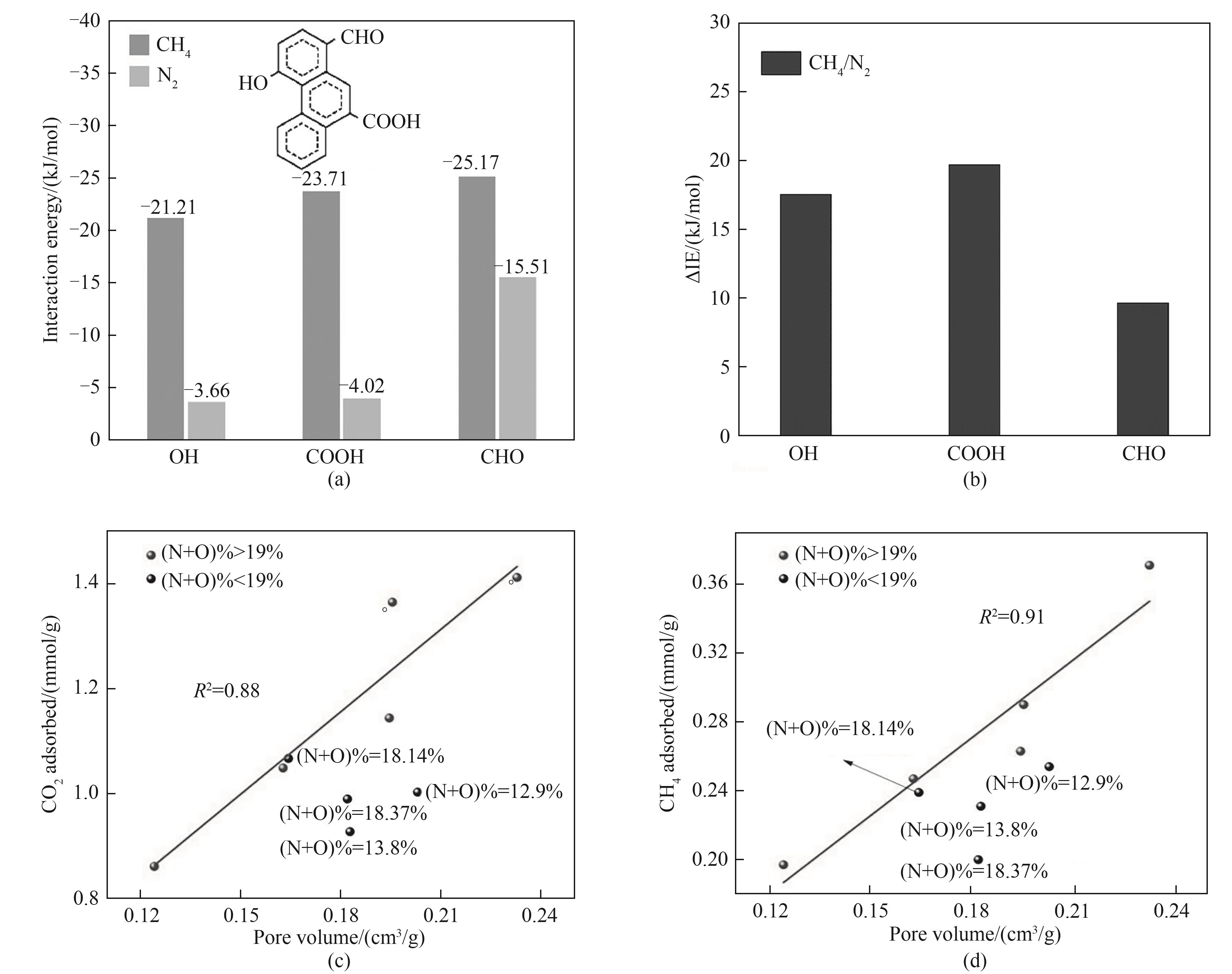
图2 CH4/N2分子与样品表面羧基/羟基/醛基之间的相互作用能(a); CH4和N2在官能团上的相互作用能的绝对差值(ΔIE) (b) [27]; (N+O)含量与CO2(c)和CH4(d)捕获能力的关系(298 K,15 kPa条件下,小于0.7 nm的孔容)[28]
Fig.2 Interaction energy between CH4/N2 molecules and the surface carboxylic/hydroxyl/aldehyde groups of the samples (a); Absolute difference of the interaction energies (ΔIE) between CH4 and N2 on functional groups[27] (b); The relationship of (N+O)-contents with CO2 (c) and CH4 (d) capture capacity at 298 K under 15 kPa and <0.7 nm pore volume[28]
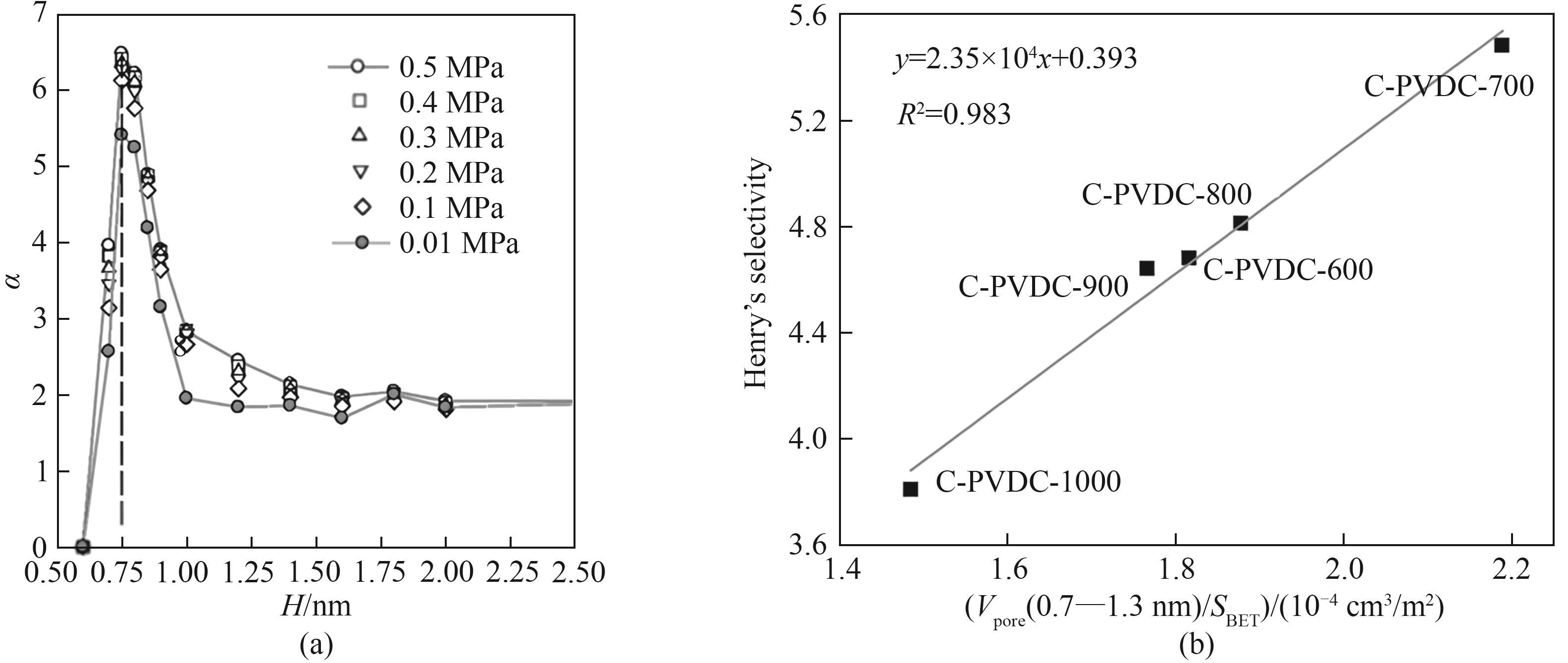
图3 (a) 基于 GCMC 模拟的分离系数[37]; (b) CH4对N2的亨利选择性与在0.7~1.3 nm范围内的孔隙体积比单位表面积的相关性[38]
Fig.3 (a) The separation coefficient based on GCMC simulation[37]; (b) Correlation of Henry’s selectivity of CH4 over N2 with pore volume in the range of 0.7—1.3 nm reduced to unit surface area[38]

图4 (a) PCNPs 的原子力显微镜(AFM)图像; (b) 根据273 K时对CO2的吸附测定的微孔尺寸分布和微孔体积(1 Å=0.1 nm); (c) PCNPs和SCNPs在2 kPa(298 K)条件下吸附CH4的动力学比较; (d) PCNPs、13X分子筛以及CMS对CH4的突破曲线[50]
Fig.4 (a) AFM images of PCNPs and corresponding cross-section analysis for the dashed orange line in the images; (b) Micropore size distribution and micropore volume determined from CO2 adsorption at 273 K; (c) The comparison of kinetic adsorption of CH4 for PCNPs and SCNPs at 2 kPa (298 K); (d) Breakthrough curves of PCNPs, 13X zeolite and CMS for CH4[50]
| 吸附剂 | 比表面积/(m2/g) | 总孔容/(cm3/g) | 微孔孔容/(cm3/g) | 吸附量/(mmol/g) | 选择性 | 文献 | |
|---|---|---|---|---|---|---|---|
| CH4 | N2 | ||||||
| ACK2N1 | 1981 | 0.83 | 0.78 | 3.00① | 0.75① | 7.1② | [ |
| ClCTF-1-650 | 974 | 0.37 | 0.37 | 1.34 | 0.32 | 8.6 | [ |
| PRC-850 | 776 | 0.57 | 0.19 | 1.12 | — | 5.5~9.3③ | [ |
| PS-2-450 | 1089 | 0.55 | 0.42 | 1.13 | 0.22 | 7.6 | [ |
| PZS-900 | 896 | — | — | 1.88 | 0.66 | 4.5 | [ |
| 10%Ni/C | 1367 | — | 0.37 | 1.16 | 0.31 | 5.3⑤ | [ |
| C-PVDC-700 | 1130 | 0.45 | 0.25 | 1.57 | ~0.35 | 5.5⑤ | [ |
| GOC-2 | 1306 | 0.67 | — | 1.82 | — | 5.8 | [ |
| CGUCs-1-8 | 1071 | 0.44 | 0.37 | ~1.3 | ~0.40 | 5.0 | [ |
| AC-KP | 1549 | 0.62 | 0.28 | 1.87 | 0.67 | 6.5② | [ |
| PCNPs | 690 | — | 0.26 | 1.17 | 0.28 | 10.1④ | [ |
表3 典型多孔炭吸附剂的理化性质和 CH4/N2 吸附分离性能汇总
Table 3 Summary of the physicochemical properties and CH4/N2 adsorption separation performances of typical porous carbon adsorbents
| 吸附剂 | 比表面积/(m2/g) | 总孔容/(cm3/g) | 微孔孔容/(cm3/g) | 吸附量/(mmol/g) | 选择性 | 文献 | |
|---|---|---|---|---|---|---|---|
| CH4 | N2 | ||||||
| ACK2N1 | 1981 | 0.83 | 0.78 | 3.00① | 0.75① | 7.1② | [ |
| ClCTF-1-650 | 974 | 0.37 | 0.37 | 1.34 | 0.32 | 8.6 | [ |
| PRC-850 | 776 | 0.57 | 0.19 | 1.12 | — | 5.5~9.3③ | [ |
| PS-2-450 | 1089 | 0.55 | 0.42 | 1.13 | 0.22 | 7.6 | [ |
| PZS-900 | 896 | — | — | 1.88 | 0.66 | 4.5 | [ |
| 10%Ni/C | 1367 | — | 0.37 | 1.16 | 0.31 | 5.3⑤ | [ |
| C-PVDC-700 | 1130 | 0.45 | 0.25 | 1.57 | ~0.35 | 5.5⑤ | [ |
| GOC-2 | 1306 | 0.67 | — | 1.82 | — | 5.8 | [ |
| CGUCs-1-8 | 1071 | 0.44 | 0.37 | ~1.3 | ~0.40 | 5.0 | [ |
| AC-KP | 1549 | 0.62 | 0.28 | 1.87 | 0.67 | 6.5② | [ |
| PCNPs | 690 | — | 0.26 | 1.17 | 0.28 | 10.1④ | [ |

图5 (a) 25℃下活性炭对CH4的吸附等温线; (b)通过拟合 0℃下的CO2吸附数据得到的活性炭微孔尺寸分布[64]
Fig.5 (a) Micropore size distributions of the activated carbon, obtained by fitting CO2 adsorption data at 0℃; (b) Methane adsorption isotherms at 25℃ on the activated carbons. The lines represent the fitting of the virial equation[64]
| 吸附剂 | 比表面积/(m2/g) | 总孔容/(cm3/g) | 微孔孔容/(cm3/g) | 吸附量/(mmol/g) | 选择性 | 文献 | |
|---|---|---|---|---|---|---|---|
| CO2 | CH4 | ||||||
| SA-1-700 | 1406 | 0.72 | 0.60 | 4.20 | 1.53 | 8.0① | [ |
| NAC-4 | 1593 | 0.76 | 0.21 | 3.33 | 0.57 | 5.8 | [ |
| GL | 310 | 0.13 | 0.11 | 1.62② | 0.45② | 54.0② | [ |
| PS | 790 | 0.33 | 0.26 | 3.63② | 1.38② | 15.0② | [ |
| NPC-725 | 314 | 0.21 | 0.14 | 3.22 | 1.02 | 24.3① | [ |
| Glc-Cs | 3153 | 2.06 | 0.30 | 22.40③ | 10.00③ | 27.0③ | [ |
表4 典型多孔炭吸附剂的理化性质和 CO2/CH4 吸附分离性能汇总
Table 4 Summary of the physicochemical properties and CO2/CH4 adsorption separation performances of typical porous carbon adsorbents
| 吸附剂 | 比表面积/(m2/g) | 总孔容/(cm3/g) | 微孔孔容/(cm3/g) | 吸附量/(mmol/g) | 选择性 | 文献 | |
|---|---|---|---|---|---|---|---|
| CO2 | CH4 | ||||||
| SA-1-700 | 1406 | 0.72 | 0.60 | 4.20 | 1.53 | 8.0① | [ |
| NAC-4 | 1593 | 0.76 | 0.21 | 3.33 | 0.57 | 5.8 | [ |
| GL | 310 | 0.13 | 0.11 | 1.62② | 0.45② | 54.0② | [ |
| PS | 790 | 0.33 | 0.26 | 3.63② | 1.38② | 15.0② | [ |
| NPC-725 | 314 | 0.21 | 0.14 | 3.22 | 1.02 | 24.3① | [ |
| Glc-Cs | 3153 | 2.06 | 0.30 | 22.40③ | 10.00③ | 27.0③ | [ |
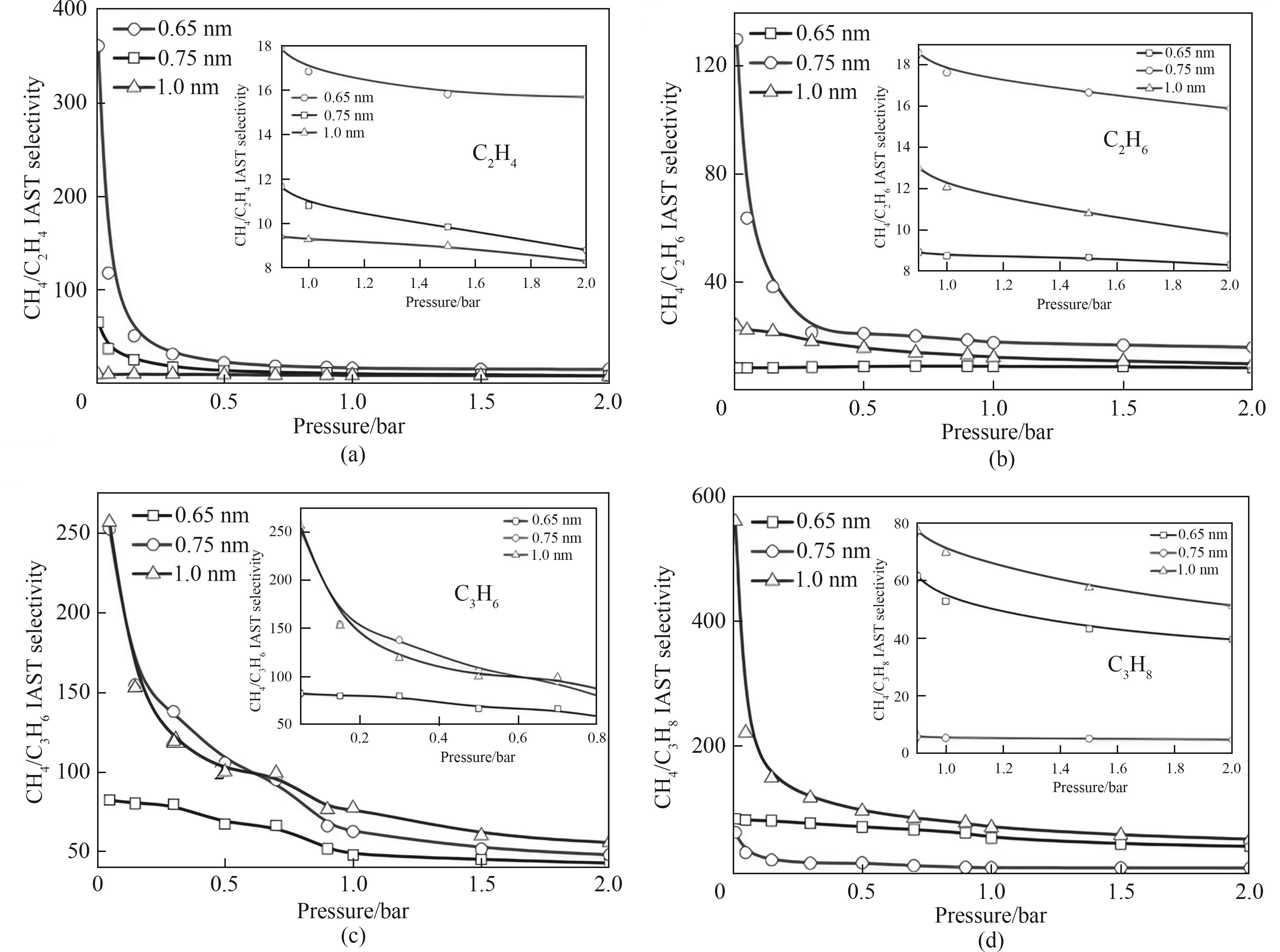
图6 300 K时S掺杂石墨狭缝孔的CH4/C2H4(a), CH4/C2H6(b), CH4/C3H6(c)和CH4/C3H8(d)选择性与压力的关系[75]
Fig. 6 CH4/C2H4(a), CH4/C2H6(b), CH4/C3H6(c) and CH4/C3H8 (d) selectivity of S-graphite slit pore versus the adsorption pressure at 300 K[75]
| 吸附剂 | 比表面积/ (m2/g) | 总孔容/ (cm3/g) | 微孔孔容/ (cm3/g) | 吸附量/(mmol/g) | 选择性 | 文献 | |||
|---|---|---|---|---|---|---|---|---|---|
| CH4 | C2H6 | C3H8 | C2H6/CH4 | C3H8/CH4 | |||||
| A-AC-4 | 3131 | 1.92 | — | 1.18 | 6.59 | 11.76 | 15.1① | 88.8① | [ |
| SMC3 | 1999 | 0.81 | 0.69 | 1.00 | 5.28 | 8.39 | 27.1① | 146.0① | [ |
| C-PVDC-800 | 1211 | 0.45 | 0.45 | 5.22 | 5.19 | 74.9 | 3387.2 | [ | |
| UC800 | 3839 | 2.3 | 1.13 | 1.26 | 7.19 | 12.02 | 9.1 | 41.8 | [ |
| FCP-1-KC | 800 | 0.4 | 0.36 | 1.70 | 5.10 | 5.30 | 71.0② | 386.0② | [ |
| NPC-Li | 3579 | 1.49 | — | 0.48 | 7.67 | 3.55 | 8.0 | 336.0 | [ |
表5 典型多孔炭吸附剂的理化性质和 C2~3H x /CH4 吸附分离性能汇总
Table 5 Summary of the physicochemical properties and C2-3H x /CH4 adsorption separation performances of typical porous carbon adsorbents
| 吸附剂 | 比表面积/ (m2/g) | 总孔容/ (cm3/g) | 微孔孔容/ (cm3/g) | 吸附量/(mmol/g) | 选择性 | 文献 | |||
|---|---|---|---|---|---|---|---|---|---|
| CH4 | C2H6 | C3H8 | C2H6/CH4 | C3H8/CH4 | |||||
| A-AC-4 | 3131 | 1.92 | — | 1.18 | 6.59 | 11.76 | 15.1① | 88.8① | [ |
| SMC3 | 1999 | 0.81 | 0.69 | 1.00 | 5.28 | 8.39 | 27.1① | 146.0① | [ |
| C-PVDC-800 | 1211 | 0.45 | 0.45 | 5.22 | 5.19 | 74.9 | 3387.2 | [ | |
| UC800 | 3839 | 2.3 | 1.13 | 1.26 | 7.19 | 12.02 | 9.1 | 41.8 | [ |
| FCP-1-KC | 800 | 0.4 | 0.36 | 1.70 | 5.10 | 5.30 | 71.0② | 386.0② | [ |
| NPC-Li | 3579 | 1.49 | — | 0.48 | 7.67 | 3.55 | 8.0 | 336.0 | [ |
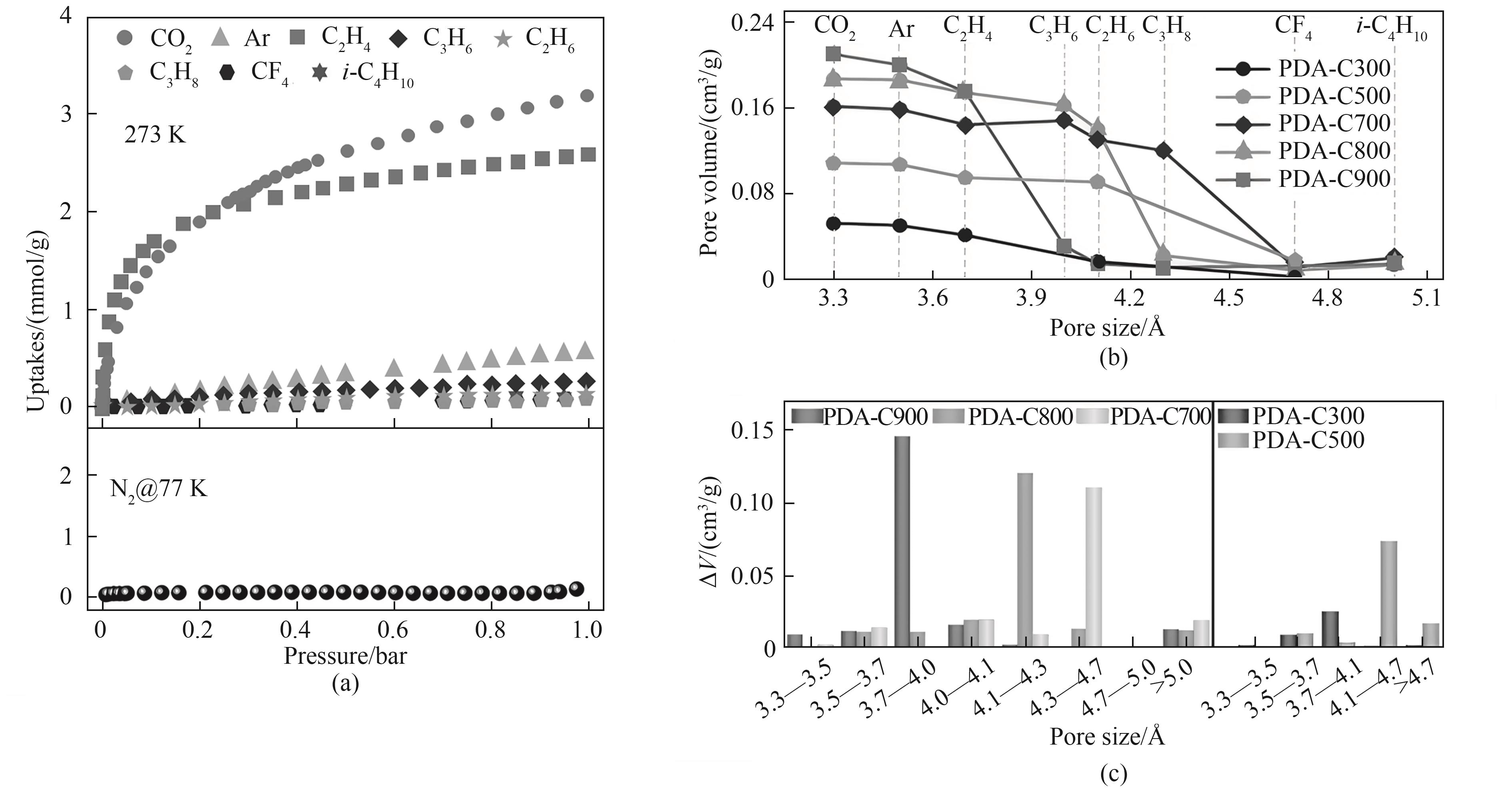
图7 (a) 最小分子尺寸从0.33 nm(CO2)到0.5 nm(i-C4H10)在273 K和N2在77 K的条件下在PDA-C900上的吸附平衡等温线; (b) 根据Dubinin-Astakhov方程计算的不同探针气体在PDA-C x 上的孔隙体积(从左到右的数据点分别由PDA-C x 上的CO2、Ar、C2H4、C3H6、C2H6、C3H8、CF4和i-C4H10等探针气体计算得出。而富含杂原子的PDA-C300和PDA-C500由于主客体相互作用较强,因此不包括极化率较高的C3H6、C3H8和i-C4H10); (c) PDA-C x 的孔径分布(y轴的孔隙体积差(∆V)是由连续尺寸的探针得到的。从VCO2中减去VAr,从VAr中减去VC2H4,以此类推)[80]
Fig.7 (a) Sorption equilibrium isotherms of various gas probes with minimum molecular dimensions ranging from 0.33 nm (CO2) to 0.5 nm (i-C4H10) at 273 K and N2 at 77 K on PDA-C900 materials; (b) The pore volumes of PDA-C x calculated from different probe gases based on the Dubinin-Astakhov equation (the data points from left to right were calculated from probing gases of CO2, Ar, C2H4, C3H6, C2H6, C3H8, CF4, and i-C4H10 for PDA-C x . While C3H6, C3H8, and i-C4H10 with high polarizability were excluded for heteroatom-rich PDA-C300 and PDA-C500 due to stronger host-guest interaction); (c) The pore size distributions of PDA-C x (the differential pore volume (∆V) of y-axis was obtained from probes with successive sizes. VAr was subtracted from VCO2, VC2H4 from VAr, and so on)[80]
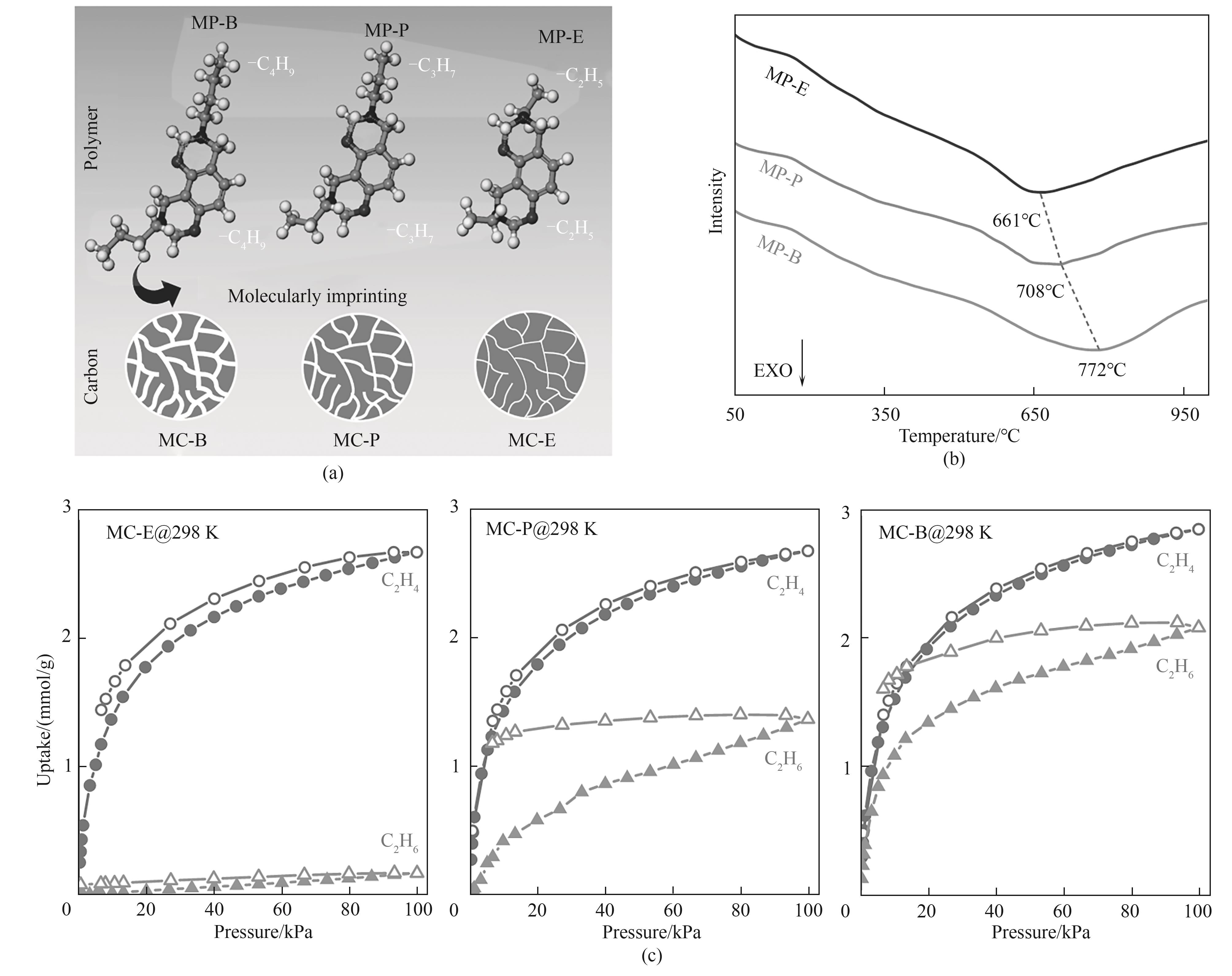
图8 (a) 基于分子印迹概念的三种类型聚合物单体的结构示意图; (b) MP-B、MP-P和MP-E在Ar气氛中的DSC曲线; (c) MC-E(左)、MC-P(中)和MC-B(右)在298 K下对C2H4/C2H6的吸附-脱附等温线[83]
Fig.8 (a) Structure schematic of the three types of polymer monomers with the incorporated amines with different carbon chains; (b) The DSC curves of MP-B, MP-P, and MP-E in argon atmosphere; (c) C2H4/C2H6 adsorption-desorption isotherms for MC-E (left), MC-P (medium), and MC-B (right) at 298 K[83]

图9 FAU-ZTC (a)、EMT-ZTC (b)和beta-ZTC (c)的结构示意图和石英模型; 303 K时吸附剂对乙烷和乙烯的吸附等温线:FAU-ZTC (d), EMT-ZTC (e), beta-ZTC (f)[89]
Fig.9 Schematic structures and schwarzite models of FAU-ZTC (a), EMT-ZTC (b), and beta-ZTC (c); Adsorption isotherms of ethane and ethylene by adsorbents at 303 K: FAU-ZTC (d), EMT-ZTC (e), beta-ZTC (f)[89]
| 名称 | 比表面积/ (m2/g) | 总孔容/ (cm3/g) | 微孔孔容/ (cm3/g) | 吸附量/(mmol/g) | 扩散速率/s-1 | 选择性 | 文献 | ||
|---|---|---|---|---|---|---|---|---|---|
| C2H4 | C2H6 | C2H4 | C2H6 | ||||||
| PDA-C900 | 400① | — | 0.21① | 2.25 | 0.091 | 4.13 × 10⁻³ | — | 24.7 | [ |
| CNC-700 | 317① | — | 0.16① | 1.44 | 0.093 | — | — | 15.2 | [ |
| d-CMS-3 | — | — | — | 1.52 | 0.14 | 2.0 × 10⁻³ | 1 × 10⁻⁵ | 10.9 | [ |
| MC-E | 317 | — | — | 2.66 | 0.17 | — | — | 15.6 | [ |
| CMK-3 | 1182 | 1.19 | — | 2.90② | 3.10② | — | — | 0.9 | [ |
| 8CuCl/CMK-3 | 303 | 0.37 | — | 3.60② | 1.30② | — | — | 2.8 | |
| CuCl(8.0)/AC | 224 | 0.38 | — | 2.60② | 0.70② | — | — | 3.7 | [ |
| 50CPDA@A-ACs | 1799 | 0.72 | — | 6.30 | 7.10 | — | — | 3.0③ | [ |
| MGA-750-3 | 3189 | 1.48 | 0.93 | 5.70 | 7.00 | — | — | 4.2③ | [ |
| C-PDA-3 | 3160 | 1.51 | — | 6.57 | 5.10 | — | — | 1.9④ | [ |
| beta-ZTC | 3200 | — | — | 7.30② | 4.90② | — | — | 1.7⑤ | [ |
| EMT-ZTC | 2980 | — | — | 5.90② | 4.10② | — | — | 1.6⑤ | |
| FAU-ZTC | 2700 | — | — | 5.00② | 4.00② | — | — | 1.5⑤ | |
表6 典型多孔炭吸附剂的理化性质和C2H4/C2H6吸附分离性能汇总
Table 6 Summary of the physicochemical properties and C2H4/C2H6 adsorption separation performances of typical porous carbon adsorbents
| 名称 | 比表面积/ (m2/g) | 总孔容/ (cm3/g) | 微孔孔容/ (cm3/g) | 吸附量/(mmol/g) | 扩散速率/s-1 | 选择性 | 文献 | ||
|---|---|---|---|---|---|---|---|---|---|
| C2H4 | C2H6 | C2H4 | C2H6 | ||||||
| PDA-C900 | 400① | — | 0.21① | 2.25 | 0.091 | 4.13 × 10⁻³ | — | 24.7 | [ |
| CNC-700 | 317① | — | 0.16① | 1.44 | 0.093 | — | — | 15.2 | [ |
| d-CMS-3 | — | — | — | 1.52 | 0.14 | 2.0 × 10⁻³ | 1 × 10⁻⁵ | 10.9 | [ |
| MC-E | 317 | — | — | 2.66 | 0.17 | — | — | 15.6 | [ |
| CMK-3 | 1182 | 1.19 | — | 2.90② | 3.10② | — | — | 0.9 | [ |
| 8CuCl/CMK-3 | 303 | 0.37 | — | 3.60② | 1.30② | — | — | 2.8 | |
| CuCl(8.0)/AC | 224 | 0.38 | — | 2.60② | 0.70② | — | — | 3.7 | [ |
| 50CPDA@A-ACs | 1799 | 0.72 | — | 6.30 | 7.10 | — | — | 3.0③ | [ |
| MGA-750-3 | 3189 | 1.48 | 0.93 | 5.70 | 7.00 | — | — | 4.2③ | [ |
| C-PDA-3 | 3160 | 1.51 | — | 6.57 | 5.10 | — | — | 1.9④ | [ |
| beta-ZTC | 3200 | — | — | 7.30② | 4.90② | — | — | 1.7⑤ | [ |
| EMT-ZTC | 2980 | — | — | 5.90② | 4.10② | — | — | 1.6⑤ | |
| FAU-ZTC | 2700 | — | — | 5.00② | 4.00② | — | — | 1.5⑤ | |

图10 (a) 带筛分层的木框结构炭的制备过程示意图; (b) 木框、聚苯并𫫇嗪聚合物涂层木材 PBZ@W 和带筛分层的木框结构炭 WSCS 的扫描电镜照片; (c) 在298 K和100 kPa条件下,以2 ml/min的流速测量等摩尔二元混合物C3H6/C3H8的WSC、WSCS和PDC的穿透曲线(t1为C3H8的穿透点; t2为C3H6的穿透点)[91]
Fig.10 (a) Schematic preparation procedures for the wood frame structured carbons with sieving layer, WSCS; (b) SEM images of wood frame, polybenzoxazine polymer coated wood, PBZ@W, and wood frame structured carbons with sieving layer, WSCS; (c) Breakthrough curves of WSC, WSCS, and PDC for equimolar binary mixture C3H6/C3H8 with a flow rate of 2 ml/min at 298 K and 100 kPa (t1 is the breakthrough point of C3H8; t2 is the breakthrough point of C3H6)[91]
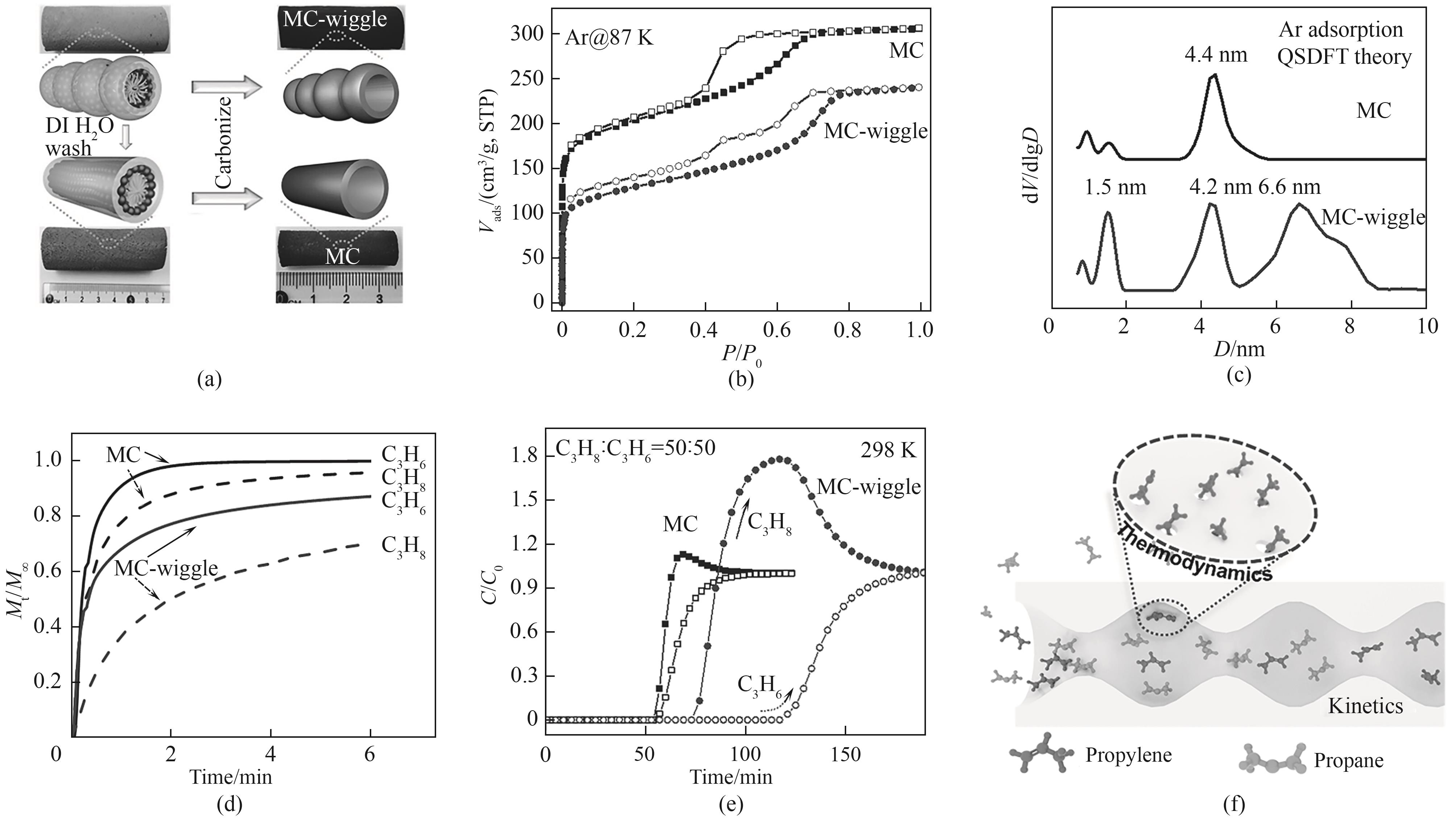
图11 (a) MC-wiggle 的合成示意图; (b) 87 K时的Ar吸附等温线及(c)相应的孔径分布; (d) 298 K时C3H6/C3H8 的时间分辨吸附曲线; (e) 在环境条件下,以 2 ml/min的流速对等摩尔C3H6/C3H8二元混合物的气体进料的穿透曲线; (f) C3H6/C3H8在摆动介孔中的选择性吸附示意图[98]
Fig.11 (a) Synthesis schematic of MC-wiggle; (b) Ar adsorption isotherms at 87 K and (c) corresponding pore size distributions; (d) Time-resolved adsorption profiles for C3H6/C3H8 at 298 K; (e) Breakthrough curves for gas feed of equimolar binary mixture of C3H6/C3H8 with a flow rate of 2 ml/min under ambient conditions; (f) Illustration of the proposed selective adsorption of C3H6/C3H8 in wiggling mesopores[98]
| 吸附剂 | 比表面积/ (m2/g) | 总孔容/ (cm3/g) | 微孔孔容/ (cm3/g) | 吸附量/(mmol/g) | 扩散速率/s-1 | 选择性 | 文献 | ||
|---|---|---|---|---|---|---|---|---|---|
| C3H6 | C3H8 | C3H6 | C3H8 | ||||||
| PDA-C800 | 375① | 0.19 | 1.98 | 0.054 | 7.57×10⁻³ | 36.7 | [ | ||
| SCMS-0.2-800 | 0.24 | 2.54 | 0.08 | 31.8 | [ | ||||
| SCMS-1-800 | 2.22 | 0.02 | 111.0 | ||||||
| WSCS | 19② | 0.18 | 1.72 | 0.17 | 2.68×10⁻³ | 6.26×10⁻⁵ | 10.1 | [ | |
| Carbon-0.2 | 680 | 0.18 | 2.14 | 0.54 | 5.2×10⁻³ | 1.1×10⁻⁴ | 4.0 | [ | |
| SUC-900 | 458 | 0.23 | 2.0 | 0.055 | 36.4 | [ | |||
| CMS-850 | 382 | 0.13 | 1.53③ | 0.66 | 2.3 | [ | |||
| CNP-3 | 3.03 | 1.86 | 9.6×10⁻³ | 8.8×10⁻⁴ | 1.6 | [ | |||
| SCS-800 | 0.18 | 2.0 | 0.25 | 1.34×10⁻⁴ | 1.18×10⁻⁶ | 8.0 | [ | ||
| MCC-micro | 479② | 0.22② | 0.16② | 2.4 | 1.1 | 1.26×10⁻² | 2.76×10⁻⁵ | 2.2 | [ |
| MC-wiggle | 413② | 2.6 | 1.5 | 4.2×10⁻³ | 2.1×10⁻⁴ | 1.7 | [ | ||
| C-CDMOF-2-700 | 371① | 0.19① | 1.97 | 0.13 | 3.15×10⁻³④ | 15.1 | [ | ||
| MFF_8 | 1.4 | 2.9 | 1.2×10⁻¹ | 1.4×10⁻¹ | 2.1 | [ | |||
表7 典型多孔炭吸附剂的理化性质和C3H6/C3H8吸附分离性能汇总
Table 7 Summary of the physicochemical properties and C3H6/C3H8 adsorption separation performances of typical porous carbon adsorbents
| 吸附剂 | 比表面积/ (m2/g) | 总孔容/ (cm3/g) | 微孔孔容/ (cm3/g) | 吸附量/(mmol/g) | 扩散速率/s-1 | 选择性 | 文献 | ||
|---|---|---|---|---|---|---|---|---|---|
| C3H6 | C3H8 | C3H6 | C3H8 | ||||||
| PDA-C800 | 375① | 0.19 | 1.98 | 0.054 | 7.57×10⁻³ | 36.7 | [ | ||
| SCMS-0.2-800 | 0.24 | 2.54 | 0.08 | 31.8 | [ | ||||
| SCMS-1-800 | 2.22 | 0.02 | 111.0 | ||||||
| WSCS | 19② | 0.18 | 1.72 | 0.17 | 2.68×10⁻³ | 6.26×10⁻⁵ | 10.1 | [ | |
| Carbon-0.2 | 680 | 0.18 | 2.14 | 0.54 | 5.2×10⁻³ | 1.1×10⁻⁴ | 4.0 | [ | |
| SUC-900 | 458 | 0.23 | 2.0 | 0.055 | 36.4 | [ | |||
| CMS-850 | 382 | 0.13 | 1.53③ | 0.66 | 2.3 | [ | |||
| CNP-3 | 3.03 | 1.86 | 9.6×10⁻³ | 8.8×10⁻⁴ | 1.6 | [ | |||
| SCS-800 | 0.18 | 2.0 | 0.25 | 1.34×10⁻⁴ | 1.18×10⁻⁶ | 8.0 | [ | ||
| MCC-micro | 479② | 0.22② | 0.16② | 2.4 | 1.1 | 1.26×10⁻² | 2.76×10⁻⁵ | 2.2 | [ |
| MC-wiggle | 413② | 2.6 | 1.5 | 4.2×10⁻³ | 2.1×10⁻⁴ | 1.7 | [ | ||
| C-CDMOF-2-700 | 371① | 0.19① | 1.97 | 0.13 | 3.15×10⁻³④ | 15.1 | [ | ||
| MFF_8 | 1.4 | 2.9 | 1.2×10⁻¹ | 1.4×10⁻¹ | 2.1 | [ | |||
| 1 | Fahim M A, Al-Sahhaf T A, Elkilani A. Fundamentals of Petroleum Refining[M]. UK: Elsevier, 2009. |
| 2 | Pines H. The Chemistry of Catalytic Hydrocarbon Conversions[M]. New York: Academic Press, 1981. |
| 3 | 王松汉. 乙烯工艺与技术[M]. 北京: 中国石化出版社, 2012. |
| Wang S H. Ethylene Process and Technology[M]. Beijing: China Petrochemical Press, 2012. | |
| 4 | Malek A, Farooq S. Hydrogen purification from refinery fuel gas by pressure swing adsorption[J]. AIChE Journal, 1998, 44(9): 1985-1992. |
| 5 | Qi G G, Fu L L, Giannelis E P. Sponges with covalently tethered amines for high-efficiency carbon capture[J]. Nature Communications, 2014, 5: 5796. |
| 6 | Ko D. Optimization of vacuum pressure swing adsorption processes to sequester carbon dioxide from coalbed methane[J]. Industrial & Engineering Chemistry Research, 2016, 55(33): 8967-8978. |
| 7 | Yaghi O M, Li G M, Li H L. Selective binding and removal of guests in a microporous metal-organic framework[J]. Nature, 1995, 378: 703-706. |
| 8 | Noro S I, Kitagawa S, Kondo M, et al. A new, methane adsorbent, porous coordination polymer [{CuSiF6(4,4'-bipyridine)2} n ][J]. Angewandte Chemie International Edition, 2000, 39(12): 2081-2084. |
| 9 | Ahmed A, Babarao R, Huang R H, et al. Porous aromatic frameworks impregnated with lithiated fullerenes for natural gas purification[J]. The Journal of Physical Chemistry C, 2015, 119(17): 9347-9354. |
| 10 | 王永飞, 华贲, 李亚军. 炼厂干气的综合利用研究[J]. 现代化工, 2008, 28(2): 69-71, 74. |
| Wang Y F, Hua B, Li Y J. Study on comprehensive utilization of refinery dry gas[J]. Modern Chemical Industry, 2008, 28(2): 69-71, 74. | |
| 11 | Sadrameli S M. Thermal/catalytic cracking of hydrocarbons for the production of olefins: a state-of-the-art review (Ⅰ): Thermal cracking review[J]. Fuel, 2015, 140: 102-115. |
| 12 | Wang Y Y, Chen J F, Pang X Q, et al. Faulting controls on oil and gas composition in the Yingmai 2 Oilfield, Tarim Basin, NW China[J]. Organic Geochemistry, 2018, 123: 48-66. |
| 13 | Zhang J H, Li L T, Qin Q. Effects of micropore structure of activated carbons on the CH4/N2 adsorption separation and the enrichment of coal-bed methane[J]. Clean Energy, 2021, 5(2): 329-338. |
| 14 | Yang X, Li Z Y, Zhang C Z, et al. Practical separation performance evaluation of coal mine methane upgrading with carbon molecular sieves[J]. Chemical Engineering Journal, 2019, 367: 295-303. |
| 15 | Dang W, Zhang J C, Tang X, et al. Investigation of gas content of organic-rich shale: a case study from Lower Permian shale in southern North China Basin, Central China[J]. Geoscience Frontiers, 2018, 9(2): 559-575. |
| 16 | Shi J T, Jia Y R, Zhang L L, et al. The generalized method for estimating reserves of shale gas and coalbed methane reservoirs based on material balance equation[J]. Petroleum Science, 2022, 19(6): 2867-2878. |
| 17 | Wang Y S, Zhang X J, Ba Y Q, et al. Recent advances in carbon-based adsorbents for adsorptive separation of light hydrocarbons[J]. Research, 2022, 2022: 9780864. |
| 18 | Zhang J C, Si L L, Chen J G, et al. Stimulation techniques of coalbed methane reservoirs[J]. Geofluids, 2020, 2020: 5152646. |
| 19 | Lan W J, Wang H X, Liu Q H, et al. Investigation on the microwave heating technology for coalbed methane recovery[J]. Energy, 2021, 237: 121450. |
| 20 | Yang Z X, Hussain M Z, Marín P, et al. Enrichment of low concentration methane: an overview of ventilation air methane[J]. Journal of Materials Chemistry A, 2022, 10(12): 6397-6413. |
| 21 | Zhong D L, Wang W C, Zou Z L, et al. Investigation on methane recovery from low-concentration coal mine gas by tetra-n-butyl ammonium chloride semiclathrate hydrate formation[J]. Applied Energy, 2018, 227: 686-693. |
| 22 | Yang J F, Bai H H, Shang H, et al. Experimental and simulation study on efficient CH4/N2 separation by pressure swing adsorption on silicalite-1 pellets[J]. Chemical Engineering Journal, 2020, 388: 124222. |
| 23 | Li J R, Kuppler R J, Zhou H C. Selective gas adsorption and separation in metal-organic frameworks[J]. Chemical Society Reviews, 2009, 38(5): 1477-1504. |
| 24 | Feng Y Y, Yang W, Wang N, et al. Effect of nitrogen-containing groups on methane adsorption behaviors of carbon spheres[J]. Journal of Analytical and Applied Pyrolysis, 2014, 107: 204-210. |
| 25 | Zhang L, Dong Y G, Zhang D, et al. Facile preparation of nitrogen-doped microporous carbon from potassium citrate/urea for effective CH4 separation and uptake[J]. Fuel, 2023, 351: 128915. |
| 26 | Yao K X, Chen Y L, Lu Y, et al. Ultramicroporous carbon with extremely narrow pore distribution and very high nitrogen doping for efficient methane mixture gases upgrading[J]. Carbon, 2017, 122: 258-265. |
| 27 | Tang R L, Dai Q B, Liang W W, et al. Synthesis of novel particle rice-based carbon materials and its excellent CH4/N2 adsorption selectivity for methane enrichment from low-rank natural gas[J]. Chemical Engineering Journal, 2020, 384: 123388. |
| 28 | Liu F, Zhang Y, Zhang P X, et al. Facile preparation of N and O-rich porous carbon from palm sheath for highly selective separation of CO2/CH4/N2 gas-mixture[J]. Chemical Engineering Journal, 2020, 399: 125812. |
| 29 | Wang S M, Wu P C, Fu J W, et al. Heteroatom-doped porous carbon microspheres with ultramicropores for efficient CH4/N2 separation with ultra-high CH4 uptake[J]. Separation and Purification Technology, 2021, 274: 119121. |
| 30 | Li S H, Fu S G, Gong Y Q, et al. New insight into efficient CH4/N2 separation based on Ni-decorated porous carbon functional composites[J]. Fuel, 2023, 347: 128480. |
| 31 | Zheng Y N, Li Q Z, Yuan C C, et al. Influence of temperature on adsorption selectivity: coal-based activated carbon for CH4 enrichment from coal mine methane[J]. Powder Technology, 2019, 347: 42-49. |
| 32 | Liu J Q, Shang H, Yang J F, et al. Novel zeolite/carbon monolith adsorbents for efficient CH4/N2 separation[J]. Chemical Engineering Journal, 2021, 426: 130163. |
| 33 | Steel K M, Koros W J. Investigation of porosity of carbon materials and related effects on gas separation properties[J]. Carbon, 2003, 41(2): 253-266. |
| 34 | Cui X J, Bustin R M, Dipple G. Selective transport of CO2, CH4, and N2 in coals: insights from modeling of experimental gas adsorption data[J]. Fuel, 2004, 83(3): 293-303. |
| 35 | Zhao G F, Bai P, Zhu H M, et al. The modification of activated carbons and the pore structure effect on enrichment of coal-bed methane[J]. Asia-Pacific Journal of Chemical Engineering, 2008, 3(3): 284-291. |
| 36 | Cai Y D, Liu D M, Pan Z J, et al. Pore structure and its impact on CH4 adsorption capacity and flow capability of bituminous and subbituminous coals from Northeast China[J]. Fuel, 2013, 103: 258-268. |
| 37 | Liu C M, Dang Y Y, Zhou Y P, et al. Effect of carbon pore structure on the CH4/N2 separation[J]. Adsorption, 2012, 18(3): 321-325. |
| 38 | Chen F Q, Zhang Z G, Yang Q W, et al. Microporous carbon adsorbents prepared by activating reagent-free pyrolysis for upgrading low-quality natural gas[J]. ACS Sustainable Chemistry & Engineering, 2020, 8(2): |
| 39 | Dong Z, Li B, Shang H, et al. Ultramicroporous carbon granules with narrow pore size distribution for efficient CH4 separation from coal-bed gases[J]. AIChE Journal, 2021, 67(9): e17281. |
| 40 | Zhang P X, Wang J, Fan W, et al. Ultramicroporous carbons with extremely narrow pore size distribution via in situ ionic activation for efficient gas-mixture separation[J]. Chemical Engineering Journal, 2019, 375: 121931. |
| 41 | Liu F X, Lin Q, Fu C B, et al. Alkaline KMnO4 solution pretreat hydrochar to prepare high ultra-micropore volume carbon for CH4 enrichment from low-concentration coalbed methane[J]. Fuel, 2021, 303: 121301. |
| 42 | 马东祝. 煤矿乏风瓦斯变压吸附分离吸附剂的研究[D]. 北京: 北京工业大学, 2013. |
| Ma D Z. Study on adsorbent for pressure swing adsorption separation of coal mine ventilation [D]. Beijing: Beijing University of Technology, 2013. | |
| 43 | Krishna R. Methodologies for evaluation of metal-organic frameworks in separation applications[J]. RSC Advances, 2015, 5(64): 52269-52295. |
| 44 | Zhang J H, Qu S J, Li L T, et al. Preparation of carbon molecular sieves used for CH4/N2 separation[J]. Journal of Chemical & Engineering Data, 2018, 63(5): 1737-1744. |
| 45 | Grande C A, Cavenati S, Da Silva F A, et al. Carbon molecular sieves for hydrocarbon separations by adsorption[J]. Industrial & Engineering Chemistry Research, 2005, 44(18): 7218-7227. |
| 46 | Wang S, Cheng F, Zhang P, et al. Fabrication of high-pore volume carbon nanosheets with uniform arrangement of mesopores[J]. Nano Research, 2017, 10(6): 2106-2116. |
| 47 | Hao G P, Jin Z Y, Sun Q, et al. Porous carbon nanosheets with precisely tunable thickness and selective CO2 adsorption properties[J]. Energy & Environmental Science, 2013, 6(12): 3740-3747. |
| 48 | Guo L P, Li W C, Qiu B, et al. Interfacial assembled preparation of porous carbon composites for selective CO2 capture at elevated temperatures[J]. Journal of Materials Chemistry A, 2019, 7(10): 5402-5408. |
| 49 | Jin Z Y, Xu Y Y, Sun Q, et al. Evidence of microporous carbon nanosheets showing fast kinetics in both gas phase and liquid phase environments[J]. Small, 2015, 11(38): 5151-5156. |
| 50 | Xu S, Li W C, Wang C T, et al. Self-pillared ultramicroporous carbon nanoplates for selective separation of CH4/N2 [J]. Angewandte Chemie International Edition, 2021, 60(12): 6339-6343. |
| 51 | Rainone F, D'Agostino O, Erto A, et al. Biogas upgrading by adsorption onto activated carbon and carbon molecular sieves: experimental and modelling study in binary CO2/CH4 mixture[J]. Journal of Environmental Chemical Engineering, 2021, 9(5): 106256. |
| 52 | Santos M P S, Grande C A, Rodrigues A E. Pressure swing adsorption for biogas upgrading. Effect of recycling streams in pressure swing adsorption design[J]. Industrial & Engineering Chemistry Research, 2011, 50(2): 974-985. |
| 53 | Yang F Q, Wang J, Liu L, et al. Synthesis of porous carbons with high N-content from shrimp shells for efficient CO2-capture and gas separation[J]. ACS Sustainable Chemistry & Engineering, 2018, 6(11): 15550-15559. |
| 54 | Zhang M, Liu L, He T, et al. Molten salt assisted pyrolysis approach for the synthesis of nitrogen-rich microporous carbon nanosheets and its application as gas capture sorbent[J]. Microporous and Mesoporous Materials, 2020, 300: 110177. |
| 55 | Zhang P X, Zhong Y, Ding J, et al. A new choice of polymer precursor for solvent-free method: preparation of N-enriched porous carbons for highly selective CO2 capture[J]. Chemical Engineering Journal, 2019, 355: 963-973. |
| 56 | Li Y, Liu N, Zhang T, et al. Highly microporous nitrogen-doped carbons from anthracite for effective CO2 capture and CO2/CH4 separation[J]. Energy, 2020, 211: 118561. |
| 57 | Furmaniak S, Kowalczyk P, Terzyk A P, et al. Synergetic effect of carbon nanopore size and surface oxidation on CO2 capture from CO2/CH4 mixtures[J]. Journal of Colloid and Interface Science, 2013, 397: |
| 58 | Su W, Yao L, Ran M, et al. Adsorption properties of N2, CH4, and CO2 on sulfur-doped microporous carbons[J]. Journal of Chemical & Engineering Data, 2018, 63(8): 2914-2920. |
| 59 | Saha D, Orkoulas G, Chen J H, et al. Adsorptive separation of CO2 in sulfur-doped nanoporous carbons: selectivity and breakthrough simulation[J]. Microporous and Mesoporous Materials, 2017, 241: 226-237. |
| 60 | Park J, Attia N F, Jung M, et al. Sustainable nanoporous carbon for CO2, CH4, N2, H2 adsorption and CO2/CH4 and CO2/N2 separation[J]. Energy, 2018, 158: 9-16. |
| 61 | Cheng J, Liu N, Wang Y L, et al. Nitrogen-doped microporous carbon material decorated with metal nanoparticles derived from solid Zn/Co zeolitic imidazolate framework with high selectivity for CO2 separation[J]. Fuel, 2020, 265: 116972. |
| 62 | Kapoor A, Yang R T. Kinetic separation of methane-carbon dioxide mixture by adsorption on molecular sieve carbon[J]. Chemical Engineering Science, 1989, 44(8): 1723-1733. |
| 63 | Rocha L A M, Andreassen K A, Grande C A. Separation of CO2/CH4 using carbon molecular sieve (CMS) at low and high pressure[J]. Chemical Engineering Science, 2017, 164: 148-157. |
| 64 | Mestre A S, Freire C, Pires J, et al. High performance microspherical activated carbons for methane storage and landfill gas or biogas upgrade[J]. Journal of Materials Chemistry A, 2014, 2(37): 15337-15344. |
| 65 | Matranga K R, Myers A L, Glandt E D. Storage of natural gas by adsorption on activated carbon[J]. Chemical Engineering Science, 1992, 47(7): 1569-1579. |
| 66 | Wang X J, Yuan B Q, Zhou X, et al. Novel glucose-based adsorbents (Glc-Cs) with high CO2 capacity and excellent CO2/CH4/N2 adsorption selectivity[J]. Chemical Engineering Journal, 2017, 327: 51-59. |
| 67 | Grancha T, Mon M, Ferrando-Soria J, et al. Tuning the selectivity of light hydrocarbons in natural gas in a family of isoreticular MOFs[J]. Journal of Materials Chemistry A, 2017, 5(22): 11032-11039. |
| 68 | Russell B P, LeVan M D. Coadsorption of organic compounds and water vapor on BPL activated carbon. 3. Ethane, propane, and mixing rules[J]. Industrial & Engineering Chemistry Research, 1997, 36(6): 2380-2389. |
| 69 | Xue D, Chen Z X, Lu C G. Establishment of the comprehensive material balance equation for coalbed methane reservoirs at the gas desorption stage[J]. Fuel, 2022, 326: 124979. |
| 70 | He Y F, Yun J H, Seaton N A. Adsorption equilibrium of binary methane/ethane mixtures in BPL activated carbon: isotherms and calorimetric heats of adsorption[J]. Langmuir, 2004, 20(16): 6668-6678. |
| 71 | Holland C E, Al-Muhtaseb S A, Ritter J A. Adsorption of C1-C7 normal alkanes on BAX activated carbon (1): Potential theory correlation and adsorbent characterization[J]. Industrial & Engineering Chemistry Research, 2001, 40(1): 338-346. |
| 72 | Liang W W, Xiao H Y, Lv D F, et al. Novel asphalt-based carbon adsorbents with super-high adsorption capacity and excellent selectivity for separation for light hydrocarbons[J]. Separation and Purification Technology, 2018, 190: 60-67. |
| 73 | Ke Z F, Xiao H Y, Wen Y J, et al. Adsorption property of starch-based microporous carbon materials with high selectivity and uptake for C1/C2/C3 separation[J]. Industrial & Engineering Chemistry Research, 2021, 60(12): 4668-4676. |
| 74 | Chen F Q, Guo K Q, Huang X L, et al. Extraction of propane and ethane from natural gas on ultramicroporous carbon adsorbent with record selectivity[J]. Science China Materials, 2023, 66(1): 319-326. |
| 75 | Xue Q Z, Li X F, Chang X, et al. S-graphite slit pore: a superior selective adsorbent for light hydrocarbons[J]. Applied Surface Science, 2018, 444: 772-779. |
| 76 | Ma X C, Chen R F, Zhou K, et al. Activated porous carbon with an ultrahigh surface area derived from waste biomass for acetone adsorption, CO2 capture, and light hydrocarbon separation[J]. ACS Sustainable Chemistry & Engineering, 2020, 8(31): 11721-11728. |
| 77 | Ma X C, Fang M, Liu B G, et al. Urea-assisted synthesis of biomass-based hierarchical porous carbons for the light hydrocarbons adsorption and separation[J]. Chemical Engineering Journal, 2022, 428: 130985. |
| 78 | Zhang L H, Li W C, Liu H, et al. Thermoregulated phase-transition synthesis of two-dimensional carbon nanoplates rich in sp2 carbon and unimodal ultramicropores for kinetic gas separation[J]. Angewandte Chemie International Edition, 2018, 57(6): 1632-1635. |
| 79 | Ma X C, Liu B G, Wu Q D, et al. Specific Li+ sites in a nanoporous carbon for enhanced light hydrocarbons storage and separation: GCMC and DFT simulations[J]. Fuel, 2021, 288: 119647. |
| 80 | Du S J, Huang J W, Ryder M R, et al. Probing sub-5 Ångstrom micropores in carbon for precise light olefin/paraffin separation[J]. Nature Communications, 2023, 14(1): 1197. |
| 81 | Huang B L, Zhu L, Du Z L, et al. Highly efficient ethylene/ethane separation via molecular sieving using chitosan-derived ultramicroporous carbon[J]. Separation and Purification Technology, 2024, 333: 125862. |
| 82 | Liu R S, Wang M, Li W C, et al. Balancing the kinetic and thermodynamic synergetic effect of doped carbon molecular sieves for selective separation of C2H4/C2H6 [J]. Small, 2024, 20(38): e2401965. |
| 83 | Wang Y S, Li T Y, Song Y H, et al. Stepwise tuning carbon slits at sub-angstrom scale for dynamical separation of hydrogen isotope[J]. Separation and Purification Technology, 2025, 354: 129130. |
| 84 | Jiang W J, Sun L B, Yin Y, et al. Ordered mesoporous carbon CMK-3 modified with Cu(Ⅰ) for selective ethylene/ethane adsorption[J]. Separation Science and Technology, 2013, 48(6): 968-976. |
| 85 | Gao F, Wang Y Q, Wang X, et al. Ethylene/ethane separation by CuCl/AC adsorbent prepared using CuCl2 as a precursor[J]. Adsorption, 2016, 22(7): 1013-1022. |
| 86 | Liang W W, Wu Y, Xiao H Y, et al. Ethane-selective carbon composites CPDA@A-ACs with high uptake and its enhanced ethane/ethylene adsorption selectivity[J]. AIChE Journal, 2018, 64(9): 3390-3399. |
| 87 | Wang X J, Wu Y, Peng J J, et al. Novel glucosamine-based carbon adsorbents with high capacity and its enhanced mechanism of preferential adsorption of C2H6 over C2H4 [J]. Chemical Engineering Journal, 2019, 358: 1114-1125. |
| 88 | Wang X J, Wu Y, Zhou X, et al. Novel C-PDA adsorbents with high uptake and preferential adsorption of ethane over ethylene[J]. Chemical Engineering Science, 2016, 155: 338-347. |
| 89 | Lee S K, Park H, Yoon J W, et al. Microporous 3D graphene-like zeolite-templated carbons for preferential adsorption of ethane[J]. ACS Applied Materials & Interfaces, 2020, 12(25): 28484-28495. |
| 90 | Du S J, Huang J W, Anjum A W, et al. A novel mechanism of controlling ultramicropore size in carbons at sub-angstrom level for molecular sieving of propylene/propane mixtures[J]. Journal of Materials Chemistry A, 2021, 9(42): 23873-23881. |
| 91 | Wang C T, Li W C, Xu S, et al. Wood frame structured carbons with integrated sieving layer for propylene/propane separation[J]. Chemical Engineering Journal, 2023, 477: 146891. |
| 92 | Wang C T, Li W C, Wang M, et al. Wood-structured carbon with reassembled pores showing high propylene adsorption rate for efficient separation of propylene/propane[J]. Separation and Purification Technology, 2025, 354: 128649. |
| 93 | Du S J, Guo M L, Zhou D H, et al. Influence of structural domain evolution in carbon materials on the selective separation of alkenes from alkanes[J]. ACS Sustainable Chemistry & Engineering, 2024, 12(26): 9758-9765. |
| 94 | Liu J Q, Liu Y J, Kayrak Talay D, et al. A new carbon molecular sieve for propylene/propane separations[J]. Carbon, 2015, 85: 201-211. |
| 95 | Xu S, Li W C, Wang C T, et al. Beyond the selectivity-capacity trade-off: ultrathin carbon nanoplates with easily accessible ultramicropores for high-efficiency propylene/propane separation[J]. Nano Letters, 2022, 22(16): 6615-6621. |
| 96 | Guo L P, Liu R S, Qian J H, et al. Surface sieving carbon skins for propylene and propane separation[J]. Nature Chemical Engineering, 2024, 1: 411-420. |
| 97 | Wang Y S, Li T Y, Ba Y Q, et al. “Mortar-and-cobblestone” type carbon pellets with interlinked C3H6-philic domains and mesoporous transport channels for propylene/propane separation[J]. Separation and Purification Technology, 2023, 305: 122436. |
| 98 | Yuan Y F, Wang Y S, Zhang X L, et al. Wiggling mesopores kinetically amplify the adsorptive separation of propylene/propane[J]. Angewandte Chemie International Edition, 2021, 60(35): 19063-19067. |
| 99 | Dang S, Zhu Q L, Xu Q. Nanomaterials derived from metal-organic frameworks[J]. Nature Reviews Materials, 2017, 3: 17075. |
| 100 | 姚显芳, 李映伟. MOFs作为牺牲模板制备纳米多孔炭材料的方法及其应用[J]. 科学通报, 2015, 60(20): 1906-1914. |
| Yao X F, Li Y W. Method for preparing nanoporouss carbon materials using MOFs as sacrificial templates and its applications[J]. Chinese Science Bulletin, 2015, 60(20): 1906-1914. | |
| 101 | Li B Y, Belmabkhout Y, Zhang Y M, et al. From an equilibrium based MOF adsorbent to a kinetic selective carbon molecular sieve for paraffin/iso-paraffin separation[J]. Chemical Communications, 2016, 52(96): 13897-13900. |
| 102 | Chen F Q, Ding J Q, Guo K Q, et al. CoNi alloy nanoparticles embedded in metal-organic framework-derived carbon for the highly efficient separation of xenon and krypton via a charge-transfer effect[J]. Angewandte Chemie International Edition, 2021, 60(5): 2431-2438. |
| 103 | Chen F Q, Huang X L, Guo K Q, et al. Molecular sieving of propylene from propane in metal-organic framework-derived ultramicroporous carbon adsorbents[J]. ACS Applied Materials & Interfaces, 2022, 14(26): 30443-30453. |
| 104 | Li X Y, Liu J Q, Zhou K, et al. Tuning metal-organic framework (MOF) topology by regulating ligand and secondary building unit (SBU) geometry: structures built on 8-connected M6 (M = Zr, Y) clusters and a flexible tetracarboxylate for propane-selective propane/propylene separation[J]. Journal of the American Chemical Society, 2022, 144(47): 21702-21709. |
| 105 | Gong W, Xie Y, Yamano A, et al. Rational design and reticulation of infinite qbe rod secondary building units into metal-organic frameworks through a global desymmetrization approach for inverse C3H8/C3H6 separation[J]. Angewandte Chemie International Edition, 2024, 63(5): e202318475. |
| 106 | Andrade M, Parnell A J, Bernardo G, et al. Propane selective carbon adsorbents from phenolic resin precursor[J]. Microporous and Mesoporous Materials, 2021, 320: 111071. |
| [1] | 何燎, 李俊, 高梦舒, 刘东阳, 张宇豪, 赵亮, 高金森, 徐春明. 石油烃中芳烃分离技术研究进展[J]. 化工学报, 2025, 76(5): 1909-1926. |
| [2] | 徐泽海, 刘超, 张国亮. 聚合物基疏水渗透汽化膜及其溶剂回收应用[J]. 化工学报, 2025, 76(5): 2055-2069. |
| [3] | 徐智超, 俞镇东, 吴昊峰, 吴沛文, 武洪翔, 巢艳红, 朱文帅, 刘植昌, 徐春明. 富酸位13X分子筛的制备及其超深度吸附脱除生物柴油中硫醇[J]. 化工学报, 2025, 76(5): 2198-2208. |
| [4] | 郭彭涛, 王婷, 薛波, 应允攀, 刘大欢. 用于CH4/N2分离的多吸附位点超微孔MOF[J]. 化工学报, 2025, 76(5): 2304-2312. |
| [5] | 唐磊, 王振菲, 李聪利, 杨佳辉, 郑浩, 石琪, 董晋湘. Co-MOF-74和Mg-MOF-74的CO工作吸附容量及操作条件[J]. 化工学报, 2025, 76(5): 2279-2293. |
| [6] | 李紫鹃, 谭晓艳, 吴永盛, 杨陈怡, 陈红, 毕小刚, 刘捷, 喻发全. 分子模拟研究三维扭曲催化芳烃-降冰片烯环化聚合物膜的CO2/N2分离机理[J]. 化工学报, 2025, 76(5): 2348-2357. |
| [7] | 花敬贤, 罗宇荣, 顾亚伟, 吴婷婷, 潘宜昌, 邢卫红. 超薄取向ZIF-8膜的制备及乙烯/乙烷高效分离[J]. 化工学报, 2025, 76(5): 2209-2218. |
| [8] | 李艳, 雷美丽, 李鑫钢. 基于分离性能的顺序式模拟移动床结构调控策略[J]. 化工学报, 2025, 76(5): 2219-2229. |
| [9] | 谈朋, 李雪梅, 刘晓勤, 孙林兵. 基于柔性MOFs的磁响应复合材料及其丙烯吸附性能研究[J]. 化工学报, 2025, 76(5): 2230-2240. |
| [10] | 向昕辰, 鲁丹, 赵影, 姚之侃, 寇瑞强, 郑丹军, 周志军, 张林. 聚酰胺纳滤膜表面季铵化提高荷正电性及其锂镁分离性能[J]. 化工学报, 2025, 76(5): 2377-2386. |
| [11] | 马瑞洁, 黄子轩, 关雪倩, 陈光进, 刘蓓. ZIF-8/DMPU浆液分离C2H6/ CH4混合气研究[J]. 化工学报, 2025, 76(5): 2262-2269. |
| [12] | 高冰冰, 许诺, 白云翔, 张春芳, 杨永强, 董亮亮. 氦气分离聚合物膜[J]. 化工学报, 2025, 76(5): 2119-2135. |
| [13] | 李家顺, 李旺, 秦祖赠, 苏通明, 谢新玲, 纪红兵. 聚酰亚胺增强木质纤维素纳米纤丝气凝胶制备及其油水分离性能研究[J]. 化工学报, 2025, 76(5): 2169-2185. |
| [14] | 胡嘉朗, 姜明源, 金律铭, 张永刚, 胡鹏, 纪红兵. 机器学习辅助MOFs高通量计算筛选及气体分离研究进展[J]. 化工学报, 2025, 76(5): 1973-1996. |
| [15] | 顾栋, 皮行健, 张叠, 张瑛. 不同粒径CAU-1/PI混合基质膜的构建与H2/CO2分离性能研究[J]. 化工学报, 2025, 76(5): 2410-2418. |
| 阅读次数 | ||||||
|
全文 |
|
|||||
|
摘要 |
|
|||||
 京公网安备 11010102001995号