化工学报 ›› 2020, Vol. 71 ›› Issue (2): 669-679.DOI: 10.11949/0438-1157.20190857
邢瑞( ),江南,刘冰,安亚雄,汪亚燕,张东辉()
收稿日期:2019-07-25
修回日期:2019-12-24
出版日期:2020-02-05
发布日期:2020-02-05
通讯作者:
张东辉
作者简介:邢瑞(1995—),男,硕士研究生, 基金资助:
Rui XING(),Nan JIANG,Bing LIU,Yaxiong AN,Yayan WANG,Donghui ZHANG()
Received:2019-07-25
Revised:2019-12-24
Online:2020-02-05
Published:2020-02-05
Contact:
Donghui ZHANG
摘要:
针对真空变压吸附制氧在gPROMS软件中建立了严格的数学模型,基于LiLSX吸附剂设计了两塔八步的真空变压吸附流程生产纯度为92%的O 2。对此流程进行优化,其纯度和回收率有了明显的改进。在此基础上,引入实际生产中经常存在的如进料流量的变化以及吸附性能降低等扰动因素,使模拟工作更接近实际。根据产品气中O 2纯度的反馈,采用模型辨识技术设计了MPC控制器,用于预测控制VPSA过程的动态行为。开环和闭环控制结果的对比显示,流程在设计的MPC控制下展现出更好的结果,这表明MPC控制策略可以明显改善空气分离制氧的生产过程。
中图分类号:
邢瑞, 江南, 刘冰, 安亚雄, 汪亚燕, 张东辉. 基于MPC控制技术优化VPSA制氧工艺的模拟[J]. 化工学报, 2020, 71(2): 669-679.
Rui XING, Nan JIANG, Bing LIU, Yaxiong AN, Yayan WANG, Donghui ZHANG. Simulation of oxygen production via VPSA optimized based on MPC control strategy[J]. CIESC Journal, 2020, 71(2): 669-679.
| Parameter | N 2 | O 2 | Ar |
|---|---|---|---|
| IP 1/(kmol·kg -1·Pa -1) | 7.107×10 -10 | 6.861×10 -9 | 6.254×10 -9 |
| IP 2/K | 2910 | 1567 | 1334 |
| IP 3/Pa -1 | 2.563×10 -8 | 4.625×10 -8 | 4.374×10 -8 |
| IP 4/K | 1612 | 441.3 | 450.6 |
| Δ H/(kJ·mol -1) | -23.43 | -13.22 | -12.65 |
表1 扩展Langmuir模型的拟合参数
Table 1 Fitting parameters of extended Langmuir model
| Parameter | N 2 | O 2 | Ar |
|---|---|---|---|
| IP 1/(kmol·kg -1·Pa -1) | 7.107×10 -10 | 6.861×10 -9 | 6.254×10 -9 |
| IP 2/K | 2910 | 1567 | 1334 |
| IP 3/Pa -1 | 2.563×10 -8 | 4.625×10 -8 | 4.374×10 -8 |
| IP 4/K | 1612 | 441.3 | 450.6 |
| Δ H/(kJ·mol -1) | -23.43 | -13.22 | -12.65 |
| Parameter | Value |
|---|---|
| Tfeed/K | 298 |
| c pg/(kJ·kg -1·K -1) | 1.03 |
| c ps/(kJ·kg -1·K -1) | 1.21 |
| Rp/m | 8.5×10 -4 |
| 1.30×10 -4 | |
| 1.29×10 -4 | |
| D, v, Ar/(m 2·s -1) | 1.24×10 -4 |
| h/(W·m -2·K -1) | 0.3 |
| kg/(W·m -1·K -1) | 0.02452 |
| ks/(W·m -1·K -1) | 0.48 |
表2 传质传热模型参数
Table 2 Mass and heat transfer parameters
| Parameter | Value |
|---|---|
| Tfeed/K | 298 |
| c pg/(kJ·kg -1·K -1) | 1.03 |
| c ps/(kJ·kg -1·K -1) | 1.21 |
| Rp/m | 8.5×10 -4 |
| 1.30×10 -4 | |
| 1.29×10 -4 | |
| D, v, Ar/(m 2·s -1) | 1.24×10 -4 |
| h/(W·m -2·K -1) | 0.3 |
| kg/(W·m -1·K -1) | 0.02452 |
| ks/(W·m -1·K -1) | 0.48 |
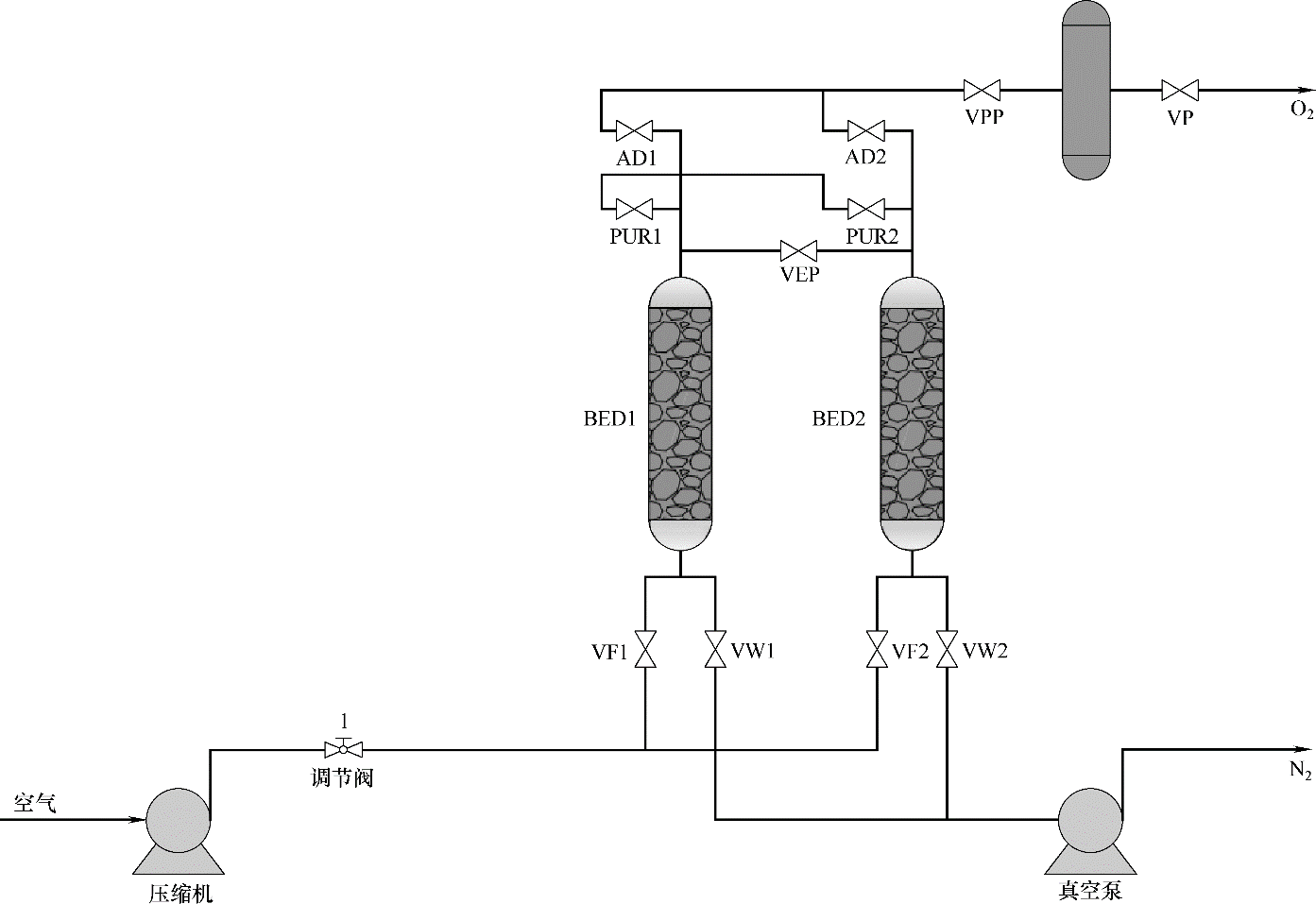
图1 两塔-八步VPSA模拟过程
Fig.1 Simulation of two-bed, eight-step VPSA process
| 时间 /s | BED1 | BED2 |
|---|---|---|
| 6 | AD 1 | VU 2 |
| 3 | AD 2 | PUR |
| 3 | ED | ER |
| 10 | VU 1 | FR |
| 6 | VU 2 | AD 1 |
| 3 | PUR | AD 2 |
| 3 | ER | ED |
| 10 | FR | VU 1 |
表3 VPSA流程的时序
Table 3 Schedule of VPSA process
| 时间 /s | BED1 | BED2 |
|---|---|---|
| 6 | AD 1 | VU 2 |
| 3 | AD 2 | PUR |
| 3 | ED | ER |
| 10 | VU 1 | FR |
| 6 | VU 2 | AD 1 |
| 3 | PUR | AD 2 |
| 3 | ER | ED |
| 10 | FR | VU 1 |

图2 各循环步骤操作示意图
Fig.2 Schematic diagram of cycle sequence
| 方程 | 方程表达式 |
|---|---|
| 组分质量方程 | |
| 总质量方程 | |
| 能量衡算方程 | |
| 动量方程 | |
| Langmuir 吸附等温方程 | |
| 线性推动力方程 | |
| 扩散系数 | |
| 边界条件 | |
| 阀门方程 |
表4 VPSA过程模型方程
Table 4 Model equations of VPSA process
| 方程 | 方程表达式 |
|---|---|
| 组分质量方程 | |
| 总质量方程 | |
| 能量衡算方程 | |
| 动量方程 | |
| Langmuir 吸附等温方程 | |
| 线性推动力方程 | |
| 扩散系数 | |
| 边界条件 | |
| 阀门方程 |
| 变量 | 初始值 | 下限值 | 上限值 | 优化值 |
|---|---|---|---|---|
| 决策变量 | ||||
| 进料流量/(m 3·h -1) | 3.0 | 1.0 | 15.0 | 4.2 |
| 终升压流量/(m 3·h -1) | 4.8 | 1.0 | 15.0 | 6.0 |
| 抽真空流量/(m 3·h -1) | 7.2 | 1.0 | 30.0 | 18.6 |
| 吸附出口阀门开度/(mol·(bar·s) -1) | 0.2 | 0.01 | 100.0 | 0.97 |
| 均压步骤阀门开度/(mol·(bar·s) -1) | 0.2 | 0.01 | 10.0 | 0.86 |
| 冲洗步骤阀门开度/(mol·(bar·s) -1) | 0.2 | 0.01 | 30.0 | 2.6 |
| 优化目标 | ||||
| 纯度/% | 90.2 | 92 | 100 | 92.03 |
| 回收率/% | 58.7 | 60 | 100 | 60.5 |
| 能耗/(kW·h·m -3) | 0.42 | 0.31 | ||
表5 决策变量与优化目标的上限值、下限值、初始值以及最佳值
Table 5 Upper and lower bounds, initial and optimal value of decision variables and optimization objectives
| 变量 | 初始值 | 下限值 | 上限值 | 优化值 |
|---|---|---|---|---|
| 决策变量 | ||||
| 进料流量/(m 3·h -1) | 3.0 | 1.0 | 15.0 | 4.2 |
| 终升压流量/(m 3·h -1) | 4.8 | 1.0 | 15.0 | 6.0 |
| 抽真空流量/(m 3·h -1) | 7.2 | 1.0 | 30.0 | 18.6 |
| 吸附出口阀门开度/(mol·(bar·s) -1) | 0.2 | 0.01 | 100.0 | 0.97 |
| 均压步骤阀门开度/(mol·(bar·s) -1) | 0.2 | 0.01 | 10.0 | 0.86 |
| 冲洗步骤阀门开度/(mol·(bar·s) -1) | 0.2 | 0.01 | 30.0 | 2.6 |
| 优化目标 | ||||
| 纯度/% | 90.2 | 92 | 100 | 92.03 |
| 回收率/% | 58.7 | 60 | 100 | 60.5 |
| 能耗/(kW·h·m -3) | 0.42 | 0.31 | ||
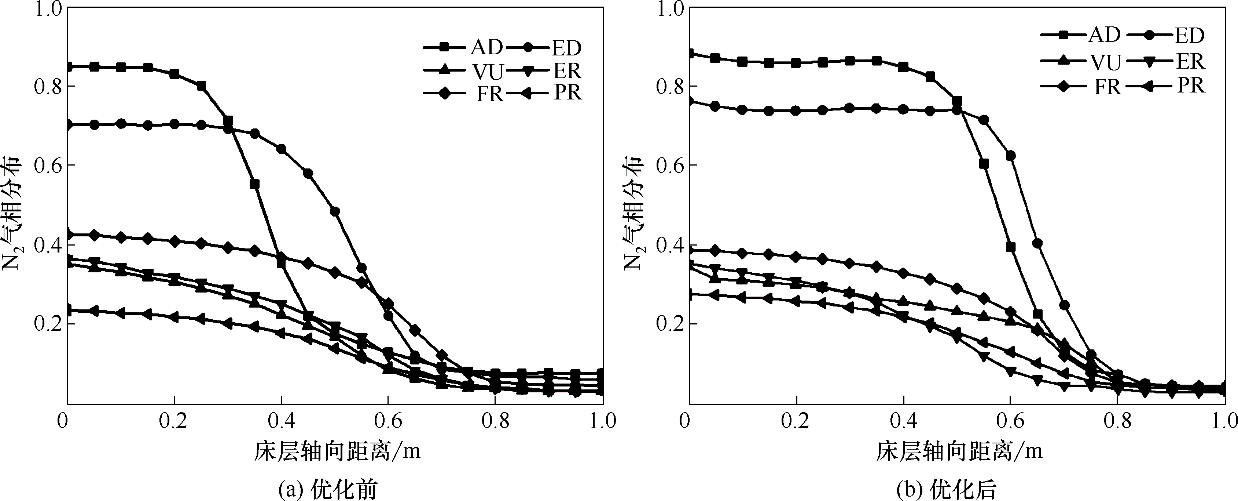
图3 N 2轴向气相分布优化前后对比
Fig.3 Comparison of N 2 axial gas phase distribution before and after optimization
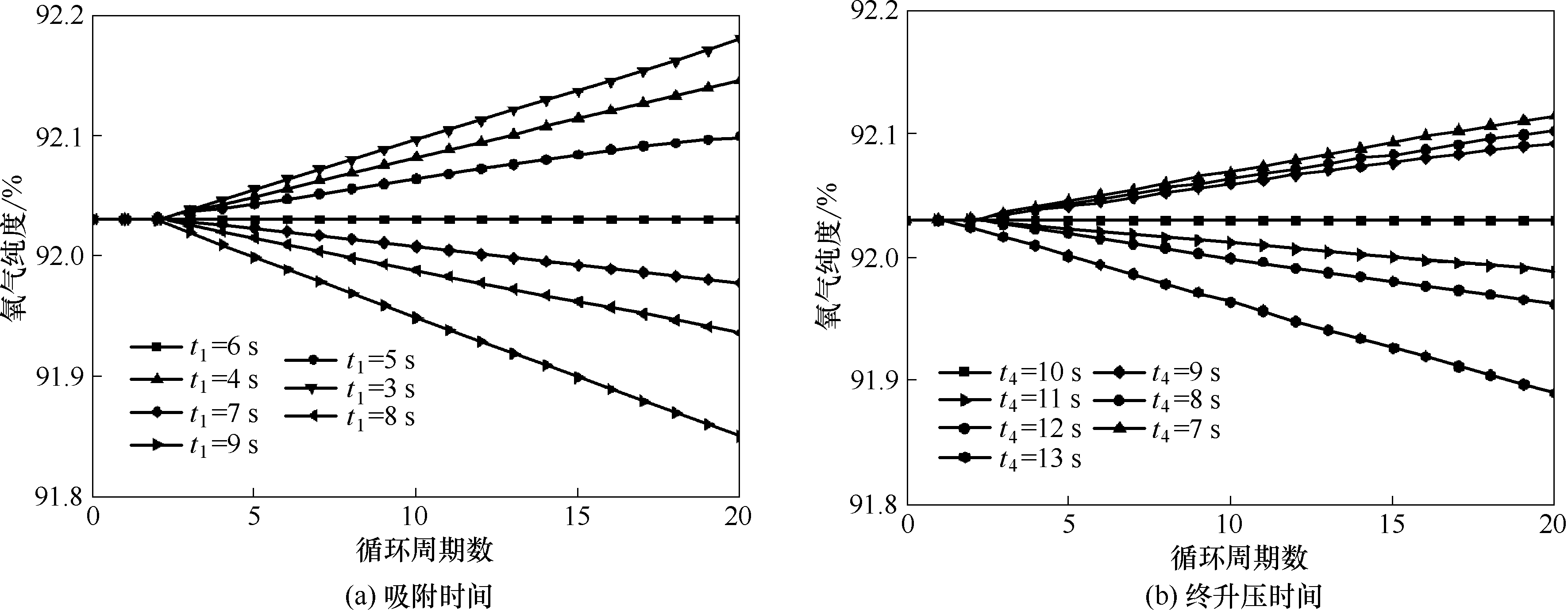
图4 吸附时间(a)和终升压时间(b)的改变对纯度的影响
Fig.4 Influence of adsorption time (a) and pressurization time (b) on purity
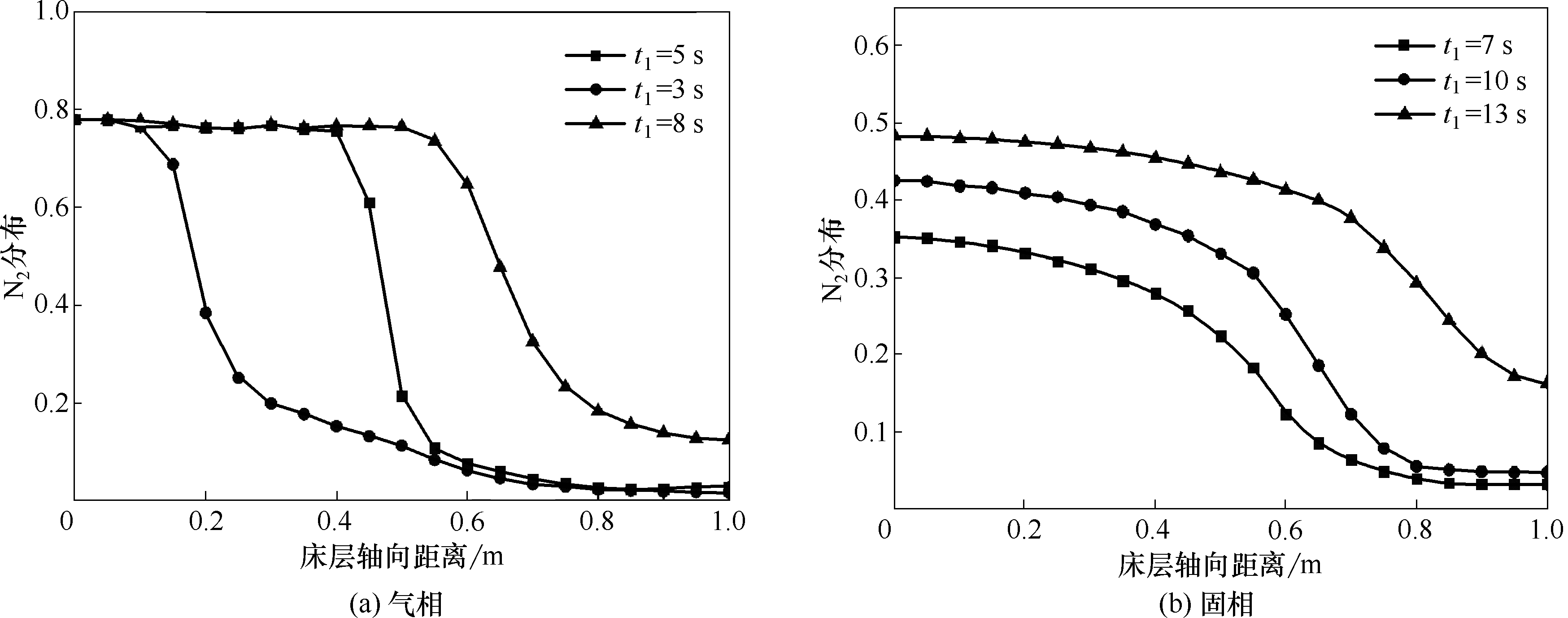
图5 吸附步骤和终升压步骤结束时塔内N 2气固相分布
Fig.5 N 2 gas and solid phase distribution in tower at end of adsorption step and pressurization step
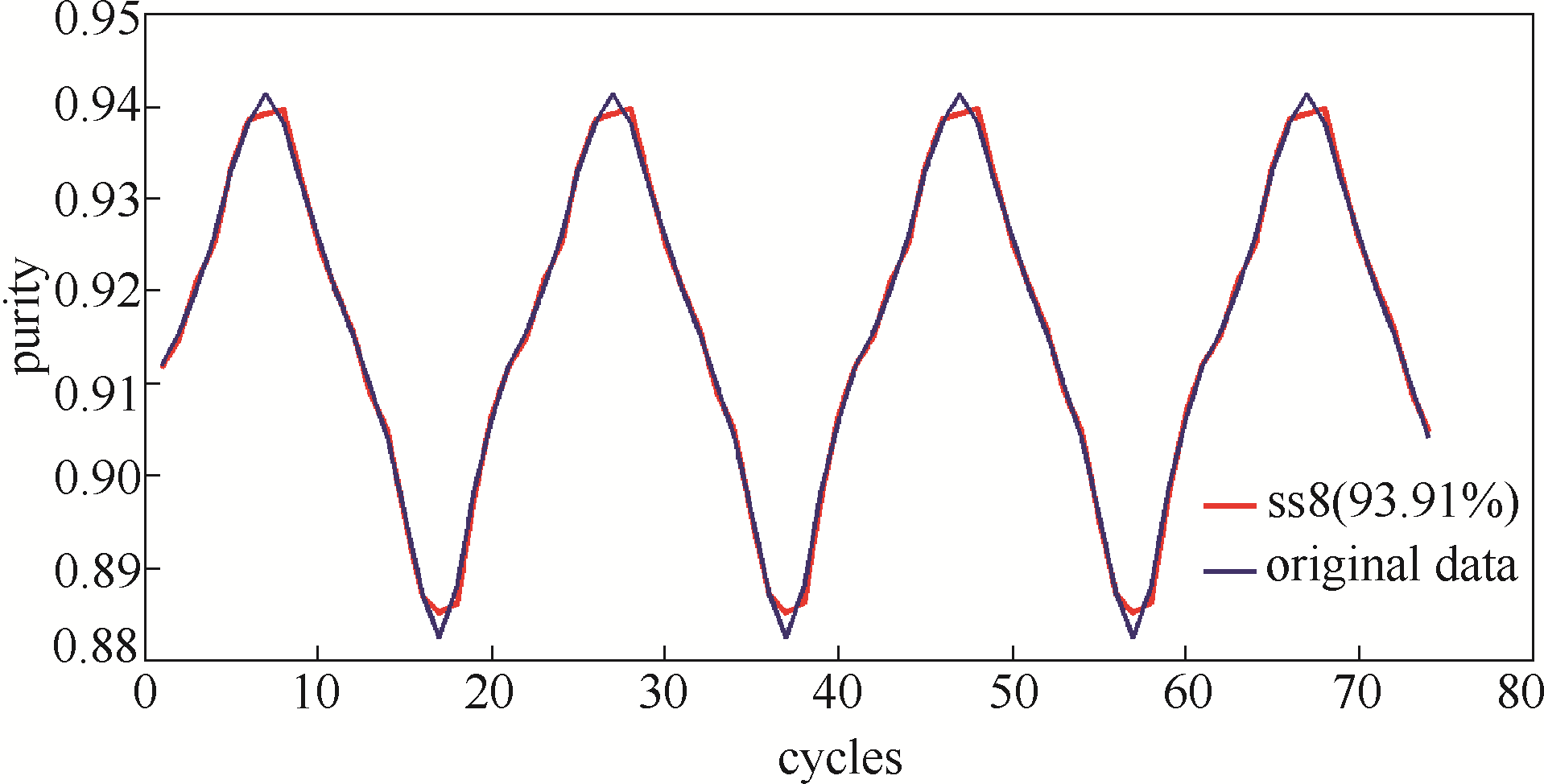
图6 状态空间模型与原始数据的比较
Fig.6 Comparison of state space model and original data

图7 扰动前后塔内压力变化
Fig.7 Pressure changes inside tower before and after disturbance

图8 情况1条件下O 2纯度的变化比较
Fig.8 Comparison of product purity change with and without control under Case 1
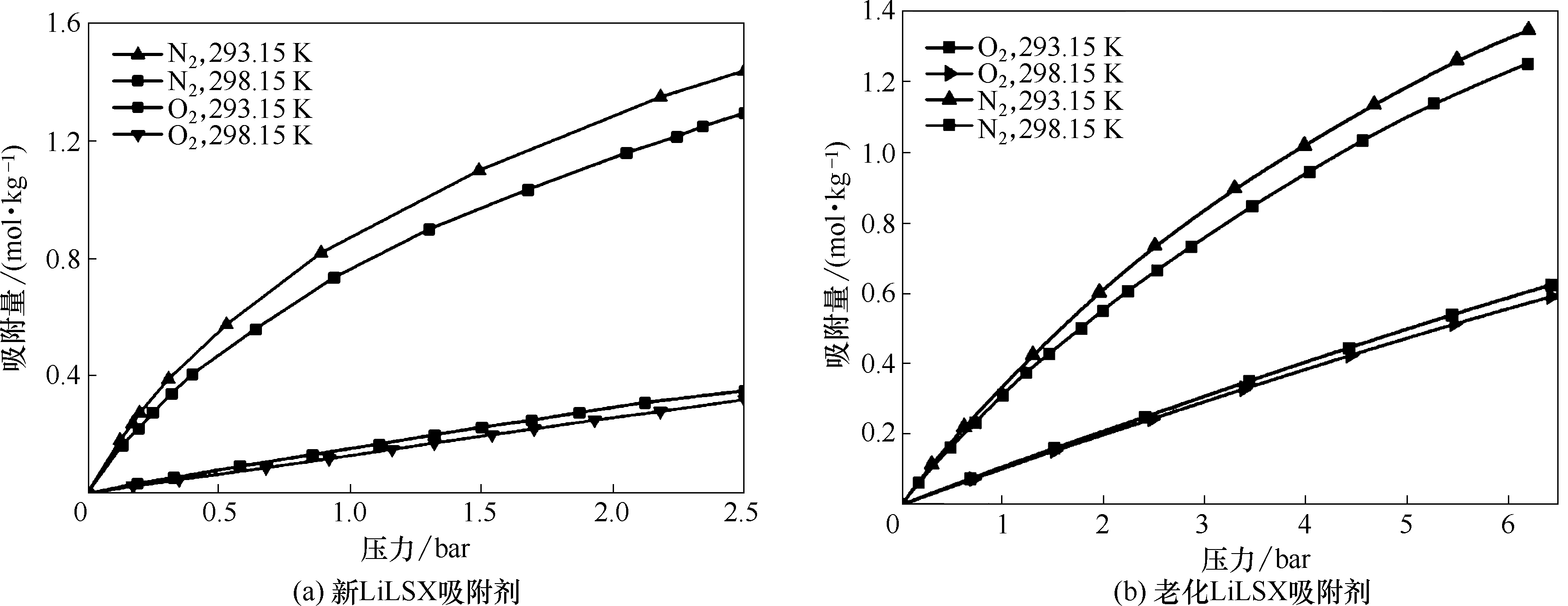
图9 N 2和O 2在LiLSX上的吸附等温线
Fig.9 N 2 and O 2 adsorption isotherms on LiLSX zeolite
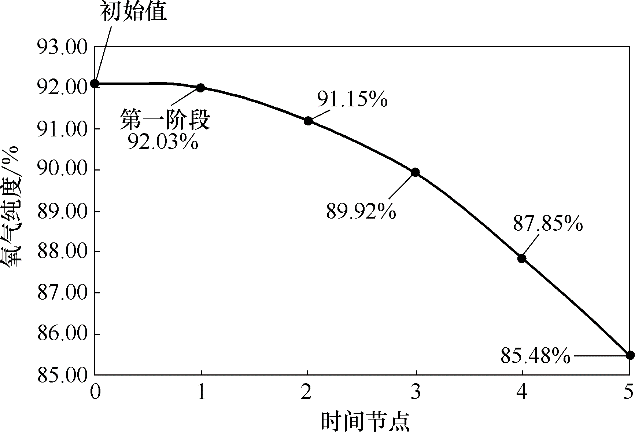
图10 不同吸附性能条件下O 2纯度的变化
Fig.10 Oxygen purity under different adsorption performance conditions
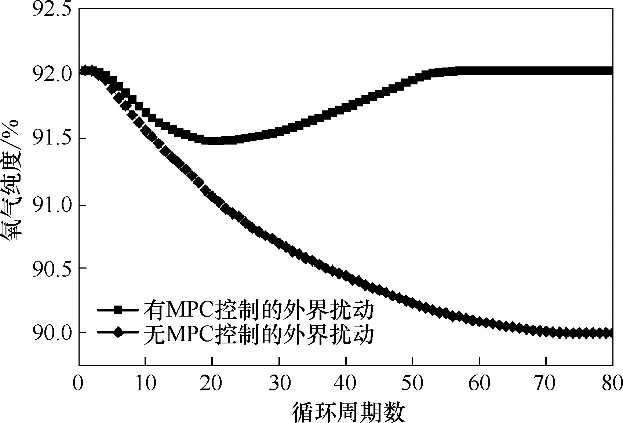
图11 无控制和MPC控制两种情况下O 2纯度的变化
Fig.11 Comparison of purity O 2 in two cases disturbance without control and adding MPC controller after disturbance
| 1 | Helfferich F G. Principles of adsorption & adsorption processes, by D. M. Ruthven, John Wiley & Sons, 1984, xxiv + 433 pp [J]. AIChE Journal, 1985, 31( 3): 523- 524. |
| 2 | Ding Z Y, Han Z Y, Fu Q, et al. Optimization and analysis of the VPSA process for industrial-scale oxygen production[J]. Adsorption, 2018, 24: 499- 516. |
| 3 | Zhu X Q, Liu Y S, Yang X, et al. Progress of adsorbent modified and process of pressure swing adsorption for oxygen production in China[J]. Chem. Ind. Eng. Prog., 2014, 55: 119- 124. |
| 4 | Li Y L, Liu Y S. Oxygen enrichment and its application to life support systems for workers in high-altitude areas[J]. International Journal of Occupational and Environmental Health, 2014, 20( 3): 207- 214. |
| 5 | Ruthven D M, Farooq S. Air separation by pressure swing adsorption[J]. Gas Separation & Purification, 1990, 4( 3): 141- 148. |
| 6 | 刘应书, 祝显强, 杨雄, 等. 快速真空变压吸附制氧实验研究[J]. 医用气体工程, 2016, 1: 29- 32. |
| Liu Y S, Zhu X Q, Yang X, et al. An experimental study of rapid vacuum pressure swing adsorption for producing oxygen [J]. Medical Gases Engineering, 2016, 1: 29- 32. | |
| 7 | Mayne D Q, Rawlings J B, Rao C V, et al. Constrained model predictive control: stability and optimality[J]. Automatica, 2000, 36( 6): 789- 814. |
| 8 | Khajuria H, Pistikopoulos E N. Dynamic modeling and explicit/multi-parametric MPC control of pressure swing adsorption systems[J]. Journal of Process Control, 2011, 21( 1): 151- 163. |
| 9 | 蒲荣. 可编程控制器在变压吸附装置中的应用[J]. 天然气化工(C1化学与化工), 1999, 24( 1): 44- 48. |
| Pu R. Application of programmable controller in pressure swing adsorption device [J]. Natural Gas Chemical Industry, 1999, 24( 1): 44- 48. | |
| 10 | Froisy J B. Model predictive control: past, present and future[J]. Isa Transactions, 1999, 33( 3): 235- 243. |
| 11 | Sircar S, Hanley B F. Production of oxygen enriched air by rapid pressure swing adsorption[J]. Adsorption, 1995, 1( 4): 313- 320. |
| 12 | Bitzer M. Model-based Nonlinear Tracking Control of Pressure Swing Adsorption Plants[M]// Control and Observer Design for Nonlinear Finite and Infinite Dimensional Systems. Berlin: Springer, 2005: 403- 418. |
| 13 | Kouramas K I, Faísca N P, Panos C, et al. Explicit/multi-parametric model predictive control (MPC) of linear discrete-time systems by dynamic and multi-parametric programming[J]. Automatic, 2011, 47( 8): 1638- 1645. |
| 14 | Khajuria H, Pistikopoulos E N. Optimization and control of pressure swing adsorption processes under uncertainty [J]. AIChE Journal, 2013, 59( 1): 120- 131. |
| 15 | Sereno C, Rodrigues A. Can steady-state momentum equations be used in modeling pressurization of adsorption beds[J]. Gas Separation & Purification, 1993, 7( 3): 167- 174. |
| 16 | Sun W N, Shen Y H, Zhang D H, et al. A systematic simulation and proposed optimization of the pressure swing adsorption process for N 2/CH 4 separation under external disturbances [J]. Industrial & Engineering Chemistry Research, 2015, 54( 30): 7489- 7501. |
| 17 | 丁兆阳, 韩治洋, 石文荣, 等. 快速变压吸附制氧动态传质系数模拟分析[J]. 化工学报, 2018, 69( 2): 759- 768. |
| Ding Z Y, Han Z Y, Shi W R, et al. Analysis of dynamic effective mass transfer coefficients of rapid pressure swing adsorption process for oxygen production[J]. CIESC Journal, 2018, 69( 2): 759- 768. | |
| 18 | Chihara K, Yoneda I, Morishita S, et al. Simulation of pressure swing adsorption for air separation[J]. Studies in Surface Science & Catalysis, 1986, 28: 563- 570. |
| 19 | Knaebel K S, Hill F B. Pressure swing adsorption: development of an equilibrium theory for gas separations[J]. Chemical Engineering Science, 1985, 40( 12): 2351- 2360. |
| 20 | Li D D, Zhou Y, Shen Y H, et al. Experiment and Simulation for Separating CO 2/N 2 by dual-reflux pressure swing adsorption process [J]. Chemical Engineering Journal, 2016, 297: 315- 324. |
| 21 | Banerje A, Arkun Y. Model predictive control of plant transitions using a new identification technique for interpolating nonlinear models[J]. Process Control, 1998, 8( 5): 441- 457. |
| 22 | Arefi M M, Montazeri A, Poshtan J, et al. Wiener-neural identification and predictive control of a more realistic plug-flow tubular reactor[J]. Chemical Engineering Journal, 2008, 138( 1/ 2/ 3): 274- 282. |
| 23 | Hasan M M F, Baliban R C, Elia J A, et al. Modeling, simulation, and optimization of postcombustion CO 2 capture for variable feed concentration and flow rate(2): Pressure swing adsorption and vacuum swing adsorption processes [J]. Industrial & Engineering Chemistry Research, 2016, 51( 48): 15665- 15682. |
| 24 | Joss L, Capra F, Gazzani M, et al. MO-MCS: an efficient multi-objective optimization algorithm for the optimization of temperature/pressure swing adsorption cycles [C]// 26th European Symposium on Computer Aided Process Engineering. 2016: 1467- 1472. |
| 25 | Yang H W, Yin C B, Jiang B, et al. Optimization and analysis of a VPSA process for N 2/CH 4 separation [J]. Separation & Purification Technology, 2014, 134( 1): 232- 240. |
| 26 | Agarwal A, Biegler L T, Zitney S E. Simulation and optimization of pressure swing adsorption systems using reduced-order modeling[J]. Industrial & Engineering Chemistry Research, 2009, 48( 5): 2327- 2343. |
| 27 | Bitzer M. Model-based Nonlinear Tracking Control of Pressure Swing Adsorption Plants [M]// Control and Observer Design for Nonlinear Finite and Infinite Dimensional Systems. Springer Berlin Heidelberg, 2005: 403- 418. |
| 28 | Sentoni G B, Biegler L T, Guiver J B, et al. State-space nonlinear process modeling: identification and universality[J]. AIChE Journal, 1998, 44( 10): 2229- 2239. |
| 29 | Santos G C A. Dynamic study of the pressure swing adsorption process for biogas upgrading and its responses to feed disturbances[J]. Industrial & Engineering Chemistry Research, 2013, 52( 15): 5445- 5454. |
| 30 | Zhu Y. Multivariable system identification for process control[J]. International Journal of Modelling Identification & Control, 2013, 6( 1): 335- 344. |
| [1] | 杨欣, 王文, 徐凯, 马凡华. 高压氢气加注过程中温度特征仿真分析[J]. 化工学报, 2023, 74(S1): 280-286. |
| [2] | 晁京伟, 许嘉兴, 李廷贤. 基于无管束蒸发换热强化策略的吸附热池的供热性能研究[J]. 化工学报, 2023, 74(S1): 302-310. |
| [3] | 何松, 刘乔迈, 谢广烁, 王斯民, 肖娟. 高浓度水煤浆管道气膜减阻两相流模拟及代理辅助优化[J]. 化工学报, 2023, 74(9): 3766-3774. |
| [4] | 陈哲文, 魏俊杰, 张玉明. 超临界水煤气化耦合SOFC发电系统集成及其能量转化机制[J]. 化工学报, 2023, 74(9): 3888-3902. |
| [5] | 杨学金, 杨金涛, 宁平, 王访, 宋晓双, 贾丽娟, 冯嘉予. 剧毒气体PH3的干法净化技术研究进展[J]. 化工学报, 2023, 74(9): 3742-3755. |
| [6] | 齐聪, 丁子, 余杰, 汤茂清, 梁林. 基于选择吸收纳米薄膜的太阳能温差发电特性研究[J]. 化工学报, 2023, 74(9): 3921-3930. |
| [7] | 高燕, 伍鹏, 尚超, 胡泽君, 陈晓东. 基于双流体喷嘴的磁性琼脂糖微球的制备及其蛋白吸附性能探究[J]. 化工学报, 2023, 74(8): 3457-3471. |
| [8] | 张曼铮, 肖猛, 闫沛伟, 苗政, 徐进良, 纪献兵. 危废焚烧处理耦合有机朗肯循环系统工质筛选与热力学优化[J]. 化工学报, 2023, 74(8): 3502-3512. |
| [9] | 诸程瑛, 王振雷. 基于改进深度强化学习的乙烯裂解炉操作优化[J]. 化工学报, 2023, 74(8): 3429-3437. |
| [10] | 邢雷, 苗春雨, 蒋明虎, 赵立新, 李新亚. 井下微型气液旋流分离器优化设计与性能分析[J]. 化工学报, 2023, 74(8): 3394-3406. |
| [11] | 陈国泽, 卫东, 郭倩, 向志平. 负载跟踪状态下的铝空气电池堆最优功率点优化方法[J]. 化工学报, 2023, 74(8): 3533-3542. |
| [12] | 盛冰纯, 于建国, 林森. 铝基锂吸附剂分离高钠型地下卤水锂资源过程研究[J]. 化工学报, 2023, 74(8): 3375-3385. |
| [13] | 刘文竹, 云和明, 王宝雪, 胡明哲, 仲崇龙. 基于场协同和 耗散的微通道拓扑优化研究[J]. 化工学报, 2023, 74(8): 3329-3341. 耗散的微通道拓扑优化研究[J]. 化工学报, 2023, 74(8): 3329-3341. |
| [14] | 张瑞航, 曹潘, 杨锋, 李昆, 肖朋, 邓春, 刘蓓, 孙长宇, 陈光进. ZIF-8纳米流体天然气乙烷回收工艺的产品纯度关键影响因素分析[J]. 化工学报, 2023, 74(8): 3386-3393. |
| [15] | 陈吉, 洪泽, 雷昭, 凌强, 赵志刚, 彭陈辉, 崔平. 基于分子动力学的焦炭溶损反应及其机理研究[J]. 化工学报, 2023, 74(7): 2935-2946. |
| 阅读次数 | ||||||
|
全文 |
|
|||||
|
摘要 |
|
|||||
 京公网安备 11010102001995号